Chemistry 5070/42 — May/June 2025
Cambridge O-Level · Alternative to Practical · worked solutions for every part, with the mark scheme
Topics Experimental Contexts · Planning Experiments and Investigations · Analysis, Conclusions and Evaluation · Use of Techniques, Apparatus and Materials · Observations and Measurements · Qualitative Analysis
A student investigates how the solubility of solid potassium nitrate varies with temperature.
The student:
step 1 puts of water into a beaker at room temperature
step 2 measures the mass of the beaker of water
step 3 adds some potassium nitrate to the water
step 4 stirs the mixture until all the potassium nitrate dissolves
step 5 repeats steps 3 and 4 until a small amount of undissolved solid remains in the beaker
step 6 measures the mass of the beaker of water and potassium nitrate
step 7 repeats steps 1 to 6 using water at different temperatures
step 8 calculates the mass of potassium nitrate dissolved in the water at each temperature.
The student does not make an important measurement.
State the measurement that the student needs to make.
______
Answer
Temperature (of the water / solution)
Temperature
Walkthrough
The investigation is about how the solubility of potassium nitrate varies with temperature. In step 1 and step 7, the student uses water at room temperature and then repeats at different temperatures, but never measures the actual temperature using a thermometer in the step-by-step procedure. Therefore, the missing measurement is the temperature.
Key Takeaways
- To investigate the effect of an independent variable (such as temperature), the numerical value of that variable must be measured and recorded.
Common Mistakes
- Naming a variable that was already recorded (e.g. mass of water or mass of potassium nitrate).
Things to Be Careful About
- Ensure you specify temperature, not just "use a thermometer" (the question asks for the measurement, not the apparatus).
The student's results are shown in Table 1.1.
Table 1.1
| temperature / | mass of potassium nitrate dissolved in of water / |
|---|---|
| 15 | 26.4 |
| room temperature | 31.7 |
| 35 | 54.9 |
| 55 | |
| 75 | 152.4 |
| 95 | 225.3 |
Estimate the mass of potassium nitrate dissolved in of water at .
mass = ______
Working
The mass dissolved increases with temperature:
- At :
- At :
The value at must lie between and (a reasonable estimate is around to ).
Answer
95 g
Walkthrough
Looking at the table, solubility increases as temperature rises. The value at is intermediate between () and (). Any reasonable value in the accepted range of to is acceptable.
Key Takeaways
- When estimating missing data from a table, ensure the value fits the trend between the adjacent data points.
Common Mistakes
- Providing a value outside the trend (less than or greater than ).
Things to Be Careful About
- The mark scheme accepts any value from to .
The student observes that when the solution made at is left at room temperature a solid appears in the beaker.
Explain why.
______
Answer
- The solution cools down (to room temperature).
- The solubility of potassium nitrate decreases at lower temperatures, so excess solid crystallises / comes out of solution.
The solution cools down and the solubility of potassium nitrate decreases at lower temperatures.
Walkthrough
When a saturated solution prepared at a higher temperature () is allowed to stand at room temperature, it cools down. Potassium nitrate is less soluble in cold water than in hot water. Because the cooler water cannot hold as much dissolved solute, the excess solid precipitates/crystallises out.
Key Takeaways
- Solubility of most solids decreases as temperature decreases.
- When a hot saturated solution cools, solute in excess of the lower solubility precipitates out.
Common Mistakes
- Mentioning only that the liquid evaporated rather than that the temperature decreased.
- Forgetting to state that solubility decreases at lower temperatures.
Things to Be Careful About
- Two distinct points are required for the 2 marks: the solution cools, and solubility decreases at lower temperatures.
Answer
Water boils at (so liquid water is not present at under atmospheric pressure).
Water boils at 100 °C
Walkthrough
The solvent used is water. At standard atmospheric pressure, water has a boiling point of and turns into steam, so liquid water cannot exist at in an open beaker.
Key Takeaways
- Aqueous experiments in open containers cannot be conducted at temperatures above the boiling point of water ().
Common Mistakes
- Saying the potassium nitrate decomposes, rather than identifying that water boils/evaporates away at .
Things to Be Careful About
- Explicitly mention that water boils at .
Explain why the method the student uses gives a higher value for the solubility than the true value.
______
Answer
Some of the solid potassium nitrate weighed in step 6 remains undissolved in the beaker.
Some of the solid remains undissolved.
Walkthrough
In step 5, the student continues adding solid until "a small amount of undissolved solid remains in the beaker". In step 6, the student measures the total mass added. Because this total mass includes the undissolved solid as well as the dissolved solid, the calculated mass of dissolved potassium nitrate is higher than the actual mass that dissolved.
Key Takeaways
- Any undissolved solute counted as part of the dissolved mass creates a positive systematic error in solubility calculations.
Common Mistakes
- Stating that water evaporated, which would lead to less water rather than explaining why the mass of solute was overestimated by weighing undissolved solid.
Things to Be Careful About
- Focus directly on step 5 and step 6 of the method: the undissolved solid is weighed as if it were dissolved.
Solid W is an impure organic acid, .
A student determines the mass of in a sample of W by titration with sodium hydroxide, .
The student:
step 1 places the sample of W in a beaker
step 2 uses a measuring cylinder to add of distilled water to the beaker
step 3 stirs the mixture until the solid is fully dissolved
step 4 labels this mixture X
step 5 pipettes of into a conical flask and adds five drops of thymolphthalein indicator
step 6 fills the burette with X
step 7 adds X to the conical flask until the solution just changes colour
step 8 repeats this titration two more times.
Explain why it is important to use distilled water and not tap water for the experiment.
______
Answer
Tap water is impure and contains dissolved substances or minerals.
Tap water is impure / contains dissolved substances / minerals
Walkthrough
Tap water contains dissolved mineral ions (such as , , and ) and impurities that could react with the acid or sodium hydroxide, affecting the titration volume. Distilled water is pure water containing no dissolved solutes, ensuring that only the dissolved acid reacts with the alkali.
Key Takeaways
- Distilled or deionised water must be used in quantitative analysis because tap water contains dissolved minerals and impurities that interfere with the reaction.
Common Mistakes
- Stating that tap water contains bacteria or germs, which is irrelevant to chemical titrations.
Things to Be Careful About
- Clearly state that tap water contains dissolved impurities, minerals, or ions.
Fig. 2.1 shows the initial and final burette readings for titration 1.
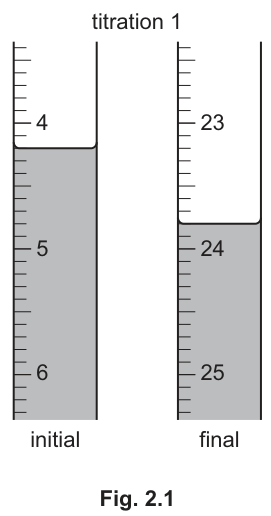
Table 2.1 shows some of the student's results.
Complete Table 2.1 by:
- writing the initial and final readings for titration 1
- calculating the volume of X used in each titration
- ticking (✓) the best titration results.
Table 2.1
| titration 1 | titration 2 | titration 3 | |
|---|---|---|---|
| final burette reading / | 19.2 | 38.6 | |
| initial burette reading / | 0.1 | 19.3 | |
| volume used / | |||
| best titration results (✓) |
Answer
| titration 1 | titration 2 | titration 3 | |
|---|---|---|---|
| final burette reading / | 23.8 | 19.2 | 38.6 |
| initial burette reading / | 4.2 | 0.1 | 19.3 |
| volume used / | 19.6 | 19.1 | 19.3 |
| best titration results (✓) | ✓ | ✓ |
Titration 1: final = 23.8 cm3, initial = 4.2 cm3; volumes used = 19.6, 19.1, 19.3 cm3; ticks on titration 2 and titration 3
Walkthrough
-
Read the burette scales for Titration 1:
- Burettes are calibrated downwards (numbers increase downwards).
- For the initial reading: the bottom of the meniscus is at .
- For the final reading: the bottom of the meniscus is at .
-
Calculate the volume used for each titration:
- Titration 1:
- Titration 2:
- Titration 3:
-
Select the best titration results:
- 'Best titration results' (concordant titres) are those within of each other.
- Titration 2 () and Titration 3 () differ by only , whereas Titration 1 () differs by and .
- Tick titration 2 and titration 3.
Key Takeaways
- Always read a burette downwards at the bottom of the meniscus.
- Concordant titres are typically within (or ) of each other.
Common Mistakes
- Reading the burette upwards (e.g. reading 4.2 as 4.8 or 23.8 as 24.2).
- Forgetting to write all values consistently to 1 decimal place.
Things to Be Careful About
- Ensure the volume used is calculated as .
Use the best titration results (✓) to calculate the average volume of X used.
average volume = ______
Working
Answer
19.2
19.2
Walkthrough
The average titre is calculated using only the ticked best titration results:
Key Takeaways
- Only include concordant (ticked) results when calculating the mean titre; do not include the rough or non-concordant titre.
Common Mistakes
- Averaging all three titrations instead of only the best results.
Things to Be Careful About
- Retain the appropriate number of decimal places (1 d.p. here, matching the data).
Working
Answer
0.0025
0.0025
Walkthrough
Using the formula :
Key Takeaways
- Always convert volume from to by dividing by 1000 when multiplying by .
Common Mistakes
- Forgetting to divide the volume by 1000, giving 2.5 moles.
Things to Be Careful About
- Either decimal form (0.0025) or standard form () is acceptable.
The equation for the reaction between and is shown.
Calculate the number of moles of that react with of .
number of moles = ______
Working
From the equation, of reacts with of .
Answer
0.000833
0.000833
Walkthrough
From the stoichiometric equation:
The ratio of is .
Key Takeaways
- Use the stoichiometric coefficients in the balanced equation to convert between moles of reactants.
Common Mistakes
- Multiplying by 3 instead of dividing by 3.
Things to Be Careful About
- Provide the answer to at least two significant figures ( or ).
Working
The average volume of X containing of is .
Total volume of solution X .
Answer
0.00434
0.00434
Walkthrough
- In each titration, the average volume of acid solution X used from the burette to neutralise the was .
- Therefore, of solution X contains of .
- The total original sample of W was dissolved to make of solution X.
- Scale up the moles to find the total moles in the original :
Key Takeaways
- To find the total moles in the initial sample, scale the moles found in the titre volume by the factor .
Common Mistakes
- Using instead of the average titre volume () in the scaling fraction.
Things to Be Careful About
- Give the final value to at least two significant figures ( or ).
The relative molecular mass of is 210.
Calculate the mass of in the sample of W.
mass = ______
Working
Answer
0.91
0.91
Walkthrough
Using the formula :
Key Takeaways
- .
Common Mistakes
- Dividing by instead of multiplying.
Things to Be Careful About
- Maintain rounding to at least two significant figures ().
In step 2 a measuring cylinder is used to add of distilled water to the beaker.
Explain why using the measuring cylinder makes the volume of distilled water used inaccurate. Suggest an improvement.
explanation ______
improvement ______
Answer
explanation: The measuring cylinder does not have a high resolution / only reads to / does not read to 1 decimal place.
improvement: Use a burette / volumetric pipette / volumetric flask.
explanation: measuring cylinder has low resolution; improvement: use a burette / pipette / volumetric flask
Walkthrough
- Explanation: A measuring cylinder has relatively large graduations (low resolution, typically to or ), which introduces a higher percentage uncertainty in the volume measured compared to precision volumetric glassware.
- Improvement: Using a piece of volumetric glassware designed for higher precision — such as a volumetric pipette, a burette, or preparing the solution in a volumetric flask — significantly improves the accuracy of the volume.
Key Takeaways
- Measuring cylinders provide approximate volumes; volumetric flasks, pipettes, and burettes provide high-precision measurements.
Common Mistakes
- Suggesting a beaker as an improvement (beakers are even less accurate than measuring cylinders).
Things to Be Careful About
- Ensure both an explanation (mentioning resolution/precision) and a suitable replacement apparatus are given.
Before the student does step 6 the burette is rinsed with distilled water and then with X.
Answer
To remove impurities or residues from the burette.
To remove impurities (from the burette)
Walkthrough
Rinsing the burette with distilled water cleans the glassware by washing out any residual chemicals, dust, or contaminants left from previous uses.
Key Takeaways
- Glassware is first washed with distilled water to remove chemical residues and impurities.
Common Mistakes
- Stating that water makes the burette wet or lubricates it.
Things to Be Careful About
- Focus on the removal of impurities/contaminants.
Suggest and explain the effect on the titration results if the burette is not rinsed with X after rinsing with distilled water.
effect ______
explanation ______
Answer
effect: The titration result / titre volume increases.
explanation: The water remaining in the burette dilutes solution X, decreasing its concentration, so a larger volume is needed to neutralise the sodium hydroxide.
effect: titration result increases; explanation: water dilutes solution X / concentration of X decreases
Walkthrough
- Effect: If the burette is rinsed with water but not with solution X, droplets of water remain clinging to the inside walls.
- Explanation: When solution X is added, the water dilutes it, lowering its concentration. Since the acid solution is now less concentrated, a greater volume of X is required to provide the same number of moles of acid needed to neutralise the of . Hence, the titre volume increases.
Key Takeaways
- A burette (and pipette) must always be rinsed with the solution it will contain to prevent dilution by residual water.
- Diluting the acid in the burette causes the titre volume to increase.
Common Mistakes
- Stating that the titre volume decreases (confusing the dilution of the titrant with dilution of the flask contents).
Things to Be Careful About
- Clearly connect the presence of water to the dilution/lower concentration of X, which leads to an increased titre volume.
A student investigates solid A and aqueous solution B.
Solid A is a metal carbonate. Solution B contains only one cation and one anion.
The student does a flame test on solid A.
Answer
- Dip a clean (nichrome/platinum) wire into the solid.
- Hold the wire in a blue / roaring / non-luminous flame.
- Observe the colour of the flame.
Dip a wire into the solid and hold it in a blue (roaring) flame; observe the flame colour.
Walkthrough
A flame test is used to identify metal ions by the colour they give to a flame. The solid must be picked up on a wire and placed into the hottest part of the flame. A blue flame is used because a yellow flame would mask the colour produced by the sample. The colour observed is then compared with known flame colours.
Key Takeaways
- Flame tests identify metal cations by characteristic flame colours.
- The wire must be clean so that it does not contaminate the sample.
- Use the blue (roaring) flame, not the yellow luminous flame.
Common Mistakes
- Using a yellow flame: the yellow colour from the flame itself hides the test colour.
- Putting the solid directly into the flame without a wire or splint.
- Not cleaning the wire between tests, which can give a false colour.
Things to Be Careful About
- The mark scheme accepts 'wire', 'splint' or 'rod'.
- The flame must be described as blue, roaring, airhole open, non-luminous or colourless.
- Do not say 'dip the solid into the flame' – the wire carrying the solid is placed in the flame.
The student observes a blue-green colour in the flame.
Identify the cation present in A.
______
Answer
Copper(II) ions, .
Copper(II) ions, Cu2+
Walkthrough
A blue-green flame is the characteristic flame colour of copper(II) ions. Since solid A is a metal carbonate, the metal ion must be copper(II).
Key Takeaways
- Copper(II) gives a blue-green flame.
- Flame tests can identify metal cations in solids or solutions.
Common Mistakes
- Writing 'copper' instead of 'copper(II)' – the ion is Cu2+.
- Confusing blue-green with other flame colours, such as green for barium.
Things to Be Careful About
- The mark scheme allows 'copper' or 'Cu2+'.
- The flame colour is often described as blue-green or green-blue.
The student adds dilute hydrochloric acid to A.
An aqueous solution C and a colourless gas are formed.
Describe the observations the student makes. Describe the chemical test and the positive result used to identify the gas formed.
observations ______
test ______
result ______
Answer
Observations
- Effervescence / fizzing / bubbling.
- The solid dissolves / disappears.
- A blue / green solution is formed.
Test
- Bubble the gas through limewater.
Positive result
- The limewater turns milky / cloudy.
Effervescence, solid dissolves, blue/green solution formed; gas turns limewater milky.
Walkthrough
A metal carbonate reacts with dilute hydrochloric acid to give a salt, water and carbon dioxide. The carbon dioxide is seen as effervescence (bubbles). As the solid reacts it disappears, and the copper(II) salt formed gives a blue/green solution. To identify the gas, bubble it through limewater: carbon dioxide turns limewater milky because calcium carbonate is formed.
Key Takeaways
- Metal carbonate + acid → salt + water + carbon dioxide.
- Carbon dioxide is tested with limewater; a milky/cloudy result is positive.
- The colour of the solution gives a clue to the metal ion (blue/green suggests copper).
Common Mistakes
- Forgetting to give all three observations (bubbling, solid disappears, coloured solution).
- Saying 'limewater turns white' instead of milky/cloudy.
- Testing the gas with a lighted splint instead of limewater.
Things to Be Careful About
- The test must be described as passing or bubbling the gas into limewater.
- The positive result is 'milky' or 'cloudy', not just 'a precipitate'.
- The solution colour is blue/green because the metal is copper.
Answer
The reaction has finished when no solid remains undissolved and effervescence stops.
No solid remains undissolved / effervescence stops.
Walkthrough
As long as solid carbonate remains, acid can react and bubbles of carbon dioxide are produced. When all the solid has reacted, no more gas can be formed, so bubbling stops. This tells the student the reaction is complete.
Key Takeaways
- A reaction is complete when one reactant is used up.
- Here, disappearance of the solid and stopping of effervescence show completion.
Common Mistakes
- Saying 'when the solution stops changing colour' – the colour change is not the endpoint.
- Only saying 'effervescence stops' and missing 'no solid remains'.
Things to Be Careful About
- The mark scheme allows either observation: no solid remains undissolved OR effervescence stops.
Explain how the student uses aqueous ammonia to confirm the metal ion present in C.
Include the observations you expect.
______
Answer
- Add aqueous ammonia (dropwise, then in excess).
- A pale blue precipitate forms.
- The precipitate dissolves in excess ammonia.
- A dark blue solution is formed.
This confirms copper(II) ions.
Pale blue precipitate, soluble in excess ammonia to give a dark blue solution – confirms copper(II).
Walkthrough
Aqueous ammonia is a test for metal cations. With copper(II) ions it first forms a pale blue precipitate of copper(II) hydroxide. On adding more ammonia, this precipitate dissolves and a dark blue solution is formed. This behaviour is characteristic of copper(II) and confirms the cation in solution C.
Key Takeaways
- Ammonia can identify cations by the colour of the precipitate and its solubility in excess.
- Copper(II): pale blue precipitate, soluble in excess to give a dark blue solution.
Common Mistakes
- Saying the precipitate is 'blue' without 'pale'.
- Forgetting to say the precipitate dissolves in excess.
- Saying 'dark blue precipitate' instead of 'dark blue solution'.
Things to Be Careful About
- Add ammonia dropwise first, then excess; both stages are needed.
- The dark blue solution is the key positive result for copper(II).
- Do not confuse with iron(II) (green precipitate) or iron(III) (red-brown precipitate).
The student does tests on B. The results are shown in Table 3.1.
Table 3.1
| test | observation |
|---|---|
| adds dilute nitric acid and aqueous barium nitrate | colourless solution formed |
| adds dilute nitric acid and aqueous silver nitrate | cream precipitate formed |
| adds aqueous sodium hydroxide and aluminium foil then warms the mixture | colourless solution formed |
Identify the anion in B.
______
Answer
Bromide ions, .
Bromide ions, Br−
Walkthrough
When dilute nitric acid and silver nitrate are added to a solution, halide ions give precipitates: chloride gives white, bromide gives cream, iodide gives yellow. A cream precipitate therefore shows bromide ions. The barium nitrate test gives no precipitate, so sulfate is absent. The sodium hydroxide/aluminium foil test is used for nitrate/ammonium and the observation given is not a positive result for nitrate.
Key Takeaways
- Acidified silver nitrate distinguishes halides by precipitate colour: chloride white, bromide cream, iodide yellow.
- Barium nitrate tests for sulfate (white precipitate).
- The anion in B is bromide.
Common Mistakes
- Saying 'chloride' because silver chloride is white – cream is bromide.
- Forgetting to mention acidification with nitric acid to remove carbonate ions.
- Confusing the silver nitrate test with the barium nitrate test.
Things to Be Careful About
- The cream precipitate is silver bromide, AgBr.
- Nitric acid is added to prevent carbonate ions from giving a false white precipitate.
- The mark scheme accepts 'bromide' or 'Br−'.
Q is a mixture of solid copper(II) carbonate and solid lead sulfate.
Lead sulfate is insoluble in water and does not react with dilute sulfuric acid.
Copper(II) carbonate is insoluble in water. It reacts with dilute sulfuric acid to form copper(II) sulfate solution.
Plan an investigation to obtain pure copper(II) sulfate crystals and pure lead sulfate solid from Q.
Your plan should describe the use of common laboratory apparatus, dilute sulfuric acid and Q. No other chemicals should be used.
Your plan should include:
- the apparatus needed
- the preparation of copper(II) sulfate solution
- the method to obtain pure copper(II) sulfate crystals
- the method to obtain pure lead sulfate solid
- how to test that the lead sulfate is pure.
You may draw a diagram to help answer the question.
Answer
1. Apparatus needed
- Beakers, glass stirring rod, filter funnel, filter paper, conical flask, evaporating basin, Bunsen burner (or water bath/electric heater), tripod, gauze, and melting point apparatus.
2. Preparation of copper(II) sulfate solution
- Place the mixture in a beaker.
- Add dilute sulfuric acid in excess (continue adding acid and stirring until effervescence stops) to ensure all copper(II) carbonate has fully reacted.
3. Separation and obtaining pure lead sulfate solid
- Filter the mixture using a filter funnel and filter paper to collect the unreacted lead sulfate as the residue.
- Wash the residue (lead sulfate) with distilled water to remove soluble impurities.
- Dry the lead sulfate solid between sheets of filter paper (or in a warm oven).
4. Obtaining pure copper(II) sulfate crystals
- Transfer the filtrate (copper(II) sulfate solution) into an evaporating basin.
- Heat the filtrate using a Bunsen burner until the crystallisation point is reached (or until saturated / crystals begin to form on a glass rod).
- Allow the hot solution to cool and crystallise.
- Filter the crystals and dry them between filter papers.
5. Testing the purity of lead sulfate
- Determine the melting point of the dried lead sulfate solid using melting point apparatus.
- A sharp melting point matching the true literature value confirms that the lead sulfate is pure.
See working
Walkthrough
This is a structured 6-mark practical planning question requiring a logical, step-by-step procedure to separate and purify two substances from a mixture (solid copper(II) carbonate, , and solid lead sulfate, ).
- Apparatus: Mention all appropriate laboratory apparatus needed for mixing, filtration, heating/crystallisation, and testing purity.
- Reacting the mixture: reacts with dilute sulfuric acid to form soluble copper(II) sulfate, water, and carbon dioxide gas:
Adding excess acid (or adding acid until no more bubbling occurs) ensures that all copper(II) carbonate reacts, leaving only lead sulfate as the solid.
3. Obtaining pure lead sulfate: Because is insoluble in water and unreactive with dilute sulfuric acid, it remains as an insoluble solid. Filtration separates as the residue. To make it pure, it must be washed with distilled water (to remove traces of acid/copper(II) sulfate solution) and dried.
4. Obtaining pure copper(II) sulfate crystals: The filtrate contains aqueous . Heating evaporates water until saturation / the crystallisation point is reached. Cooling allows hydrated copper(II) sulfate crystals to form slowly. Crystals are then filtered and dried.
5. Testing purity: Purity of a solid is tested by measuring its melting point. A sharp melting point at the known literature value indicates high purity.
Key Takeaways
- When planning to obtain both a soluble and an insoluble product from a mixture, react the soluble-forming component completely using excess reagent.
- Insoluble residues must always be washed (with distilled water) and dried to be considered 'pure'.
- Soluble salts are crystallised by evaporating to the point of crystallisation and cooling, not by evaporating to dryness (which produces anhydrous powder or decomposes hydrated salts).
- Purity of a solid substance is verified using melting point determination.
Common Mistakes
- Forgetting to specify adding acid in excess or until bubbling stops (leaving unreacted mixed with ).
- Heating the copper(II) sulfate solution to complete dryness rather than heating to saturation/crystallisation point.
- Omitting the washing and drying steps for the lead sulfate residue.
- Suggesting chemical tests (e.g. adding barium ions or sodium hydroxide) instead of a physical purity test like melting point.
Things to Be Careful About
- The prompt explicitly states: "No other chemicals should be used." Therefore, do not suggest adding other acids, bases, or indicator solutions.
- Ensure each required bullet in the question prompt is clearly addressed under its own sub-heading to guarantee marks across all rubric sections.