Chemistry 5070/41 — May/June 2025
Cambridge O-Level · Alternative to Practical · worked solutions for every part, with the mark scheme
Topics Experimental Contexts · Observations and Measurements · Analysis, Conclusions and Evaluation · Planning Experiments and Investigations · Use of Techniques, Apparatus and Materials · Qualitative Analysis
A student determines the solubility of solid ammonium chloride in water at .
The student:
- step 1 puts of water into a beaker
- step 2 heats the water
- step 3 measures the mass of a weighing bottle containing ammonium chloride
- step 4 adds some of this ammonium chloride to the water
- step 5 stirs the mixture to dissolve the solid
- step 6 repeats steps 4 and 5 until a small amount of undissolved solid remains in the beaker
- step 7 measures the mass of the weighing bottle and unused ammonium chloride
- step 8 calculates the mass of ammonium chloride added to the water.
Answer
Measure the temperature of the water (in °C) to confirm that it is 60 °C.
Measure the temperature of the water to ensure it is 60 °C
Walkthrough
The method already fixes the volume of water as and will give the mass of ammonium chloride added from the two weighing-bottle readings. The solubility of a solid depends on the temperature, so the number that is still missing is the temperature of the water. The student must measure it to confirm that the experiment is being carried out at 60 °C.
Key Takeaways
- Solubility is the mass of solute that dissolves in a given volume of water at a specified temperature.
- A value quoted at a named temperature is only meaningful if that temperature is actually measured.
Common Mistakes
- Answering with the volume of water — the volume is already fixed at 100 cm³.
- Answering with the mass of ammonium chloride — that mass is already found from the two readings.
Things to Be Careful About
- The mark scheme wants the idea of temperature: measure the temperature of the water to ensure that it is 60 °C.
- Saying only "measure the temperature" is rewarded; the reason is that solubility is measured at a particular temperature.
The student’s results are shown in Table 1.1.
Table 1.1
| initial mass in step 3 / | 173.7 |
| final mass in step 7 / | 115.5 |
Use the results to calculate the solubility of ammonium chloride at in .
solubility = ______
Working
Mass of ammonium chloride added:
The water volume is , so the mass dissolved in is obtained by multiplying by :
Answer
582 g / dm³
Walkthrough
The initial mass is the mass of weighing bottle + ammonium chloride before any solid is added. The final mass is the mass of weighing bottle with the solid that was not used. Their difference gives the mass of ammonium chloride actually added to the water.
The student used 100 cm³ of water. Since solubility is usually expressed per dm³, and 1 dm³ is ten times this volume, multiply the mass by 10. This is exactly what the mark scheme's two steps show.
Key Takeaways
- Mass of solid used = final initial mass − final mass.
- To convert a mass dissolved in 100 cm³ into g / dm³, multiply by 10.
- Always carry the unit g / dm³ through the final answer.
Common Mistakes
- Stopping at 58.2 g instead of multiplying by 10. This is the mass in 100 cm³, not in 1 dm³.
- Subtracting in the wrong order, which gives a negative or an incorrect value.
Things to Be Careful About
When the mark scheme uses M1 and M2, M1 is the subtraction and M2 is the ×10 conversion. Write both steps clearly in the working.
Explain why the method the student uses gives a higher value for the solubility than the true value.
______
Answer
Some of the solid did not dissolve. This undissolved solid is included in the calculated mass added, so the calculated solubility is too high.
Some of the solid did not dissolve
Walkthrough
Steps 4–6 are repeated until a small amount of solid remains undissolved. The mass difference from steps 3 and 8 counts all of the ammonium chloride that was tipped into the beaker, including the small amount that never dissolved. But only the dissolved solid should be counted when finding the solubility. Therefore the calculated mass of dissolved ammonium chloride is larger than actual, making the density result too high.
Key Takeaways
- A correct solubility measurement must use only the mass that actually dissolves.
- An experiment designed to stop when solid remains still includes that undissolved solid in the measured mass.
Common Mistakes
- Saying the water evaporated. That is not the main error identified by the method; the intended reason is undissolved solid.
- Saying the temperature was too high. The problem is not about the temperature value but about the undissolved solid being counted.
Things to Be Careful About
The mark scheme wording is "some of the solid did not dissolve". Use this idea in the answer; it explains why the measured solubility is too high.
The student repeats the experiment at different temperatures.
The results are shown in Table 1.2.
Table 1.2
| ammonium chloride | |
|---|---|
| temperature in | solubility in |
| 0 | 300 |
| 40 | 480 |
| 80 | 660 |
Estimate the solubility of ammonium chloride at .
solubility = ______
Working
At 0 °C, the solubility is 300 g / dm³; at 40 °C, it is 480 g / dm³.
20 °C is halfway between 0 °C and 40 °C, so estimate:
Answer
390 g / dm^3
Walkthrough
The table has readings at 0 °C and 40 °C. The time 20 °C lies exactly halfway between them, so an appropriate estimate is the average of the two solubilities. The difference between 480 and 300 is 180, and half of this is 90; adding 90 to 300 gives 390 g / dm³.
Key Takeaway
- When a value is wanted between two known points, interpolate by choosing a value between them.
- For equal intervals such as 0 °C and 40 °C, the midpoint is often a simple average.
Common Mistakes
- Using 40 °C and 80 °C instead of the two surrounding points, which would give a different and less suitable estimate.
- Rounding the result unnecessarily; the mark scheme accepts exactly 390.
Things to Be Careful About
The question says "estimate", so a clear number with the unit is enough. Include the unit g / dm³ in the answer line.
The student also wants to measure the solubility of ammonia.
Suggest why the method used for ammonium chloride is not suitable for determining the solubility of ammonia.
______
Answer
Ammonia is a gas at room temperature, so it cannot be weighed on a balance using this method.
Ammonia is a gas at room temperature, so it cannot be weighed on a balance
Walkthrough
The method for ammonium chloride works by weighing a solid in a bottle before and after adding it to water. Ammonia at room temperature is a gas, so it cannot be measured in the same way. A enough amount of gas cannot simply be put in a weighing bottle and reweighed, because it escapes and cannot be weighed directly on a balance.
The mark scheme's single principle is that "you cannot weigh a gas on a balance".
Key Takeaways
- The solubility method used in the question is designed for solid solutes.
- A gas needs a different technique, such as measuring the volume of gas absorbed or collected.
Common Mistakes
- Answering only "ammonia is different" without mentioning the gas state.
- Saying that ammonia reacts with water; that is not the key reason in this mark scheme.
Things to Be Careful About
Give the reason clearly: ammonia is a gas at ordinary conditions, so it cannot be weighed on a balance.
Solid A is impure calcium carbonate.
A student determines the number of moles of calcium carbonate in a sample of A.
The student:
- places the sample of A into a beaker
- uses a measuring cylinder to add of hydrochloric acid, , to the beaker
- stirs the mixture until no further effervescence is observed
- labels the mixture B.
Calculate the number of moles of added to the beaker.
number of moles = ______
Working
Answer
0.025
0.025
Walkthrough
To find the number of moles of hydrochloric acid added, use the formula:
Convert the volume from to by dividing by :
Multiply by the concentration:
Key Takeaways
- Volume in must always be converted to before calculating moles using molarity.
Common Mistakes
- Forgetting to convert into , yielding instead of .
Things to Be Careful About
- Ensure correct arithmetic with decimal places.
The student:
- rinses a burette with water and then with sodium hydroxide,
- fills the burette with
- adds of B and five drops of methyl orange indicator to a conical flask
- adds from the burette to the conical flask until the methyl orange indicator just changes colour
- repeats this titration two more times.
Fig. 2.1 shows the initial and final burette readings for titration 1.
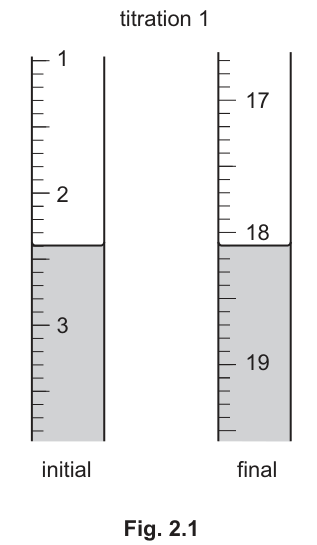
Table 2.1 shows some of the student’s results.
Complete Table 2.1 by:
- writing the initial and final readings for titration 1
- calculating the volume of used in each titration
- ticking (✓) the best titration results.
Table 2.1
| titration 1 | titration 2 | titration 3 | |
|---|---|---|---|
| final burette reading / | 15.4 | 30.8 | |
| initial burette reading / | 0.2 | 15.4 | |
| volume used / | |||
| best titration results (✓) |
Answer
| titration 1 | titration 2 | titration 3 | |
|---|---|---|---|
| final burette reading / | 18.1 | 15.4 | 30.8 |
| initial burette reading / | 2.4 | 0.2 | 15.4 |
| volume used / | 15.7 | 15.2 | 15.4 |
| best titration results (✓) | ✓ | ✓ |
Titration 1: initial 2.4, final 18.1, volume 15.7; Titration 2 volume 15.2 (ticked); Titration 3 volume 15.4 (ticked)
Walkthrough
-
Read the burette diagrams in Fig. 2.1:
- Burette scales increase downwards.
- Initial reading: The meniscus sits four divisions below 2, which is .
- Final reading: The meniscus sits one division below 18, which is .
-
Calculate the volume used for each titration:
-
Select the best titration results:
- Best (concordant) results are those within of each other.
- Comparing the titres: and differ by only , whereas is too far away.
- Therefore, place ticks in the columns for titration 2 and titration 3.
Key Takeaways
- Burettes read from top to bottom (0 at the top, 50 at the bottom).
- Concordant titres in O Level are typically within of each other.
Common Mistakes
- Reading the burette upwards (e.g., reading instead of , or instead of ).
- Selecting all three titres or ticking titration 1 instead of the two closest results.
Things to Be Careful About
- Keep all readings to 1 decimal place consistently.
Use the best titration results (✓) to calculate the average volume of used.
average volume = ______
Working
Answer
15.3
15.3
Walkthrough
Calculate the mean of the ticked (best) titration values from part (b)(i):
Key Takeaways
- Only use concordant (ticked) titres to calculate the average titre; exclude rough or non-concordant runs.
Common Mistakes
- Including all three titrations in the average (e.g., ).
Things to Be Careful About
- Check that the calculated average matches the precision of the burette readings (1 decimal place).
The acid used in (a) to prepare mixture B is in excess.
Use your answer to (b)(ii) to calculate the number of moles of that react with of B.
number of moles = ______
Working
Answer
0.00153
0.00153
Walkthrough
Using the average volume of from (b)(ii) () and its concentration ():
Key Takeaways
- Amount of substance in moles is found by multiplying volume in by molar concentration.
Common Mistakes
- Using (volume of B) instead of the titre volume of .
Things to Be Careful About
- Ensure correct power-of-ten conversion when dividing by .
Working
Answer
0.00612
0.00612
Walkthrough
In part (c), the moles of reacting with a portion of mixture B was calculated.
Mixture B has a total volume of .
To find the moles of that would react with the entire of B, multiply the moles from (c) by the scaling factor:
Key Takeaways
- When scaling from an aliquot to the original total solution, multiply by the ratio .
Common Mistakes
- Dividing by 4 instead of multiplying by 4.
Things to Be Careful About
- Express the answer to at least two significant figures as required by the mark scheme.
The answer to (d) is equal to the number of moles of that remain in the beaker after the acid reacts with the calcium carbonate in the sample of A.
Use your answers to (a) and (d) to calculate the number of moles of that react with the calcium carbonate in the sample of A.
number of moles = ______
Working
Answer
0.0189
0.0189
Walkthrough
This is a back titration calculation:
- Initial moles of added to sample A (from part (a)).
- Moles of unreacted remaining in of B (equal to moles of in (d) because and react in a ratio).
- Subtract the remaining moles from the initial moles to find the moles of that reacted with the calcium carbonate:
Rounded to 3 significant figures, this gives .
Key Takeaways
- .
Common Mistakes
- Adding the two values instead of subtracting them.
Things to Be Careful About
- Give the final value to at least two significant figures ( or ).
The equation for the reaction between hydrochloric acid and calcium carbonate is shown.
Calculate the number of moles of calcium carbonate in the sample of A.
number of moles = ______
Working
From the balanced equation, react with .
Answer
0.00944
0.00944
Walkthrough
The balanced equation is:
According to the stoichiometry, of reacts with of .
Therefore, divide the moles of reacted (from part (e)) by 2:
Key Takeaways
- Use stoichiometric coefficients from the balanced equation to relate moles of different substances.
Common Mistakes
- Multiplying by 2 instead of dividing by 2.
Things to Be Careful About
- Maintain at least two significant figures in the final value.
In (a) the mixture of A and acid is stirred until effervescence stops.
Answer
To make it react faster / to increase the rate of reaction / to help the calcium carbonate dissolve and react quicker.
To make it react faster
Walkthrough
Stirring ensures good contact between the solid calcium carbonate particles and the hydrochloric acid, which increases the frequency of collisions and speeds up the rate of reaction.
Key Takeaways
- Stirring increases particle mixing and ensures a faster rate of reaction.
Common Mistakes
- Writing vague statements like 'to mix them' without explaining that it speeds up the reaction.
Things to Be Careful About
- Mention the increase in reaction speed or rate.
Answer
To ensure all the calcium carbonate has reacted / to ensure the reaction is complete.
To ensure the reaction is complete
Walkthrough
Effervescence is due to the production of carbon dioxide gas. When effervescence stops, no more carbon dioxide is being produced, indicating that all of the calcium carbonate has completely reacted with the excess acid.
Key Takeaways
- Gas evolution stops when the limiting reagent is completely consumed and the reaction has finished.
Common Mistakes
- Stating that 'the acid has been used up' (the acid is in excess, not the calcium carbonate).
Things to Be Careful About
- Identify calcium carbonate as the limiting reactant that has fully reacted.
In (a) a measuring cylinder is used to add of to the beaker.
Explain why using the measuring cylinder makes the volume of used inaccurate. Suggest an improvement.
explanation ______
improvement ______
Answer
Explanation: A measuring cylinder has a low resolution / is not as precise / only measures to the nearest or .
Improvement: Use a volumetric pipette / burette / volumetric flask.
Explanation: measuring cylinder has low resolution; Improvement: use a pipette or burette
Walkthrough
- Explanation: Measuring cylinders have large scale divisions and a wide diameter, which gives them lower precision/resolution compared to specialised volumetric glassware.
- Improvement: To measure an accurate volume of liquid for volumetric analysis, use a volumetric pipette, a burette, or a volumetric flask.
Key Takeaways
- Measuring cylinders are suitable for approximate volumes, but volumetric analysis requires higher-precision apparatus such as pipettes or burettes.
Common Mistakes
- Suggesting a beaker as an improvement (a beaker is even less accurate).
- Saying the measuring cylinder is 'unreliable' without stating that it lacks resolution or precision.
Things to Be Careful About
- Ensure both the explanation and the improvement are clearly stated.
In (b) the burette is rinsed with water and then with .
Explain why the burette is rinsed with sodium hydroxide after rinsing with water.
______
Answer
To remove any remaining water from the burette so that the sodium hydroxide solution is not diluted.
To remove residual water and prevent dilution of the sodium hydroxide solution
Walkthrough
When a burette is rinsed with water, droplets of water cling to the inside walls. If sodium hydroxide solution is added immediately without rinsing with the solution first, these water droplets will dilute the sodium hydroxide solution, decreasing its concentration and causing an inaccurate titration result.
Key Takeaways
- Burettes and pipettes must be rinsed with the solution they are to contain to prevent dilution from residual water.
- Conical flasks are only rinsed with distilled water, as leftover water does not change the number of moles of reactant placed inside them.
Common Mistakes
- Stating that it is 'to clean the burette' rather than specifically mentioning preventing dilution or washing away residual water.
Things to Be Careful About
- Clearly mention either removing the water or preventing the dilution of the .
A student tests two aqueous solutions, W and X.
The student adds aqueous chlorine to W and concludes that W contains iodide ions.
Describe the observation that the student makes that leads to this conclusion.
Explain how this shows that W contains iodide ions.
observation ______
explanation ______
Answer
Observation: a red-brown solution forms (or a black solid appears).
Explanation: chlorine is more reactive than iodine, so it displaces iodine from the iodide solution.
Red-brown solution / black solid forms; chlorine displaces iodine from the iodide.
Walkthrough
Chlorine is above iodine in Group VII, so it is more reactive. When aqueous chlorine is added to a solution containing iodide ions, chlorine displaces iodine:
The iodine produced gives a red-brown colour to the solution, or appears as a black solid if the concentration is high. This colour change is the observation. The explanation is that only iodide ions can be oxidised by chlorine to iodine; chloride, bromide and other common ions would not give this colour.
Key Takeaways
- Halogens become less reactive down Group VII.
- A more reactive halogen displaces a less reactive halogen from its salt solution.
- Aqueous iodine is red-brown; solid iodine is black.
Common Mistakes
- Writing only 'the solution turns brown' without saying iodine is formed.
- Saying chlorine is displaced by iodine (the reverse).
- Forgetting the explanation must mention displacement.
Things to Be Careful About
- The mark scheme accepts 'red-brown solution' OR 'black solid' as the observation.
- Use 'iodide ions' not 'iodine ions'.
- State that chlorine displaces iodine, not that iodine displaces chlorine.
Describe another test and the observation that confirms that W contains iodide ions.
test ______
observation ______
Answer
Test: add dilute nitric acid, then aqueous silver nitrate.
Observation: a pale yellow precipitate forms.
Dilute nitric acid and aqueous silver nitrate; pale yellow precipitate.
Walkthrough
The standard test for halide ions uses aqueous silver nitrate. Dilute nitric acid is added first to remove carbonate ions and other ions that could also give precipitates. Silver iodide is insoluble and pale yellow, so a pale yellow precipitate confirms iodide.
Key Takeaways
- Halide test: acidify with dilute nitric acid, then add aqueous silver nitrate.
- AgCl white, AgBr cream, AgI pale yellow.
Common Mistakes
- Using hydrochloric acid instead of nitric acid: chloride ions from the acid would give a false white precipitate.
- Adding silver nitrate without acid: carbonates could precipitate.
- Writing 'yellow solution' instead of 'pale yellow precipitate'.
Things to Be Careful About
- The acid must be dilute nitric acid, not sulfuric or hydrochloric.
- The observation must be a precipitate, not a colour change of the solution.
- 'Pale yellow' is the accepted colour for silver iodide.
The student does a flame test on W and observes a lilac flame.
Describe how the student does the flame test on W.
______
Answer
Dip a clean wire or splint into W, then hold it in a blue (roaring) Bunsen flame. Observe the initial colour of the flame.
Dip a clean wire/splint into W and hold it in a blue Bunsen flame; observe the initial flame colour.
Walkthrough
A flame test is done by dipping a clean wire or splint into the solution and holding it in a hot, non-luminous Bunsen flame. The blue flame is used because a yellow luminous flame would mask the colour produced by the metal ion. The initial colour of the flame is observed; for potassium it is lilac.
Key Takeaways
- Flame test procedure: clean wire, dip in sample, place in blue flame, observe initial colour.
- Potassium gives a lilac flame.
Common Mistakes
- Using a yellow/luminous flame, which obscures the test colour.
- Not cleaning the wire, so contamination from previous tests appears.
- Observing the flame after the colour has faded instead of the initial flash.
Things to Be Careful About
- The mark scheme accepts dipping a rod/splint/wire or spraying the solution into the flame.
- The flame must be blue/roaring/non-luminous (air-hole open).
- The observation should be the initial colour.
Answer
Potassium iodide, KI.
Potassium iodide (KI)
Walkthrough
The lilac flame is characteristic of potassium ions. From part (a), the solution contains iodide ions. Combining these, W must be potassium iodide, formula KI.
Key Takeaways
- Flame colour identifies the cation.
- The anion is identified by a separate test.
- A salt is named by its cation and anion.
Common Mistakes
- Writing 'potassium iodine' instead of 'potassium iodide'.
- Forgetting the formula KI.
Things to Be Careful About
- Iodide is the ion ; iodine is the element .
- The formula of potassium iodide is KI, not .
X contains one anion and one cation.
The student:
- adds aqueous sodium hydroxide to X in a test-tube
- warms the mixture
- holds a piece of damp red litmus paper above the test-tube.
A white precipitate, soluble in excess aqueous sodium hydroxide, is formed.
The litmus paper does not change colour.
State three conclusions that are made from these observations.
______
Answer
The solution may contain ions.
The solution may contain ions.
It does not contain ions because no ammonia is given off.
May contain Al3+; may contain Zn2+; no NH4+ present.
Walkthrough
When sodium hydroxide is added, a white precipitate soluble in excess is a known result for both and . Their hydroxides are amphoteric and dissolve in excess NaOH. So the cation may be or . The damp red litmus paper not changing colour means no ammonia gas was produced. If ammonium ions were present, warming with NaOH would release ammonia, which turns damp red litmus blue. Therefore is absent.
Key Takeaways
- and both give white precipitates with NaOH that dissolve in excess.
- ions give ammonia gas when warmed with NaOH.
- Damp red litmus turning blue is the test for ammonia.
Common Mistakes
- Stating the cation is definitely or definitely ; the test only shows it may be either.
- Forgetting to conclude that ammonium ions are absent.
- Saying the litmus turned blue when it did not.
Things to Be Careful About
- The question says 'one anion and one cation', so it cannot contain both and .
- 'Soluble in excess' is the key phrase that narrows the possibilities.
- The litmus result is a negative test: no ammonia, so no .
The conclusions in (d) identify cations that may be present in X.
Describe another test that the student does and its observations to identify the cation in X.
test ______
observations ______
Answer
Test: add aqueous ammonia until it is in excess.
Observations: if a white precipitate forms that is insoluble in excess ammonia, the cation is . If a white precipitate forms that dissolves in excess ammonia, the cation is .
Add aqueous ammonia in excess; white ppt insoluble in excess = Al3+, soluble in excess = Zn2+.
Walkthrough
To distinguish from , add aqueous ammonia until it is in excess. Both form white precipitates with ammonia, but aluminium hydroxide is insoluble in excess ammonia, while zinc hydroxide dissolves in excess ammonia. So the solubility in excess ammonia identifies the cation.
Key Takeaways
- Ammonia is used to distinguish from .
- is insoluble in excess ammonia; is soluble.
Common Mistakes
- Using sodium hydroxide instead of ammonia; both give the same result for and , so it would not distinguish them.
- Not adding excess ammonia.
- Saying both precipitates dissolve or both are insoluble.
Things to Be Careful About
- The test must be 'aqueous ammonia until in excess'.
- The observation must state what happens in excess ammonia.
- Mark scheme: Al gives white ppt insoluble in excess; Zn gives white ppt soluble in excess.
The student adds excess aqueous sodium hydroxide to X, then adds a piece of aluminium foil and warms the mixture.
Ammonia gas is given off and tested with damp red litmus paper.
Describe what happens to the litmus paper.
______
Answer
The damp red litmus paper turns from red to blue.
Turns from red to blue.
Walkthrough
Ammonia is an alkaline gas. When it meets damp red litmus paper, it turns the paper blue. This is the standard test for ammonia.
Key Takeaways
- Ammonia turns damp red litmus blue.
- Ammonia is the only common alkaline gas tested this way.
Common Mistakes
- Saying blue litmus turns red.
- Forgetting the paper must be damp.
Things to Be Careful About
- The observation is 'turns from red to blue'.
- The paper is damp red litmus, not dry.
Answer
Nitrate ion, .
Nitrate, NO3-
Walkthrough
The production of ammonia when a solution is warmed with sodium hydroxide and aluminium foil is the test for nitrate ions. The aluminium reduces nitrate ions to ammonia. Since ammonia was given off, the anion in X is nitrate, .
Key Takeaways
- Nitrate test: add NaOH and aluminium foil, warm, and test the gas with damp red litmus.
- Ammonia gas confirms nitrate ions.
Common Mistakes
- Confusing this test with the ammonium ion test, which uses only NaOH and heat.
- Writing 'nitrite' instead of 'nitrate'.
- Forgetting the formula .
Things to Be Careful About
- The aluminium foil is essential: without it, nitrate ions do not give ammonia.
- The gas is ammonia, not hydrogen.
- The anion is nitrate, .
Q is a mixture of solid magnesium oxide and solid barium sulfate.
Magnesium oxide is insoluble in water. It reacts with dilute hydrochloric acid to make a solution of magnesium chloride.
Barium sulfate is insoluble in water and does not react with dilute hydrochloric acid.
Plan an investigation to obtain pure magnesium chloride crystals and pure barium sulfate solid from Q.
Your plan should describe the use of common laboratory apparatus, dilute hydrochloric acid and Q. No other chemicals should be used.
Your plan should include:
- the apparatus needed
- the preparation of magnesium chloride solution
- the method to obtain pure magnesium chloride crystals
- the method to obtain pure barium sulfate solid
- how to test that the barium sulfate is pure.
You may draw a diagram to help answer the question.
Answer
1. Apparatus needed
- Beaker, stirring rod, filter funnel, filter paper, conical flask, evaporating basin, Bunsen burner (or water bath/tripod and gauze), and melting point apparatus.
2. Preparation of magnesium chloride solution
- Place the mixture in a beaker.
- Add excess dilute hydrochloric acid and stir until no further reaction occurs (all magnesium oxide dissolves).
3. Method to obtain pure barium sulfate solid
- Filter the reaction mixture using the filter funnel and filter paper to separate the insoluble barium sulfate as the residue.
- Wash the residue (barium sulfate) with a small amount of distilled water to remove any soluble acid or magnesium chloride.
- Dry the solid between sheets of filter paper (or in a low-temperature oven).
4. Method to obtain pure magnesium chloride crystals
- Collect the filtrate (containing ) in an evaporating basin.
- Heat the filtrate gently over a Bunsen burner / water bath to evaporate water until the crystallisation point is reached (saturated solution / crystals begin to form around the edge).
- Leave the solution to cool and crystallise.
- Filter off the crystals and dry them between filter papers.
5. Test that the barium sulfate is pure
- Determine the melting point of the dry barium sulfate using melting point apparatus and compare it with the known/literature melting point (a pure substance has a sharp, fixed melting point).
Add excess dilute HCl to Q, filter to separate insoluble BaSO4 residue, wash with water and dry; heat MgCl2 filtrate to crystallisation point, cool to form crystals, filter and dry; test purity of BaSO4 by measuring its sharp melting point.
Walkthrough
To plan this investigation successfully, break the task down into the five required stages:
-
Apparatus: Specify common laboratory glassware and heating tools needed for dissolving, filtering, heating, and testing (beaker, stirring rod, filter funnel, filter paper, conical flask, evaporating dish, Bunsen burner, melting point apparatus).
-
Preparation of solution: Magnesium oxide is a basic oxide that reacts with dilute hydrochloric acid:
Adding excess dilute ensures that all insoluble has completely reacted and dissolved into aqueous magnesium chloride, leaving only unreacted insoluble barium sulfate () in the mixture. -
Obtaining pure barium sulfate: The mixture now contains solid and aqueous / . Filtering separates the insoluble on the filter paper as the residue. To make it pure, the residue must be washed with distilled water to remove any lingering soluble impurities (magnesium chloride and acid) and then dried.
-
Obtaining pure magnesium chloride crystals: The filtrate contains aqueous . To obtain hydrated crystals (rather than an anhydrous powder or decomposing the salt by heating to dryness), the filtrate is heated until the crystallisation point is reached (saturated solution, when crystals form on a glass rod). It is then left to cool slowly so crystals grow, filtered to collect the crystals, and dried.
-
Purity test for barium sulfate: A pure solid substance has a sharp and distinct melting point matching literature values. Determining its melting point confirms purity.
Key Takeaways
- Separation of a soluble salt from an insoluble substance requires selective dissolution followed by filtration.
- An insoluble residue must be washed with distilled water and dried to be pure.
- Crystallisation requires heating to saturation/crystallisation point, then cooling, rather than evaporating to complete dryness.
- Purity of a solid is tested by measuring a sharp, characteristic melting point.
Common Mistakes
- Heating the solution to complete dryness instead of crystallisation point (evaporating to dryness gives an anhydrous powder or decomposes hydrated salts).
- Forgetting to wash and dry the barium sulfate residue after filtration.
- Using additional chemical reagents when the stem explicitly specifies: "No other chemicals should be used."
Things to Be Careful About
- Ensure excess acid is mentioned so no unreacted magnesium oxide contaminates the barium sulfate residue.
- When describing purity testing without adding other chemicals, physical methods (measuring melting point) are the valid approach.