Chemistry 5070/22 — May/June 2025
Cambridge O-Level · Theory · worked solutions for every part, with the mark scheme
Topics Organic Chemistry · Stoichiometry · Acids, Bases and Salts · Chemical Reactions · Atoms, Elements and Compounds · Chemical Energetics · +6 more
Choose from the following salts to answer the questions.
aluminium sulfate
barium chloride
copper(II) nitrate
copper(II) sulfate
magnesium chloride
potassium iodide
potassium manganate(VII)
silver chloride
sodium bromide
Each salt can be used once, more than once or not at all.
State which salt:
Answer
silver chloride
silver chloride
Walkthrough
Precipitation is used to prepare insoluble salts by mixing two soluble salt solutions.
According to standard solubility rules:
- All nitrates, sodium, and potassium salts are soluble.
- Most sulfates and chlorides are soluble, with key exceptions.
- Silver chloride () and lead(II) chloride are insoluble in water.
Therefore, silver chloride is the insoluble salt in the list prepared by precipitation.
Key Takeaways
- Insoluble salts are prepared by precipitation (mixing two aqueous solutions of soluble salts, filtering, washing, and drying).
- All common silver halides (except silver fluoride) are insoluble in water.
Common Mistakes
- Confusing soluble salts (like aluminium sulfate, barium chloride, copper(II) sulfate) with insoluble salts.
- Writing a formula when the question asks to choose from the given names (or writing incorrect formulae).
Things to Be Careful About
- Ensure the name is copied accurately from the given list.
Answer
sodium bromide
sodium bromide
Walkthrough
A flame test is used to identify metal ions:
- Sodium () produces a characteristic persistent yellow / golden-yellow flame.
- Potassium () produces a lilac flame.
- Copper(II) () produces a blue-green flame.
- Barium () produces an apple-green flame.
From the given list, sodium bromide contains sodium ions and gives a yellow flame test colour.
Key Takeaways
- ions give a yellow flame.
- Flame test colours are characteristic of the metal cation present.
Common Mistakes
- Confusing the yellow flame of sodium with the lilac flame of potassium.
Things to Be Careful About
- Choose the exact salt from the provided bank.
Answer
potassium manganate(VII)
potassium manganate(VII)
Walkthrough
Potassium manganate(VII), , is an intense dark purple solid that dissolves in water to produce a characteristic deep purple solution. It is commonly used in laboratory chemistry as a powerful oxidising agent.
Key Takeaways
- Aqueous potassium manganate(VII) () is purple.
- In redox reactions, acidified turns from purple to colourless as is reduced to .
Common Mistakes
- Confusing potassium manganate(VII) (purple) with potassium dichromate(VI) (orange) or copper(II) salts (blue).
Things to Be Careful About
- Copy the oxidation state in the name correctly: potassium manganate(VII).
has an aqueous solution that reacts with dilute sulfuric acid to give a white precipitate
______
Answer
barium chloride
barium chloride
Walkthrough
Dilute sulfuric acid contains sulfate ions (). When mixed with an aqueous solution containing barium ions (), such as barium chloride, an insoluble white precipitate of barium sulfate () forms immediately:
None of the other cations in the soluble salts list form an insoluble white precipitate with sulfate ions.
Key Takeaways
- The reaction between and produces an insoluble white precipitate of .
- This reaction forms the basis of the standard qualitative test for sulfate ions.
Common Mistakes
- Selecting magnesium chloride or aluminium sulfate (magnesium sulfate and aluminium sulfate are soluble in water).
Things to Be Careful About
- Ensure you identify the reactant that supplies from the list.
Answer
potassium iodide
potassium iodide
Walkthrough
In Group VII (the halogens), reactivity decreases down the group ().
A halogen can only displace a halide ion below it in the group:
- Aqueous bromine () is more reactive than iodine ().
- Therefore, aqueous bromine reacts with potassium iodide solution to displace iodide ions, forming potassium bromide and iodine:
Bromine cannot displace chloride from / , nor can it displace bromide from .
Key Takeaways
- More reactive halogens displace less reactive halide ions from solution.
- Bromine reacts with iodide ions (turning the solution brown due to the formation of ).
Common Mistakes
- Choosing sodium bromide (a halogen cannot react with or displace its own halide ion).
Things to Be Careful About
- Remember the order of reactivity of halogens: chlorine > bromine > iodine.
A dilute aqueous solution of magnesium chloride is electrolysed using graphite electrodes.
Graphite has a high melting point and is inert.
Answer
Graphite has a giant covalent structure. It has many strong covalent bonds between carbon atoms, and a large amount of energy is needed to break these bonds, so its melting point is high.
Giant covalent structure with many strong covalent bonds that require a large amount of energy to break.
Walkthrough
Graphite is made of carbon atoms joined by covalent bonds. To melt it you must break these bonds. The question asks you to use ideas about structure and bonding, so first state that graphite has a giant covalent structure. Then explain that it contains many strong covalent bonds, and breaking these bonds needs a lot of energy. That is why graphite has a high melting point.
Key Takeaways
- Graphite is a giant covalent structure, not a simple molecular substance.
- Melting a giant covalent structure requires breaking strong covalent bonds, so it has a high melting point.
- The mark scheme wants both the type of structure and the energy needed to break the bonds.
Common Mistakes
- Saying "it has strong bonds" without mentioning that it is a giant covalent structure.
- Confusing graphite with a simple molecular substance; graphite is a giant covalent structure.
- Mentioning weak intermolecular forces, which apply to simple molecules, not graphite.
Things to Be Careful About
- The mark scheme gives one mark for "giant (covalent) structure" and one mark for "(many) strong covalent bonds / needs lots of energy to break". Include both ideas.
- Use "covalent bonds" specifically; do not just say "bonds".
- No need to discuss delocalised electrons here; that is relevant to electrical conductivity, not melting point.
State one other property of graphite that makes it suitable for use as an electrode during electrolysis.
______
Answer
It conducts electricity.
conducts electricity
Walkthrough
An electrode must allow charge to pass through it. Graphite is suitable because it conducts electricity. In graphite, each carbon atom uses three of its four outer electrons to form covalent bonds, leaving one electron delocalised. These delocalised electrons are free to move through the structure, so graphite conducts electricity.
Key Takeaways
- Graphite conducts electricity because of delocalised electrons.
- Electrodes need to be electrical conductors.
- Graphite is inert, so it does not react with the electrolyte or products.
Common Mistakes
- Saying "it is a good conductor of heat" instead of electricity.
- Giving "it is inert" as the answer; inertness is already stated in the stem and is a different property.
- Confusing graphite with diamond, which does not conduct electricity.
Things to Be Careful About
- The question asks for "one other property" besides high melting point and inertness, so "conducts electricity" is the expected answer.
- Do not write "it has delocalised electrons" alone; the property asked for is electrical conductivity.
Predict the products of the electrolysis of dilute aqueous magnesium chloride with graphite electrodes.
product at anode ______
product at cathode ______
Answer
anode: oxygen (O2)
cathode: hydrogen (H2)
anode: oxygen; cathode: hydrogen
Walkthrough
In dilute aqueous magnesium chloride, the solution contains Mg2+, Cl−, H+ and OH− ions (from water). At the cathode, H+ ions are discharged in preference to Mg2+ because magnesium is more reactive than hydrogen, so hydrogen gas is produced. At the anode, in a dilute solution, OH− ions are discharged in preference to Cl− ions, so oxygen gas is produced. The magnesium ions and chloride ions remain in solution.
Key Takeaways
- In dilute aqueous solutions, water provides H+ and OH− ions that can be discharged.
- At the cathode, the ion that is lower in the reactivity series (less reactive metal) is discharged; hydrogen is discharged instead of reactive metals like magnesium.
- At the anode, in dilute solution, OH− is discharged instead of halide ions, giving oxygen.
Common Mistakes
- Writing chlorine at the anode; chlorine is only produced from concentrated chloride solutions.
- Writing magnesium at the cathode; magnesium is too reactive to be discharged from aqueous solution.
- Forgetting that water is involved and writing products from the solute only.
Things to Be Careful About
- The word "dilute" is important: it means chloride ions are not discharged at the anode.
- The mark scheme accepts "oxygen (and water)" or "O2 (and H2O)" for the anode and "hydrogen / H2" for the cathode.
- State symbols are not required here, but the names of the gases are.
Molten aluminium oxide is electrolysed using graphite electrodes to form oxygen and aluminium.
Construct the ionic half-equation for the reaction at each electrode.
reaction at anode ______
reaction at cathode ______
Answer
At the anode:
At the cathode:
anode: 2O2- -> O2 + 4e-; cathode: Al3+ + 3e- -> Al
Walkthrough
Molten aluminium oxide contains Al3+ and O2− ions. At the cathode, Al3+ ions gain electrons and are reduced to aluminium atoms: . At the anode, O2− ions lose electrons and are oxidised to oxygen molecules: . The electrons balance because four electrons are released at the anode for every two oxide ions, and these electrons travel through the external circuit to the cathode, where they are used to reduce aluminium ions.
Key Takeaways
- In molten compounds, only the ions from the compound are present; no water.
- Oxidation is loss of electrons; reduction is gain of electrons.
- Half-equations must balance both atoms and charge.
Common Mistakes
- Writing Al3+ + e− → Al (not balanced for charge).
- Writing O2− → O2 + 2e− without balancing the oxygen atoms.
- Mixing up anode and cathode: oxidation at anode, reduction at cathode.
- Using state symbols when not required, or writing water in the equation for a molten compound.
Things to Be Careful About
- The mark scheme accepts both 2O2− → O2 + 4e− and 2O2− − 4e− → O2.
- The cathode equation must be Al3+ + 3e− → Al exactly.
- Do not include water because the aluminium oxide is molten, not aqueous.
A metal object is electroplated with copper.
The metal object is the cathode during this electrolysis.
State the name of the substance used for the anode and for the electrolyte.
anode ______
electrolyte ______
Answer
anode: copper
electrolyte: aqueous copper(II) sulfate
anode: copper; electrolyte: aqueous copper(II) sulfate
Walkthrough
In copper electroplating, the object to be plated is the cathode. The anode is a piece of pure copper, and the electrolyte is an aqueous solution containing copper(II) ions, usually aqueous copper(II) sulfate. During electrolysis, copper atoms at the anode lose electrons and enter the solution as Cu2+ ions, while Cu2+ ions in the solution gain electrons at the cathode and deposit as copper metal on the object.
Key Takeaways
- Electroplating uses a pure metal anode and a solution of a salt of that metal as electrolyte.
- For copper electroplating: anode = copper, electrolyte = aqueous copper(II) sulfate.
- The cathode is the object to be plated.
Common Mistakes
- Writing "copper(II) chloride" or another copper salt; copper(II) sulfate is the standard electrolyte.
- Writing "copper oxide" as the anode; it must be the metal copper.
- Confusing anode and cathode in electroplating.
Things to Be Careful About
- The mark scheme says "(pure) copper" for the anode and "aqueous copper(II) sulfate" for the electrolyte.
- The question already tells you the object is the cathode, so no need to state that in the answer.
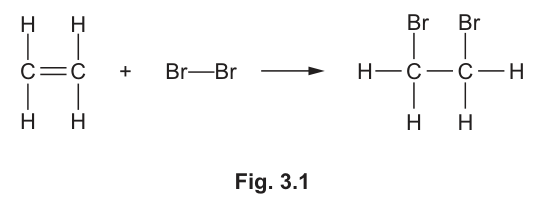
The equation for the reaction between ethene and bromine is shown in Fig. 3.1.
Answer
orange to colourless
orange to colourless
Walkthrough
Aqueous bromine (bromine water) is orange (or reddish-brown). When an unsaturated hydrocarbon such as ethene is bubbled through it, an addition reaction occurs across the double bond to form 1,2-dibromoethane, which is colourless. Thus, the solution turns from orange to colourless (it is decolourised).
Key Takeaways
- Alkenes decolourise aqueous bromine, turning it from orange/brown to colourless.
- This reaction is the standard qualitative test to distinguish unsaturated hydrocarbons (alkenes) from saturated hydrocarbons (alkanes).
Common Mistakes
- Writing "becomes clear" instead of "becomes colourless" (a coloured solution can also be clear/transparent).
- Stating only the final colour ("colourless") without stating the initial colour or the complete colour change.
Things to Be Careful About
- Give both the starting colour (orange, brown, or reddish-brown) and the final colour (colourless).
Table 3.1 shows some bond energies.
Table 3.1
| bond | bond energy in kJ / mol |
|---|---|
| C-H | 410 |
| C-C | 350 |
| C=C | 610 |
| Br-Br | 193 |
| C-Br | 280 |
Show by calculation that the enthalpy change of the reaction between ethene and bromine, , is .
Working
Bonds broken (endothermic):
- (The four bonds remain unchanged: )
Bonds formed (exothermic):
Enthalpy change of reaction, :
Answer
-107 kJ / mol
Walkthrough
To find the overall enthalpy change using bond energies:
-
Identify the bonds broken in the reactants:
- Breaking one double bond:
- Breaking one single bond:
- Total energy absorbed for bonds broken .
(Note: You can also include all four bonds () on both sides; they will cancel out: .)
-
Identify the bonds formed in the product:
- Forming one single bond:
- Forming two single bonds:
- Total energy released in bonds formed .
(With four bonds included: .)
-
Calculate :
Key Takeaways
- Bond breaking is endothermic (requires energy, ).
- Bond making is exothermic (releases energy, ).
- .
Common Mistakes
- Reversing the formula to , which leads to instead of .
- Counting only one bond instead of two.
Things to Be Careful About
- Always ensure you show each stage of working clearly: total energy for bond breaking, total energy for bond making, and the final subtraction showing the correct negative sign.
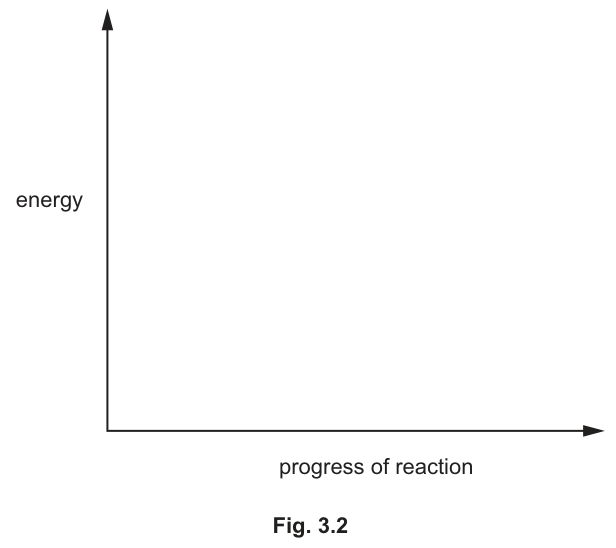
Complete the reaction pathway diagram in Fig. 3.2 for the reaction between ethene and bromine.
Label the:
- reactants
- product
- enthalpy change of the reaction,
- activation energy, .
Answer
- Reactant energy level is drawn higher than the product energy level (reactants on the left, product on the right).
- An energy hump connects reactants to product.
- Activation energy, , is shown as a vertical arrow pointing upwards from the reactant level to the peak of the hump.
- Enthalpy change, , is shown as a vertical arrow pointing downwards from the reactant level to the product level.
Exothermic reaction pathway diagram showing reactants above product, activation energy arrow pointing up from reactant level to peak, and enthalpy change arrow pointing down from reactant level to product level.
Walkthrough
The reaction has a negative enthalpy change (), which means it is exothermic.
- Energy levels: Draw a horizontal line on the left labelled 'reactants' (or ) and a lower horizontal line on the right labelled 'product' (or ).
- Reaction curve: Draw a curved line rising from the reactant level to a peak (the transition state) and then descending to the product level.
- Activation Energy (): Draw a single-headed vertical arrow pointing upwards starting from the reactant energy level up to the highest point of the curve, labelled ''.
- Enthalpy Change (): Draw a vertical arrow pointing downwards from the reactant level to the product level, labelled ''.
Key Takeaways
- In an exothermic reaction, the products have less chemical energy than the reactants (products lie below reactants).
- Activation energy () is always measured from the reactants to the top of the curve and points upwards.
- Overall enthalpy change () is the vertical difference between reactant and product levels.
Common Mistakes
- Drawing from the horizontal axis (zero energy) or from the product level instead of the reactant level.
- Drawing double-headed arrows for or when direction is required.
- Drawing an endothermic diagram where products are higher than reactants.
Things to Be Careful About
- Ensure the arrowheads point in the correct direction: points up; for an exothermic reaction points down.
Draw a dot-and-cross diagram to show the electronic configuration in a molecule of ethene.
Show only the outer shell electrons.
Answer
- Four shared electrons (two pairs of dots/crosses) in the overlap between the two carbon atoms representing the double bond.
- Two shared electrons (one dot and one cross) in each of the four overlapping regions.
- No non-bonding outer shell electrons remain on carbon or hydrogen.
Dot-and-cross diagram of ethene showing two shared electron pairs between the carbon atoms and one shared pair between each carbon and hydrogen atom.
Walkthrough
Ethene has the molecular formula .
- Each carbon atom has 4 outer electrons (Group IV) and needs 4 more electrons to complete its octet (8 electrons).
- Each hydrogen atom has 1 electron and needs 1 more to complete its shell (2 electrons).
- Between the two carbon atoms, 4 electrons are shared (2 pairs, forming a double covalent bond).
- Each carbon also shares 1 pair of electrons with each of two hydrogen atoms (forming two single covalent bonds per carbon atom).
- Checking outer shell counts:
- Left carbon: 4 electrons in + 2 in top + 2 in bottom = 8 electrons.
- Right carbon: 4 electrons in + 2 in top + 2 in bottom = 8 electrons.
- Each hydrogen: 2 shared electrons.
Key Takeaways
- A double bond consists of two shared pairs of electrons (four electrons in total).
- Only outer shell electrons should be shown.
Common Mistakes
- Showing only one pair of electrons between the carbon atoms (drawing ethane instead of ethene).
- Adding extra non-bonding electrons on carbon atoms, exceeding the octet.
Things to Be Careful About
- Use consistent symbols (e.g., dots for hydrogen electrons and crosses for carbon electrons, or distinct symbols for each atom) so it is clear where the shared electrons originate.
Ethanoic acid, , is a member of the homologous series of carboxylic acids.
Answer
or
CnH2n+1COOH
Walkthrough
The question asks for the general formula of the homologous series of carboxylic acids. Carboxylic acids contain the carboxyl functional group (). The remaining part of the molecule is an alkyl chain, . Combining these gives the general formula (or equivalently ).
Key Takeaways
Every homologous series has a general formula that describes all its members. For carboxylic acids, the functional group is and the alkyl chain is .
Common Mistakes
Writing (which is the molecular formula for the series but not the structural general formula) or forgetting the in the group.
Things to Be Careful About
Both and are accepted. Ensure the valency of carbon and oxygen is correct in your formula.
One characteristic of a homologous series is that all the compounds share similar chemical properties.
Explain why the compounds share similar chemical properties.
______
Answer
They have the same functional group.
They have the same functional group.
Walkthrough
A homologous series is a family of organic compounds that have the same functional group and the same general formula. The functional group is the part of the molecule responsible for its chemical reactions. Because all members of the series share this identical functional group, they undergo the same chemical reactions and therefore share similar chemical properties.
Key Takeaways
The functional group dictates the chemical properties of an organic molecule. Similar functional groups lead to similar chemical behaviour.
Common Mistakes
Saying "they have the same molecular formula" (they do not, they differ by ) or "they have the same physical properties" (physical properties change gradually down the series).
Things to Be Careful About
The question asks for chemical properties, not physical ones. Focus your answer strictly on the functional group.
The equation for the reaction between calcium and dilute ethanoic acid is shown.
Answer
calcium ethanoate
calcium ethanoate
Walkthrough
The compound is . Calcium is the metal cation (), giving the first part of the salt name as "calcium". The anion is the ethanoate ion (), derived from ethanoic acid. Combining these gives the name "calcium ethanoate".
Key Takeaways
Salts formed from carboxylic acids are named by combining the metal name with the carboxylate name (e.g., ethanoic acid -> ethanoate).
Common Mistakes
Naming it "calcium acetate" (the IUPAC/O Level name is ethanoate) or "calcium ethanoic acid".
Things to Be Careful About
Ensure the spelling is "ethanoate", not "ethanoic".
A sample of of calcium is added to excess dilute ethanoic acid.
Calculate the volume of hydrogen formed measured at room temperature and pressure.
Give your answer to two significant figures.
volume = ______
Working
From the balanced equation, 1 mole of produces 1 mole of .
At room temperature and pressure, 1 mole of gas occupies .
Answer
0.81
0.81
Walkthrough
Step 1: Calculate the moles of calcium. The relative atomic mass () of calcium is 40.
Step 2: Use the stoichiometry of the given equation to find the moles of hydrogen gas.
The molar ratio of to is 1:1. Therefore, moles of = 0.03375 mol.
Step 3: Calculate the volume of hydrogen at r.t.p. The molar gas volume at r.t.p. is .
The question asks for the answer to two significant figures. 0.81 is already two significant figures.
Key Takeaways
Always convert mass to moles first, use the mole ratio from the balanced equation, and then convert to the required quantity (volume, mass, etc.). Remember the molar gas volume at r.t.p. is .
Common Mistakes
Using the wrong for calcium (e.g., 20 instead of 40), forgetting the 1:1 mole ratio, or using when the question asks for .
Things to Be Careful About
The question specifically asks for the volume in and to two significant figures. is correct; would be three significant figures.
Dilute ethanoic acid is a component of vinegar.
Describe the manufacture of vinegar.
Include the reactants and conditions.
Answer
Aqueous ethanol reacts with oxygen in the presence of bacteria.
Aqueous ethanol reacts with oxygen in the presence of bacteria.
Walkthrough
Vinegar is dilute ethanoic acid. It is manufactured by the oxidation of ethanol. This process is called fermentation (specifically, acetic acid fermentation).
- Reactant 1 (starting material): Ethanol, which must be in aqueous solution (e.g., from the fermentation of sugars).
- Reactant 2: Oxygen from the air.
- Conditions: The reaction requires the presence of specific bacteria (such as Acetobacter) and is carried out at room temperature over a period of time (weeks or months).
Key Takeaways
Vinegar is made by the slow oxidation of ethanol to ethanoic acid using bacteria and oxygen from the air.
Common Mistakes
Saying "ethanol reacts with water" (water is not the oxidising agent), or stating "high temperature" (the process occurs at ambient temperature), or omitting "aqueous" when describing the ethanol.
Things to Be Careful About
The mark scheme specifically looks for: (1) aqueous ethanol, (2) reacts with oxygen, (3) presence of bacteria. Ensure all three are mentioned for full marks.
Butanoic acid and propanoic acid are two other carboxylic acids.
Answer
C4H8O2
Walkthrough
Butanoic acid has a 4-carbon chain. Using the general formula , where the total number of carbons is , we have .
Substituting into the alkyl part gives .
Adding the group gives , which simplifies to the molecular formula .
Key Takeaways
The prefix "but-" indicates 4 carbon atoms in total for the carboxylic acid. The molecular formula can be found by summing the carbons, hydrogens, and oxygens.
Common Mistakes
Writing (counting the carbonyl carbon twice) or (incorrect hydrogen count).
Things to Be Careful About
Ensure the molecular formula is fully summed: 4 carbons, hydrogens, 2 oxygens.
Answer
Displayed formula of propanoic acid: CH3-CH2-COOH with all atoms and bonds shown.
Walkthrough
Propanoic acid has a 3-carbon chain. The displayed formula must show every atom and every bond.
- Carbon 1 (carboxyl carbon): double bond to one oxygen atom, single bond to an group, single bond to Carbon 2.
- Carbon 2 (middle carbon): single bonds to two hydrogen atoms, single bonds to Carbon 1 and Carbon 3.
- Carbon 3 (methyl carbon): single bonds to three hydrogen atoms, single bond to Carbon 2.
Key Takeaways
A displayed formula shows all atoms and all bonds as lines. Do not use condensed formulae like when a displayed formula is asked for.
Common Mistakes
Omitting the hydrogen atoms on the carbon chain, drawing a single bond to the carbonyl oxygen instead of a double bond, or missing the hydrogen on the hydroxyl oxygen.
Things to Be Careful About
Ensure all valencies are correct: carbon forms 4 bonds, oxygen forms 2 bonds, hydrogen forms 1 bond.
Solid sodium carbonate is added to dilute propanoic acid.
Predict an observation for this reaction.
______
Answer
bubbles / fizzing / effervescence / forms a colourless solution
bubbles / fizzing / effervescence
Walkthrough
Propanoic acid is an acid, and sodium carbonate is a carbonate. When an acid reacts with a carbonate, it produces a salt, water, and carbon dioxide gas. The evolution of carbon dioxide gas is observed as bubbles, fizzing, or effervescence. Since sodium propanoate is soluble in water, the solid sodium carbonate will also dissolve, forming a colourless solution.
Key Takeaways
Acids react with carbonates to produce carbon dioxide gas. The visual observation is fizzing or effervescence.
Common Mistakes
Saying "a precipitate forms" (the product is soluble) or "a colourless gas is evolved" without mentioning the visible fizzing/bubbles (the gas itself is invisible; the bubbles are the observable evidence).
Things to Be Careful About
The question asks for an observation. You must describe what you can see (bubbles/fizzing), not what you can infer (carbon dioxide is produced).
Aqueous sodium hydroxide is added to dilute butanoic acid.
State the names of the products of this reaction.
______
Answer
sodium butanoate and water
sodium butanoate and water
Walkthrough
Butanoic acid is a carboxylic acid, and sodium hydroxide is an alkali (a base). When an acid reacts with an alkali, a neutralisation reaction occurs, producing a salt and water.
The salt is formed from the sodium ion () from the alkali and the butanoate ion () from the acid. This gives the salt "sodium butanoate".
The other product is always water () in an acid-alkali neutralisation.
Key Takeaways
Acid + alkali salt + water. The salt name combines the metal name from the alkali with the carboxylate name from the acid.
Common Mistakes
Naming the salt "sodium butanoic acid" (it should be butanoate) or omitting water as a product.
Things to Be Careful About
Ensure the spelling is "butanoate" to match the IUPAC naming convention used in the question.
The combustion of fossil fuels is used in some power stations.
Some power stations use diesel oil as a fuel.
One compound in diesel oil has the formula .
Construct the symbol equation to show the complete combustion of .
______
Answer
(or )
C12H26 + 18.5O2 -> 12CO2 + 13H2O
Walkthrough
Complete combustion of any alkane produces carbon dioxide () and water ().
- Write the unbalanced equation:
- Balance carbon atoms: 12 carbons in gives .
- Balance hydrogen atoms: 26 hydrogens in gives .
- Count total oxygen atoms on the right-hand side: oxygen atoms.
- Balance oxygen: .
Both the fractional form () and the whole-number form () are fully accepted.
Key Takeaways
- Complete combustion of hydrocarbons always produces and .
- Fractional coefficients for diatomic oxygen (e.g., or ) are fully allowed in chemical equations.
Common Mistakes
- Confusing complete combustion (producing ) with incomplete combustion (producing or ).
- Arithmetic errors when summing the oxygen atoms from both and .
Things to Be Careful About
- Ensure all atom counts on both sides match exactly.
The complete combustion of produces an air pollutant.
State one adverse effect of this pollutant.
______
Answer
Global warming (or climate change).
global warming
Walkthrough
The complete combustion of hydrocarbons produces carbon dioxide, . Carbon dioxide is a greenhouse gas that absorbs thermal infrared radiation emitted by the Earth, trapping heat in the atmosphere and causing global warming (which leads to climate change).
Key Takeaways
- Carbon dioxide () causes global warming and climate change.
- Incomplete combustion produces carbon monoxide (toxic) or soot/particulates (respiratory issues/smog).
Common Mistakes
- Stating 'acid rain' for — acid rain is mainly caused by sulfur dioxide and oxides of nitrogen.
- Stating 'ozone depletion' — this is caused by CFCs, not carbon dioxide.
Things to Be Careful About
- Be specific with the effect: 'global warming' or 'climate change' are standard accepted terms.
Answer
- By fractional distillation (using a fractionating column).
- Petroleum is heated / vapourised / boiled.
- Fractions condense and separate because they have different boiling points (diesel oil condenses and is collected at its specific boiling point range).
Fractional distillation; petroleum is heated/vapourised; fractions separate due to different boiling points.
Walkthrough
Petroleum (crude oil) is a complex mixture of hydrocarbons with different chain lengths and boiling points. It is separated industrially by fractional distillation:
- Process/Apparatus: Fractional distillation is carried out in a fractionating column.
- Vapourisation: Petroleum is heated until it vapourises and enters the bottom of the column, which is hot at the bottom and cooler at the top.
- Separation principle: As vapours rise up the column, each fraction cools and condenses when the temperature falls below its specific boiling point. Diesel oil has a specific range of boiling points and condenses at the corresponding height in the column, allowing it to be drawn off separately.
Key Takeaways
- Fractional distillation separates mixtures based on differences in boiling points.
- Longer-chain hydrocarbons have stronger intermolecular forces, higher boiling points, and condense lower down the column.
Common Mistakes
- Mentioning simple distillation instead of fractional distillation.
- Omitting that heating or vapourisation is required.
- Stating that fractions have different melting points instead of boiling points.
Things to Be Careful About
- Include all three key marking points: name of process, heating/vapourisation step, and separation based on boiling points.
Sulfur dioxide is removed from the emissions from a power station using calcium carbonate powder.
Answer
Acid rain (or irritation of the respiratory system / breathing difficulties).
acid rain
Walkthrough
Sulfur dioxide () dissolves in atmospheric water to form sulfurous acid (), which oxidises to sulfuric acid (), resulting in acid rain. Acid rain lowers the pH of lakes (killing aquatic life), damages trees and vegetation, and corrodes limestone buildings and metal structures.
Key Takeaways
- and are the primary causes of acid rain.
- In humans, is also a respiratory irritant.
Common Mistakes
- Stating 'global warming' or 'greenhouse effect' for sulfur dioxide.
Things to Be Careful About
- Ensure you do not confuse the effects of carbon dioxide (global warming) with sulfur dioxide (acid rain).
One mole of sulfur dioxide reacts with one mole of calcium carbonate to make one mole of carbon dioxide and only one other product.
Suggest the formula of this product.
formula = ______
Answer
CaSO3
Walkthrough
We are given that of reacts with of to produce of and one other product:
- Write out the reactants:
- Count atoms on the left-hand side:
- Subtract the atoms present in ( and ):
- The remaining atoms form the compound calcium sulfite: .
Key Takeaways
- Applying the law of conservation of mass allows deduction of unknown formulae by balancing atoms.
- is calcium sulfite, formed when acidic reacts with basic/carbonate compounds of calcium in flue gas desulfurisation.
Common Mistakes
- Writing (calcium sulfate) instead of (calcium sulfite) because of familiarity with sulfate salts; would require oxygen from air as an additional reactant.
Things to Be Careful About
- Write the formula with correct capitalisation and subscripts: .
State and explain the effect of increasing the temperature on the rate of this reaction.
Answer
- The rate increases.
- Particles have more kinetic energy and move faster.
- A greater proportion of collisions have energy greater than or equal to the activation energy (leading to more successful / effective collisions per unit time).
Rate increases; particles gain kinetic energy so more collisions have energy >= activation energy (more successful collisions).
Walkthrough
- Effect on rate: Increasing temperature increases the rate of reaction.
- Particle behaviour: At higher temperatures, particles gain thermal energy which is converted to kinetic energy, causing them to move faster.
- Collision frequency and energy: Because particles move faster, they collide more frequently. More importantly, a much higher fraction of colliding particles possess energy equal to or greater than the activation energy (). This results in a higher frequency of successful (effective) collisions.
Key Takeaways
- Temperature affects rate primarily by increasing the fraction of particles with energy , rather than just collision frequency.
- A successful collision requires both proper orientation and sufficient energy ().
Common Mistakes
- Only stating that particles collide more often without mentioning activation energy or successful collisions.
- Forgetting to state the initial effect on rate ('rate increases').
Things to Be Careful About
- Use clear terms like 'successful collisions' or 'collisions with energy greater than activation energy' to secure the second mark.
Lumps of calcium carbonate are used instead of calcium carbonate powder.
State and explain the effect of this change on the rate of this reaction.
Answer
- The rate decreases.
- Lumps have a smaller surface area (fewer particles exposed).
- There are less frequent collisions (fewer collisions per unit time / per second).
Rate decreases; lumps have a smaller surface area so collisions are less frequent.
Walkthrough
- Effect on rate: Using lumps instead of powder decreases the rate of reaction.
- Surface area change: Large lumps have a smaller total surface area (and a smaller surface area to volume ratio) than the same mass of fine powder. Therefore, fewer calcium carbonate particles are exposed at the surface to collide with sulfur dioxide gas.
- Collision frequency: With fewer exposed reactant particles, collisions occur less frequently (lower collision frequency / fewer collisions per second).
Key Takeaways
- Larger pieces/lumps have a smaller surface area than finely divided powders.
- A smaller surface area reduces the frequency of collisions between reactant particles, slowing down the reaction.
Common Mistakes
- Stating that lumps give 'less energy' or 'lower activation energy' — surface area only affects collision frequency, not collision energy.
- Saying 'less collisions' without specifying a time frame ('less frequent collisions' or 'fewer collisions per unit time/second').
Things to Be Careful About
- Clearly state that rate decreases, identify the smaller surface area, and link this to lower collision frequency.
Bromine, , is in Group VII of the Periodic Table.
The melting point of bromine is and the boiling point is .
Answer
is below the melting point of bromine (), so bromine exists as a solid.
−50 °C is lower than bromine's melting point (−7 °C), so bromine is a solid.
Walkthrough
Bromine has a melting point of . At temperatures below this, particles do not have enough energy to break the forces between them, so the substance remains solid. Since is lower than , bromine is solid.
Key Takeaways
A pure substance is solid below its melting point, liquid between melting point and boiling point, and gas above its boiling point. The mark is earned by comparing the given temperature with the melting point.
Common Mistakes
- Writing that the temperature is 'very cold' without comparing it with the melting point.
- Using the boiling point of instead of the melting point.
Things to Be Careful About
Show the comparison: . The single mark is for recognising that the temperature is below the melting point.
Answer
The molecules are touching / very close together and are arranged in a regular pattern. They vibrate about fixed positions.
Close together (touching); regular/ordered arrangement; vibrating about fixed positions.
Walkthrough
At bromine is solid, so the particle model for a solid applies. The molecules are packed closely together, almost touching. They are not free to move around; instead they occupy fixed positions in a regular pattern. Their only motion is vibration about those positions. The answer needs all three ideas for the three marks.
Key Takeaways
The kinetic particle model describes a solid as particles that are close together, regularly arranged, and vibrating about fixed positions.
Common Mistakes
- Saying the molecules are far apart or moving freely: that describes a gas.
- Missing the word 'vibrate' or saying 'move' without saying 'about fixed positions'.
Things to Be Careful About
Write three distinct points: touching/close, regular arrangement, vibration. Do not use liquid or gas descriptions.
A sample of bromine liquid contains molecules.
One mole of bromine liquid contains molecules.
Calculate the mass of this sample of bromine liquid.
mass of sample = ______
Working
Number of moles:
Answer
6400 g
6400 g
Walkthrough
First convert the number of molecules into moles using the Avogadro constant: divide by , which gives 40 mol. Then calculate the molar mass of bromine molecules: each molecule is , so . Finally, mass = moles × molar mass: g.
Key Takeaways
Amount of substance in moles can be found from a count of particles. Converting moles to mass uses . Remember that bromine exists as diatomic molecules, so use 160, not 80.
Common Mistakes
- Using the relative atomic mass of bromine, 80, instead of of , 160.
- Misreading the powers of ten: gives 40 mol, not 0.4 mol.
- Forgetting the unit g in the final answer.
Things to Be Careful About
The mark scheme gives 40 mol as the first mark and 6400 g as the second. Show the division and the mass calculation clearly.
The ionic equation shows the reaction of bromine with warm concentrated aqueous sodium hydroxide.
Answer
: 0
: -1
Br2: 0; Br−: -1
Walkthrough
An element in its elemental form has oxidation number 0, so bromine in has oxidation number 0. A simple monatomic ion has oxidation number equal to its charge; the bromide ion has charge , so its oxidation number is .
Key Takeaways
The oxidation number of an uncombined element is always 0. For a simple ion, the oxidation number is the same as the charge on the ion.
Common Mistakes
- Giving bromine in as because halogens are usually in compounds.
- Giving as 0 because it is a halogen.
Things to Be Careful About
A lone element always has oxidation number 0. The sign of the charge on the ion must match its oxidation number.
During the reaction bromine is reduced.
Explain why, using ideas about electrons.
______
Answer
Bromine is reduced because it gains electrons.
Bromine gains electrons.
Walkthrough
In the ionic equation, is changed into . Each bromine atom gains one electron to become a bromide ion: . Reduction is defined as gain of electrons, so bromine is reduced.
Key Takeaways
Reduction = gain of electrons. The oxidation number of bromine falls from 0 in to in , confirming that reduction has happened.
Common Mistakes
- Saying bromine 'loses electrons' — that is oxidation, not reduction.
- Trying to explain reduction using oxygen rather than electrons, as the question specifically asks for ideas about electrons.
Things to Be Careful About
Use the exact phrase 'gains electrons'. The mark depends on this idea, not just on saying 'it is reduced'.
Bromine reacts with hydrogen in a closed system to form an equilibrium mixture. The forward reaction releases thermal energy into the surroundings.
The temperature of the equilibrium mixture is increased. The pressure remains constant.
State and explain what happens to the position of equilibrium.
statement ______
explanation ______
Answer
Statement: the position of equilibrium moves to the left / towards the reactants.
Explanation: the forward reaction is exothermic, so increasing the temperature favours the endothermic backward reaction. More decomposes into and .
Moves to left/reactants side; forward reaction is exothermic, so the endothermic backward reaction is favoured.
Walkthrough
The question tells you that the forward reaction releases thermal energy, so the forward reaction is exothermic. This means the backward reaction is endothermic. When the temperature is increased at constant pressure, the equilibrium shifts in the direction that absorbs heat, i.e. the endothermic direction. Here that is the backward direction, so the position of equilibrium moves to the left, forming more and .
Key Takeaways
Increasing temperature moves the equilibrium in the endothermic direction. The phrase 'the forward reaction is exothermic' is the key explanation mark.
Common Mistakes
- Saying the equilibrium moves right because 'heat speeds up the reaction'.
- Forgetting to state which reaction is exothermic or endothermic.
Things to Be Careful About
The answer needs both a statement (moves left/towards reactants) and an explanation (forward is exothermic, so backward is endothermic and is favoured).
The pressure of the equilibrium mixture is increased. The temperature remains constant.
State and explain what happens to the position of equilibrium.
statement ______
explanation ______
Answer
No effect / the position of equilibrium stays the same.
Explanation: there are the same number of moles of gas on each side of the equation (2 on the left and 2 on the right), so increasing pressure affects both forward and backward reactions equally.
No change; equal moles/volumes of gas on both sides.
Walkthrough
The equation has on the left, which is 2 moles of gas, and on the right, which is also 2 moles of gas. Pressure changes affect equilibria by favouring the side with fewer moles of gas. Here neither side has fewer moles, so an increase in pressure has no effect on the position of equilibrium.
Key Takeaways
For equilibrium, only count gaseous species. If the number of moles of gas is equal on both sides, changing pressure does not shift the equilibrium.
Common Mistakes
- Saying the equilibrium shifts right because the reaction has fewer moles on the right, without counting the left side.
- Counting solid or liquid species that are not present here.
Things to Be Careful About
State explicitly that there are equal numbers of moles of gas on each side. This is the explanation mark.
A bromide of phosphorus contains phosphorus by mass.
Calculate the empirical formula of this bromide.
Show your working.
empirical formula = ______
Working
| substance | phosphorus | bromine |
|---|---|---|
| % by mass | 7.2 | 92.8 |
| moles in 100 g |
Divide by the smallest number of moles:
Therefore the ratio P : Br = 1 : 5.
Answer
PBr5
Walkthrough
The bromide contains only phosphorus and bromine. Since phosphorus is 7.2% by mass, bromine must be % by mass. In 100 g of the compound there are 7.2 g of phosphorus and 92.8 g of bromine. Convert each to moles: phosphorus mol; bromine mol. Divide both by the smaller value, 0.232, giving a P : Br ratio of 1 : 5. Hence the empirical formula is .
Key Takeaways
To find an empirical formula from percentage composition, assume 100 g of compound, convert masses to moles, and divide by the smallest number of moles to obtain the whole-number ratio.
Common Mistakes
- Using 7.2% for bromine instead of subtracting from 100% to get 92.8%.
- Using the relative atomic mass of bromine as 35.5 (chlorine) instead of 80.
- Writing PBr without reducing the ratio correctly.
Things to Be Careful About
The empirical formula compares atoms, not masses. The ratio 0.232 : 1.16 simplifies exactly to 1 : 5, so the formula is .
Iron is used to make stainless steel.
Stainless steel is used to make cutlery because it is resistant to rusting.
Answer
It is hard / strong.
hard
Walkthrough
Cutlery must not bend easily during use and should withstand mechanical wear. Apart from corrosion resistance, stainless steel is used because it is hard, strong, and does not react with food substances.
Key Takeaways
- Alloys such as stainless steel are harder and stronger than pure metals because different-sized atoms disrupt the regular lattice structure.
Common Mistakes
- Giving 'resistant to rusting' or 'does not rust', which is already stated in the question stem.
Things to Be Careful About
- Always ensure the property given is different from the one provided in the question stem.
Answer
A mixture of a metal with other elements.
mixture of a metal with other elements
Walkthrough
An alloy is defined as a mixture of a metal with other elements (which can be other metals or non-metals like carbon). It is a physical mixture rather than a chemically bonded compound.
Key Takeaways
- An alloy is a mixture, not a compound.
- An alloy must contain at least one metal mixed with other elements.
Common Mistakes
- Describing an alloy as a compound or stating that elements are chemically joined.
Things to Be Careful About
- Use the word 'mixture' rather than 'compound' or 'molecule'.
Iron nails are galvanised with zinc to prevent rusting.
Explain two ways in which galvanising iron nails with zinc prevents rusting.
Answer
- Barrier method: The zinc coating forms a protective barrier that prevents oxygen and water from reaching the surface of the iron.
- Sacrificial protection: Zinc is more reactive than iron, so if the coating is scratched, the zinc corrodes in preference to the iron.
Zinc acts as a barrier preventing water and oxygen reaching the iron, and zinc is more reactive than iron so it corrodes sacrificially in preference to iron.
Walkthrough
Galvanising protects iron in two complementary ways:
- Barrier protection: The layer of zinc physically covers the iron surface, preventing contact with oxygen (air) and water/moisture, both of which are required for rusting.
- Sacrificial protection: Zinc is higher than iron in the reactivity series (more reactive). If the zinc coating is scratched or damaged, zinc oxidises/corrodes preferentially by losing electrons more readily than iron, thereby protecting the iron from rusting.
Key Takeaways
- Rusting requires both oxygen and water.
- Galvanising provides both barrier protection and sacrificial protection.
- Sacrificial protection works because the more reactive metal loses electrons more easily.
Common Mistakes
- Mentioning only that zinc covers the iron without stating what it blocks (oxygen and water).
- Stating that iron is more reactive than zinc.
Things to Be Careful About
- Clearly distinguish between the barrier effect and sacrificial protection when asked for two ways.
Iron reacts with hot dilute sulfuric acid to form hydrogen and aqueous iron(III) sulfate as the only products.
Construct a symbol equation for this reaction.
Include state symbols.
______
Answer
2Fe(s) + 3H2SO4(aq) -> Fe2(SO4)3(aq) + 3H2(g)
Walkthrough
-
Identify the formulae of reactants and products:
- Iron metal:
- Dilute sulfuric acid:
- Iron(III) sulfate contains and . Balancing charges gives the formula .
- Hydrogen gas:
-
Balance the equation:
- 2 iron atoms on the right require on the left.
- 3 sulfate groups on the right require on the left.
- 6 hydrogen atoms on the left produce on the right.
-
Include state symbols:
- Solid iron: (s)
- Aqueous sulfuric acid: (aq)
- Aqueous iron(III) sulfate: (aq)
- Gaseous hydrogen: (g)
Key Takeaways
- Metal + acid salt + hydrogen.
- Iron(III) ions have a charge, so iron(III) sulfate is .
Common Mistakes
- Writing iron(II) sulfate () instead of iron(III) sulfate ().
- Forgetting or writing incorrect state symbols.
- Writing diatomic hydrogen without the subscript 2 (e.g. ).
Things to Be Careful About
- The question explicitly specifies iron(III) sulfate, not iron(II) sulfate.
Fig. 8.1 shows the displayed formula of compound A.
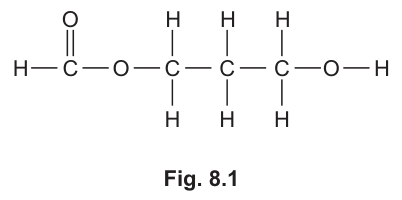
Compound A is both a saturated alcohol and a saturated ester.
Answer
All carbon-carbon bonds are single bonds (there are no double bonds).
All carbon-carbon bonds are single bonds
Walkthrough
In organic chemistry, a molecule is described as saturated if all the covalent bonds between carbon atoms are single bonds (). A compound containing double bonds between carbon atoms () is unsaturated. Note that the presence of a double bond does not make the carbon skeleton unsaturated in this context.
Key Takeaways
- Saturated = contains only single carbon-to-carbon bonds.
- Unsaturated = contains at least one carbon-to-carbon multiple bond (e.g. ).
Common Mistakes
- Stating that it has only single bonds without specifying carbon-carbon bonds (since compound A contains a double bond).
- Saying "it contains the maximum number of hydrogen atoms" without mentioning carbon-carbon single bonds.
Things to Be Careful About
- Always specify carbon-carbon bonds when defining saturated or unsaturated.
Answer
It contains the (hydroxyl) functional group.
Contains the -OH functional group
Walkthrough
Alcohols are characterised by the presence of a hydroxyl functional group () attached to a carbon atom. Looking at the right-hand end of the displayed formula of compound A, there is a terminal group.
Key Takeaways
- The characteristic functional group of alcohols is the hydroxyl group ().
Common Mistakes
- Writing "hydroxide" instead of "hydroxyl" or " group" (hydroxide refers to the ion in ionic compounds).
Things to Be Careful About
- Make sure the bond line is attached to oxygen: or .
Answer
It contains the ester linkage ( / ).
Contains the -COO- linkage
Walkthrough
An ester is identified by the presence of the ester functional group (or ester linkage), which consists of a carbonyl group directly attached to an oxygen atom bonded to another carbon (). Looking at the left-hand portion of compound A, the unit is an ester group.
Key Takeaways
- The ester linkage is .
Common Mistakes
- Confusing the ester linkage () with a carboxylic acid group () or ether group ().
Things to Be Careful About
- Clearly state or "ester linkage/group".
Fig. 8.2 shows compound B.
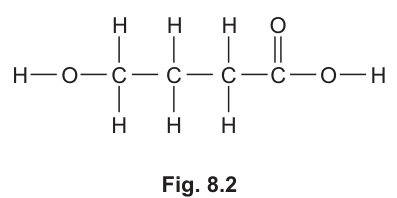
Explain why compound A and compound B are a pair of structural isomers.
______
Answer
They have the same molecular formula () but different structural formulae (different structures).
They have the same molecular formula but different structures
Walkthrough
Structural isomers are compounds that share the same molecular formula (same number and type of each atom) but have different structural formulae (different arrangements of atoms/bonds).
- Compound A: , , .
- Compound B: , , .
Because both have the molecular formula but have their atoms connected differently (compound A is an ester-alcohol, while compound B is a hydroxy-carboxylic acid), they are structural isomers.
Key Takeaways
- Structural isomers have the same molecular formula but different structural formulae.
Common Mistakes
- Stating "same chemical formula" instead of "same molecular formula".
- Forgetting to mention BOTH "same molecular formula" AND "different structure / structural formula".
Things to Be Careful About
- Always mention both halves of the definition.
The displayed formula of compound C is shown in Fig. 8.3.
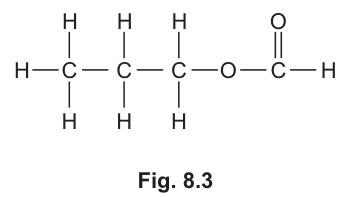
Compound C is an ester.
Compound C is made by the reaction of an alcohol and a carboxylic acid in the presence of a catalyst.
Answer
Acid (or acidic catalyst / concentrated sulfuric acid)
Acidic
Walkthrough
Esterification reactions between an alcohol and a carboxylic acid are catalysed by an acid (most commonly concentrated sulfuric acid, ). The question asks for the type of catalyst, so "acid" or "acidic" is the expected answer.
Key Takeaways
- Esterification is catalysed by an acid (such as concentrated sulfuric acid).
Common Mistakes
- Stating a specific non-acid catalyst like nickel, iron, or yeast.
Things to Be Careful About
- The question asks for the type of catalyst, so "acidic" or "acid" directly answers the prompt.
State the name and draw the displayed formula of the alcohol used in this reaction.
name ______
displayed formula
Answer
Name: propan-1-ol (or propanol)
Displayed formula:
propan-1-ol
Walkthrough
- Compound C is propyl methanoate: .
- In an ester , the alkyl group attached to the single-bonded oxygen () originates from the alcohol. Here, comes from propan-1-ol.
- The name of this 3-carbon straight-chain primary alcohol is propan-1-ol (or propanol).
- When drawing a displayed formula, every single atom and every single bond line must be shown explicitly, including the bond.
Key Takeaways
- Ester structure: .
- A displayed formula must show every atom and every covalent bond line.
Common Mistakes
- Drawing as a condensed group without the bond line (in a displayed formula, the bond MUST be drawn).
- Naming the alcohol as propan-2-ol or propanoic acid.
Things to Be Careful About
- Ensure the carbon chain has 3 carbons with 4 bonds per carbon atom, and oxygen has 2 single bonds.
Fig. 8.4 shows two monomers that react to make a condensation polymer.
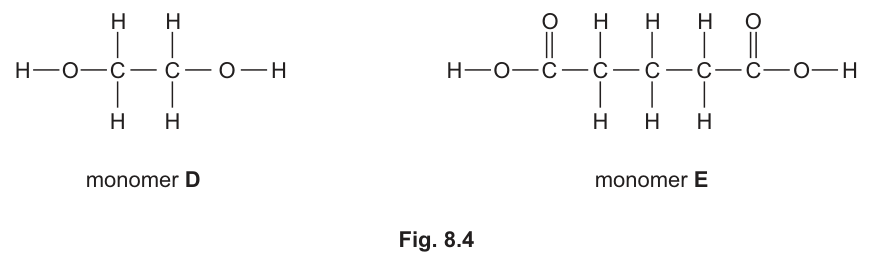
Answer
-O-CH2-CH2-O-CO-CH2-CH2-CH2-CO-
Walkthrough
- Identify the monomers:
- Monomer D is a diol: (ethane-1,2-diol).
- Monomer E is a dicarboxylic acid: (pentanedioic acid).
- Condensation reaction:
- Each group loses an , and each group on the alcohol loses an , releasing water () and forming an ester linkage ().
- Combine to form one repeat unit:
- Start with the diol residue:
- Link to the dicarboxylic acid residue:
- Together, the repeat unit is:
- Continuation bonds: Ensure open continuation bonds extend out from the left terminal oxygen and the right terminal carbonyl carbon.
Key Takeaways
- A polyester is formed by reacting a diol with a dicarboxylic acid.
- A repeat unit must contain continuation bonds extending beyond the ends without terminal or groups.
Common Mistakes
- Leaving terminal or groups on the ends of the repeat unit.
- Missing continuation bonds at either end.
- Missing one of the groups in the central carbon chain of monomer E.
Things to Be Careful About
- Count the carbon atoms carefully: 2 carbons in the diol section and 5 carbons (including the two carbonyl carbons) in the dicarboxylic acid section.
An equal number of moles of the monomers D and E are reacted to make the condensation polymer.
The total mass of the monomers D and E is . There is a yield.
Explain why the mass of the condensation polymer made is less than .
______
Answer
A small molecule / by-product (water, ) is also formed and eliminated during condensation polymerisation.
A by-product (water) is formed and eliminated during condensation polymerisation
Walkthrough
In condensation polymerisation, monomer molecules join together with the simultaneous elimination of small molecules (such as water, ). Therefore, the total mass of the reactants () equals the mass of the polymer PLUS the mass of the water eliminated by conservation of mass. Because some of the mass leaves as water, the mass of the polymer alone is less than .
Key Takeaways
- Condensation polymerisation produces a polymer AND a small by-product (usually water).
- Addition polymerisation produces only the polymer (mass of polymer = mass of monomers at yield).
Common Mistakes
- Stating that mass was lost as a gas due to incomplete reaction, when the question explicitly states there is a yield.
Things to Be Careful About
- Attribute the difference specifically to the formation and loss of the small molecule / by-product (water).