Chemistry 5070/21 — May/June 2025
Cambridge O-Level · Theory · worked solutions for every part, with the mark scheme
Topics Acids, Bases and Salts · Organic Chemistry · Chemical Reactions · Stoichiometry · Metals · Atoms, Elements and Compounds · +5 more
Choose from the following salts to answer the questions.
aluminium chloride
barium sulfate
calcium chloride
copper(II) sulfate
magnesium chloride
potassium iodide
potassium manganate(VII)
silver nitrate
sodium bromide
sodium sulfite
Each salt can be used once, more than once or not at all.
State which salt:
Answer
barium sulfate
barium sulfate
Walkthrough
Precipitation reactions are used to prepare insoluble salts by mixing solutions of two soluble salts.
Looking at the list of salts:
- (barium sulfate) is insoluble in water (sulfates of barium, lead, and calcium are insoluble/sparingly soluble).
- All other salts in the list are soluble in water (chlorides, nitrates, potassium/sodium salts).
Therefore, barium sulfate is prepared via a precipitation reaction.
Key Takeaways
- Insoluble salts are prepared by precipitation (mixing two aqueous solutions containing the required cation and anion).
- Solubility rules: all nitrates and all potassium/sodium salts are soluble; barium sulfate is insoluble.
Common Mistakes
- Confusing soluble sulfates (such as ) with insoluble sulfates (, ).
Things to Be Careful About
- Write the full name of the salt exactly as given in the list.
in aqueous solution, reacts with an excess of aqueous ammonia to give a dark blue solution
______
Answer
copper(II) sulfate
copper(II) sulfate
Walkthrough
Aqueous ammonia added dropwise to a solution containing forms a light blue precipitate of . When excess aqueous ammonia is added, the precipitate dissolves to give a characteristic deep/dark blue solution containing tetraamminecopper(II) ions.
Among the choices, copper(II) sulfate contains ions.
Key Takeaways
- + excess dark blue solution.
Common Mistakes
- Omitting the oxidation state (II) if writing a name freely, though here candidates should copy from the list.
Things to Be Careful About
- Copy the name precisely from the provided list: copper(II) sulfate.
reacts with warm aqueous sodium hydroxide and aluminium foil to give a gas that turns damp red litmus paper blue
______
Answer
silver nitrate
silver nitrate
Walkthrough
The reaction with warm aqueous sodium hydroxide and aluminium foil reduces nitrate ions () to ammonia gas (). Ammonia is an alkaline gas that turns damp red litmus paper blue.
Scanning the list for a nitrate salt gives silver nitrate.
Key Takeaways
- Test for nitrate ions: warm with aqueous and foil; gas is evolved, which turns damp red litmus paper blue.
Common Mistakes
- Confusing the test for ammonium ions (warm with only, no aluminium needed) with the test for nitrate ions.
Things to Be Careful About
- Silver nitrate is the only nitrate salt present in the list.
Answer
potassium iodide
potassium iodide
Walkthrough
Aqueous potassium iodide () contains iodide ions (), which act as a reducing agent. When reacted with an oxidising agent, iodide ions are oxidised to iodine (), producing a colour change from colourless to brown.
Therefore, potassium iodide is used as a standard chemical test for oxidising agents.
Key Takeaways
- Aqueous potassium iodide is a reducing agent used to test for oxidising agents (turns from colourless to brown due to the formation of ).
- Acidified potassium manganate(VII) is an oxidising agent used to test for reducing agents.
Common Mistakes
- Confusing potassium iodide (test for oxidising agents) with potassium manganate(VII) (test for reducing agents).
Things to Be Careful About
- Make sure not to select potassium manganate(VII), which is an oxidising agent itself, not a test for oxidising agents.
Answer
silver nitrate
silver nitrate
Walkthrough
For copper metal to react with a salt solution in a displacement reaction, copper must be more reactive than the metal cation in the salt.
In the reactivity series:
Silver () is below copper in the reactivity series. Therefore, copper displaces silver from aqueous silver nitrate:
Key Takeaways
- A more reactive metal displaces a less reactive metal from its aqueous solution.
- Copper is above silver in the reactivity series, so copper reduces to .
Common Mistakes
- Thinking a salt can only be used once; the instructions explicitly state "Each salt can be used once, more than once or not at all."
Things to Be Careful About
- Silver is the only metal in the list lower than copper in the reactivity series.
A concentrated aqueous solution of copper(II) bromide is electrolysed using graphite electrodes.
Graphite has good electrical conductivity.
Explain why graphite has good electrical conductivity.
Use ideas about structure and bonding.
______
Answer
Each carbon atom forms three covalent bonds using three of its outer-shell electrons. The fourth outer-shell electron from each carbon is delocalised (mobile) between the layers. These mobile electrons can move through the structure and carry electrical charge, so graphite conducts electricity.
Each carbon uses three outer-shell electrons in covalent bonds; the fourth electron is delocalised and mobile
Walkthrough
Recall that graphite is a giant covalent substance with layers. In each layer, every carbon atom is covalently bonded to three other carbons, so it uses three of its four outer-shell electrons. The fourth electron is not held by one atom; it is delocalised over the layer and can move. When a voltage is applied these mobile electrons drift, so graphite conducts electricity. Here, carbon has four outer-shell electrons (configuration 2,4); using three for bonds leaves one delocalised electron per carbon.
Key Takeaways
- Graphite is special among covalent substances because it can conduct electricity.
- The delocalised fourth electron from each carbon carries the current.
- Conduction in graphite is electronic, not ionic.
Common Mistakes
- Saying that 'all' electrons are free – only one electron per carbon is delocalised.
- Confusing graphite with diamond, in which all four electrons are used in covalent bonds and there are no delocalised electrons.
- Writing that graphite conducts because it contains ions.
Things to Be Careful About
The two marks are earned by two ideas: (1) each carbon uses three outer-shell electrons in covalent bonds, and (2) there are mobile (delocalised) electrons between the layers. Use the words 'delocalised' or 'mobile'. Do not mention layer sliding or high melting point, as these are not needed for this mark.
State one other property of graphite that makes it suitable for use as an electrode during electrolysis.
______
Answer
Graphite is chemically inert (unreactive), so it does not react with the electrolyte or with the substances formed during electrolysis.
chemically inert (unreactive)
Walkthrough
An electrode must not take part in the electrolysis or be destroyed by the substances formed. Graphite is chemically inert, meaning it does not react with the electrolyte or the products at either electrode, so it is suitable for use as an electrode. Its strong giant covalent structure makes it stable in these conditions.
Key Takeaways
- A suitable electrode material is both a good conductor and chemically inert.
- 'Inert' means it does not react, so the electrode is not used up.
Common Mistakes
- Giving 'high melting point' as the only property – the mark scheme expects 'inert' (chemically unreactive).
- Saying 'it is a good conductor', which is already given in the stem and is not the requested 'other property'.
Things to Be Careful About
Answer with the single word 'inert' or 'chemically unreactive'. If you add an explanation, keep it very short; the mark is for the property itself.
Predict the products of the electrolysis of concentrated aqueous copper(II) bromide with graphite electrodes.
product at anode = ______
product at cathode = ______
Answer
product at anode = bromine ()
product at cathode = copper ()
anode: bromine (Br2); cathode: copper (Cu)
Walkthrough
Copper(II) bromide solution contains , , and ions. At the anode, bromide ions are discharged in preference to hydroxide ions when the halide solution is concentrated. The half-equation is , so bromine gas is produced. At the cathode, copper(II) ions are below hydrogen in the reactivity series, so they are discharged in preference to hydrogen ions: . Copper metal is deposited on the cathode. Graphite is inert, so it is not a product.
Key Takeaways
- In aqueous electrolysis, the ion that is discharged is the one that is easier to oxidise or reduce (or the one present in high concentration).
- In a concentrated halide solution, halide ions are discharged at the anode rather than hydroxide ions.
- A metal ion less reactive than hydrogen is discharged at the cathode in preference to hydrogen ions.
Common Mistakes
- Writing oxygen at the anode because the solution contains water – in concentrated copper(II) bromide, bromide ions are discharged first.
- Writing hydrogen at the cathode – copper(II) ions are less reactive than hydrogen, so copper is deposited.
- Forgetting that graphite is inert and so does not react or dissolve.
Things to Be Careful About
Name the products as requested: bromine at the anode and copper at the cathode. It is helpful to know the half-equations even though the question only asks for the product names, because they show why these ions are discharged.
Dilute sulfuric acid is electrolysed using graphite electrodes to form oxygen and hydrogen.
Construct the ionic half-equation for the reaction at each electrode.
reaction at anode = ______
reaction at cathode = ______
Answer
anode:
cathode:
anode: 4OH- -> O2 + 2H2O + 4e-; cathode: 2H+ + 2e- -> H2
Walkthrough
In dilute sulfuric acid the relevant ions from water are and . At the anode, hydroxide ions are oxidised: four ions give one molecule and two water molecules, releasing four electrons. The equation is balanced for oxygen (4 O atoms on each side), for hydrogen (4 H atoms on each side) and for charge (a total of 4− on both sides). At the cathode, hydrogen ions are reduced: two ions take two electrons to form one molecule. This equation balances atoms and charge as well.
Key Takeaways
- Half-equations must be balanced for atoms and for charge.
- Oxidation at the anode releases electrons; reduction at the cathode uses electrons.
- In dilute sulfuric acid, the anode reaction oxidises hydroxide ions from water to oxygen, and the cathode reaction reduces hydrogen ions to hydrogen gas.
Common Mistakes
- Unbalanced equations, e.g. one giving , or ignoring water molecules.
- Omitting the electrons from the half-equation.
- Reversing the equations or putting the anode reaction at the cathode.
- Writing the alternative 2H2O -> O2 + 4H+ + 4e- at the anode; the mark scheme allows 4OH- -> O2 + 2H2O + 4e- or 4OH- - 4e- -> O2 + 2H2O.
Things to Be Careful About
Check that each half-equation has equal numbers of atoms and equal total charge on both sides. The cathode equation must be because hydrogen is diatomic.
Hydrogen and oxygen are used in a fuel cell to produce electricity.
Answer
water
water
Walkthrough
In a hydrogen–oxygen fuel cell, hydrogen and oxygen combine chemically to form water. The chemical energy of the reaction is converted directly into electrical energy. The only chemical product is water.
Key Takeaways
- A hydrogen–oxygen fuel cell uses hydrogen and oxygen as reactants and produces water.
- The fuel cell converts chemical energy into electrical energy without combustion.
Common Mistakes
- Naming hydrogen or oxygen as the product; these are the reactants.
- Naming carbon dioxide, which is not formed because the cell burns no carbon-based fuel.
Things to Be Careful About
The question asks for the 'only' product, so answer just 'water'.
Describe one disadvantage of using hydrogen–oxygen fuel cells in vehicles compared to gasoline or petrol engines.
______
Answer
Hydrogen is difficult to store because it must be kept under high pressure (or at a very low temperature as a liquid), so storage tanks are bulky and expensive.
difficult to store hydrogen under pressure / lack of refuelling infrastructure
Walkthrough
Compared with a petrol engine, a hydrogen fuel cell is clean, but hydrogen gas is very low-density. To store enough hydrogen in a vehicle it must be compressed to high pressure, or cooled and stored as a liquid, which needs heavy tanks and uses energy. Alternatively, there are very few places where hydrogen fuel can be bought, so the refuelling network is much less developed than for petrol. Either answer shows a practical disadvantage.
Key Takeaways
- Hydrogen fuel cells are clean but have practical drawbacks.
- The main disadvantage is the difficulty of storing hydrogen safely and compactly, or the lack of hydrogen refuelling stations.
Common Mistakes
- Saying the fuel cell produces harmful emissions; it produces only water.
- Giving a vague answer such as 'it is expensive' without saying why.
Things to Be Careful About
One clear disadvantage is enough for the mark. Make sure it is a comparison with petrol engines, e.g. 'petrol is easy to store in a tank, but hydrogen must be kept under high pressure'.
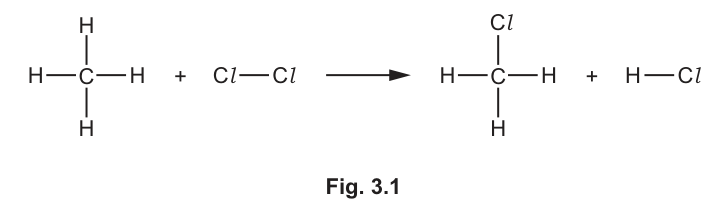
The equation for the reaction between methane and chlorine is shown in Fig. 3.1.
Answer
ultraviolet light / UV light
ultraviolet light
Walkthrough
Alkanes are generally unreactive because they contain strong, non-polar and single covalent bonds. They only undergo substitution reactions with halogens (such as chlorine or bromine) in the presence of ultraviolet (UV) light or sunlight. The UV light provides the initial energy required to break the bond into reactive chlorine radicals (photochemical reaction).
Key Takeaways
- Substitution of alkanes with halogens requires ultraviolet (UV) light or sunlight.
Common Mistakes
- Stating general conditions like "heat" or "high pressure" without mentioning UV light.
Things to Be Careful About
- Ensure you specify "ultraviolet light" or "UV light" (or "sunlight"); "light" on its own may not always be accepted if bright/UV light is specifically required.
Answer
A hydrogen atom in methane is replaced by a chlorine atom.
A hydrogen atom is replaced by a chlorine atom
Walkthrough
A substitution reaction is defined as a reaction in which an atom or group of atoms in an organic molecule is replaced by another atom or group of atoms. Looking at Fig. 3.1, one atom on the methane molecule () is replaced by a atom to form chloromethane (), while the displaced atom combines with the other atom to form .
Key Takeaways
- Substitution involves swapping/replacing one atom or functional group for another.
- In the chlorination of methane, one is replaced by one .
Common Mistakes
- Confusing substitution with addition (addition occurs across double bonds in unsaturated molecules, adding atoms without removing any).
Things to Be Careful About
- Clearly state that an atom is replaced by another atom, or describe the specific replacement (hydrogen replaced by chlorine).
Table 3.1 shows some bond energies.
Table 3.1
| bond | bond energy in |
|---|---|
| C—H | 410 |
| C—Cl | 340 |
| Cl—Cl | 242 |
| H—Cl | 431 |
Show by calculation that the enthalpy change of the reaction between methane and chlorine, , is .
Working
Bonds broken:
Bonds formed:
Enthalpy change of reaction:
(Alternatively, breaking all bonds gives ; forming , , gives ; )
Answer
-119 kJ / mol
Walkthrough
To calculate the overall enthalpy change () from bond energies:
- Identify bonds broken (endothermic process, requires energy input):
Only one bond and one bond are broken in the reactants. - Identify bonds formed (exothermic process, releases energy):
One bond and one bond are formed in the products. - Calculate overall :
Because bond making releases more energy than bond breaking requires, the reaction is exothermic ().
Key Takeaways
- Bond breaking is endothermic ().
- Bond forming is exothermic ().
- .
Common Mistakes
- Inverting the subtraction () and giving an endothermic value.
- Forgetting to include the negative sign in the final answer.
Things to Be Careful About
- You can either calculate the net bonds changed (1 broken, 1 formed) or break all 4 bonds and form 3 bonds back. Both methods give the same correct result.
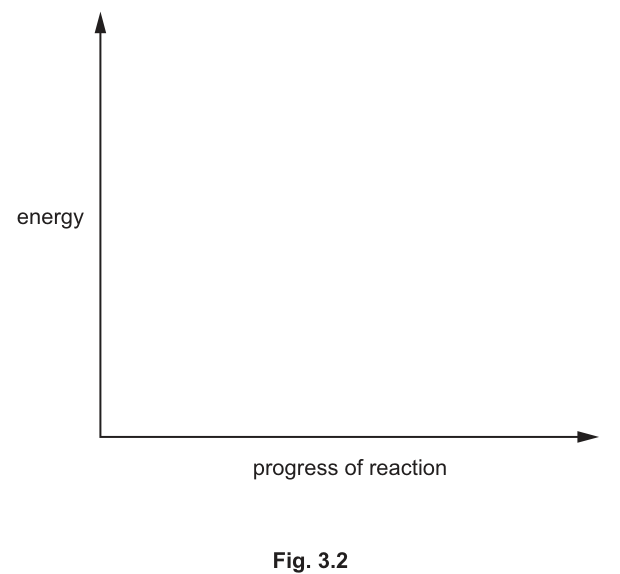
Complete the reaction pathway diagram in Fig. 3.2 for the reaction between methane and chlorine.
Label the:
- reactants
- products
- enthalpy change of the reaction,
- activation energy,
Answer
- Reactants line drawn on the left at a higher energy level than the products line on the right.
- A curved energy hump drawn rising above the reactants and falling to the products.
- Activation energy, , shown as an upward arrow from the reactant energy level to the peak of the curve.
- Enthalpy change, , shown as a downward arrow from the reactant energy level to the product energy level.
Exothermic reaction pathway diagram with reactants above products, activation energy Ea from reactants to peak, and enthalpy change ΔH from reactants to products
Walkthrough
Since , the reaction is exothermic.
- Energy levels of reactants and products: In an exothermic reaction, the products have less chemical energy than the reactants. Therefore, the horizontal line for the reactants () is drawn at a higher level than the horizontal line for the products ().
- Reaction pathway curve: The curve rises from the reactant level up to a peak (representing the transition state) and then slopes down to the product level.
- Activation energy (): This is the minimum energy particles must have to react. It is represented by a vertical arrow starting precisely at the reactant energy level and pointing up to the maximum height of the curve.
- Enthalpy change (): This is the difference between the reactant and product energy levels. For an exothermic reaction, it is represented by a downward vertical arrow pointing from the reactant level down to the product level.
Key Takeaways
- For exothermic reactions, reactants are higher in energy than products.
- is always measured from the reactants level up to the peak of the hump.
- is measured from the reactants level to the products level (pointing down for exothermic).
Common Mistakes
- Drawing starting from the products level or from the bottom axis (it must start from the reactants level).
- Drawing pointing upwards or from the peak of the curve.
- Drawing an endothermic profile (products higher than reactants) despite the negative calculated in part (c).
Things to Be Careful About
- Ensure arrowheads clearly indicate the correct direction: points up, points down.
Draw a dot-and-cross diagram to show the electronic configuration in a molecule of methane.
Show only the outer shell electrons.
Answer
- Four single covalent bonds between the central carbon atom and each of the four hydrogen atoms.
- Each bond consists of one shared pair of electrons (one dot and one cross).
- Carbon has a complete octet of 8 outer electrons; each hydrogen has 2 outer electrons; no non-bonding outer electrons remain.
Dot-and-cross diagram of methane showing four C-H single bonds with one dot and one cross per shared pair
Walkthrough
To draw the dot-and-cross diagram for methane ():
- Carbon is in Group IV (outer shell has 4 electrons) and needs 4 more electrons to achieve a stable octet (8 electrons).
- Each hydrogen atom has 1 electron in its outer shell and needs 1 more to complete its shell of 2 electrons.
- Carbon forms 4 single covalent bonds, sharing one of its electrons with each of the four hydrogen atoms.
- In each overlap between the central carbon circle and a surrounding hydrogen circle, place one dot () and one cross ().
- Check that all 4 outer valence electrons of carbon are used in bonding (no lone pairs on carbon) and each hydrogen has 2 electrons.
Key Takeaways
- Covalent bonding involves the sharing of pairs of electrons between non-metal atoms.
- Methane contains 4 single covalent bonds (4 shared pairs) and zero lone pairs.
Common Mistakes
- Adding extra lone pairs of electrons on carbon (carbon only has 4 valence electrons).
- Drawing double bonds or unpaired electrons.
- Drawing inner shells when the question specifies 'Show only the outer shell electrons'.
Things to Be Careful About
- Ensure one electron in each pair is clearly distinguishable from the other (e.g. one dot and one cross).
Ethanol, , is a member of the homologous series of alcohols.
Answer
CnH2n+1OH
Walkthrough
A homologous series is a family of organic compounds represented by the same general formula. For the aliphatic alcohols (such as methanol and ethanol ), each member contains an alkyl group with carbon atoms and hydrogen atoms bonded to an functional group. Therefore, the general formula is .
Key Takeaways
- The general formula for alcohols is (or ).
Common Mistakes
- Confusing the alcohol formula with alkanes () or carboxylic acids ().
Things to Be Careful About
- Ensure the formula clearly shows the functional group if required, though is the standard format accepted by the syllabus.
Members of a homologous series have the same general formula and share similar chemical properties.
State two other general characteristics of a homologous series.
- ______
- ______
Answer
Any two from:
- Show a gradual trend in physical properties
- Have the same functional group
- Successive members differ by a unit (or differ in by )
Same functional group; trend in physical properties
Walkthrough
The question asks for two characteristics of a homologous series other than having the same general formula and similar chemical properties (which were already given in the question stem).
The remaining standard characteristics are:
- Successive members differ from each other by a group (a relative formula mass difference of 14).
- They exhibit a gradation or trend in physical properties (e.g., boiling point increases with chain length).
- They contain the same functional group.
Key Takeaways
- Characteristics of a homologous series:
- Same general formula
- Same functional group
- Similar chemical properties
- Gradation/trend in physical properties
- Consecutive members differ by
Common Mistakes
- Repeating the characteristics already stated in the prompt (same general formula or similar chemical properties).
- Writing that they have the same physical properties instead of a trend/gradation in physical properties.
Things to Be Careful About
- Clearly distinguish between chemical properties (which are similar) and physical properties (which show a trend).
The equation for the reaction between ethanol and sodium is shown.
A sample of of sodium is added to excess ethanol.
Calculate the volume of hydrogen formed measured at room temperature and pressure.
Give your answer to two significant figures.
volume = ______
Working
Calculate the moles of sodium ():
From the balanced equation, , so the mole ratio of is :
Calculate the volume of at r.t.p. ():
Rounding to two significant figures gives .
Answer
0.70 dm3
Walkthrough
- Find the moles of sodium added:
- Use the stoichiometry from the equation:
According to the equation , of produce of . - Calculate the volume of gas produced at r.t.p.:
Molar gas volume at r.t.p. is . - Apply significant figures:
The question specifies two significant figures, so rounds to .
Key Takeaways
- Molar gas volume at r.t.p. is always .
- Always follow stoichiometric ratios from the balanced chemical equation.
- Trailing zeroes after the decimal point are significant (e.g., has 2 s.f.).
Common Mistakes
- Forgetting to divide the moles of by 2 to get the moles of .
- Forgetting to round the final answer to the requested 2 significant figures, or writing 0.7 instead of 0.70.
Things to Be Careful About
- Ensure you use from the Periodic Table.
Water is added to the reaction mixture to make an aqueous solution.
A few drops of litmus are then added. The litmus changes colour to blue.
Suggest the name of the ion present in the aqueous solution responsible for the colour change.
______
Answer
Hydroxide ion
hydroxide
Walkthrough
When sodium ethoxide () reacts with water, it hydrolyses to form ethanol and sodium hydroxide:
Sodium hydroxide dissolves in water to release hydroxide ions, . Hydroxide ions make the solution alkaline, turning litmus indicator blue.
Key Takeaways
- Hydroxide ions () are responsible for alkalinity in aqueous solutions and turn litmus paper/solution blue.
Common Mistakes
- Naming sodium ion () or ethoxide ion instead of hydroxide.
- Giving the formula rather than the name when the prompt asks specifically for the name.
Things to Be Careful About
- The question explicitly asks for the name of the ion, so write 'hydroxide' (or 'hydroxide ion').
Answer
- Fuel
- Solvent
Fuel, solvent
Walkthrough
Ethanol is widely used across industry and everyday life. The two principal syllabus uses are:
- Fuel: Ethanol burns cleanly and is used directly as a biofuel or blended with petrol (gasohol).
- Solvent: It dissolves many organic substances that do not dissolve in water (used in perfumes, paints, cosmetics, and medicines).
Other acceptable uses include as an alcoholic beverage or as an antiseptic/disinfectant.
Key Takeaways
- The two primary uses of ethanol are as a fuel and as a solvent.
Common Mistakes
- Vague descriptions such as 'for cleaning' without specifying solvent or antiseptic.
Things to Be Careful About
- Keep answers concise and direct: 'fuel' and 'solvent'.
Describe the manufacture of ethanol from ethene.
Include the other reactant and the conditions for the manufacture.
______
Answer
- Reactant: steam / water
- Conditions (any two from):
- Temperature:
- Pressure: /
- Catalyst: phosphoric acid / acid catalyst
Steam, 300°C, 60 atm, phosphoric acid catalyst
Walkthrough
Ethanol is industrially manufactured by the direct hydration of ethene:
To obtain full marks:
- State the other reactant: steam (or gaseous water).
- State the reaction conditions:
- Temperature of approximately
- High pressure of (or )
- An acid catalyst (specifically concentrated phosphoric acid, ).
Key Takeaways
- Direct hydration of ethene requires steam, high temperature (), high pressure (), and a phosphoric acid catalyst.
Common Mistakes
- Stating liquid water instead of steam (though mark schemes often allow water, steam is the chemically precise term for gas-phase hydration).
- Confusing this industrial process with fermentation (yeast, , anaerobic conditions, aqueous glucose).
Things to Be Careful About
- Ensure you give both the reactant and the physical conditions (temperature, pressure, catalyst).
Vehicles that use petrol as a fuel produce several air pollutants.
Petrol is a mixture of hydrocarbons which includes octane, .
Explain why octane is a hydrocarbon.
______
Answer
It is a compound containing only carbon and hydrogen (atoms).
Contains only carbon and hydrogen
Walkthrough
A hydrocarbon is defined strictly as a compound that consists solely of hydrogen and carbon atoms. The word "only" (or "solely") is essential for the mark to distinguish hydrocarbons from other organic compounds containing additional elements such as oxygen or nitrogen.
Key Takeaways
- Hydrocarbons contain only hydrogen and carbon.
Common Mistakes
- Forgetting the word "only" (e.g. simply stating "contains carbon and hydrogen").
- Referring to it as a mixture or element rather than a compound.
Things to Be Careful About
- Ensure the definition explicitly rules out any other elements.
Two of the air pollutants produced are carbon monoxide and nitrogen monoxide.
Explain how carbon monoxide, , is formed in a petrol engine.
Include a symbol equation.
______
Answer
Formed by the incomplete combustion of octane / petrol (due to a limited supply of oxygen).
(or )
2C8H18 + 17O2 -> 16CO + 18H2O (or C8H18 + 8.5O2 -> 8CO + 9H2O)
Walkthrough
- In an engine, if there is insufficient oxygen, petrol (such as octane, ) undergoes incomplete combustion rather than complete combustion, producing toxic carbon monoxide () alongside water.
- Balancing the equation for incomplete combustion of octane: Multiplying by 2 gives integer coefficients:
Key Takeaways
- Incomplete combustion occurs when there is a limited supply of air/oxygen, forming and .
Common Mistakes
- Writing the equation for complete combustion producing .
- Incorrect stoichiometry when balancing oxygen atoms.
Things to Be Careful About
- Either fraction () or whole-number coefficients are accepted in Cambridge mark schemes.
Explain how nitrogen monoxide, , is formed in a petrol engine.
Include a symbol equation.
______
Answer
Nitrogen and oxygen from the air react together at the high temperatures inside the car engine.
N2 + O2 -> 2NO
Walkthrough
- Nitrogen is very unreactive due to its strong triple covalent bond. However, the extremely high temperatures inside an internal combustion engine supply enough energy for nitrogen () and oxygen () from the intake air to react.
- The balanced equation is:
Key Takeaways
- is formed from atmospheric nitrogen and oxygen reacting at high temperatures inside vehicle engines.
Common Mistakes
- Stating that nitrogen comes from the fuel rather than from the air.
- Forgetting to mention the essential requirement of high temperature.
A catalytic converter removes most of the and formed in a petrol engine.
Answer
- Oxidation: / carbon gains oxygen to form .
- Reduction: / nitrogen loses oxygen to form .
CO is oxidised because it gains oxygen, and NO is reduced because it loses oxygen
Walkthrough
In the equation:
- Carbon monoxide () gains oxygen atoms to form carbon dioxide (), which is an oxidation process.
- Nitrogen monoxide () loses oxygen atoms to form nitrogen gas (), which is a reduction process.
- Since both processes occur simultaneously, it is a redox reaction.
Key Takeaways
- Oxidation is the gain of oxygen (or loss of electrons).
- Reduction is the loss of oxygen (or gain of electrons).
Common Mistakes
- Stating only that oxidation or reduction happens without explicitly naming which substance gains or loses oxygen.
Things to Be Careful About
- Clearly name both the substance undergoing oxidation and the substance undergoing reduction.
The reaction is catalysed using platinum metal.
Explain how a catalyst increases the rate of a reaction.
______
Answer
It provides an alternative pathway with a lower activation energy ().
Lowers the activation energy
Walkthrough
A catalyst provides an alternative reaction pathway that has a lower activation energy (). As a result, a greater proportion of colliding particles possess energy equal to or greater than the activation energy, leading to a higher rate of effective collisions without the catalyst being consumed.
Key Takeaways
- Catalysts increase reaction rate by lowering the activation energy.
Common Mistakes
- Claiming that a catalyst gives particles more kinetic energy (only temperature does this).
State and explain the effect of increasing the temperature on the rate of this reaction.
______
Answer
- Effect: Rate of reaction increases.
- Explanation: Particles gain more kinetic energy and move faster, so a greater fraction of collisions have energy activation energy, resulting in more frequent successful (effective) collisions.
Rate increases because particles have more kinetic energy, leading to more frequent successful collisions
Walkthrough
- State: Increasing the temperature increases the rate of reaction.
- Explain using collision theory:
- Higher temperature gives the reacting gas particles more kinetic energy, so they move faster.
- More importantly, a much higher proportion of particles possess energy greater than or equal to the activation energy ().
- This results in a higher frequency of successful / effective collisions per second.
Key Takeaways
- Temperature increases both collision frequency and the fraction of particles with sufficient activation energy.
Common Mistakes
- Only stating that collisions happen more often without mentioning that more collisions have energy exceeding the activation energy.
Things to Be Careful About
- Ensure the word 'successful' or 'effective' is used when discussing collision frequency.
State and explain the effect of decreasing the pressure on the rate of this reaction.
______
Answer
- Effect: Rate of reaction decreases.
- Explanation: Gas particles are further apart (fewer particles per unit volume), leading to a lower frequency of collisions (fewer collisions per unit time).
Rate decreases because particles are further apart (fewer per unit volume), resulting in less frequent collisions
Walkthrough
- State: Decreasing the pressure decreases the rate of reaction.
- Explain:
- When pressure decreases, the gas volume expands and the gas particles spread further apart (there are fewer particles per unit volume).
- Consequently, reactant molecules collide with each other less frequently (lower collision frequency), reducing the rate of reaction.
Key Takeaways
- Decreasing pressure reduces particle concentration in gases, which decreases the collision frequency and lowers the reaction rate.
Common Mistakes
- Confusing rate with equilibrium position (Le Chatelier's principle).
- Forgetting to mention collision frequency / rate of collisions.
Chlorine, , is in Group VII of the Periodic Table.
The melting point of chlorine is and the boiling point is .
Answer
is above the melting point () and below the boiling point ().
-50 °C is between the melting point and boiling point
Walkthrough
A substance is:
- A solid at temperatures below its melting point.
- A liquid at temperatures between its melting point and boiling point.
- A gas at temperatures above its boiling point.
Since lies between (melting point) and (boiling point), chlorine is in the liquid state.
Key Takeaways
- To determine the state of matter at a specified temperature, compare it with both the melting point and boiling point.
Common Mistakes
- Forgetting that negative numbers with smaller absolute values are higher temperatures (e.g., is higher than , but lower than ).
Things to Be Careful About
- Ensure you mention both boundaries (higher than melting point and lower than boiling point).
Answer
- Arrangement: The molecules are close together / touching each other in a random / irregular arrangement (no fixed pattern).
- Motion: The molecules slide / flow over one another.
Arrangement: randomly arranged and touching / close together; Motion: slide or roll past one another
Walkthrough
At , chlorine is a liquid. In a liquid:
- Particles are closely packed / touching one another.
- The arrangement is random with no regular lattice pattern.
- Particles are free to move and slide/flow past each other.
Key Takeaways
- Liquid state characteristics in kinetic particle theory:
- Proximity: mostly touching / close together.
- Arrangement: random / irregular.
- Movement: sliding / moving past each other.
Common Mistakes
- Describing the arrangement as "far apart" (which applies to gases) or "vibrating about fixed positions" (which applies to solids).
Things to Be Careful About
- Answer both parts of the prompt: both the arrangement (closeness and pattern) and the motion.
A sample of chlorine gas contains molecules.
One mole of chlorine gas contains molecules.
Calculate the mass of this sample of chlorine gas.
mass of chlorine = ______
Working
Calculate the number of moles of chlorine molecules, :
Calculate the relative molecular mass () of :
Calculate the mass of the sample:
Answer
0.0142 g
Walkthrough
- First find the moles of chlorine gas using Avogadro's constant ( particles/mol):
- Chlorine gas exists as diatomic molecules, . The relative atomic mass of chlorine is , so the relative molecular mass of is .
- Use :
Key Takeaways
- Chlorine is diatomic (), so its molar mass is , not .
Common Mistakes
- Using instead of for the molar mass of chlorine gas molecules.
- Errors in handling powers of 10 on a calculator.
Things to Be Careful About
- Ensure you check whether the question refers to chlorine atoms or chlorine molecules.
The ionic equation for the reaction of chlorine with cold dilute aqueous sodium hydroxide is shown.
Answer
Cl2 = 0, Cl- = -1
Walkthrough
- Elements in their uncombined/elemental state always have an oxidation number of . Thus, for , the oxidation number is .
- For a simple monatomic ion, the oxidation number is equal to the charge on the ion. Thus, for , the oxidation number is .
Key Takeaways
- Oxidation number of an uncombined element .
- Oxidation number of a monatomic ion charge on the ion.
Common Mistakes
- Writing instead of for an oxidation number (charges are written , but oxidation states have the sign first, ).
- Stating the oxidation number of as or .
Things to Be Careful About
- Include the sign for negative oxidation states.
During the reaction chlorine is reduced.
Explain why, using ideas about electrons.
______
Answer
Chlorine gains electrons (OIL RIG: Reduction Is Gain of electrons).
Chlorine gains electrons
Walkthrough
Reduction can be defined in terms of electrons using the mnemonic OIL RIG:
- Oxidation Is Loss of electrons.
- Reduction Is Gain of electrons.
When chlorine is reduced to form , each chlorine atom gains an electron.
Key Takeaways
- Reduction is the gain of electrons.
- Oxidation is the loss of electrons.
Common Mistakes
- Confusing oxidation with reduction (stating that reduction is loss of electrons).
Things to Be Careful About
- The question specifically asks for an explanation using ideas about electrons, so do not answer in terms of oxidation state or oxygen transfer alone.
Chlorine reacts with cold water to form an equilibrium mixture containing the acids and .
The forward reaction releases thermal energy into the surroundings.
The temperature of the equilibrium mixture is increased.
State and explain what happens to the acidity of the equilibrium mixture.
statement = ______
explanation = ______
Answer
- statement: Acidity decreases.
- explanation: The forward reaction is exothermic (releases heat) / the backward reaction is endothermic, so increasing the temperature shifts the equilibrium position to the left (favouring the backward reaction, decreasing the concentration of acids / ions).
statement: Acidity decreases; explanation: The forward reaction is exothermic, so increasing the temperature causes the equilibrium to shift to the left
Walkthrough
- Forward reaction enthalpy: The question states that the forward reaction releases thermal energy into the surroundings, meaning the forward reaction is exothermic (and the reverse reaction is endothermic).
- Effect of increasing temperature: According to Le Chatelier's principle, an increase in temperature favours the endothermic direction to absorb the added thermal energy. Therefore, the position of equilibrium shifts to the left.
- Effect on acidity: As equilibrium shifts to the left, the products and (which produce ions responsible for acidity) are consumed, leading to a decrease in concentration, so the acidity decreases (the pH increases).
Key Takeaways
- Increasing temperature shifts equilibrium in the endothermic direction.
- Decreasing the concentrations of acidic products reduces acidity.
Common Mistakes
- Stating that acidity increases because reactions go faster at higher temperatures (confusing rate with equilibrium position).
Things to Be Careful About
- Clearly identify the forward reaction as exothermic when explaining why the equilibrium shifts left.
is a strong acid and is a weak acid.
Describe the difference between a strong acid and a weak acid.
______
Answer
- A strong acid completely ionises / dissociates in aqueous solution to produce ions.
- A weak acid only partially ionises / dissociates in aqueous solution to produce ions.
A strong acid completely ionises / dissociates in water, whereas a weak acid only partially ionises / dissociates in water.
Walkthrough
- Acids produce hydrogen ions () in aqueous solution.
- Strong acid: Dissociates completely in water (e.g., ). Virtually all acid molecules break into ions.
- Weak acid: Dissociates partially in water, forming an equilibrium (e.g., ). Only a small fraction of acid molecules form ions.
Key Takeaways
- Strong = complete ionisation/dissociation.
- Weak = partial/incomplete ionisation/dissociation.
Common Mistakes
- Confusing "strong/weak" (extent of ionisation) with "concentrated/dilute" (amount of acid dissolved per unit volume).
Things to Be Careful About
- Must use the keywords completely and partially (or incompletely) alongside dissociates or ionises.
A chloride of iron contains iron by mass.
Calculate the empirical formula of this chloride.
Show your working.
empirical formula = ______
Working
Percentage of chlorine:
Calculate the number of moles of each element in of the compound (, ):
Divide each by the smallest mole value ():
Simplest whole number ratio is .
Answer
FeCl3
Walkthrough
- Find percentage of chlorine: Since the compound contains only iron and chlorine, .
- Convert mass percentages to moles: Divide the mass of each element by its relative atomic mass ():
- Find the simplest whole-number ratio: Divide both mole amounts by the smaller value ():
- The empirical formula is therefore .
Key Takeaways
- To find empirical formula:
- Find masses/percentages of all elements.
- Divide each by its to find moles.
- Divide all mole values by the smallest mole value to find the simplest ratio.
Common Mistakes
- Dividing the mass of chlorine by ( of ) instead of its atomic mass ( of ). Empirical formula calculations always use atomic masses ().
Things to Be Careful About
- Round only at the final step to avoid rounding errors.
Aluminium is used in the manufacture of aircraft and food containers.
Aluminium is resistant to corrosion by water and oxygen.
Answer
Low density
low density
Walkthrough
Aluminium is widely used in the aerospace industry because it combines two essential characteristics: corrosion resistance and low density (it is lightweight). Since the question stem already mentions corrosion resistance, the other key physical property required for aircraft construction is low density.
Key Takeaways
- Aircraft bodies require materials that are strong, lightweight (low density), and resistant to corrosion.
Common Mistakes
- Repeating that it is resistant to corrosion (which was excluded by the question asking for one other reason).
- Vague terms like "it is light" without referencing density.
Things to Be Careful About
- Ensure you provide a distinct property from the one already stated in the question stem.
Answer
- It has an oxide layer on its surface.
- This layer is impermeable / forms a protective barrier to water and oxygen.
It has an oxide layer on its surface that is impermeable to water and oxygen.
Walkthrough
Although aluminium is high up in the reactivity series, it appears unreactive (corrosion resistant) under normal conditions. This is because it reacts quickly with oxygen in the air to form a very thin, tough, and tightly adhering layer of aluminium oxide () on its surface. This oxide layer is non-porous and impermeable, which prevents further water and oxygen from coming into contact with the underlying metal.
Key Takeaways
- The apparent lack of reactivity of aluminium is due to a protective, impermeable layer of aluminium oxide on its surface.
Common Mistakes
- Stating that aluminium is unreactive because it is low in the reactivity series (it is actually very reactive, near the top).
- Forgetting to explain how the oxide layer stops corrosion (it is impermeable/acts as a barrier).
Things to Be Careful About
- Two distinct marks: (1) identification of the oxide layer on the surface, (2) the layer prevents contact / is impermeable to water and oxygen.
Aluminium metal reacts with hot dilute sulfuric acid to form hydrogen and aqueous aluminium sulfate as the only products.
Construct the symbol equation for this reaction.
Include state symbols.
______
Answer
2Al(s) + 3H2SO4(aq) -> Al2(SO4)3(aq) + 3H2(g)
Walkthrough
-
Identify the formulae of reactants and products:
- Aluminium:
- Sulfuric acid:
- Aluminium sulfate: formed from and ions, giving
- Hydrogen gas:
-
Balance the equation:
- Two atoms are needed on the left:
- Three sulfate groups are needed on the right, so three molecules are required:
- The six hydrogen atoms form three molecules:
-
Add state symbols:
- Aluminium is solid: (s)
- Dilute sulfuric acid is aqueous: (aq)
- Aluminium sulfate solution is aqueous: (aq)
- Hydrogen is a gas: (g)
Key Takeaways
- A metal reacting with an acid produces a salt and hydrogen gas.
- Ensure charges balance when writing formulae for polyatomic salts: and .
Common Mistakes
- Writing incorrect formula for aluminium sulfate, such as .
- Forgetting or writing incorrect state symbols (e.g. writing (l) instead of (aq) for acid or aqueous solution).
Things to Be Careful About
- Double check the balancing numbers: .
Aluminium oxide reacts with sulfuric acid and with the alkali aqueous sodium hydroxide.
State the name of the type of oxide that reacts with both acids and alkalis.
______
Answer
Amphoteric
amphoteric
Walkthrough
Oxides are classified into four main types:
- Basic oxides: React only with acids (mostly metal oxides, e.g. , ).
- Acidic oxides: React only with bases/alkalis (mostly non-metal oxides, e.g. , ).
- Neutral oxides: Do not react with acids or bases (e.g. , , ).
- Amphoteric oxides: React with both acids and alkalis/bases to form salts and water (e.g. , , ).
Since aluminium oxide reacts with both sulfuric acid (an acid) and sodium hydroxide (an alkali), it is an amphoteric oxide.
Key Takeaways
- An amphoteric oxide behaves as a base when reacting with an acid, and as an acid when reacting with a base.
Common Mistakes
- Confusing amphoteric with neutral.
Things to Be Careful About
- Spell "amphoteric" correctly.
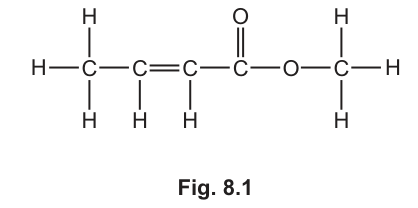
Fig. 8.1 shows the displayed formula of methylbut-2-enoate.
Methylbut-2-enoate is an unsaturated ester.
Answer
It has a carbon-carbon double bond (C=C).
has a carbon-carbon double bond
Walkthrough
The question asks why methylbut-2-enoate is classified as unsaturated. In organic chemistry, a molecule is unsaturated if it contains at least one carbon-carbon double bond (C=C) or triple bond. Looking at the displayed formula in Fig. 8.1, there is a clear double bond between the second and third carbon atoms in the chain. This C=C bond is the defining feature of unsaturation.
Key Takeaways
Unsaturated organic compounds contain carbon-carbon double (or triple) bonds. This is a structural feature that can be directly read from a displayed formula.
Common Mistakes
Candidates sometimes write "it has a double bond" without specifying it is a carbon-carbon double bond. The mark scheme requires the C=C specification. Writing "it is an alkene" is incorrect here because the molecule also contains an ester functional group; it is an unsaturated ester.
Things to Be Careful About
Always specify "carbon-carbon" when discussing unsaturation in organic molecules, as other double bonds (like C=O in the ester group) do not make a molecule unsaturated in this context.
Answer
Add aqueous bromine (bromine water). The orange/brown colour of the bromine water is decolourised (turns colourless).
aqueous bromine; orange to colourless
Walkthrough
To test for a carbon-carbon double bond (unsaturation), the standard test is to add bromine water (aqueous bromine) to the compound. Bromine water is naturally orange or brown. When it reacts with an alkene or unsaturated compound, an addition reaction occurs across the C=C double bond, consuming the bromine. As the bromine is used up, the orange/brown colour disappears, leaving a colourless solution. The two marks awarded are for correctly naming the reagent (aqueous bromine) and correctly stating the colour change (orange to colourless).
Key Takeaways
The bromine water test is the definitive test for unsaturation. The reagent is aqueous bromine (orange/brown), and a positive result is a colour change to colourless.
Common Mistakes
- Saying "bromine" instead of "aqueous bromine" or "bromine water". Liquid bromine is not used for this standard test.
- Stating the colour change as "brown to colourless" is often accepted, but "orange to colourless" is the precise mark scheme wording.
- Saying "decolourises" without mentioning the initial colour, or vice versa. Both the reagent and the change must be stated.
Things to Be Careful About
Do not confuse this with the test for aldehydes or alkanes. Bromine water reacts with C=C bonds via addition. It does not react with the C=O bond in the ester group under these conditions.
Methylbut-2-enoate is made by the reaction of an alcohol and a carboxylic acid in the presence of a catalyst.
Answer
Acidic (or concentrated sulfuric acid).
acidic
Walkthrough
Esterification is the reaction between a carboxylic acid and an alcohol to form an ester and water. This reaction is slow and reversible at room temperature. To increase the rate and reach equilibrium faster, an acid catalyst is used. The most common catalyst specified in the syllabus is concentrated sulfuric acid, which makes the catalyst "acidic".
Key Takeaways
Esterification requires an acid catalyst, typically concentrated sulfuric acid.
Common Mistakes
Writing "sulfuric acid" is acceptable, but the mark scheme specifically looks for the descriptor "acidic" to indicate the type of catalyst. Writing "base" or "alkaline" is incorrect and would lose the mark.
Things to Be Careful About
The catalyst is not consumed in the reaction; it only speeds it up. Do not write "sulfuric acid" as a reactant in the equation.
Answer
Methanol.
methanol
Walkthrough
The name of an ester is derived from the alcohol and the carboxylic acid it is made from. The first part of the name (the alkyl group) comes from the alcohol, and the second part (the alkanoate) comes from the carboxylic acid.
In methylbut-2-enoate:
- "methyl" comes from the alcohol: methanol (CH3OH).
- "but-2-enoate" comes from the carboxylic acid: but-2-enoic acid (a 4-carbon chain with a double bond at C2 and a carboxyl group at C1).
Therefore, the alcohol used is methanol.
Key Takeaways
Ester naming convention: [alkyl group from alcohol][alkanoate from acid]. The alkyl group tells you the alcohol; the alkanoate tells you the acid.
Common Mistakes
Confusing the two parts of the ester name. For example, thinking "but" comes from the alcohol (butanol) instead of the acid. Remember: the first word is the alcohol, the second is the acid.
Things to Be Careful About
Ensure you write the full name of the alcohol (methanol), not just the alkyl group (methyl).
Answer
The carboxylic acid is but-2-enoic acid. Its displayed formula is:
(All single and double bonds explicitly drawn between every atom.)
Displayed formula of but-2-enoic acid: H3C-CH=CH-COOH with all bonds shown
Walkthrough
The ester is methylbut-2-enoate. As established in part (b)(ii), the "methyl" part comes from methanol, and the "but-2-enoate" part comes from the carboxylic acid. Therefore, the acid is but-2-enoic acid.
But-2-enoic acid has:
- A 4-carbon chain (but-).
- A carboxyl group (-COOH) at carbon 1.
- A carbon-carbon double bond starting at carbon 2 (between C2 and C3).
To draw the displayed formula, every atom must be shown, and every bond must be drawn as a line:
- C1 is bonded to =O (double bond), -OH (single bond), and C2 (single bond).
- C2 is bonded to C1 (single), C3 (double), and one H (single).
- C3 is bonded to C2 (double), C4 (single), and one H (single).
- C4 is bonded to C3 (single) and three H atoms (single bonds).
Key Takeaways
When converting an ester name to the parent carboxylic acid, replace the '-oate' suffix with '-oic acid' and the alkyl group with 'H' (to form the -OH of the carboxyl group). A displayed formula requires every single bond and atom to be explicitly drawn.
Common Mistakes
- Drawing a structural formula (e.g., CH3CH=CHCOOH) instead of a displayed formula. The question asks for a displayed formula, so all C-H and C-C bonds must be shown as lines.
- Placing the double bond in the wrong position. "but-2-enoic" means the double bond starts at C2, so it is between C2 and C3, not C1 and C2 (which would be but-2-enoic? No, C1 is the carboxyl carbon, so C2=C3 is correct).
- Forgetting the hydrogen on the -OH group of the carboxyl group.
Things to Be Careful About
Count the carbons carefully. The carboxyl carbon is C1. The double bond is between C2 and C3. The methyl group is on C4. Ensure the valency of every carbon is exactly 4.
Methylbut-2-enoate is a monomer used to make an addition polymer.
Answer
The addition polymer has a 4-carbon backbone (derived from the C=C bond opening). Each repeat unit consists of two carbon atoms in the main chain. One carbon has a methyl group (-CH3) and a hydrogen; the other has a hydrogen and the ester group (-C(=O)OCH3). The structure must show at least two repeat units with continuation bonds extending from both ends.
Polymer structure with two repeat units: -[CH(CH3)-CH(COOCH3)]- with continuation bonds
Walkthrough
Methylbut-2-enoate has the structure CH3-CH=CH-C(=O)OCH3. The carbon-carbon double bond is between C2 and C3 (numbering from the carbonyl carbon as C1).
In addition polymerisation, the C=C double bond breaks to form single bonds with adjacent monomer units. The atoms attached to the C=C carbons become substituents on the polymer backbone.
- C2 is attached to: H and -C(=O)OCH3 (the ester group).
- C3 is attached to: H and -CH3 (the methyl group).
The repeat unit is therefore: -[CH(COOCH3)-CH(CH3)]-. (The order of substituents on the two carbons can be swapped as long as they are on the correct carbons).
To draw at least two repeat units:
- Draw a horizontal backbone of 4 carbon atoms (two repeat units of 2 carbons each).
- On the first C (from left), attach -CH3 (top) and -H (bottom).
- On the second C, attach -H (top) and -C(=O)OCH3 (bottom). The ester group should show the C=O double bond and C-O-CH3 single bonds.
- Repeat this pattern for the next two carbons (third and fourth).
- Add continuation bonds (lines extending outwards) from the first and last carbons of the drawn chain to indicate the polymer continues.
Key Takeaways
In addition polymerisation of an alkene, the C=C double bond opens up to form the main chain. The substituents on the original C=C carbons become side chains on the polymer backbone. Always show continuation bonds and at least two repeat units as requested.
Common Mistakes
- Drawing the C=O double bond inside the backbone instead of as a side chain. The C=O is part of the ester substituent, not the backbone.
- Forgetting the continuation bonds at the ends of the polymer chain.
- Drawing only one repeat unit when the question asks for at least two.
- Incorrectly placing the methyl and ester groups on the wrong carbons of the repeat unit.
Things to Be Careful About
The ester group (-COOCH3) must be drawn correctly with the C=O and C-O bonds. Do not break the ester group when drawing the polymer; it remains intact as a side chain. The backbone is formed solely from the carbons that were part of the C=C double bond.
A sample of of methylbut-2-enoate is reacted to make the addition polymer.
There is a yield.
State the mass of addition polymer made.
Explain your answer.
mass of addition polymer = ______
explanation = ______
Answer
mass of addition polymer = 80 g
explanation = Addition polymerisation produces only the polymer; there are no by-products (such as water) formed, so all the mass of the monomer is retained in the polymer.
80; no by-products are formed in addition polymerisation
Walkthrough
The question states that 80 g of methylbut-2-enoate is reacted with a 100% yield to form an addition polymer.
In addition polymerisation, monomers join together by breaking their C=C double bonds and forming new single bonds with each other. Unlike condensation polymerisation (which produces a small molecule by-product like water), addition polymerisation incorporates 100% of the atoms from the monomers into the polymer chain.
Therefore, by the law of conservation of mass, the mass of the polymer produced is exactly equal to the mass of the monomer reacted, assuming 100% yield.
Mass of polymer = Mass of monomer = 80 g.
Key Takeaways
Addition polymerisation has no by-products. The total mass of the polymer equals the total mass of the monomers reacted (at 100% yield). This is a key difference from condensation polymerisation.
Common Mistakes
- Calculating the molar mass of the monomer and trying to find moles and then back to mass. This is unnecessary and can lead to calculation errors. The mass is simply conserved.
- Thinking that a small molecule is lost. Only condensation polymers (like nylon or PET) lose mass due to by-products.
Things to Be Careful About
Ensure you state that there are "no by-products" or "only the polymer is made". Simply writing "mass is conserved" might not be specific enough; the explanation must reference the nature of addition polymerisation.
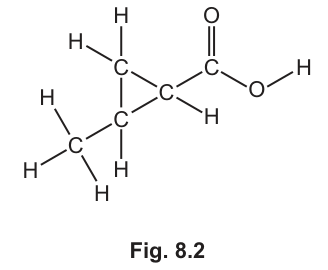
Fig. 8.2 shows compound B.
Explain why methylbut-2-enoate and compound B are a pair of structural isomers.
______
Answer
They have the same molecular formula but different structural formulae (different arrangement of atoms).
same molecular formula but different structures
Walkthrough
Structural isomers are molecules that have the same molecular formula (same number and types of atoms) but different structural formulae (different arrangement or bonding of those atoms).
Methylbut-2-enoate (C5H8O2) and compound B (cyclobutanecarboxylic acid, also C5H8O2) have the same molecular formula. However, methylbut-2-enoate is an open-chain unsaturated ester, while compound B is a cyclic carboxylic acid. Their atoms are connected in a different order, making them structural isomers.
The mark scheme awards 1 mark for stating they have the same molecular formula and 1 mark for stating they have different structures. Since this part is only 1 mark, either half of the definition is sufficient, but both should be stated for completeness.
Key Takeaways
Structural isomers must have the same molecular formula and different structures. This can include different functional groups (functional group isomerism), different carbon chain arrangements (chain isomerism), or different positions of functional groups (position isomerism).
Common Mistakes
- Saying they have the same structural formula. That would mean they are the same molecule.
- Forgetting to mention the molecular formula. Isomers must have the same molecular formula.
- Writing "different properties". While isomers often have different properties, the definition is based on formula and structure, not properties.
Things to Be Careful About
Always check the molecular formulas of both compounds to ensure they are actually isomers before applying the definition. In this case, both are C5H8O2.