Chemistry 5070/12 — May/June 2025
Cambridge O-Level · Multiple Choice · answer key with instant marking and worked solutions
Topics Atoms, Elements and Compounds · Stoichiometry · Organic Chemistry · Chemical Reactions · Acids, Bases and Salts · The Periodic Table · +6 more
Tap an option under each question to check it — your score builds as you go.
At temperature X, the volume of samples of hexane and pentane are not affected by changing the pressure from 1 atm to 2 atm.
At temperature X, the pentane molecules are free to move.
At temperature X, the hexane molecules are in fixed positions.
What are the states of hexane and pentane at temperature X?
Options
| hexane | pentane | |
|---|---|---|
| A | liquid | solid |
| B | liquid | gas |
| C | solid | liquid |
| D | solid | gas |
Working
- The volumes of both hexane and pentane are not affected by a change in pressure, which means neither substance is a gas (liquids and solids are virtually incompressible).
- Hexane molecules are in fixed positions, which is characteristic of the regular lattice arrangement of a solid.
- Pentane molecules are free to move (slide past one another) while being incompressible, which is characteristic of a liquid.
Therefore, at temperature X, hexane is a solid and pentane is a liquid.
Answer
C
C
Walkthrough
To determine the physical states of hexane and pentane at temperature X, we analyze the given properties using the kinetic particle theory:
- Effect of pressure: Gases have large spaces between particles, making their volume highly dependent on pressure. In solids and liquids, particles are closely packed, so their volumes are almost completely unaffected by pressure changes between and . This rules out the gas state for both substances, eliminating options B and D.
- Hexane: Particles in a solid vibrate about fixed positions in a regular lattice. Since hexane molecules are in fixed positions, hexane must be a solid.
- Pentane: Particles in a liquid are closely packed but are free to move and slide over one another. Since pentane molecules are free to move and cannot be a gas, pentane must be a liquid.
Matching hexane = solid and pentane = liquid gives option C.
Key Takeaways
- Solids: Particles are arranged in a fixed, regular pattern and can only vibrate about their fixed positions; they have a fixed volume and fixed shape.
- Liquids: Particles are close together in a random arrangement, free to move around and slide past each other; they have a fixed volume but take the shape of the container.
- Gases: Particles are far apart and move rapidly and randomly in all directions; they are easily compressed and fill any container.
Common Mistakes
- Confusing liquids with gases when interpreting "free to move": gas particles move freely and rapidly at high speeds with large gaps between them, whereas liquid particles are free to move past one another but remain closely packed.
- Forgetting that solids and liquids are both considered incompressible under moderate pressure changes.
Things to Be Careful About
- Check both criteria (compressibility and particle motion) for each substance to eliminate distractors systematically.
A gas is produced by a chemical reaction at one side of a laboratory.
After a few minutes, the gas is detected at the other side of the laboratory.
Which process explains why the gas is detected at the other side of the laboratory?
Options
A condensation
B diffusion
C dissolving
D evaporation
Working
Diffusion is the net movement of particles from a region of higher concentration to a region of lower concentration as a result of their random motion. As the gas particles move randomly and collide with air molecules, they spread throughout the laboratory.
- A (condensation) is the change of state from gas to liquid.
- B (diffusion) is the spreading out of particles from higher to lower concentration.
- C (dissolving) is the process of a solute mixing into a solvent.
- D (evaporation) is the change of state from liquid to gas at temperatures below boiling point.
Answer
B
B
Walkthrough
When a gas is produced, its concentration is highest at the source of the reaction. Gas particles are in constant, random motion, colliding with other particles in the air. Over time, these random collisions cause the particles to spread out evenly across the entire room, moving from an area of higher concentration to an area of lower concentration. This process is called diffusion.
Let's evaluate the options:
- A condensation: The change of a substance from gas to liquid.
- B diffusion: The net movement of particles from a region of higher concentration to a region of lower concentration down a concentration gradient due to random thermal motion.
- C dissolving: A solute breaking down into individual particles in a liquid solvent to form a solution.
- D evaporation: The transition of liquid particles escaping into the gas phase from the surface of a liquid.
Therefore, option B is the correct choice.
Key Takeaways
- Diffusion describes how particles spread out naturally to fill the available space due to random movement.
- The rate of diffusion of a gas depends on its temperature (average kinetic energy) and its relative molecular mass ().
Common Mistakes
- Confusing diffusion (particle movement/spreading) with changes of state such as evaporation or condensation.
Things to Be Careful About
- Ensure the definition used focuses on the random motion of particles leading to a net movement from high to low concentration.
Which statement is correct?
Options
A All compounds are ionic.
B All compounds conduct electricity when molten.
C Each atom of an element contains the same number of protons.
D In a mixture of substances, the proportions of the substances are always the same.
Working
- A is incorrect: Many compounds are covalent (such as or ), not ionic.
- B is incorrect: Covalent compounds with simple molecular structures do not conduct electricity when molten because they have no free-moving ions or electrons.
- C is correct: By definition, all atoms of a particular element have the same number of protons (the proton / atomic number).
- D is incorrect: The substances in a mixture can be mixed together in any variable proportion.
Answer
C
C
Walkthrough
To determine the correct statement, let us evaluate each option based on core chemical definitions:
-
Option A: "All compounds are ionic."
- A compound consists of two or more different elements chemically combined. These can be bonded ionically (between metals and non-metals) or covalently (between non-metal atoms). Therefore, this statement is false.
-
Option B: "All compounds conduct electricity when molten."
- Only compounds containing mobile charged particles (such as ions in molten ionic compounds) conduct electricity. Covalent molecular substances (e.g. molten wax or liquid water) do not contain free ions or delocalised electrons to conduct electricity. Therefore, this statement is false.
-
Option C: "Each atom of an element contains the same number of protons."
- An element is defined by its atomic (proton) number. While atoms of the same element can have different numbers of neutrons (isotopes), every single atom of that element must have the exact same number of protons. Therefore, this statement is correct.
-
Option D: "In a mixture of substances, the proportions of the substances are always the same."
- A mixture contains two or more substances not chemically combined, and they can be present in any ratio or variable proportion (unlike compounds, which have fixed ratios by mass). Therefore, this statement is false.
Key Takeaways
- Proton number (): Defines the identity of an element. All atoms of the same element contain the identical number of protons.
- Compounds vs. Mixtures: Compounds have a fixed chemical composition and fixed ratios of atoms; mixtures have variable composition.
- Electrical conductivity: Requires mobile charged particles (delocalised electrons or free-moving ions).
Common Mistakes
- Confusing mass number with proton number: isotopes of the same element have different mass numbers (different numbers of neutrons), but always have the same proton number.
- Confusing the fixed composition of a compound with the variable composition of a mixture.
Things to Be Careful About
- Ensure you read broad generalisations like "All..." or "always..." carefully, as chemical counterexamples (like covalent bonding vs ionic bonding) readily disprove them.
Atoms of element Q form positive ions.
An ion of Q has 10 electrons and 14 neutrons.
Which statement is correct?
Options
A An atom of Q has only two occupied electron shells.
B Q is a non-metal.
C The atomic number of Q is 10.
D The mass number of Q is greater than 24.
Working
- Element forms positive ions (cations), which means neutral atoms of lose electrons to form ions. Therefore, a neutral atom of has more electrons than its positive ion: , so .
- Since has electrons, its neutral electron configuration has at least three occupied shells (e.g. 2,8,1), eliminating A.
- Elements that lose electrons to form positive ions are metals, eliminating B.
- The atomic number equals the number of protons (), not the number of electrons in the ion (), eliminating C.
- The mass number is:
Since the mass number is at least , it is greater than .
Answer
D
D
Walkthrough
-
Identify the nature of the ion:
Positive ions (cations) are formed when neutral atoms lose one or more valence electrons. Because the positive ion of contains electrons, the neutral atom of must have contained more than electrons (at least electrons). -
Determine the number of protons:
In any neutral atom, the number of protons equals the number of electrons. Therefore, the atomic number (proton number) of must be at least (). This immediately rules out C. -
Calculate the mass number:
Given that there are neutrons and at least protons:
A value of or greater is strictly greater than , which confirms statement D is correct (for instance, could be magnesium-, , or aluminium-, , etc.).
-
Evaluate the remaining statements:
- A: With or more electrons, the electron configuration starts with 2,8,1... which occupies electron shells, not .
- B: Elements that readily lose electrons to form positive ions are metals, not non-metals.
Key Takeaways
- Positive ions are formed by the loss of electrons, so .
- Atomic number () is the number of protons in the nucleus and defines the element.
- Mass number () is the sum of protons and neutrons in the nucleus ().
Common Mistakes
- Confusing the number of electrons in an ion with the atomic number of the element.
- Forgetting that positive ions lose electrons, incorrectly thinking a positive charge means gaining protons or electrons.
Things to Be Careful About
- Ensure you check whether the question refers to the atom or the ion at each stage of reasoning.
Which particle contains the greatest number of electrons?
Options
A
B
C
D
Working
To find the number of electrons in each particle:
- A : Magnesium has proton number . With a charge, it has .
- B : Nitrogen has proton number . With a charge, it has .
- C : Neon has proton number . As a neutral atom, it has .
- D : Sulfur has proton number . With a charge, it has .
Therefore, contains the greatest number of electrons ().
Answer
D
D
Walkthrough
To determine the number of electrons in any atom or ion:
- Look up the atomic number (proton number, ) of the element on the Periodic Table.
- For a neutral atom, the number of electrons equals the number of protons.
- For a positive ion (cation), subtract the magnitude of the positive charge from the proton number (electrons have been lost).
- For a negative ion (anion), add the magnitude of the negative charge to the proton number (electrons have been gained).
Evaluating each option:
- : Proton number = . Electrons = .
- : Proton number = . Electrons = .
- : Proton number = . Electrons = .
- : Proton number = . Electrons = .
Species A, B, and C are isoelectronic, each having electrons (a stable 2,8 noble gas configuration). Species D has electrons (a stable 2,8,8 configuration), which is the greatest.
Key Takeaways
- Cations have fewer electrons than protons.
- Anions have more electrons than protons.
- Species that share the same total number of electrons are described as isoelectronic.
Common Mistakes
- Inverting the sign when adjusting for charge (e.g., subtracting electrons for a negative charge or adding electrons for a positive charge).
- Using mass numbers instead of proton (atomic) numbers to determine electron counts.
Things to Be Careful About
- Ensure you locate the correct element on the Periodic Table and read the atomic number (smaller integer, number of protons) rather than the relative atomic mass.
The table shows data about the two isotopes in a sample of the element europium.
| relative mass of isotope | percentage abundance of isotope |
|---|---|
| 150.92 | 47.81 |
| 152.92 | 52.19 |
What is the relative atomic mass of this sample of europium?
Options
A 151.88
B 151.96
C 152.00
D 152.04
Working
The relative atomic mass, , is the weighted average mass of the isotopes:
- Option A () would result from an incorrect calculation or reversing the percentage abundances.
- Option B () matches the calculated value.
- Option C () is the simple unweighted arithmetic mean , not accounting for percentage abundance correctly.
- Option D () is too high and overweights the heavier isotope.
Answer
B
B
Walkthrough
-
Recall the formula for relative atomic mass ():
The relative atomic mass of an element is calculated by finding the weighted average mass of naturally occurring isotopes taking into account their percentage abundances: -
Substitute the given data:
- Isotope 1: mass , abundance
- Isotope 2: mass , abundance
-
Perform the arithmetic:
Rounding to 2 decimal places (matching the options) gives , which corresponds to option B.
Key Takeaways
- Relative atomic mass () is a weighted mean of the masses of the isotopes based on their relative abundances.
- Because the heavier isotope () is slightly more abundant () than the lighter isotope (), the relative atomic mass must lie slightly above the midpoint (), ruling out values below .
Common Mistakes
- Calculating the simple arithmetic average instead of taking the weighted mean.
- Inverting the abundance percentages (multiplying by and by ).
Things to Be Careful About
- Ensure you divide by when using percentage abundances.
- Check that the total of the percentage abundances equals ().
Which statement about magnesium oxide is correct?
Options
A It has a high melting point and good electrical conductivity at r.t.p.
B It is made up of magnesium anions and oxygen cations.
C It is an ionic compound and has good electrical conductivity when molten.
D It is strongly bonded because of electrons shared between magnesium atoms and oxygen atoms.
Working
Magnesium oxide () is formed between a metal (magnesium) and a non-metal (oxygen), making it a giant ionic lattice compound containing cations and anions.
- A is incorrect: Although it has a high melting point, in the solid state at r.t.p., the ions are held in fixed positions in the lattice and cannot move, so it does not conduct electricity.
- B is incorrect: Magnesium forms positive ions (cations, ) and oxygen forms negative ions (anions, ).
- C is correct: is an ionic compound; when molten (liquid), the ionic lattice breaks down, allowing the ions to move freely and carry charge to conduct electricity.
- D is incorrect: The bonding in is ionic (electrostatic attraction between oppositely charged ions formed by electron transfer), not covalent (sharing of electrons).
Answer
C
C
Walkthrough
Magnesium is a Group II metal and oxygen is a Group VI non-metal. When they react:
- A magnesium atom transfers its two outer-shell electrons to an oxygen atom.
- This forms a magnesium ion, (a cation, because it has a positive charge), and an oxide ion, (an anion, because it has a negative charge).
- The oppositely charged ions attract each other strongly via electrostatic forces to form a giant ionic lattice.
Properties of ionic compounds tested here:
- Melting/Boiling Points: They have high melting and boiling points due to strong electrostatic forces of attraction between oppositely charged ions in the lattice.
- Electrical Conductivity:
- In the solid state (e.g. at r.t.p.), the ions are locked in fixed positions within the lattice and can only vibrate; with no mobile ions or delocalised electrons, solid ionic compounds are electrical insulators.
- In the molten (liquid) or aqueous state, the lattice structure is destroyed and the ions become free to move, enabling the substance to conduct electricity.
Evaluating the options:
- A: False because cannot conduct electricity at room temperature and pressure (solid state).
- B: False because magnesium forms cations and oxygen forms anions.
- C: True because it is an ionic compound and conducts electricity when molten due to mobile and ions.
- D: False because shared electron pairs describe covalent bonding, not ionic bonding.
Key Takeaways
- Metal + non-metal typically forms ionic bonding via electron transfer.
- Cations are positive ions (metals lose electrons), and anions are negative ions (non-metals gain electrons).
- Ionic compounds conduct electricity only when molten or in aqueous solution because the ions are free to move.
Common Mistakes
- Confusing the terms cation (positive ion) and anion (negative ion).
- Thinking ionic solids conduct electricity due to electrons — electrical conductivity in ionic substances is always due to mobile ions, not electrons.
- Confusing ionic bonding (electrostatic attraction between oppositely charged ions) with covalent bonding (shared pairs of electrons).
Things to Be Careful About
- Always verify the state of the substance when asked about conductivity: solids have fixed ions (no conductivity), while liquids/melts and aqueous solutions have mobile ions (good conductivity).
Which statement about silicon(IV) oxide is correct?
Options
A It conducts electricity.
B It has a giant covalent structure.
C It is an alloy.
D It is ionically bonded.
Working
- Silicon(IV) oxide (, silica) consists of silicon and oxygen atoms covalently bonded in a three-dimensional macromolecular lattice (giant covalent structure), similar to diamond.
- It contains no free-moving ions or delocalised electrons, so it does not conduct electricity (eliminating A).
- It is a compound composed of non-metal atoms held together by covalent bonds, not a mixture of metals (eliminating C) and not an ionic compound (eliminating D).
Therefore, statement B is correct.
Answer
B
B
Walkthrough
Silicon(IV) oxide (), commonly known as silica or quartz, is a giant covalent substance (macromolecule). In this structure:
- Each silicon atom is covalently bonded to four oxygen atoms in a tetrahedral arrangement.
- Each oxygen atom is bonded to two silicon atoms.
Evaluating each option:
- A is incorrect: All valence electrons are fixed in localized single covalent bonds; there are no delocalised electrons or mobile ions to carry an electric current.
- B is correct: It exists as a continuous 3D network of covalent bonds, which defines a giant covalent structure.
- C is incorrect: An alloy is a mixture of a metal with other elements; is a chemical compound of non-metals.
- D is incorrect: The bonding between silicon and oxygen is covalent (shared pairs of electrons), not ionic.
Key Takeaways
- Silicon(IV) oxide (), diamond, and graphite are the standard giant covalent substances studied in Cambridge O Level Chemistry.
- Giant covalent substances have very high melting and boiling points due to the extensive network of strong covalent bonds.
Common Mistakes
- Confusing silicon(IV) oxide with simple covalent molecules like carbon dioxide (), which are gases at room temperature with weak intermolecular forces.
- Assuming that compounds containing polyatomic non-metal combinations might be ionic.
Things to Be Careful About
- Ensure you recall the coordination numbers in silica: each is bonded to 4 atoms, and each is bonded to 2 atoms, leading to the empirical formula .
Which compound has the highest relative formula mass, ?
[: K, 39; N, 14; O, 16; Ca, 40; C, 12; Li, 7; S, 32; Mg, 24; Cl, 35.5]
Options
A calcium carbonate
B lithium sulfate
C magnesium chloride
D potassium nitrate
Working
Calculate the relative formula mass, , for each compound:
-
A Calcium carbonate, :
-
B Lithium sulfate, :
-
C Magnesium chloride, :
-
D Potassium nitrate, :
Lithium sulfate has the highest ().
Answer
B
B
Walkthrough
To find the compound with the highest relative formula mass ():
-
Write the correct chemical formula for each ionic compound by balancing the charges of the constituent ions:
- Calcium carbonate: and give .
- Lithium sulfate: and give .
- Magnesium chloride: and give .
- Potassium nitrate: and give .
-
Sum the relative atomic masses () of all the atoms in each formula unit using the given values:
- :
- :
- :
- :
-
Compare the values: , which corresponds to lithium sulfate (B).
Key Takeaways
- Determining formula mass requires first finding the correct chemical formula from the names of ionic compounds.
- Ionic compounds must have an overall neutral charge, so the charges on positive and negative ions must balance.
Common Mistakes
- Forgetting the stoichiometry in compound formulae, such as writing instead of or instead of .
- Multiplication errors when multiplying the number of oxygen atoms (e.g., ).
Things to Be Careful About
- Ensure you check the formula valencies: lithium has a charge and sulfate has a charge, requiring two lithium ions per sulfate ion.
of ethene is completely combusted in of oxygen. The volumes of both gases are measured at r.t.p.
What is the final volume of gas in the mixture measured at r.t.p.?
Options
A
B
C
D
Working
Write the balanced chemical equation for the complete combustion of ethene:
According to Avogadro's law, equal volumes of gases at the same temperature and pressure contain equal numbers of moles. Therefore, gas volumes react in the same ratio as the mole ratios in the equation:
- of reacts with of to produce of .
For of :
- Volume of used =
- Volume of remaining =
- Volume of formed =
- Water, , is a liquid at r.t.p. and occupies negligible gas volume.
Answer
C
C
Walkthrough
- Write and balance the combustion equation:
- Use the mole-to-volume relationship: By Avogadro's law, molar ratios of gases correspond directly to volume ratios at r.t.p.
- Determine the volume of oxygen reacted and unreacted:
- of requires of .
- Since was supplied, oxygen is in excess by .
- Determine the gaseous products formed:
- Complete combustion of of produces of .
- Water is in the liquid state at room temperature and pressure (r.t.p.), so its volume does not count toward the gas volume.
- Sum the remaining gas volumes:
- Final gas volume = unreacted () + produced () = .
Hence, the correct option is C.
Key Takeaways
- For reactions involving gases at constant temperature and pressure, volume ratios are identical to the stoichiometric mole ratios in the balanced equation.
- Always identify whether a reactant is in excess and include the unreacted volume in the final total.
- Water () formed during combustion is a liquid at r.t.p., so it does not contribute to the final gas volume.
Common Mistakes
- Forgetting the unreacted excess oxygen: Only counting the of gives option A ().
- Treating water as a gas at r.t.p.: Adding for steam would give (option D).
Things to Be Careful About
- Ensure the hydrocarbon formula is correct: ethene is , not ethane ().
- Check the state symbols at the specified conditions (r.t.p. means to and , where water is liquid).
The formula of hydrated sodium carbonate is .
What is the percentage composition by mass of oxygen in hydrated sodium carbonate?
Options
A 16.8
B 22.4
C 55.9
D 72.7
Working
- Calculate the relative formula mass () of :
- Count the total number of oxygen atoms in one formula unit:
- From : atoms
- From : atoms
- Total oxygen atoms =
- Calculate the total mass of oxygen:
- Calculate the percentage by mass of oxygen:
Answer
D
D
Walkthrough
To find the percentage composition by mass of an element in a compound:
-
Determine the relative formula mass () of the hydrated salt:
- :
- :
- Total
-
Determine the total mass contribution of oxygen:
- There are oxygen atoms in the carbonate group and oxygen atoms in the ten water molecules of crystallisation, giving a total of oxygen atoms.
- Total relative mass of oxygen .
-
Calculate the percentage:
Hence, option D is the correct answer.
Key Takeaways
- For hydrated compounds, remember to count atoms from both the anhydrous salt and the waters of crystallisation.
- The multiplier in front of applies to both hydrogen and oxygen inside the water molecule.
Common Mistakes
- Only counting the oxygen in the carbonate ion (), which leads to (Option A).
- Forgetting the water of crystallisation when calculating the and getting , or including only the oxygen in water (), which gives (Option C).
Things to Be Careful About
- Ensure you multiply the oxygen in water by and add the oxygen atoms from the carbonate anion.
The diagram shows the electrolysis of molten lead bromide with inert electrodes.
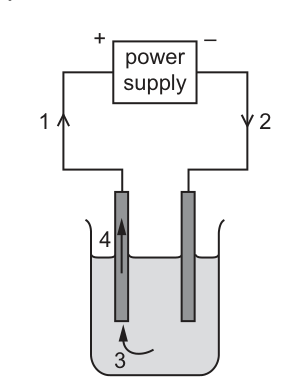
Which row identifies the particles that carry charge along each arrow?
Options
| 1 | 2 | 3 | 4 | |
|---|---|---|---|---|
| A | bromide ions | electrons | lead ions | electrons |
| B | electrons | electrons | bromide ions | lead ions |
| C | electrons | electrons | bromide ions | electrons |
| D | electrons | electrons | electrons | electrons |
Working
- Arrow 1: Located in the external metallic connecting wire leading away from the positive electrode (anode) towards the positive terminal of the power supply. Charge in external wires is carried by electrons flowing away from the anode.
- Arrow 2: Located in the external metallic wire leading from the negative terminal of the power supply to the negative electrode (cathode). Charge is carried by electrons.
- Arrow 3: Located in the molten electrolyte, directed towards the positive electrode (anode). Negatively charged ions are attracted to the positive electrode; in molten lead(II) bromide (), these are bromide ions ().
- Arrow 4: Located inside the solid inert electrode (anode). Inert electrodes (such as graphite or platinum) conduct electricity via delocalised electrons.
Matching the rows gives:
- 1: electrons
- 2: electrons
- 3: bromide ions
- 4: electrons
This corresponds to option C.
Answer
C
C
Walkthrough
To determine the charge carriers at each numbered position, we must consider the type of conductor present:
- External Circuit (Wires): Metallic wires conduct electricity through the movement of free/delocalised electrons. Arrow 1 and Arrow 2 are both in the external wiring, so the charge carriers for both are electrons. Electrons travel from the negative terminal of the power supply to the cathode (Arrow 2), and from the anode back to the positive terminal of the power supply (Arrow 1).
- Electrolyte (Molten ): In a molten ionic compound, charge is carried by mobile ions rather than electrons. The left electrode is connected to the terminal of the power supply, making it the positive anode. Oppositely charged anions are attracted to it. In molten lead(II) bromide, the anions are bromide ions (). Arrow 3 points towards the positive electrode, so it represents the migration of bromide ions.
- Electrode: Inert electrodes used in electrolysis are typically made of graphite or platinum. These solid conductors conduct electricity through the movement of electrons (Arrow 4) as bromide ions give up electrons at the anode surface:
These released electrons travel up through the anode and around the external circuit.
Combining these points gives the sequence: electrons, electrons, bromide ions, electrons, which matches option C.
Key Takeaways
- In metallic conductors and electrodes (like wires and graphite rods), electric current is the flow of delocalised electrons.
- In electrolytes (molten ionic compounds or aqueous solutions), electric current is the movement of mobile ions (cations towards the cathode, anions towards the anode).
- Electrons never flow through the electrolyte itself.
Common Mistakes
- Confusing the direction of ion flow: thinking lead ions () move to the anode (left) instead of the cathode (right).
- Assuming electrons travel through the electrolyte solution (as suggested in option D).
- Believing ions travel into the external wire (as suggested in option A).
Things to Be Careful About
- Always check the signs on the power supply to correctly identify the anode () and cathode ().
- Anions (negative ions) move to the Anode (positive electrode).
- Cations (positive ions) move to the Cathode (negative electrode).
What are the products formed at the two electrodes when aqueous copper(II) sulfate is electrolysed using copper electrodes?
Options
| anode product | cathode product | |
|---|---|---|
| A | aqueous copper(II) ions | copper metal |
| B | aqueous copper(II) ions | hydrogen gas |
| C | oxygen gas | copper metal |
| D | oxygen gas | hydrogen gas |
Working
- At the anode (+): Since copper is a non-inert (active) electrode, copper atoms from the anode lose electrons and dissolve into solution as copper(II) ions:
- At the cathode (-): ions are less reactive than ions, so copper(II) ions are discharged to form copper metal:
Therefore, the anode product is aqueous copper(II) ions and the cathode product is copper metal, which corresponds to row A.
Answer
A
A
Walkthrough
In the electrolysis of aqueous copper(II) sulfate ():
- Cathode (negative electrode): Both and cations migrate to the cathode. In the reactivity series, copper is less reactive than hydrogen, so ions are preferentially discharged by gaining electrons (reduction) to form solid copper metal:
- Anode (positive electrode): When inert electrodes (such as carbon/graphite or platinum) are used, hydroxide ions () from water are discharged to form oxygen gas (). However, this question specifies copper electrodes (active/reactive electrodes). The copper anode itself oxidises and dissolves into the electrolyte as aqueous copper(II) ions:
Thus, the product formed at the anode is and at the cathode is copper metal ().
Key Takeaways
- Inert vs. Active Electrodes: Inert electrodes (graphite, platinum) do not take part in the reaction. Active electrodes (such as copper) dissolve at the anode.
- Purification/Electroplating Principle: Using copper electrodes in transfers copper from the anode to the cathode, keeping the concentration of copper(II) ions in the solution constant.
Common Mistakes
- Confusing this with the electrolysis of using carbon/graphite electrodes, which produces oxygen gas () at the anode (Option C).
- Assuming hydrogen gas is evolved at the cathode; is discharged in preference to because copper is lower in the reactivity series.
Things to Be Careful About
- Always check whether the electrodes are described as inert (carbon/graphite, platinum) or reactive/active (copper, silver).
Which statement about a hydrogen–oxygen fuel cell is correct?
Options
A It uses a chemical reaction that has only one product.
B It works by burning hydrogen in air.
C It requires a continuous input of electrical energy.
D It is less efficient than a petrol engine.
Working
- The overall reaction occurring in a hydrogen-oxygen fuel cell is:
This reaction produces only one product, water (), so A is correct.
- B is incorrect because a fuel cell oxidises hydrogen electrochemically without direct combustion (burning).
- C is incorrect because a fuel cell generates electrical energy from a chemical reaction; it does not consume electrical energy.
- D is incorrect because fuel cells are more energy-efficient than internal combustion engines (such as petrol engines).
Answer
A
A
Walkthrough
A hydrogen-oxygen fuel cell generates electricity by combining hydrogen and oxygen chemically through electrochemical reactions at the electrodes, rather than by burning the fuel.
- Overall reaction:
Because water is the only product formed, statement A is completely correct.
- Evaluating the distractors:
- B: Fuel cells do not involve direct combustion/burning; they operate via controlled oxidation and reduction half-reactions at electrodes.
- C: Fuel cells produce electricity (output) from chemical energy; they require a continuous supply of fuel and oxidant, not a continuous input of electrical energy (which is true for electrolysis, not cells).
- D: Fuel cells convert chemical energy directly to electrical energy without thermal energy losses associated with heat engines, making them more efficient than petrol engines.
Key Takeaways
- In a hydrogen-oxygen fuel cell, hydrogen is the fuel, oxygen is the oxidant, and water () is the only chemical product.
- Fuel cells are non-polluting at the point of use and have higher energy conversion efficiencies compared to conventional combustion engines.
Common Mistakes
- Confusing electrochemical oxidation in a fuel cell with simple combustion (burning in a flame).
- Confusing fuel cells (which produce electricity) with electrolysis cells (which consume electricity).
Things to Be Careful About
- Ensure you distinguish between the continuous input required by fuel cells (hydrogen and oxygen fuels) versus the continuous output produced (electrical current and water).
A reaction pathway diagram is shown.
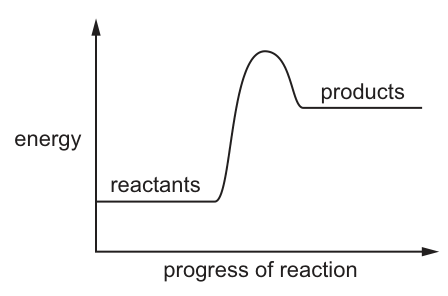
Which equation does the reaction pathway diagram show?
Options
A
B
C
D
Working
- The reaction pathway diagram shows that the products are at a higher energy level than the reactants, which represents an endothermic reaction ().
- A: involves bond making, which is exothermic.
- B: involves breaking the covalent bond, which requires energy input and is endothermic.
- C: is condensation, which releases energy (exothermic).
- D: involves forming an covalent bond, which is exothermic.
Therefore, only B matches the endothermic profile shown.
Answer
B
B
Walkthrough
-
Analyse the reaction pathway diagram:
- The horizontal level for the reactants is lower than the horizontal level for the products.
- This means overall energy is absorbed from the surroundings into the chemical system, so the reaction is endothermic ( is positive).
-
Evaluate each option to find the endothermic change:
- Bond breaking is endothermic (requires energy intake).
- Bond making is exothermic (releases energy).
- In A (), two covalent bonds are formed from separate atoms. Since only bond formation occurs, it is an exothermic process.
- In B (), the covalent bond in an molecule is broken to produce isolated hydrogen atoms. Bond breaking absorbs energy, so this is an endothermic process.
- In C (), water vapour condenses into liquid water, forming intermolecular forces, which is an exothermic physical change.
- In D (), a double covalent bond is formed from separate oxygen atoms, which is an exothermic process.
Thus, only reaction B corresponds to the diagram.
Key Takeaways
- In an endothermic profile, the energy of the products is higher than that of the reactants ().
- In an exothermic profile, the energy of the products is lower than that of the reactants ().
- "MEXO BENDO": Making bonds is EXOthermic; Breaking bonds is ENDOthermic.
Common Mistakes
- Confusing bond breaking and bond making (thinking that forming a bond requires energy rather than releasing it).
- Misreading the diagram as exothermic by focusing only on the downward slope from the top of the activation energy hump to the products level, rather than comparing the initial reactant level to the final product level.
Things to Be Careful About
- Always compare the baseline of the reactants on the left directly with the baseline of the products on the right to determine the overall enthalpy change (). The peak between them represents the activation energy (), not the net energy change.
Which process is a chemical change?
Options
A the distillation of aqueous ethanol
B the evaporation of water from aqueous sodium chloride
C the melting of wax
D the rusting of iron
Working
- A chemical change involves the formation of one or more new chemical substances and is typically irreversible by simple physical methods.
- A: Distillation is a physical separation process involving changes of state (boiling and condensation); no new chemical substance is formed.
- B: Evaporation is a physical change of state from liquid to gas; solid remains chemically unchanged.
- C: Melting is a physical change of state from solid to liquid; the chemical composition of wax does not change.
- D: Rusting is an oxidation reaction where iron reacts with oxygen and water to form a new substance, hydrated iron(III) oxide (), which is a chemical change.
Answer
D
D
Walkthrough
- A physical change is a change in which no new chemical substances are produced. Changes of state (such as melting, freezing, boiling, condensing, evaporating) and separation methods (such as filtration, distillation, chromatography) are physical processes because the chemical identity of the particles remains unchanged.
- A chemical change (or chemical reaction) involves the breaking and making of chemical bonds to form one or more new substances with different chemical and physical properties.
- Evaluating the given choices:
- Option A (distillation of aqueous ethanol) separates ethanol from water using differences in their boiling points. Both substances retain their original chemical formulas.
- Option B (evaporation of water from aqueous sodium chloride) removes water vapor physically, leaving solid crystals behind. No chemical bonds within the compounds are permanently altered into new chemical species.
- Option C (melting of wax) only alters the arrangement and kinetic energy of the hydrocarbon molecules from a solid lattice to a liquid state; no new substance is formed.
- Option D (rusting of iron) is a redox reaction in which metallic iron () reacts with oxygen () and moisture () from the air to produce hydrated iron(III) oxide, . A completely new substance is formed, making it a chemical change.
Therefore, option D is correct.
Key Takeaways
- In a physical change, no new substance is made and the process is usually easily reversible.
- In a chemical change, one or more new substances are formed, typically accompanied by detectable energy changes (temperature change, light), colour changes, or gas evolution.
- Rusting is a chemical oxidation process that forms hydrated iron(III) oxide.
Common Mistakes
- Confusing the melting of wax (physical change) with the burning/combustion of a wax candle (chemical change).
- Believing that dissolving or evaporation is a chemical reaction because the appearance of the solution changes.
Things to Be Careful About
- Be clear on the distinction between phase changes (melting, freezing, boiling) and chemical reactions (rusting, combustion, neutralisation, thermal decomposition).
Aqueous sodium thiosulfate reacts with hydrochloric acid. The rate of the reaction increases if the concentration of both reactants is increased.
Nitrogen gas reacts with hydrogen gas. The rate of the reaction increases if the pressure in the reaction vessel is increased.
Which row correctly explains why the given change increases the rate of the reaction?
Options
| increasing the concentration of aqueous sodium thiosulfate and hydrochloric acid | increasing the pressure in the reaction vessel containing nitrogen and hydrogen | |
|---|---|---|
| A | higher frequency of collisions between particles | higher frequency of collisions between particles |
| B | higher frequency of collisions between particles | the activation energy is decreased |
| C | the activation energy is decreased | higher frequency of collisions between particles |
| D | the activation energy is decreased | the activation energy is decreased |
Working
- Increasing the concentration of reactants in aqueous solution means there are more particles per unit volume, which leads to a higher frequency of collisions between reacting particles.
- Increasing the pressure of a gaseous mixture forces the gas molecules closer together (more particles per unit volume), which also leads to a higher frequency of collisions between reacting particles.
- The activation energy is only lowered by adding a suitable catalyst, not by changing concentration or pressure.
Therefore, both columns are correctly explained by a higher frequency of collisions between particles, corresponding to row A.
Answer
A
A
Walkthrough
According to collision theory, for a chemical reaction to occur, reactant particles must collide with energy greater than or equal to the activation energy ().
-
Effect of Concentration:
Increasing the concentration of solutions (such as aqueous sodium thiosulfate and hydrochloric acid) increases the number of particles per unit volume. As the particles are crowded closer together, they collide more frequently, increasing the rate of successful collisions per unit time (collision frequency). -
Effect of Pressure:
Increasing the pressure on a gaseous mixture (such as nitrogen and hydrogen) decreases the volume available, thereby increasing the number of gas particles per unit volume. This also leads to an increased frequency of collisions between reacting molecules. -
Activation Energy:
Activation energy is an intrinsic property of the reaction pathway. Neither changing concentration nor changing pressure alters the activation energy; only the addition of a catalyst provides an alternative pathway with a lower activation energy.
Hence, row A is the correct option.
Key Takeaways
- Concentration and Pressure: Both increase the number of particles per unit volume, leading to a higher frequency of collisions between reacting particles.
- Catalysts: The only factor that changes (lowers) the activation energy of a reaction.
Common Mistakes
- Confusing factors that affect collision frequency (concentration, pressure, surface area) with factors that affect activation energy (catalysts) or the fraction of particles with (temperature).
Things to Be Careful About
- Ensure you describe collision changes as an increase in the frequency or rate of collisions (collisions per second/unit time), rather than just the total number of collisions.
Magnesium reacts with dilute sulfuric acid.
Two experiments are carried out at .
experiment 1: of powdered magnesium is reacted with of sulfuric acid.
experiment 2: of powdered magnesium is reacted with of sulfuric acid.
During each experiment, the volume of hydrogen produced is measured at regular time intervals.
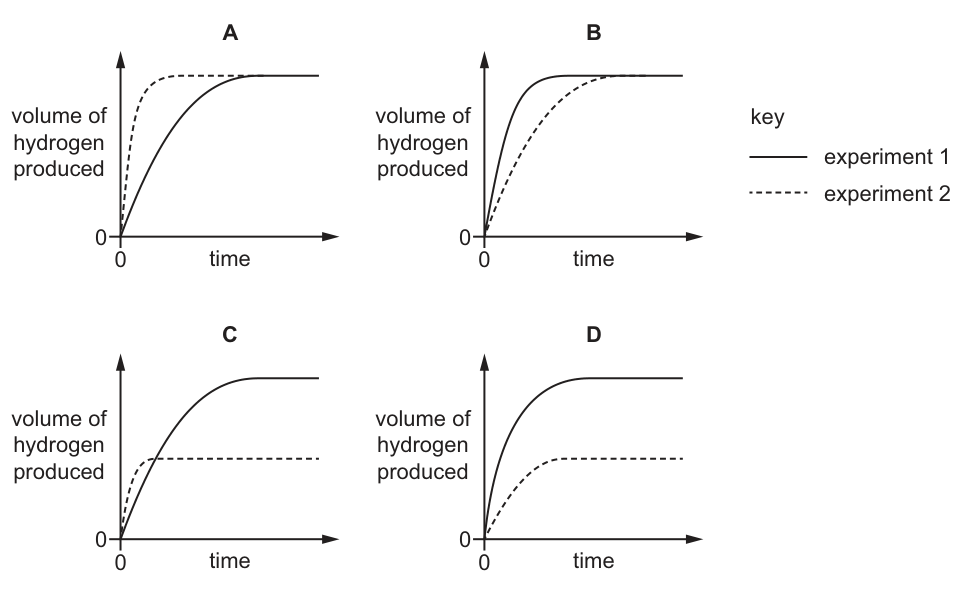
The results are plotted on a graph.
Which graph is correct?
Options
Working
-
Determine the limiting reactant and volume of gas produced:
- Experiment 1:
- Experiment 2:
In both experiments, sulfuric acid is the limiting reactant and magnesium is in excess. Since both contain equal moles of (), both experiments produce the same total volume of . Both curves must level off at the same height.
-
Compare the initial rates of reaction:
- Experiment 2 uses a higher concentration of sulfuric acid () than experiment 1 ().
- A higher concentration means a faster rate of reaction, so experiment 2 (dashed line) has a steeper initial gradient and finishes sooner than experiment 1 (solid line).
Graph A correctly shows experiment 2 having a steeper initial slope and both curves plateauing at the same final volume.
Answer
A
A
Walkthrough
To choose the correct graph, two independent features must be determined:
-
The final volume of gas (the plateau level):
- .
- .
- .
Since of reacts with of , the magnesium is in large excess in both experiments. The acid is the limiting reactant. Because both experiments supply the same number of moles of acid (), each reaction produces the same total volume of hydrogen gas (). Therefore, both curves must level off at the identical height (eliminating C and D).
-
The initial rate of reaction (the initial steepness / gradient):
- Experiment 2 uses acid, whereas experiment 1 uses acid.
- A higher concentration contains more acid particles per unit volume, leading to a greater collision frequency between acid particles and the magnesium surface.
- Hence, experiment 2 has a faster initial rate, corresponding to a steeper initial gradient and reaching the plateau in a shorter time (eliminating B).
This matches Graph A.
Key Takeaways
- The initial gradient of a volume-against-time graph represents the initial rate of reaction, which increases with higher reactant concentration, smaller particle size (surface area), higher temperature, or the addition of a catalyst.
- The final plateau (horizontal line) represents the total amount of product formed and is determined strictly by the moles of the limiting reactant, not by the rate of reaction.
Common Mistakes
- Mistaking a smaller total volume of solution ( vs ) for less product formed, without calculating the moles ().
- Confusing the solid and dashed lines in the key and selecting B instead of A.
Things to Be Careful About
- Always convert volumes in to by dividing by when using the formula .
- Check for excess reactants by comparing the mole ratio of the balanced chemical equation.
Which row gives the catalyst for each of the two processes?
Options
| Contact process | Haber process | |
|---|---|---|
| A | iron | iron |
| B | iron | nickel |
| C | vanadium(V) oxide | iron |
| D | vanadium(V) oxide | nickel |
Working
- Contact process (manufacture of sulfuric acid): The key reversible step is the oxidation of sulfur dioxide to sulfur trioxide (), which uses vanadium(V) oxide () as the catalyst.
- Haber process (manufacture of ammonia): The reaction between nitrogen and hydrogen () uses finely divided iron () as the catalyst.
Matching these catalysts with the options:
- Contact process: vanadium(V) oxide
- Haber process: iron
This corresponds to row C.
Answer
C
C
Walkthrough
In Cambridge O Level Chemistry, candidates are expected to recall the essential conditions and catalysts for key industrial processes:
- The Contact Process produces sulfuric acid (). In stage 2, sulfur dioxide is converted to sulfur trioxide:
This reaction requires:
- A catalyst of vanadium(V) oxide,
- A temperature of around
- A pressure of
- The Haber Process produces ammonia () from nitrogen and hydrogen:
This reaction requires:
- An iron catalyst (finely divided)
- A temperature of around
- A pressure of around
Matching these two catalysts gives row C.
Key Takeaways
- Contact Process catalyst: Vanadium(V) oxide ().
- Haber Process catalyst: Iron ().
- Hydrogenation of alkenes catalyst: Nickel () — often included as a distractor in these questions.
Common Mistakes
- Confusing the iron catalyst of the Haber process with nickel (nickel is used in the hydrogenation of vegetable oils/alkenes to make margarine/alkanes).
- Swapping the catalysts between the two processes.
Things to Be Careful About
- Ensure you check both columns carefully before selecting your answer to avoid swapping row pairings.
The diagram shows the change in pH as a strong alkali is added to a weak acid.
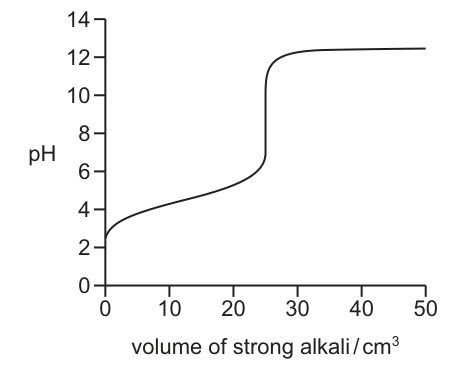
of a strong alkali is added to a weak acid and a sample of the solution is tested separately with methyl orange and thymolphthalein.
Which row is correct?
Options
| methyl orange test | thymolphthalein test | |
|---|---|---|
| A | red | colourless |
| B | yellow | colourless |
| C | red | blue |
| D | yellow | blue |
Working
- From the graph, at a volume of of added strong alkali, the is approximately (strongly alkaline).
- Methyl orange is red in acid and yellow in alkaline solution (alkaline ), so it will be yellow.
- Thymolphthalein is colourless in acid/neutral solution and blue in alkaline solution (alkaline ), so it will be blue.
Therefore, row D is correct.
Answer
D
D
Walkthrough
To determine the correct colours of the indicators:
-
Read the pH from the titration curve:
Locate on the horizontal axis ("volume of strong alkali / "). Follow the line up to the curve and read across to the vertical axis. At , the is well into the alkaline plateau region, approximately . -
Determine the colour of methyl orange:
- Methyl orange is an acid-base indicator that changes colour over the range of roughly to .
- In acidic solution below , it is red.
- In neutral and alkaline solutions (above ), it is yellow.
- At , methyl orange is yellow.
-
Determine the colour of thymolphthalein:
- Thymolphthalein changes colour in the alkaline region (roughly to ).
- In acidic and neutral solutions (below ), it is colourless.
- In strongly alkaline solutions (above ), it is blue.
- At , thymolphthalein is blue.
Matching these two observations gives yellow for methyl orange and blue for thymolphthalein, corresponding to option D.
Key Takeaways
- For Cambridge O Level (5070), candidates should know the colours of standard indicators in both acidic and alkaline conditions:
- Litmus: red in acid, blue in alkali
- Methyl orange: red in acid, yellow in alkali
- Thymolphthalein: colourless in acid, blue in alkali
- Phenolphthalein: colourless in acid, pink in alkali
- When alkali is added beyond the equivalence point (here around ), the mixture becomes strongly alkaline with high .
Common Mistakes
- Confusing the colours of methyl orange: candidates often mistakenly think methyl orange turns orange or red in alkali.
- Confusing thymolphthalein with phenolphthalein: phenolphthalein turns pink in alkali, whereas thymolphthalein turns blue.
- Looking at the start of the titration curve (pH 2.5–3) rather than at the specified volume of .
Things to Be Careful About
- Ensure you check the exact volume of titrant stated in the question stem () and not the equivalence point () or initial point ().
Which row shows the equations for the dissociation of methanoic acid and of nitric acid?
Options
| methanoic acid | nitric acid | |
|---|---|---|
| A | ||
| B | ||
| C | ||
| D |
Working
- Methanoic acid () is a carboxylic acid and therefore a weak acid. Weak acids only partially dissociate in aqueous solution, so the dissociation is represented using a reversible reaction arrow ():
- Nitric acid () is a strong acid. Strong acids dissociate completely in aqueous solution, so the dissociation is represented using a one-way arrow ():
Matching these equations with the options gives row D.
Answer
D
D
Walkthrough
An acid is defined as a proton () donor that dissociates in water to produce hydrogen ions.
-
Weak acids:
- Methanoic acid () is a weak organic acid (a carboxylic acid).
- In aqueous solution, weak acids ionise only partially. Most of the molecules remain undissociated, and an equilibrium is established between the un-ionised molecules and the ions.
- Because this process is reversible, it is represented with a reversible reaction arrow ():
-
Strong acids:
- Nitric acid () is a strong mineral acid.
- Strong acids ionise completely in aqueous solution. Essentially no undissociated molecules remain in solution.
- Because the ionisation goes to completion, it is represented with a single forward arrow ():
Comparing with the options in the table:
- Option A incorrectly uses a single arrow for methanoic acid.
- Option B incorrectly uses a single arrow for methanoic acid and a reversible arrow for nitric acid.
- Option C incorrectly uses a reversible arrow for nitric acid.
- Option D correctly uses for methanoic acid and for nitric acid.
Key Takeaways
- Strong acid: An acid that fully/completely dissociates (ionises) in aqueous solution (represented by ). Common examples include , , and .
- Weak acid: An acid that only partially dissociates (ionises) in aqueous solution (represented by ). Common examples include carboxylic acids (e.g., ethanoic acid, methanoic acid) and carbonic acid ().
Common Mistakes
- Confusing acid strength (extent of ionisation) with acid concentration (amount of solute per unit volume of solution).
- Writing a single forward arrow for the ionisation of a weak acid.
- Using an equilibrium arrow for strong mineral acids like , , or .
Things to Be Careful About
- Always check whether an acid is a carboxylic acid (weak) or a mineral acid like / / (strong) when selecting the type of reaction arrow.
Which statement about elements in the Periodic Table is correct?
Options
A Across a period, elements at the left-hand side of the Periodic Table are more metallic than those at the right-hand side.
B Down a group, elements at the top of the group lose electrons more readily than those at the bottom of the group.
C Elements in the same group of the Periodic Table have the same number of completed shells of electrons.
D Elements in the same period of the Periodic Table have the same number of electrons in the outer shell.
Working
- A is correct: Across a period from left to right, elements change from metallic to non-metallic character. Therefore, elements on the left-hand side are more metallic than those on the right-hand side.
- B is incorrect: Down a group, atomic radius increases and outer electrons are further from the nucleus with more shielding, so elements at the bottom lose electrons more readily (not those at the top).
- C is incorrect: Down a group, each successive element has an extra electron shell, so they do not have the same number of completed shells.
- D is incorrect: Elements in the same period have the same number of occupied electron shells, but the number of outer-shell electrons increases across the period from Group I to Group VIII/0.
Answer
A
A
Walkthrough
Across any period of the Periodic Table (from left to right):
- Metallic to non-metallic trend: Elements on the far left (Groups I and II) are metals that readily lose valence electrons. As you move to the right, the elements become less metallic, transitioning through metalloids to non-metals (Groups VI, VII, and VIII/0). Thus, statement A is fully correct.
- Ease of electron loss: As you move down a group, each successive element adds an electron shell. The outer electrons are further from the positively charged nucleus and experience greater shielding from inner shells. Consequently, attraction to the nucleus weakens, and atoms at the bottom of a group lose valence electrons more easily than those at the top, making statement B incorrect.
- Number of shells: Elements in the same group have the same number of valence (outer-shell) electrons, but different numbers of completed/inner shells, which refutes statement C.
- Period meaning: The period number corresponds to the total number of occupied electron shells. Across a period, the number of outer-shell electrons increases by one for each successive group, making statement D incorrect.
Key Takeaways
- Across a period (left to right), character changes from metallic to non-metallic.
- Down a group (top to bottom), the ease of losing outer electrons increases for metals.
- Group number indicates the number of outer-shell (valence) electrons.
- Period number indicates the number of occupied electron shells.
Common Mistakes
- Confusing the definition of group (columns, same outer-shell electrons) with period (rows, same number of electron shells).
- Thinking that reactivity always increases down a group for all elements; while metals lose electrons more easily going down, non-metals (like halogens) gain electrons less easily going down.
Things to Be Careful About
- Ensure you read "left-hand side" and "right-hand side" carefully to determine the direction of the trend across a period.
Rubidium and caesium are both elements in Group I of the Periodic Table.
Which prediction comparing rubidium and caesium is correct?
Options
A Caesium has the higher density and the greater reactivity.
B Caesium has the higher density; rubidium has the greater reactivity.
C Rubidium has the higher density and the greater reactivity.
D Rubidium has the higher density; caesium has the greater reactivity.
Working
Going down Group I of the Periodic Table (lithium sodium potassium rubidium caesium):
- Density: generally increases down the group. Caesium is below rubidium, so caesium has the higher density.
- Reactivity: increases down the group because the outer electron is further from the nucleus, experience more shielding, and is more easily lost. Therefore, caesium is more reactive than rubidium.
Thus, caesium has the higher density and the greater reactivity, corresponding to option A.
Answer
A
A
Walkthrough
Group I elements are known as the alkali metals. The elements in order down the group are:
-
Trend in Density:
- As you move down the group, the relative atomic mass () increases faster than the atomic volume.
- As a result, the density generally increases down the group. Therefore, caesium () is denser than rubidium ().
-
Trend in Reactivity:
- Group I metals react by losing their single valence electron to form a unipositive cation ().
- Going down the group, the number of electron shells increases, placing the outer electron further from the positively charged nucleus.
- There is also greater electron shielding by inner shells.
- Consequently, the electrostatic attraction between the nucleus and the valence electron weakens down the group, making it easier to lose that electron.
- Reactivity therefore increases down the group, meaning caesium is more reactive than rubidium.
Combining these two points:
- Density: Caesium > Rubidium
- Reactivity: Caesium > Rubidium
This matches option A.
Key Takeaways
- In Group I (alkali metals), reactivity increases down the group.
- In Group I, density generally increases down the group, while melting and boiling points decrease.
Common Mistakes
- Confusing the trend in reactivity of Group I (increases down) with Group VII (decreases down).
- Thinking melting point increases down the group instead of decreasing.
Things to Be Careful About
- Ensure you identify the relative positions of rubidium (Period 5) and caesium (Period 6) correctly in Group I.
Three statements about the halogens are listed.
- All halogens are non-metallic diatomic molecules.
- Chlorine displaces both bromine and iodine from aqueous solutions of their salts.
- The halogens become more reactive on descending Group VII of the Periodic Table.
Which statements are correct?
Options
A 1, 2 and 3
B 1 and 2 only
C 1 and 3 only
D 2 and 3 only
Working
- Statement 1 is correct: The halogens () are all non-metals that exist as diatomic, covalently bonded molecules.
- Statement 2 is correct: Chlorine is higher up in Group VII than bromine and iodine, so it is more reactive and displaces bromide () and iodide () ions from aqueous solutions of their salts.
- Statement 3 is incorrect: Reactivity decreases down Group VII because the outer electron shell is further from the nucleus and more shielded, making it harder for the atom to attract and gain an incoming electron.
Since statements 1 and 2 are correct, option B is the right choice.
Answer
B
B
Walkthrough
- Statement 1 (Structure and bonding): Group VII elements (the halogens) are non-metals. Each halogen atom has 7 valence electrons and shares one pair of electrons with another halogen atom to form a single covalent bond, existing as diatomic molecules (e.g., , , , ). This statement is true.
- Statement 2 (Displacement reactions): A more reactive halogen will displace a less reactive halogen from an aqueous solution of its halide salt. Since chlorine is positioned above bromine and iodine in Group VII, it is more reactive than both of them. Chlorine displaces (forming ) and (forming ). This statement is true.
- Statement 3 (Reactivity trend): Halogens react by gaining one electron to achieve a full outer shell (forming negative halide ions, ). As you descend Group VII, atomic radius increases and electron shielding increases. Consequently, the electrostatic attraction between the positive nucleus and an incoming electron weakens, making it harder to gain an electron. Therefore, reactivity decreases down the group (fluorine is the most reactive, iodine is less reactive). This statement is false.
Combining these evaluations, statements 1 and 2 are correct, which corresponds to option B.
Key Takeaways
- Halogens exist as diatomic molecules ().
- Group VII reactivity decreases down the group (opposite to Group I alkali metals where reactivity increases down the group).
- A more reactive halogen displaces a less reactive halide ion from aqueous solution.
Common Mistakes
- Confusing the reactivity trend of Group VII (decreases down the group) with Group I (increases down the group).
- Thinking chlorine cannot displace bromine because of colour or state rather than reactivity hierarchy.
Things to Be Careful About
- Ensure you distinguish between the halogen element (e.g. , ) and the halide ion (e.g. , ) when discussing displacement.
Which statements about neon are correct?
- It is unreactive.
- It has strong intermolecular forces.
- It has a full outer shell of electrons.
Options
A 1, 2 and 3
B 1 and 3 only
C 1 only
D 3 only
Working
- Statement 1 is correct: Neon is a Group VIII (noble gas) element with a complete outer shell of 8 valence electrons, making it chemically inert / unreactive.
- Statement 2 is incorrect: Neon exists as individual monatomic gas particles held together by very weak intermolecular forces (van der Waals' forces), which gives it an extremely low boiling point.
- Statement 3 is correct: Neon has atomic number 10 with an electron configuration of 2,8, which is a full outer shell.
Therefore, only statements 1 and 3 are correct.
Answer
B
B
Walkthrough
Neon () belongs to Group VIII (also known as Group 0), the noble gases.
- Statement 1 is correct: Noble gases are famously unreactive (inert) because their atoms already possess stable octets of electrons in their outer valence shells. They do not readily gain, lose, or share electrons.
- Statement 2 is incorrect: Neon is a monatomic gas at room temperature and pressure. The attractive forces between individual neon atoms are very weak intermolecular (dispersion) forces. If it had strong intermolecular forces, it would be a solid or liquid with a high boiling point rather than a gas.
- Statement 3 is correct: Neon has a proton number of 10. Its electronic configuration is 2,8, meaning its outer (second) electron shell is completely full.
Since statements 1 and 3 are correct, option B is the correct choice.
Key Takeaways
- Group VIII / 0 elements (noble gases) are monatomic non-metals with complete valence electron shells.
- A full outer shell of electrons confers exceptional chemical stability (inertness).
- Monatomic noble gases have very weak intermolecular forces of attraction, resulting in very low melting and boiling points.
Common Mistakes
- Confusing strong intramolecular/covalent bonds with intermolecular forces. Monatomic gases have only weak intermolecular attractions.
- Thinking that unreactive means it cannot form any forces at all; weak dispersion forces still exist between the atoms.
Things to Be Careful About
- Check whether the question asks for statements that are correct or incorrect.
- Distinguish between electron shells (e.g. Helium has 2 in outer shell; Neon and Argon have 8). Both represent full outer shells.
Substance X has the following properties.
- melting point
- boiling point
- malleable
- good electrical and thermal conductivity at r.t.p.
What is the structure of substance X?
Options
A giant covalent
B giant ionic lattice
C giant metallic lattice
D simple molecular
Working
- Substance X has high melting and boiling points, conducts electricity and heat at r.t.p. (room temperature and pressure), and is malleable.
- A (giant covalent): Most giant covalent substances (such as diamond or silica) do not conduct electricity (except graphite) and are brittle, not malleable.
- B (giant ionic lattice): Ionic compounds do not conduct electricity in the solid state at r.t.p. (only when molten or aqueous) and are brittle.
- C (giant metallic lattice): Metals have high melting points, conduct electricity and heat in the solid state at r.t.p. due to delocalised electrons, and are malleable because layers of positive ions can slide over one another without disrupting the metallic bonding.
- D (simple molecular): Simple molecular substances have low melting and boiling points and do not conduct electricity.
Therefore, substance X has a giant metallic lattice structure.
Answer
C
C
Walkthrough
To identify the correct type of structure, analyse the given physical properties of substance X:
- High melting point () and boiling point (): This indicates strong attractive forces throughout a giant structure, ruling out simple molecular substances (Option D).
- Good electrical and thermal conductivity at r.t.p. (solid state): Metals conduct electricity and heat in the solid state due to the presence of mobile, delocalised electrons. Ionic solids (Option B) have fixed ions in the lattice at r.t.p. and only conduct electricity when molten or dissolved in water. Most giant covalent substances (Option A) are electrical insulators (with graphite being an exception).
- Malleability: In a metallic lattice, layers of positive metal ions can slide past one another when a force is applied while maintaining the non-directional metallic bond with the sea of delocalised electrons. In contrast, ionic and giant covalent substances are brittle because applied stress forces like charges or rigid directional bonds to fracture.
Combining all these properties confirms that substance X has a giant metallic lattice structure (Option C).
Key Takeaways
- Metals: Giant metallic lattice, high melting/boiling points, conduct electricity in both solid and liquid states, malleable and ductile.
- Ionic compounds: Giant ionic lattice, high melting/boiling points, conduct electricity only when molten or aqueous, brittle.
- Giant covalent: Very high melting/boiling points, generally non-conductors (except graphite), hard and brittle.
- Simple molecular: Low melting/boiling points due to weak intermolecular forces, non-conductors.
Common Mistakes
- Confusing ionic and metallic conductivity: candidates often forget that ionic compounds cannot conduct electricity at room temperature and pressure (solid state).
- Forgetting that malleability is a unique characteristic of metals compared to brittle ionic or giant covalent crystals.
Things to Be Careful About
- Always check the state at which electrical conductivity occurs: conductivity at room temperature and pressure (r.t.p.) points directly to a metal (or graphite), but the property of malleability uniquely identifies a metal.
Which statement explains why objects manufactured from aluminium corrode very slowly?
Options
A Aluminium is above hydrogen in the reactivity series.
B Aluminium is below hydrogen in the reactivity series.
C The objects become coated with a protective layer of aluminium nitride.
D The objects become coated with a protective layer of aluminium oxide.
Working
Aluminium is a reactive metal high in the reactivity series (above hydrogen). However, when exposed to air, it reacts rapidly with oxygen to form a very thin, tough, and unreactive layer of aluminium oxide, , on its surface. This adherent layer protects the underlying metal from further attack by air, water, or dilute acids, causing aluminium objects to corrode very slowly.
- A and B are incorrect because aluminium's position in the reactivity series would suggest high reactivity, not slow corrosion, and aluminium is placed above hydrogen, not below it.
- C is incorrect because the protective layer formed in air is an oxide (from ), not a nitride.
- D is correct.
Answer
D
D
Walkthrough
Aluminium is relatively high in the reactivity series (above hydrogen, iron, zinc, etc.). Based on its position alone, aluminium would be expected to react vigorously with moisture and oxygen (i.e. corrode quickly).
In reality, fresh aluminium metal reacts immediately with oxygen in the atmosphere to form a continuous, impermeable, and tightly adhering protective layer of aluminium oxide ():
This layer acts as a physical barrier preventing further oxygen or water molecules from coming into direct contact with the underlying aluminium metal. As a result, manufactured aluminium items (such as drink cans, window frames, and aircraft bodies) resist corrosion and appear unreactive under ordinary conditions.
Therefore, option D correctly identifies this protective oxide coating.
Key Takeaways
- Aluminium has an apparent lack of reactivity due to an impervious, non-porous surface layer of aluminium oxide ().
- Removing this oxide layer (e.g. by abrasion or reaction with certain acids/alkalis) restores the typical high reactivity of aluminium.
Common Mistakes
- Confusing the protective oxide layer with a nitride layer (nitrogen is largely unreactive and does not readily form a surface film under ambient conditions).
- Assuming aluminium corrodes slowly because it is low in the reactivity series (aluminium is above zinc, iron, and hydrogen in the reactivity series).
Things to Be Careful About
- Distinguish between intrinsic reactivity (determined by ease of electron loss, where is high) and observed chemical behavior (passivated by the surface film).
The iron(III) oxide used in a blast furnace contains the impurity silicon(IV) oxide, .
Which reaction removes the silicon(IV) oxide?
Options
A
B
C
D
Working
In the blast furnace, limestone () decomposes to form calcium oxide (), a basic oxide. Silicon(IV) oxide () is an acidic impurity present in iron ore (haematite).
reacts with in a neutralisation reaction to form molten calcium silicate (, slag):
- Option A shows an unfeasible reaction producing a non-existent species.
- Option B does not occur in the blast furnace.
- Option C correctly describes slag formation.
- Option D is not chemically valid in this process.
Answer
C
C
Walkthrough
In the extraction of iron from haematite (), sand/silica () is the main acidic impurity.
Limestone (, ) is added to the charge at the top of the blast furnace. Near the middle of the furnace, the high temperature causes thermal decomposition of limestone into calcium oxide and carbon dioxide:
Calcium oxide is a basic oxide, which reacts with the acidic silicon(IV) oxide in a neutralisation reaction:
The product is molten calcium silicate, commonly known as slag, which floats on top of the denser molten iron at the bottom of the blast furnace and is tapped off separately. Hence, option C is correct.
Key Takeaways
- is an acidic non-metal oxide.
- is a basic metal oxide.
- Slag formation is an acid-base neutralisation: .
Common Mistakes
- Confusing slag formation with the reduction of iron ore by carbon monoxide ().
- Incorrectly assuming carbon directly reduces to elemental silicon in the blast furnace.
Things to Be Careful About
- Ensure the formula of slag is remembered as (calcium silicate) and that it is formed by the reaction between and .
The domestic water supply is treated before it is supplied to houses. Three treatments are listed.
- sedimentation and filtration
- treatment with chlorine
- treatment with carbon
Which row shows the purpose of the treatments?
Options
| sedimentation and filtration | treatment with chlorine | treatment with carbon | |
|---|---|---|---|
| A | kills microbes | removes solids | removes unpleasant tastes and odours |
| B | removes solids | kills microbes | removes unpleasant tastes and odours |
| C | removes solids | removes unpleasant tastes and odours | kills microbes |
| D | removes unpleasant tastes and odours | kills microbes | removes solids |
Working
- Sedimentation and filtration: removes insoluble solid particles and suspended matter.
- Treatment with chlorine (chlorination): kills bacteria and other harmful microorganisms (microbes).
- Treatment with carbon (activated charcoal): adsorbs dissolved organic impurities that cause unpleasant tastes and odours.
Matching these roles with the table gives row B.
Answer
B
B
Walkthrough
In the treatment of the domestic water supply, several steps are carried out to make raw water safe and pleasant for drinking:
- Sedimentation and filtration: Water is allowed to stand so large particles settle out (sedimentation), then passed through beds of sand and gravel (filtration) to remove remaining insoluble suspended solids.
- Chlorination: A small amount of chlorine gas or compound is added to kill pathogenic microbes (bacteria/viruses) and disinfect the water.
- Carbon filtration: Passing water through activated carbon (charcoal) removes trace dissolved organic substances responsible for unpleasant odours and tastes.
Therefore, row B correctly identifies the function of each treatment.
Key Takeaways
- Filtration and sedimentation remove insoluble solids.
- Chlorine is a disinfectant used to kill bacteria / microbes.
- Carbon/charcoal adsorbs chemicals causing unpleasant tastes and odours.
Common Mistakes
- Confusing the role of chlorine (disinfection/killing bacteria) with the removal of tastes or solids.
- Believing filtration removes dissolved substances or kills bacteria.
Things to Be Careful About
- Ensure you distinguish clearly between the removal of physical solids (filtration), microbiological disinfection (chlorination), and chemical/odour adsorption (carbon treatment).
Nitrates and ammonium salts are used as fertilisers.
Which fertiliser contains the greatest mass of nitrogen in of the compound?
[: H, 1; N, 14; O, 16; S, 32; Cl, 35.5; K, 39]
Options
A
B
C
D
Working
To find which fertiliser contains the greatest mass of nitrogen in a fixed total mass (), determine the percentage by mass of nitrogen in each compound:
-
A :
-
B :
-
C :
-
D :
has the highest percentage of nitrogen (), so of contains the greatest mass of nitrogen.
Answer
B
B
Walkthrough
The question asks which of the given fertilisers provides the largest mass of nitrogen in a fixed sample mass of . The mass of nitrogen present is directly proportional to the percentage by mass of nitrogen in the compound.
The percentage by mass of an element is calculated using:
Let us evaluate each option:
- : Contains 1 nitrogen atom () in a formula mass of . Fraction of ().
- : Contains 2 nitrogen atoms () in a formula mass of . Fraction of ().
- : Contains 2 nitrogen atoms () in a formula mass of . Fraction of ().
- : Contains 1 nitrogen atom () in a formula mass of . Fraction of ().
Comparing the fractions, (option B) has the highest proportion of nitrogen by mass (), meaning will yield of nitrogen, which is the greatest among all options.
Key Takeaways
- Percentage mass of an element in a compound is calculated by dividing the total mass contributed by that element in the formula by the relative formula mass (), then multiplying by .
- For a fixed sample mass, the compound with the highest mass percentage of nitrogen will always supply the greatest absolute mass of nitrogen.
Common Mistakes
- Forgetting that has two nitrogen atoms (one in the ammonium ion and one in the nitrate ion) and only including 14 instead of 28 in the numerator.
- Forgetting to multiply inside the brackets for , which also has 2 nitrogen atoms.
Things to Be Careful About
- Count all atoms of the element of interest carefully across the entire chemical formula.
- You do not need to calculate the actual mass in kilograms for all options; comparing the percentages or fractions directly saves valuable exam time.
Which strategy reduces methane emissions?
Options
A flue gas desulfurisation
B planting more trees
C reduction in livestock farming
D use of catalytic converters
Working
- A (flue gas desulfurisation): removes sulfur dioxide () from waste gases to reduce acid rain.
- B (planting more trees): increases photosynthesis, which removes carbon dioxide (), not methane.
- C (reduction in livestock farming): ruminant livestock (such as cattle and sheep) produce large amounts of methane () during digestion; reducing farming reduces these emissions.
- D (use of catalytic converters): removes carbon monoxide (), nitrogen oxides (), and unburnt hydrocarbons from vehicle exhaust emissions.
Answer
C
C
Walkthrough
Methane () is a potent greenhouse gas that contributes to global warming and climate change.
Major anthropogenic sources of methane include:
- Digestive processes of livestock (enteric fermentation in ruminants such as cows and sheep).
- Decomposition of organic vegetation in flooded rice paddy fields.
- Bacterial decay of organic matter in landfill waste sites.
Evaluating the given options:
- A: Flue gas desulfurisation reacts acidic sulfur dioxide () with calcium oxide or calcium carbonate to form calcium sulfate, preventing acid rain.
- B: Planting trees (afforestation) takes in carbon dioxide () during photosynthesis, mitigating levels rather than .
- C: Reduction in livestock farming directly decreases the number of animals producing methane gas through digestion, thus effectively reducing methane emissions.
- D: Catalytic converters are fitted to car exhausts to convert harmful gases (, , and unburned fuel hydrocarbons) into less harmful gases (, , and ).
Therefore, C is the correct option.
Key Takeaways
- Methane () and carbon dioxide () are the principal greenhouse gases studied in O Level Chemistry.
- Key sources of methane are livestock farming, rice paddy fields, and decomposing landfill waste.
- Different environmental control measures target specific pollutants: desulfurisation targets , tree planting targets , and catalytic converters target , , and hydrocarbons.
Common Mistakes
- Confusing the target pollutants of catalytic converters or flue gas desulfurisation with greenhouse gas mitigation strategies.
- Assuming planting trees reduces all greenhouse gases equally; photosynthesis specifically absorbs carbon dioxide, not methane.
Things to Be Careful About
- Ensure you correctly link each specific atmospheric pollutant (, , , , ) to its individual environmental impact and mitigation strategy.
Compound P is an alcohol with the molecular formula .
How many structural isomers are there of compound P?
Options
A 2
B 3
C 4
D 5
Working
To find the number of structural isomers of the alcohol :
-
Straight-chain skeleton (butan-1-ol and butan-2-ol):
- (butan-1-ol)
- (butan-2-ol)
-
Branched-chain skeleton (2-methylpropan-1-ol and 2-methylpropan-2-ol):
- (2-methylpropan-1-ol)
- (2-methylpropan-2-ol)
There are alcohol structural isomers in total.
Answer
C
C
Walkthrough
Structural isomers are compounds with the same molecular formula but different structural formulae (different arrangements of atoms).
For an alcohol of formula (or ):
-
Consider a 4-carbon straight chain:
- Placing the group on carbon-1 gives butan-1-ol:
- Placing the group on carbon-2 gives butan-2-ol:
(Placing it on carbon-3 or carbon-4 is identical to carbon-2 and carbon-1 respectively by numbering from the other end).
- Placing the group on carbon-1 gives butan-1-ol:
-
Consider a 3-carbon branched chain (a propane chain with a methyl group at carbon-2):
- Placing the group on a terminal carbon (carbon-1) gives 2-methylpropan-1-ol:
- Placing the group on the central carbon (carbon-2) gives 2-methylpropan-2-ol:
- Placing the group on a terminal carbon (carbon-1) gives 2-methylpropan-1-ol:
Adding these together gives structural isomers. Therefore, option C is correct.
Key Takeaways
- To find all structural isomers systematically, first vary the carbon skeleton (straight chain vs. branched chain), and then place the functional group () in all non-equivalent positions on each skeleton.
- Always check for symmetry by naming the compounds using IUPAC rules to ensure no duplicate structures are counted.
Common Mistakes
- Counting ethers: While compounds like diethyl ether () also have the molecular formula , the question specifies that compound P is an alcohol (contains an group).
- Double-counting structures: For example, thinking that placing on the other end of the 4-carbon chain gives a different compound, when it is also butan-1-ol.
Things to Be Careful About
- Ensure you carefully read the word alcohol in the stem, which restricts the search to compounds containing the hydroxyl group ().
Alkanes undergo a substitution reaction with chlorine.
Which row shows two correct statements about the reaction between alkanes and chlorine?
Options
| statement 1 | statement 2 | |
|---|---|---|
| A | a carbon atom is replaced by a chlorine atom | the reaction requires thermal energy |
| B | a hydrogen atom is replaced by a chlorine atom | the reaction requires thermal energy |
| C | a carbon atom is replaced by a chlorine atom | the reaction requires ultraviolet light |
| D | a hydrogen atom is replaced by a chlorine atom | the reaction requires ultraviolet light |
Working
- In a substitution reaction of an alkane with chlorine, one or more hydrogen atoms attached to the carbon chain are replaced by chlorine atoms (e.g. ).
- This photochemical reaction requires ultraviolet (UV) light or sunlight to break the covalent bond.
- Therefore, statement 1 is "a hydrogen atom is replaced by a chlorine atom" and statement 2 is "the reaction requires ultraviolet light", which corresponds to row D.
Answer
D
D
Walkthrough
Alkanes are saturated hydrocarbons containing only single covalent bonds ( and ). Due to the strength of these single bonds, alkanes are generally unreactive, but they undergo photochemical substitution reactions with halogens such as chlorine.
- Statement 1: In a substitution reaction, a hydrogen atom in the hydrocarbon chain is replaced by a halogen atom (chlorine). The carbon backbone remains intact; carbon atoms are not replaced.
- Statement 2: The reaction requires ultraviolet (UV) light (or sunlight) to provide the energy needed to break the strong covalent bond between chlorine atoms in molecules, initiating the reaction.
Matching these facts to the options:
- Statement 1: "a hydrogen atom is replaced by a chlorine atom"
- Statement 2: "the reaction requires ultraviolet light"
This matches row D.
Key Takeaways
- Substitution reaction of alkanes: an atom or group of atoms (in this case, ) is replaced by another atom or group of atoms ().
- Essential condition: Ultraviolet (UV) light or sunlight (photochemical reaction).
- Products of mono-chlorination: a chloroalkane and hydrogen chloride gas ().
Common Mistakes
- Confusing substitution of hydrogen with breaking/replacing carbon atoms.
- Confusing the condition for alkane substitution (UV light) with conditions for other organic reactions (e.g. high thermal energy / catalyst for cracking, or nickel catalyst / heat for alkene hydrogenation).
Things to Be Careful About
- Always ensure that both statements in the chosen row are correct. For instance, row B correctly states that a hydrogen atom is replaced, but incorrectly identifies the required condition as thermal energy rather than UV light.
A molecule of the compound is shown.
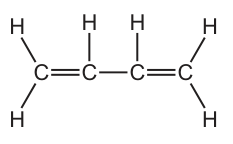
This molecule undergoes two separate addition reactions. It undergoes an addition reaction with excess bromine and an addition reaction with steam.
One molecule of reacts with ......1...... of bromine.
When reacts with steam, ......2...... is formed.
Which words complete gaps 1 and 2?
Options
| 1 | 2 | |
|---|---|---|
| A | one molecule | an alcohol |
| B | one molecule | a carboxylic acid |
| C | two molecules | an alcohol |
| D | two molecules | a carboxylic acid |
Working
- The displayed formula shows that each molecule of contains two double bonds. Each double bond reacts with one molecule of bromine () in an addition reaction. Therefore, with excess bromine, one molecule of reacts with two molecules of bromine.
- The addition reaction between an alkene (or a compound with bonds) and steam () adds an and an group across the double bond, forming an alcohol.
Matching both:
- Gap 1: two molecules
- Gap 2: an alcohol
This corresponds to option C.
Answer
C
C
Walkthrough
-
Gap 1 (Bromine addition):
- Examine the displayed structure of (buta-1,3-diene). It contains two carbon–carbon double bonds ().
- In an addition reaction, one molecule of bromine () adds across one double bond to form a dibromo compound.
- Because there are two double bonds and bromine is in excess, both double bonds react. Thus, one molecule of reacts with molecules of to form a tetrabromoalkane ().
-
Gap 2 (Hydration / Steam addition):
- The addition of steam (water, ) to an unsaturated hydrocarbon containing double bonds (hydration) introduces a hydroxyl functional group () into the molecule.
- Compounds containing the functional group belong to the alcohol homologous series.
- Carboxylic acids contain the group and are formed by oxidation of alcohols, not by direct addition of steam to alkenes.
Combining both deductions leads directly to option C.
Key Takeaways
- Each double bond in an unsaturated organic molecule can undergo an addition reaction with one molecule of a halogen (like ) or one molecule of steam ().
- Addition of steam across produces an alcohol.
- Addition of halogen across produces a dihaloalkane.
Common Mistakes
- Forgetting to count both double bonds and assuming the reaction ratio is always as it is for simple alkenes with one double bond (such as ethene).
- Confusing the hydration of alkenes (which forms alcohols) with the oxidation of alcohols (which forms carboxylic acids).
Things to Be Careful About
- Ensure you check the formula and structure for multiple double bonds (dienes) rather than assuming single unsaturation from the word "alkene".
Which statement about members of the homologous series of alcohols is correct?
Options
A An alcohol with two carbon atoms in each molecule is called methanol.
B Butanol can be combusted to give carbon dioxide and water only.
C Ethanol is the only alcohol that can be oxidised to a carboxylic acid.
D Propanol can be made by the catalysed addition of steam to ethene.
Working
- A is incorrect: An alcohol with two carbon atoms per molecule is ethanol (methanol contains one carbon atom).
- B is correct: Complete combustion of any alcohol, including butanol (), in excess oxygen produces carbon dioxide and water only:
- C is incorrect: Other primary alcohols can also be oxidised to their corresponding carboxylic acids (e.g. propanol oxidises to propanoic acid).
- D is incorrect: The addition of steam to ethene (a 2-carbon alkene) produces ethanol (a 2-carbon alcohol), not propanol.
Answer
B
B
Walkthrough
To determine which statement about alcohols is correct, let us evaluate each option:
- Option A: Organic prefixes indicate the number of carbon atoms (, , , ). An alcohol with two carbons is ethanol, not methanol.
- Option B: Complete combustion of hydrocarbons and alcohols (compounds containing carbon, hydrogen, and oxygen) in sufficient oxygen produces only carbon dioxide () and water (). Therefore, butanol combusts completely to give carbon dioxide and water only. This statement is correct.
- Option C: Oxidation to carboxylic acids is a general property of primary alcohols in the homologous series (e.g., methanol oxidises to methanoic acid, propanol oxidises to propanoic acid), not just ethanol.
- Option D: The catalysed addition of steam to an alkene produces an alcohol with the same number of carbon atoms. Ethene () has 2 carbon atoms, so its hydration produces ethanol (), not propanol (, which is prepared from propene).
Thus, B is the correct statement.
Key Takeaways
- Members of the same homologous series share similar chemical properties, such as undergoing complete combustion to form and .
- Nomenclature prefixes (, , , ) correspond to and carbon atoms respectively.
- Hydration of an alkene adds across the double bond without changing the number of carbon atoms.
Common Mistakes
- Confusing (1 carbon) with (2 carbons).
- Assuming that because ethanol's oxidation to ethanoic acid is commonly highlighted in the syllabus (e.g. in vinegar production), it is the only alcohol that undergoes oxidation.
Things to Be Careful About
- Ensure you match the number of carbons in the reactant alkene to the product alcohol during hydration addition reactions.
The diagram shows the structure of a compound called ethanoic anhydride.
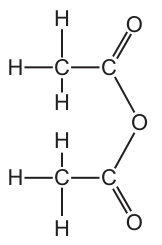
of ethanoic anhydride reacts with water to form of a carboxylic acid only. This carboxylic acid reacts with ethanol to form an ester.
How many moles of water react with of the ethanoic anhydride and what is the structure of the ester?
Options
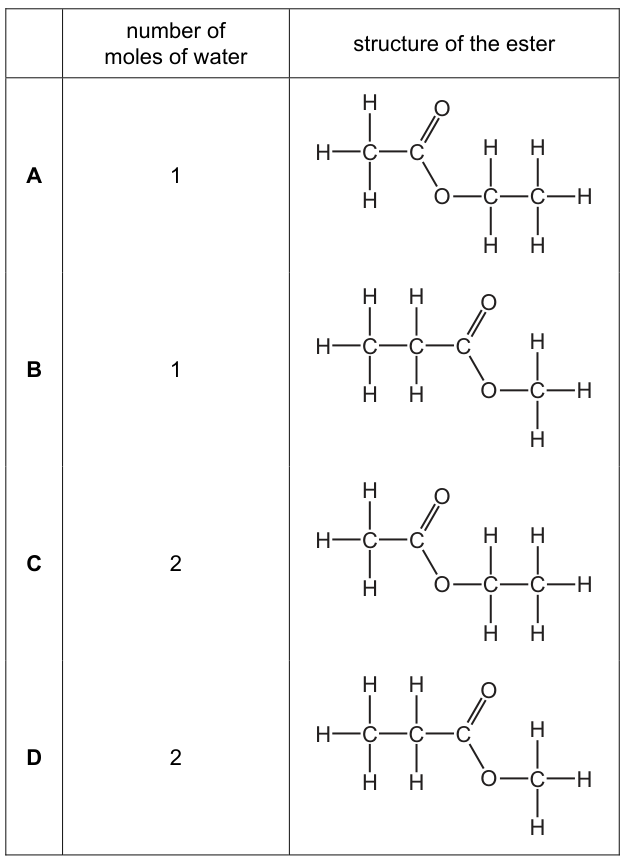
Working
- Moles of water required:
Ethanoic anhydride has the molecular formula . When it reacts with water to form of a carboxylic acid containing two carbon atoms each (ethanoic acid, , ):
Therefore, of ethanoic anhydride reacts with of .
- Structure of the ester:
The carboxylic acid formed is ethanoic acid (). When ethanoic acid reacts with ethanol (), it produces ethyl ethanoate:
Option A shows of water and the correct displayed structure of ethyl ethanoate ().
Answer
A
A
Walkthrough
-
Determine the carboxylic acid formed:
Ethanoic anhydride, , consists of two acetyl groups () connected by an oxygen atom (total formula ).
The stem states that of ethanoic anhydride produces of a single carboxylic acid. Since there are 4 carbon atoms in total, each molecule of carboxylic acid must contain 2 carbon atoms, meaning the carboxylic acid is ethanoic acid (). -
Find the number of moles of water:
Adding of provides the two hydrogen atoms and one oxygen atom needed to convert into ( of ethanoic acid):
Thus, of water reacts with of ethanoic anhydride.
- Deduce the structure of the ester:
Ethanoic acid () undergoes esterification with ethanol () in the presence of an acid catalyst to form the ester ethyl ethanoate and water:- The acid part supplies the group (ethanoate).
- The alcohol part supplies the group (ethyl).
The displayed formula corresponding to is given in option A.
Key Takeaways
- An anhydride is formed by the removal of water from two carboxylic acid molecules; conversely, adding of water hydrolyses an acid anhydride back into of carboxylic acid.
- Esterification between ethanoic acid and ethanol yields ethyl ethanoate ().
Common Mistakes
- Mistaking the ester formed as methyl propanoate (options B and D), which would form from propanoic acid and methanol rather than ethanoic acid and ethanol.
- Thinking that 2 moles of acid require 2 moles of water, forgetting that the anhydride already contains one bridging oxygen atom.
Things to Be Careful About
- When reading displayed formulae of esters, always distinguish the acyl part () derived from the carboxylic acid from the alkoxy part () derived from the alcohol.
Four samples are analysed using paper chromatography.
P, Q and R are pure substances.
M is a mixture of different substances.
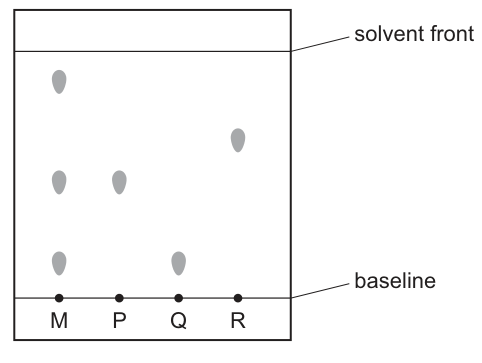
Which substances does mixture M contain?
Options
A P, Q and R
B P, Q and another substance
C P and Q only
D P and R only
Working
- Lane M contains three spots, indicating that it is a mixture of at least three substances.
- The lowest spot in lane M is at the same vertical height as the single spot for Q, showing M contains substance Q.
- The middle spot in lane M aligns with the single spot for P, showing M contains substance P.
- The spot for substance R is located between the middle and top spots of M; none of the spots in M align with R, so substance R is not present.
- The top spot in lane M does not correspond to P, Q, or R, meaning it represents another substance.
Thus, mixture M contains P, Q and another substance.
Answer
B
B
Walkthrough
In paper chromatography, pure substances travel a characteristic distance relative to the solvent front under identical conditions ( value).
To identify the components of a mixture:
- Look vertically up the lane of the mixture (M): it shows three distinct spots.
- Trace horizontally across from each spot in M to find matches in lanes P, Q, and R:
- The bottom spot aligns horizontally with Q Q is present in M.
- The middle spot aligns horizontally with P P is present in M.
- Substance R has a spot higher than the middle spot of M, but lower than the top spot of M. Since there is no spot in lane M at the exact height of R, mixture M does not contain R.
- The uppermost spot in M has no matching pure sample among P, Q, or R, indicating it is an unidentified, third substance.
Therefore, mixture M contains P, Q, and another substance, matching option B.
Key Takeaways
- A pure substance produces a single spot on a chromatogram.
- A mixture separates into multiple spots corresponding to its individual components.
- Components of a mixture are identified when their spots travel the same distance (have the same height / value) as known reference standards run on the same chromatogram.
Common Mistakes
- Mistaking the top spot in lane M for substance R by simply seeing that both are high up, without verifying horizontal alignment.
- Concluding that M contains P and Q only (option C) while ignoring the third spot near the solvent front.
Things to Be Careful About
- Ensure you draw a straight horizontal line across from each reference spot to the mixture lane to accurately confirm whether a spot matches.
A student is making a sample of aqueous copper(II) sulfate. The student adds an excess of copper(II) oxide powder to warm sulfuric acid and stirs the mixture.
Which apparatus is used to separate aqueous copper(II) sulfate from the excess copper(II) oxide?
Options
A burette
B distillation apparatus
C filter funnel and paper
D measuring cylinder
Working
Copper(II) oxide, , is an insoluble basic oxide added in excess, leaving unreacted solid in the mixture. Copper(II) sulfate, , is a soluble salt dissolved in water (aqueous solution).
To separate an insoluble solid from a solution:
- Filtration using a filter funnel and filter paper is required. The excess unreacted is trapped as the residue on the filter paper, while the solution passes through as the filtrate.
- A burette (A) and a measuring cylinder (D) are volumetric apparatus used for measuring liquid volumes, not for separation.
- Distillation apparatus (B) is used to separate a solvent from a solution or liquids with different boiling points, not for separating an insoluble solid from a liquid.
Therefore, the correct apparatus is a filter funnel and paper.
Answer
C
C
Walkthrough
In the preparation of a soluble salt from an insoluble base and an acid:
- Warm dilute sulfuric acid is reacted with an excess of solid copper(II) oxide to ensure that all the acid is completely neutralised:
- Because an excess of copper(II) oxide is used, the resulting mixture contains solid unreacted suspended in aqueous copper(II) sulfate solution.
- The mixture must be filtered using a filter funnel and filter paper.
- The solid is retained on the filter paper as the residue.
- The clear blue solution of passes through into the conical flask/beaker as the filtrate.
Evaluating the options:
- A (burette): Used to accurately measure and deliver variable volumes of liquids, typically in titrations.
- B (distillation apparatus): Used to separate a volatile liquid from non-volatile solutes or to separate miscible liquids with different boiling points.
- C (filter funnel and paper): Correct apparatus for filtration.
- D (measuring cylinder): Used to measure approximate volumes of liquids.
Thus, option C is correct.
Key Takeaways
- Filtration is the standard method for separating an insoluble solid from a liquid or solution.
- In the preparation of soluble salts from an insoluble reactant (metal, base, or carbonate), adding an excess of the solid ensures all the acid is neutralised, and the excess solid is removed by filtration.
Common Mistakes
- Confusing filtration with crystallisation or distillation. Distillation would boil off the water, leaving solid copper(II) sulfate mixed with copper(II) oxide rather than separating the solution.
- Confusing volumetric apparatus (burette, measuring cylinder) with separation apparatus.
Things to Be Careful About
- Always check the solubility of each substance in the mixture: is insoluble in water (solid residue), while is highly soluble (aqueous filtrate).
How can a pure sample of barium sulfate be obtained from barium carbonate?
Options
A Dissolve it in dilute hydrochloric acid, add dilute sulfuric acid, filter and crystallise.
B Dissolve it in dilute hydrochloric acid, add dilute sulfuric acid, filter and wash.
C Dissolve it in water, add dilute sulfuric acid, filter and crystallise.
D Dissolve it in water, add dilute sulfuric acid, filter and wash.
Working
- Solubility of starting material: Barium carbonate () is insoluble in water, so it cannot simply be dissolved in water. It must first be reacted with dilute hydrochloric acid () to produce a solution of soluble barium chloride ():
- Precipitation: Adding dilute sulfuric acid () provides sulfate ions, which react with barium ions to form a precipitate of insoluble barium sulfate ():
- Separation and purification: Because barium sulfate is an insoluble salt, the solid residue is collected by filtration, washed with distilled water to remove soluble impurities, and dried. Crystallisation is used for soluble salts, not insoluble precipitates.
This makes B the correct method.
Answer
B
B
Walkthrough
To prepare a pure, dry sample of a salt, we must first consider whether the target salt and starting materials are soluble or insoluble:
- Barium carbonate (): All carbonates are insoluble in water, except those of Group I elements and ammonium. Therefore, cannot be dissolved in water alone (eliminating options C and D).
- Barium sulfate (): Most sulfates are soluble, but barium sulfate, lead(II) sulfate, and calcium sulfate are insoluble (with calcium sulfate being sparingly soluble). Therefore, must be prepared by precipitation from two soluble solutions.
Step 1: Dissolve the insoluble carbonate in dilute hydrochloric acid to form aqueous barium chloride:
(Note: cannot be reacted directly with dilute because an insoluble layer of quickly coats the solid carbonate and stops the reaction.)
Step 2: Add dilute sulfuric acid (or any soluble sulfate such as ) to supply ions. An insoluble white precipitate of barium sulfate forms instantly.
Step 3: Separate the solid barium sulfate from the reaction mixture by filtration. Wash the residue on the filter paper with distilled water to rinse away excess acid and any remaining soluble ions, then dry the solid between filter papers. Crystallisation is used only to obtain crystals of a soluble salt from solution, which makes option A incorrect.
Key Takeaways
- Insoluble salts are prepared via precipitation by mixing solutions containing the required cation and anion.
- Purification of an insoluble salt requires filtration washing the residue with distilled water drying.
- Carbonates of Group II metals (like ) are insoluble in water and must be converted to a soluble salt using a suitable acid (e.g., or ) before precipitation.
Common Mistakes
- Confusing the purification process for soluble salts (crystallisation) with that for insoluble salts (filtration and washing).
- Assuming barium carbonate is soluble in water.
- Attempting to add sulfuric acid directly to solid barium carbonate: this creates an impermeable layer of insoluble on the surface of , halting the reaction prematurely.
Things to Be Careful About
- Always double-check solubility rules: all nitrates are soluble; all chlorides are soluble except and ; all sulfates are soluble except , , and ; most carbonates are insoluble except those of Group I and ammonium.
A sample of a white powder, X, is dissolved in water.
Tests are done on separate portions of this solution and the observations are shown in the table.
| test | observation |
|---|---|
| add aqueous sodium hydroxide a drop at a time until in excess | white precipitate forms, soluble in excess, giving a colourless solution |
| acidify with dilute nitric acid then add aqueous silver nitrate | white precipitate forms |
| acidify with dilute nitric acid then add aqueous barium nitrate | the solution remains colourless |
What is X?
Options
A aluminium chloride
B aluminium sulfate
C calcium chloride
D calcium sulfate
Working
- Test 1: Addition of aqueous sodium hydroxide gives a white precipitate that dissolves in excess to give a colourless solution. This indicates the presence of or or . Among the options ( vs ), this confirms (calcium forms a white precipitate that is insoluble in excess ).
- Test 2: Acidifying with dilute nitric acid followed by aqueous silver nitrate produces a white precipitate of , confirming the presence of chloride ions ().
- Test 3: Acidifying with dilute nitric acid followed by aqueous barium nitrate gives no precipitate (solution remains colourless), confirming that sulfate ions () are absent.
Combining the cation () and anion () identifies compound as aluminium chloride.
Answer
A
A
Walkthrough
To identify compound , we analyse the results of the three qualitative tests:
-
Cation identification (Reaction with ):
- When aqueous is added to a solution containing ions, a white precipitate of aluminium hydroxide, , forms initially:
- Because aluminium hydroxide is amphoteric, it reacts with excess hydroxide ions to form a soluble, colourless complex aluminate ion, , causing the precipitate to dissolve.
- In contrast, calcium ions () form a white precipitate of which is insoluble in excess . Therefore, the cation is .
-
Halide test (Reaction with acidified ):
- Acidifying with dilute and adding aqueous silver nitrate gives a white precipitate of silver chloride ():
- This confirms the presence of ions.
-
Sulfate test (Reaction with acidified ):
- If sulfate ions () were present, a dense white precipitate of barium sulfate () would form. Since the solution remains colourless, no sulfate ions are present.
Thus, compound is aluminium chloride (A).
Key Takeaways
- , , and form white precipitates with that dissolve in excess .
- forms a white precipitate with that remains insoluble in excess.
- Chloride ions () are tested using dilute nitric acid followed by silver nitrate solution, giving a white precipitate ().
- Sulfate ions () are tested using dilute nitric acid followed by barium nitrate solution, giving a white precipitate ().
Common Mistakes
- Confusing the solubility of and in excess sodium hydroxide.
- Forgetting that nitric acid is added prior to silver nitrate/barium nitrate to eliminate any carbonate ions that would also give a white precipitate.
Things to Be Careful About
- Both and dissolve in excess ; to distinguish between them, aqueous ammonia is used (in which dissolves in excess, but remains insoluble). Since the options only contrast aluminium with calcium, the test alone is sufficient here.
Your score so far
Answer a question to start scoring
Your marks add up here as you work through the paper.