Chemistry 5070/11 — May/June 2025
Cambridge O-Level · Multiple Choice · answer key with instant marking and worked solutions
Topics Atoms, Elements and Compounds · Organic Chemistry · Stoichiometry · Metals · Chemical Reactions · The Periodic Table · +6 more
Tap an option under each question to check it — your score builds as you go.
Four gases are listed.
What is the order of their rate of diffusion at room temperature and pressure?
Options
| slowest fastest | ||||
|---|---|---|---|---|
| A | 1 | 2 | 4 | 3 |
| B | 2 | 1 | 3 | 4 |
| C | 3 | 4 | 2 | 1 |
| D | 4 | 1 | 3 | 2 |
Working
Calculate the relative molecular mass () of each gas:
- 1 ():
- 2 ():
- 3 ():
- 4 ():
The rate of diffusion of a gas is inversely proportional to its relative molecular mass; gases with a higher diffuse more slowly, while gases with a lower diffuse more quickly.
Ordering from highest (slowest) to lowest (fastest):
This corresponds to the sequence: 3 4 2 1.
Answer
C
C
Walkthrough
-
Concept of Diffusion and :
Diffusion is the random net movement of particles from a region of higher concentration to a region of lower concentration. In gases, lighter particles (those with lower relative molecular mass, ) have a higher average speed at a given temperature than heavier particles, meaning they diffuse faster. -
Calculate for each gas:
- Gas 1 (): ,
- Gas 2 (): ,
- Gas 3 (): ,
- Gas 4 ():
-
Arrange from slowest to fastest:
- Slowest = highest (, Gas 3)
- Next = (, Gas 4)
- Next = (, Gas 2)
- Fastest = lowest (, Gas 1)
This gives the order 3 4 2 1, which corresponds to option C.
Key Takeaways
- The rate of diffusion of a gas depends inversely on its relative molecular mass () at constant temperature.
- Lower faster rate of diffusion; higher slower rate of diffusion.
Common Mistakes
- Inverting the direction (e.g., ordering fastest to slowest instead of slowest to fastest, which would lead to option A).
- Forgetting that nitrogen gas is diatomic () and using instead of .
Things to Be Careful About
- Always double-check the requested order in the table header: "slowest fastest" means highest to lowest .
Sodium is added to water and a chemical reaction occurs. Hydrogen and aqueous sodium hydroxide are produced.
Which row describes the reactants and products in this reaction?
Options
| reactants and products that are elements | reactants and products that are compounds | reactants and products that are mixtures | |
|---|---|---|---|
| A | hydrogen | water and sodium | aqueous sodium hydroxide |
| B | hydrogen and sodium | water | aqueous sodium hydroxide |
| C | aqueous sodium hydroxide | hydrogen and sodium | water |
| D | sodium and water | aqueous sodium hydroxide | hydrogen |
Working
- Elements are substances made of only one type of atom: (sodium) and (hydrogen).
- Compounds are substances containing two or more elements chemically combined in fixed proportions: (water).
- Mixtures contain two or more substances physically mixed together: aqueous sodium hydroxide () consists of the compound sodium hydroxide dissolved in water.
Matching these classifications with the table gives row B.
Answer
B
B
Walkthrough
To determine the correct row, classify each species involved in the reaction:
- Sodium (): A pure metal containing only sodium atoms, so it is an element.
- Hydrogen (): A diatomic gas containing only hydrogen atoms, so it is an element.
- Water (): Composed of hydrogen and oxygen atoms chemically bonded in a fixed ratio, so it is a compound.
- Aqueous sodium hydroxide (): A solution of the compound sodium hydroxide dissolved in water. Since a solution is a homogeneous mixture of a solute and a solvent, it is a mixture.
Looking across the options:
- Row A: Incorrectly places sodium as a compound.
- Row B: Correctly lists hydrogen and sodium as elements, water as a compound, and aqueous sodium hydroxide as a mixture.
- Row C: Inverts elements and mixtures completely.
- Row D: Incorrectly classifies water as an element and hydrogen as a mixture.
Therefore, row B is correct.
Key Takeaways
- An element contains only one type of atom (e.g. , ).
- A compound consists of two or more different elements chemically bonded together in a fixed ratio (e.g. , solid ).
- A mixture consists of two or more substances not chemically combined. Any aqueous solution (denoted by ) is a mixture of a solute and water.
Common Mistakes
- Mistaking an aqueous solution () for a single compound rather than a mixture of solute and solvent.
- Forgetting that diatomic gases like are elements because they consist of only one type of atom.
Things to Be Careful About
- The word "aqueous" indicates that water is present as the solvent, which makes the resulting liquid a mixture (solution), not a pure compound.
An atom of element X is shown.
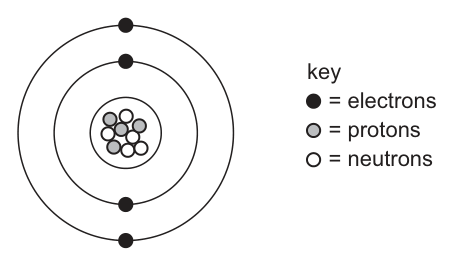
Which element is X?
Options
A beryllium
B boron
C carbon
D magnesium
Working
-
Count the number of subatomic particles from the diagram using the key:
- Number of protons (shaded circles)
- Number of electrons (black circles) (arranged as 2 in the inner shell, 2 in the outer shell)
- Number of neutrons (open circles)
-
The identity of an element is determined by its proton number (atomic number):
- Proton number , which corresponds to beryllium ().
Therefore, element X is beryllium.
Answer
A
A
Walkthrough
-
Use the key to identify each particle:
- Shaded circles represent protons.
- Open circles represent neutrons.
- Solid black circles on the electron shells represent electrons.
-
Count the particles:
- Looking at the nucleus, there are shaded circles, so the atom has protons.
- Counting the electrons on the concentric shells, there are electrons in the first (inner) shell and electrons in the second (outer) shell, making a total of electrons. This confirms it is a neutral atom of atomic number 4.
-
Match the atomic number to the Periodic Table:
- An element with an atomic number (proton number) of is beryllium ().
- Boron has an atomic number of .
- Carbon has an atomic number of .
- Magnesium has an atomic number of .
Thus, element X is beryllium, which corresponds to option A.
Key Takeaways
- The proton number (atomic number) uniquely identifies a chemical element.
- In a neutral atom, the number of protons equals the number of electrons.
- Mass number is the total number of protons and neutrons in the nucleus ( in this atom of beryllium).
Common Mistakes
- Counting the neutrons () instead of the protons () and incorrectly choosing boron (atomic number ).
- Adding protons and neutrons together () and confusing the nucleon (mass) number with the atomic number.
Things to Be Careful About
- Ensure you carefully distinguish between the shaded circles (protons) and the open white circles (neutrons) as indicated in the key.
Which definition of isotopes is correct?
Options
A atoms of different elements that have the same number of electrons
B atoms of different elements that have the same number of neutrons
C atoms of the same element that have different numbers of electrons
D atoms of the same element that have different numbers of neutrons
Working
Isotopes are defined as atoms of the same element (having the same number of protons / same atomic number) that have different numbers of neutrons (and therefore different mass / nucleon numbers).
- A and B are incorrect because isotopes must be atoms of the same element.
- C is incorrect because atoms of the same element with different numbers of electrons are ions, not isotopes.
- D correctly states that isotopes are atoms of the same element that have different numbers of neutrons.
Answer
D
D
Walkthrough
Isotopes are atoms of the same chemical element that contain the same number of protons (which defines the identity of the element) but a different number of neutrons in their nucleus.
Let's evaluate each statement:
- Option A: Mentions "atoms of different elements", which is incorrect for isotopes. Furthermore, having the same number of electrons would make them isoelectronic species, not isotopes.
- Option B: Mentions "atoms of different elements", which are isotones if they share the same neutron number, not isotopes.
- Option C: Mentions "different numbers of electrons". Atoms of the same element that differ in their electron count have net electrical charges and are called ions.
- Option D: Correctly describes isotopes as "atoms of the same element that have different numbers of neutrons".
Key Takeaways
- Isotopes always belong to the same element (same proton / atomic number, ).
- Isotopes have different numbers of neutrons, leading to different mass / nucleon numbers ().
- Isotopes have identical chemical properties because they have the same electron configuration.
Common Mistakes
- Confusing the subatomic particles: thinking isotopes differ in electron or proton numbers instead of neutrons.
- Confusing isotopes with ions (ions differ in the number of electrons).
Things to Be Careful About
- Ensure you check both parts of the definition: "same element / same number of protons" AND "different number of neutrons / different nucleon number".
A pure sample of element X has a relative atomic mass of 51.8.
The sample consists of three isotopes.
The table shows the relative masses and percentage abundances of two of the isotopes.
| relative mass of isotope | percentage abundance of isotope |
|---|---|
| 50 | 40 |
| 55 | 20 |
What is the relative mass of the third isotope?
Options
A 51
B 52
C 53
D 54
Working
- Calculate the percentage abundance of the third isotope:
- Let be the relative mass of the third isotope. Use the relative atomic mass formula:
Therefore, the relative mass of the third isotope is .
Answer
B
B
Walkthrough
Relative atomic mass () is the weighted average mass of naturally occurring atoms of an element on a scale where an atom of carbon-12 has a mass of exactly 12 units.
-
Find the abundance of the third isotope:
The sum of all percentage abundances for the isotopes of an element must equal . -
Set up the weighted average equation:
Substituting the given values:
-
Solve for (the mass of the third isotope):
- Calculate the known products: and .
- Total contribution of known isotopes: .
- Multiply both sides by : .
- Rearrange: .
- Divide by : .
Thus, option B is the correct answer.
Key Takeaways
- The sum of percentage abundances of all isotopes in a sample is always .
- The formula for calculating relative atomic mass from percentage abundances is:
- When an isotopic mass is unknown, set up an algebraic equation and solve for the unknown variable.
Common Mistakes
- Forgetting to subtract the given abundances from to find the abundance of the missing isotope.
- Dividing by the number of isotopes (e.g. dividing by 3) instead of dividing by the total abundance ().
Things to Be Careful About
- Arithmetic errors when multiplying out the terms (, not ).
- Ensure isotopic mass is rounded to an integer (whole number mass number) since relative isotopic mass approximates the nucleon number.
Magnesium reacts with oxygen to form magnesium oxide.
Which row is correct?
Options
| structure of | structure of | |||
|---|---|---|---|---|
| A | giant lattice | simple molecules | anion | cation |
| B | simple molecules | giant lattice | anion | cation |
| C | giant lattice | simple molecules | cation | anion |
| D | simple molecules | giant lattice | cation | anion |
Working
- is a metal with a metallic structure consisting of a giant lattice of positive ions in a sea of delocalised electrons.
- is a non-metal element that exists as simple diatomic covalent molecules.
- is a positively charged ion, which is a cation.
- is a negatively charged ion, which is an anion.
Matching these across the table gives row C.
Answer
C
C
Walkthrough
- Structure of : Magnesium is a Group II metal. All metals have giant metallic lattice structures consisting of closely packed positive metal ions surrounded by delocalised electrons.
- Structure of : Oxygen is a non-metal gas at room temperature consisting of separate molecules held together by strong covalent bonds within the molecules and weak intermolecular forces between them, so it has a simple molecular structure.
- Identification of and :
- A cation is a positively charged ion (formed when a magnesium atom loses two valence electrons to form ).
- An anion is a negatively charged ion (formed when an oxygen atom gains two electrons to form ).
Combining these four features leads directly to row C.
Key Takeaways
- Metals form giant lattices with metallic bonding.
- Non-metal diatomic gases (like , , ) exist as simple molecules.
- Positive ions are called cations; negative ions are called anions.
Common Mistakes
- Confusing the terms cation and anion (remember: ca+ion is positive; a negative ion = anion).
- Thinking that solid magnesium exists as discrete molecules rather than a giant lattice.
Things to Be Careful About
- Ensure you check every column systematically: structure of the metal, structure of the non-metal molecule, and the correct assignment of ionic names to the positive and negative charges.
Which statement about solid calcium chloride is correct?
Options
A It conducts electricity.
B It has a low melting point.
C It has an ionic lattice structure.
D It is insoluble in water.
Working
- Calcium chloride, , is an ionic compound formed between a metal (calcium) and a non-metal (chlorine).
- Ionic compounds form a regular giant ionic lattice structure of alternating positive and negative ions held together by strong electrostatic attractions.
- Evaluating the statements:
- A is incorrect: Solid ionic compounds do not conduct electricity because the ions are fixed in position within the lattice and cannot move.
- B is incorrect: It has a high melting point due to the strong electrostatic forces between oppositely charged ions which require a large amount of energy to overcome.
- C is correct: Calcium chloride forms a giant ionic lattice.
- D is incorrect: Most ionic chlorides (including calcium chloride) are soluble in water.
Answer
C
C
Walkthrough
Calcium is a Group II metal and chlorine is a Group VII non-metal. When they react, calcium atoms lose two electrons to form ions, and chlorine atoms gain one electron each to form ions.
These ions arrange themselves into a regular, repeating three-dimensional framework known as a giant ionic lattice, where each positive ion is surrounded by negative ions and vice versa, held tightly by strong electrostatic attractions (ionic bonds).
Let us evaluate the physical properties of solid calcium chloride:
- Electrical Conductivity: In the solid state, ions are locked into fixed positions within the lattice and can only vibrate; with no mobile ions or free electrons, solid cannot conduct electricity. (It only conducts when molten or dissolved in water, where ions are free to move).
- Melting Point: Overcoming the strong electrostatic forces throughout the lattice requires a large amount of thermal energy, giving it a high melting point.
- Solubility: Most chlorides are soluble in water (with the exceptions of silver chloride and lead(II) chloride), so calcium chloride readily dissolves in water.
- Structure: It has an ionic lattice structure, making C the only correct statement.
Key Takeaways
- Metal + non-metal compounds form giant ionic lattices.
- Solid ionic compounds do not conduct electricity because their ions are in fixed positions.
- Ionic compounds have high melting and boiling points due to strong ionic bonds throughout the lattice.
Common Mistakes
- Confusing electrical conductivity in the solid state with the molten or aqueous states.
- Confusing giant ionic structures with simple molecular structures, which have low melting points.
Things to Be Careful About
- Ensure you distinguish between the movement of electrons (in metals and graphite) and the movement of ions (in ionic substances) when explaining electrical conductivity.
Which description of metallic bonding is correct?
Options
A the electrostatic attraction between negative ions in a lattice and a ‘sea’ of electrons
B the electrostatic attraction between negative ions in a lattice and a ‘sea’ of protons
C the electrostatic attraction between positive ions and negative ions in a lattice
D the electrostatic attraction between positive ions in a lattice and a ‘sea’ of electrons
Working
- Metallic bonding is defined as the electrostatic attraction between positive metal ions in a regular lattice and the surrounding 'sea' of delocalised electrons.
- Option A incorrectly specifies negative ions.
- Option B incorrectly specifies negative ions and a 'sea' of protons.
- Option C describes ionic bonding (attraction between oppositely charged ions in a giant lattice).
- Option D correctly states the attraction between positive ions in a lattice and a 'sea' of electrons.
Answer
D
D
Walkthrough
Metallic bonding occurs in pure metals and alloys. Metal atoms lose their outer-shell valence electrons to form positive ions (cations), which arrange themselves in a regular, repeating giant three-dimensional lattice.
The released outer electrons are free to move throughout the entire structure and are described as a 'sea' of delocalised electrons. The metallic bond itself is the strong electrostatic force of attraction between these positively charged metal ions and the negatively charged delocalised electrons holding the lattice together.
Evaluating the options:
- A is incorrect because metal lattices consist of positive ions (cations), not negative ions.
- B is incorrect because protons are bound inside atomic nuclei and do not form a mobile 'sea', and metals contain positive ions.
- C describes ionic bonding (the electrostatic attraction between oppositely charged ions, such as and ).
- D accurately describes metallic bonding.
Key Takeaways
- Metallic bonding is the electrostatic attraction between a lattice of positive ions and a 'sea' of delocalised electrons.
- The delocalised electrons are responsible for typical metallic properties, such as electrical and thermal conductivity, malleability, and ductility.
Common Mistakes
- Confusing metallic bonding with ionic bonding (attraction between positive and negative ions).
- Thinking that metal atoms form negative ions or that protons are mobile particles involved in bonding.
Things to Be Careful About
- Ensure you clearly distinguish the terms: positive ions (fixed in the lattice) vs delocalised electrons (mobile 'sea').
The ions and combine to form an ionic compound.
What is the formula of the compound?
Options
A
B
C
D
Working
An ionic compound must have an overall charge of zero.
- Charge on calcium ion =
- Charge on phosphate ion =
To balance the positive and negative charges, find the lowest common multiple of and , which is :
Thus, ions combine with ions to give the formula .
Answer
D
D
Walkthrough
In an ionic compound, the total positive charge from the cations must balance the total negative charge from the anions so that the compound is electrically neutral.
-
Identify the charges of the given ions:
- Calcium ion: (charge )
- Phosphate ion: (charge )
-
Determine the ratio needed to balance the charges:
- The lowest common multiple of and is .
- Positive charge needed: , which requires ions ().
- Negative charge needed: , which requires ions ().
-
Combine the ions in this ratio:
- Since more than one polyatomic phosphate ion is needed, brackets must be placed around with the subscript outside the brackets.
- This gives the formula .
Therefore, option D is correct.
Key Takeaways
- Ionic compounds must be electrically neutral (total positive charge equals total negative charge).
- When more than one polyatomic ion is present in a formula, enclosing brackets must be used before adding the subscript.
Common Mistakes
- Inverting the subscripts (e.g., choosing instead of ).
- Forgetting that the subscript applies to the whole polyatomic ion, leading to incorrect formulae without brackets.
Things to Be Careful About
- Ensure the lowest whole-number ratio is used and that brackets are placed correctly around polyatomic ions whenever the subscript is greater than .
Magnesium reacts with aqueous copper(II) sulfate to form copper and aqueous magnesium sulfate.
What is the correct equation for this reaction?
Options
A
B
C
D
Working
-
Determine the formula of each substance:
- Magnesium is an element:
- Copper(II) sulfate contains and ions, giving the formula
- Copper is an element:
- Magnesium sulfate contains (Group II) and ions, giving the formula
-
Construct the balanced symbol equation:
This matches option A.
Answer
A
A
Walkthrough
In this single displacement (redox) reaction, magnesium displaces copper from aqueous copper(II) sulfate because magnesium is higher than copper in the reactivity series.
To identify the correct chemical equation:
- Identify the ions and their charges:
- Copper(II) indicates . The sulfate ion is . Combining these in a ratio gives .
- Magnesium is in Group II of the Periodic Table, so it forms ions. Combining with the sulfate ion () gives .
- Write the reactants and products:
- Reactants: and
- Products: and
- Balance the equation:
All atoms are balanced with a stoichiometric ratio, corresponding to option A.
Key Takeaways
- Roman numerals in chemical names, like copper(II), indicate the oxidation state and charge on the transition metal cation (i.e. ).
- Sulfate is a polyatomic ion with a formula and charge of .
- Group II metals form cations (e.g. ).
Common Mistakes
- Incorrectly writing the formula of copper(II) sulfate as , which would correspond to copper(I) sulfate.
- Incorrectly writing the formula of magnesium sulfate as , treating as a ion instead of .
Things to Be Careful About
- Always verify ionic charges when constructing chemical formulae: and both form compounds with the ion.
An organic compound has an of 88.
What is the molecular formula of this compound?
Options
A
B
C
D
Working
Calculate the relative molecular mass () for each option using , , and :
- A :
- B :
- C :
- D :
Therefore, matches the relative molecular mass of 88.
Answer
C
C
Walkthrough
The relative molecular mass () of a compound is calculated by summing the relative atomic masses () of all the atoms present in its molecular formula.
From the Periodic Table:
- Carbon ():
- Hydrogen ():
- Oxygen ():
Let us evaluate each given option:
Option C gives the required of 88 (which corresponds to compounds such as ethyl ethanoate or butanoic acid).
Key Takeaways
- To find , multiply the number of atoms of each element by its relative atomic mass () and add the products together.
- Ensure you check the Periodic Table values: , , .
Common Mistakes
- Confusing the number of oxygen atoms (e.g. evaluating with only one oxygen atom gives 72 instead of 88).
- Arithmetic slips in multiplying carbon by 12 or missing the hydrogen count.
Things to Be Careful About
- Do not use atomic numbers (proton numbers) instead of relative atomic masses (mass numbers); for instance, carbon is 12 (not 6) and oxygen is 16 (not 8).
of hydrogen gas is mixed with of chlorine gas. The equation for the reaction that takes place is shown.
All the hydrogen reacts. The total volume of gas at the end of the reaction is .
All measurements are at room temperature and pressure.
What is the value of ?
Options
A
B
C
D
Working
From the balanced chemical equation:
reacts with to produce .
- Volume of reacted = .
- Volume of reacted = .
- Volume of gas produced:
- The total final volume of gas is , which consists of the produced gas and the unreacted excess gas:
- Initial volume of chlorine, :
Answer
C
C
Walkthrough
According to Avogadro's law, equal volumes of all gases at the same temperature and pressure contain equal numbers of moles (or molecules). Therefore, mole ratios in a balanced equation involving gases directly equal their volume ratios.
From the equation:
- reacts with to produce .
- Thus, of reacts completely with of and produces of .
The question states that the total volume of gas remaining at the end of the reaction is . Since all hydrogen was consumed, the remaining gas consists of the of produced plus the unreacted (excess) :
The total initial volume of chlorine gas is the sum of the chlorine that reacted and the chlorine that remained in excess:
This corresponds to option C.
Key Takeaways
- For gaseous reactions at constant temperature and pressure, reacting volume ratios directly mirror stoichiometric coefficients in the balanced chemical equation.
- The total gas volume after a reaction includes both gaseous products and any unreacted gaseous reactants left in excess.
Common Mistakes
- Forgetting that is a gas at r.t.p. and counting only the excess chlorine as the remaining gas, which would incorrectly give .
- Assuming (option A) by ignoring the total final gas volume given and only matching the stoichiometric coefficient ratio .
- Forgetting to add back the of that reacted, arriving at (option B).
Things to Be Careful About
- Check whether any product formed is a gas, liquid, or solid at r.t.p. Here, hydrogen chloride is a gas, so its volume must be included in the total final volume of gas.
of aqueous potassium hydroxide with a concentration of reacts with excess dilute sulfuric acid.
of pure anhydrous potassium sulfate is produced.
What is the percentage yield of potassium sulfate?
Options
A 5%
B 10%
C 20%
D 40%
Working
- Calculate the moles of used:
- Use the stoichiometric ratio from the balanced equation:
- Calculate the relative formula mass () of :
- Calculate the theoretical mass of :
- Calculate the percentage yield:
Answer
D
D
Walkthrough
To determine the percentage yield of potassium sulfate, , follow these structured steps:
-
Calculate the amount (in moles) of the limiting reactant ():
Using the formula : -
Determine the theoretical amount of product formed:
From the balanced equation, produce .
Therefore: -
Find the relative formula mass () of :
-
Calculate the theoretical mass:
-
Calculate the percentage yield:
Thus, option D is the correct answer.
Key Takeaways
- Mole from concentration: Moles of solute = . Remember to convert to by dividing by .
- Mole ratios: Always check the stoichiometry of the balanced equation; here, .
- Percentage yield: .
Common Mistakes
- Forgetting the mole ratio between and , which leads to calculating a theoretical yield of and an incorrect yield of (Option C).
- Forgetting to convert volume from to .
- Incorrectly calculating the formula mass of potassium sulfate (e.g., using of potassium as instead of standard Periodic Table value , or miscounting the oxygen atoms).
Things to Be Careful About
- Keep track of units during intermediate steps to ensure concentrations in are multiplied by volumes in , not .
Which statement about electrolysis is correct?
Options
A Negative anions move towards the positive cathode.
B Negative cations move towards the positive cathode.
C Positive anions move towards the negative cathode.
D Positive cations move towards the negative cathode.
Working
In an electrolytic cell:
- Cations are positively charged ions.
- Anions are negatively charged ions.
- The cathode is the negative electrode.
- The anode is the positive electrode.
Opposite charges attract, so positively charged cations move towards the negatively charged cathode, while negatively charged anions move towards the positively charged anode.
- A is incorrect because the cathode is negative, not positive.
- B is incorrect because cations are positive, not negative.
- C is incorrect because anions are negative, not positive.
- D is correct because cations are positive and the cathode is negative.
Answer
D
D
Walkthrough
During electrolysis, an electric current is passed through an electrolyte (a molten ionic compound or an aqueous ionic solution), causing chemical decomposition.
To determine which statement is correct, remember the names and charges of the electrodes and ions:
- Cathode: The negative electrode (connected to the negative terminal of the power supply).
- Anode: The positive electrode (connected to the positive terminal of the power supply).
- Cation: A positively charged ion ().
- Anion: A negatively charged ion ().
Because opposite charges attract:
- Positively charged cations migrate towards the negative cathode (where they gain electrons / undergo reduction).
- Negatively charged anions migrate towards the positive anode (where they lose electrons / undergo oxidation).
Evaluating the given options:
- Option A: The cathode is negatively charged, not positive.
- Option B: Cations are positively charged, not negative.
- Option C: Anions are negatively charged, not positive.
- Option D: Positively charged cations move towards the negatively charged cathode, which is completely correct.
Key Takeaways
- Cations are positive ions; anions are negative ions.
- In electrolysis, the cathode is negative and the anode is positive (the mnemonic PANIC helps: Positive is Anode, Negative Is Cathode).
- Cations attract to the cathode; anions attract to the anode.
Common Mistakes
- Confusing the charges of ions with the charges of electrodes (e.g., thinking cations are negative because they move to the cathode).
- Forgetting that the cathode in an electrolytic cell is negative, unlike in simple chemical cells (batteries).
Things to Be Careful About
- Always double-check both the sign assigned to the ion name and the sign assigned to the electrode name in each statement before selecting the answer.
The diagram shows an electrolysis experiment using inert electrodes.
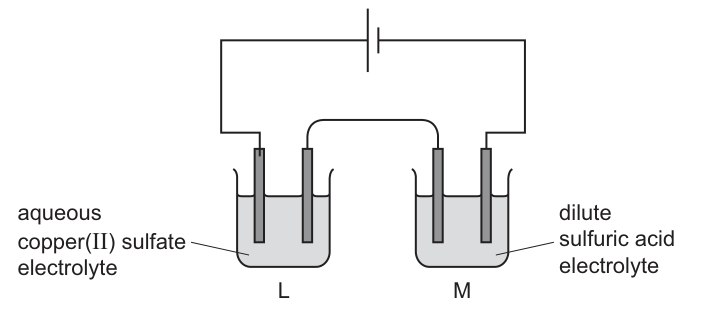
Which row shows what happens to the concentration of the electrolyte in L and in M as the electrolysis proceeds?
Options
| L | M | |
|---|---|---|
| A | ✗ | ✗ |
| B | ✗ | ✓ |
| C | ✓ | ✗ |
| D | ✓ | ✓ |
key
✓ = concentration stays constant
✗ = concentration does not stay constant
Working
-
In Beaker L (aqueous with inert electrodes):
- At the cathode (negative electrode), ions are discharged to form copper metal:
- At the anode (positive electrode), hydroxide ions () are discharged to form oxygen gas and water:
- ions are continuously removed from solution, so the concentration of copper(II) sulfate decreases (does not stay constant, ✗).
-
In Beaker M (dilute with inert electrodes):
- At the cathode, ions are discharged:
- At the anode, ions are discharged to form and .
- The overall reaction is the electrolysis of water (). As water is removed, the sulfuric acid becomes more concentrated (does not stay constant, ✗).
Therefore, both concentrations change (row A: ✗ and ✗).
Answer
A
A
Walkthrough
-
Identify the ions present in Beaker L (aqueous copper(II) sulfate):
- Ions present: , , , and .
- Because copper is lower than hydrogen in the reactivity series, is preferentially discharged at the cathode to form solid copper ().
- At the anode, hydroxide ions are discharged over sulfate ions to form oxygen gas and water ().
- As ions are removed from the solution to form copper metal, the blue color of the solution fades and the concentration of decreases. Hence, its concentration does not stay constant (✗).
-
Identify the ions present in Beaker M (dilute sulfuric acid):
- Ions present: , , and .
- At the cathode, hydrogen ions are discharged: .
- At the anode, hydroxide ions are discharged: .
- The net chemical change is the decomposition/loss of water from the solution. As solvent (water) is electrolysed away into hydrogen and oxygen gases, the amount of dissolved sulfuric acid remains the same while the volume of water decreases, making the acid more concentrated. Hence, its concentration does not stay constant (✗).
Combining both conclusions gives row A (✗ for L, ✗ for M).
Key Takeaways
- Electrolysis of an aqueous solution containing a metal below hydrogen in the reactivity series (such as ) results in the metal depositing at the cathode, lowering the concentration of that metal salt in the solution.
- Electrolysis of dilute sulfuric acid (or any dilute acid/salt where only and are produced) is effectively the electrolysis of water, causing the remaining solution to become more concentrated over time.
Common Mistakes
- Assuming that because inert electrodes are used, the electrolyte concentrations never change. Inert electrodes simply do not take part in the reaction; they do not prevent ions from the solution being discharged.
- Believing that dilute sulfuric acid remains at constant concentration because hydrogen ions are being discharged at the cathode while being regenerated by water dissociation—candidates overlook that water is being consumed overall, which increases the concentration of the acid.
Things to Be Careful About
- Check electrode material: if copper electrodes were used in Beaker L instead of inert electrodes, copper would dissolve from the anode at the same rate it deposits at the cathode, keeping the concentration constant. However, the question specifies inert electrodes, so copper is permanently removed from solution.
Which row is correct for a chemical reaction in which is negative?
Options
| bond energy change | type of reaction | |
|---|---|---|
| A | energy of bonds broken greater than energy of bonds formed | endothermic |
| B | energy of bonds broken less than energy of bonds formed | exothermic |
| C | energy of bonds broken greater than energy of bonds formed | exothermic |
| D | energy of bonds broken less than energy of bonds formed | endothermic |
Working
- A reaction with a negative (enthalpy change) releases heat energy to the surroundings, so it is exothermic.
- In any chemical reaction:
- Bond breaking is an endothermic process (energy absorbed).
- Bond making is an exothermic process (energy released).
- For an exothermic reaction (), the energy released when new bonds are formed is greater than the energy required to break existing bonds. Therefore, the energy of bonds broken is less than the energy of bonds formed.
Matching these criteria with the options:
- Type of reaction: exothermic (eliminates A and D).
- Bond energy change: energy of bonds broken is less than energy of bonds formed (eliminates C).
Thus, row B is correct.
Answer
B
B
Walkthrough
-
Identify the reaction type from the sign of :
- A negative indicates that the system loses enthalpy to the surroundings in the form of heat, which is the definition of an exothermic reaction. (A positive indicates an endothermic reaction).
-
Analyze bond energy changes:
- Breaking chemical bonds requires energy input (endothermic, ).
- Forming chemical bonds releases energy (exothermic, ).
- The overall enthalpy change is calculated as:
- For to be negative, the value subtracted (energy released in forming bonds) must be larger than the value added (energy absorbed in breaking bonds). Therefore, the energy of bonds broken is less than the energy of bonds formed.
- Select the corresponding row:
- Row B correctly identifies the reaction as exothermic and states that the energy of bonds broken is less than the energy of bonds formed.
Key Takeaways
- corresponds to an exothermic reaction; corresponds to an endothermic reaction.
- MEXO BENDO: Making bonds is EXOthermic; Breaking bonds is ENDOthermic.
- In an exothermic reaction: .
Common Mistakes
- Confusing the signs: thinking means endothermic because energy is 'taken in'.
- Reversing the bond energy rules: incorrectly assuming bond making requires energy.
Things to Be Careful About
- Always double-check both columns of the table to ensure both statements match an exothermic process.
The diagram shows apparatus used to investigate two different reactions that produce gases.
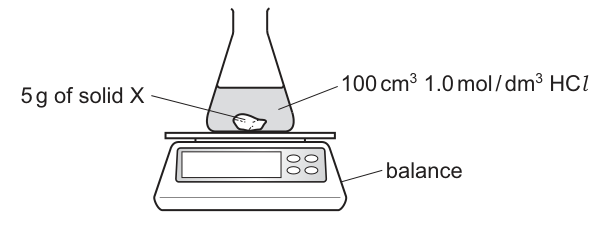
The reactants for each experiment are mixed and the mass of flask plus contents for each experiment is recorded every 30 seconds.
A graph of the mass against time is drawn.
In experiment 1, solid X is calcium carbonate.
In experiment 2, solid X is magnesium.
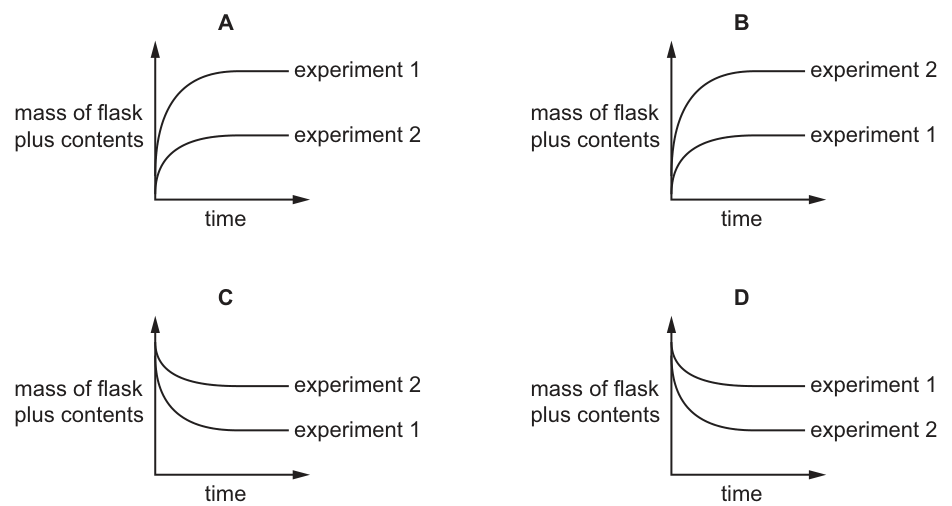
Which graph is correct?
Options
Working
-
In both reactions, a gas is produced and escapes from the open flask into the surroundings, so the total mass of the flask plus contents decreases over time. This eliminates graphs A and B.
-
Determine the mass of gas lost in each experiment:
- Amount of present in each flask:
-
Experiment 1 ():
- Moles of .
- of reacts completely with of .
- Moles of evolved .
- Mass of lost .
-
Experiment 2 ():
- Moles of (in excess; is limiting).
- of produces of .
- Mass of lost .
- Since Experiment 1 loses much more mass () than Experiment 2 (), the final mass of flask plus contents in Experiment 1 is lower than in Experiment 2. Therefore, the curve for Experiment 2 lies above Experiment 1.
Answer
C
C
Walkthrough
When tracking the progress of a chemical reaction using an open flask on a balance, any gas produced escapes into the air. This causes a decrease in the measured mass over time:
- In Experiment 1, the reaction between calcium carbonate and hydrochloric acid produces carbon dioxide gas:
- In Experiment 2, the reaction between magnesium and hydrochloric acid produces hydrogen gas:
Because mass decreases in both experiments, the graph must slope downwards from the initial total mass, ruling out options A and B.
Next, consider how much mass is lost:
- The amount of available in both cases is:
- In Experiment 1, of reacts completely with of () to produce of . With , the mass of gas lost is .
- In Experiment 2, is the limiting reactant (), producing of . With , the mass of gas lost is .
Because the loss of mass in Experiment 1 is significantly greater than in Experiment 2, the remaining mass in Experiment 1 drops much lower than in Experiment 2. Thus, the curve for Experiment 2 ends at a higher final mass than Experiment 1, corresponding to graph C.
Key Takeaways
- When gas is evolved in an open flask, the total mass of the flask and contents decreases.
- The magnitude of the mass loss depends directly on the relative molecular mass () and moles of the escaping gas, not merely the volume of gas produced.
- Even if equal molar amounts of gas are produced, a dense gas like () causes a much larger mass loss than a light gas like ().
Common Mistakes
- Confusing a graph of volume of gas produced vs. time (which increases from zero) with mass of flask plus contents vs. time (which decreases from the initial mass).
- Assuming magnesium produces a larger mass decrease because the reaction is faster or more vigorous, forgetting that hydrogen has an extremely low molar mass ().
In a closed flask, gases Q and R reach a dynamic equilibrium.
Which change will move the equilibrium to the right?
Options
A adding a catalyst
B decreasing the temperature
C increasing the pressure
D increasing the volume of the flask
Working
-
Effect of volume/pressure:
- The forward reaction produces more moles of gas ().
- Increasing the volume of the flask decreases the pressure.
- By Le Chatelier's principle, the system responds to a decrease in pressure by shifting towards the side with more moles of gas (to the right).
- Therefore, increasing the volume of the flask shifts the equilibrium to the right.
-
Evaluating other options:
- A (adding a catalyst): Speeds up the forward and reverse reactions equally; it does not change the position of equilibrium.
- B (decreasing the temperature): Since is positive (endothermic in the forward direction), decreasing the temperature shifts the equilibrium in the exothermic direction (to the left).
- C (increasing the pressure): Shifts the equilibrium to the side with fewer moles of gas (to the left, towards ).
Answer
D
D
Walkthrough
For the reversible reaction:
-
Moles of gas:
- Left-hand side (reactants):
- Right-hand side (products):
-
Effect of volume and pressure:
- Increasing the volume of the container decreases the pressure of the gaseous mixture.
- According to Le Chatelier's principle, when pressure is decreased, the equilibrium shifts in the direction that produces more moles of gas to oppose the change and increase pressure.
- Since the right-hand side has compared to on the left, the equilibrium shifts to the right.
- Thus, D is correct.
-
Why other options are incorrect:
- A: Adding a catalyst increases the rates of both the forward and backward reactions equally, allowing equilibrium to be reached faster without changing the position of equilibrium.
- B: The forward reaction is endothermic (). A decrease in temperature favours the exothermic direction (reverse reaction), shifting the equilibrium to the left.
- C: Increasing the pressure shifts the equilibrium to the side with fewer gas molecules (to the left).
Key Takeaways
- Pressure and Gas Moles: Increasing pressure (or decreasing volume) shifts the equilibrium to the side with fewer gas molecules. Decreasing pressure (or increasing volume) shifts the equilibrium to the side with more gas molecules.
- Temperature: Increasing temperature favours the endothermic reaction (). Decreasing temperature favours the exothermic reaction ().
- Catalyst: A catalyst has no effect on the position of equilibrium or yield; it only increases the rate at which equilibrium is reached.
Common Mistakes
- Confusing the effect of increasing volume with increasing pressure. Increasing volume decreases the pressure.
- Forgetting that a catalyst does not alter the yield or shift the equilibrium position.
Things to Be Careful About
- Always count only the stoichiometric coefficients of substances in the gas state when evaluating pressure or volume changes.
Which row shows the typical conditions used for the conversion of sulfur dioxide to sulfur trioxide in the Contact process?
Options
| catalyst | pressure / kPa | |
|---|---|---|
| A | iron | 20 000 |
| B | iron | 200 |
| C | vanadium(V) oxide | 20 000 |
| D | vanadium(V) oxide | 200 |
Working
In the Contact process, the oxidation of sulfur dioxide to sulfur trioxide:
operates under the following typical conditions:
- Catalyst: Vanadium(V) oxide ()
- Temperature:
- Pressure: (approximately )
An iron catalyst and a very high pressure of () are typical of the Haber process, not the Contact process.
Matching the rows:
- A: Iron and (Haber process conditions) — incorrect.
- B: Iron and (incorrect catalyst) — incorrect.
- C: Vanadium(V) oxide and (pressure is far too high) — incorrect.
- D: Vanadium(V) oxide and — correct.
Answer
D
D
Walkthrough
The conversion of sulfur dioxide () to sulfur trioxide () is the key reversible step in the industrial manufacture of sulfuric acid (the Contact process):
The standard conditions used for this stage are:
- Catalyst: Vanadium(V) oxide (). This increases the rate of reaction to reach equilibrium quickly at an economically viable temperature.
- Temperature: Approximately . This is an optimum compromise: low enough to favour a high equilibrium yield of (since the forward reaction is exothermic), but high enough to ensure a reasonably fast rate of reaction.
- Pressure: Relatively low, around (). Because the equilibrium yield at atmospheric pressure is already extremely high (around ), using higher pressure is unnecessary and avoids the high costs and safety hazards of high-pressure equipment.
Therefore, row D gives the correct catalyst and pressure.
Key Takeaways
- Contact process conditions: Vanadium(V) oxide catalyst, , ().
- Haber process conditions: Finely divided iron catalyst, , ().
Common Mistakes
- Confusing the conditions of the Contact process with those of the Haber process (iron catalyst and ).
The pH of dilute ethanoic acid is measured. The equation for the partial dissociation of ethanoic acid is shown.
Aqueous sodium ethanoate, , is added to the dilute ethanoic acid and the pH is measured again.
What is the initial pH of the dilute ethanoic acid and how does it change after the addition of the aqueous sodium ethanoate?
Options
| initial pH | change in pH after adding aqueous sodium ethanoate | |
|---|---|---|
| A | 3–4 | increases |
| B | 3–4 | decreases |
| C | 8–9 | increases |
| D | 8–9 | decreases |
Working
- Ethanoic acid () is a weak acid, meaning it partially ionises in water. Its aqueous solution is acidic with a typical of around (options C and D give an alkaline of and are eliminated).
- Adding aqueous sodium ethanoate () introduces a high concentration of ethanoate ions, .
- According to Le Chatelier's principle, increasing the concentration of shifts the equilibrium to the left:
- Shifting the position of equilibrium to the left decreases the concentration of ions.
- A lower means the acidity decreases, so the increases.
Therefore, the initial is and the increases.
Answer
A
A
Walkthrough
-
Determine the initial pH:
Ethanoic acid is a weak organic carboxylic acid. Unlike strong mineral acids (such as or , which fully dissociate to give a around ), dilute weak acids undergo only partial dissociation, typically exhibiting a between and . Therefore, the initial of dilute ethanoic acid is . -
Determine the effect of adding sodium ethanoate:
Sodium ethanoate, , is a soluble ionic salt that completely dissociates in aqueous solution to release and ions:The ethanoic acid equilibrium in solution is:
Adding increases the concentration of one of the products on the right-hand side. By Le Chatelier's principle, the system responds to oppose this increase by shifting the position of equilibrium to the left, consuming ions in the process.
-
Relate hydrogen ion concentration to pH:
As the equilibrium shifts to the left, the concentration of free ions decreases. Because is inversely related to , a decrease in hydrogen ion concentration causes the to increase (it becomes less acidic / moves closer to neutral).
Combining both conclusions gives option A.
Key Takeaways
- Weak acids only partially ionise in aqueous solution, giving a in the range of rather than .
- Adding a common ion (in this case ) shifts the position of equilibrium in the direction that removes the added ion (to the left).
- A decrease in ion concentration always causes the to increase.
Common Mistakes
- Confusing acid and alkali values: selecting for ethanoic acid (confusing an acid with an alkali).
- Inverting the scale: thinking that removing ions makes the solution "more acidic" or that a lower concentration results in a lower .
Things to Be Careful About
- Remember that the scale is an inverse scale with respect to : as decreases, increases.
Which element reacts with oxygen to produce an amphoteric oxide?
Options
A carbon
B copper
C sulfur
D zinc
Working
- Carbon forms carbon dioxide (), which is an acidic oxide, and carbon monoxide (), which is a neutral oxide.
- Copper forms copper(II) oxide (), which is a basic oxide.
- Sulfur forms sulfur dioxide () and sulfur trioxide (), which are acidic oxides.
- Zinc forms zinc oxide (), which reacts with both acids and bases to form salts and water, making it an amphoteric oxide.
Answer
D
D
Walkthrough
An oxide is classified based on its acid-base properties:
- Acidic oxides: Formed mainly by non-metals (such as , , ). They react with bases/alkalis to form salt and water.
- Basic oxides: Formed by most metals (such as , , ). They react with acids to form salt and water.
- Amphoteric oxides: Metallic oxides that react with both acids and bases (alkalis) to produce salts and water. In the Cambridge O Level syllabus, the standard examples to know are zinc oxide () and aluminium oxide (), as well as lead(II) oxide ().
- Neutral oxides: Non-metal oxides that show neither acidic nor basic properties (e.g., , , ).
Since zinc reacts with oxygen to form , which is amphoteric, D is the correct option.
Key Takeaways
- Metal oxides are typically basic, but aluminium oxide () and zinc oxide () are amphoteric.
- Non-metal oxides are typically acidic (or neutral).
- Amphoteric oxides neutralise both acids and alkalis.
Common Mistakes
- Confusing basic metal oxides (like ) with amphoteric metal oxides.
- Thinking non-metal oxides can be amphoteric.
Things to Be Careful About
- Remember the specific pairs of amphoteric oxides frequently tested at O Level: aluminium oxide and zinc oxide.
Element X is in Period 2 of the Periodic Table. X reacts with magnesium to form an ionic compound with the formula .
What is X?
Options
A chlorine
B fluorine
C oxygen
D sulfur
Working
- Magnesium is in Group II and forms a cation.
- For an electrically neutral compound with the formula , the two ions must balance the charge of one ion:
- An ion with a charge () belongs to Group VII (the halogens).
- The element in Period 2 and Group VII of the Periodic Table is fluorine (proton number 9).
- Chlorine is in Group VII but in Period 3 (giving ).
- Oxygen and sulfur are in Group VI and form ions (giving and ).
Answer
B
B
Walkthrough
-
Find the charge of ion :
Magnesium is an alkaline earth metal in Group II, having two valence electrons. It loses two electrons to form the stable cation . In the compound , there is one ion for every two ions. To ensure electrical neutrality, each ion must carry a single negative charge (), meaning is a non-metal that gains one electron to form an anion. -
Identify the group:
Non-metals that gain one electron to complete an octet have 7 outer electrons and belong to Group VII (the halogens). -
Match with Period 2:
- Period 2 elements include: Li, Be, B, C, N, O, F, Ne.
- The Group VII element in Period 2 is fluorine (F).
- Chlorine (Cl) is also in Group VII, but it is in Period 3.
- Oxygen (O) is in Period 2, Group VI (forms , giving ).
- Sulfur (S) is in Period 3, Group VI (forms , giving ).
Thus, element is fluorine, corresponding to option B.
Key Takeaways
- Chemical formulae of ionic compounds are balanced so that total positive charge equals total negative charge.
- The magnitude of the ionic charge reflects the group number of the element (Group II metals form ions; Group VII non-metals form ions; Group VI non-metals form ions).
- Remember how to read periods (horizontal rows) versus groups (vertical columns) on the Periodic Table.
Common Mistakes
- Confusing the period number with the group number (e.g., choosing chlorine because it forms , but forgetting that chlorine is in Period 3, not Period 2).
- Incorrectly calculating the ratio of ions, leading to selecting oxygen or sulfur.
Things to Be Careful About
- Double-check the period: Period 1 contains H and He, Period 2 begins with Li (atomic number 3) and ends with Ne (atomic number 10). Therefore, fluorine (atomic number 9) is in Period 2, whereas chlorine (atomic number 17) is in Period 3.
Rubidium is an element in Group I of the Periodic Table.
Which statement about rubidium is correct?
Options
A It has a higher melting point than potassium.
B It reacts with water to produce an acidic solution.
C It reacts with water to produce oxygen gas.
D It is more reactive than potassium.
Working
- Group I elements (the alkali metals) increase in reactivity down the group. Rubidium () is below potassium () in Group I, so it is more reactive than potassium. This makes option D correct.
- Melting points decrease down Group I, so rubidium has a lower melting point than potassium (eliminating A).
- Group I metals react with water to form an alkaline metal hydroxide solution () and hydrogen gas (), not an acidic solution or oxygen gas (eliminating B and C).
Answer
D
D
Walkthrough
Rubidium () is an alkali metal located in Group I of the Periodic Table, positioned below lithium (), sodium (), and potassium ().
Let us evaluate each statement according to the trends in Group I:
- Reactivity: Reactivity increases down Group I as the outer shell electron gets further from the nucleus and is more easily lost due to increased electron shielding. Since rubidium is located below potassium in Group I, rubidium is more reactive than potassium. Therefore, statement D is correct.
- Melting and Boiling Points: Melting points decrease down Group I because the metallic bonds become weaker as atomic radii increase. Thus, rubidium has a lower melting point than potassium, making statement A incorrect.
- Reaction with Water: When an alkali metal reacts with cold water, it forms an aqueous metal hydroxide (which is strongly alkaline, with a ) and hydrogen gas:
Since an alkaline solution and hydrogen gas are formed, statements B and C are incorrect.
Key Takeaways
- Reactivity of Group I elements increases down the group ().
- Melting points and boiling points of Group I elements decrease down the group.
- Group I metals react vigorously with water to produce a metal hydroxide (alkaline solution) and hydrogen gas ().
Common Mistakes
- Confusing the reactivity trend of Group I (increases down the group) with Group VII halogens (decreases down the group).
- Thinking the gas produced in the reaction of alkali metals with water is oxygen instead of hydrogen.
- Assuming the solution produced with water is neutral or acidic, rather than strongly alkaline.
Things to Be Careful About
- Remember that alkali metals are named because they form alkaline solutions (hydroxides) when they react with water.
Which statement is correct?
Options
A Noble gases are unreactive because they all have eight electrons in their outer shells.
B The Group VII element astatine, , is expected to be a black solid at room temperature.
C The reactivity of the elements in both Group I and Group VII increases down the group.
D When aqueous chlorine is added to aqueous potassium bromide, there is no change in colour.
Working
- A is incorrect: Helium () is a noble gas with only 2 electrons in its outer shell (a full first shell), so they do not all have eight outer electrons.
- B is correct: Down Group VII, the elements become darker in colour and have higher melting points (gas liquid solid). Chlorine is a pale yellow-green gas, bromine is a red-brown liquid, iodine is a dark grey/black solid. Therefore, astatine, being below iodine, is predicted to be a black solid at room temperature.
- C is incorrect: Reactivity increases down Group I, but decreases down Group VII.
- D is incorrect: Chlorine is more reactive than bromine and displaces bromide ions from aqueous solution to form aqueous bromine, changing the colour from colourless to orange/brown:
Answer
B
B
Walkthrough
To find the correct statement, we evaluate each option systematically:
-
Option A: Noble gases are chemically unreactive because they have full outer electron shells. However, not all noble gases have 8 electrons in their outer shell—helium (, proton number 2) has a full first shell containing only 2 electrons. Thus, statement A is false.
-
Option B: Halogens (Group VII) show a clear trend in physical properties down the group:
- Fluorine: pale yellow gas
- Chlorine: pale green gas
- Bromine: red-brown liquid
- Iodine: dark grey/black solid
Since physical states progress from gas to solid and colours become progressively darker down the group, astatine (), which lies directly below iodine, is expected to be a black solid at room temperature. Thus, statement B is correct.
-
Option C: In Group I (alkali metals), reactivity increases down the group as outer electrons are lost more easily. In Group VII (halogens), reactivity decreases down the group because larger atoms attract an incoming electron less strongly. Thus, statement C is false.
-
Option D: Chlorine is higher in Group VII than bromine, making it more reactive. When chlorine water is added to potassium bromide solution, chlorine displaces bromine:
The solution changes from colourless to orange/brown due to the formation of aqueous bromine (). Thus, statement D is false.
Key Takeaways
- Physical trends down Group VII: melting and boiling points increase (gas liquid solid) and colours darken down the group.
- Chemical reactivity trends: increases down Group I, decreases down Group VII.
- A more reactive halogen displaces a less reactive halide from its aqueous salt solution.
- Helium has a duplet (2 electrons), whereas other noble gases have an octet (8 electrons) in their valence shell.
Common Mistakes
- Forgetting helium when considering noble gas configurations and assuming all have 8 outer electrons.
- Confusing the reactivity trend of Group VII with that of Group I.
Things to Be Careful About
- Words like "all" in multiple-choice statements often indicate an exception (e.g. helium in Option A). Always check the first member of the group.
M is a metal that forms coloured compounds.
M is extracted from its oxide either by heating with carbon or by electrolysis.
M reacts with dilute hydrochloric acid.
What is M?
Options
A copper or magnesium
B copper only
C iron or magnesium
D iron only
Working
- Forms coloured compounds: This is a characteristic of transition elements (e.g. and compounds are coloured, whereas compounds of Group II metals such as magnesium are white/colourless). This rules out magnesium.
- Extracted from its oxide by heating with carbon: The metal must be below carbon in the reactivity series. Iron is less reactive than carbon, whereas magnesium is more reactive than carbon and can only be extracted by electrolysis.
- Reacts with dilute hydrochloric acid: The metal must be above hydrogen in the reactivity series. Iron reacts with dilute hydrochloric acid to produce iron(II) chloride and hydrogen gas (). Copper is below hydrogen and does not react with dilute acid.
Therefore, metal M can only be iron.
Answer
D
D
Walkthrough
To identify metal M, we test each of the given metals against the three provided clues:
-
"Forms coloured compounds":
- Transition elements typically form coloured compounds (e.g. iron(II) is pale green, iron(III) is red-brown, copper(II) is blue).
- Main-group metals like magnesium (Group II) form white/colourless compounds.
- This eliminates magnesium.
-
"Extracted from its oxide either by heating with carbon or by electrolysis":
- Metals below carbon in the reactivity series (such as zinc, iron, and copper) can be extracted from their oxides by reduction with carbon (heating with coke or carbon monoxide, as seen in the blast furnace for iron).
- Magnesium is higher than carbon in the reactivity series, so its oxide cannot be reduced by carbon; it requires electrolysis.
-
"Reacts with dilute hydrochloric acid":
- A metal must be more reactive than hydrogen (above hydrogen in the reactivity series) to displace hydrogen from dilute acids.
- Iron is above hydrogen (), so it reacts.
- Copper is below hydrogen in the reactivity series and therefore does not react with dilute hydrochloric acid.
Since only iron satisfies all three conditions, metal M is iron only (Option D).
Key Takeaways
- Transition Elements: Form coloured compounds, have variable oxidation states, and often act as catalysts.
- Reactivity Series & Extraction:
- Metals more reactive than carbon () must be extracted by electrolysis of their molten compounds.
- Metals less reactive than carbon () can be extracted by reduction with carbon or carbon monoxide.
- Reactions with Dilute Acids: Only metals above hydrogen in the reactivity series displace hydrogen from dilute non-oxidising acids like .
Common Mistakes
- Confusing copper's extraction method with its reactivity with acids: copper forms coloured compounds and can be reduced by carbon, but students often forget that copper is below hydrogen and will not react with dilute .
- Assuming magnesium forms coloured compounds because its flame test or ribbon burns brightly: magnesium ions () form colourless aqueous solutions and white solid salts.
Things to Be Careful About
- Remember the relative positions of carbon and hydrogen in the reactivity series:
- Any metal can theoretically be extracted by electrolysis, but only metals below carbon can be reduced by heating with carbon.
Which statement about brass is correct?
Options
A It is a compound.
B It is an alloy.
C It is an isomer.
D It is an isotope.
Working
- A is incorrect: Brass is a mixture of copper and zinc, not a chemically combined compound with a fixed stoichiometric ratio.
- B is correct: Brass is an alloy, which is a mixture of a metal (copper) with another element (zinc).
- C is incorrect: Isomers are compounds with the same molecular formula but different structural arrangements, which applies to organic molecules.
- D is incorrect: Isotopes are atoms of the same element with the same number of protons but different numbers of neutrons.
Answer
B
B
Walkthrough
An alloy is defined as a mixture of a metal with other elements (which can be metals or non-metals).
Brass is a well-known alloy formed by mixing copper () and zinc (). Because the elements are physically mixed rather than chemically bonded in fixed proportions, brass is a mixture (specifically an alloy), not a compound (Option A).
Options C and D refer to completely different chemical concepts:
- Isomers are molecules that share the same molecular formula but have different structural formulae.
- Isotopes are different forms of the same chemical element containing the same number of protons but different numbers of neutrons.
Therefore, statement B is the only correct statement.
Key Takeaways
- An alloy is a mixture of a metal with other elements.
- Common alloys tested in O Level Chemistry include brass (copper + zinc), bronze (copper + tin), and steel (iron + carbon/other metals).
- Alloys retain metallic properties but are typically harder and stronger than pure metals because differently sized atoms disrupt the regular lattice layers, preventing them from sliding easily over one another.
Common Mistakes
- Confusing brass with bronze (bronze contains tin, whereas brass contains zinc).
- Mistaking an alloy for a chemical compound; alloys do not have fixed chemical formulae.
Things to Be Careful About
- Ensure you clearly distinguish between fundamental definitions: element, compound, mixture/alloy, isomer, and isotope.
Iron is galvanised with zinc to prevent rusting.
Which type of protection is provided by galvanising?
Options
A alloy formation
B barrier and sacrificial
C barrier only
D sacrificial only
Working
- Galvanising involves coating iron or steel with a layer of zinc.
- As long as the zinc layer is intact, it acts as a physical barrier keeping out water and oxygen.
- If the zinc layer is scratched or damaged, zinc is more reactive than iron and oxidises preferentially (losing electrons in place of iron), providing sacrificial protection.
- Therefore, galvanising provides both barrier and sacrificial protection.
Answer
B
B
Walkthrough
Galvanising is the process of coating iron with a layer of zinc to prevent rusting:
- Barrier protection: The complete layer of zinc prevents air (oxygen) and moisture (water) from coming into direct contact with the underlying iron.
- Sacrificial protection: Zinc is higher in the reactivity series than iron. If the zinc coating is scratched or chipped, zinc corrodes preferentially by losing electrons () instead of the iron. The electrons flow to the iron, preventing it from oxidising ().
Because galvanising operates through both mechanisms, the correct option is B.
Key Takeaways
- Rusting of iron requires both oxygen and water.
- Barrier methods (painting, greasing, plastic coating) only work while the layer remains intact.
- Sacrificial protection uses a more reactive metal (e.g., zinc or magnesium) that reacts in preference to iron.
- Galvanising uniquely provides both barrier and sacrificial protection.
Common Mistakes
- Confusing galvanising with alloy formation: galvanising is a surface coating of zinc, not an alloy like stainless steel.
- Thinking galvanising is sacrificial protection only or barrier protection only, neglecting that an intact layer acts as a physical barrier while also offering sacrificial protection when breached.
Things to Be Careful About
- Ensure you distinguish between metals higher than iron in the reactivity series (like zinc and magnesium, which give sacrificial protection) and metals lower than iron (like tin or copper, which accelerate rusting if the barrier layer is scratched).
Iron is extracted from its ore hematite in a blast furnace.
Which statement about this extraction process is correct?
Options
A Air is blown into the blast furnace to react with carbon.
B At the bottom of the blast furnace, a layer of molten iron floats on top of a layer of molten slag.
C Limestone is decomposed in the blast furnace to produce carbon monoxide.
D Silicon dioxide, an impurity in the ore, is a basic oxide.
Working
- A is correct: Hot air (providing oxygen) is blown into the bottom of the blast furnace through tuyeres to burn coke (carbon), producing heat and carbon dioxide via .
- B is incorrect: Molten slag () is less dense than molten iron, so molten slag floats on top of the molten iron layer.
- C is incorrect: Limestone () undergoes thermal decomposition to form calcium oxide () and carbon dioxide (), not carbon monoxide.
- D is incorrect: Silicon dioxide () is a non-metal oxide and an acidic oxide, which reacts with basic calcium oxide to form slag.
Answer
A
A
Walkthrough
In the extraction of iron from hematite (mainly ):
- Combustion: Hot air is blasted in at the bottom through pipes called tuyeres. The oxygen in the air reacts with coke (carbon) in an exothermic reaction:
This provides the high temperatures needed in the furnace and initiates the formation of the reducing agent. Therefore, statement A is correct.
-
Density of molten products: At the bottom, molten iron is very dense and collects at the lowest point. Molten slag () is less dense and floats on top of the molten iron, which also prevents the iron from being re-oxidised by incoming air. Thus, statement B has the layers reversed.
-
Decomposition of limestone: Limestone () decomposes thermally at high temperatures:
It produces carbon dioxide, not carbon monoxide. Carbon monoxide is formed when carbon dioxide reacts with more coke higher up the furnace (). Thus, statement C is incorrect.
- Nature of impurities: Silicon dioxide () is a non-metallic oxide and is acidic. It reacts with the basic oxide calcium oxide () in a neutralisation reaction to form calcium silicate (, slag):
Thus, statement D is incorrect.
Key Takeaways
- Blast furnace raw materials: iron ore (hematite), coke (carbon), limestone (), and hot air.
- Hot air burns coke to generate heat and .
- Slag is less dense than iron and floats on top.
- Limestone removes acidic silicon dioxide impurities by forming slag via an acid-base neutralisation reaction.
Common Mistakes
- Confusing the relative densities of molten iron and molten slag (thinking iron floats on slag).
- Misidentifying the role or decomposition products of limestone.
- Classifying silicon dioxide as basic rather than acidic.
Things to Be Careful About
- Ensure you distinguish between the products of thermal decomposition of limestone ( and ) and the reduction of by coke ().
Chlorine and carbon are both used in the treatment of the domestic water supply.
Which row describes one reason for the use of each substance?
Options
| chlorine | carbon | |
|---|---|---|
| A | causes the sedimentation of some solids | removes tastes from the water |
| B | causes the sedimentation of some solids | removes dissolved oxygen from the water |
| C | kills some microbes | removes tastes from the water |
| D | kills some microbes | removes dissolved oxygen from the water |
Working
- Chlorine is added during water treatment to act as a disinfectant that kills harmful microorganisms and bacteria (microbes).
- Carbon (in the form of activated charcoal) is used to adsorb impurities that cause unpleasant tastes and odours, removing them from the water.
Matching these roles with the options:
- A: Incorrect (sedimentation is aided by coagulants such as aluminium sulfate, not chlorine).
- B: Incorrect (chlorine does not cause sedimentation; carbon is not used to remove dissolved oxygen).
- C: Correct (chlorine kills microbes and carbon removes tastes/odours).
- D: Incorrect (carbon does not remove dissolved oxygen).
Answer
C
C
Walkthrough
In the purification of the domestic water supply, several distinct stages are used to make water safe to drink (potable):
- Filtration / Screening: Removes large debris and insoluble solids.
- Coagulation and Sedimentation: Chemicals such as aluminium sulfate (alum) are added to cause fine suspended particles to clump together into larger particles (floc) and settle to the bottom.
- Carbon Treatment: Water is passed through beds of activated carbon (charcoal). Activated carbon has a very large surface area and adsorbs organic molecules that cause unpleasant tastes, odours, and discolouration.
- Chlorination: Chlorine gas or chlorine-containing compounds are added in small, controlled amounts to kill bacteria, viruses, and other microbes (disinfection).
- Fluoridation (optional in some areas): Added to help prevent tooth decay.
Therefore, chlorine is used to kill microbes, and carbon is used to remove unpleasant tastes and odours. This matches row C.
Key Takeaways
- Chlorine is a disinfectant used to destroy bacteria and other pathogens in drinking water.
- Activated carbon acts as an adsorbent to remove dissolved impurities that cause bad tastes and smells.
- Sedimentation is achieved by adding coagulants, not chlorine.
Common Mistakes
- Confusing the roles of chlorine (disinfectant) with coagulants like alum (sedimentation/clarification).
- Assuming carbon reacts chemically to remove dissolved gases like oxygen, rather than acting via physical adsorption of organic taste/odour compounds.
Things to Be Careful About
- Ensure you distinguish between insoluble solid removal (filtration and sedimentation) and chemical/biological purification (chlorination and carbon adsorption).
Which row states an adverse effect for the named pollutant?
Options
| air pollutant | adverse effect | |
|---|---|---|
| A | carbon dioxide | increases plant growth |
| B | methane | causes cancer |
| C | oxides of nitrogen | photochemical smog |
| D | particulates | acid rain |
Working
- A is incorrect: while can increase plant growth via photosynthesis, this is not an adverse effect (its adverse effect is contributing to global warming / climate change).
- B is incorrect: methane is a greenhouse gas leading to global warming, not a cause of cancer.
- C is correct: oxides of nitrogen ( and ) react in the presence of sunlight with other pollutants to form photochemical smog (and also cause acid rain and respiratory issues).
- D is incorrect: particulates cause respiratory problems and global dimming, whereas acid rain is caused by sulfur dioxide and oxides of nitrogen.
Answer
C
C
Walkthrough
Each option pairs an atmospheric pollutant with an effect. We need to identify the correct pollutant and its adverse effect according to the syllabus:
- Carbon dioxide (): Although carbon dioxide is absorbed by plants during photosynthesis to promote growth, this is a normal biological process, not an adverse effect. The harmful effect of increased atmospheric is enhanced global warming.
- Methane (): Methane is a potent greenhouse gas that contributes to climate change; it is not classified as a carcinogen.
- Oxides of nitrogen (): Formed inside car engines at high temperatures, nitrogen oxides react in the atmosphere in the presence of sunlight and volatile organic compounds to produce photochemical smog, which causes breathing difficulties and reduced visibility. This is a correctly stated adverse effect.
- Particulates (unburnt carbon/soot): Particulates deposit in the lungs causing respiratory illnesses (like asthma) and contribute to global dimming, but they do not cause acid rain (acid rain is caused by acidic gases such as and ).
Therefore, row C is the correct answer.
Key Takeaways
- Oxides of nitrogen (): Cause acid rain, photochemical smog, and respiratory problems.
- Sulfur dioxide (): Causes acid rain and respiratory problems.
- Carbon monoxide (): Toxic gas that binds to haemoglobin, reducing the oxygen-carrying capacity of blood.
- Particulates (soot/carbon): Cause respiratory problems, cancer, and global dimming.
- Methane () and Carbon dioxide (): Greenhouse gases contributing to global warming and climate change.
Common Mistakes
- Confusing the causes of acid rain ( and ) with particulates.
- Treating general biological effects (like photosynthesis) as "adverse effects".
Things to Be Careful About
- Ensure you distinguish clearly between the primary effect of each pollutant (e.g., toxic poisoning, respiratory damage, greenhouse effect, or acid rain formation).
Three statements about global warming and greenhouse gases are listed.
- Global warming is occurring because more of the Earth’s thermal energy is released to space.
- Greenhouse gases both absorb and emit thermal energy.
- Greenhouse gas levels in the atmosphere may be reduced by replacing fossil fuels with hydrogen.
Which statements are correct?
Options
A 1, 2 and 3
B 1 and 2 only
C 1 and 3 only
D 2 and 3 only
Working
- Statement 1 is incorrect: Global warming occurs because greenhouse gases trap thermal energy, meaning less thermal energy is radiated into space.
- Statement 2 is correct: Greenhouse gas molecules absorb infrared (thermal) radiation emitted by the Earth's surface and re-emit it in all directions, including back towards Earth.
- Statement 3 is correct: Burning hydrogen produces only water vapour () rather than carbon dioxide (), reducing greenhouse gas emissions compared to fossil fuels.
Therefore, statements 2 and 3 are correct.
Answer
D
D
Walkthrough
- Evaluate Statement 1: The greenhouse effect works by absorbing thermal infrared radiation emitted by the Earth's surface. Enhanced greenhouse gas concentrations trap more of this radiation, so less (not more) thermal energy escapes into space. Hence, statement 1 is false.
- Evaluate Statement 2: Greenhouse gases (such as carbon dioxide and methane) absorb thermal energy (infrared radiation) radiated from the Earth's surface and re-radiate/emit it in all directions, warming the atmosphere and the surface. Thus, statement 2 is true.
- Evaluate Statement 3: When fossil fuels burn, they release carbon dioxide (), a major greenhouse gas. Replacing fossil fuels with hydrogen fuel () produces only water as a combustion product, thereby eliminating emissions and helping to reduce greenhouse gas accumulation. Thus, statement 3 is true.
Combining the evaluated statements, only statements 2 and 3 are correct, giving option D.
Key Takeaways
- Greenhouse gases absorb outgoing infrared radiation and re-emit it, keeping the atmosphere warm.
- An increase in greenhouse gases reduces the net loss of thermal energy into space, leading to global warming.
- Hydrogen is a non-carbon fuel; its combustion produces only water (), making it a potential replacement for fossil fuels to mitigate climate change.
Common Mistakes
- Confusing the greenhouse effect mechanism: thinking global warming is caused by more heat escaping rather than less heat escaping.
- Misunderstanding the dual role of greenhouse gases, which both absorb and re-emit infrared radiation.
Things to Be Careful About
- Ensure you read statement 1 carefully: global warming is caused by thermal energy being trapped in the atmosphere, not released to space.
Which compound is an alcohol?
Options
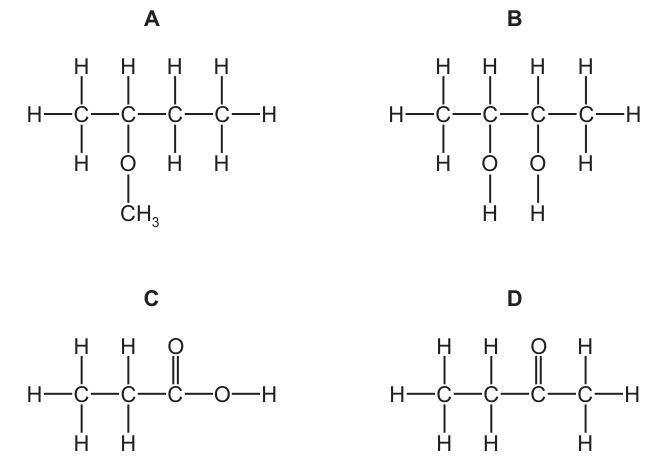
Working
- An alcohol contains the hydroxyl functional group () bonded directly to a carbon atom.
- A contains an ether linkage ().
- B contains two hydroxyl groups (), making it a diol (an alcohol).
- C contains a carboxylic acid group ().
- D contains a carbonyl group (, ketone).
Therefore, B is an alcohol.
Answer
B
B
Walkthrough
To identify which compound is an alcohol, look for the functional group characteristic of alcohols:
- The functional group of an alcohol is the hydroxyl group, written as (or shown with a single covalent bond between oxygen and hydrogen, ), attached directly to a carbon atom of a saturated hydrocarbon chain.
Let's analyse each given structure:
- Structure A: The oxygen atom is bonded to two carbon atoms (). This is an ether (2-methoxybutane), not an alcohol.
- Structure B: The molecule possesses two groups bonded to carbon atoms along the 4-carbon chain (specifically butane-2,3-diol). Because it contains hydroxyl functional groups, it belongs to the alcohol family (a diol).
- Structure C: Contains a carbon double-bonded to an oxygen and single-bonded to an group (). This is a carboxylic acid (propanoic acid).
- Structure D: Contains a carbon double-bonded to an oxygen () between two carbon atoms. This is a ketone (butan-2-one).
Hence, structure B is the correct choice.
Key Takeaways
- Alcohols are characterised by the presence of the (hydroxyl) group attached to a carbon skeleton.
- Carboxylic acids contain the group (both a and an attached to the same carbon).
Common Mistakes
- Mistaking a carboxylic acid (structure C) for an alcohol because it contains an group. In a carboxylic acid, the is bonded to a carbonyl carbon (), which forms a distinct functional group with different chemical properties.
Things to Be Careful About
- Ensure the group is attached to a standard alkyl carbon and not part of a larger carbonyl/carboxyl group.
An ester has the structural formula .
What is the name of this ester?
Options
A ethyl propanoate
B methyl propanoate
C propyl ethanoate
D propyl methanoate
Working
An ester's name consists of two parts:
- The alkyl group derived from the alcohol: attached to the single-bonded oxygen atom. Here, contains 3 carbon atoms, which corresponds to propyl.
- The carboxylate group derived from the carboxylic acid: contains the carbonyl carbon. Here, contains 2 carbon atoms, which corresponds to ethanoate.
Combining these gives the name propyl ethanoate.
- A (ethyl propanoate) has formula .
- B (methyl propanoate) has formula .
- D (propyl methanoate) has formula .
Answer
C
C
Walkthrough
Esters are formed in a condensation reaction between a carboxylic acid and an alcohol.
To name an ester from its formula :
- Identify the part originating from the alcohol (), which is bonded to the oxygen atom. In , the alkyl group on the right is (propan-1-ol derivative), giving the first word propyl.
- Identify the acyl part originating from the carboxylic acid (), which includes the carbonyl carbon. In this compound, has 2 carbon atoms (ethanoic acid derivative), giving the second word ethanoate.
Putting both parts together gives propyl ethanoate, which corresponds to option C.
Key Takeaways
- Esters are named as [alkyl group from alcohol] [carboxylate group from acid].
- Always count all the carbon atoms in the acid part, including the carbonyl carbon ().
Common Mistakes
- Inverting the order of naming (e.g. naming the acid part first, leading to ethyl propanoate or confusing it with an isomer).
- Miscounting the carbon atoms in the acid chain by forgetting to count the carbonyl carbon atom in .
Things to Be Careful About
- The formula is written with the acid component on the left and the alcohol component on the right. When written as , the connectivity is the same, so ensure you always identify which side is attached to the oxygen atom and which side contains the carbonyl group.
Petroleum is separated into fractions in a fractionating column.
Which property of the fractions increases from the bottom to the top of the column?
Options
A boiling point
B chain length
C viscosity
D volatility
Working
In the fractional distillation of petroleum, the temperature decreases from the bottom to the top of the fractionating column.
As you move from the bottom to the top:
- Hydrocarbon molecules become smaller (shorter chain length).
- Intermolecular attractive forces become weaker.
- Boiling point decreases.
- Viscosity decreases (the liquids flow more easily).
- Flammability and volatility increase (fractions evaporate more easily at lower temperatures).
Therefore, volatility is the property that increases from the bottom to the top of the column.
Answer
D
D
Walkthrough
Petroleum (crude oil) is a mixture of hydrocarbons with different carbon chain lengths and boiling points. It is separated by fractional distillation in a fractionating column that is hot at the bottom and cooler at the top.
- At the bottom of the column: The temperature is high. Fractions collected here (such as bitumen and lubricating oil) consist of large molecules with long carbon chains. Because of their large surface area, these molecules have strong intermolecular forces. As a result, they have high boiling points, high viscosity (they are thick and do not flow easily), and low volatility (they do not evaporate easily).
- At the top of the column: The temperature is cooler. Fractions collected near or at the top (such as refinery gases and petrol/gasoline) consist of small molecules with short carbon chains and weak intermolecular forces. Consequently, they have low boiling points, low viscosity, and high volatility.
Therefore, from the bottom to the top of the column, volatility increases, making D the correct option.
Key Takeaways
- As carbon chain length decreases (moving up the column):
- Boiling point decreases
- Viscosity decreases
- Flammability increases
- Volatility increases
Common Mistakes
- Confusing volatility (ease of evaporation) with viscosity (resistance to flow).
- Reversing the direction of the trend (e.g. thinking boiling point increases towards the top of the column instead of decreasing).
Things to Be Careful About
- Always double-check the direction stated in the question: "from the bottom to the top" means from long-chain, high-boiling fractions to short-chain, low-boiling fractions.
Three statements about alkanes are listed.
- They contain carbon and hydrogen only.
- They contain only single covalent bonds.
- They are saturated hydrocarbons.
Which statements are correct?
Options
A 1, 2 and 3
B 1 and 2 only
C 2 and 3 only
D 3 only
Working
- Statement 1: Alkanes are hydrocarbons, which means they consist of carbon and hydrogen atoms only. Statement 1 is correct.
- Statement 2: The carbon and hydrogen atoms in alkanes are joined exclusively by single covalent bonds ( and ). Statement 2 is correct.
- Statement 3: Because alkanes contain only single covalent bonds and no double bonds, they are saturated. Being composed solely of carbon and hydrogen, they are saturated hydrocarbons. Statement 3 is correct.
Since statements 1, 2, and 3 are all correct, option A is the correct choice.
Answer
A
A
Walkthrough
To determine the correct option, each statement about alkanes must be evaluated:
-
"They contain carbon and hydrogen only."
- By definition, a hydrocarbon is a compound containing hydrogen and carbon only. Alkanes are a homologous series of hydrocarbons, so this statement is correct.
-
"They contain only single covalent bonds."
- Each carbon atom in an alkane forms four single covalent bonds (either single bonds or single bonds). There are no multiple bonds (such as double bonds) present. Hence, this statement is correct.
-
"They are saturated hydrocarbons."
- A organic molecule is described as saturated when all carbon-carbon bonds are single bonds (meaning no more hydrogen atoms can be added across a double bond). Because alkanes are hydrocarbons with only single bonds, they are saturated hydrocarbons. Hence, this statement is correct.
Since statements 1, 2, and 3 are all true, option A is the correct answer.
Key Takeaways
- A hydrocarbon is a compound containing carbon and hydrogen only.
- Saturated means the molecule contains only single carbon-carbon bonds.
- Alkanes have the general formula and are saturated hydrocarbons.
Common Mistakes
- Confusing alkanes (saturated, single bonds only) with alkenes (unsaturated, containing at least one double bond).
- Thinking hydrocarbons can contain elements other than carbon and hydrogen (e.g., confusing them with alcohols or carboxylic acids).
Things to Be Careful About
- Ensure you check every statement independently before selecting the matching combination from the multiple-choice options.
The flowchart shows some reactions of hydrocarbons.

Which row is correct?
Options
| process 1 | condition 2 | |
|---|---|---|
| A | cracking | heat with nickel catalyst |
| B | fractional distillation | heat with acid catalyst |
| C | cracking | heat with acid catalyst |
| D | fractional distillation | heat with nickel catalyst |
Working
-
Identify Process 1:
- Saturated hydrocarbons with large molecules (long-chain alkanes) are broken down into smaller, unsaturated hydrocarbons (alkenes).
- This chemical process is known as cracking.
- Fractional distillation only physically separates fractions by boiling point without breaking covalent bonds or changing saturated molecules into unsaturated ones. This eliminates options B and D.
-
Identify Condition 2:
- The reaction of an unsaturated hydrocarbon (alkene) with hydrogen () to produce a saturated hydrocarbon (alkane) is an addition reaction (hydrogenation).
- Hydrogenation requires heat and a nickel catalyst (typically at around ).
- An acid catalyst (such as concentrated ) is used for the addition of steam (hydration) to form alcohols, not for hydrogenation. This eliminates option C.
Therefore, row A is correct.
Answer
A
A
Walkthrough
-
Step 1: Determine Process 1
- Large alkane molecules from petroleum fractions have low demand. They undergo catalytic or thermal cracking (high temperature with a catalyst such as ) to be broken down into more useful, smaller molecules, including alkenes (unsaturated hydrocarbons) and short-chain alkanes or hydrogen.
- Therefore, process 1 is cracking.
-
Step 2: Determine Condition 2
- The addition of hydrogen gas across the double bond of an alkene converts it into an alkane (a saturated hydrocarbon). This reaction is called hydrogenation (or catalytic addition of hydrogen).
- The standard industrial condition for hydrogenation is heating in the presence of a nickel () catalyst.
- Therefore, condition 2 is heat with nickel catalyst.
Combining both conclusions gives option A.
Key Takeaways
- Cracking converts long-chain alkanes into smaller, more valuable alkanes and alkenes.
- Hydrogenation of alkenes involves adding across the double bond to form alkanes, requiring a nickel catalyst and heat.
Common Mistakes
- Confusing fractional distillation (a physical separation method based on boiling points) with cracking (a chemical breakdown reaction).
- Confusing the catalyst for hydrogenation (nickel catalyst) with that for hydration (addition of steam to form alcohols, which uses an acid catalyst such as phosphoric acid, ).
Things to Be Careful About
- Check whether the reaction adds hydrogen (requires and heat) or steam (requires acid catalyst and high pressure/temperature). Always match the specific reagent added () with its corresponding conditions.
The structure of a condensation polymer is shown.

Which two monomers form this polymer?
Options
A and
B and
C and
D and
Working
The polymer in Fig. 5 contains amide links (), meaning it is a polyamide formed from a diamine and a dicarboxylic acid. To find the monomers, identify the repeating unit and break the chain at the amide bonds (the bonds), adding an to the nitrogen end and an to the carbonyl carbon end.
- Identify the repeating unit: The chain alternates between a nitrogen-containing part and a carbonyl-containing part. The repeating unit is .
- Break at the amide links:
- The diamine part is , which comes from (ethanediamine).
- The dicarboxylic acid part is , which comes from (butanedioic acid).
- Check the options:
- A uses a 2-carbon diamine () and a 2-carbon dicarboxylic acid (). Incorrect.
- B uses a 2-carbon diamine () and a 4-carbon dicarboxylic acid (). Incorrect diamine.
- C uses a 1-carbon diamine () and a 4-carbon dicarboxylic acid (). This matches our derivation perfectly.
- D uses a 1-carbon diamine () and a 2-carbon dicarboxylic acid (). Incorrect dicarboxylic acid.
The correct monomers are and .
Answer
C
C
Walkthrough
- Identify the polymer type: The displayed formula in Fig. 5 shows repeating groups. These are amide links, which characterise polyamides. Polyamides are formed by condensation polymerisation between a diamine (a molecule with two groups) and a dicarboxylic acid (a molecule with two groups), releasing water at each link.
- Locate the repeating unit: Scan the chain for the amide bonds and trace the atoms between them. The repeating unit is . Notice the asymmetry: one side has a single group between two nitrogens, and the other side has two groups between two carbonyls.
- Deduce the monomers: To reverse the condensation reaction, break the polymer at the bonds of the amide links. Add an atom to each nitrogen to reform the groups, and add an group to each carbonyl carbon to reform the groups.
- Breaking the nitrogen-containing segment gives .
- Breaking the carbonyl-containing segment gives .
- Evaluate the options: Compare these deduced monomers with the choices. Option C is the only one that matches both the diamine () and the dicarboxylic acid (). Options A, B, and D have incorrect carbon chain lengths for one or both monomers.
Key Takeaways
- Condensation polymers like polyamides are formed from monomers with two functional groups each (e.g., a diamine and a dicarboxylic acid).
- The repeating unit can be identified by finding the amide link () and tracing the chain between them.
- To find the original monomers from a polymer structure, break the polymer at the linking bonds (the bonds of the amide groups) and add an to the amine end and an to the carboxylic acid end.
Common Mistakes
- Misidentifying the repeating unit by not correctly locating the amide link and breaking the chain at the right place. Breaking at the wrong bond (e.g. inside the chain) gives incorrect monomers.
- Counting the carbon atoms incorrectly in the monomer options. Remember to include the carbonyl carbon () when counting the carbons in a dicarboxylic acid. For example, has 3 carbons total (ethanedioic acid), while has 4 carbons (butanedioic acid).
- Confusing the diamine (which has one group) with (which has two groups).
Things to Be Careful About
- When breaking amide links to find monomers, always add to the nitrogen and to the carbonyl carbon. Do not add to the carbonyl carbon or to the nitrogen, as this would produce incorrect functional groups.
- Pay close attention to the number of groups in each segment of the polymer chain. A single between two nitrogens indicates , while two groups between carbonyls indicates .
A titration is completed.
of aqueous sodium hydroxide is added to a conical flask.
A few drops of methyl orange indicator are added.
Dilute hydrochloric acid is added slowly to the mixture until the colour changes.
Which row is correct?
Options
| apparatus used to add alkali | apparatus used to add acid | colour change of indicator | |
|---|---|---|---|
| A | volumetric pipette | burette | red to orange |
| B | measuring cylinder | burette | red to orange |
| C | volumetric pipette | burette | yellow to orange |
| D | volumetric pipette | measuring cylinder | yellow to orange |
Working
- To accurately deliver a fixed volume of of aqueous sodium hydroxide into the conical flask, a volumetric pipette is used.
- To add the dilute hydrochloric acid dropwise/slowly until the end-point is reached and record the variable titre volume, a burette is used.
- Methyl orange indicator is yellow in alkaline solution (aqueous ) and turns orange at the neutral end-point (and red in excess acid). Therefore, as acid is added to the alkali until the colour change occurs at the end-point, the colour change observed is yellow to orange.
Matching these gives row C.
Answer
C
C
Walkthrough
-
Apparatus for measuring fixed volume of alkali ():
- A volumetric pipette (or simply pipette) is designed to measure and deliver a fixed, highly accurate volume (such as ) of liquid into the conical flask.
- A measuring cylinder is not sufficiently accurate for quantitative volumetric titration analysis.
-
Apparatus for adding acid:
- A burette is calibrated to deliver variable volumes accurately drop by drop and allows the user to read the initial and final volumes to determine the exact volume of acid needed for neutralisation.
-
Indicator colour change:
- Methyl orange has distinct colours depending on pH:
- In an alkaline solution (), it is yellow.
- In an acidic solution (), it is red.
- At the titration end-point (neutralisation of a strong base by a strong acid), the colour changes from yellow through to orange.
- Since the flask initially contains (alkali), the starting colour is yellow. As is added until neutralisation, the colour changes from yellow to orange.
- Methyl orange has distinct colours depending on pH:
Therefore, row C is correct.
Key Takeaways
- In acid-base titrations, a volumetric pipette is used to transfer a precise fixed aliquot (e.g., ) of analyte, and a burette is used to deliver the titrant.
- Methyl orange colours:
- Alkali: Yellow
- End-point: Orange
- Acid: Red
Common Mistakes
- Confusing methyl orange colours with other indicators (e.g., phenolphthalein, which is pink in alkali and colourless in acid, or litmus, which is blue in alkali and red in acid).
- Thinking the titration starts in acid (red) and goes to alkali, forgetting that the alkali was placed in the conical flask first.
- Choosing a measuring cylinder instead of a pipette for measuring the sample.
Things to Be Careful About
- Always identify which solution is placed in the conical flask (the starting solution) and which solution is in the burette (the added solution) to deduce the correct direction of the colour change (e.g., yellow to orange vs red to orange).
An impure sample of compound X has a melting point of .
X is purified and its melting point is measured again.
Which row is correct?
Options
| method of purifying X | melting point of pure X / | |
|---|---|---|
| A | crystallisation | 125 |
| B | crystallisation | 115 |
| C | distillation | 125 |
| D | distillation | 115 |
Working
-
State of substance X and purification method:
Compound X has a melting point of , meaning it is a solid at room temperature. A solid dissolved in a solution is purified by crystallisation (or recrystallisation), whereas distillation is typically used to purify or separate liquids. -
Effect of purity on melting point:
Impurities disrupt the regular lattice structure of a solid, weakening the forces holding the particles together. As a result, an impure solid melts at a lower temperature and over a broader temperature range than the pure substance.
Therefore, pure X must have a higher melting point than the impure sample (), meaning its melting point is .
Matching both deductions leads to row A.
Answer
A
A
Walkthrough
To determine the correct row, two chemical concepts need to be evaluated:
-
Method of Purification:
Compound X has a melting point well above room temperature (), indicating that it exists as a solid under normal conditions. Crystallisation is the standard separation technique used to purify a crystalline solid from solution, while distillation is used to separate a solvent from a solution or liquids with different boiling points. -
Effect of Impurities on Melting Point:
A pure substance has a sharp, characteristic melting point. When impurities are present in a solid, they disrupt the regular arrangement of the particles within the crystal lattice, making it easier to break the lattice structure. Consequently, impurities lower (depress) the melting point and cause it to melt over a wider temperature range. When the sample is purified, the true, higher melting point is restored. Since the impure sample melted at , pure X must have a melting point greater than (i.e. ).
Combining these two points:
- Method: crystallisation
- Melting point of pure X:
Thus, row A is the correct answer.
Key Takeaways
- Impurities decrease the melting point of a substance and broaden the melting range.
- Impurities increase the boiling point of a liquid.
- Crystallisation is used to obtain pure solid crystals from a solution.
Common Mistakes
- Confusing the effect of impurities on melting point with that on boiling point (e.g. thinking impurities increase the melting point, which would incorrectly lead to option B).
- Choosing distillation instead of crystallisation for a solid substance.
Things to Be Careful About
- Always identify the physical state of the compound first to choose the appropriate separation technique (solid crystallisation/filtration; liquid distillation).
Samples of two compounds, P and Q, are tested. The result of each test is shown.
| test | P | Q |
|---|---|---|
| add dilute hydrochloric acid | gas given off that turns limewater milky | no observable change |
| acidify with dilute nitric acid then add aqueous barium nitrate | no precipitate forms | white precipitate |
| add aqueous sodium hydroxide | no observable change | green precipitate, soluble in excess |
| add aqueous ammonia | no observable change | green precipitate, insoluble in excess |
| flame test | lilac flame | not tested |
Which row shows the identities of the ions present in P and Q?
Options
| P | Q | |
|---|---|---|
| A | and | and |
| B | and | and |
| C | and | and |
| D | and | and |
Working
-
Identify ions in P:
- Adding dilute produces a gas that turns limewater milky (), confirming the presence of carbonate ions, .
- A lilac flame test confirms the presence of potassium ions, .
- Thus, contains and .
-
Identify ions in Q:
- Acidifying with dilute nitric acid followed by aqueous barium nitrate gives a white precipitate of , confirming the presence of sulfate ions, .
- Adding aqueous gives a green precipitate that is soluble in excess (forming a green solution), while adding aqueous gives a green precipitate insoluble in excess. This is characteristic of chromium(III) ions, . (Note: forms a green precipitate insoluble in excess of both and ).
- Thus, contains and .
Matching these gives row C.
Answer
C
C
Walkthrough
To identify the ions present in compounds and :
-
Compound P:
- Anion: Reaction with dilute hydrochloric acid releases carbon dioxide gas (which turns limewater milky / cloudy), showing that carbonate ions () are present:
- Cation: The flame test gives a distinctive lilac flame, which confirms potassium ions ().
-
Compound Q:
- Anion: Acidifying with dilute nitric acid followed by barium nitrate forms a white precipitate of barium sulfate, confirming sulfate ions ():
- Cation: The reaction with aqueous sodium hydroxide produces a green precipitate (chromium(III) hydroxide) that dissolves in excess to give a green solution. With aqueous ammonia, it gives a green precipitate that remains insoluble in excess. This confirms chromium(III) ions ().
Therefore, row C correctly identifies as containing and and as containing and .
Key Takeaways
- reacts with acid to give gas (tested with limewater).
- forms a white precipitate with in acidic solution.
- gives a lilac flame, while gives a red flame.
- gives a green precipitate soluble in excess but insoluble in excess . In contrast, forms a green precipitate that is insoluble in excess of both reagents.
Common Mistakes
- Confusing and : both give a green precipitate with dilute , but only dissolves in excess .
- Confusing flame test colours, such as lilac for versus red for .
Things to Be Careful About
- Always check both the initial precipitate colour and whether it dissolves in excess reagent when distinguishing transition metal cations.
Your score so far
Answer a question to start scoring
Your marks add up here as you work through the paper.