Chemistry 5070/22 — October/November 2024
Cambridge O-Level · Theory · worked solutions for every part, with the mark scheme
Topics Stoichiometry · Chemical Reactions · Atoms, Elements and Compounds · Metals · The Periodic Table · Organic Chemistry · +6 more
Fig. 1.1 shows the electronic configurations of five atoms, A, B, C, D and E.
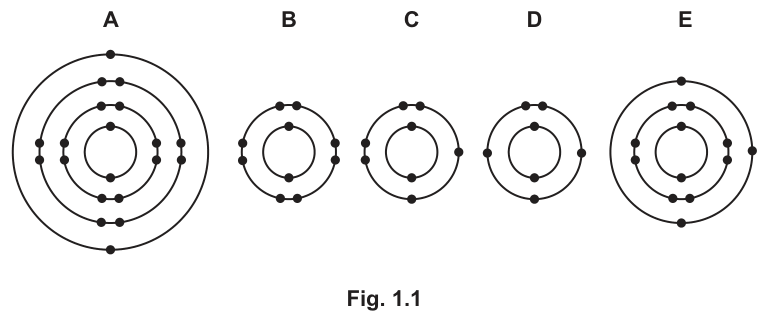
Answer the questions about these electronic configurations.
Each electronic configuration may be used once, more than once or not at all.
State which electronic configuration, A, B, C, D or E, represents:
Answer
E
E
Walkthrough
Noble gases are in Group 0 of the Periodic Table. Their atoms have a full outer shell of electrons. For the first two periods, a full outer shell is 8 electrons (except helium, which is 2). Looking at the configurations:
- A: 2, 8, 3 (outer shell has 3)
- B: 2, 7 (outer shell has 7)
- C: 2, 5 (outer shell has 5)
- D: 2, 6 (outer shell has 6)
- E: 2, 8, 8 (outer shell has 8, and it is full)
Configuration E represents argon, a noble gas.
Key Takeaways
Noble gases have full outer electron shells. For elements in Period 2 and 3, this is 8 electrons in the outermost shell.
Common Mistakes
Confusing the total number of electrons with the outer shell number. Always check the outermost circle.
Things to Be Careful About
Helium is a noble gas with only 2 electrons (2), but it is not present here. For Period 2 and 3 elements, the full shell is 8.
an atom of an element that is used in food containers because of its resistance to corrosion
______
Answer
A
A
Walkthrough
The element used in food containers (like cans and foil) due to its resistance to corrosion is aluminium. Aluminium is in Group III and Period 3 of the Periodic Table. Its atomic number is 13, so its electronic configuration is 2, 8, 3. Looking at the options, configuration A is 2, 8, 3.
Key Takeaways
Aluminium (2, 8, 3) is a lightweight metal with a protective oxide layer, making it resistant to corrosion and suitable for food packaging.
Common Mistakes
Choosing argon (E) because it is unreactive, but it is a gas and not used for containers.
Things to Be Careful About
Ensure you match the correct metal to its use. Aluminium is Group III (3 outer electrons), not Group I or II.
Answer
C
C
Walkthrough
For main group elements (Groups I to VII), the group number is equal to the number of electrons in the outer shell. Group V elements have 5 outer electrons.
- A: 3 outer electrons (Group III)
- B: 7 outer electrons (Group VII)
- C: 5 outer electrons (Group V)
- D: 6 outer electrons (Group VI)
- E: 8 outer electrons (Group 0)
Configuration C (2, 5) represents nitrogen, which is in Group V.
Key Takeaways
The number of outer shell electrons determines the group number for elements in Groups I–VII.
Common Mistakes
Confusing group number with period number or total number of electrons.
Things to Be Careful About
This rule applies to Groups I–VII and 0. Transition metals do not follow this simple rule.
Answer
E
(or A)
E
Walkthrough
The period number of an element is equal to the number of electron shells (energy levels) it has.
- A: 3 shells (Period 3)
- B: 2 shells (Period 2)
- C: 2 shells (Period 2)
- D: 2 shells (Period 2)
- E: 3 shells (Period 3)
Both A and E are in Period 3. The mark scheme accepts E (argon), though A (aluminium) is also correct. We will provide E as the primary answer.
Key Takeaways
The period number tells you how many electron shells an atom has.
Common Mistakes
Counting the total number of electrons instead of the number of shells.
Things to Be Careful About
Both A and E are valid answers for Period 3. If the question implies a unique answer, check if there are other constraints, but here both are correct.
Answer
D
D
Walkthrough
An ion with a 2- charge has gained 2 electrons. This happens when an atom has 6 outer electrons and needs 2 more to complete its outer shell (to reach 8).
- A: 3 outer electrons -> loses 3 to form 3+
- B: 7 outer electrons -> gains 1 to form 1-
- C: 5 outer electrons -> gains 3 to form 3-
- D: 6 outer electrons -> gains 2 to form 2-
- E: 8 outer electrons -> does not form ions
Configuration D (2, 6) represents oxygen, which forms the oxide ion O²⁻.
Key Takeaways
Non-metals gain electrons to form negative ions. The charge is (8 - number of outer electrons) with a negative sign.
Common Mistakes
Thinking atoms with 2 outer electrons form 2- ions (they lose 2 to form 2+).
Things to Be Careful About
Ensure you are looking for an atom that GAINS electrons to reach 8, not one that already has 2.
Deduce the number of protons and neutrons in the vanadium atom shown.
number of protons = ______
number of neutrons = ______
Answer
number of protons = 23
number of neutrons = 28
protons = 23, neutrons = 28
Walkthrough
In the isotope notation :
- (subscript) is the proton number (atomic number).
- (superscript) is the mass number (proton number + neutron number).
For :
- Proton number = 23
- Mass number = 51
Number of neutrons = Mass number - Proton number = 51 - 23 = 28.
Key Takeaways
Proton number is the bottom number; mass number is the top number. Neutrons = mass number - proton number.
Common Mistakes
Subtracting proton number from mass number incorrectly (e.g., 23 - 51 = -28).
Things to Be Careful About
Always ensure mass number is larger than proton number. The result for neutrons must be a positive integer.
Iron is extracted in the blast furnace by the reduction of iron(III) oxide, .
This process is made up of three steps.
In step 1, carbon burns in air to produce carbon dioxide.
Give one other reason why carbon is burned in air in the blast furnace.
______
Answer
To produce heat / to heat the furnace.
To produce heat / to heat the furnace
Walkthrough
In the blast furnace, coke (carbon) is burned in a blast of hot air. The main combustion reaction is
This reaction is strongly exothermic, so it releases heat. The question asks for one other reason why carbon is burned in air, and the credited answer is simply that it produces heat to keep the furnace hot. The carbon dioxide formed is then converted to carbon monoxide in step 2, and that carbon monoxide is the reducing agent that reduces iron(III) oxide.
Key Takeaways
- The blast furnace needs a very high temperature.
- Burning coke supplies that heat; the carbon monoxide produced later does the reducing.
Common Mistakes
- Writing “to produce carbon monoxide” as the reason. That is the purpose of step 2, not the reason for burning carbon in air in step 1.
- Saying “to reduce iron(III) oxide”; carbon itself is not the main reducing agent in the furnace.
Things to Be Careful About
- The answer must be about heat. “To make the furnace hot”, “to provide heat” and “to heat the furnace” are all accepted.
In step 2, carbon monoxide is produced by the reaction of carbon dioxide with carbon.
State one adverse effect of carbon monoxide on health.
______
Answer
Carbon monoxide is toxic / poisonous.
Toxic / poisonous
Walkthrough
Carbon monoxide is produced in the blast furnace when carbon dioxide reacts with more carbon. It is a colourless, odourless gas that is very dangerous because it is poisonous. It combines with haemoglobin in the blood and stops oxygen being carried around the body. The mark scheme only requires the word “toxic” or “poisonous”.
Key Takeaways
- Carbon monoxide is a toxic air pollutant.
- It is produced by incomplete combustion or by the reduction of carbon dioxide by carbon.
Common Mistakes
- Writing “it causes global warming” or “it is an acidic gas”. These are not credited.
- Describing a long mechanism when one word is enough for the mark.
Things to Be Careful About
- “Toxic” and “poisonous” are both accepted. “Harmful” alone may be too vague; use the credited word.
In step 3, iron(III) oxide is reduced by carbon monoxide.
Write the symbol equation for this reaction.
______
Answer
Fe2O3 + 3CO -> 2Fe + 3CO2
Walkthrough
Step 3 is the reduction of iron(III) oxide by carbon monoxide. Write the formulae first: iron(III) oxide is , carbon monoxide is , iron is and carbon dioxide is . The unbalanced equation is
Balance iron: two Fe atoms on the left, so put 2 before Fe. Balance carbon and oxygen together: if 3 CO molecules are used, 3 CO2 molecules form, giving 3 O from Fe2O3 plus 3 O from CO = 6 O on the left, and 6 O on the right as 3 CO2. So the balanced equation is
Key Takeaways
- A symbol equation must have the same number of each atom on both sides.
- Iron(III) oxide is reduced because oxygen is removed; carbon monoxide is oxidised to carbon dioxide.
Common Mistakes
- Writing or instead of .
- Forgetting the balancing coefficient 3 in front of CO and CO2.
- Leaving the equation unbalanced.
Things to Be Careful About
- State symbols are not required by the mark scheme, but if you add them they must be correct: .
Explain why calcium carbonate is added to the blast furnace.
Include any relevant reactions or equations in your answer.
______
Answer
Calcium carbonate decomposes to calcium oxide:
Calcium oxide reacts with the acidic impurity (sand / silicon dioxide) to form slag:
CaCO3 -> CaO + CO2; CaO + SiO2 -> CaSiO3
Walkthrough
Limestone is added to the blast furnace to remove the sandy impurity (silicon dioxide, SiO2) from the iron ore. In the hot furnace, calcium carbonate first undergoes thermal decomposition:
The calcium oxide formed is a basic oxide. It reacts with the acidic impurity silicon dioxide to form calcium silicate, which is the slag:
The molten slag is less dense than molten iron and is tapped off separately. The two marks come from these two reactions/roles.
Key Takeaways
- Calcium carbonate is not added to reduce iron oxide; it is added to remove impurities.
- Calcium oxide is basic and reacts with acidic sand to form slag.
Common Mistakes
- Writing only “to remove impurities” without giving the equations or naming the impurity.
- Writing directly; the mark scheme wants the two separate steps.
- Forgetting that the product is calcium silicate, .
Things to Be Careful About
- The mark scheme allows either the word description or the equation for each mark.
- “Sand”, “silicon dioxide” and “SiO2” are all accepted as the impurity.
Iron is a transition element.
Transition elements have high melting and boiling points.
State two other properties that are typical of transition elements but not of Group I metals.
- ______
- ______
Answer
- They form coloured compounds.
- They have variable oxidation numbers.
(Other acceptable answers: high density, act as catalysts, hard, less reactive than Group I metals.)
They form coloured compounds; they have variable oxidation numbers
Walkthrough
Iron is a transition element. The question already states that transition elements have high melting and boiling points, so that cannot be used again. Typical transition-element properties that are not shown by Group I metals include:
- forming coloured compounds (e.g. iron(II) salts are green, iron(III) salts are yellow-brown, copper(II) salts are blue);
- having variable oxidation numbers (iron can be Fe2+ or Fe3+, copper can be Cu+ or Cu2+);
- acting as catalysts;
- being dense and hard;
- being less reactive than Group I metals.
Any two of these score the two marks.
Key Takeaways
- Transition elements have characteristic properties that distinguish them from Group I metals.
- Group I metals form white/colourless compounds and only have oxidation number +1.
Common Mistakes
- Repeating “high melting and boiling points”, which is already given in the question.
- Writing “good conductors of electricity”; Group I metals are also good conductors, so this does not distinguish them.
- Listing only one property when two are asked for.
Things to Be Careful About
- The mark scheme accepts any two from: high density, coloured compounds, variable oxidation numbers, act as catalysts, not as reactive, hard.
- Write each property as a clear separate point.
Iron is prevented from rusting by galvanising with zinc.
Explain two different ways in which zinc prevents rusting.
______
Answer
Zinc forms a protective barrier, preventing oxygen and water from reaching the iron.
Zinc is more reactive than iron, so zinc corrodes in preference to iron, protecting the iron.
Zinc acts as a barrier to oxygen and water; zinc is more reactive than iron and corrodes preferentially
Walkthrough
Galvanising means coating iron with a layer of zinc. There are two ways this prevents rusting.
First, the zinc layer is a physical barrier. It stops oxygen and water from reaching the surface of the iron, and both are needed for rusting.
Second, zinc gives sacrificial protection. Zinc is higher in the reactivity series than iron, so if the coating is scratched and iron is exposed, zinc corrodes in preference to iron. The zinc loses electrons more readily than iron, so the iron remains protected even where the coating is damaged.
The mark scheme awards up to three marks from: zinc forms a protective layer/barrier; the barrier prevents oxygen/water reaching the iron; zinc is more reactive than iron; zinc corrodes in preference to iron.
Key Takeaways
- Rusting needs both oxygen and water.
- A more reactive metal can protect a less reactive metal by corroding in preference to it.
Common Mistakes
- Saying “zinc is less reactive than iron”; this is wrong and reverses the whole argument.
- Saying “zinc rusts”; rusting is the corrosion of iron, not zinc.
- Giving only “barrier” without saying what it stops reaching the iron.
Things to Be Careful About
- For full marks, mention both the barrier effect and the sacrificial effect.
- “Zinc corrodes in preference” is the key phrase for sacrificial protection.
The equation shows the reaction of iron with steam in a closed container.
Predict and explain what happens to the position of equilibrium when the pressure is increased. The temperature remains the same.
prediction = ______
explanation = ______
Answer
Prediction: no effect.
Explanation: there are the same number of moles of gas on each side of the equation.
No effect; equal moles of gas on both sides
Walkthrough
This is a reversible reaction in a closed container with gases on both sides. When the pressure is increased, the equilibrium shifts in the direction that has fewer moles of gas, to reduce the pressure. Count only the gaseous species:
Left-hand side: — 4 moles of gas.
Right-hand side: — 4 moles of gas.
The solids and are not counted because they do not contribute to gas pressure. Since the number of moles of gas is the same on both sides, increasing the pressure has no effect on the position of equilibrium.
Key Takeaways
- For a gaseous equilibrium, pressure changes only matter if the number of gas moles differs between the two sides.
- Equal moles of gas on both sides means no shift.
Common Mistakes
- Counting the solids as gas particles.
- Predicting a shift to the left or right when the gas moles are equal.
- Saying “the equilibrium shifts to the side with fewer moles” without noticing the moles are equal.
Things to Be Careful About
- The explanation must state that the number of moles of gas is the same on both sides.
- “Equal volumes of gas on each side” is also accepted.
reacts with concentrated hydrochloric acid.
The products are iron(II) chloride, iron(III) chloride and a liquid that turns blue cobalt(II) chloride paper pink.
Construct the symbol equation for this reaction.
______
Answer
Fe3O4 + 8HCl -> FeCl2 + 2FeCl3 + 4H2O
Walkthrough
The question tells you the products: iron(II) chloride, iron(III) chloride and a liquid that turns blue cobalt(II) chloride paper pink. Cobalt(II) chloride paper is the test for water, so the liquid is water.
Write the formulae:
- iron(II) chloride:
- iron(III) chloride:
- water:
So the unbalanced equation is
Balance it:
- Iron: 3 on the left, so 1 + 2 gives 3 Fe.
- Chlorine: 2 + 6 = 8 Cl, so 8 HCl.
- Hydrogen: 8 H from 8 HCl, so 4 .
- Oxygen: 4 O in , and 4 O in 4 .
The mark scheme gives one mark for correct formulae and one mark for correct balancing.
Key Takeaways
- Cobalt(II) chloride paper turning pink is the test for water.
- Iron can form two chlorides because it has variable oxidation numbers: Fe2+ and Fe3+.
Common Mistakes
- Writing the wrong formula for iron(III) chloride, e.g. or for both.
- Forgetting to include water as a product.
- Not balancing the equation.
Things to Be Careful About
- State symbols are not required by the mark scheme.
- Check every atom: Fe, H, Cl and O must balance.
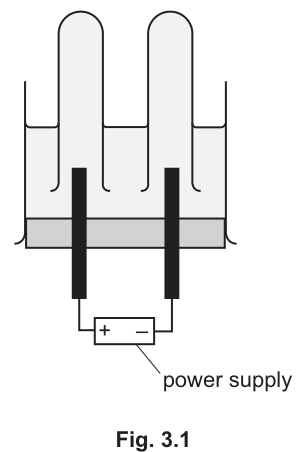
Fig. 3.1 shows the apparatus used for the electrolysis of dilute sulfuric acid using graphite electrodes.
Answer
Electrolysis is the decomposition of an aqueous or molten ionic compound by electricity (or electric current).
decomposition of an aqueous or molten ionic compound by electricity
Walkthrough
Electrolysis is defined as the chemical decomposition that occurs when an electric current is passed through an ionic substance. For the compound to conduct electricity and allow ions to move freely, it must either be dissolved in water (aqueous) or melted (molten). Solid ionic compounds do not conduct because their ions are fixed in the lattice. The two key components of the definition are therefore the process (decomposition of an ionic compound) and the energy source (electricity or electric current).
Key Takeaways
- Electrolysis requires an ionic compound that is either molten or in aqueous solution.
- The driving force is an electric current.
Common Mistakes
- Defining electrolysis as the decomposition of any compound (it must be ionic).
- Forgetting to mention that the compound must be molten or aqueous (solid ionic compounds do not conduct).
- Saying "by power" or "by voltage" instead of "by electricity" or "electric current".
Things to Be Careful About
- Both parts of the definition are required for the two marks: the nature of the substance (aqueous/molten ionic compound) and the method (electricity/current).
Answer
The anode is the electrode connected to the positive terminal of the power supply. In Fig. 3.1, label the left-hand electrode as "anode".
left hand electrode
Walkthrough
In an electrolytic cell, the anode is always the electrode connected to the positive terminal of the power supply, where oxidation (loss of electrons) occurs. Looking at Fig. 3.1, the '+' terminal is on the left side of the power supply, and the wire from this terminal connects to the left-hand graphite electrode. Therefore, the left-hand electrode is the anode and should be labelled as such.
Key Takeaways
- Anode = positive electrode (connected to '+').
- Cathode = negative electrode (connected to '–').
Common Mistakes
- Confusing the anode and cathode and labelling the right-hand electrode.
- Forgetting to actually write the word "anode" on the diagram.
Things to Be Careful About
- The label must be clearly written on or next to the correct electrode. A line pointing to the electrode is acceptable, but the text must be legible.
Answer
Hydrogen
hydrogen
Walkthrough
In the electrolysis of dilute sulfuric acid ( in water), the ions present are , , and . At the cathode (negative electrode), positive ions are attracted. The only positive ion is . Hydrogen is below copper in the reactivity series but above hydrogen in the case of aqueous solutions; more simply, is the only cation present, so it is discharged. Hydrogen ions gain electrons to form hydrogen gas: .
Key Takeaways
- At the cathode, cations gain electrons (reduction).
- In dilute sulfuric acid, is the only cation, so hydrogen gas is produced.
Common Mistakes
- Suggesting that sulfur or sulfate is produced at the cathode (sulfate is an anion and goes to the anode).
- Forgetting that hydrogen is a gas and writing "H" instead of "hydrogen" or "".
Things to Be Careful About
- The question asks for the "name" of the product, so write "hydrogen", not "" (though is often accepted, the name is safer when asked for a name).
Oxygen is formed at the anode.
Construct the ionic half-equation for the reaction at the anode.
______
Answer
4OH⁻ → O₂ + 2H₂O + 4e⁻
Walkthrough
At the anode (positive electrode), negative ions are attracted. The anions present are and . Hydroxide ions are discharged in preference to sulfate ions in dilute solutions. The hydroxide ions lose electrons (oxidation) to form oxygen gas and water. To balance the equation, four hydroxide ions are needed to produce one oxygen molecule, two water molecules, and four electrons.
Key Takeaways
- At the anode, anions lose electrons (oxidation).
- In dilute sulfuric acid, is discharged over , producing oxygen gas and water.
Common Mistakes
- Writing the half-equation for sulfate discharge (which does not happen in dilute solutions).
- Forgetting to balance the equation or to include the electrons.
- Writing on the wrong side of the equation.
Things to Be Careful About
- Ensure the equation is balanced in both mass and charge. The left side has a total charge of , and the right side has from the electrons. State symbols are not required for this half-equation in 5070 unless specified, but if included, , , and are correct.
Name a suitable element other than graphite that is used for the electrodes in this electrolysis.
______
Answer
Platinum
platinum
Walkthrough
Electrodes used in electrolysis must be inert, meaning they do not react with the electrolyte or the products formed. Graphite (a form of carbon) is commonly used because it is cheap and inert. Another suitable element that is inert and conducts electricity well is platinum.
Key Takeaways
- Electrodes must be inert to avoid unwanted side reactions.
- Platinum is a common alternative to graphite for inert electrodes.
Common Mistakes
- Suggesting reactive metals like copper or iron (these would dissolve at the anode instead of producing oxygen).
- Suggesting non-conductors like gold (gold is inert but a poor conductor and not typically used; platinum is the standard answer).
Things to Be Careful About
- The question asks for a "suitable element", so "platinum" is the correct answer. "Carbon" is not an element other than graphite in this context, and "gold" is not a standard acceptable answer for O Level.
This question is about alkanes and alkenes.
Butane belongs to the alkane homologous series.
Members of the same homologous series have the same functional group and the same general formula.
State two other characteristics of a homologous series.
- ______
- ______
Answer
- Differ from one member to the next by a –CH₂– unit.
- Have similar chemical properties.
(Accept: trend in physical properties instead of similar chemical properties.)
Differ from one member to the next by a –CH₂– unit; have similar chemical properties.
Walkthrough
A homologous series is a family of organic compounds that share a common structural feature. To score the two marks, recall the three defining characteristics taught for homologous series and select any two:
- Each member differs from the next by a –CH₂– unit.
- They share the same general formula.
- They exhibit similar chemical properties due to the same functional group.
- They show a trend in physical properties (e.g. boiling points increase with chain length).
The question already states the first two, so the remaining two are similar chemical properties and a trend in physical properties.
Key Takeaways
Memorise the four defining characteristics of a homologous series. Examiners often test this by giving two and asking for the other two.
Common Mistakes
- Writing "same molecular formula" (that is isomerism, not a homologous series).
- Writing "same empirical formula" (that applies to alkenes and cycloalkanes, not the whole series).
Things to Be Careful About
Ensure you write the –CH₂– unit correctly with the minus signs. Do not just say "same formula"; specify the –CH₂– difference.
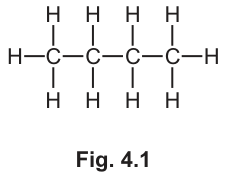
Fig. 4.1 shows the displayed formula of butane.
Answer
All the carbon–carbon bonds are single bonds.
All the carbon-carbon bonds are single bonds.
Walkthrough
A saturated compound is one that contains only single bonds between carbon atoms. Looking at Fig. 4.1, every line connecting a carbon atom to another carbon atom is a single line, representing a single covalent bond. There are no double or triple carbon–carbon bonds present.
Key Takeaways
Saturated means only single C–C bonds. Unsaturated means at least one C=C or C≡C bond. Displayed formulas show every bond, making it easy to spot saturation.
Common Mistakes
- Saying "it has only single bonds" without specifying carbon–carbon bonds. (C–H bonds are always single in alkanes; the definition of saturation depends on the C–C bonds).
- Writing "it has hydrogen" (that does not define saturation).
Things to Be Careful About
Be precise: state that the carbon–carbon bonds are single. Just saying "single bonds" is too vague because C–H bonds are also single in both saturated and unsaturated compounds.
Answer
CH₃CH₂CH₂CH₃
CH3CH2CH2CH3
Walkthrough
A structural formula shows the atoms and how they are arranged in groups, but omits the bonds. Starting from the left in Fig. 4.1:
- The first carbon has 3 hydrogens: CH₃
- The second carbon has 2 hydrogens: CH₂
- The third carbon has 2 hydrogens: CH₂
- The fourth carbon has 3 hydrogens: CH₃
Combine them in order: CH₃CH₂CH₂CH₃.
Key Takeaways
Displayed formulas show every atom and every bond. Structural formulas group the hydrogens with their carbon and drop the bond lines. Condensed structural formulas are written exactly like this.
Common Mistakes
- Writing the molecular formula C₄H₁₀ (that is not a structural formula).
- Forgetting to write the hydrogens in brackets or grouping them correctly (e.g. CH3-CH2-CH2-CH3 is acceptable, but CH3CH2CH2CH3 is the standard compact form).
Things to Be Careful About
Ensure the order of atoms matches the carbon chain. Do not write CH₃CH₂CH₃CH₂ (that is not butane).
Nonane, , is present in the naphtha fraction from the distillation of petroleum.
Answer
Chemical feedstock.
Chemical feedstock
Walkthrough
The naphtha fraction from fractional distillation of petroleum has a low boiling point range and is primarily used as a chemical feedstock for making plastics, synthetic fibres, and other chemicals via cracking and other processes. It can also be used as a petrol blending component or as a solvent, but "chemical feedstock" is the most common and expected answer for naphtha.
Key Takeaways
Each petroleum fraction has characteristic uses. Naphtha is mainly a feedstock for the petrochemical industry.
Common Mistakes
- Saying "fuel" or "gasoline" (that is the petrol fraction, which is slightly lower boiling than naphtha, though they overlap; naphtha is specifically valued as a feedstock).
- Saying "lubricating oil" (that is a higher fraction).
Things to Be Careful About
Match the fraction to its primary industrial use. Naphtha = feedstock. Petrol = fuel. Diesel = fuel/heating. Bitumen = road surfacing.
When nonane is cracked, shorter hydrocarbon molecules are formed.
Construct the symbol equation for a reaction in which nonane is cracked and the only products are propane and ethene.
______
Answer
C9H20 -> C3H8 + 3C2H4
Walkthrough
Cracking breaks a long-chain alkane into a shorter alkane and an alkene. The reactant is nonane: C₉H₂₀. The products given are propane (C₃H₈) and ethene (C₂H₄).
Write the unbalanced equation:
C₉H₂₀ → C₃H₈ + C₂H₄
Balance the carbons: 9 = 3 + 2x → 2x = 6 → x = 3. So we need 3 molecules of ethene.
Check hydrogens: 20 = 8 + (3 × 4) = 8 + 12 = 20. Balanced.
Final equation: C₉H₂₀ → C₃H₈ + 3C₂H₄.
Key Takeaways
In cracking, the total number of carbon and hydrogen atoms must be conserved. If one product is an alkane (CₙH₂ₙ₊₂) and the other is an alkene (CₘH₂ₘ), balance by adjusting the coefficient of the alkene.
Common Mistakes
- Forgetting to balance the equation (e.g. writing C₉H₂₀ → C₃H₈ + C₂H₄).
- Writing the wrong formula for propane or ethene.
- Including state symbols (not required unless specified).
Things to Be Careful About
Ensure the equation is fully balanced. The mark scheme awards one mark for correct formulae and one for correct balancing. Write the coefficient '3' clearly in front of C₂H₄.
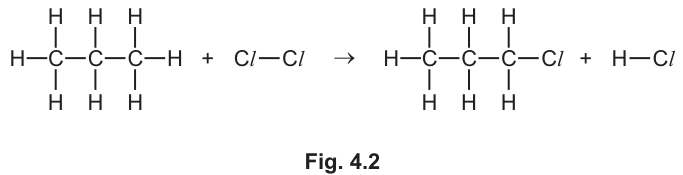
Propane reacts with chlorine in the presence of ultraviolet light.
Fig. 4.2 shows the displayed formulae of the reactants and products.
Answer
Substitution.
Substitution
Walkthrough
In the reaction, one hydrogen atom in propane is replaced by a chlorine atom, and the hydrogen combines with the other chlorine atom to form HCl. An atom or group of atoms in a molecule is replaced by another atom or group. This is the definition of a substitution reaction.
Key Takeaways
Alkanes undergo substitution reactions with halogens in the presence of UV light. The hydrogen is substituted by the halogen.
Common Mistakes
- Writing "addition" (that is for alkenes, where the double bond opens up and atoms add across it).
- Writing "combustion" (that would require oxygen and produce CO₂ and H₂O).
Things to Be Careful About
Substitution is specific to alkanes (and some aromatics) under UV light. Addition is for alkenes/alkynes.
Answer
It provides the activation energy for the reaction.
Provides the activation energy
Walkthrough
The reaction between an alkane and a halogen is very slow at room temperature because the C–H bond is strong. Ultraviolet light provides the energy needed to break the Cl–Cl bond homolytically, initiating the free-radical chain reaction. In O Level terms, UV light provides the activation energy.
Key Takeaways
UV light is the energy source that initiates free-radical substitution by supplying the activation energy to break the halogen bond.
Common Mistakes
- Saying "UV light is a catalyst" (it is not; it is consumed as energy and does not appear in the overall equation).
- Saying "UV light speeds up the reaction" (vague; specify activation energy).
Things to Be Careful About
Do not call UV light a catalyst. It provides energy. The mark scheme specifically looks for "activation energy".
Calculate the enthalpy change of this reaction in .
Use the bond energies in Table 4.1.
Table 4.1
| type of bond | C–C | C–H | Cl–Cl | C–Cl | H–Cl |
|---|---|---|---|---|---|
| bond energy in | 347 | 413 | 243 | 346 | 432 |
enthalpy change = ______
Working
Bonds broken: 1 × C–H (413) + 1 × Cl–Cl (243) = 656 kJ / mol
Bonds formed: 1 × C–Cl (346) + 1 × H–Cl (432) = 778 kJ / mol
Enthalpy change = energy to break bonds − energy released when bonds form
Enthalpy change = 656 − 778 = −122 kJ / mol
Answer
−122
-122
Walkthrough
To calculate the enthalpy change using bond energies:
- Identify which bonds are broken in the reactants: one C–H bond and one Cl–Cl bond.
- Identify which bonds are formed in the products: one C–Cl bond and one H–Cl bond.
- Sum the energies required to break the bonds (endothermic, positive): 413 + 243 = 656 kJ / mol.
- Sum the energies released when new bonds form (exothermic, negative): 346 + 432 = 778 kJ / mol.
- Enthalpy change = energy in (bonds broken) − energy out (bonds formed) = 656 − 778 = −122 kJ / mol.
Key Takeaways
Bond breaking always requires energy (+), bond making always releases energy (−). The overall enthalpy change is the sum of these, or equivalently, bonds broken minus bonds formed.
Common Mistakes
- Forgetting the sign: writing +122 instead of −122.
- Adding all four bond energies together (413 + 243 + 346 + 432).
- Using the wrong bond energy from the table.
Things to Be Careful About
The question asks for the answer in kJ / mol. Ensure the final value has the correct sign. A negative value means the reaction is exothermic.
The equation shows the reaction of ethene with chlorine.
Explain how this equation shows that this reaction is an addition reaction.
______
Answer
Only a single product is formed.
Only a single product is formed
Walkthrough
An addition reaction is one where two or more molecules combine to form a single product. In the given equation, ethene (C₂H₄) and chlorine (Cl₂) react to form only one product, 1,2-dichloroethane (C₂H₄Cl₂). No other products are shown, which is the defining feature of an addition reaction.
Key Takeaways
Addition reactions have two reactants and one product. The atoms from both reactants end up in the single product molecule.
Common Mistakes
- Saying "the double bond breaks" (that explains how it happens, not why the equation shows it is an addition reaction. The question asks how the equation shows it).
- Writing "atoms are added" (vague; specify single product).
Things to Be Careful About
Focus on the equation itself: two reactants, one product. Do not over-explain the mechanism (e.g. breaking the pi bond) at O Level; the equation's stoichiometry is what defines the reaction type here.
A student adds large pieces of zinc to dilute hydrochloric acid. The zinc is in excess.
Answer
The state symbol for zinc chloride is (aq) and for hydrogen is (g).
ZnCl₂(aq) + H₂(g)
Walkthrough
Zinc is a metal above hydrogen in the reactivity series, so it reacts with dilute hydrochloric acid to produce a salt (zinc chloride) and hydrogen gas. Zinc chloride is soluble in water, so it is aqueous (aq). Hydrogen is a gas (g). The equation is already balanced for atoms, we just need the state symbols.
Key Takeaways
Metals reacting with dilute acids produce a metal salt and hydrogen gas. Salts formed from dilute acid reactions are typically aqueous. Hydrogen is always a gas.
Common Mistakes
- Forgetting state symbols entirely.
- Writing ZnCl₂ as (s) or (l); it is soluble, so (aq).
- Writing H₂ as (aq); it is a gas that bubbles off.
Things to Be Careful About
Ensure the equation is balanced. Here, 2 HCl are needed for 1 Zn, producing 1 ZnCl₂ and 1 H₂. The question provides the balanced skeleton, just fill the blanks.
Fig. 5.1 shows how the volume of hydrogen changes with time as the reaction proceeds.
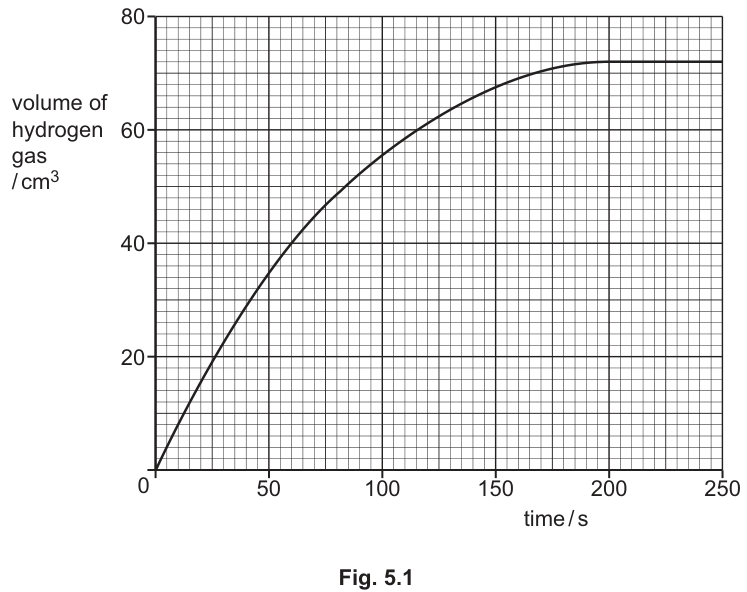
Describe how the shape of the curve in Fig. 5.1 shows that the rate of reaction decreases with time.
______
Answer
The gradient (steepness) of the curve decreases as time increases.
The gradient decreases (as time increases)
Walkthrough
The graph plots volume of gas against time. The gradient of this graph represents the rate of reaction (volume of gas produced per unit time). At the start, the curve is steep (high gradient, fast rate). As time goes on, the curve becomes less steep and eventually flat. Therefore, the gradient decreases, meaning the rate decreases.
Key Takeaways
For a gas volume vs time graph, the gradient at any point is the rate of reaction. A decreasing gradient means the reaction is slowing down.
Common Mistakes
- Saying 'the volume decreases'. The volume is increasing, just more slowly.
- Saying 'the rate is negative'. The rate is positive but decreasing.
Things to Be Careful About
Use the word 'gradient' or 'steepness'. Do not just say 'the line goes down' (it doesn't, it goes up then flattens).
Explain in terms of collision theory why the rate of reaction decreases with time.
______
Answer
As the reaction proceeds, the acid is used up, so the particles get further apart (concentration decreases). This leads to a lower frequency of collisions between the particles, so the rate decreases.
The particles get further apart; frequency of collisions decreases
Walkthrough
Collision theory states that for a reaction to occur, particles must collide with sufficient energy. The rate depends on how often these successful collisions happen. As the reaction proceeds, the concentration of hydrochloric acid (the reactant in solution) decreases. This means the H⁺ and Cl⁻ ions are more spread out (further apart). With particles further apart, they collide less often. Fewer collisions per unit time means a slower rate of reaction.
Key Takeaways
Rate decreases as reactants are consumed because concentration drops. Lower concentration -> particles further apart -> fewer collisions -> slower rate.
Common Mistakes
- Saying 'particles lose energy'. (They don't necessarily, the concentration is the key factor here).
- Saying 'there are fewer particles'. (There are fewer reacting particles effectively, but 'further apart' is the standard explanation for concentration).
- Forgetting to mention 'frequency' or 'number' of collisions.
Things to Be Careful About
The question asks 'in terms of collision theory'. You must mention collisions. 'Particles get further apart' explains the concentration drop.
The student repeats the experiment using the same mass of powdered zinc instead of large pieces of zinc. All other conditions stay the same.
Describe and explain the difference in rate of reaction when powdered zinc is used.
______
Answer
The rate of reaction increases.
With powdered zinc, the surface area is greater. This means more zinc particles are exposed to the acid, so the frequency of collisions (or number of collisions per unit time) increases.
Rate increases; surface area greater; collision frequency increases
Walkthrough
Powdered zinc has a much larger total surface area compared to the same mass of large pieces (lumps). The reaction happens at the surface where solid zinc meets aqueous acid. A larger surface area means more zinc atoms are in contact with the acid at any one time. This leads to more frequent collisions between reactant particles, increasing the rate of reaction.
Key Takeaways
Increasing surface area (by powdering a solid) increases the rate of reaction for heterogeneous reactions (solid + liquid/gas).
Common Mistakes
- Saying 'the concentration increases'. (Surface area is not concentration).
- Forgetting to say 'rate increases'.
- Just saying 'more surface area' without linking it to collisions.
Things to Be Careful About
Must mention 'surface area' and 'collision frequency/rate'.
Excess zinc is added to of hydrochloric acid.
Calculate the volume of hydrogen gas released measured at room temperature and pressure.
Give your answer to two significant figures.
volume of hydrogen gas = ______
Working
From the equation , the ratio of HCl to H₂ is 2:1.
Molar gas volume at r.t.p. is .
Rounding to two significant figures:
Answer
volume of hydrogen gas = 0.077 dm³
0.077
Walkthrough
- Calculate moles of HCl: . Volume must be in dm³, so . mol.
- Use stoichiometry: The balanced equation shows 2 moles of HCl produce 1 mole of H₂. So moles of H₂ = mol.
- Calculate volume: At room temperature and pressure (r.t.p.), 1 mole of gas occupies . Volume = .
- Significant figures: The question asks for two significant figures. rounds to .
Key Takeaways
- Convert cm³ to dm³ by dividing by 1000.
- Use the mole ratio from the balanced equation.
- Molar gas volume at r.t.p. is .
Common Mistakes
- Forgetting to divide volume by 1000.
- Using the wrong mole ratio (e.g., 1:1 instead of 2:1).
- Using (which is for s.t.p., not r.t.p.).
- Incorrect rounding (0.0768 to 2 s.f. is 0.077, not 0.08).
Things to Be Careful About
- Zinc is in excess, so HCl is the limiting reactant. Calculations must be based on HCl.
- Ensure the final unit is dm³ as requested.
The reaction of zinc with hydrochloric acid is exothermic.
Complete the reaction pathway diagram in Fig. 5.2 to show:
- the reactants and products
- a labelled arrow for the activation energy,
- a labelled arrow for the enthalpy change, .
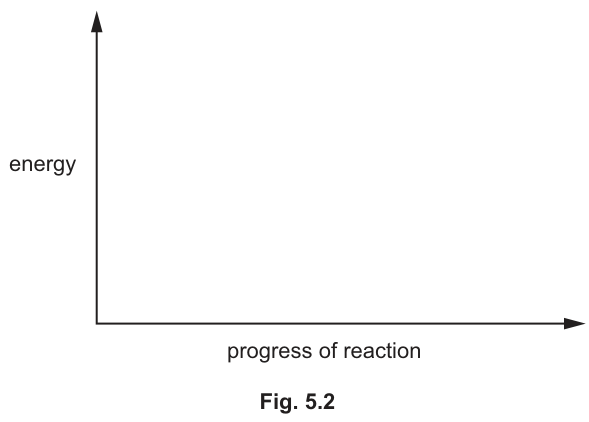
Answer
The diagram shows an exothermic reaction pathway:
- Reactants (Zn + HCl) are at a higher energy level than Products (ZnCl₂ + H₂).
- The curve rises from reactants to a peak (activation energy hump) then falls to products.
- : An upward arrow from the reactant energy level to the top of the peak, labelled .
- : A downward arrow from the reactant energy level to the product energy level, labelled .
Diagram Description
See .
See diagram: Reactants higher than products, hump with Ea arrow up, Delta H arrow down.
Walkthrough
The reaction is exothermic, meaning energy is released. Therefore, the products have less energy than the reactants. The energy profile must show the reactant line higher than the product line.
- Draw a horizontal line on the left for reactants. Label it 'reactants'.
- Draw a curve that goes up (activation energy barrier) and then down to a lower horizontal line on the right. Label the right line 'products'.
- Activation Energy (): The energy needed to start the reaction. Draw an arrow from the reactant level up to the top of the curve (the peak). Label it .
- Enthalpy Change (): The overall energy change. Since it's exothermic, is negative. Draw an arrow from the reactant level down to the product level. Label it .
Key Takeaways
- Exothermic: Reactants > Products (energy wise). is negative (downward arrow).
- Endothermic: Reactants < Products. is positive (upward arrow).
- is always the energy from reactants to the top of the hump.
Common Mistakes
- Drawing products higher than reactants (that's endothermic).
- Labeling from the bottom (x-axis) to products. It must be from reactants to products.
- Drawing the arrow from the x-axis. It must be from the reactant level.
- Forgetting labels on the arrows.
Things to Be Careful About
The arrows for and must be labelled. The reactant level must be above the product level.
Describe the observations made when:
- a few drops of aqueous ammonia are added to an aqueous solution containing zinc ions
______
- excess aqueous ammonia is added to an aqueous solution containing zinc ions.
______
Answer
- Few drops of aqueous ammonia: A white precipitate is formed.
- Excess aqueous ammonia: The white precipitate dissolves to form a colourless solution.
White precipitate; dissolves in excess to form colourless solution
Walkthrough
Zinc ions () react with ammonia to form zinc hydroxide, which is a white insoluble solid (precipitate).
(simplified: ).
Zinc hydroxide is amphoteric and is one of the few hydroxides that dissolves in excess ammonia (forming a complex ion ). This is a key distinction from, for example, iron(II) or iron(III) hydroxides which do not dissolve in excess ammonia.
Key Takeaways
- + aqueous -> white ppt, soluble in excess (colourless solution).
- + aqueous -> white ppt, insoluble in excess.
- + aqueous -> pale blue ppt, soluble in excess (deep blue solution).
Common Mistakes
- Saying 'colourless precipitate'. Precipitates are described by colour (white, blue, etc.).
- Saying 'dissolves in excess' without specifying the final solution is colourless (for zinc).
- Confusing with sodium hydroxide (Zn(OH)2 also dissolves in excess NaOH to give colourless solution, but the question asks for ammonia).
Things to Be Careful About
The question asks for observations for both few drops and excess. Must answer both parts. 'Colourless solution' is the correct description for the final zinc-ammonia complex solution at this level.
Describe how to prepare pure, dry crystals of zinc chloride after reacting excess zinc with dilute hydrochloric acid.
______
Answer
- Filter the mixture to remove the excess solid zinc. The filtrate is aqueous zinc chloride.
- Evaporate the filtrate (heat it) until it reaches the crystallisation point (or until a saturated solution is formed / a crust forms on a glass rod).
- Cool the solution (or leave it to cool) to allow crystals to form.
- Filter off the crystals (or take them out) and dry them between filter papers (or in a warm oven).
Filter off excess zinc; evaporate filtrate to crystallisation point; cool/crystallize; filter and dry crystals with filter paper
Walkthrough
We are making a soluble salt (zinc chloride) from an insoluble reactant (zinc) and an acid (HCl). Since zinc is in excess, we have unreacted solid zinc left over.
- Separation: We need to remove the excess zinc. Filtration is the standard method. Pour the mixture through filter paper in a funnel. The solid zinc stays on the paper (residue), and the zinc chloride solution passes through (filtrate).
- Crystallisation: To get crystals, we need to remove the water. Heat the filtrate in an evaporating basin. Stop heating when the solution is saturated (crystallisation point). If you evaporate to dryness, you might decompose the salt or get impurities.
- Cooling: Allow the saturated solution to cool slowly. Crystals of zinc chloride will form as solubility decreases with temperature.
- Drying: Separate the crystals from the remaining liquid (mother liquor) by filtering or picking them out. Dry them by pressing between filter papers to remove surface water.
Key Takeaways
Preparation of soluble salt from insoluble reactant + acid:
- Add excess reactant to ensure all acid is used up.
- Filter to remove excess reactant.
- Evaporate filtrate to crystallisation point.
- Cool to crystallize.
- Dry crystals.
Common Mistakes
- Saying 'evaporate to dryness'. This is for insoluble salts or getting anhydrous salts sometimes, but for hydrated crystals, evaporate to crystallisation point.
- Forgetting to filter off the excess zinc first.
- Not mentioning drying the crystals.
Things to Be Careful About
- 'Evaporate to dryness' is often marked wrong for preparing hydrated crystals. Use 'evaporate to crystallisation point' or 'heat until saturated'.
- Ensure the sequence is logical: Filter -> Evaporate -> Cool -> Filter/Dry.
Fig. 6.1 shows the structures of boron nitride and hydrazine.
Boron nitride has a structure similar to diamond.
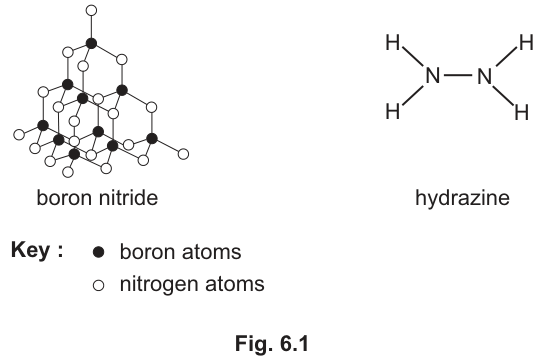
Explain why boron nitride has a high melting point.
Use the information in Fig. 6.1.
______
Answer
Boron nitride has a giant covalent structure (1).
There are strong covalent bonds throughout the structure that must be broken to melt it (1).
Giant covalent structure with strong covalent bonds throughout
Walkthrough
The question states that boron nitride has a structure similar to diamond. Diamond is the classic example of a giant covalent (macromolecular) structure, where every atom is bonded to four others in a tetrahedral network. Because the entire structure is one giant molecule held together by strong covalent bonds, a large amount of energy is required to break these bonds and change the solid into a liquid. Therefore, the melting point is high.
Key Takeaways
- Giant covalent structures have very high melting and boiling points because strong covalent bonds must be broken throughout the lattice.
- Diamond and boron nitride are both giant covalent structures with tetrahedral bonding.
Common Mistakes
- Saying "there are strong forces between molecules". Boron nitride is a giant structure, not a simple molecular one, so there are no intermolecular forces to break; the covalent bonds themselves must be broken.
- Simply writing "strong bonds" without specifying that it is a giant structure or that bonds must be broken.
Things to Be Careful About
- The mark scheme awards one mark for identifying the structure as giant, and one mark for stating the bonds are strong. Both are required for full credit.
Explain why hydrazine is a poor electrical conductor.
Use the information in Fig. 6.1.
______
Answer
There are no mobile electrons (or mobile ions) in hydrazine (1).
No mobile electrons
Walkthrough
Hydrazine () is a simple molecular substance. All its electrons are held in covalent bonds or as lone pairs within the molecules. For a substance to conduct electricity, it needs mobile charge carriers—either delocalised electrons (as in metals) or mobile ions (as in molten ionic compounds or aqueous solutions). Since hydrazine has neither, it is a poor electrical conductor.
Key Takeaways
- Simple molecular substances do not conduct electricity in any state because they lack mobile charged particles.
- Conductivity requires mobile electrons or mobile ions.
Common Mistakes
- Saying "there are no electrons". There are electrons, but they are not mobile.
- Saying "it is a covalent compound" without explaining why that prevents conduction.
Things to Be Careful About
- The mark scheme specifically looks for the phrase "no mobile electrons". Simply stating "covalent" is not enough; the reason must be linked to the absence of mobile charge carriers.
Complete Fig. 6.2 to show the dot-and-cross diagram for the electronic configuration of hydrazine.
Show only the outer shell electrons.
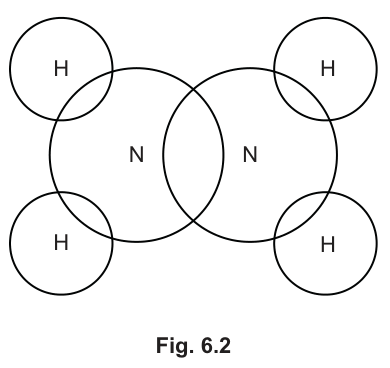
Answer
Each overlap region contains one shared pair of electrons (one dot and one cross). Each nitrogen atom has one lone pair of electrons (two dots or a dot and a cross) in its outer shell.
Five shared pairs (one in each overlap) and two lone pairs (one on each nitrogen)
Walkthrough
Hydrazine has the formula . Each nitrogen atom has 5 outer shell electrons, and each hydrogen atom has 1 outer shell electron. Total outer electrons = .
In the molecule, there is one N–N single bond and four N–H single bonds, making 5 covalent bonds in total. Each bond is a shared pair of electrons, accounting for electrons. The remaining 4 electrons form two lone pairs, one on each nitrogen atom, to complete their octets.
On the given template:
- Draw one dot and one cross in each of the five overlap regions (four N–H overlaps and one N–N overlap) to represent the shared pairs.
- Draw two dots (or one dot and one cross) in the non-overlapping region of each nitrogen circle to represent the lone pair.
- Leave the hydrogen circles empty, as hydrogen has no inner shell electrons and its only outer electron is shared.
Key Takeaways
- Dot-and-cross diagrams show the outer shell electrons involved in bonding.
- Shared pairs go in overlap regions; lone pairs go inside the atom's circle but outside any overlap.
- Hydrogen only has 1 outer electron, which is always shared.
Common Mistakes
- Drawing inner shell electrons for nitrogen (the 1s² electrons). The question specifies "show only the outer shell electrons".
- Forgetting the lone pairs on nitrogen. Each nitrogen needs 8 electrons in its outer shell; 6 are in bonds (3 bonds × 2 electrons), so 2 must be a lone pair.
- Drawing too many or too few electrons in the overlap regions.
Things to Be Careful About
- Use dots for one atom's electrons and crosses for the other's to show their origin, though mark schemes often accept any consistent representation as long as shared pairs and lone pairs are correctly placed.
- Ensure the lone pairs are clearly inside the nitrogen circles and not in the overlap regions.
The ionic equation for the reaction of nitride ions with water is shown.
The oxidation number of hydrogen in is +1.
Deduce the oxidation number of nitrogen in .
______
Answer
-3
Walkthrough
In , the oxidation number of hydrogen is given as . There are three hydrogen atoms, so the total oxidation number contribution from hydrogen is .
Since is a neutral molecule, the sum of the oxidation numbers of all atoms must be zero. Let the oxidation number of nitrogen be .
Key Takeaways
- The sum of oxidation numbers in a neutral molecule is zero.
- Hydrogen is usually when bonded to non-metals.
Common Mistakes
- Forgetting that there are three hydrogen atoms and only using instead of .
- Writing instead of .
Things to Be Careful About
- Always include the sign with the oxidation number. is correct; or are wrong.
Explain why this is not a redox reaction by referring to the oxidation number of nitrogen.
______
Answer
The oxidation number of nitrogen in is , and in it is also (1).
There is no change in the oxidation number of nitrogen (1).
No change in oxidation number of nitrogen (remains -3)
Walkthrough
A redox reaction involves a change in oxidation numbers (oxidation is an increase, reduction is a decrease).
In the reactant , the oxidation number of nitrogen is simply the charge of the ion, which is .
In the product , we calculated in part (i) that the oxidation number of nitrogen is .
Since the oxidation number of nitrogen is on both sides of the equation, there is no change in oxidation number. Therefore, this is not a redox reaction.
Key Takeaways
- A redox reaction must involve a change in at least one oxidation number.
- If no oxidation numbers change, the reaction is not redox.
Common Mistakes
- Saying "there is no electron transfer" without referring to oxidation numbers. The question specifically asks to refer to the oxidation number of nitrogen.
- Failing to state the oxidation number of nitrogen in .
Things to Be Careful About
- The mark scheme requires you to state that there is "no change" in the oxidation number. Simply saying "it is not redox" without the reason will not score.
Boron oxide reacts with magnesium as shown.
of boron oxide is reacted with of magnesium.
Show by calculation that boron oxide is in excess.
______
Working
From the equation, 1 mol of reacts with 3 mol of Mg.
Moles of Mg required to react with 0.1143 mol of :
We only have 0.3 mol of Mg, which is less than 0.3429 mol required.
Therefore, Mg is the limiting reactant and is in excess.
Answer
Boron oxide is in excess.
Boron oxide is in excess (0.1143 mol available, 0.1 mol required)
Walkthrough
To determine which reactant is in excess, we calculate the moles of each reactant and compare them using the stoichiometric ratio from the balanced equation.
Step 1: Calculate moles of
Step 2: Calculate moles of Mg
Step 3: Use the stoichiometric ratio
The balanced equation is:
The ratio of to Mg is 1 : 3. This means 1 mole of requires 3 moles of Mg.
Step 4: Determine the limiting reactant
Moles of Mg required to react with all the :
We have 0.3 mol of Mg available, but 0.3429 mol is required. Since we have less Mg than needed, Mg is the limiting reactant, and is in excess.
Alternatively, moles of required to react with all the Mg:
We have 0.1143 mol of , but only 0.1 mol is required. Since we have more than needed, it is in excess.
Key Takeaways
- To find the limiting reactant, calculate moles of each reactant and use the stoichiometric ratio to see which one is completely consumed.
- The reactant that is not completely consumed is in excess.
Common Mistakes
- Using the wrong for . Boron is 11, oxygen is 16, so .
- Forgetting to use the stoichiometric ratio (1:3) when comparing moles.
- Calculating the mass of excess reactant remaining when the question only asks to show it is in excess.
Things to Be Careful About
- The mark scheme accepts either approach: showing that Mg required is more than Mg available, or showing that available is more than required.
- Carry out calculations to at least 3 significant figures to avoid rounding errors.
Esters are represented by the formula .
Answer
general formula
general formula
Walkthrough
A formula written with 'n' to represent any member of a homologous series is called a general formula.
Key Takeaways
A general formula expresses the number of each type of atom in any member of a homologous series using 'n'.
Common Mistakes
Confusing 'general formula' with 'molecular formula' or 'empirical formula'.
Things to Be Careful About
The question asks for the name of the type of formula, not the formula itself.
Working
Propyl ethanoate is made from propanol (3 carbons) and ethanoic acid (2 carbons).
Total carbon atoms = 3 + 2 = 5.
For the general formula , is the number of carbon atoms.
Answer
5
5
Walkthrough
The name 'propyl ethanoate' tells us the ester is formed from a 3-carbon alcohol (propanol, giving the 'propyl' group) and a 2-carbon carboxylic acid (ethanoic acid, giving the 'ethanoate' group). The total number of carbon atoms in the molecule is 3 + 2 = 5. The general formula has as the number of carbon atoms, so .
Key Takeaways
Ester names are 'alkyl alkanoate'. The alkyl part comes from the alcohol and the alkanoate part from the carboxylic acid. The total number of carbons is the sum of the carbons in both parts.
Common Mistakes
Only counting the carbons in one part of the name (e.g., thinking or ). Forgetting that the carbonyl carbon in the acid part is included in the 'ethanoate' count.
Things to Be Careful About
Make sure to add the carbons from both the alcohol and the acid parts together.
The ester ethyl butanoate is produced by reacting ethanol with butanoic acid.
Draw the displayed formula of ethyl butanoate.
Answer
The displayed formula of ethyl butanoate is:
In plain text:
with all C-H, C-C, C=O, and C-O bonds shown explicitly.
Displayed formula of ethyl butanoate: CH3-CH2-CH2-C(=O)-O-CH2-CH3 with all atoms and bonds shown.
Walkthrough
Ethyl butanoate is an ester formed from ethanol (2 carbons) and butanoic acid (4 carbons). The 'butanoate' part comes from the acid and contains the carbonyl group (C=O). The 'ethyl' part comes from the alcohol and is attached to the single-bonded oxygen.
Key Takeaways
A displayed formula must show every single atom and every bond. For esters, remember the -COO- linkage: a carbon double-bonded to one oxygen and single-bonded to another.
Common Mistakes
Forgetting to draw the hydrogen atoms on the carbon atoms. Drawing the ester linkage backwards (e.g., -O-C(=O)- instead of -C(=O)-O-). Not showing the double bond to the oxygen in the carbonyl group.
Things to Be Careful About
Count the carbons: 4 in the butanoate chain (including the carbonyl carbon) and 2 in the ethyl group. Total 6 carbons. Ensure all 4 valencies of each carbon are satisfied with bonds to H or other carbons/oxygens.
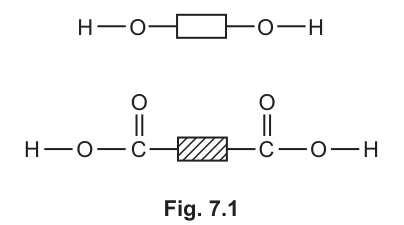
Fig. 7.1 shows the simplified structures of two molecules that combine to form a polyester.
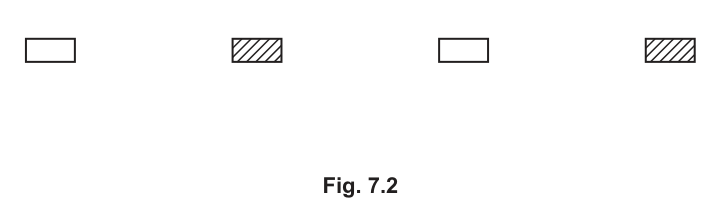
Complete the diagram in Fig. 7.2 to show the structure of two repeat units of this polyester.
Show all of the atoms and all of the bonds in the linkages.
Answer
The completed diagram shows two repeat units connected by ester linkages:
With full displayed linkages:
- Between first empty rectangle and first shaded rectangle: (oxygen from diol, carbonyl from acid)
- Between first shaded rectangle and second empty rectangle:
- Between second empty rectangle and second shaded rectangle:
- Left end: H attached to O of first diol unit
- Right end: H attached to O of last acid unit (or just continuation bonds depending on exact repeat unit definition, but mark scheme shows H-O-...-O-H style ends for the full chain, or continuation bonds for repeat units. Mark scheme M3: left hand box ends in and right hand box ends in )
Correct structure for two repeat units (4 boxes):
(continuation bonds at both ends)
Two repeat units connected by ester linkages: H-O-[rect]-O-C(=O)-[shaded]-C(=O)-O-[rect]-O-C(=O)-[shaded]-C(=O)-O- with continuation bonds at ends.
Walkthrough
The monomers are a diol (H-O-[rect]-O-H) and a dicarboxylic acid (H-O-C(=O)-[shaded]-C(=O)-O-H). They undergo condensation polymerisation, losing water to form ester linkages (-COO-). The oxygen from the diol's -OH group bonds to the carbonyl carbon of the acid's -COOH group. For two repeat units, we need 2 diol molecules and 2 acid molecules (4 blocks total). The linkages between blocks are: -O-C(=O)-. The left end of the first diol block retains its H (from H-O-), and the right end of the last acid block has a continuation bond from the carbonyl carbon (or O, depending on how the repeat unit is defined, but mark scheme says right hand box ends in -C(=O)- with continuation bond).
Key Takeaways
In polyester formation, the diol provides the -O- part and the dicarboxylic acid provides the -C(=O)- part of the ester linkage. The order is always -O-C(=O)- when reading from left to right if the diol is on the left.
Common Mistakes
Drawing the ester linkage backwards (-O-C(=O)- vs -C(=O)-O-). Forgetting the double bond to oxygen in the carbonyl group. Not drawing continuation bonds at the ends of the repeat units. Forgetting to show all atoms and bonds in the linkage itself.
Things to Be Careful About
The mark scheme specifically requires: link between all 4 boxes (1), ester linkages in correct directions (1), left hand box ends in -O- and right hand box ends in -C(=O)- (1). Ensure the oxygen from the diol is on the left side of the ester linkage and the carbonyl carbon from the acid is on the right side when connecting to the next diol.
Answer
condensation
condensation
Walkthrough
When two different monomers (a diol and a dicarboxylic acid) join together to form a polymer and a small molecule (water) is lost in each joining step, the process is called condensation polymerisation.
Key Takeaways
Addition polymerisation involves only one type of monomer (usually with a C=C double bond) and no small molecule is lost. Condensation polymerisation involves two different monomers with two functional groups each, and a small molecule like water is eliminated.
Common Mistakes
Saying 'addition' polymerisation. Forgetting that water is the small molecule lost.
Things to Be Careful About
The question asks for the 'type' of polymerisation. 'Condensation' is the precise term.
PET is a plastic.
Describe the chemical processes involved in converting used PET into a new plastic.
______
Answer
- PET is broken down (hydrolysed or reacted) into its monomers (or small molecules).
- The monomers are then re-polymerised to form new PET plastic.
PET broken down into monomers, then re-polymerised.
Walkthrough
Chemical recycling of PET involves breaking the polymer chain back into its original monomers (or simpler molecules) using chemical processes like hydrolysis or glycolysis. These monomers can then be purified and re-polymerised to make new, high-quality PET plastic. This is different from mechanical recycling, which just melts and remoulds the plastic.
Key Takeaways
Chemical recycling breaks polymers down to monomers, allowing the creation of new polymer with the same properties as virgin material. This is especially useful for condensation polymers like PET and nylon.
Common Mistakes
Saying 'melting and remoulding' (this is mechanical recycling, not chemical). Not mentioning both steps: breakdown AND re-polymerisation.
Things to Be Careful About
The question asks for 'chemical processes'. So you must mention breaking down into monomers and re-polymerising. Don't just say 'recycling'.
Ethanoic acid reacts with sodium carbonate.
Name the three products of this reaction.
- ______
- ______
- ______
Answer
- sodium ethanoate
- water
- carbon dioxide
sodium ethanoate, water, carbon dioxide
Walkthrough
Ethanoic acid () is an acid. Sodium carbonate () is a carbonate. The reaction between an acid and a carbonate produces a salt, water, and carbon dioxide gas. The salt formed uses the metal from the carbonate (sodium) and the anion from the acid (ethanoate, ). So the salt is sodium ethanoate.
Equation:
Key Takeaways
Acid + carbonate -> salt + water + carbon dioxide. The salt name is 'metal alkanoate' for carboxylic acids.
Common Mistakes
Saying 'sodium ethanoate' as 'sodium acetate' (acceptable but stick to IUPAC/5070 naming: sodium ethanoate). Forgetting carbon dioxide or water.
Things to Be Careful About
The question asks to 'name' the three products. Write the full names, not formulae, unless formulae are accepted (mark scheme says names). Order doesn't matter.
Ethanoic acid is a liquid at room temperature.
Describe the arrangement and motion of the particles in a liquid.
arrangement = ______
motion = ______
Answer
arrangement = irregular (or close together but not in a regular pattern)
motion = sliding over each other (or moving freely past each other)
arrangement: irregular; motion: sliding over each other
Walkthrough
In a liquid, the particles are close together (similar to a solid) but not arranged in a regular, fixed lattice. They are irregularly arranged. The particles have more energy than in a solid, so they can move past each other. This is described as 'sliding over each other' or 'moving freely past each other'.
Key Takeaways
Solid: regular arrangement, vibrating in fixed positions. Liquid: irregular arrangement, close together, sliding over each other. Gas: far apart, moving quickly in straight lines.
Common Mistakes
Saying particles are 'far apart' (that's a gas). Saying particles are 'in a regular pattern' (that's a solid). Saying particles 'cannot move' (that's a solid).
Things to Be Careful About
Use the exact wording from the mark scheme if possible: 'irregular' for arrangement and 'sliding over each other' for motion. 'Close together' is also acceptable for arrangement but 'irregular' is the key distinguishing feature from solids.