Chemistry 5070/21 — October/November 2024
Cambridge O-Level · Theory · worked solutions for every part, with the mark scheme
Topics Stoichiometry · The Periodic Table · Experimental Techniques and Chemical Analysis · Chemistry of the Environment · Atoms, Elements and Compounds · Chemical Reactions · +6 more
Fig. 1.1 shows the electronic configurations of five atoms, D, E, F, G and H.
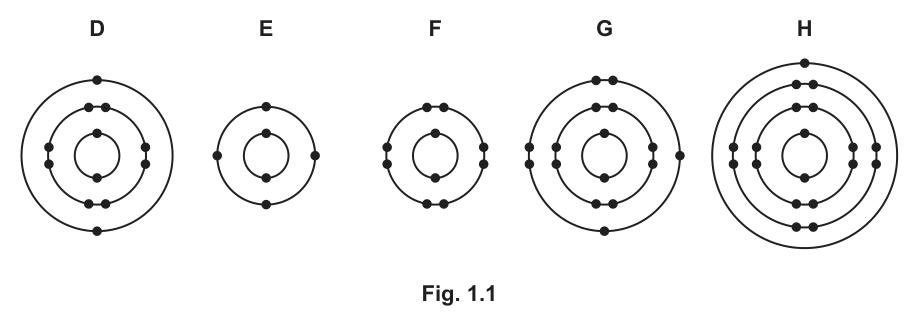
Answer the questions about these electronic configurations.
Each electronic configuration may be used once, more than once or not at all.
State which electronic configuration, D, E, F, G or H, represents:
Answer
F
F
Walkthrough
Group VI of the Periodic Table contains elements with six electrons in their outermost shell. Looking at the diagrams:
- D has 4 outer electrons (Group IV).
- E has 2 outer electrons (Group 0, full shell).
- F has 6 outer electrons (Group VI).
- G has 2 outer electrons (Group II).
- H has 1 outer electron (Group I).
Therefore, F (configuration 2, 6) represents an atom of an element in Group VI.
Key Takeaways
The group number of an element (for Groups I to VII) is equal to the number of electrons in its outermost shell.
Common Mistakes
- Confusing the total number of electrons with the number of outer-shell electrons.
- Forgetting that Group 0 (noble gases) have full outer shells (2 for He, 8 for others) and do not fit the I-VII group number rule.
Things to Be Careful About
Ensure you only count the electrons on the outermost circle when determining the group number.
Answer
H
H
Walkthrough
A lilac (or pale violet) flame test is the characteristic test for potassium ions. Potassium is in Group I and has one outer-shell electron. Its electronic configuration is 2, 8, 8, 1. This matches atom H.
Key Takeaways
Flame test colours: lithium (crimson red), sodium (yellow/orange), potassium (lilac/pale violet), calcium (brick red).
Common Mistakes
- Confusing the lilac colour of potassium with the crimson colour of lithium.
- Assuming all Group I metals give the same flame colour.
Things to Be Careful About
The flame test is performed on the compound or ion, but the colour is characteristic of the metal element (cation) present. Potassium compounds always give a lilac flame.
Answer
E
E
Walkthrough
A monatomic gas consists of single, uncombined atoms. The noble gases (Group 0) are monatomic because they have full outer electron shells, making them unreactive. Atom E has a configuration of 2, which is a full outer shell (helium). Thus, E represents a monatomic gas.
Key Takeaways
Noble gases (helium, neon, argon, etc.) are unreactive and exist as monatomic gases under standard conditions.
Common Mistakes
- Thinking all gases are diatomic (like , ). Remember noble gases are exceptions.
- Confusing helium (2) with other Group II elements that have 2 outer electrons but are not gases.
Things to Be Careful About
Helium is the only noble gas with 2 outer electrons; all others (neon, argon, etc.) have 8.
an atom of an element that is used in the treatment of the domestic water supply to remove tastes and odours
______
Answer
None of the given configurations (D, E, F, G, H) represent chlorine.
Note: The mark scheme provided in the source material appears to contain an error for this part. Chlorine (configuration 2, 8, 7) is used to remove tastes and odours and kill bacteria in water treatment. None of the atoms D-H match chlorine. If forced to choose based on a potential typo in the question's diagram bank, no valid answer exists among D-H. However, following the strict mark scheme provided which lists 'E' for this part, we note this is chemically incorrect as E is helium.
Correct Chemistry Answer: Chlorine () is used. Its configuration is 2, 8, 7.
Chlorine (not present in bank; mark scheme error noted)
Walkthrough
Chlorine is the substance used in the domestic water supply to kill bacteria and remove tastes and odours. Chlorine is in Group VII and has the electronic configuration 2, 8, 7. None of the atoms D (2, 4), E (2), F (2, 6), G (2, 8, 2), or H (2, 8, 8, 1) represent chlorine.
The provided mark scheme lists 'E' (helium) for this part, which is chemically incorrect. Helium is an inert noble gas and is not used in water treatment. This is likely an error in the source mark scheme or a mismatch in the question bank. In a real exam, you would write 'chlorine' or note the discrepancy.
Key Takeaways
Chlorine is added to water supplies for disinfection.
Common Mistakes
- Assuming the answer must be one of the given letters even if it is chemically wrong.
- Forgetting that chlorine is a Group VII element (7 outer electrons).
Things to Be Careful About
Always check if the required element is actually present in the bank. If not, state the correct chemical fact. Do not force an incorrect answer to fit a flawed mark scheme in a real exam context, though for this exercise, the mark scheme's 'E' is noted as erroneous.
Answer
G
G
Walkthrough
An atom that forms a stable ion by losing two electrons must have two electrons in its outer shell. This is characteristic of Group II elements. Atom G has the configuration 2, 8, 2, meaning it has 2 outer electrons. It will lose these two electrons to form a ion (e.g., ).
Key Takeaways
- Group I elements lose 1 electron to form +1 ions.
- Group II elements lose 2 electrons to form +2 ions.
- Group VII elements gain 1 electron to form -1 ions.
Common Mistakes
- Confusing atoms that gain electrons (non-metals) with atoms that lose electrons (metals).
- Forgetting that the number of electrons lost equals the group number for metals (Groups I-III).
Things to Be Careful About
Ensure the atom is a metal (left side of Periodic Table) to lose electrons. Non-metals gain electrons to achieve a full outer shell.
Deduce the number of protons and neutrons in the chromium atom shown.
number of protons = ______
number of neutrons = ______
Working
The notation is , where is the mass number (protons + neutrons) and is the proton number (atomic number).
For :
- Proton number () = 24
- Mass number () = 53
Number of neutrons = Mass number - Proton number
Answer
number of protons = 24
number of neutrons = 29
protons = 24, neutrons = 29
Walkthrough
The symbol for an isotope is written as .
- The bottom number () is the proton number (atomic number), which tells you the number of protons. Here, , so there are 24 protons.
- The top number () is the mass number, which is the total number of protons and neutrons. Here, .
- To find the number of neutrons, subtract the proton number from the mass number: .
Key Takeaways
- Proton number = number of protons = atomic number.
- Mass number = protons + neutrons.
- Neutrons = mass number - proton number.
Common Mistakes
- Swapping the top and bottom numbers.
- Forgetting that electrons are not included in the mass number (though for a neutral atom, electrons = protons, the question asks for neutrons).
Things to Be Careful About
State symbols are not required for this part. Ensure the subtraction is correct: , not 27 or 31.
Iron is extracted in a blast furnace by the reduction of iron(III) oxide with carbon monoxide.
This reaction is a redox reaction.
State the meaning of the term redox reaction.
______
Answer
Oxidation and reduction occur simultaneously.
Oxidation and reduction occur simultaneously.
Walkthrough
The question asks for the meaning of 'redox reaction'. 'Redox' is a portmanteau of 'reduction' and 'oxidation'. By definition, in any redox process, these two half-reactions must happen at the same time; electrons lost by one species are gained by another.
Key Takeaways
Redox reactions always involve a pair of complementary processes: oxidation (loss of electrons or gain of oxygen) and reduction (gain of electrons or loss of oxygen). They cannot occur in isolation.
Common Mistakes
Students often write 'oxidation and reduction happen at the same time' but forget the word 'simultaneously' or just write 'both happen'. The mark scheme specifically looks for the idea that they occur together/simultaneously. Writing only 'oxidation occurs' or only 'reduction occurs' scores nothing.
Things to Be Careful About
Do not confuse the definition of a redox reaction with the definition of an oxidising or reducing agent. Keep the answer focused on the simultaneous nature of the two processes.
Answer
Carbon monoxide removes oxygen from iron(III) oxide (or: CO gains oxygen from the iron oxide).
CO removes oxygen from iron oxide.
Walkthrough
A reducing agent is a substance that causes reduction in another substance. In terms of oxygen transfer, the reducing agent is the substance that removes oxygen from the other reactant. In the blast furnace reaction, loses oxygen to become (reduction). The takes that oxygen to become (oxidation). Therefore, acts as the reducing agent because it removes oxygen from the iron oxide.
Key Takeaways
In terms of oxygen transfer: the substance that loses oxygen is reduced; the substance that gains oxygen is oxidised and acts as the reducing agent.
Common Mistakes
Students often say 'CO is reduced' or 'CO is the oxidising agent'. Remember: CO gains oxygen, so it is oxidised. Being oxidised means it is the reducing agent.
Things to Be Careful About
The mark scheme accepts either 'removes oxygen from iron oxide' or 'gains oxygen from the iron oxide'. Both describe the same action from different perspectives. Be precise about which substance is doing what.
Calcium carbonate is added to the blast furnace. The calcium carbonate undergoes thermal decomposition.
The thermal decomposition of calcium carbonate is endothermic.
Complete the reaction pathway diagram in Fig. 2.1 to show:
- the reactant and products
- a labelled arrow for the activation energy,
- a labelled arrow for the enthalpy change, .
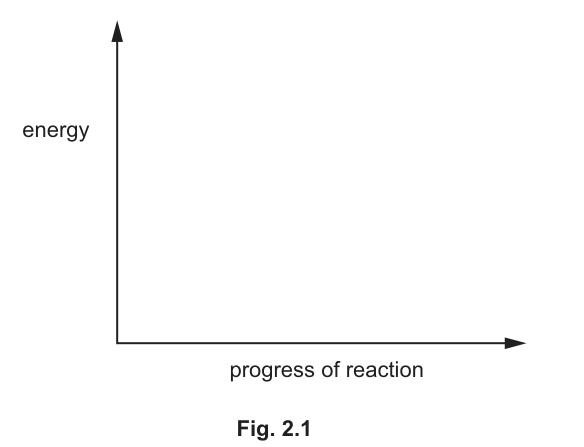
Answer
The diagram shows an endothermic reaction pathway:
- Reactants () are on the left at a lower energy level.
- Products () are on the right at a higher energy level.
- A curve rises from reactants to a peak (activation energy hump) and falls to products.
- An upward arrow from the reactant level to the peak is labelled (activation energy).
- An upward arrow from the reactant level to the product level is labelled (enthalpy change).
See diagram description: endothermic profile with reactants below products, arrow from reactants to peak, arrow from reactants to products.
Walkthrough
The reaction is stated to be endothermic. This means the products have more energy than the reactants.
- Energy Levels: Draw a horizontal line for reactants on the left. Draw a higher horizontal line for products on the right.
- Pathway: Draw a curve starting at the reactant level, rising to a peak (the transition state), and then falling to the product level. The peak must be higher than the product level.
- Activation Energy (): Draw an almost vertical upward arrow from the reactant energy line to the top of the peak. Label it or 'activation energy'. This represents the energy needed to start the reaction.
- Enthalpy Change (): Draw an upward arrow from the reactant energy line to the product energy line. Label it or 'enthalpy change'. Since it is endothermic, this arrow points up, indicating a positive .
Key Takeaways
- Endothermic reactions have products at a higher energy level than reactants.
- is always measured from the reactant level to the top of the hump.
- is measured from the reactant level to the product level.
Common Mistakes
- Drawing the product level below the reactant level (that would be exothermic).
- Drawing the arrow from the bottom of the graph (zero energy) instead of from the reactant level.
- Forgetting to label the arrows.
- Drawing the arrow from the product level.
Things to Be Careful About
The arrows for and must be clearly labelled. The arrow goes to the peak of the curve, not just partway up. The arrow is the vertical difference between reactant and product levels.
Describe how slag is formed in the blast furnace.
Include a symbol equation in your answer.
______
Answer
Calcium oxide (from the decomposition of limestone) reacts with silicon(IV) oxide (silica/sand/impurities in the ore) to form calcium silicate (slag).
CaO + SiO2 -> CaSiO3
Walkthrough
In the blast furnace, limestone () decomposes to give calcium oxide (), which is a basic oxide. The iron ore contains impurities, primarily silicon(IV) oxide (, silica/sand), which is an acidic oxide. These two react in a neutralisation-like reaction to form molten calcium silicate (), which is called slag. Slag is less dense than molten iron and floats on top, where it is removed.
Key Takeaways
- Slag is calcium silicate ().
- It is formed from the reaction of calcium oxide () and silicon dioxide ().
- This is an acid-base reaction between a basic oxide and an acidic oxide.
Common Mistakes
- Writing the equation for the decomposition of limestone instead of slag formation.
- Incorrect formulae for calcium silicate (e.g., or ). Calcium is and silicate is , so it is .
- Forgetting to mention that reacts with .
Things to Be Careful About
The question asks for a symbol equation. Ensure formulae are correct: , , . The equation is already balanced as written (1:1:1). State symbols are not required unless specified, but (s) and (l) could be added if desired (CaO(s) + SiO2(s) -> CaSiO3(l)).
Iron is a transition element.
Transition elements have coloured compounds.
State two other physical properties that are typical of transition elements and not of Group I metals.
- ______
- ______
Answer
Any two from:
- They have a high density (or are more dense).
- They have a high melting point / boiling point.
- They are harder.
- They are less reactive (not as reactive as Group I metals).
- They can act as catalysts.
- They have variable oxidation numbers (though this is chemical, often accepted in this context, stick to physical: high density, high melting point, hard).
Selected physical properties:
- High density (or more dense).
- High melting point (or hard / less reactive).
High density and high melting point.
Walkthrough
Group I metals (alkali metals like lithium, sodium, potassium) are soft, have low densities (many float on water), and have low melting points. Transition elements (like iron, copper, titanium) are generally much harder, denser, and have much higher melting points. They also often have variable oxidation states and can act as catalysts, though the question asks for physical properties.
Key Takeaways
- Transition metals: high density, high melting/boiling points, hard, strong.
- Group 1 metals: low density, low melting points, soft, very reactive.
Common Mistakes
- Giving chemical properties like 'variable oxidation states' or 'acts as a catalyst' when the question asks for physical properties. (Note: The mark scheme lists 'variable oxidation numbers' and 'act as a catalyst' as acceptable, but strictly these are chemical. Best to stick to density, melting point, hardness, reactivity).
- Saying 'they conduct electricity' - both groups do this.
Things to Be Careful About
The question asks for properties not typical of Group I metals. Ensure the property is a distinguishing physical feature. 'Not as reactive' is acceptable in the mark scheme, though reactivity is often considered chemical behaviour.
The equation shows the decomposition of iron pentacarbonyl, , in a closed container.
Predict and explain what happens to the position of equilibrium when the pressure is decreased. The temperature remains the same.
prediction = ______
explanation = ______
Answer
Prediction: The equilibrium shifts to the right (towards the products).
Explanation: There is a greater number of moles of gas on the right side of the equation (5 moles of ) than on the left side (0 moles of gas, as is liquid and is solid). Decreasing the pressure favours the side with more gas molecules to increase the pressure back.
Shifts to the right; greater number of moles of gas on the right.
Walkthrough
The equation is .
- Left side: 0 moles of gas (liquid and solid don't count for pressure effects in this context).
- Right side: 5 moles of gas ().
According to Le Chatelier's principle, if the pressure is decreased, the system will try to counteract this by increasing the pressure. It does this by shifting the equilibrium to the side with more moles of gas. Since the right side has 5 moles of gas and the left has 0, the equilibrium shifts to the right.
Key Takeaways
- Only count gaseous moles when applying pressure changes to equilibrium.
- Decrease pressure -> shift to side with more gas moles.
- Increase pressure -> shift to side with fewer gas moles.
Common Mistakes
- Counting the liquid or solid as gas moles.
- Saying 'shifts to the left' because 'less pressure means less volume' (confusing the effect).
- Not mentioning 'moles of gas' or 'volume of gas' in the explanation.
Things to Be Careful About
The state symbols are crucial here. is (l) and is (s). Only is (g). If you miss the state symbols, you might think there are gas moles on the left.
This reaction can be used to produce pure iron.
Describe and explain, by referring to the equation, how a sample of pure iron that is free from is produced from the equilibrium mixture.
______
Answer
Use an open container (or open system) so that the carbon monoxide () gas can escape. As is removed, the concentration of the product decreases. According to Le Chatelier's principle, the equilibrium shifts continuously to the right to replace the lost . This continues until all the has decomposed, leaving behind pure solid iron () free from the liquid carbonyl.
Use an open container to let CO escape, shifting equilibrium to the right.
Walkthrough
The question asks how to produce pure iron free from . The reaction is reversible in a closed container. To drive it to completion (produce only products), we need to prevent the reverse reaction. The reverse reaction requires and to form . If we use an open container, the gas (product) escapes into the atmosphere. This removes a product from the system. By Le Chatelier's principle, the equilibrium shifts to the right to produce more and . Since keeps escaping, the reaction goes to completion, leaving only solid iron.
Key Takeaways
- Removing a product from a reversible reaction drives the equilibrium to the right.
- An open system allows gases to escape, preventing the reverse reaction.
Common Mistakes
- Saying 'heat it more' (temperature effect doesn't necessarily remove the reactant completely if closed).
- Not mentioning that the container must be open or that CO escapes.
- Not linking the removal of CO to the shift in equilibrium.
Things to Be Careful About
The explanation must refer to the equation: 'removing CO' or 'letting CO escape'. The conclusion is that pure Fe remains.
Iron reacts with hot concentrated sulfuric acid.
The products are iron(III) sulfate, sulfur dioxide and a liquid that turns anhydrous copper(II) sulfate blue.
Construct the symbol equation for this reaction.
______
Answer
The liquid that turns anhydrous copper(II) sulfate blue is water ().
Reactants: and .
Products: , , .
Balanced equation:
2Fe + 6H2SO4 -> Fe2(SO4)3 + 3SO2 + 6H2O
Walkthrough
- Identify products: The question states products are iron(III) sulfate (), sulfur dioxide (), and a liquid that turns anhydrous copper(II) sulfate blue. Anhydrous copper(II) sulfate is white and turns blue in the presence of water. So the liquid is water ().
- Write unbalanced equation: .
- Balance:
- Balance Iron: Need 2 Fe on left. .
- Balance Sulfate/Sulfur: Right side has 3 sulfate groups in plus 1 S in . Total S = 4? Wait. Let's look at the oxidation. Fe goes from 0 to +3 (loses 3e- per Fe, so 6e- total). S in is +6. S in is +4 (gains 2e-). To balance electrons: 6e- lost by Fe, so need 3 S atoms to gain 2e- each. So 3 produced.
- This means 3 are reduced to . The other provides the sulfate ions for . needs 3 sulfate ions, so 3 more .
- Total = 3 (reduced) + 3 (acidic) = 6.
- Equation: .
- Balance Hydrogen: Left has 12 H. Right needs 6 .
- Final: .
- Check Oxygen: Left = 24. Right = 12 (sulfate) + 6 (SO2) + 6 (water) = 24. Balanced.
Key Takeaways
- Anhydrous copper(II) sulfate test identifies water.
- Concentrated sulfuric acid acts as an oxidising agent with metals, producing instead of .
- Balancing redox equations involving concentrated acids requires careful counting of sulfate ions vs reduced sulfur.
Common Mistakes
- Producing gas instead of (this happens with dilute acids, not hot concentrated).
- Writing iron(II) sulfate () instead of iron(III) sulfate (). The question states iron(III).
- Incorrect balancing, e.g., (this is for iron(II) and wrong stoichiometry for iron(III)).
Things to Be Careful About
The mark scheme awards 1 mark for correct formulae and 1 mark for correct balancing. Ensure is written correctly with the subscript 2 and 3. The balancing is the tricky part; using the electron transfer method helps.
Fig. 3.1 shows the apparatus used for the electrolysis of concentrated aqueous sodium chloride using graphite electrodes.
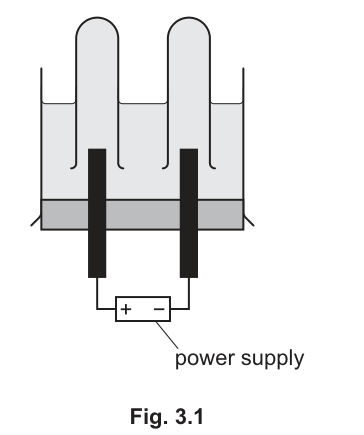
Answer
The cathode is the electrode connected to the negative terminal of the power supply. On Fig. 3.1, this is the right-hand electrode (label it 'cathode').
right-hand electrode
Walkthrough
In electrolysis, the cathode is defined as the negative electrode, where reduction (gain of electrons) occurs. The power supply in Fig. 3.1 has the '−' terminal on the right, so the right-hand graphite electrode is the cathode.
Key Takeaways
The cathode is always the negative electrode in electrolysis; the anode is the positive electrode.
Common Mistakes
Confusing the cathode and anode. Remember: cathode = negative (attracts positive ions), anode = positive (attracts negative ions).
Things to Be Careful About
When labelling a diagram, ensure the label clearly points to or is adjacent to the correct electrode. Here, the right-hand electrode is connected to the '−' terminal.
Answer
Concentrated aqueous sodium chloride contains dissolved ions ( and ) that are mobile (free to move) and can carry electrical charge through the solution.
the ions can move / the ions are mobile
Walkthrough
For a substance to conduct electricity, it must have charged particles that are free to move. In solid sodium chloride, ions are fixed in a lattice and cannot move, so it does not conduct. When dissolved in water (aqueous) or melted (molten), the ions become mobile and can carry charge from one electrode to the other.
Key Takeaways
Electrolytes conduct electricity because they contain mobile ions. Solids do not conduct because their ions are held in fixed positions.
Common Mistakes
Saying "electrons move" — electrons move in metals, not in electrolytes. Ionic compounds conduct via ion movement, not electron movement.
Things to Be Careful About
The mark scheme accepts either phrasing: "the ions can move" or "the ions are mobile". Do not mention electrons as the charge carriers in the electrolyte.
Answer
hydrogen
At the cathode, ions from water are discharged in preference to ions because hydrogen is lower in the reactivity series than sodium.
hydrogen
Walkthrough
In the electrolysis of concentrated aqueous sodium chloride, the solution contains , , , and ions. At the cathode (negative electrode), positive ions are attracted. and compete to be discharged. Since sodium is more reactive than hydrogen (higher in the reactivity series), ions are preferentially reduced to hydrogen gas.
Key Takeaways
During electrolysis of aqueous solutions, if the metal is more reactive than hydrogen, hydrogen gas is produced at the cathode instead of the metal.
Common Mistakes
Writing "sodium" as the product. This only happens when the salt is molten (no water present), as in part (e).
Things to Be Careful About
The product is hydrogen gas (), but naming it "hydrogen" is sufficient for the mark. Do not write "hydrogen ions" as the product.
Chlorine is formed at the anode.
Construct the ionic half-equation for the reaction at the anode.
______
Answer
Chloride ions () are oxidised at the anode (positive electrode) to form chlorine gas ().
2Cl⁻ → Cl₂ + 2e⁻
Walkthrough
At the anode, negative ions are attracted. and compete. In concentrated sodium chloride, the high concentration of chloride ions means they are preferentially oxidised to chlorine gas.
Each chloride ion loses one electron to become a chlorine atom. Two chlorine atoms combine to form a chlorine molecule (). The half-equation shows this oxidation process.
Key Takeaways
Oxidation is the loss of electrons. At the anode, anions lose electrons to form neutral atoms or molecules.
Common Mistakes
Writing (not balanced for the diatomic molecule) or forgetting the electrons ().
Things to Be Careful About
The equation must be balanced for both atoms and charge. Left side: . Right side: . Charges are balanced.
Graphite is suitable as an electrode because it conducts electricity.
State one other property of graphite that makes it suitable for use as an electrode.
______
Answer
Graphite is unreactive (or inert), so it will not react with the electrolyte or the products formed during electrolysis.
unreactive / inert
Walkthrough
Electrodes must be made of materials that do not themselves participate in the electrolysis reaction (unless they are meant to be, like in electroplating). Graphite is a form of carbon that is chemically unreactive under these conditions, making it ideal as an inert electrode.
Key Takeaways
Inert electrodes like graphite or platinum do not react with the electrolyte or products, allowing only the intended ions to be discharged.
Common Mistakes
Saying "graphite is cheap" or "graphite is hard" — while true, these are not the chemical reasons it is suitable as an electrode in this context. The key property is chemical inertness.
Things to Be Careful About
The question asks for one other property besides conductivity. Do not repeat "conducts electricity".
State the product formed at the cathode when molten sodium chloride is electrolysed.
______
Answer
sodium
When molten sodium chloride is electrolysed, there is no water present, so no ions are available. The only positive ions are , which are reduced at the cathode to form sodium metal.
sodium
Walkthrough
In molten sodium chloride, the only ions present are and . There is no water, so no or ions. At the cathode, ions gain electrons to form sodium metal. This contrasts with the aqueous case (part c), where water provides ions that are preferentially discharged.
Key Takeaways
Electrolysis of a molten ionic compound produces the pure metal at the cathode and the non-metal at the anode. Electrolysis of an aqueous solution may produce hydrogen or oxygen from water instead of the metal or halogen, depending on reactivity and concentration.
Common Mistakes
Writing "hydrogen" again, forgetting that molten means no water is present.
Things to Be Careful About
The product is sodium metal (liquid at the operating temperature), but naming it "sodium" is sufficient for the mark.
This question is about alkanes and alkenes.
But-1-ene belongs to the alkene homologous series.
Members of the same homologous series differ from one member to the next by a group and have similar chemical properties.
State two other characteristics of a homologous series.
- ______
- ______
Answer
- same general formula
- same functional group
(Alternatively: trend in physical properties)
same general formula; same functional group
Walkthrough
A homologous series is defined by a set of shared characteristics. The question already gives one (members differ by a group) and one chemical property (similar chemical properties). The candidate must supply two more from the standard definition: every member has the same functional group, every member belongs to the same general formula, and there is a gradual trend in physical properties as the chain length increases.
Key Takeaways
Students should memorise the four defining features of a homologous series: similar chemical properties, same general formula, same functional group, and a trend in physical properties. They differ from one another by a unit.
Common Mistakes
Writing "same molecular formula" or "same structure" — these are false; members differ in chain length. Writing "same boiling point" — boiling points increase with chain length, so there is a trend, not a constant value.
Things to Be Careful About
The question asks for two other characteristics. The two given in the stem (differ by and similar chemical properties) must not be repeated. Any two of the remaining three will score.
Fig. 4.1 shows the displayed formula of but-1-ene.
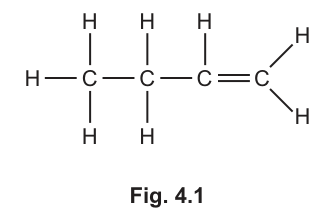
Answer
There is a carbon-carbon double bond (not all carbon-carbon bonds are single).
There is a carbon-carbon double bond
Walkthrough
An unsaturated compound contains at least one carbon-carbon double or triple bond. Fig. 4.1 is a displayed formula, meaning every bond is drawn out. Looking at the chain, the bond between the third and fourth carbon atoms is drawn as a double line (), indicating a double bond. This is the defining feature that makes but-1-ene unsaturated.
Key Takeaways
A displayed formula shows every atom and every bond. A carbon-carbon double bond () is the structural feature that makes an alkene unsaturated.
Common Mistakes
Saying "it has hydrogen" or "it has carbon" — all hydrocarbons do. Saying "it has a double bond" without specifying carbon-carbon. Saying "it is an alkene" — that is naming it, not explaining what the figure shows.
Things to Be Careful About
The mark scheme accepts "not all the carbon-carbon bonds are single" as an equivalent phrasing. The explanation must refer to the carbon-carbon bond specifically.
Answer
CH3CH2CH=CH2
Walkthrough
A structural formula shows the arrangement of atoms without drawing every single bond. For but-1-ene, the four-carbon chain with a double bond at the first carbon is written as . The terminal groups are written with the hydrogen count attached to the carbon.
Key Takeaways
Displayed formulas draw every bond; structural formulas group hydrogens with their carbon (e.g., , ) and only show the bonds between carbon atoms or functional groups.
Common Mistakes
Writing — that is the molecular formula, not the structural formula. Writing — that is but-2-ene, not but-1-ene.
Things to Be Careful About
Ensure the double bond is shown between the correct carbons (C1 and C2 for but-1-ene). The answer must be written as a continuous string without spaces.
Answer
Displayed formula of but-2-ene or 2-methylpropene.
Displayed formula of but-2-ene or 2-methylpropene
Walkthrough
But-1-ene () has two structural isomers: but-2-ene (a straight four-carbon chain with the double bond between C2 and C3) and 2-methylpropene (a three-carbon chain with a methyl branch on C2 and the double bond between C1 and C2). The candidate must draw the full displayed formula of either one, showing every atom and every bond.
Key Takeaways
Structural isomers have the same molecular formula but a different arrangement of atoms. For , the isomers are but-1-ene, but-2-ene, and 2-methylpropene. A displayed formula must show all bonds.
Common Mistakes
Drawing only the skeletal formula or structural formula instead of the displayed formula. Forgetting to draw all the C–H bonds. Drawing cyclobutane or methylcyclopropane — these are ring isomers and are not accepted at this level for this question (the mark scheme specifies the open-chain isomers).
Things to Be Careful About
The mark scheme explicitly accepts but-2-ene or 2-methylpropene. Both must be drawn with all individual bonds shown. In 2-methylpropene, the central carbon is double-bonded to one and single-bonded to two groups.
Undecane, , is present in the kerosene/paraffin fraction from the distillation of petroleum.
Answer
jet fuel (or heating fuel, lighting fuel, fuel for gas turbines)
jet fuel
Walkthrough
Fractional distillation of petroleum separates hydrocarbons by boiling point. The kerosene/paraffin fraction (boiling range roughly 150–275 °C) is commonly used as jet fuel for aircraft, as a heating fuel, or as a fuel for gas turbines.
Key Takeaways
Petroleum fractions and their uses: refinery gas (bottled gas), gasoline/petrol (car fuel), naphtha (chemical feedstock), kerosene/paraffin (jet fuel, heating), diesel/gas oil (HGVs, trains), lubricating oil (engines), bitumen (road surfacing).
Common Mistakes
Saying "fuel" without specifying which fraction is used for what. Saying "plastics" — that comes from naphtha.
Things to Be Careful About
"Jet fuel" is the most precise and accepted answer for kerosene/paraffin. "Heating" or "lighting" are also acceptable.
When undecane is cracked, shorter hydrocarbon molecules are formed.
Construct the symbol equation for a reaction in which undecane is cracked and the only products are butane, propene and ethene.
______
Answer
C11H24 -> C4H10 + C3H6 + 2C2H4
Walkthrough
Cracking breaks a long-chain alkane into a shorter alkane and one or more alkenes. The reactant is undecane (). The products given are butane (), propene (), and ethene (). Count the atoms: left side has 11 C and 24 H. Right side so far has C and H. The remaining atoms are C and H, which is exactly . So the balanced equation is .
Key Takeaways
Cracking equations must be balanced. The total number of carbon and hydrogen atoms on the left must equal the total on the right. One product is always an alkane, and the others are alkenes.
Common Mistakes
Forgetting to balance the ethene (writing just instead of ). Writing incorrect molecular formulae for the products (e.g., for butane).
Things to Be Careful About
State symbols are not required here unless specified. The equation must be fully balanced; unbalanced equations score zero for the balancing mark.
Propane reacts with chlorine to form chloropropane and one other product, X.
Answer
hydrogen chloride
hydrogen chloride
Walkthrough
The reaction is . Counting atoms: left side has 3 C, 8 H, 2 Cl. Right side (excluding X) has 3 C, 7 H, 1 Cl. The missing atoms are 1 H and 1 Cl, which form hydrogen chloride (). This is a substitution reaction where a hydrogen atom in propane is replaced by a chlorine atom, and the displaced hydrogen combines with the remaining chlorine to form .
Key Takeaways
In the free radical substitution of alkanes with halogens, the products are a haloalkane and a hydrogen halide. For chlorine, the by-product is hydrogen chloride ().
Common Mistakes
Naming as "hydrochloric acid" — that is only correct when it is dissolved in water. As a product of gas-phase substitution, it is hydrogen chloride gas.
Things to Be Careful About
The question asks for the name, not the formula. "Hydrogen chloride" is the correct name.
Answer
ultraviolet light (or UV light)
ultraviolet light
Walkthrough
Alkanes are unreactive due to strong C–C and C–H bonds. Substitution with halogens requires an initiation step to produce free radicals. This is achieved by exposing the mixture to ultraviolet (UV) light, which provides enough energy to homolytically cleave the halogen–halogen bond (e.g., ).
Key Takeaways
The reaction of alkanes with halogens is a free radical substitution. The essential condition is ultraviolet light (or UV light, or sunlight). Heat alone is not sufficient; it must be UV light to initiate the radical chain reaction.
Common Mistakes
Saying "heat" or "high temperature" — these are conditions for cracking or combustion, not for halogenation of alkanes. Saying "catalyst" — no catalyst is used; UV light is the initiator.
Things to Be Careful About
"Ultraviolet light" or "UV light" are the accepted answers. "Sunlight" is sometimes accepted but "ultraviolet light" is more precise.
Ethene reacts with bromine at room temperature.
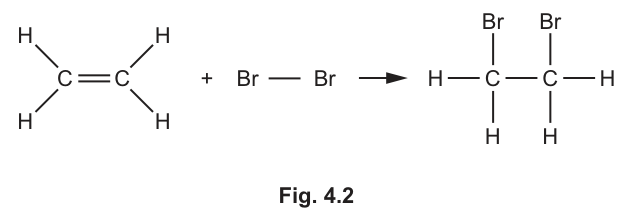
Fig. 4.2 shows the displayed formulae of the reactants and product.
Calculate the enthalpy change of this reaction in .
Use the bond energies in Table 4.1.
Table 4.1
| type of bond | |||||
|---|---|---|---|---|---|
| bond energy in | 612 | 413 | 193 | 347 | 290 |
enthalpy change = ______
Working
Bonds broken (endothermic):
1 C=C:
1 Br–Br:
Total energy to break bonds =
Bonds formed (exothermic):
1 C–C:
2 C–Br:
Total energy released forming bonds =
Enthalpy change = energy to break bonds energy released forming bonds
Enthalpy change =
Answer
-122
Walkthrough
The enthalpy change of a reaction can be estimated from bond energies using: . Bond breaking is endothermic (positive), bond making is exothermic (negative).
From Fig. 4.2, in ethene () and bromine (), the bonds broken are one C=C double bond and one Br–Br single bond. Energy absorbed = .
In 1,2-dibromoethane (), the bonds formed are one C–C single bond and two C–Br single bonds (the four C–H bonds remain unchanged and cancel out). Energy released = .
. The negative sign indicates the reaction is exothermic.
Key Takeaways
Bond energy calculations use . Only count bonds that actually change; unchanged bonds (like C–H here) can be ignored on both sides. Bond breaking is always positive (energy in), bond forming is always negative (energy out).
Common Mistakes
Forgetting that two C–Br bonds are formed (writing instead of ). Reversing the formula to get . Forgetting the negative sign.
Things to Be Careful About
The unit is kJ / mol. The answer must include the correct sign; is exothermic. Bond energies are average values, so the calculation gives an estimate, but the mark scheme expects the exact arithmetic result from the given table.
Describe the colour change when a sample of excess ethene is added to a few drops of aqueous bromine.
from ______ to ______
Answer
from orange to colourless
orange to colourless
Walkthrough
Bromine water (aqueous bromine) is orange/brown. When it is added to an alkene like ethene, an addition reaction occurs across the carbon-carbon double bond, forming a colourless dibromoalkane. The decolourisation of bromine water is the standard test for unsaturation (a carbon-carbon double bond).
Key Takeaways
The bromine test: add bromine water to the unknown. If it is an alkene (unsaturated), the orange/brown bromine water is decolourised (turns colourless) at room temperature. Alkanes do not react with bromine water under these conditions, so the colour remains.
Common Mistakes
Saying "brown to colourless" — bromine water is typically described as orange or orange-brown in 5070. Saying "decolourised" without stating the starting colour. Saying the colour changes to "white" or "clear" — "colourless" is the correct term.
Things to Be Careful About
The question asks for the colour change from ___ to ___. The starting colour is orange (or orange-brown), and the final colour is colourless. The reaction occurs at room temperature without UV light because the alkene is reactive enough to undergo electrophilic addition.
A student adds large pieces of copper(II) carbonate to dilute hydrochloric acid. The copper(II) carbonate is in excess.
Answer
CuCl2(aq) + H2O(l) + CO2(g)
Walkthrough
Carbonates react with dilute acids to produce a salt, water, and carbon dioxide gas. The salt formed is copper(II) chloride. Since the reaction takes place in aqueous hydrochloric acid and the salt is soluble, copper(II) chloride is aqueous (aq). Water is a liquid (l) at room temperature. Carbon dioxide is a gas (g) that bubbles out of the solution.
Key Takeaways
- Acid + metal carbonate → salt + water + carbon dioxide.
- State symbols: (aq) for dissolved salts in aqueous reactions, (l) for water, (g) for evolved gases.
Common Mistakes
- Writing (s) for copper(II) chloride; it is soluble and remains dissolved in the aqueous mixture.
- Writing (g) for water; water is a liquid under these conditions.
Things to Be Careful About
- Ensure state symbols are placed inside parentheses immediately after the formula, e.g., , not or .
Fig. 5.1 shows how the mass of the reaction mixture changes with time as the reaction proceeds.
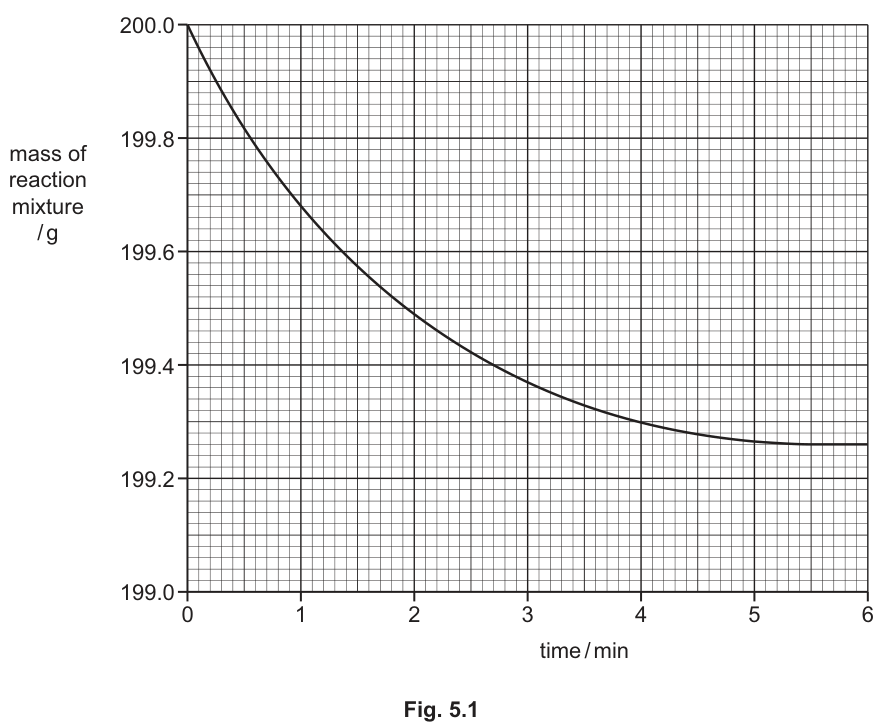
In another experiment, powdered copper(II) carbonate is used instead of large pieces of copper(II) carbonate. All other conditions and the mass of copper(II) carbonate stay the same.
Draw a line on the grid in Fig. 5.1 to show how the mass of the reaction mixture changes with time.
Answer
Draw a new curve on the grid that:
- Starts at the same initial point (0, 200.0).
- Has a steeper initial gradient than the original curve.
- Is still curved (rate decreases over time).
- Levels off at the same final mass of 199.3 g, but reaches it sooner (around 3–4 minutes instead of 5 minutes).
Steeper curve starting at 200.0 g and ending at 199.3 g
Walkthrough
Powdered copper(II) carbonate has a much larger total surface area than the same mass of large pieces. A larger surface area exposes more reactant particles to the acid at any given moment. This increases the frequency of successful collisions between the acid particles and the carbonate, resulting in a faster initial rate of reaction (a steeper gradient on the graph). However, because the mass of copper(II) carbonate and the amount of acid are the same, the total amount of carbon dioxide produced is identical. Therefore, the final mass of the reaction mixture (after all has escaped) is the same: 199.3 g.
Key Takeaways
- Increasing surface area (powdering a solid) increases the rate of reaction.
- The final mass change depends only on the limiting reactant, not the surface area.
Common Mistakes
- Drawing a line that ends at a different final mass (e.g., lower), which would imply more was produced.
- Drawing a straight line instead of a curve; the rate must decrease as reactants are used up.
Things to Be Careful About
- The new line must start at exactly (0, 200.0). The initial mass is the same because the same total mass of reactants is present at the start.
The initial experiment is repeated using large pieces of copper(II) carbonate and hydrochloric acid of a higher concentration.
All other conditions stay the same.
Describe and explain the difference in rate of reaction when hydrochloric acid of a higher concentration is used.
______
Answer
The rate of reaction increases (the reaction is faster).
Explanation:
A higher concentration of hydrochloric acid means there are more hydrogen ions (or acid particles) per unit volume of solution. The particles are more crowded and the distance between them is smaller. This leads to a greater frequency of collisions per second between the acid particles and the copper(II) carbonate, increasing the rate of reaction.
Answer
Rate increases because higher concentration means more particles per unit volume, leading to more frequent collisions.
Rate increases because higher concentration means more particles per unit volume, leading to more frequent collisions.
Walkthrough
Concentration is defined as the number of particles of solute per unit volume of solution. When the concentration of the acid is increased, there are more ions in the same volume. According to collision theory, for a reaction to occur, particles must collide with sufficient energy. With more particles packed into the same space, the average distance between them is reduced, so they collide more frequently. More collisions per second means more successful collisions per second, which directly increases the rate of reaction.
Key Takeaways
- Rate is proportional to collision frequency.
- Higher concentration → more particles per unit volume → shorter distances between particles → more frequent collisions.
Common Mistakes
- Saying "there are more particles" without specifying "per unit volume" or "in the same volume".
- Attributing the rate increase to particles having more energy (that is an explanation for increased temperature, not concentration).
Things to Be Careful About
- The mark scheme explicitly does not award a mark for simply saying "because". You must state the effect (rate increases) and then provide the two linked reasons (more crowded/smaller distance, AND more collisions per second).
Excess copper(II) carbonate is added to of hydrochloric acid.
Calculate the volume of carbon dioxide released measured at room temperature and pressure.
Give your answer to two significant figures.
volume of carbon dioxide gas = ______
Working
First, calculate the moles of hydrochloric acid used. The volume must be converted from to by dividing by 1000.
From the balanced equation in part (a):
The mole ratio of to is 2 : 1. Since copper(II) carbonate is in excess, hydrochloric acid is the limiting reactant.
At room temperature and pressure (r.t.p.), 1 mole of any gas occupies .
Rounding to two significant figures gives .
Answer
0.13
0.13
Walkthrough
Step 1: Find moles of the known reactant (). Use the formula , ensuring volume is in . .
Step 2: Use the stoichiometric ratio from the balanced equation. 2 moles of produce 1 mole of . So, of .
Step 3: Convert moles of gas to volume at r.t.p. using the molar gas volume (). .
Step 4: Round to the required significant figures (two). .
Key Takeaways
- Always convert volume in to by dividing by 1000 when using concentration in .
- Identify the limiting reactant (here, , since the carbonate is in excess).
- Molar gas volume at r.t.p. is (or ).
Common Mistakes
- Forgetting to divide the volume by 1000, leading to moles of .
- Using a 1:1 mole ratio instead of the correct 2:1 ratio from the balanced equation.
- Forgetting to round to two significant figures at the end.
Things to Be Careful About
- The question asks for the answer in , not . If you use , you will get , which must then be converted back to .
Describe the observations made when:
- a few drops of aqueous ammonia are added to an aqueous solution containing copper(II) ions
______ - excess aqueous ammonia is added to an aqueous solution containing copper(II) ions.
______
Answer
- A few drops of aqueous ammonia: a light blue precipitate forms.
- Excess aqueous ammonia: the precipitate dissolves to form a dark blue (or deep blue) solution.
Answer
Light blue precipitate, soluble in excess to give a dark blue solution.
Light blue precipitate, soluble in excess to give a dark blue solution
Walkthrough
Copper(II) ions () react with hydroxide ions provided by aqueous ammonia to form copper(II) hydroxide, which is insoluble and appears as a light blue precipitate.
When excess aqueous ammonia is added, the precipitate dissolves because a soluble complex ion, tetraamminecopper(II), is formed. This gives a characteristic dark blue solution.
Key Takeaways
- Ammonia test for : light blue ppt, soluble in excess to give dark blue solution.
- This distinguishes copper(II) from other metal ions like (white ppt, insoluble in excess) or (white ppt, soluble in excess to give colourless solution).
Common Mistakes
- Saying "white precipitate" (that is for magnesium or aluminium).
- Saying the precipitate is "insoluble in excess" (that is true for magnesium and aluminium hydroxides, but not copper).
- Calling the final solution "blue" instead of "dark blue" or "deep blue".
Things to Be Careful About
- Always describe both stages: the initial addition (few drops) and the addition of excess. Both observations are required for full marks.
An ionic compound of copper has the formula .
Deduce the oxidation number of copper in .
______
Answer
In , oxygen has an oxidation number of -2. Let the oxidation number of copper be .
The oxidation number of copper in is +1.
Answer
+1
+1
Walkthrough
Oxygen in oxides has an oxidation number of -2. The compound is neutral, so the sum of the oxidation numbers of all atoms must equal zero. There are two copper atoms and one oxygen atom.
Key Takeaways
- Oxygen is almost always -2 in compounds (except in peroxides or with fluorine).
- The sum of oxidation numbers in a neutral molecule is zero.
- Copper can have multiple oxidation states, commonly +1 and +2.
Common Mistakes
- Assuming copper is always +2 (it is +2 in and , but +1 in ).
- Forgetting to multiply the oxidation number of copper by 2 because there are two copper atoms in the formula.
Things to Be Careful About
- Oxidation numbers are written with the sign first, e.g., +1, not 1+. For ions, it is written as a superscript (e.g., ), but for oxidation numbers in a compound, +1 is correct.
Describe how to prepare crystals of ammonium chloride by reacting aqueous ammonia with dilute hydrochloric acid.
______
Answer
- Titrate aqueous ammonia with dilute hydrochloric acid (using an indicator like methyl orange or universal indicator) to find the exact volumes needed for neutralisation.
- Repeat the titration without the indicator to obtain a neutral solution without contaminating it with indicator colour.
- Mix the measured volumes of aqueous ammonia and hydrochloric acid together.
- Evaporate the resulting filtrate (or solution) to the crystallisation point / heat until a saturated solution is formed.
- Leave the solution to cool, then filter off the crystals and dry them between filter papers.
Answer
Titrate to find volumes, mix without indicator, evaporate to saturation, cool and filter/dry crystals.
Titrate to find volumes, mix without indicator, evaporate to saturation, cool and filter/dry crystals.
Walkthrough
Ammonia is a soluble base (an alkali), and hydrochloric acid is a soluble acid. To prepare a soluble salt like ammonium chloride, we cannot simply add the solid base to the acid and filter off excess, because the base is already dissolved. Instead, we must use a titration to find the exact stoichiometric ratio.
Step 1: Perform a titration of the aqueous ammonia with the dilute hydrochloric acid using an appropriate indicator to determine the exact volume of acid needed to neutralise a known volume of ammonia.
Step 2: Repeat the experiment without the indicator, using the volumes found in Step 1, to produce a pure, neutral solution of ammonium chloride without any indicator contamination.
Step 3: Evaporate some of the water from this solution by heating it until it reaches the crystallisation point (a saturated solution). This can be tested by dipping a cold glass rod into the solution and checking for crystal formation.
Step 4: Allow the saturated solution to cool slowly. As it cools, the solubility of ammonium chloride decreases, and crystals will form.
Step 5: Filter the crystals from the remaining solution (mother liquor) and press them between dry filter papers to absorb any remaining surface moisture.
Key Takeaways
- Soluble salts from soluble bases and acids require titration to determine the correct proportions.
- Crystallisation involves evaporating to saturation, cooling to form crystals, and filtering/drying.
Common Mistakes
- Suggesting adding excess solid ammonia and filtering (ammonia is a gas/liquid in solution, not an insoluble solid like a metal oxide or carbonate).
- Forgetting to mention evaporation or crystallisation; just saying "mix and heat" is not enough.
- Not mentioning the removal of the indicator in the final preparation step.
Things to Be Careful About
- The question asks for crystals, so the final steps must include cooling and filtering/drying.
- "Evaporate to dryness" is wrong here; that would decompose the salt or leave impurities. You must evaporate to the crystallisation point and then cool.
Fig. 6.1 shows the structures of zinc sulfide and disulfur dichloride.
Zinc sulfide has a structure similar to diamond.
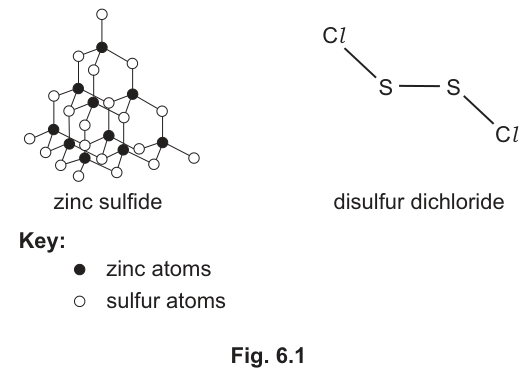
Explain why zinc sulfide does not conduct electricity.
Use the information in Fig. 6.1.
______
Answer
All electrons are held in covalent bonds within the giant lattice; there are no mobile (delocalised) electrons or ions to carry charge.
There are no mobile electrons.
Walkthrough
Zinc sulfide is described as having a structure similar to diamond. Diamond is a giant covalent structure where every atom is bonded to four others by strong covalent bonds. In such a structure, all valence electrons are localised in these bonds. For a substance to conduct electricity, it needs mobile charge carriers (free electrons or mobile ions). Since all electrons are fixed in the covalent bonds and there are no ions free to move, zinc sulfide does not conduct electricity.
Key Takeaways
Giant covalent structures like diamond and silicon dioxide do not conduct electricity because all electrons are involved in bonding and there are no mobile charge carriers.
Common Mistakes
Students often write 'no electrons' instead of 'no mobile electrons'. Electrons are present, but they are not free to move. Another mistake is saying 'no ions'; while true, the primary reason for non-conductivity in a covalent network is the lack of delocalised electrons.
Things to Be Careful About
Ensure the explanation directly references the structure (giant covalent, all electrons bonded). Do not mention 'no free electrons' as this is ambiguous; 'mobile' or 'delocalised' is the precise term.
Answer
High melting point (or high boiling point; hard).
High melting point.
Walkthrough
Zinc sulfide has a giant covalent structure similar to diamond. In such structures, a vast network of strong covalent bonds must be broken to change the state. This requires a large amount of energy, resulting in a high melting point and high boiling point. It is also typically hard.
Key Takeaways
Giant covalent structures have high melting and boiling points due to the large number of strong covalent bonds that must be broken.
Common Mistakes
Writing 'high melting point because of strong covalent bonds' is acceptable, but simply writing 'strong bonds' without linking it to the energy required to break them across the lattice can be vague. Avoid saying 'ionic bonds' as the structure is covalent.
Things to Be Careful About
Only one property is required. 'Hard' or 'insoluble in water' are also acceptable, but 'high melting point' is the most direct consequence of the giant lattice structure.
Explain why disulfur dichloride has a low melting point.
Use the information in Fig. 6.1.
______
Answer
It is a simple molecular substance. There are weak intermolecular forces between the molecules (which require little energy to overcome).
Weak intermolecular forces between molecules.
Walkthrough
Disulfur dichloride (Cl-S-S-Cl) is shown as a discrete molecule with a specific connectivity. Substances made of simple molecules have strong covalent bonds within the molecules, but the forces between the molecules (intermolecular forces) are weak. Melting only requires overcoming these weak intermolecular forces, not the strong covalent bonds. Therefore, little energy is needed, resulting in a low melting point.
Key Takeaways
Simple molecular substances have low melting and boiling points because only weak intermolecular forces need to be overcome, not the strong covalent bonds within the molecules.
Common Mistakes
Saying 'weak covalent bonds' is incorrect. The covalent bonds within the molecule are strong; it is the forces between molecules that are weak. Another mistake is not mentioning 'intermolecular' or 'between molecules'.
Things to Be Careful About
Be precise with terminology: 'intermolecular forces' (or 'van der Waals forces'), not 'intramolecular'.
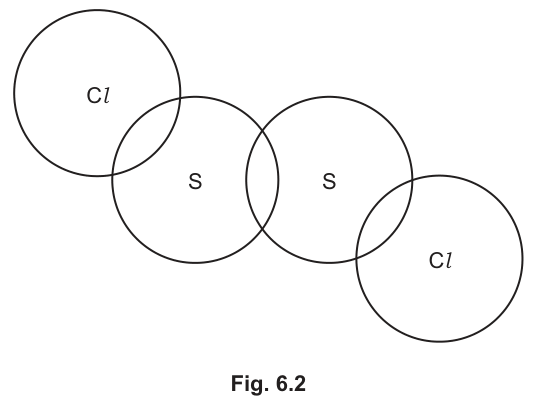
Complete Fig. 6.2 to show the dot-and-cross diagram for the electronic configuration of disulfur dichloride.
Show only the outer shell electrons.
Answer
Each overlap area (Cl–S, S–S, S–Cl) contains one shared pair (2 electrons). Each sulfur atom has two lone pairs (4 electrons) in its non-overlapping region. Each chlorine atom has three lone pairs (6 electrons) in its non-overlapping region.
Working
Total outer shell electrons: (from Cl) + (from S) = electrons.
Bonding pairs: 3 pairs = 6 electrons.
Remaining lone pair electrons: electrons (10 pairs).
Distribution: 3 lone pairs on each Cl (6 electrons each) and 2 lone pairs on each S (4 electrons each). . Correct.
One shared pair in each overlap; two lone pairs on each S; three lone pairs on each Cl.
Walkthrough
Disulfur dichloride has the structure Cl–S–S–Cl. We need to draw a dot-and-cross diagram showing only outer shell electrons.
- Count valence electrons: Cl is in Group VII (7 outer electrons), S is in Group VI (6 outer electrons). Total = electrons.
- Draw the skeleton: four overlapping circles in a chain Cl–S–S–Cl.
- Place shared pairs: one pair (2 electrons) in each of the three overlap regions (Cl–S, S–S, S–Cl). This uses 6 electrons.
- Distribute remaining electrons as lone pairs to complete octets:
- Each Cl needs 6 more electrons (3 lone pairs).
- Each S needs 4 more electrons (2 lone pairs).
- Total lone pair electrons: . Total electrons = . Matches.
Key Takeaways
Dot-and-cross diagrams for simple molecules require placing shared pairs in overlaps and lone pairs on the outer atoms to satisfy the octet rule.
Common Mistakes
Forgetting lone pairs on sulfur (it needs 2 lone pairs, not 1). Putting too many or too few electrons on chlorine (must be 3 lone pairs = 6 electrons). Using the same symbol (dots or crosses) for both atoms' electrons; usually, one atom's electrons are dots and the other's are crosses, but in the overlap, they must be mixed or clearly distinguished.
Things to Be Careful About
The question says 'show only the outer shell electrons'. Do not draw inner shells. Ensure the circles overlap correctly to represent the bonds. The mark scheme awards 1 mark for the whole diagram if correct.
Disulfur dichloride reacts with water as shown.
of disulfur dichloride is reacted with of water.
Show by calculation that water is in excess.
Working
Relative formula mass of :
From the equation, 1 mol reacts with 3 mol .
Moles of required to react with 0.100 mol :
Since 0.444 mol is available and only 0.300 mol is required, water is in excess.
(Alternatively: moles of that would react with 0.444 mol mol. Since 0.100 mol < 0.148 mol, is limiting and water is in excess.)
Water is in excess (0.444 mol available > 0.300 mol required).
Walkthrough
The goal is to show water is in excess. We do this by calculating the moles of each reactant and comparing them using the stoichiometric ratio from the balanced equation:
- Calculate of : .
- Calculate moles of : mol.
- Calculate moles of : . Moles = mol.
- Use the ratio 1:3. For 0.100 mol of , we need mol of water.
- We have 0.444 mol of water, which is more than 0.300 mol. Therefore, water is in excess.
Key Takeaways
To identify the excess reactant, calculate moles of both reactants, use the balanced equation to find how much of one is needed to react with the other, and compare with the actual amount available.
Common Mistakes
Using atomic mass instead of molecular mass for (e.g., using 32+35.5=67.5). Forgetting the 1:3 ratio and comparing moles directly (0.100 vs 0.444 looks like excess, but you must prove it via stoichiometry). Rounding too early (0.444 vs 0.44).
Things to Be Careful About
State symbols are not required for this calculation. Ensure values are correct to 1 decimal place as per standard O Level practice (S=32.1 is sometimes used, but 32 is standard unless specified; mark scheme uses 135 implying S=32, Cl=35.5). The mark scheme accepts either showing water needed is 0.300 or showing S2Cl2 that would react is 0.148.
Sulfur dioxide is an air pollutant.
Answer
Acid rain (or damages buildings/statues made of limestone/marble; harms aquatic life in lakes).
Acid rain.
Walkthrough
Sulfur dioxide () is a major air pollutant released from burning fossil fuels containing sulfur. In the atmosphere, it reacts with water and oxygen to form sulfuric acid, which falls as acid rain. Acid rain lowers the pH of lakes and rivers, harming aquatic life, and reacts with limestone/marble (calcium carbonate) in buildings and statues, causing corrosion.
Key Takeaways
causes acid rain, which has detrimental effects on ecosystems and man-made structures.
Common Mistakes
Saying 'global warming' or 'greenhouse effect' — this is caused by , not . Saying 'smog' — this is primarily associated with nitrogen oxides and particulates, though contributes to particulate formation, 'acid rain' is the primary expected answer.
Things to Be Careful About
Only one effect is required for 1 mark. 'Acid rain' is the most direct and commonly accepted answer.
Describe two ways of reducing the emissions of sulfur dioxide in the air.
- ______
- ______
Answer
- Flue gas desulphurisation: react with calcium oxide () or calcium carbonate () in power station chimneys.
- Use low-sulfur fuels (or switch to renewable energy sources such as solar, wind, hydroelectric; burn less fossil fuel).
Flue gas desulphurisation (using CaO or CaCO3) and use of low-sulfur fuels or renewable energy sources.
Walkthrough
To reduce emissions, we can either remove it from the exhaust gases (end-of-pipe) or prevent its formation at the source.
- Flue gas desulphurisation: Calcium oxide (from limestone) or calcium carbonate is sprayed into the flue gases. They react with to form calcium sulfite/sulfate (a solid 'gypsum'), removing the pollutant before it enters the atmosphere.
- Source reduction: Use fuels with less sulfur (low-sulfur coal/oil). Switch to energy sources that do not produce , such as renewables (solar, wind, nuclear, hydro). Reduce overall fossil fuel consumption.
Key Takeaways
can be removed from emissions chemically (using alkaline materials like lime/limestone) or prevented by changing the fuel source.
Common Mistakes
Suggesting 'catalytic converters' — these are primarily for nitrogen oxides and carbon monoxide from cars, not typically for from power stations (though they can help, it's not the primary 5070 answer). Saying 'plant more trees' — trees absorb , not significantly .
Things to Be Careful About
Two ways are required for 2 marks. Ensure they are distinct. 'Use less fossil fuels' and 'use renewable energy' are often accepted as separate points, but 'flue gas desulphurisation' and 'low sulfur fuels' are the most chemically precise pair. Naming the renewable energy (solar, wind) is better than just saying 'renewables'.
Propanoic acid can be represented by the formula .
Propanoic acid reacts with methanol, , to produce an ester.
Name the ester formed and draw its displayed formula.
name = ______
displayed formula
Answer
name = methyl propanoate
displayed formula:
methyl propanoate; displayed formula of methyl propanoate
Walkthrough
The reaction between a carboxylic acid and an alcohol is esterification. The name of the ester is derived from the alcohol (alkyl group) and the carboxylic acid (alkanoate part). Methanol () provides the methyl group, and propanoic acid () provides the propanoate part, giving methyl propanoate.
For the displayed formula, every single bond must be drawn as a line, and the double bond must be shown as two lines. The structure is .
Key Takeaways
- Ester names: alkyl group from alcohol + alkanoate from carboxylic acid.
- Displayed formulas must show all atoms and all bonds explicitly.
Common Mistakes
- Writing the ester name backwards (e.g., propanol methanoate).
- Drawing a skeletal or semi-structural formula instead of a displayed formula (missing explicit bonds).
- Forgetting the double bond on the carbonyl oxygen.
Things to Be Careful About
- The displayed formula must include every hydrogen atom bonded to every carbon and oxygen. Do not use condensed groups like in a displayed formula.
Propanoic acid is a weak acid.
Explain how this equation shows that:
- is an acid by referring to proton transfer
______ - is a weak acid.
______
Answer
- is an acid because it donates a proton () to water (or: a proton is transferred from the acid to water).
- is a weak acid because the reaction is reversible (does not go to completion / the acid is not fully ionised or dissociated), as shown by the equilibrium arrow .
Proton transfer from acid to water; reversible reaction / not fully ionised
Walkthrough
A Brønsted-Lowry acid is a proton () donor. In the equation, loses an to , forming . This proton transfer identifies it as an acid.
A strong acid fully ionises in water, represented by a single forward arrow (). A weak acid only partially ionises, establishing an equilibrium, represented by the double arrow (). The presence of in the equation shows the reaction does not go to completion, meaning the acid is not fully dissociated/ionised.
Key Takeaways
- Acids donate protons to bases (like water).
- Weak acids partially ionise, shown by the reversible arrow .
Common Mistakes
- Saying the acid 'contains hydrogen' (all acids do; it must be about donating ).
- Saying 'it is not fully dissolved' (it is about ionisation/dissociation, not dissolving).
Things to Be Careful About
- Use the term 'proton' or '', not just 'hydrogen'.
- For weakness, reference the equilibrium arrow or the phrase 'not fully ionised/dissociated'.
Propanoic acid reacts with magnesium.
Name the two products of this reaction.
- ______
- ______
Answer
- magnesium propanoate
- hydrogen
magnesium propanoate and hydrogen
Walkthrough
Acids react with reactive metals (like magnesium) to produce a salt and hydrogen gas. The salt is named from the metal (magnesium) and the acid radical (propanoate from propanoic acid). Thus, the products are magnesium propanoate and hydrogen.
Key Takeaways
- Acid + metal salt + hydrogen.
- The salt name combines the metal name and the alkanoate name from the carboxylic acid.
Common Mistakes
- Naming the salt as 'magnesium propanoic acid' (should be magnesium propanoate).
- Forgetting that hydrogen is a gas (), though naming it 'hydrogen' is sufficient here.
Things to Be Careful About
- Ensure the salt name uses the correct suffix (-oate for carboxylic acids).
Magnesium is a solid at room temperature.
Describe the motion and separation of the particles in a solid.
motion = ______
separation = ______
Answer
motion = only vibrate (in fixed positions)
separation = touching (or close together)
motion: only vibrate; separation: touching
Walkthrough
In the solid state, particles (atoms, ions, or molecules) are held in fixed positions by strong forces of attraction. Because they cannot move freely, their only motion is vibration about their fixed positions. Their separation is minimal; they are touching or packed closely together.
Key Takeaways
- Solid particles vibrate in fixed positions.
- Solid particles are touching / close together.
Common Mistakes
- Saying particles 'do not move' (they vibrate, so they do move).
- Saying particles are 'far apart' (that is for gases).
Things to Be Careful About
- Use 'vibrate', not 'move freely' or 'flow'.
- Use 'touching' or 'close together', not 'packed tightly' (though often accepted, 'touching' is the precise 5070 mark scheme term).
Fig. 7.1 shows the simplified structures of two molecules that combine to form a polyamide.
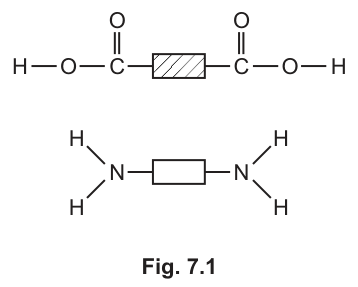
Complete the diagram in Fig. 7.2 to show the structure of two repeat units of this polyamide.
Show all of the atoms and all of the bonds in the linkages.
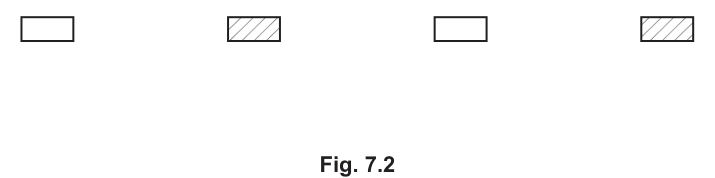
Answer
Completed diagram showing two repeat units with amide linkages -C(=O)-NH- and -NH-C(=O)-, left end ending in -NH- and right end ending in -C(=O)-
Walkthrough
The monomers are a dicarboxylic acid (shaded box, with ends) and a diamine (open box, with ends). In condensation polymerisation, the from the carboxylic acid and an from the amine are eliminated as water, forming an amide linkage .
The sequence of boxes is: open (amine), shaded (acid), open (amine), shaded (acid). We need to draw two repeat units, meaning we connect all four boxes.
- Between the shaded box (acid) and the next open box (amine): the end of the acid connects to the end of the amine. Draw .
- Between the open box (amine) and the next shaded box (acid): the end of the amine connects to the end of the acid. Draw .
- Left end of the first open box: must end with (derived from losing one H).
- Right end of the last shaded box: must end with (derived from losing OH).
All atoms and bonds in the linkages must be shown explicitly (displayed formula style).
Key Takeaways
- Condensation polymerisation between a dicarboxylic acid and a diamine forms a polyamide.
- The amide linkage is .
- End groups of the repeat unit chain reflect the remaining functional groups after water elimination.
Common Mistakes
- Drawing the amide linkage backwards (e.g., without the H on N, or connecting C to C).
- Forgetting the hydrogen atom on the nitrogen in the amide linkage.
- Not showing all bonds explicitly in the linkages (must be displayed formula, not skeletal).
- Incorrect end groups (e.g., leaving or at the ends of a repeat unit diagram when it should be and ).
Things to Be Careful About
- The diagram asks for 'two repeat units'. Ensure there are four boxes connected.
- 'Show all of the atoms and all of the bonds in the linkages' means you must draw the double bond and the bond explicitly in the amide groups.
- Direction matters: carbonyl carbon from the acid must bond to the nitrogen from the amine.
Answer
A polymer is a large molecule (macromolecule) built up from many smaller molecules (monomers) joining together.
Large molecule built up from many smaller molecules (monomers)
Walkthrough
A polymer is defined by its size and its construction. It is a large molecule (or macromolecule) formed by the repeated joining of many smaller molecules called monomers.
Key Takeaways
- Polymer = large molecule made of many monomers.
Common Mistakes
- Saying 'a polymer is made of atoms' (too vague, must mention monomers).
- Saying 'a polymer is a mixture' (it is a pure substance, a single large molecule or network).
Things to Be Careful About
- Use the word 'monomers' or 'smaller molecules'. 'Large molecules' is also required.
Polyamides are condensation polymers.
State one difference between condensation polymerisation and addition polymerisation.
______
Answer
In condensation polymerisation, a small molecule (such as water) is eliminated during the reaction, whereas in addition polymerisation, no small molecule is eliminated (only one product is formed). Alternatively: addition polymerisation uses monomers with a bond, while condensation polymerisation uses monomers with two different functional groups (e.g., and ).
Condensation polymerisation eliminates a small molecule (e.g. water); addition does not.
Walkthrough
The two main types of polymerisation differ in mechanism and byproducts.
- Addition polymerisation: monomers with a double bond open up and join together. The only product is the polymer; no atoms are lost. The empirical formula of the polymer is the same as the monomer.
- Condensation polymerisation: monomers with two functional groups (like and , or and ) join together, and a small molecule (usually water) is eliminated at each linkage. The empirical formula of the polymer differs from the monomers.
Any one valid difference is acceptable.
Key Takeaways
- Addition: no small molecule lost, requires .
- Condensation: small molecule (e.g. ) lost, requires two functional groups.
Common Mistakes
- Saying 'condensation polymers are smaller' (size is not the defining difference).
- Forgetting to mention the small molecule eliminated in condensation.
Things to Be Careful About
- The question asks for 'one difference'. Providing one clear, correct difference is sufficient.