Chemistry 5070/12 — October/November 2024
Cambridge O-Level · Multiple Choice · answer key with instant marking and worked solutions
Topics Stoichiometry · Atoms, Elements and Compounds · Chemical Reactions · Electrochemistry · Chemistry of the Environment · Acids, Bases and Salts · +6 more
Tap an option under each question to check it — your score builds as you go.
Helium gas and argon gas are mixed in a closed container at room temperature and pressure (r.t.p.).
What happens when the two gases are in the container?
Options
A Argon and helium atoms become evenly mixed throughout the container even though they have different masses.
B Argon and helium atoms both move towards the bottom of the container. The argon atoms settle more quickly because they are larger and heavier.
C Argon and helium atoms both move towards the bottom of the container. The helium atoms settle more quickly because they are smaller and lighter.
D Argon atoms move to the bottom of the container because they are heavier. Helium atoms move to the top of the container because they are lighter.
Working
Gas particles (atoms of helium and argon) are in continuous, random, rapid motion and diffuse to fill any available volume uniformly. Because of this continuous random motion, the two gases will mix completely and evenly throughout the container over time, regardless of the difference in their atomic masses. Gas particles do not settle into separate layers under gravity in a laboratory container at room temperature and pressure.
- Option A correctly states that the atoms become evenly mixed throughout the container.
- Options B, C, and D incorrectly suggest that the gases settle into distinct layers or fall to the bottom based on their masses.
Answer
A
A
Walkthrough
According to the kinetic particle theory:
- Gas particles (in this case, monoatomic noble gas atoms of helium, , and argon, ) have negligible forces of attraction between them.
- The particles possess high kinetic energy and move constantly, randomly, and rapidly in all directions.
- Through the process of diffusion—the net movement of particles from a region of higher concentration to a region of lower concentration as a result of their random motion—the gases completely and uniformly mix with each other to form a homogeneous mixture.
- Even though helium atoms have a smaller relative atomic mass () and therefore diffuse faster than argon atoms (), the continuous collisions and random movement mean that both gases will spread out uniformly throughout the entire container rather than settling into separate layers.
Thus, option A is the correct statement.
Key Takeaways
- Gases expand to completely and uniformly fill any container they are placed in.
- Diffusion causes different gases to mix homogeneously regardless of differences in particle mass or density.
- The kinetic energy of gas particles at room temperature is far greater than the effect of gravity, preventing them from settling out.
Common Mistakes
- Confusing the rate of diffusion with the final equilibrium state: while lighter gas particles diffuse faster, both light and heavy gases ultimately mix evenly.
- Thinking that gases separate into layers like immiscible liquids of different densities.
Things to Be Careful About
- Relative atomic mass affects the rate (speed) of diffusion (lighter particles diffuse faster at the same temperature), but it does not prevent complete and even mixing once mixed.
Substance X has a simple molecular structure and substance Y has a giant covalent structure.
Which row is correct?
Options
| X could be | Y could be | |
|---|---|---|
| A | an element only | an element only |
| B | an element only | an element or a compound |
| C | an element or a compound | an element only |
| D | an element or a compound | an element or a compound |
Working
-
Substance X (simple molecular structure):
- Can be an element (e.g. , , , , ).
- Can be a compound (e.g. , , ).
- Therefore, X can be an element or a compound.
-
Substance Y (giant covalent structure):
- Can be an element (e.g. diamond, graphite — allotropes of carbon).
- Can be a compound (e.g. silicon dioxide, ).
- Therefore, Y can be an element or a compound.
Matching both deductions identifies row D as correct.
Answer
D
D
Walkthrough
To determine the correct row, we evaluate the possible types of chemical classification (element vs. compound) for both structure types:
-
Substance X has a simple molecular structure:
- A simple molecular substance consists of discrete molecules held together by covalent bonds, with weak intermolecular forces between the molecules.
- Elements: Many non-metal elements exist as simple molecules, such as diatomic gases (, , , ) and polyatomic molecules (, , buckminsterfullerene ).
- Compounds: Many non-metal compounds exist as simple molecules (e.g. , , , ).
- Hence, X can be either an element or a compound.
-
Substance Y has a giant covalent structure:
- A giant covalent structure (macromolecule) consists of a three-dimensional lattice where all atoms are linked by strong covalent bonds.
- Elements: Carbon exists in giant covalent allotropes including diamond and graphite.
- Compounds: Silicon dioxide (silica, ) is a giant covalent compound composed of silicon and oxygen atoms.
- Hence, Y can also be either an element or a compound.
Therefore, row D is the correct answer.
Key Takeaways
- Both simple molecular and giant covalent structures can exist as either pure elements (composed of only one type of atom) or chemical compounds (composed of two or more different elements chemically combined).
- Classic O Level examples to remember:
- Simple molecular element: ,
- Simple molecular compound: ,
- Giant covalent element: diamond, graphite (carbon)
- Giant covalent compound: silicon dioxide ()
Common Mistakes
- Assuming giant covalent structures are only elements because diamond and graphite are the most frequently discussed examples, forgetting silicon dioxide (sand/quartz).
- Assuming simple molecular substances must be compounds because water and carbon dioxide are the most common examples, overlooking diatomic elemental gases like and .
Things to Be Careful About
- Ensure you clearly distinguish between the structural type (simple molecular vs. giant covalent) and the chemical classification (element vs. compound).
The diagram shows an atom of element Z.
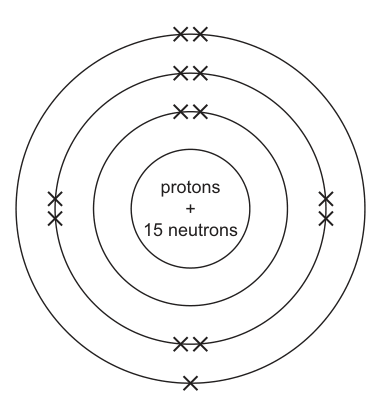
Which symbol for element Z is correct?
Options
A
B
C
D
Working
-
Count the number of electrons in the neutral atom:
- Innermost shell:
- Middle shell:
- Outermost shell:
- Total electrons
-
In a neutral atom, the number of protons equals the number of electrons, so:
-
Calculate the nucleon number (mass number, ):
-
Nuclide notation is written as , which gives .
Answer
C
C
Walkthrough
To find the correct chemical symbol (nuclide notation) for an atom, we need to determine its proton number () and its mass number ():
-
Determine the proton number ():
An atom is electrically neutral, meaning the number of positive protons in the nucleus must equal the total number of negative electrons orbiting the nucleus.- Looking at the electron shells in the diagram: electrons in the first shell, in the second, and in the third shell.
- Total number of electrons .
- Therefore, the number of protons , which gives the bottom number (atomic number, ).
-
Determine the mass number ():
The mass number (nucleon number) is the total number of protons and neutrons in the nucleus.- The nucleus is labelled as containing .
- .
- This gives the top number ().
Combining these into the standard notation gives , which corresponds to option C.
Key Takeaways
- In a neutral atom: .
- Atomic number (proton number, ) is the lower number in nuclide notation: .
- Mass number (nucleon number, ) is the upper number in nuclide notation: .
Common Mistakes
- Inverting the notation by putting the atomic number at the top and mass number at the bottom (as in option A).
- Forgetting to add the protons to the neutrons and writing the neutron number as the mass number (as in option D).
- Assuming the mass number is simply double the proton number () instead of using the provided neutron count (as in option B).
Things to Be Careful About
- Ensure you carefully count all the electrons across every shell without missing the unpaired electron on the outer shell.
- Remember that the mass number represents all nucleons (protons + neutrons), not just the neutrons.
A sample of element Q contains two isotopes.
The diagram shows the relative abundances and relative masses of the two isotopes.
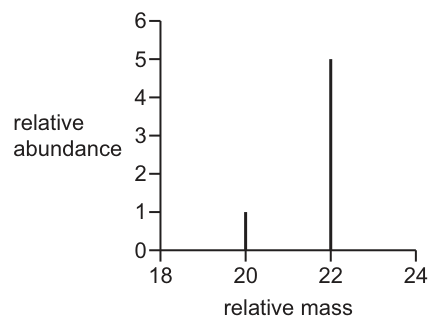
What is the relative atomic mass, , of this sample of Q?
Options
A 21.0
B 21.2
C 21.5
D 21.7
Working
From the graph:
- Isotope with relative mass has a relative abundance of .
- Isotope with relative mass has a relative abundance of .
Total abundance:
Calculate the relative atomic mass ():
This matches option D.
Answer
D
D
Walkthrough
-
Identify the isotope masses and their relative abundances from the graph:
- The peak at relative mass has a height of .
- The peak at relative mass has a height of .
-
Apply the formula for relative atomic mass ():
Relative atomic mass is the weighted average mass of naturally occurring atoms of an element on a scale where an atom of has a mass of exactly units. -
Substitute the values:
-
Check the result against intuition:
Since the isotope of mass is much more abundant (5 out of 6 parts) than the isotope of mass (1 out of 6 parts), the average must lie much closer to than to . A value of makes complete physical sense.
Key Takeaways
- The relative atomic mass () is a weighted mean that takes into account both the mass and the relative abundance of each isotope.
- When abundances are given as ratios or peak heights (not percentages), divide by the sum of the abundances rather than .
Common Mistakes
- Dividing by instead of the total abundance (): (Option A), which incorrectly assumes equal abundance.
- Dividing by automatically without noticing that the abundances are given as simple ratios ( and ), not percentages.
- Misreading the heights of the bars on the vertical axis.
Things to Be Careful About
- Always find the sum of the abundances first before carrying out the division.
- Round your final answer to the appropriate number of decimal places or significant figures as presented in the multiple-choice options (here, 1 decimal place).
Which statement about electrical conductivity is correct?
Options
A Covalent compounds, such as glucose, conduct when molten or dissolved in water.
B Dilute acids, such as sulfuric acid, conduct because all the ions are free to move.
C Ionic compounds, such as sodium chloride, conduct due to movement of electrons.
D Metals, such as copper, conduct due to movement of positive ions.
Working
- A is incorrect: Simple covalent compounds, such as glucose, consist of neutral molecules and do not have mobile ions or delocalised electrons to carry charge when molten or dissolved in water.
- B is correct: Dilute acids (e.g. dilute ) are aqueous solutions containing mobile ions ( and ), which are free to move and conduct electricity.
- C is incorrect: Molten or aqueous ionic compounds conduct electricity due to the movement of mobile ions, not electrons.
- D is incorrect: Metals conduct electricity due to the movement of delocalised electrons, while the positive ions remain fixed in a lattice.
Answer
B
B
Walkthrough
For a substance to conduct electricity, it must contain mobile charge carriers—either free-moving ions or delocalised electrons.
- In metals, conduction is caused by the movement of delocalised electrons through a regular lattice of fixed positive metal ions. Therefore, statement D is incorrect.
- In molten or aqueous ionic compounds, conduction is caused by the movement of mobile ions towards oppositely charged electrodes, not by electrons. Therefore, statement C is incorrect.
- In simple covalent compounds (such as glucose), there are no free ions or delocalised electrons; they consist of uncharged molecules and therefore cannot conduct electricity in the solid, liquid, or dissolved state. Therefore, statement A is incorrect.
- In aqueous solutions of acids (such as sulfuric acid, ), the acid dissociates in water into mobile hydrogen ions () and sulfate ions (). Because these ions are free to move throughout the solution, dilute acids conduct electricity. Thus, statement B is correct.
Key Takeaways
- Electrical conductivity in metals and graphite is due to the movement of delocalised electrons.
- Electrical conductivity in molten ionic compounds and aqueous electrolytes (including acids and alkalis) is due to the movement of mobile ions.
- Solid ionic compounds and simple molecular covalent compounds do not conduct electricity because they have no free-moving charge carriers.
Common Mistakes
- Confusing the charge carriers: thinking that ionic compounds conduct via electrons, or that metals conduct by moving positive ions.
- Forgetting that acids ionise in aqueous solutions to produce mobile ions, making them good electrical conductors (electrolytes).
Things to Be Careful About
- Ensure you clearly distinguish between ions (which conduct in electrolytes/liquids) and delocalised electrons (which conduct in metallic and graphite structures).
Which substance is not malleable and conducts electricity by the movement of electrons through a lattice of atoms?
Options
A aqueous sodium chloride
B gold
C graphite
D solid sodium chloride
Working
- Aqueous sodium chloride conducts electricity via mobile ions ( and ), not electrons.
- Gold is a metal and is malleable; it conducts electricity via delocalised electrons through a lattice of positive metal ions.
- Graphite is a giant covalent substance (lattice of carbon atoms) with delocalised electrons between its hexagonal layers, allowing it to conduct electricity, and it is non-malleable (it is soft and brittle/flaky).
- Solid sodium chloride does not conduct electricity because its ions are held in fixed positions within the ionic lattice.
Answer
C
C
Walkthrough
To find the correct substance, evaluate each option against the two conditions given:
-
Conducts electricity by the movement of electrons through a lattice of atoms:
- In aqueous sodium chloride (), the charge carriers are mobile aqueous ions ( and ), not electrons.
- In solid sodium chloride (), the ions are locked in fixed positions in the lattice, so it cannot conduct electricity.
- Both gold and graphite conduct electricity using delocalised electrons moving through a lattice.
-
Is not malleable:
- Gold is a typical metal consisting of layers of cations that can slide over each other without breaking the metallic bond, making it highly malleable.
- Graphite has a giant covalent structure consisting of layers of carbon atoms held together by weak intermolecular forces. Applying a force causes the layers to flake off or break rather than deform plastically; hence, graphite is non-malleable (it is brittle/soft).
Thus, graphite fits both criteria.
Key Takeaways
- Electrical conduction can occur via delocalised electrons (in metals and graphite) or via mobile ions (in molten or aqueous ionic compounds).
- Graphite has carbon atoms each bonded to three other carbon atoms in hexagonal layers, leaving one delocalised electron per carbon atom free to move and carry charge throughout the layers.
- Metals are malleable because regular layers of ions can slide over each other without disrupting the metallic bond, whereas giant covalent structures like graphite are not malleable.
Common Mistakes
- Confusing electrical conduction by ions with conduction by electrons (e.g., selecting aqueous sodium chloride).
- Overlooking the condition "not malleable" and incorrectly choosing gold.
- Forgetting that solid ionic compounds do not conduct electricity because their ions are fixed in place.
Things to Be Careful About
- Ensure you check both requirements stated in the stem: mechanical property (not malleable) and electrical conduction mechanism (movement of electrons through a lattice of atoms).
What is the relative molecular mass, , of ethene?
Options
A the average mass of the isotopes of C and H compared to of the mass of an atom of
B the atomic numbers of the isotopes of C and H compared to of the mass of an atom of
C twice the of C plus four times the of H
D twice the of C plus six times the of H
Working
- Ethene is an alkene containing two carbon atoms, with the molecular formula .
- The relative molecular mass () is the sum of the relative atomic masses () of all the atoms present in the molecule:
- This corresponds to "twice the of C plus four times the of H".
- Option A gives a distorted definition of relative atomic mass.
- Option B incorrectly uses atomic numbers instead of masses.
- Option D gives the formula for ethane ().
Answer
C
C
Walkthrough
- Identify the chemical formula of ethene:
- Ethene belongs to the homologous series of alkenes with the general formula .
- With , ethene has the molecular formula .
- Determine how relative molecular mass () is calculated:
- The of a covalent molecule is calculated by adding together the relative atomic masses () of all the individual atoms in its molecular formula.
- In , there are carbon atoms and hydrogen atoms.
- Therefore, .
- Match with the correct option:
- Option C accurately describes this calculation.
Key Takeaways
- Molecular formula of ethene: .
- Relative molecular mass (): The sum of the relative atomic masses () of all the atoms shown in the molecular formula.
Common Mistakes
- Confusing ethene () with ethane (), which leads to choosing option D.
- Confusing atomic number (proton number) with relative atomic mass ().
Things to Be Careful About
- Always double-check prefixes: "eth-" means 2 carbons, and the "-ene" suffix indicates an alkene (), not an alkane ().
What is the relative molecular mass, , of N₂O?
Options
A 22
B 30
C 44
D 46
Working
Using the relative atomic masses from the Periodic Table:
Calculate the relative molecular mass of :
- Option A () incorrectly divides the value by .
- Option B () is the of ().
- Option C () is the correct of .
- Option D () is the of ().
Answer
C
C
Walkthrough
To find the relative molecular mass () of a compound, sum the relative atomic masses () of all the atoms present in its chemical formula:
-
Identify the constituent elements and the number of atoms of each from the formula :
- nitrogen () atoms
- oxygen () atom
-
Look up the relative atomic masses () on the Periodic Table:
-
Multiply each by the number of atoms and sum the values:
Therefore, option C is correct.
Key Takeaways
- The relative molecular mass () is the sum of the relative atomic masses of all atoms shown in the formula.
- Subscripts denote the quantity of each specific atom (e.g. the subscript in applies only to nitrogen).
Common Mistakes
- Confusing (dinitrogen monoxide) with (nitrogen dioxide, ) or (nitrogen monoxide, ).
- Forgetting to multiply the of nitrogen by .
Things to Be Careful About
- Always double-check which atom the subscript applies to before calculating.
Which contains the greatest mass of oxygen?
Options
A 0.2 mol of aluminium nitrate, Al(NO₃)₃
B 0.3 mol of potassium sulfate, K₂SO₄
C 0.4 mol of sodium nitrate, NaNO₃
D 0.5 mol of magnesium carbonate, MgCO₃
Working
The mass of oxygen in each sample is directly proportional to the total moles of oxygen atoms ():
-
A:
Each formula unit contains oxygen atoms. -
B:
Each formula unit contains oxygen atoms. -
C:
Each formula unit contains oxygen atoms. -
D:
Each formula unit contains oxygen atoms.
Comparing the values, of in option A is the greatest amount, and therefore corresponds to the greatest mass ().
A
Walkthrough
To find which sample contains the greatest mass of oxygen, we need to calculate the quantity of oxygen atoms present in each option:
-
Identify the number of oxygen atoms per formula unit:
- In , the bracket subscript multiplies everything inside the bracket: there are oxygen atoms per formula unit.
- In , there are oxygen atoms per formula unit.
- In , there are oxygen atoms per formula unit.
- In , there are oxygen atoms per formula unit.
-
Multiply by the number of moles of compound:
- Option A: of
- Option B: of
- Option C: of
- Option D: of
-
Relate moles to mass:
Since , and the relative atomic mass of oxygen () is constant for all options, the sample with the largest number of moles of oxygen atoms automatically has the greatest mass of oxygen.
Option A gives of (), which is greater than option D (), option B (), and option C ().
Key Takeaways
- When brackets are present in a chemical formula, multiply the subscript inside the bracket by the subscript outside the bracket to get the total number of atoms of that element.
- Comparing masses of the same element across different compounds only requires comparing the total moles of that element.
Common Mistakes
- Forgetting to multiply subscripts inside brackets by the outside subscript (e.g., counting only or oxygen atoms in instead of ).
- Selecting the option with the largest number of moles of compound ( in D) without accounting for the number of oxygen atoms in the formula unit.
Things to Be Careful About
- Ensure you calculate the moles of oxygen atoms () rather than assuming oxygen gas (), though relative comparisons yield the same result either way.
Compound Z contains carbon, hydrogen and oxygen only.
Compound Z contains 48.65% carbon and 8.11% hydrogen by mass.
What is the empirical formula of Z?
Options
A C₂H₄O
B C₃H₆O₂
C C₄H₈O₃
D C₈H₁₆O₅
Working
- Find the percentage by mass of oxygen:
- Find the number of moles of each element in of compound Z using values (, , ):
- Divide each mole quantity by the smallest value ():
- Multiply by to obtain the simplest whole-number ratio:
Therefore, the empirical formula is .
Answer
B
B
Walkthrough
To find the empirical formula of a compound from percentage composition by mass:
-
Determine the percentage of all elements:
The question states that compound Z contains only carbon, hydrogen, and oxygen. The sum of all mass percentages must be . -
Convert percentages to moles:
Assuming a sample of the compound, the mass of each element in grams is equal to its percentage. Divide each mass by the respective relative atomic mass (): -
Find the simplest molar ratio:
Divide each mole value by the smallest number of moles calculated, which is : -
Convert non-integers to integers:
Since the ratio contains a half-integer (), multiply all numbers in the ratio by :
This gives an empirical formula of , which corresponds to option B.
Key Takeaways
- The empirical formula is the simplest whole-number ratio of the atoms of each element present in a compound.
- When a percentage is missing for a compound of known elemental composition, subtract the given percentages from .
- If dividing by the smallest mole value yields a decimal ending close to , multiply all ratios by (or by if ending in or ) to reach the lowest whole-number ratio.
Common Mistakes
- Forgetting to calculate the percentage of oxygen by subtracting the given percentages from .
- Rounding directly to or instead of multiplying all ratios by to maintain the true proportions.
- Dividing by the relative molecular mass of diatomic gases (e.g., using for or for ) rather than atomic masses ().
Things to Be Careful About
- Use relative atomic masses directly from the Periodic Table (, , ).
- Keep intermediate calculations to at least three significant figures to prevent rounding errors that could distort the molar ratio.
Which fertiliser contains the highest percentage by mass of nitrogen?
[: NH₄NO₃, 80; (NH₄)₃PO₄, 149; (NH₄)₂SO₄, 132; (NH₂)₂CO, 60]
Options
A NH₄NO₃
B (NH₄)₃PO₄
C (NH₄)₂SO₄
D (NH₂)₂CO
Working
The percentage by mass of nitrogen is calculated using:
Given :
-
A ():
-
B ():
-
C ():
-
D ():
(urea) has the highest percentage by mass of nitrogen ().
Answer
D
D
Walkthrough
To find which fertiliser contains the highest percentage of nitrogen by mass, calculate the percentage of nitrogen in each compound:
- In (ammonium nitrate), there are 2 nitrogen atoms:
- In (ammonium phosphate), there are 3 nitrogen atoms:
- In (ammonium sulfate), there are 2 nitrogen atoms:
- In (urea), there are 2 nitrogen atoms:
Urea (option D) gives the highest percentage of nitrogen by mass ().
Key Takeaways
- Percentage by mass depends on the ratio of the total atomic mass of the target element to the formula mass () of the whole compound.
- When comparing fractions with identical numerators (such as , , and ), the fraction with the smallest denominator gives the largest value.
Common Mistakes
- Counting only 1 nitrogen atom instead of 2 in or .
- Assuming the compound with the most nitrogen atoms per formula unit (e.g., with 3 nitrogens) must have the highest percentage, without taking its larger formula mass into account.
Things to Be Careful About
- Ensure all subscripts and bracket multipliers are correctly accounted for when counting the number of nitrogen atoms in the formula unit.
An electrolytic cell is shown.
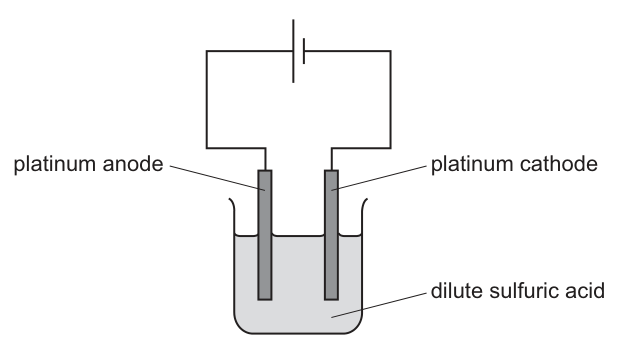
Which statement is correct?
Options
A Electrons move from the cathode to the anode in the external circuit.
B Hydrogen ions gain electrons at the anode.
C In the electrolyte, positive ions move to the cathode and negative ions move to the anode.
D The hydroxide ions in the electrolyte move to the cathode.
Working
- In an electrolytic cell:
- The anode is the positive electrode, and the cathode is the negative electrode.
- In the electrolyte, cations (positive ions, e.g. ) are attracted to the negative cathode, while anions (negative ions, e.g. and ) are attracted to the positive anode. Therefore, statement C is correct.
- Electrons move through the external circuit from the anode (positive electrode, where oxidation occurs) to the cathode (negative electrode, where reduction occurs), so A is incorrect.
- Hydrogen ions () are cations and move to the cathode, where they gain electrons (reduction), so B is incorrect.
- Hydroxide ions () are anions and move to the anode (positive electrode), so D is incorrect.
Answer
C
C
Walkthrough
During electrolysis:
- The power supply sets up the polarity of the electrodes: the long line of the battery symbol represents the positive terminal (connected to the anode) and the short line represents the negative terminal (connected to the cathode).
- Current flows through the electrolyte via the migration of mobile ions:
- Positive ions (cations) migrate towards the negatively charged cathode.
- Negative ions (anions) migrate towards the positively charged anode.
- This directly matches statement C.
Let's verify why the other options are incorrect:
- A is incorrect: Electrons leave the anode (where oxidation produces electrons) and travel through the external circuit wires to the cathode (where reduction consumes electrons).
- B is incorrect: Hydrogen ions () are positively charged, so they are attracted to the cathode, where they gain electrons according to .
- D is incorrect: Hydroxide ions () are negatively charged anions and therefore migrate towards the positive anode.
Key Takeaways
- Remember the mnemonic: PANIC (Positive Anode, Negative Is Cathode) for electrolytic cells.
- Cations Cathode; Anions Anode.
- Charge is carried by electrons in the external metallic circuit and by mobile ions in the electrolyte solution.
Common Mistakes
- Confusing the direction of electron flow with the movement of ions.
- Mixing up the polarity of the cathode and anode, or which ions migrate to which electrode.
Things to Be Careful About
- Ensure you distinguish between an electrolytic cell (driven by an external power supply) and a simple electrochemical cell (which produces voltage). In an electrolytic cell, the anode is positive and the cathode is negative.
An aqueous mixture of copper(II) nitrate and silver nitrate is electrolysed with pure copper electrodes.
Which ionic half-equation describes the change occurring at the anode?
Options
A Cu → Cu²⁺ + 2e⁻
B Cu²⁺ + 2e⁻ → Cu
C Ag → Ag⁺ + e⁻
D Ag⁺ + e⁻ → Ag
Working
- The electrodes are made of pure copper, which means the anode is active (not inert like platinum or graphite).
- At the anode (positive electrode), oxidation (loss of electrons) occurs.
- Because the copper anode is active, copper metal from the electrode dissolves by losing electrons to form aqueous copper(II) ions:
- Options B and D represent reduction reactions occurring at the cathode.
- Option C is incorrect because the anode is made of copper, not silver.
Answer
A
A
Walkthrough
In electrolysis, the anode is the positive electrode where oxidation (the loss of electrons) takes place.
When inert electrodes (such as carbon/graphite or platinum) are used, anions in the aqueous solution (such as or halide ions) are discharged. However, when an active metal electrode such as copper is used as the anode, the metal atoms of the anode itself lose electrons more readily than any anions in the solution.
Therefore, copper atoms at the anode lose two electrons each to form aqueous copper(II) ions:
Evaluating the given options:
- A: is the correct oxidation reaction occurring at the copper anode.
- B: represents reduction (gain of electrons), which occurs at the cathode.
- C: would represent the oxidation of silver, but the electrodes are specified as pure copper.
- D: is a reduction half-equation occurring at the cathode.
Thus, A is the correct answer.
Key Takeaways
- Anode vs. Cathode: Oxidation occurs at the anode (positive electrode in electrolysis); reduction occurs at the cathode (negative electrode).
- Active vs. Inert Electrodes: If an active metal (like copper) is used as the anode, the electrode dissolves () rather than water or anions discharging.
Common Mistakes
- Confusing oxidation with reduction and picking B.
- Forgetting that the electrode material dictates the anode reaction when using non-inert electrodes.
- Selecting C due to the presence of silver nitrate in the electrolyte, forgetting that the anode itself is pure copper.
Things to Be Careful About
- Ensure you check the material of the electrodes: "pure copper electrodes" indicates that the anode participates chemically in the reaction.
What is a disadvantage of using a hydrogen-oxygen fuel cell to power a car?
Options
A Gasoline / petrol is a non-renewable resource.
B The hydrogen tank may split in an accident, leading to an explosion.
C The product of the reaction between oxygen and hydrogen is toxic.
D The oxygen is obtained from air.
Working
- A is a disadvantage of conventional petrol/gasoline engines, not a disadvantage of a hydrogen-oxygen fuel cell.
- B is correct because hydrogen gas is highly flammable and stored under high pressure, so tank rupture during a collision presents a significant explosion risk.
- C is incorrect because the only chemical product of a hydrogen-oxygen fuel cell is water (), which is non-toxic and harmless.
- D is an advantage because air is an abundant, free, and renewable source of oxygen.
Answer
B
B
Walkthrough
A hydrogen-oxygen fuel cell generates electricity through the reaction between hydrogen and oxygen:
Let us analyse the options to identify the disadvantage of using a fuel cell:
- Option A: While gasoline is a non-renewable fossil fuel, this is an issue related to internal combustion engines, not a drawback of using a hydrogen fuel cell.
- Option B: Hydrogen must be stored as a compressed gas or liquid at very high pressures. In a car accident, a ruptured fuel tank could release hydrogen, which ignites and explodes very easily in air. This is a well-known safety disadvantage.
- Option C: The only product of the overall cell reaction is water, which is non-polluting and completely non-toxic.
- Option D: Obtaining oxygen directly from the surrounding air is an advantage as it requires no separate oxygen storage on board the vehicle.
Therefore, B is the correct answer.
Key Takeaways
- The main advantages of hydrogen-oxygen fuel cells are that they produce no greenhouse gases or toxic pollutants (only water is formed) and they are highly efficient.
- The major disadvantages include the difficulty and safety risks of storing high-pressure flammable hydrogen, the lack of refuelling infrastructure, and the fact that hydrogen is often manufactured from fossil fuels.
Common Mistakes
- Confusing the combustion/reaction products of hydrogen with fossil fuel emissions (hydrogen produces only water, not carbon monoxide or oxides of nitrogen).
- Selecting statements that describe disadvantages of conventional petrol vehicles rather than fuel cells.
Things to Be Careful About
- Ensure you distinguish clearly between advantages (e.g. non-toxic product , abundance of in air) and disadvantages (flammability/storage hazards of ).
When chemical reaction X takes place, thermal energy is given out.
Which row is correct for this reaction?
Options
| type of reaction | explanation | |
|---|---|---|
| A | endothermic | More energy is required to break the bonds than the energy released when the bonds are formed. |
| B | endothermic | Less energy is required to break the bonds than the energy released when the bonds are formed. |
| C | exothermic | More energy is required to break the bonds than the energy released when the bonds are formed. |
| D | exothermic | Less energy is required to break the bonds than the energy released when the bonds are formed. |
Working
The reaction gives out thermal energy, so it is exothermic. This eliminates options A and B, which call it endothermic.
In an exothermic reaction, less energy is required to break the bonds than the energy released when the new bonds are formed. Option D states this correctly.
Answer
D
D
Walkthrough
A reaction that gives out thermal energy is exothermic. The word 'exothermic' means heat is released to the surroundings.
In any chemical reaction, bonds in the reactants must be broken, and this requires energy. New bonds are then formed in the products, and this releases energy.
- If the energy released when bonds form is greater than the energy needed to break bonds, the overall reaction releases energy: exothermic.
- If the energy needed to break bonds is greater than the energy released when bonds form, the overall reaction absorbs energy: endothermic.
Here, thermal energy is given out, so the reaction is exothermic and the correct explanation is that less energy is required to break the bonds than is released when the bonds are formed. That is row D.
Key Takeaways
- Exothermic reactions release thermal energy; endothermic reactions absorb thermal energy.
- Bond breaking always requires energy.
- Bond forming always releases energy.
- The difference between these two amounts decides whether a reaction is exothermic or endothermic.
Common Mistakes
- Choosing A or B by thinking that 'energy is given out' means endothermic. Endothermic reactions take in energy.
- Choosing C because it says exothermic but then giving the endothermic explanation. If more energy is needed to break bonds than is released on forming bonds, the reaction is endothermic, not exothermic.
- Thinking that bond breaking releases energy. Bond breaking requires energy; bond forming releases energy.
Things to Be Careful About
- Read the phrase 'thermal energy is given out' as a clear sign of an exothermic reaction.
- Compare the two energy terms in the correct order: energy required to break bonds versus energy released when bonds are formed.
- The mark scheme accepts only the exact idea that less energy is required to break bonds than is released when bonds are formed for an exothermic reaction.
Which statement about a physical change is correct?
Options
A A physical change is impossible to reverse.
B In a physical change, the appearance of a substance may change.
C New substances are formed in a physical change.
D There is no energy released or taken in during a physical change.
Working
- A is incorrect: Physical changes are usually easily reversible (e.g. melting ice can be reversed by freezing).
- B is correct: The appearance, state, or shape of a substance often changes during a physical change (e.g. liquid water turning into solid ice or steam).
- C is incorrect: No new chemical substances are made in a physical change; the chemical composition remains the same.
- D is incorrect: Changes of state (which are physical changes) involve taking in energy (melting, boiling) or releasing energy (condensing, freezing).
Answer
B
B
Walkthrough
A physical change is a change in which no new chemical substances are formed. The chemical identity and composition of the particles remain unchanged, but their arrangement, energy, movement, or appearance may change.
Let us evaluate each option:
- Option A: Physical changes are typically easily reversible (e.g., heating ice melts it into water, and cooling the water freezes it back into ice). Chemical changes, on the other hand, are often difficult to reverse.
- Option B: In a physical change, physical properties such as appearance, state of matter (solid, liquid, gas), or shape can certainly change. For example, crushing a crystal, dissolving salt in water, or boiling water alters the appearance.
- Option C: The formation of one or more new chemical substances is the defining feature of a chemical change, not a physical change.
- Option D: Energy changes accompany physical changes. For instance, melting and boiling are endothermic (absorb heat energy), while freezing and condensing are exothermic (release heat energy).
Therefore, option B is the correct statement.
Key Takeaways
- In a physical change, no new chemical substances are produced, and the change is usually easy to reverse.
- In a chemical change, new substances with different chemical properties are formed, bonds are broken and made, and the change is generally difficult to reverse.
- Physical changes involve energy changes (e.g., latent heat during changes of state).
Common Mistakes
- Confusing the characteristics of physical and chemical changes (thinking new substances are formed in physical changes).
- Believing that no energy is transferred during physical changes; state changes always absorb or release thermal energy.
Things to Be Careful About
- Do not confuse changes of appearance (physical) with evidence of a chemical reaction (such as unexpected colour change due to a new compound forming, effervescence/gas production, or precipitation).
Gas P decomposes to form gas Q.
Two experiments are done to investigate the rate of reaction. The conditions are the same except that two different temperatures, and , are used.
The results are plotted on graphs, drawn to the same scale.
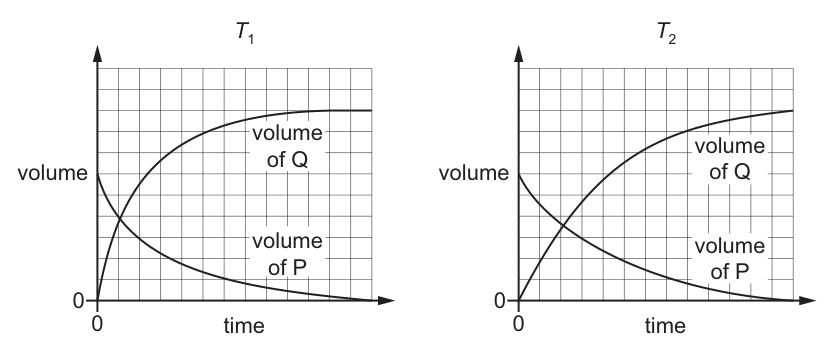
Which row is correct?
Options
| x | y | temperature | |
|---|---|---|---|
| A | 2 | 3 | is higher than |
| B | 2 | 3 | is higher than |
| C | 3 | 2 | is higher than |
| D | 3 | 2 | is higher than |
Working
-
Determine the stoichiometric coefficients and :
- Initial volume of ; final volume of , so of react.
- Initial volume of ; final volume of , so of are produced.
- By Avogadro's law, equal volumes of gases at the same temperature and pressure contain equal numbers of moles. Therefore, the volume ratio equals the mole ratio: Hence, and .
-
Compare the temperatures and :
- At , the initial gradient is steeper and the reaction reaches completion in a shorter time than at .
- A faster rate of reaction corresponds to a higher temperature, so is higher than .
Therefore, row A is correct.
Answer
A
A
Walkthrough
-
Finding the ratio of to :
Under the same conditions of temperature and pressure, the volume of a gas is directly proportional to the number of moles (Avogadro's law / molar gas volume concept). Looking at the vertical axis of either graph:- Volume of gas used up .
- Volume of gas formed .
The ratio of moles reacting is therefore:
Thus, and .
-
Comparing temperatures and :
- The graph for shows a steeper initial slope and reaches the plateau (reaction completion) earlier than the graph for .
- A steeper curve indicates a higher rate of reaction.
- Increasing temperature increases the kinetic energy of the particles, leading to more frequent collisions and a greater proportion of particles having energy greater than or equal to the activation energy, thus increasing the rate of reaction.
- Since the rate is faster at , must be higher than .
Matching these deductions (, , ) gives option A.
Key Takeaways
- For reactions involving gases at identical conditions, the ratio of reacting and produced volumes directly reflects the stoichiometric coefficients in the balanced chemical equation.
- On a volume-time or mass-time graph, a steeper initial gradient and earlier plateau indicate a faster rate of reaction.
- Higher temperature increases the rate of reaction.
Common Mistakes
- Inverting the stoichiometric ratio (thinking because ends up higher than started).
- Confusing the effect of temperature: assuming a longer time to complete means a higher temperature.
Things to Be Careful About
- Ensure you count grid units accurately from . The volume of starts at units and drops to , while starts at and rises to .
Samples of nitrogen and hydrogen are reacted and allowed to reach equilibrium. The equation is shown.
The temperature is increased and a new equilibrium is established.
Which statement about the new equilibrium is correct?
Options
A The amount of product increases.
B The amount of product decreases.
C The rate of the forward reaction is greater than the rate of the reverse reaction.
D The rate of the forward reaction is less than the rate of the reverse reaction.
Working
- The forward reaction is exothermic (). Therefore, the reverse reaction is endothermic.
- According to Le Chatelier's principle, increasing the temperature favours the endothermic direction (the reverse reaction) to absorb thermal energy.
- As equilibrium shifts to the left, the amount of ammonia (the product) decreases and the amounts of nitrogen and hydrogen increase.
- At any established dynamic equilibrium, the rate of the forward reaction is equal to the rate of the reverse reaction, which eliminates options C and D.
Answer
B
B
Walkthrough
In the given reversible reaction:
- The forward reaction has a negative enthalpy change (), meaning it is exothermic (releases heat).
- The backward or reverse reaction is endothermic (absorbs heat).
When the temperature of an equilibrium mixture is increased, the system responds by shifting in the direction that takes in heat (endothermic) to counteract the increase in temperature. This shifts the position of equilibrium to the left.
- Because equilibrium shifts to the left, more decomposes into and , so the amount of product decreases. This makes option B correct and option A incorrect.
- Once the new equilibrium is established, the rate of the forward reaction equals the rate of the reverse reaction by definition of dynamic equilibrium. Therefore, options C and D are incorrect.
Key Takeaways
- For an exothermic forward reaction, increasing temperature favours the reverse reaction (shifts equilibrium to the left), reducing the yield of products.
- At dynamic equilibrium, the rates of the forward and reverse reactions are always equal, even though the amounts of reactants and products may be different.
Common Mistakes
- Confusing the temporary state during the shift with the newly established equilibrium (e.g., thinking one rate stays permanently higher than the other at equilibrium).
- Forgetting that refers specifically to the forward reaction as written.
Things to Be Careful About
- Ensure you identify the sign of : a negative value indicates an exothermic reaction, while a positive value indicates an endothermic reaction.
In the diagram, R represents one of the reactions in the Contact process.
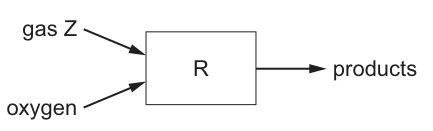
Which statement is correct?
Options
A Gas Z is SO₂.
B In R, an iron catalyst speeds up the reaction.
C In R, the pressure is approximately 200 atm.
D In R, the temperature is approximately .
Working
In the Contact process for the manufacture of sulfuric acid, the main reaction step is the reversible oxidation of sulfur dioxide to sulfur trioxide:
- A is correct: Gas Z is sulfur dioxide, , which reacts with oxygen.
- B is incorrect: The catalyst used is vanadium(V) oxide (), not iron (iron is used in the Haber process).
- C is incorrect: The pressure used is close to atmospheric pressure (around ), not (which is used in the Haber process).
- D is incorrect: The operating temperature is approximately , not .
Answer
A
A
Walkthrough
The Contact process is used industrially to make sulfuric acid (). It involves three main stages:
- Burning sulfur in air to produce sulfur dioxide:
- The oxidation of sulfur dioxide to sulfur trioxide (reaction R shown in the diagram):
The essential conditions for this equilibrium reaction are:
- Catalyst: Vanadium(V) oxide,
- Temperature:
- Pressure: (just above atmospheric pressure)
- Converting sulfur trioxide to sulfuric acid by dissolving it in concentrated to form oleum (), followed by dilution with water.
Matching the diagram, the two gases entering reactor R are oxygen () and gas Z, which must be sulfur dioxide (). Thus, option A is the correct statement.
Key Takeaways
- Be familiar with the key stage of the Contact process: .
- Remember the standard industrial conditions for the Contact process (, , catalyst).
Common Mistakes
- Confusing the conditions of the Contact process with those of the Haber process (iron catalyst, , ).
- Misreading as .
Things to Be Careful About
- High pressure is not required in the Contact process because the equilibrium yield of at and is already very high (around ), making expensive high-pressure equipment unnecessary.
Peroxodisulfate ions, , react with iron(II) ions, .
The only elements that are either oxidised or reduced in this reaction are sulfur and iron.
Which row is correct?
Options
| the element that is reduced | behaviour of ions | |
|---|---|---|
| A | iron | oxidising agent |
| B | iron | reducing agent |
| C | sulfur | oxidising agent |
| D | sulfur | reducing agent |
Working
-
Look at the change in iron:
-
Since the question states only sulfur and iron are oxidised or reduced, sulfur must be the element that is reduced (gains electrons).
-
An oxidising agent oxidises another species while being reduced itself. Because oxidises to , behaves as an oxidising agent.
Therefore, the element that is reduced is sulfur, and acts as an oxidising agent (Row C).
Answer
C
C
Walkthrough
To solve this question, we apply the definitions of oxidation, reduction, and oxidising/reducing agents using electron transfer (OIL RIG: Oxidation Is Loss, Reduction Is Gain):
-
Determine what happens to iron:
Iron changes from to .
Each iron(II) ion loses one electron to become an iron(III) ion. Loss of electrons is oxidation, so iron is oxidised. -
Determine the element that is reduced:
The question states that the only elements either oxidised or reduced are sulfur and iron. Since iron is oxidised, sulfur must be the element that is reduced. -
Determine the behaviour of :
- An oxidising agent accepts electrons from another substance, causing that substance to be oxidised while the agent itself is reduced.
- Since causes to be oxidised to , and is itself reduced, acts as an oxidising agent.
Combining these two conclusions corresponds to row C.
Key Takeaways
- Oxidation is the loss of electrons (or an increase in oxidation state).
- Reduction is the gain of electrons (or a decrease in oxidation state).
- An oxidising agent oxidises another species and undergoes reduction in the process.
- A reducing agent reduces another species and undergoes oxidation in the process.
Common Mistakes
- Confusing the element being reduced with the role of the substance: students often forget that a substance being reduced is the oxidising agent, not the reducing agent.
- Misidentifying the change in charge: thinking going from to is a gain of electrons instead of a loss of negative charge.
Things to Be Careful About
- Ensure you distinguish between the element that is oxidised/reduced (e.g. sulfur) and the ion/substance acting as the agent (e.g. peroxodisulfate, ).
Which solid reacts with dilute hydrochloric acid to produce a gas?
Options
A carbon
B copper
C magnesium oxide
D sodium carbonate
Working
- A (carbon): Non-metal; does not react with dilute hydrochloric acid.
- B (copper): Below hydrogen in the reactivity series; does not react with dilute hydrochloric acid to produce hydrogen gas.
- C (magnesium oxide): A basic metal oxide; reacts with dilute hydrochloric acid to form magnesium chloride and water (no gas produced):
- D (sodium carbonate): A metal carbonate; reacts with dilute hydrochloric acid to produce carbon dioxide gas, a salt, and water:
Answer
D
D
Walkthrough
Dilute acids undergo characteristic reactions with different types of substances:
- Acid + Metal carbonate Salt + Water + Carbon dioxide gas
- Sodium carbonate reacts with dilute hydrochloric acid to produce carbon dioxide gas (), which can be identified by bubbling through limewater to turn it cloudy / milky.
- Acid + Metal oxide (base) Salt + Water
- Magnesium oxide is a metal oxide, so it neutralises the acid to form a salt and water only; no gas is evolved.
- Acid + Metal Salt + Hydrogen gas
- Only metals situated above hydrogen in the reactivity series react with dilute acids to produce hydrogen. Copper is below hydrogen and therefore does not react.
- Non-metals such as carbon do not react with dilute acids.
Thus, only sodium carbonate (option D) produces a gas when reacted with dilute hydrochloric acid.
Key Takeaways
- General word equations for acid reactions:
- (only for metals above hydrogen in the reactivity series)
Common Mistakes
- Mistaking copper for a reactive metal and assuming it produces gas with dilute acids.
- Confusing metal oxides with metal carbonates and thinking that metal oxides release a gas.
Things to Be Careful About
- Check the position of metals relative to hydrogen in the reactivity series (K, Na, Ca, Mg, Al, C, Zn, Fe, Pb, H, Cu, Ag, Au).
- Clearly distinguish between neutralisation reactions that produce no gas (acid + metal oxide/hydroxide) and those that produce gas (acid + carbonate).
Which aqueous solution has the highest pH?
Options
A hydrochloric acid
B sodium chloride
C sodium hydroxide
D sulfuric acid
Working
On the pH scale at room temperature:
- Acidic solutions have a .
- Hydrochloric acid () is a strong acid ( for a solution).
- Sulfuric acid () is a strong dibasic acid ().
- Neutral solutions have a .
- Sodium chloride () is a neutral salt formed from a strong acid and a strong base ().
- Alkaline solutions have a .
- Sodium hydroxide () is a strong alkali ( for a solution).
Therefore, sodium hydroxide has the highest pH.
Answer
C
C
Walkthrough
The pH scale is a measure of the acidity or alkalinity of an aqueous solution:
- : Acidic (higher concentration of ions than ions). The lower the pH value, the more acidic the solution.
- : Neutral (equal concentration of and ions).
- : Alkaline (higher concentration of ions than ions). The higher the pH value, the more alkaline the solution.
Evaluating each option:
- A (hydrochloric acid): A strong acid, giving a pH around .
- B (sodium chloride): A soluble neutral salt that dissolves in water without affecting the balance of and ions, giving .
- C (sodium hydroxide): A strong soluble base (alkali) that fully dissociates into and ions, giving a very high .
- D (sulfuric acid): A strong dibasic acid, which produces an even higher concentration of ions than hydrochloric acid at the same molar concentration, resulting in an extremely low pH.
Thus, sodium hydroxide has the highest pH value.
Key Takeaways
- Acids have low pH values ( to ), neutral solutions have , and alkalis have high pH values ( to ).
- Strong alkalis such as and produce high concentrations of hydroxide ions () in solution, resulting in the highest pH values.
Common Mistakes
- Confusing "highest acidity" with "highest pH". Strong acids have the lowest pH, while strong alkalis have the highest pH.
- Assuming salts are slightly acidic or basic; standard Group I halides like produce neutral solutions ().
Things to Be Careful About
- Ensure you read whether the question asks for the highest or lowest pH. Highest corresponds to the most alkaline solution, while lowest corresponds to the most acidic.
Oxide Q reacts with separate samples of dilute hydrochloric acid and aqueous potassium hydroxide.
Both reactions produce a salt and water.
Which statement is correct?
Options
A Q is an acidic oxide.
B Q is an amphoteric oxide.
C Q is a basic oxide.
D Q is a non-metal oxide.
Working
An oxide that reacts with both acids (such as dilute hydrochloric acid) and bases/alkalis (such as aqueous potassium hydroxide) to produce a salt and water is defined as an amphoteric oxide.
- A is incorrect because acidic oxides only react with bases to form a salt and water.
- B is correct because amphoteric oxides neutralise both acids and alkalis.
- C is incorrect because basic oxides only react with acids to form a salt and water.
- D is incorrect because non-metal oxides are typically acidic or neutral, not amphoteric.
Answer
B
B
Walkthrough
Oxides are classified based on their acid-base properties into four main types:
- Basic oxides: Typically metal oxides (e.g. , ) that react with acids to form a salt and water, but do not react with alkalis.
- Acidic oxides: Typically non-metal oxides (e.g. , ) that react with alkalis to form a salt and water, but do not react with acids.
- Amphoteric oxides: Metal oxides (specifically , , ) that show both acidic and basic properties, reacting with both acids and alkalis to form a salt and water.
- Neutral oxides: Non-metal oxides (e.g. , , ) that react with neither acids nor bases.
Since oxide Q reacts with both dilute hydrochloric acid (an acid) and aqueous potassium hydroxide (an alkali) to form a salt and water in each case, it fits the definition of an amphoteric oxide.
Key Takeaways
- Amphoteric oxides react with both acids and alkalis/bases to form a salt and water.
- Key examples of amphoteric oxides at O Level are aluminium oxide () and zinc oxide ().
Common Mistakes
- Confusing amphoteric with neutral: neutral oxides do not react with acids or bases, whereas amphoteric oxides react with both.
- Assuming all metal oxides are basic; some are amphoteric.
Things to Be Careful About
- Ensure you check both reactions mentioned: reacting with an acid alone would make it basic, reacting with an alkali alone would make it acidic, but reacting with both means it is amphoteric.
The table shows four methods used to prepare pure salts.
Which row shows a method of making a pure sample of each named salt?
Options
| acid + carbonate | acid + metal | precipitation | titration | |
|---|---|---|---|---|
| A | copper(II) sulfate | magnesium sulfate | silver chloride | sodium chloride |
| B | sodium sulfate | copper(II) sulfate | sodium chloride | silver chloride |
| C | potassium chloride | sodium chloride | copper(II) sulfate | magnesium sulfate |
| D | potassium sulfate | sodium chloride | silver chloride | copper(II) sulfate |
Working
To determine the correct row, we check each method of preparation against the given salts:
-
acid + carbonate (excess insoluble base/carbonate method):
- Used for preparing soluble salts of moderately reactive metals.
- is soluble and can be prepared by reacting dilute sulfuric acid with excess insoluble copper(II) carbonate: .
-
acid + metal:
- Used for soluble salts where the metal is moderately reactive (above hydrogen in the reactivity series, but not dangerously reactive like Group I).
- Magnesium is above hydrogen and reacts safely with dilute sulfuric acid to form soluble magnesium sulfate: .
- Note: Copper is below hydrogen and does not react with dilute acids.
-
precipitation:
- Used to prepare insoluble salts by mixing two aqueous solutions containing the required ions.
- Silver chloride, , is an insoluble salt and is prepared by precipitation (e.g., ).
- and are soluble salts and cannot be prepared by precipitation.
-
titration:
- Used to prepare soluble salts containing Group I metals (like or ) or ammonium ions from soluble reactants (acid + alkali/soluble carbonate).
- Sodium chloride, , is prepared by titrating dilute hydrochloric acid with sodium hydroxide solution.
Row A matches all four preparation methods correctly.
Answer
A
A
Walkthrough
To choose the correct preparation method for any salt, consider two main factors: whether the salt is soluble or insoluble, and the nature/reactivity of the starting materials.
-
Insoluble Salts (Precipitation):
- All silver halides (except AgF) are insoluble, making an insoluble salt.
- Insoluble salts are prepared by ionic precipitation: mixing two soluble solutions (e.g., aqueous and aqueous ) to form a solid precipitate of , which is filtered, washed with distilled water, and dried.
-
Soluble Salts of Group I and Ammonium (Titration):
- Sodium salts (, ) and potassium salts (, ) are all soluble.
- Because their oxides, hydroxides, and carbonates are also soluble, an excess cannot simply be filtered off. Therefore, an acid-alkali titration with an indicator must be used to find the exact reacting volumes before repeating without indicator to obtain a pure solution for crystallisation.
-
Soluble Salts of Transition and Group II/other Metals (Excess Insoluble Base/Carbonate/Metal):
- is a soluble salt. Copper is unreactive (below hydrogen in the reactivity series), so it does not react directly with dilute acid. Thus, it is made by reacting dilute with excess insoluble (or ).
- is a soluble salt. Magnesium is moderately reactive (above hydrogen), so it reacts directly with dilute to form and gas.
Matching these gives row A as the correct row.
Key Takeaways
- Precipitation is only used to prepare insoluble salts from two soluble starting solutions.
- Titration is required for soluble salts derived from soluble bases/carbonates (principally Group I and ammonium salts).
- Excess insoluble reactant (metal, base, or carbonate) is used for preparing soluble salts of non-Group I metals.
- Metals below hydrogen (such as copper) do not react with dilute acids to produce salts and hydrogen gas.
Common Mistakes
- Attempting to make a copper salt using copper metal and dilute acid (copper is unreactive and does not displace hydrogen from acids).
- Choosing precipitation to prepare a soluble salt such as or .
- Attempting to make sodium or potassium salts using the excess solid method (sodium and potassium hydroxides/carbonates are soluble, so the excess cannot be filtered off).
Things to Be Careful About
- Ensure you recall the fundamental solubility rules:
- All nitrates, sodium, potassium, and ammonium salts are soluble.
- All chlorides are soluble except silver chloride and lead(II) chloride.
- All sulfates are soluble except barium sulfate, lead(II) sulfate, and calcium sulfate (sparingly soluble).
Which property determines the order of the elements in the Periodic Table?
Options
A the masses of their atoms
B the number of electrons in the outer shell
C the number of neutrons in the nucleus
D the number of protons in the nucleus
Working
- The modern Periodic Table arranges elements in order of increasing atomic number (proton number), which is the number of protons in the nucleus of an atom.
- A is incorrect: early periodic tables (e.g. Mendeleev's) were arranged roughly by atomic mass, but the modern table is strictly ordered by proton number (e.g. tellurium comes before iodine despite having a greater atomic mass).
- B is incorrect: the number of outer-shell electrons determines the group number, not the overall sequential order of the elements.
- C is incorrect: the number of neutrons varies among isotopes of the same element and does not determine an element's position.
Answer
D
D
Walkthrough
In the modern Periodic Table, elements are placed in order of increasing atomic number (). The atomic number is defined as the number of protons in the nucleus of an atom of that element. As you move from left to right across each period, each subsequent element has one more proton than the previous element.
- Option A: Historically, Dmitri Mendeleev arranged known elements in order of relative atomic mass. However, this caused pair reversals (such as argon and potassium, or tellurium and iodine) where chemical properties did not align. Ordering by proton number resolved these anomalies.
- Option B: The number of outer-shell (valence) electrons tells us which Group (vertical column) an element belongs to, rather than its overall position in the sequence.
- Option C: Neutrons contribute to the mass number and can vary between isotopes of the same element, so they do not define the element's position.
- Option D: Correct. Proton number uniquely identifies the element and sets its position from (hydrogen) upwards.
Key Takeaways
- Elements in the modern Periodic Table are arranged strictly in order of increasing proton (atomic) number.
- The proton number defines the identity of an element.
- The number of outer-shell electrons determines the group number (vertical column).
- The number of electron shells determines the period number (horizontal row).
Common Mistakes
- Confusing the modern arrangement (proton number) with historical arrangements (atomic mass / masses of atoms).
- Confusing what determines the sequential order (proton number) with what determines the group (outer-shell electrons) or period (number of occupied shells).
Things to Be Careful About
- Always distinguish between proton number (atomic number) and mass number (nucleon number). The Periodic Table is strictly arranged by proton number.
Which statement explains why helium and neon are unreactive?
Options
A They are both gases at room temperature and pressure.
B They both have eight electrons in their outer shell.
C They both have equal numbers of protons and electrons in their atoms.
D They both have all their occupied electron shells completely filled.
Working
- Group VIII / Group 0 elements (noble gases) are chemically unreactive (inert) because their atoms possess a stable, fully filled outermost shell of electrons (a full valence shell).
- Helium (atomic number ) has an electron configuration of (its first and only occupied shell is full with electrons).
- Neon (atomic number ) has an electron configuration of (its second shell is full with electrons).
- Therefore, both elements have all their occupied electron shells completely filled.
Evaluating the options:
- A is incorrect because physical state at r.t.p. does not explain chemical inertness (many reactive elements such as fluorine and chlorine are also gases).
- B is incorrect because helium has only electrons in its outer shell (a duplet), not .
- C is incorrect because all neutral atoms of every element have equal numbers of protons and electrons, not just noble gases.
- D is correct as both helium and neon have completely filled occupied electron shells.
Answer
D
D
Walkthrough
Noble gases belong to Group VIII (or Group 0) of the Periodic Table. Their characteristic chemical inertness (lack of reactivity) is directly linked to their electronic configurations:
- Helium () has proton number , so a neutral atom has electrons. These occupy the first electron shell, which can hold a maximum of electrons. Thus, helium has a full outer shell (a stable duplet).
- Neon () has proton number , with the electronic configuration . Its outer (second) shell contains electrons, which is the maximum capacity for that shell (a stable octet).
Because all occupied electron shells in both helium and neon are completely full, they have no tendency to gain, lose, or share electrons to achieve stability, making them monatomic and unreactive. Hence, D is the correct statement.
Key Takeaways
- Noble gases are unreactive because they have full outer shells of electrons (a stable configuration).
- The first electron shell holds a maximum of electrons; subsequent shells hold up to electrons at O Level.
- Helium has outer electrons, while all other noble gases (neon, argon, krypton, xenon) have outer electrons.
Common Mistakes
- Confusing the outer shell of helium with the octet rule: candidates often incorrectly choose B, forgetting that helium only has electrons in total and therefore cannot have outer electrons.
- Choosing C: having equal numbers of protons and electrons is a property of all uncharged atoms across the entire Periodic Table, not a reason for noble gas unreactivity.
Things to Be Careful About
- Pay close attention to wording: "eight electrons in their outer shell" applies to neon, argon, etc., but not to helium. Statement D correctly generalises that all occupied shells are completely filled for both elements.
Substance X conducts electricity in the solid state. Substance X is malleable.
Which statement is correct?
Options
A X conducts electricity by the movement of electrons between layers of negative ions.
B X conducts electricity by the movement of positive ions through a giant lattice.
C X has a giant lattice of positive ions in a 'sea' of delocalised electrons.
D X has layers of atoms with delocalised electrons between the layers.
Working
Substance X is malleable and conducts electricity when solid, which are defining properties of a metal.
- Metallic bonding consists of a giant lattice of positive metal ions surrounded by a 'sea' of delocalised electrons.
- A is incorrect because the lattice consists of positive ions (cations), not negative ions.
- B is incorrect because in a solid metal, positive ions are fixed in lattice positions and cannot move; electrical conduction is due to mobile delocalised electrons.
- C is correct as it accurately describes the structure of a metal.
- D describes the structure of graphite (layers of carbon atoms), which is brittle, not malleable.
Answer
C
C
Walkthrough
-
Identify the class of substance from the given properties:
- Substance X conducts electricity in the solid state.
- Substance X is malleable (can be hammered or bent into shape without shattering).
- These two physical properties specifically describe a metal.
-
Recall the structure of a metallic lattice:
- A metal consists of a regular giant lattice of positive metal ions (cations) surrounded by a 'sea' of mobile, delocalised electrons.
- Metals conduct electricity because these delocalised electrons are free to move throughout the entire structure when a potential difference is applied.
- Metals are malleable because layers of positive ions can slide over one another without breaking the metallic bonds, as the sea of delocalised electrons adjusts and maintains electrostatic attraction.
-
Evaluate the given options:
- Option A: Incorrect. The lattice consists of positive ions, not negative ions.
- Option B: Incorrect. Positive ions in a solid lattice are fixed in place (vibrating only) and do not move through the lattice.
- Option C: Correct. This is the precise definition of metallic structure.
- Option D: Incorrect. This describes graphite, which conducts electricity as a solid but is brittle and flaky, not malleable.
Key Takeaways
- Metallic bonding is the electrostatic attraction between a lattice of positive metal ions and a 'sea' of delocalised electrons.
- Electrical conductivity in solid metals is due to mobile delocalised electrons, not ions.
- Malleability is explained by layers of positive ions sliding over each other while remaining held together by the non-directional metallic bond.
Common Mistakes
- Confusing graphite with metals: while graphite conducts electricity as a solid due to delocalised electrons between layers of carbon atoms, graphite is brittle rather than malleable.
- Believing that ions move to conduct electricity in solid metals: only delocalised electrons move in solid metallic conductors (ions only move when molten or in aqueous solution in ionic substances).
Things to Be Careful About
- Ensure you check whether conduction is described as being due to the movement of ions or electrons. Solid metals conduct via electrons, not ions.
Aluminium and copper are good conductors of electricity.
Why is aluminium used in overhead electrical cables instead of copper?
Options
A Aluminium is above copper in the reactivity series.
B Aluminium is less dense than copper.
C Copper does not have an oxide coating.
D Copper reacts with water.
Working
Both aluminium and copper are good electrical conductors. Overhead cables span long distances between pylons and must not sag excessively or overload the support structures under their own weight.
- Aluminium has a significantly lower density than copper, making the cables much lighter for a given volume.
- A is a true statement about reactivity, but high reactivity is not a desirable reason for choosing a material for cables.
- C is incorrect as copper also forms a tarnish/oxide layer, but this does not explain the choice for overhead cables.
- D is factually incorrect; copper is below hydrogen in the reactivity series and does not react with water.
Therefore, aluminium is chosen because it is less dense than copper.
Answer
B
B
Walkthrough
Overhead transmission cables need to conduct electricity efficiently over vast distances.
While copper is a slightly better electrical conductor than aluminium, it is much denser ( compared to for aluminium). If copper were used for overhead cables, the extreme weight would require much heavier, more closely spaced, and more expensive support pylons to prevent the cables from snapping or sagging dangerously.
Because aluminium is much less dense (lighter), it is the metal of choice for overhead power lines (usually reinforced with a steel core for tensile strength).
Key Takeaways
- Aluminium uses:
- Low density and good electrical conductivity overhead power cables.
- Low density and corrosion resistance aircraft bodies and food containers.
- Copper uses:
- Excellent electrical conductivity and ductility domestic electrical wiring.
- Good thermal conductivity and unreactivity with water cooking utensils and water pipes.
Common Mistakes
- Confusing the properties required for domestic wiring (copper, where flexibility and high conductivity in small spaces matter) with overhead transmission lines (aluminium, where low density/light weight is crucial).
- Selecting statements that are chemically true (e.g., aluminium is higher in the reactivity series) but do not provide the functional reason for the engineering application.
Things to Be Careful About
Always match the property directly to the specific use asked about in the question.
The oxide of Z is reduced by heating with carbon.
What is Z?
Options
A aluminium
B calcium
C magnesium
D zinc
Working
Carbon can only reduce the oxides of metals that are less reactive than carbon itself.
In the reactivity series:
- A (aluminium), B (calcium), and C (magnesium) are all more reactive than carbon, so their oxides cannot be reduced by carbon and must be extracted using electrolysis.
- D (zinc) is less reactive than carbon, so zinc oxide () can be reduced by heating with carbon:
Therefore, is zinc.
Answer
D
D
Walkthrough
To determine which metal oxide can be reduced by heating with carbon, we must compare the position of the metal relative to carbon in the reactivity series.
Carbon can only displace and reduce metals that are below it in the reactivity series (less reactive than carbon). Metals placed above carbon form very stable oxides whose bonds cannot be broken by reaction with carbon; these require extraction by electrolysis of their molten compounds.
Arranging the metals and carbon in decreasing order of reactivity:
- Calcium ()
- Magnesium ()
- Aluminium ()
- Carbon ()
- Zinc ()
Since zinc is below carbon in the reactivity series, carbon is able to remove oxygen from zinc oxide (), reducing it to metallic zinc. Thus, option D is correct.
Key Takeaways
- Metals higher than carbon in the reactivity series () are extracted by electrolysis of their molten ores.
- Metals lower than carbon in the reactivity series () can be extracted by reduction of their oxides with carbon or carbon monoxide.
Common Mistakes
- Confusing the position of aluminium and zinc relative to carbon; aluminium is above carbon and cannot be reduced by carbon.
- Forgetting that carbon acts as a reducing agent by taking away oxygen from the metal oxide.
Things to Be Careful About
- Ensure you know the position of carbon relative to the standard metals in the Cambridge O Level reactivity series: .
A metal ore contains an oxide, MO.
Metal M forms coloured compounds.
When a piece of iron is placed into a solution containing aqueous ions, M is displaced.
Which row is correct?
Options
| density of M | possible method of extraction of M from MO | |
|---|---|---|
| A | high | electrolysis only |
| B | high | electrolysis or heating with carbon |
| C | high | heating with carbon only |
| D | low | heating with carbon only |
Working
-
Identify the type of metal and its density:
- Metal forms coloured compounds, which is a characteristic property of transition elements.
- Transition elements are typically dense metals, so the density of is high.
-
Deduce the reactivity of :
- Iron displaces from solution, meaning is less reactive than iron (below iron in the reactivity series).
- Since iron is below carbon in the reactivity series, is also below carbon.
-
Determine the method of extraction:
- Because is less reactive than carbon, its oxide can be reduced by heating with carbon.
- Any metal can theoretically also be extracted by electrolysis of its molten compound (though heating with carbon is cheaper and more common).
- Therefore, the possible methods of extraction are electrolysis or heating with carbon.
Matching these conclusions to the options gives row B.
Answer
B
B
Walkthrough
-
Characterising Metal M:
- The stem states that metal forms coloured compounds. This is a defining physical and chemical property of transition metals (found in the central d-block of the Periodic Table).
- Transition metals are known for having high densities, high melting points, and high tensile strength compared to Group I and Group II metals (which have low densities).
- Therefore, the density of must be high, ruling out option D.
-
Reactivity and Extraction:
- When iron () is added to aqueous ions, is displaced according to the reaction:
- A more reactive metal displaces a less reactive metal from its aqueous salt solution. Hence, iron is more reactive than ( is below in the reactivity series).
- In the reactivity series, carbon lies above zinc and iron (). Since is below iron, it is also below carbon.
- Metals below carbon in the reactivity series can be extracted from their oxides by chemical reduction using carbon (or carbon monoxide). Additionally, any metal can technically be extracted by electrolysis of its molten compounds (even if it is less economically viable for less reactive metals).
- Thus, can be extracted by either electrolysis or heating with carbon.
This makes B the correct row.
Key Takeaways
- Transition Elements: Characteristic properties include forming coloured compounds, having high densities and high melting points, acting as catalysts, and showing variable oxidation states.
- Displacement Reactions: A more reactive metal will displace a less reactive metal from an aqueous solution of its ions.
- Extraction Methods:
- Metals more reactive than carbon (e.g., , , , , ) can only be extracted by electrolysis.
- Metals less reactive than carbon (e.g., , , , ) can be extracted by reduction with carbon/carbon monoxide or by electrolysis.
Common Mistakes
- Confusing "only" with possible methods: Candidates often pick option C ("heating with carbon only") thinking that because carbon reduction is cheaper, electrolysis is impossible. However, electrolysis is always chemically capable of extracting a metal from its molten ore.
- Misidentifying the density of transition metals by confusing them with Group I alkali metals (which have low densities).
Things to Be Careful About
- Always read the question carefully regarding the position in the reactivity series: a metal being displaced by iron means the metal is less reactive than iron, not more reactive.
Iron can be extracted from the ore hematite.
What is the maximum mass of iron that is produced from 500 kg of hematite?
[: O, 16; Fe, 56]
Options
A 160 kg
B 240 kg
C 350 kg
D 420 kg
Working
-
Identify the formula of hematite: .
-
Calculate the relative formula mass () of :
- Calculate the percentage by mass of iron () in hematite:
- Calculate the mass of iron extracted from of hematite:
- Option A () is the value of the relative formula mass of .
- Option B () corresponds to incorrectly assuming equal mass of iron and oxygen or using an incorrect mole ratio.
- Option D () corresponds to an arithmetic error.
Answer
C
C
Walkthrough
-
Identify the formula of the ore: Hematite is the main ore used in the extraction of iron in the blast furnace. Its chemical name is iron(III) oxide, with the chemical formula .
-
Calculate the relative formula mass ():
- Determine the fraction or percentage of iron in the compound:
Each formula unit of contains two iron atoms with a combined mass of . The fraction of iron by mass is:
- Calculate the mass of iron obtained:
Multiplying the total mass of the ore by the mass fraction gives:
Therefore, the correct option is C.
Key Takeaways
- Hematite is .
- The maximum mass of an element that can be extracted from a pure compound is calculated using percentage composition by mass: .
Common Mistakes
- Forgetting that hematite contains two iron atoms per formula unit () and using instead of .
- Confusing hematite () with magnetite () or iron(II) oxide ().
Things to Be Careful About
- Ensure the formula of hematite is correctly recalled before calculating formula mass.
- Units of mass given in kilograms () do not need conversion to grams, as the mass fraction is dimensionless and the answer options are also in .
Which row describes an advantage and a disadvantage of fertilisers?
Options
| advantage | disadvantage | |
|---|---|---|
| A | deoxygenation of water | damage to aquatic life |
| B | deoxygenation of water | addition of nitrogen to the air |
| C | improved plant growth | damage to aquatic life |
| D | improved plant growth | addition of nitrogen to the air |
Working
- Advantage of fertilisers: They provide essential nutrients (such as nitrogen, phosphorus, and potassium) to soil, resulting in improved plant growth and higher crop yields. "Deoxygenation of water" is a negative environmental effect, not an advantage.
- Disadvantage of fertilisers: Leaching and runoff into water bodies lead to eutrophication, causing algal blooms, deoxygenation of water, and consequently damage to aquatic life.
Matching the rows:
- Row A: Deoxygenation of water is not an advantage.
- Row B: Deoxygenation of water is not an advantage.
- Row C: Correct advantage (improved plant growth) and correct disadvantage (damage to aquatic life).
- Row D: "Addition of nitrogen to the air" is not a primary disadvantage of fertiliser use.
Answer
C
C
Walkthrough
- Evaluate the advantage: Fertilisers contain key elements (nitrogen, phosphorus, and potassium) that crops need to synthesise proteins and grow efficiently. Therefore, the primary agricultural benefit is improved plant growth and increased food production.
- Evaluate the disadvantage: When excess fertiliser is washed into rivers and lakes (a process called leaching), it causes rapid growth of algae (algal bloom). When the algae die, bacteria decompose them, consuming dissolved oxygen in the water. This deoxygenation leads to the death of aquatic organisms, resulting in damage to aquatic life (eutrophication).
- Comparing with the given options, C correctly pairs improved plant growth as the advantage with damage to aquatic life as the disadvantage.
Key Takeaways
- Fertilisers supply essential mineral nutrients (N, P, K) to improve crop yields and plant growth.
- The environmental downside of soluble fertilisers is water pollution leading to eutrophication, which deoxygenates water and harms aquatic ecosystems.
Common Mistakes
- Confusing an environmental consequence (such as deoxygenation of water) with an intended advantage.
- Thinking fertilisers release harmful amounts of nitrogen gas into the air rather than polluting water bodies via nitrate runoff.
Things to Be Careful About
- Ensure you identify both columns correctly: the advantage must be a beneficial outcome of applying fertilisers, and the disadvantage must be a negative consequence.
Which row about the adverse effects of air pollutants is correct?
Options
| methane | oxides of nitrogen | particulates | |
|---|---|---|---|
| A | increased global warming | respiratory problems | cancer |
| B | cancer | acid rain | increased global warming |
| C | increased global warming | cancer | respiratory problems |
| D | respiratory problems | increased global warming | acid rain |
Working
- Methane (): A potent greenhouse gas that traps thermal energy in the atmosphere, leading to increased global warming and climate change.
- Oxides of nitrogen (): Cause inflammation of the airways and respiratory problems (as well as contributing to acid rain and photochemical smog).
- Particulates (unburnt hydrocarbons / carbon soot): Small solid particles that penetrate deep into the lungs and increase the risk of developing lung diseases, including cancer.
Matching these effects to the table gives row A.
Answer
A
A
Walkthrough
Each named atmospheric pollutant causes specific environmental or human health hazards:
- Methane (): Produced by the digestive processes of livestock (enteric fermentation) and decomposition of vegetation/organic waste in landfill sites. It absorbs infrared radiation emitted from the Earth's surface, enhancing the greenhouse effect and leading to increased global warming.
- Oxides of nitrogen ( and ): Formed in vehicle engines at high temperatures where nitrogen and oxygen from the air react. They irritate the respiratory tract, causing breathing difficulties and respiratory problems such as asthma, and dissolve in water to form acid rain.
- Particulates: Microscopic solid particles of unburnt carbon (soot) and complex hydrocarbons produced by the incomplete combustion of fossil fuels (particularly diesel). When inhaled, they deposit deep in lung tissue, causing inflammation and significantly increasing the risk of respiratory diseases and cancer.
Comparing with the options, row A correctly matches all three pollutants with their adverse effects.
Key Takeaways
- Greenhouse gases: Methane and carbon dioxide absorb thermal infrared radiation, contributing to global warming.
- Acidic / toxic gases: Sulfur dioxide and oxides of nitrogen cause acid rain and irritate the human respiratory system.
- Particulates: Incomplete combustion particles cause respiratory issues and increase the risk of cancer.
Common Mistakes
- Confusing global warming with acid rain causes (e.g. attributing acid rain to methane).
- Confusing the toxic effects of carbon monoxide (which reduces the oxygen-carrying capacity of blood by binding to haemoglobin) with the effects of oxides of nitrogen or particulates.
Things to Be Careful About
- Ensure you match each pollutant to the primary hazard specified on the 5070 syllabus: methane with global warming, particulates with cancer/respiratory illness, and oxides of nitrogen with respiratory problems/acid rain.
How many different unbranched esters have the molecular formula C₄H₈O₂?
Options
A 1
B 2
C 3
D 4
Working
An ester has the general formula , containing the ester functional group . The molecular formula is , meaning the two alkyl/acyl groups combined contain a total of 3 additional carbon atoms besides the carbonyl carbon (total of 4 carbon atoms).
Since the esters must be unbranched (straight-chain alkyl groups):
- Methyl propanoate: (formed from propanoic acid and methanol)
- Ethyl ethanoate: (formed from ethanoic acid and ethanol)
- Propyl methanoate: (formed from methanoic acid and propan-1-ol)
(Note: 1-methylethyl methanoate / isopropyl methanoate is branched, so it is excluded by the question.)
Therefore, there are 3 different unbranched esters.
Answer
C
C
Walkthrough
An ester is formed from the reaction between a carboxylic acid and an alcohol, with the general formula .
For a molecular formula of , the compound has 4 carbon atoms in total. We systematically distribute the 4 carbons between the acid part () and the alcohol-derived part (), requiring that all carbon chains are unbranched (straight chains):
-
3 carbons in the acid part, 1 carbon in the alcohol part:
- Acid: propanoic acid ()
- Alcohol: methanol ()
- Ester: methyl propanoate ()
-
2 carbons in the acid part, 2 carbons in the alcohol part:
- Acid: ethanoic acid ()
- Alcohol: ethanol ()
- Ester: ethyl ethanoate ()
-
1 carbon in the acid part, 3 carbons in the alcohol part:
- Acid: methanoic acid ()
- Alcohol: propan-1-ol (, unbranched)
- Ester: propyl methanoate ()
(If we used propan-2-ol, we would get isopropyl methanoate, , but that has a branched alkyl chain and is excluded.)
Thus, there are exactly 3 unbranched esters with the formula , which corresponds to option C.
Key Takeaways
- Esters share the general molecular formula with carboxylic acids.
- To find all ester isomers, systematically shift carbons between the carboxylic acid component and the alcohol component.
- Pay close attention to conditions like "unbranched" (straight chain), which rule out branched isomers.
Common Mistakes
- Counting the branched ester, isopropyl methanoate (), which leads to an incorrect total of 4 (option D).
- Forgetting that methanoic acid () can form esters where the acid portion has only 1 carbon atom ( attached to ).
- Including carboxylic acids (such as butanoic acid) which share the molecular formula but are not esters.
Things to Be Careful About
- Ensure you read the question constraint: "unbranched esters". Branching occurs when an alkyl group is attached non-linearly (such as a group).
- Distinguish clearly between the alkyl group attached to oxygen (named first, e.g., "propyl") and the acyl group containing the carbonyl carbon (named second, e.g., "methanoate").
Petroleum is separated in a fractionating column.
Which statements are correct?
- The compounds at the top of the column are more volatile and have lower boiling points.
- The compounds at the bottom of the column are more viscous.
- The chain length of the molecules at the bottom of the column are shorter than those at the top.
Options
A 1, 2 and 3
B 1 and 2 only
C 1 and 3 only
D 2 and 3 only
Working
Evaluate each statement regarding the fractional distillation of petroleum:
- Statement 1 is correct: As petroleum vapour ascends the fractionating column, temperatures decrease. Fractions collected near the top consist of smaller molecules with weak intermolecular forces, giving them lower boiling points and higher volatility.
- Statement 2 is correct: Fractions collected near the bottom consist of large molecules with strong intermolecular forces, which resist flow and are therefore more viscous.
- Statement 3 is incorrect: Hydrocarbons collected at the bottom of the column have longer carbon chains, not shorter ones, compared to those collected at the top.
Since statements 1 and 2 are correct while statement 3 is incorrect, the correct option is B.
Answer
B
B
Walkthrough
Petroleum (crude oil) is separated into simpler mixtures of hydrocarbons called fractions using a fractionating column. This separation relies on the differences in boiling points of the alkanes present.
-
At the top of the column:
- Temperatures are lowest.
- Fractions consist of smaller hydrocarbon molecules (short carbon chains).
- Intermolecular forces of attraction are weak, requiring less thermal energy to overcome.
- As a result, these compounds have low boiling points, evaporate easily (high volatility), ignite easily (high flammability), and flow easily (low viscosity/runny).
-
At the bottom of the column:
- Temperatures are highest.
- Fractions consist of larger hydrocarbon molecules (long carbon chains).
- Intermolecular forces of attraction are stronger and more extensive.
- Consequently, these compounds have high boiling points, low volatility, are difficult to ignite, and are thick and slow-flowing (high viscosity).
Evaluating the three given statements:
- Statement 1: Compounds at the top are more volatile and have lower boiling points. True
- Statement 2: Compounds at the bottom are more viscous. True
- Statement 3: The chain length at the bottom is shorter than at the top. False (they have longer chains).
Thus, statements 1 and 2 only are correct.
Key Takeaways
- As carbon chain length increases down the fractionating column:
- Boiling point increases
- Viscosity increases (becomes thicker)
- Volatility decreases (evaporates less readily)
- Flammability decreases (burns less easily, smokier flame)
Common Mistakes
- Confusing chain length order: assuming shorter chains are heavier or sink to the bottom.
- Mixing up viscosity with volatility: confusing 'viscous' (thick, resistant to flow) with 'volatile' (easily evaporated).
Things to Be Careful About
- Ensure you check whether a question asks about the top or bottom of the column, as the trends in boiling point, chain length, and viscosity are opposite at either end.
Which statement about hydrocarbons is correct?
Options
A Alkenes are unsaturated which means that they are less soluble in water than alkanes.
B Alkenes contain a higher percentage by mass of carbon than alkanes.
C Cracking large alkanes produces only smaller alkanes and hydrogen.
D The presence of a double bond in an alkene means that 1 mol of alkene will react with exactly 80.0 g of bromine.
Working
- A is incorrect: "Unsaturated" means containing one or more carbon–carbon double bonds (); it does not describe solubility in water. Both alkanes and alkenes are non-polar hydrocarbons and are insoluble in water.
- B is correct: The general formula of alkanes is and that of alkenes is . For the same number of carbon atoms , an alkene has fewer hydrogen atoms ( instead of ), resulting in a higher ratio of carbon to hydrogen and therefore a higher percentage by mass of carbon. For example, in ethane (), carbon is , whereas in ethene (), carbon is .
- C is incorrect: Cracking large alkanes produces smaller alkanes and alkenes, or alkenes and hydrogen, not only smaller alkanes and hydrogen.
- D is incorrect: One mole of double bonds reacts with of bromine molecules (). The molar mass of is , so of alkene reacts with of bromine, not (which is only of atoms).
Answer
B
B
Walkthrough
To find the correct statement about hydrocarbons, let us evaluate each option step by step:
-
Option A: The term unsaturated refers to the presence of at least one carbon–carbon double or triple bond () in the molecule. It has nothing to do with solubility. Both alkanes and alkenes are non-polar molecules and are essentially insoluble in water (immiscible).
-
Option B: Compare the general formulae:
- Alkanes:
- Alkenes (with one double bond):
For any carbon chain length , the alkene has 2 fewer hydrogen atoms than the corresponding alkane. Consequently, the mass fraction of carbon is always greater than that of the alkane . Thus, alkenes always contain a higher percentage by mass of carbon than alkanes of the same carbon number, and in general, any alkene contains carbon compared to alkanes which range from (methane) to slightly under .
-
Option C: Thermal or catalytic cracking of long-chain alkanes breaks bonds to produce a mixture of smaller alkanes and alkenes, or alkenes and hydrogen. It is impossible to produce only alkanes from alkanes without an external supply of hydrogen.
-
Option D: In an addition reaction, one bond reacts with one molecule of diatomic bromine, :
of alkene requires of . Since the relative atomic mass of bromine is , the molar mass of is . Therefore, of alkene reacts with of bromine, not .
Hence, statement B is the only correct statement.
Key Takeaways
- Saturated vs. Unsaturated: Saturated compounds contain only single covalent bonds; unsaturated compounds contain at least one double covalent bond.
- Carbon content: Alkenes have a ratio of by atoms ( by mass), which is always higher than that in alkanes (where the ratio is ).
- Cracking: Always yields at least one unsaturated product (an alkene) because the reactant alkane does not contain enough hydrogen atoms to form only saturated products without added hydrogen.
- Bromine addition: Bromine exists as diatomic molecules (); of has a mass of .
Common Mistakes
- Forgetting that bromine is diatomic () and calculating its mass using instead of .
- Confusing the chemical meaning of "unsaturated" (bonding) with a physical property (solution saturation or solubility).
- Thinking that cracking only produces smaller alkanes.
Things to Be Careful About
- When dealing with halogen addition reactions, always use the molar mass of the diatomic halogen molecule ( of , , ) when converting moles to grams.
Two statements are shown.
- When ethanol is made from glucose by fermentation, each glucose molecule produces two molecules of ethanol.
- When ethanoic acid is made from ethanol, the ethanol acts as a reducing agent.
Which description of these statements is correct?
Options
A Statements 1 and 2 are both true.
B Statement 1 is true. Statement 2 is false.
C Statement 1 is false. Statement 2 is true.
D Statements 1 and 2 are both false.
Working
- Statement 1: The balanced chemical equation for fermentation of glucose is:
One molecule of glucose () produces two molecules of ethanol (). Thus, Statement 1 is true.
- Statement 2: The conversion of ethanol to ethanoic acid is an oxidation reaction (ethanol gains oxygen/loses hydrogen):
Since ethanol is being oxidised, it causes the oxidising agent (such as acidified or ) to be reduced. Therefore, ethanol acts as a reducing agent. Thus, Statement 2 is true.
Since both statements are true, option A is correct.
Answer
A
A
Walkthrough
-
Evaluating Statement 1:
Fermentation is the anaerobic conversion of glucose into ethanol and carbon dioxide catalysed by yeast enzymes:From the stoichiometry of the equation, of glucose yields of ethanol. Therefore, each glucose molecule produces two ethanol molecules. Statement 1 is true.
-
Evaluating Statement 2:
Ethanol () is converted to ethanoic acid () via oxidation using an oxidising agent such as acidified potassium manganate(VII) or atmospheric oxygen (bacterial oxidation).
In any redox reaction, the substance that is oxidised acts as the reducing agent because it reduces the other species (the oxidising agent). Because ethanol is oxidised to ethanoic acid, it acts as a reducing agent. Statement 2 is true. -
Since both Statement 1 and Statement 2 are true, the correct option is A.
Key Takeaways
- Fermentation equation: .
- Oxidation in organic chemistry often involves gaining oxygen atoms or losing hydrogen atoms.
- The substance undergoing oxidation is the reducing agent (and vice versa).
Common Mistakes
- Confusing the roles in redox: thinking ethanol is an "oxidising agent" because it undergoes oxidation. Remember: the reactant being oxidised is the reducing agent.
- Forgetting that carbon dioxide is co-produced in fermentation, leading to incorrect balancing of glucose to ethanol.
Things to Be Careful About
- Ensure you check both statements independently before looking at the options.
- Keep track of oxidation states or the oxygen-gain definition to confirm that ethanol undergoes oxidation, meaning it must be the reducing agent.
In a titration, a sample of sodium hydroxide is exactly neutralised by of dilute sulfuric acid.
The equation for the reaction is shown.
What is the concentration of the dilute sulfuric acid?
Options
A
B
C
D
Working
- Calculate the amount in moles of used:
- Use the stoichiometric ratio from the balanced equation () to find the moles of :
- Calculate the concentration of the dilute sulfuric acid:
- Option A () is obtained from .
- Option C () is obtained if the mole ratio is omitted ().
- Option D () is obtained if the mole ratio is inverted by multiplying by instead of dividing by .
Answer
B
B
Walkthrough
To determine the concentration of the sulfuric acid, follow the three standard steps for titration calculations:
-
Find the moles of the known reactant ():
Convert the volume from to by dividing by : -
Use the mole ratio to find the moles of :
From the balanced equation:The ratio is to . Therefore:
-
Calculate the concentration of :
Thus, option B is correct.
Key Takeaways
- Amount in moles () of a solution is calculated using , where volume must be converted to by dividing by .
- Always inspect the stoichiometric coefficients in the balanced equation: sulfuric acid is diprotic, requiring moles of sodium hydroxide per mole of sulfuric acid.
Common Mistakes
- Forgetting to divide the volume in by .
- Ignoring the reaction stoichiometry and treating the acid-base reaction as (leading to option C).
- Multiplying the moles by instead of dividing by (leading to option D).
Things to Be Careful About
- Ensure units match throughout the calculation ().
- Express final values to appropriate significant figures (here, 3 significant figures matches the precision of the provided values, and ).
Three liquids, X, Y and Z, are tested and the results are shown.
| test | X | Y | Z |
|---|---|---|---|
| add anhydrous cobalt(II) chloride | blue to pink | no change | blue to pink |
| measure boiling point |
What may be deduced about X, Y and Z from this information?
Options
| X is | Y is | Z is | |
|---|---|---|---|
| A | impure water | not water | pure water |
| B | impure water | pure water | impure water |
| C | pure water | impure water | not water |
| D | pure water | not water | impure water |
Working
-
Test with anhydrous cobalt(II) chloride:
- Anhydrous cobalt(II) chloride turns from blue to pink in the presence of water.
- X and Z turn it from blue to pink, so both contain water.
- Y gives no change, so it is not water.
-
Boiling point test for purity:
- Pure water boils at exactly at standard pressure.
- Impurities elevate the boiling point (above ).
- X boils at , so X is pure water.
- Z boils at , so Z is impure water.
Therefore:
- X is pure water
- Y is not water
- Z is impure water
This corresponds to row D.
Answer
D
D
Walkthrough
To identify what can be deduced about the liquids X, Y, and Z, we analyse the two tests:
-
Chemical Test for Water (Anhydrous Cobalt(II) Chloride):
- Anhydrous cobalt(II) chloride paper is blue and turns pink upon the addition of water:
- Liquid X and Liquid Z both turn anhydrous cobalt(II) chloride from blue to pink, meaning both substances contain water.
- Liquid Y shows no change, indicating that it does not contain water (Y is not water).
-
Physical Test for Purity (Boiling Point):
- A chemical test only indicates the presence of water; it does not confirm whether the water is pure.
- Purity is assessed by checking physical constants (melting point and boiling point).
- Pure water has a fixed, sharp boiling point of at .
- The presence of dissolved non-volatile impurities raises the boiling point above .
- Since X boils at , X is pure water.
- Since Z boils at , Z is impure water.
Matching these deductions gives option D.
Key Takeaways
- Chemical tests for water (anhydrous cobalt(II) chloride turning blue to pink, or anhydrous copper(II) sulfate turning white to blue) test for the presence of water, not its purity.
- Physical tests (boiling at exactly and melting at ) determine the purity of water.
Common Mistakes
- Thinking that a positive test with anhydrous cobalt(II) chloride proves that water is pure.
- Confusing the boiling point of pure water with that of other common solvents (e.g., ethanol boils at , which matches liquid Y).
Things to Be Careful About
- Impurities elevate the boiling point and depress the melting point of water.
- Always distinguish between a test for the identity of a substance and a test for its purity.
Compound Q is soluble in water.
A solution of Q gives a white precipitate when dilute sulfuric acid is added.
When Q is warmed with aqueous sodium hydroxide and aluminium foil, a gas is produced which turns damp red litmus paper blue.
What is Q?
Options
A ammonium chloride
B ammonium nitrate
C barium chloride
D barium nitrate
Working
- First test: Adding dilute sulfuric acid (, containing ions) produces a white precipitate. Insoluble barium sulfate () forms when reacts with :
This indicates that compound Q contains barium () ions, ruling out options A and B.
- Second test: Warming with aqueous sodium hydroxide and aluminium foil produces ammonia gas (), which turns damp red litmus paper blue. This is the positive qualitative test for nitrate () ions.
Combining both ions, compound Q is barium nitrate ().
Answer
D
D
Walkthrough
- Step 1 (Cation/Precipitation Identification): Dilute sulfuric acid contains sulfate ions (). Barium salts react with sulfate ions to form an insoluble white precipitate of barium sulfate, . Ammonium salts do not form a precipitate with sulfuric acid because ammonium sulfate is soluble. Therefore, the cation must be barium (), eliminating options A and B.
- Step 2 (Anion Identification): Warming a compound with aqueous sodium hydroxide () and aluminium foil reduces nitrate ions () to ammonia gas (). Ammonia is an alkaline gas that turns damp red litmus paper blue. Chloride ions do not react under these conditions to produce an alkaline gas, eliminating option C.
- Combining these deductions confirms that compound Q is barium nitrate ().
Key Takeaways
- (white precipitate).
- Test for nitrate ions (): warm with aqueous and aluminium foil; produces gas (turns damp red litmus paper blue).
Common Mistakes
- Confusing the test for ammonium ions () with the test for nitrate ions (): ammonium ions produce ammonia gas upon warming with alone (no aluminium foil needed), whereas nitrate ions specifically require aluminium foil as a reducing agent.
Things to Be Careful About
- Ensure the red litmus paper is damp; dry ammonia gas will not turn dry litmus paper blue.
Your score so far
Answer a question to start scoring
Your marks add up here as you work through the paper.