Chemistry 5070/11 — October/November 2024
Cambridge O-Level · Multiple Choice · answer key with instant marking and worked solutions
Topics Stoichiometry · Organic Chemistry · Atoms, Elements and Compounds · Chemical Reactions · Chemistry of the Environment · Experimental Techniques and Chemical Analysis · +6 more
Tap an option under each question to check it — your score builds as you go.
Which row shows both a property of a gas and the correct explanation for this property?
Options
| property | explanation for the property | |
|---|---|---|
| A | Gases flow easily. | The bonds within the molecules are weak. |
| B | The pressure of a sample of gas increases when the volume is decreased. | The particles collide more frequently with the walls of the container. |
| C | The volume of a sample of gas increases when the temperature is increased. | The particles in a gas are far apart. |
| D | The spread of perfume particles is due to diffusion. | Diffusion is the movement of particles from an area of low concentration to one of high concentration. |
Working
- A is incorrect: Gases flow easily because the intermolecular forces between the molecules are very weak, not because the covalent bonds within the molecules are weak.
- B is correct: Decreasing the volume of a gas decreases the space available for the particles, leading to more frequent collisions with the walls of the container per unit area, which increases the pressure.
- C is incorrect: The increase in volume when a gas is heated at constant pressure is explained by particles gaining kinetic energy and moving faster, not simply because they are far apart.
- D is incorrect: Diffusion is the net movement of particles from a region of higher concentration to a region of lower concentration, not low to high.
Answer
B
B
Walkthrough
To determine the correct row, evaluate both the property and the scientific explanation in each option:
- Option A: While it is true that gases flow easily (fluidity), this property is due to weak intermolecular attractions between molecules allowing them to move randomly and freely past one another. The strength of the internal covalent bonds within the molecules (intramolecular bonds) does not affect fluidity.
- Option B: When the volume of a container is reduced at constant temperature, the gas particles are packed closer together into a smaller space. Consequently, they collide with the walls of the container more frequently. Since gas pressure is the result of forces exerted by these particle collisions per unit area of the wall, an increased collision frequency results in higher pressure. Both the property and explanation are correct.
- Option C: Increasing the temperature increases the average kinetic energy and speed of gas particles. If the gas is allowed to expand (constant pressure), the particles move further apart to maintain equilibrium, increasing the volume. Simply stating that "particles in a gas are far apart" is a static property of gases, not the kinetic reason why volume expands upon heating.
- Option D: While perfume spreading is an example of diffusion, the definition provided in the table is backwards. Diffusion is the net movement of particles down a concentration gradient—from a region of higher concentration to a region of lower concentration.
Therefore, row B is the only correct statement.
Key Takeaways
- Gas pressure is caused by the collisions of gas particles with the inside walls of the container.
- Decreasing container volume increases the number of collisions per unit time per unit surface area (collision frequency), thus increasing gas pressure.
- Distinguish between forces between molecules (intermolecular forces) and bonds within molecules (intramolecular covalent bonds).
- Diffusion is the random movement of particles resulting in a net movement from high concentration to low concentration.
Common Mistakes
- Confusing intramolecular bonds (covalent bonds inside a molecule) with intermolecular forces when explaining physical properties such as boiling point or fluidity.
- Reversing the concentration gradient in the definition of diffusion (i.e. thinking it goes from low to high concentration).
Things to Be Careful About
- Ensure both columns (the property and the explanation) are scientifically accurate in multiple-choice pairing questions.
When measured under the same conditions of temperature and pressure, which gas diffuses at the same rate as nitrogen?
Options
A ammonia, NH₃
B carbon monoxide, CO
C ethane, C₂H₆
D oxygen, O₂
Working
Under the same conditions of temperature and pressure, gases with the same relative molecular mass () diffuse at the same rate.
Calculate for nitrogen gas, :
Calculate for each given option:
- A :
- B :
- C :
- D :
Carbon monoxide () has the same relative molecular mass () as nitrogen gas (), so it diffuses at the same rate.
Answer
B
B
Walkthrough
The rate of diffusion of a gas depends inversely on its relative molecular mass () at a given temperature and pressure: gases with lower diffuse faster, while gases with higher diffuse slower. Two gases with identical values will diffuse at the same rate under the same conditions.
- First, find the of nitrogen gas. Nitrogen is diatomic, , so .
- Next, calculate the of each option:
- :
- :
- :
- :
- Since has an of , identical to , it diffuses at the same rate.
Key Takeaways
- Diffusion is the net movement of particles from an area of higher concentration to an area of lower concentration due to random particle motion.
- The rate of diffusion of a gas is determined by its relative molecular mass () — lighter molecules move and diffuse faster.
- Gases with the same diffuse at the same rate under identical temperature and pressure conditions.
Common Mistakes
- Forgetting that nitrogen gas is diatomic (, ) and mistakenly taking its mass as atomic nitrogen (, ).
Things to Be Careful About
- Always check the formula of elemental gases — oxygen and nitrogen exist as diatomic molecules ( and ).
X and Y are both elements, one of which is a non-metal.
1 mole of X is added to 1 mole of Y and they are heated together.
X and Y react completely to form substance Z.
Substance Z cannot be easily separated to form X and Y.
Three statements are given.
- Y must be the non-metal.
- X and Y formed a compound on heating.
- Substance Z has the empirical formula XY.
Which statements are correct?
Options
A 1 and 3
B 1 only
C 2 and 3
D 2 only
Working
- Statement 1 is incorrect: the question states that one of the elements is a non-metal, but does not specify whether or is the non-metal. Either could be the non-metal.
- Statement 2 is correct: elements and react chemically upon heating to form substance , which cannot be easily separated back into its elements by physical means. Therefore, is a compound.
- Statement 3 is correct: of reacts completely with of without any leftover reactants. The simplest whole-number molar ratio of to is , so the empirical formula of is .
Thus, statements 2 and 3 are correct.
Answer
C
C
Walkthrough
Let us evaluate each of the three statements:
-
Statement 1: "Y must be the non-metal."
The question informs us that one of the two elements is a non-metal and the other is a metal, but it gives no additional clues to assign identities specifically. could be the non-metal and the metal, or vice versa. Therefore, statement 1 is not necessarily true. -
Statement 2: "X and Y formed a compound on heating."
A compound is a substance formed when two or more elements chemically combine in a fixed ratio. Unlike mixtures, compounds cannot be separated into their constituent elements by simple physical separation techniques. Because and react together completely upon heating to produce substance , which cannot be easily separated into and , substance must be a chemical compound. Statement 2 is correct. -
Statement 3: "Substance Z has the empirical formula XY."
The empirical formula represents the simplest whole-number ratio of the atoms of each element present in a compound. Since of reacts completely with of with no excess reactant, the reacting mole ratio is:This gives an empirical formula of . Statement 3 is correct.
Combining statements 2 and 3 gives option C.
Key Takeaways
- A compound consists of two or more different elements chemically joined together in fixed proportions; it cannot be separated by physical means.
- The empirical formula is the simplest whole-number ratio of atoms/moles of each element in a compound.
- When elements react in a molar ratio without any excess, their empirical formula has subscripts of for each element (e.g., ).
Common Mistakes
- Assuming the second named element is always the non-metal just because non-metals are written second in ionic formulae (e.g., ).
- Confusing the properties of a mixture (can be separated physically) with a compound (cannot be separated by physical methods).
Things to Be Careful About
- Ensure you check whether each statement must be strictly true based only on the information provided in the stem.
An ion has an electronic configuration of 2,8,8.
It has a 2– charge and a nucleon number of 36.
How many neutrons are present in the nucleus of this ion?
Options
A 16
B 18
C 19
D 20
Working
- Find the total number of electrons in the ion from its electronic configuration:
- The ion carries a charge, which means it has more electrons than protons:
- Calculate the number of neutrons using the nucleon number ():
Therefore, the correct option is D.
Answer
D
D
Walkthrough
To find the number of neutrons in the nucleus of an atom or ion, we use the fundamental relationship:
-
Find the number of electrons:
The electronic configuration is given as . Summing the electrons in all shells gives: -
Determine the number of protons:
A negatively charged ion (anion) has gained extra electrons. A charge indicates that the ion has extra electrons compared to the neutral atom. Therefore:(This corresponds to the element sulfur, ).
-
Calculate the number of neutrons:
The question states that the nucleon number is . Subtracting the proton number from the nucleon number:
Matching with the given options, D is the correct answer.
Key Takeaways
- The total number of electrons is found by summing the numbers in the electronic configuration.
- For a negative ion of charge , .
- For a positive ion of charge , .
- The nucleon number (mass number) equals .
Common Mistakes
- Option A (16): Calculating the number of protons correctly but forgetting to subtract from the nucleon number to find the number of neutrons.
- Option B (18): Incorrectly assuming the number of protons is equal to the number of electrons () and calculating .
- Adding instead of subtracting charge: Adding to to get protons, leading to neutrons.
Things to Be Careful About
- Pay close attention to the sign of the ionic charge: negative charge () means more electrons than protons, so subtract the magnitude of the charge from the total electron count to get the proton number.
- Always distinguish clearly between what the question asks for (neutrons) and intermediate calculated quantities (protons or electrons).
The formulae for two ions are given.
Which statement is correct?
Options
A The chemical properties of both ions are the same.
B The number of electrons in each ion is different.
C The number of neutrons in each ion is the same.
D The number of protons in each ion is different.
Working
For :
- Number of protons
- Number of neutrons
- Number of electrons
For :
- Number of protons
- Number of neutrons
- Number of electrons
Evaluating the statements:
- A is correct: Both species have the same number of protons () and the same electron configuration ( electrons), so their chemical properties are identical.
- B is incorrect: Both ions have electrons.
- C is incorrect: The first ion has neutrons and the second has neutrons.
- D is incorrect: Both ions have protons.
Answer
A
A
Walkthrough
- Identify the subatomic particle counts from the nuclide symbol :
- is the proton number (atomic number). Both species have , meaning they both have protons.
- is the nucleon number (mass number). The first species has , giving neutrons. The second has , giving neutrons.
- The charge is , meaning each ion has gained extra electrons: .
- Compare the two ions:
- They have the same number of protons and electrons, but a different number of neutrons (they are isotopic ions).
- Chemical properties depend entirely on the number and arrangement of electrons (and nuclear charge), which are identical in both ions. Therefore, their chemical properties are the same.
Key Takeaways
- Isotopes of the same element have the same number of protons and electrons, but different numbers of neutrons.
- Because they possess identical electronic configurations, isotopes (and their corresponding ions) exhibit the same chemical properties.
Common Mistakes
- Forgetting that a negative charge means adding electrons to the neutral atom, not subtracting.
- Confusing mass number () with neutron number ().
Things to Be Careful About
- Do not confuse chemical properties (which are determined by electrons) with physical properties like mass and density (which depend on the nucleus/neutrons).
Which pair of molecules have the same number of electrons in covalent bonds?
Options
A CH₃OH and C₂H₄
B CO₂ and H₂O
C NH₃ and N₂
D O₂ and Cl₂
Working
Each single covalent bond consists of shared electrons, a double bond has shared electrons, and a triple bond has shared electrons.
Let us calculate the total number of electrons involved in covalent bonds for each pair:
- A: In , there are single bonds (, , ), giving bonding electrons. In , there are single bonds and double bond, giving bonding electrons. ()
- B: In , there are double bonds, giving bonding electrons. In , there are single bonds, giving bonding electrons. ()
- C: In , there are single bonds, giving bonding electrons. In , there is triple bond, giving bonding electrons. Both molecules have bonding electrons.
- D: In , there is double bond, giving bonding electrons. In , there is single bond, giving bonding electrons. ()
Therefore, pair C has the same number of bonding electrons.
Answer
C
C
Walkthrough
A covalent bond is formed when atoms share a pair of electrons.
- A single bond involves shared pair = electrons.
- A double bond involves shared pairs = electrons.
- A triple bond involves shared pairs = electrons.
To find the pair of molecules with the same number of electrons in covalent bonds, we determine the number of bonding electrons in each molecule:
- : Contains single bonds, single bond, and single bond, totalling single bonds = electrons.
- : Contains single bonds and double bond, totalling electrons.
- : Contains double bonds = electrons.
- : Contains single bonds = electrons.
- : Contains single bonds = electrons.
- : Contains triple bond = electrons.
- : Contains double bond = electrons.
- : Contains single bond = electrons.
Comparing the pairs:
- Option A: vs electrons
- Option B: vs electrons
- Option C: vs electrons (identical)
- Option D: vs electrons
Thus, option C is the correct answer.
Key Takeaways
- Covalent bonding involves shared pairs of electrons between non-metal atoms.
- Single, double, and triple covalent bonds contain , , and electrons respectively.
- Make sure to count only the bonding electrons (shared electrons) and not lone pairs or inner-shell electrons when asked specifically about electrons in covalent bonds.
Common Mistakes
- Confusing total valence electrons or total atomic electrons with bonding electrons.
- Forgetting that double and triple bonds consist of and electrons respectively, rather than electrons per bond line.
Things to Be Careful About
- Ensure all bonds in polyatomic molecules (such as the and bonds in methanol) are accounted for.
- Read carefully whether the question asks for the number of bonds, the number of pairs of bonding electrons, or the total number of bonding electrons.
Chrome alum is a salt that contains two different cations and one anion.
The ions present in chrome alum are K⁺, Cr³⁺ and SO₄²⁻.
What is the formula of the salt?
Options
A KCrSO₄
B KCr(SO₄)₂
C KCr(SO₄)₃
D K₂Cr(SO₄)₃
Working
An ionic compound must be electrically neutral, meaning the total positive charge must equal the total negative charge.
- The ions present are , , and .
- Total positive charge from one and one :
- To balance a charge of , two sulfate ions () are required:
- Combining one , one , and two gives the formula .
Evaluating the options:
- A : Total charge
- B : Total charge
- C : Total charge
- D : Total charge
Answer
B
B
Walkthrough
To find the correct chemical formula for any ionic compound or salt (including double salts containing two different cations), the overall compound must have zero net electrical charge.
-
Identify the charges of the constituent ions:
- Potassium ion: has a charge of .
- Chromium(III) ion: has a charge of .
- Sulfate ion: has a charge of .
-
Add the positive charges of the cations:
If the formula contains one potassium ion and one chromium ion, the total positive charge is . -
Determine the number of sulfate ions needed to neutralise the charge:
Each sulfate ion carries a charge. To obtain a total negative charge of , two sulfate ions are needed since . -
Write the formula using brackets around the polyatomic sulfate ion:
Therefore, option B is the correct answer.
Key Takeaways
- In any neutral compound, the sum of positive oxidation states/charges must equal the sum of negative oxidation states/charges (net charge = 0).
- When polyatomic ions such as sulfate () appear more than once in a formula, they must be enclosed in brackets with the subscript outside, e.g., .
Common Mistakes
- Forgetting that sulfate has a charge and mistakenly treating it as .
- Incorrectly summing multiple cations with different charges.
Things to Be Careful About
- Ensure all subscripts are properly accounted for when calculating net charge for each option.
The table gives some information about barium and chlorine.
| relative atomic mass | group in Periodic Table | |
|---|---|---|
| barium | 137 | II |
| chlorine | 35.5 | VII |
Using this information only, a student makes three statements.
- There is more than one isotope of chlorine.
- There may be more than one isotope of barium.
- The relative formula mass of barium chloride is 208.
Which statements are correct?
Options
A 1, 2 and 3
B 1 and 3 only
C 2 and 3 only
D 3 only
Working
- Statement 1: The relative atomic mass () of chlorine is given as . Since mass numbers of individual isotopes must be whole numbers (integers), a non-integer proves that chlorine exists as a mixture of more than one isotope. Statement 1 is correct.
- Statement 2: The of barium is . An integer relative atomic mass can arise either because an element has only one stable isotope or because the weighted average of multiple isotopes rounds to/equals a whole number. Therefore, there may be more than one isotope of barium. Statement 2 is correct.
- Statement 3: Barium is in Group II, so it forms ions. Chlorine is in Group VII, so it forms ions. The formula of barium chloride is . Statement 3 is correct.
Since statements 1, 2, and 3 are all correct, option A is the correct answer.
Answer
A
A
Walkthrough
-
Evaluate Statement 1:
- The relative atomic mass () of an element is the weighted average of the masses of its naturally occurring isotopes relative to .
- Because individual protons and neutrons have mass numbers very close to 1, any individual isotope has an integer mass number (e.g., and ).
- A fractional such as is only possible if chlorine consists of a mixture of isotopes with different masses. Thus, Statement 1 is definitely correct.
-
Evaluate Statement 2:
- Barium has an of . Having an integer relative atomic mass does not rule out the presence of isotopes, because a mixture of isotopes can still have a weighted average that is a whole number (or rounds closely to 137). Therefore, it is correct to say that there may be more than one isotope. Statement 2 is correct.
-
Evaluate Statement 3:
- From the group numbers in the table:
- Barium is in Group II loses 2 electrons to form .
- Chlorine is in Group VII gains 1 electron to form .
- To balance the charges, the formula of barium chloride is .
- Calculate the relative formula mass (): Thus, Statement 3 is correct.
- From the group numbers in the table:
Since all three statements (1, 2 and 3) are correct, the correct option is A.
Key Takeaways
- A non-integer relative atomic mass () is direct evidence that an element consists of more than one isotope.
- A whole number does not prove an element has only one isotope; it could be a mono-isotopic element or a mixture whose weighted average is an integer.
- Group numbers directly give the charges on simple ions (Group II gives , Group VII gives ), allowing deduction of the correct chemical formula and subsequent calculation.
Common Mistakes
- Incorrectly assuming that an integer relative atomic mass means an element cannot have isotopes (which would lead to rejecting statement 2).
- Writing the formula of barium chloride incorrectly as , leading to instead of .
Things to Be Careful About
- Note the wording in Statement 2: "There may be more than one isotope". "May" denotes possibility, which is scientifically accurate here.
Which mass of carbon contains the same number of atoms as 16.0 g of sulfur?
Options
A 0.5 g
B 6.0 g
C 8.0 g
D 12.0 g
Working
-
Find the relative atomic masses from the Periodic Table:
-
Calculate the number of moles of sulfur atoms in :
- Equal numbers of atoms correspond to equal numbers of moles. Therefore, of carbon atoms is required:
Answer
B
B
Walkthrough
To have the same number of atoms, two samples of different elements must contain the same number of moles of atoms, because one mole of any substance contains Avogadro's number of particles ( particles).
Step 1: Calculate the amount in moles of sulfur atoms present in of sulfur. The relative atomic mass () of sulfur is .
Step 2: To contain the same number of atoms, we need of carbon atoms. The relative atomic mass () of carbon is .
Therefore, option B is the correct answer.
- Option A () confuses the number of moles () with the mass in grams.
- Option C () is half the mass of sulfur, which does not take into account the ratio of their relative atomic masses.
- Option D () is the mass of of carbon, which would contain twice as many atoms.
Key Takeaways
- The number of particles (atoms, molecules, ions) is directly proportional to the amount in moles ().
- Equal amounts in moles of different elements contain exactly the same number of atoms.
Common Mistakes
- Confusing the calculated number of moles () with the final mass, leading to selecting A.
- Assuming equal masses contain equal numbers of atoms, ignoring the differences in relative atomic masses.
Things to Be Careful About
- Always look up or verify the relative atomic masses from the Periodic Table (, ).
Compound X contains carbon, hydrogen and oxygen only.
It has an of 90.
100 g of compound X contains 40.0 g of carbon and 6.7 g of hydrogen.
How many oxygen atoms are there in each molecule of compound X?
Options
A 1
B 2
C 3
D 4
Working
- Find the mass of oxygen in of compound X:
- Determine the moles of each element in :
- Divide by the smallest value () to find the simplest whole-number mole ratio:
Empirical formula =
- Calculate the empirical formula mass ( of ):
- Determine the molecular multiplier:
Molecular formula =
Thus, there are oxygen atoms in each molecule of compound X.
Answer
C
C
Walkthrough
-
Find the mass of oxygen:
The compound contains only carbon, hydrogen, and oxygen. In a sample: -
Convert masses to moles:
Using the relative atomic masses (, , ): -
Find the empirical formula:
Divide each mole value by the smallest number of moles ():The empirical formula is .
-
Find the molecular formula:
The formula mass of the empirical unit is:The given relative molecular mass () is .
Therefore, the molecular formula is .
Each molecule contains oxygen atoms, corresponding to option C.
Key Takeaways
- For a substance composed of three elements where percentages or masses are given for only two, find the third by subtracting from the total ( or ).
- To find the empirical formula: convert mass moles using divide by the smallest value to get the simplest integer ratio.
- The molecular formula is found by scaling the empirical formula by .
Common Mistakes
- Forgetting to find the mass of oxygen and attempting to find a ratio using only carbon and hydrogen.
- Dividing the mass by atomic number instead of relative atomic mass ().
- Forgetting to convert the empirical formula to the molecular formula using the of 90 (which leads to choosing 1 oxygen atom, option A).
Things to Be Careful About
- Always use the atomic mass of oxygen (), not molecular oxygen (), when calculating the mole ratio of atoms in a chemical formula.
Aqueous copper(II) sulfate is electrolysed using copper electrodes.
Which row describes the changes that take place during the electrolysis?
Options
| mass of anode | mass of cathode | colour of solution | |
|---|---|---|---|
| A | increases | decreases | becomes paler |
| B | increases | decreases | stays the same |
| C | decreases | increases | becomes paler |
| D | decreases | increases | stays the same |
Working
During the electrolysis of aqueous copper(II) sulfate, , using copper electrodes:
-
At the anode (positive electrode):
Copper atoms lose electrons and dissolve as copper(II) ions into solution:Therefore, the mass of the anode decreases.
-
At the cathode (negative electrode):
Copper(II) ions from the solution gain electrons and are deposited as solid copper:Therefore, the mass of the cathode increases.
-
Colour of the solution:
For every ion discharged at the cathode, a ion is formed at the anode. The concentration of ions in the solution remains constant, so the blue colour of the solution stays the same.
Matching these deductions with the options:
- Mass of anode: decreases
- Mass of cathode: increases
- Colour of solution: stays the same
This corresponds to row D.
Answer
D
D
Walkthrough
When aqueous copper(II) sulfate is electrolysed, the nature of the electrodes determines what happens:
-
With inert electrodes (such as carbon/graphite or platinum):
- Cathode: (copper deposits; cathode mass increases).
- Anode: (oxygen gas bubbles off).
- In this case, ions are removed from the electrolyte without being replaced, so the blue colour of the solution gradually becomes paler.
-
With active copper electrodes (as in this question):
- Anode: The copper metal of the anode is oxidised more easily than or ions. Copper dissolves: . Thus, the mass of the anode decreases.
- Cathode: Copper(II) ions in the electrolyte are preferentially discharged over ions because copper is lower in the reactivity series: . Thus, the mass of the cathode increases.
- Electrolyte: The rate at which ions enter the solution at the anode equals the rate at which ions leave the solution at the cathode. As a result, the concentration of ions remains unchanged, and the blue colour of the solution stays the same.
Therefore, row D is the correct choice.
Key Takeaways
- Electrolysis with active (copper) electrodes results in the transfer of copper from the anode to the cathode.
- The anode decreases in mass (oxidation), while the cathode increases in mass (reduction).
- The overall concentration of copper(II) ions in the electrolyte does not change, so the solution maintains its blue colour.
Common Mistakes
- Confusing inert electrodes with copper electrodes: students often recall that the blue colour fades, which is only true when inert electrodes (e.g. graphite or platinum) are used.
- Mixing up the anode and cathode mass changes: remember that the anode dissolves (loses mass) and the cathode receives the deposited metal (gains mass).
Things to Be Careful About
- Always read the question carefully to identify whether the electrodes are inert or active (copper).
- At the anode, oxidation occurs (loss of electrons); at the cathode, reduction occurs (gain of electrons).
Which row describes one advantage and one disadvantage of using a hydrogen-oxygen fuel cell to power a road vehicle?
Options
| advantage | disadvantage | |
|---|---|---|
| A | The fuel cell obtains the oxygen from the air. | The hydrogen has to be stored in a very strong tank. |
| B | The fuel cell obtains the oxygen from the air. | The only chemical product causes acid rain. |
| C | The fuel cell obtains the oxygen from water. | The hydrogen has to be stored in a very strong tank. |
| D | The fuel cell obtains the oxygen from water. | The only chemical product causes acid rain. |
Working
- Advantage: In a hydrogen-oxygen fuel cell, oxygen gas () is taken directly from the ambient air, so only hydrogen fuel needs to be carried on board.
- Disadvantage: Hydrogen is a highly flammable gas with a low density, so it must be stored under high pressure in very strong, reinforced fuel tanks to ensure safety.
- Evaluating distractors:
- Oxygen is not extracted from water during the cell's operation (eliminating C and D).
- The only chemical product formed by the overall reaction () is water, which is non-polluting and does not cause acid rain (eliminating B and D).
Therefore, row A is correct.
Answer
A
A
Walkthrough
A hydrogen-oxygen fuel cell generates electricity by combining hydrogen and oxygen chemically:
- Reactant source: The cell uses hydrogen gas from a storage tank and draws oxygen directly from the surrounding air. This is an advantage because oxygen does not need to be carried in a separate tank.
- Storage considerations: Because hydrogen has a very low density and is a flammable gas, storing enough mass of hydrogen to give a vehicle a reasonable driving range requires compressing it to high pressures (typically 350 to 700 bar). Consequently, fuel tanks must be exceptionally strong and crash-resistant, which is a major engineering challenge and disadvantage.
- Product safety: The only product released during operation is pure water (), which is harmless and produces zero pollutant emissions (unlike fossil fuels which produce , , , and ).
Thus, option A correctly identifies a genuine advantage and disadvantage.
Key Takeaways
- In hydrogen-oxygen fuel cells, oxygen is supplied from the air, and hydrogen is stored on board.
- The only chemical product of the fuel cell reaction is water ().
- Main disadvantages of hydrogen as a vehicle fuel include high-pressure storage requirements, flammability, and the current lack of refueling infrastructure.
Common Mistakes
- Confusing the fuel cell with the electrolysis of water: the fuel cell uses hydrogen and oxygen to produce water and electricity; it does not take oxygen from water.
- Believing fuel cells produce acidic emissions: the only product is water.
Things to Be Careful About
- Ensure you distinguish between the overall product of the fuel cell (harmless water) and emissions associated with industrial hydrogen production (which may involve fossil fuels). The fuel cell itself produces only water.
Which statement about exothermic and endothermic reactions is correct?
Options
A In an endothermic reaction, energy is used to break bonds but no energy is released when bonds form.
B In an endothermic reaction, energy is released when bonds form but more energy is used to break bonds.
C In an exothermic reaction, energy is released both by breaking and by forming bonds.
D In an exothermic reaction, energy is released when bonds form but no energy is needed to break bonds.
Working
- Bond breaking is always an endothermic process (energy is absorbed/used to break bonds).
- Bond forming is always an exothermic process (energy is released when bonds form).
- In an endothermic reaction, the energy taken in to break existing bonds in the reactants is greater than the energy released when new bonds form in the products.
- Evaluating the options:
- A is incorrect because energy is always released when new bonds form.
- B is correct because energy is released during bond formation, but the energy required to break the bonds is greater, resulting in a net absorption of energy.
- C is incorrect because bond breaking requires an input of energy rather than releasing it.
- D is incorrect because energy is always required to break initial bonds.
Answer
B
B
Walkthrough
Chemical reactions involve two energetic stages:
- Bond Breaking: Energy must be supplied to separate bonded atoms in the reactant molecules. Hence, bond breaking is always an endothermic process.
- Bond Making: Energy is released when new chemical bonds are established to form the product molecules. Hence, bond forming is always an exothermic process.
The overall energy change of a reaction () is given by:
- In an endothermic reaction, . This occurs when the energy absorbed during bond breaking is greater than the energy released during bond forming.
- In an exothermic reaction, . This occurs when the energy released during bond forming is greater than the energy absorbed during bond breaking.
Option B accurately describes an endothermic reaction: energy is released when new bonds form, but more energy is absorbed to break the initial bonds, yielding a net intake of thermal energy from the surroundings.
Key Takeaways
- Bond breaking is endothermic (takes in energy; "MEXO BENDO" / B-IN, M-OUT).
- Bond making is exothermic (releases energy).
- A reaction is endothermic when .
- A reaction is exothermic when .
Common Mistakes
- Believing that endothermic reactions only involve bond breaking, or that exothermic reactions only involve bond making.
- Confusing which process (breaking vs forming) absorbs energy and which releases energy.
Things to Be Careful About
- Every chemical reaction (with negligible exceptions like radical combinations) involves both breaking of existing bonds and forming of new bonds. The overall type (exothermic or endothermic) is determined solely by the balance between the two energy quantities.
Two gases react together to produce a single product. The rate of the reaction is affected by an increase in pressure. The reaction is catalysed by platinum.
Which row describes one effect on this reaction of increasing pressure and one effect on this reaction of adding platinum?
Options
| one effect of increasing pressure | one effect of adding platinum | |
|---|---|---|
| A | The rate of the reaction decreases. | The activation energy, , decreases. |
| B | The rate of the reaction decreases. | The activation energy, , increases. |
| C | The rate of the reaction increases. | The activation energy, , decreases. |
| D | The rate of the reaction increases. | The activation energy, , increases. |
Working
- Effect of increasing pressure: Increasing the pressure of a gaseous reaction pushes the particles closer together, increasing the number of particles per unit volume. This increases the frequency of collisions between reactant particles, thereby increasing the rate of reaction.
- Effect of adding a catalyst (platinum): A catalyst provides an alternative reaction pathway with a lower activation energy (). Therefore, adding platinum decreases the activation energy.
Matching these two effects gives row C.
Answer
C
C
Walkthrough
To determine the correct row, consider each factor separately:
-
Increasing Pressure in a Gaseous Reaction:
- When pressure is increased on a system containing reacting gases, the gas particles are forced closer together (concentration of gas particles increases).
- As a result, the frequency of successful collisions between particles increases per unit time.
- Therefore, the overall rate of the reaction increases (eliminating options A and B).
-
Adding a Catalyst (Platinum):
- A catalyst speeds up a chemical reaction without being permanently consumed.
- It works by providing an alternative reaction pathway with a lower activation energy ().
- Therefore, adding platinum decreases the activation energy (eliminating options B and D).
Combining these two correct deductions points directly to row C.
Key Takeaways
- Increasing the pressure of gaseous reactants increases collision frequency, which increases the rate of reaction.
- A catalyst provides an alternative pathway that lowers the activation energy (), allowing a greater fraction of collisions to have energy greater than or equal to .
Common Mistakes
- Confusing the effect of a catalyst on activation energy: catalysts lower the activation energy, they do not increase it.
- Confusing rate with reaction time: an increase in rate means the reaction occurs faster (takes less time).
Things to Be Careful About
- Ensure you identify the required direction of change for both columns before selecting the final option.
Calcium carbonate reacts with excess dilute hydrochloric acid to form carbon dioxide.
The reaction is investigated in two experiments.
The rate of the reactions is compared by measuring the volume of carbon dioxide formed over time in each experiment. The two rates are compared by plotting graphs.
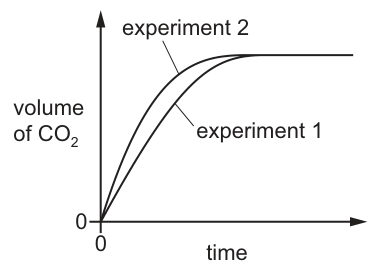
Which statement about experiments 1 and 2 is correct?
Options
A Experiments 1 and 2 both slow down as the reaction proceeds.
B Experiments 1 and 2 must both use acid of the same concentration.
C Experiments 1 and 2 must have been done at the same temperature.
D Experiment 2 uses larger lumps of calcium carbonate. All other conditions stay the same.
Working
- The gradient (slope) of a volume-time graph represents the rate of reaction. For both experiments 1 and 2, the gradient is steepest at and continuously decreases over time until the curve becomes horizontal (gradient ), showing that both reactions slow down as the reactants are consumed. Thus, statement A is correct.
- Experiment 2 has a steeper initial gradient than experiment 1, meaning experiment 2 has a faster rate. A higher rate could be caused by higher acid concentration, higher temperature, or smaller particle size (powder rather than lumps) of , so neither concentration nor temperature must be identical (B and C are incorrect).
- Larger lumps have a smaller surface area per unit volume, which would decrease the rate of reaction and produce a less steep curve, whereas curve 2 is steeper (D is incorrect).
Answer
A
A
Walkthrough
-
Understanding the graph:
- The graph plots the volume of carbon dioxide gas produced against time.
- The gradient (slope) of the tangent to the curve at any point represents the rate of reaction at that instant.
- At the beginning (), the curves are at their steepest, meaning the reaction is fastest because the concentration of acid and the available surface area of calcium carbonate are at their highest.
- As the reaction proceeds, reactants are used up. This lowers the frequency of effective collisions between particles, causing the reaction to slow down (the gradient decreases).
- Eventually, when the limiting reactant is completely used up, no more gas is produced, and the curve levels off to a horizontal plateau (rate ).
- Because both curves get progressively less steep until they flatten, both experiments slow down as the reaction proceeds. Therefore, A is correct.
-
Eliminating the distractors:
- B and C: Experiment 2 has a steeper initial slope than experiment 1, which indicates a faster initial rate. This faster rate could be achieved by using a higher temperature, a higher concentration of hydrochloric acid, or smaller pieces (powder) of calcium carbonate. Hence, it is not mandatory for temperature or concentration to be the same.
- D: If larger lumps were used in experiment 2, the total surface area would decrease. A smaller surface area leads to fewer collisions per unit time and a slower rate (a less steep curve). Experiment 2 is faster, so it cannot be using larger lumps if all other variables remain unchanged.
Key Takeaways
- On a volume-against-time graph for a gas-producing reaction, the gradient represents the rate of reaction.
- A decreasing gradient over time shows that the reaction slows down as reactants are consumed.
- A steeper initial curve indicates a faster reaction rate, which can be caused by higher temperature, higher concentration, or smaller particle size (greater surface area).
- When the total amount of limiting reactant is unchanged, the curves will reach the same horizontal plateau (final volume of gas).
Common Mistakes
- Confusing the rate of reaction (steepness of the curve) with the total amount of product formed (height of the plateau).
- Thinking larger lumps increase the rate of reaction; larger pieces have a smaller surface area-to-volume ratio, which slows down the reaction.
Things to Be Careful About
- Always check both the slope (rate) and the final horizontal line (yield/stoichiometry) when interpreting reaction rate curves.
If calcium carbonate is heated in a closed container, it will decompose, forming calcium oxide and carbon dioxide. Calcium oxide and carbon dioxide can recombine to form calcium carbonate.
After some time, a position is reached where calcium carbonate is decomposing, and calcium oxide and carbon dioxide are recombining at the same rate.
What is this position called?
Options
A activation energy
B backward reaction
C equilibrium
D neutralisation
Working
In a closed system, when the rate of the forward reaction (decomposition of ) equals the rate of the reverse reaction (recombination of and ), the system is at equilibrium.
- A (activation energy) is the minimum energy required for reacting particles to collide successfully.
- B (backward reaction) is only one direction of the reversible reaction.
- D (neutralisation) is a reaction between an acid and a base.
Answer
C
C
Walkthrough
A reversible reaction in a closed container can proceed in both the forward and backward directions:
When the rate of the forward reaction (thermal decomposition of calcium carbonate) becomes equal to the rate of the backward reaction (recombination of calcium oxide and carbon dioxide), the amounts and concentrations of the reactants and products remain constant over time. This dynamic state is called equilibrium (specifically, dynamic chemical equilibrium).
Key Takeaways
- Dynamic equilibrium occurs in a closed system when the rate of the forward reaction equals the rate of the reverse reaction.
- At equilibrium, both reactions continue to occur simultaneously at identical rates, so there is no net change in the amounts of reactants and products.
Common Mistakes
- Confusing "equilibrium" with the "backward reaction" itself. The backward reaction is merely the reverse process, whereas equilibrium refers to the overall state of balance between both processes.
Things to Be Careful About
- Ensure the concept of equilibrium is linked to two key conditions: equal rates of forward and backward reactions, and a closed system (so no matter can enter or escape).
Which set of conditions is used in the Contact process?
Options
| temperature / | pressure / | catalyst | |
|---|---|---|---|
| A | 100 | 200 | V₂O₅ |
| B | 300 | 200 | Fe |
| C | 450 | 2 | Fe |
| D | 450 | 2 | V₂O₅ |
Working
The Contact process is used for the manufacture of sulfuric acid. In the key stage, sulfur dioxide is oxidised to sulfur trioxide:
The optimum conditions used in industry are:
- Temperature:
- Pressure: (a low/moderate pressure is sufficient as the equilibrium yield is already very high)
- Catalyst: Vanadium(V) oxide,
Matching these conditions to the options gives row D.
- A is incorrect because the temperature is far too low and the pressure is unnecessarily high.
- B and C are incorrect because iron () is the catalyst for the Haber process, not the Contact process.
Answer
D
D
Walkthrough
The Contact process involves the catalytic oxidation of sulfur dioxide () to sulfur trioxide ():
- Temperature (): The forward reaction is exothermic. A lower temperature favors a higher equilibrium yield of , but causes the reaction rate to be impractically slow. Therefore, a compromise temperature of is chosen to balance yield and rate.
- Pressure (): There are 3 moles of gas on the left and 2 moles on the right. Increasing pressure shifts equilibrium to the right, but because the conversion is already around at atmospheric/low pressure, high-pressure equipment is economically unnecessary. A low pressure of is used mainly to push gases through the reactor.
- Catalyst (): Vanadium(V) oxide speeds up the reaction to achieve equilibrium rapidly at this moderate temperature without affecting the equilibrium position.
Therefore, the correct row is D.
Key Takeaways
- Contact process: , , catalyst.
- Haber process: , , catalyst.
Common Mistakes
- Confusing the conditions of the Contact process with the Haber process (e.g., using catalyst or pressure).
Things to Be Careful About
- Ensure you recognise as vanadium(V) oxide and associate it specifically with the oxidation of sulfur dioxide.
Copper forms a red oxide, Cu₂O, and a black oxide, CuO.
In the presence of a catalyst, aqueous hydrogen peroxide, H₂O₂, decomposes to form water.
The black oxide has copper in a ......1...... oxidation state than in the red oxide.
In forming water, hydrogen peroxide is ......2...... .
Which words correctly complete gaps 1 and 2?
Options
| 1 | 2 | |
|---|---|---|
| A | higher | reduced |
| B | higher | oxidised |
| C | lower | reduced |
| D | lower | oxidised |
Working
-
Determine the oxidation state of copper in each oxide:
- In (black oxide), oxygen has an oxidation number of , so the oxidation state of copper is .
- In (red oxide), oxygen has an oxidation number of , so , meaning copper has an oxidation state of .
- Therefore, the black oxide has copper in a higher oxidation state than in the red oxide.
-
Determine whether is oxidised or reduced when forming :
- The decomposition reaction is:
- In , hydrogen is and oxygen has an oxidation number of .
- In , hydrogen is and oxygen has an oxidation number of .
- The decrease in oxidation number of oxygen from to means hydrogen peroxide is reduced in forming water.
This matches row A (1: higher, 2: reduced).
Answer
A
A
Walkthrough
-
Gap 1 (Oxidation state of copper):
- In metal oxides, oxygen consistently has an oxidation state of .
- In , the neutral compound requires the copper ion to balance the charge, giving (oxidation state ).
- In , two copper ions balance the charge, giving (oxidation state ).
- Since , the black oxide (copper(II) oxide) has copper in a higher oxidation state than the red oxide (copper(I) oxide).
-
Gap 2 (Redox change of to ):
- Hydrogen peroxide, , contains a peroxide bond where oxygen has an unusual oxidation state of .
- When converts into , the oxidation state of oxygen decreases from to .
- A decrease in oxidation state corresponds to a gain of electrons, which is reduction.
- (Alternatively, the conversion of to involves the loss of oxygen, which also defines reduction).
Combining both conclusions gives higher for gap 1 and reduced for gap 2, which corresponds to option A.
Key Takeaways
- For neutral compounds, the sum of all oxidation numbers equals zero.
- Group 16 elements (like oxygen) typically have an oxidation state of , except in peroxides where oxygen is .
- Reduction is defined as a decrease in oxidation state, a gain of electrons, or a loss of oxygen.
- Oxidation is defined as an increase in oxidation state, a loss of electrons, or a gain of oxygen.
Common Mistakes
- Forgetting that oxygen in peroxides has an oxidation state of rather than .
- Confusing the formulae of copper(I) oxide () and copper(II) oxide ().
- Looking at the formation of (where oxygen goes from to , which is oxidation) instead of the specified formation of .
Things to Be Careful About
- The question specifically asks about what happens to hydrogen peroxide in forming water, not the other product (oxygen gas). In the disproportionation of , one oxygen atom is reduced to form and another is oxidised to form .
An organic compound, X, has a molecular formula C₄H₈O₂ and turns damp blue litmus paper red.
What is the displayed formula of X?
Options
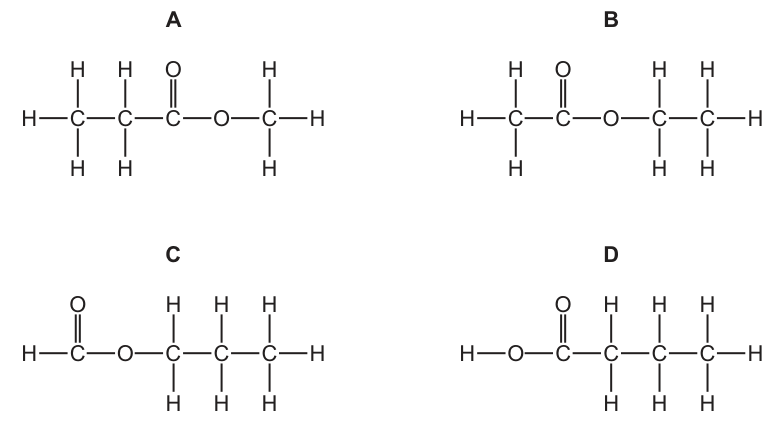
Working
- Turning damp blue litmus paper red indicates that compound is acidic.
- Among organic compounds with the general formula , carboxylic acids are acidic, whereas esters are neutral.
- Therefore, compound must be a carboxylic acid containing the functional group.
- Structures A, B, and C are all esters containing the ester linkage ():
- A is methyl propanoate.
- B is ethyl ethanoate.
- C is propyl methanoate.
- Structure D contains the carboxylic acid group () and has 4 carbon atoms, representing butanoic acid ().
Answer
D
D
Walkthrough
An organic compound with the molecular formula has two oxygen atoms and one degree of unsaturation (a double bond or a ring). In O Level Chemistry, compounds with the general formula are either carboxylic acids or esters.
The key chemical clue is that compound turns damp blue litmus paper red. This test indicates an acidic substance containing hydrogen ions () in aqueous solution:
- Carboxylic acids contain the carboxyl functional group () and weakly ionise in water to release , turning blue litmus paper red.
- Esters contain the ester linkage () within a carbon chain and are neutral, so they have no effect on blue litmus paper.
Evaluating the displayed formulae:
- A is methyl propanoate, an ester (neutral).
- B is ethyl ethanoate, an ester (neutral).
- C is propyl methanoate, an ester (neutral).
- D is butanoic acid, a four-carbon carboxylic acid featuring a terminal group, which is acidic and turns damp blue litmus red.
Thus, option D is correct.
Key Takeaways
- Carboxylic acids have the functional group and show acidic properties, such as turning damp blue litmus paper red and reacting with carbonates to produce carbon dioxide.
- Esters and carboxylic acids with the same number of carbon atoms are structural isomers (both share the general molecular formula ), but they have distinctly different functional groups and chemical properties.
Common Mistakes
- Confusing the displayed formula of an ester () with that of a carboxylic acid ().
- Forgetting that litmus paper must be damp to test gases or non-aqueous liquids for acidity.
Things to Be Careful About
- Always inspect where the oxygen atoms and the hydrogen atom are attached: a carboxylic acid must have an group directly bonded to a carbonyl carbon ().
Which statement about oxides is correct?
Options
A All acidic oxides are gases at room temperature.
B All basic oxides dissolve in water to give alkalis.
C Amphoteric oxides react with acids, alkalis and water.
D Potassium oxide is a basic oxide.
Working
- A is incorrect: Some acidic oxides are solids at room temperature (e.g. silicon dioxide, , and phosphorus(V) oxide, ).
- B is incorrect: Most basic oxides are insoluble in water (e.g. copper(II) oxide, , and iron(III) oxide, ). Only soluble metal oxides (such as Group I oxides and calcium oxide) dissolve in water to form alkalis.
- C is incorrect: Amphoteric oxides (e.g. and ) react with both acids and alkalis to form salts, but they are insoluble in water and do not react with water.
- D is correct: Potassium is a reactive metal, and its oxide, , is a metal oxide that reacts with acids to form a salt and water; hence, it is a basic oxide.
Answer
D
D
Walkthrough
Oxides are classified based on their acid-base characteristics:
- Basic oxides: Oxides of metals (e.g. , , , , ). They react with acids to form a salt and water. Most basic oxides are insoluble in water; only those of Group I metals and some Group II metals dissolve in/react with water to form alkaline solutions (metal hydroxides). Since potassium is a Group I metal, potassium oxide () is a basic oxide. Thus, D is correct.
- Acidic oxides: Oxides of non-metals (e.g. , , , , ). While many are gases at room temperature, some are solids, such as (sand/quartz) and , so statement A is false.
- Amphoteric oxides: Oxides of certain metals (notably , , ) that show both basic and acidic properties. They react with acids and with bases/alkalis to form salts and water, but they are insoluble in water and do not react with water, making statement C false.
- Neutral oxides: Non-metal oxides (e.g. , , ) that react with neither acids nor bases.
Key Takeaways
- Metal oxides are generally basic (or amphoteric).
- Non-metal oxides are generally acidic (or neutral).
- An alkali is specifically a soluble base; not all basic oxides are soluble in water.
- Amphoteric oxides (e.g. , ) react with both acids and alkalis, but not with water.
Common Mistakes
- Confusing the terms base and alkali: thinking all bases or basic oxides dissolve in water to give alkalis. Most transition metal oxides are insoluble bases.
- Assuming all acidic oxides are molecular gases, forgetting giant covalent oxides like or solid non-metal oxides like .
Things to Be Careful About
- Check absolute words such as "all" in options A and B, which are frequently false due to well-known exceptions in chemistry (e.g. insoluble metal oxides, solid acidic oxides).
A student is provided with suitable apparatus, distilled water and the following reagents.
Which salts can the student prepare as a pure dry sample?
Options
A lead nitrate, magnesium nitrate, lead chloride, lead sulfate and magnesium sulfate
B lead nitrate, magnesium nitrate, lead chloride and lead sulfate only
C lead nitrate, magnesium nitrate and lead chloride only
D lead nitrate and magnesium nitrate only
Working
-
Preparation of soluble salts using an insoluble base/carbonate and dilute acid:
- (magnesium nitrate): Add excess solid to dilute , filter off unreacted solid, and crystallise the filtrate to obtain pure, dry magnesium nitrate.
- (lead nitrate): Add excess solid to dilute , filter off unreacted solid, and crystallise the filtrate to obtain pure, dry lead nitrate.
-
Preparation of insoluble salts by precipitation:
- Once is prepared:
- Mix with to precipitate insoluble lead(II) chloride, . Filter, wash the residue with distilled water, and dry.
- Mix with to precipitate insoluble lead(II) sulfate, . Filter, wash the residue with distilled water, and dry.
- Once is prepared:
-
Magnesium sulfate:
- is a soluble salt. Mixing and does not form a precipitate, and the resulting mixture contains spectator ions (, ) that cannot be easily separated by simple filtration to give a pure sample of . Without dilute sulfuric acid, pure cannot be prepared.
Therefore, the salts that can be prepared as pure dry samples are lead nitrate, magnesium nitrate, lead chloride, and lead sulfate only.
Answer
B
B
Walkthrough
To determine which salts can be prepared as a pure, dry sample, we look at the methods of salt preparation available from the given reagents:
-
Soluble salts via excess insoluble reactant:
Excess solid magnesium hydroxide is added to dilute nitric acid, the excess is filtered off, and the filtrate is heated to saturation and cooled to form pure crystals of magnesium nitrate, .
Similarly, excess lead(II) carbonate reacts with nitric acid to produce aqueous lead(II) nitrate, , which can be crystallised.
-
Insoluble salts via precipitation:
- Insoluble salts are made by mixing two aqueous solutions containing the required ions:
Adding aqueous sodium chloride to aqueous lead(II) nitrate gives a white precipitate of . This is collected by filtration, washed with distilled water, and dried.
Adding aqueous sodium sulfate to aqueous lead(II) nitrate produces insoluble , which is also purified by filtering, washing, and drying.
- Insoluble salts are made by mixing two aqueous solutions containing the required ions:
-
Why magnesium sulfate cannot be prepared pure:
- is soluble in water. Mixing aqueous magnesium nitrate with aqueous sodium sulfate results in a solution containing , , , and ions with no precipitation. Evaporating this solution would yield a mixture of salts, not a pure sample of .
Thus, only four salts can be prepared as pure dry samples: lead nitrate, magnesium nitrate, lead chloride, and lead sulfate.
Key Takeaways
- Soluble salts (like nitrates) are prepared by reacting an acid with an excess of an insoluble base or carbonate, filtering, and crystallising.
- Insoluble salts (like and ) are prepared by precipitation (mixing two soluble solutions), filtering, washing, and drying the residue.
- Soluble salts cannot be made purely by mixing two salt solutions unless an insoluble product forms to separate out.
Common Mistakes
- Forgetting that and are insoluble and can be made by precipitation once is formed.
- Assuming can be prepared pure by mixing and , overlooking that is soluble and will remain mixed with sodium and nitrate ions.
Things to Be Careful About
- Remember solubility rules: all nitrates are soluble; most chlorides are soluble except silver and lead; most sulfates are soluble except barium, calcium, and lead.
When heated, copper(II) sulfate crystals, CuSO₄•5H₂O, react as shown.
When ......1...... copper(II) sulfate, which is ......2...... in appearance, is heated, it forms ......3...... copper(II) sulfate, which is ......4...... in appearance.
Which words correctly complete gaps 1, 2, 3 and 4?
Options
| 1 | 2 | 3 | 4 | |
|---|---|---|---|---|
| A | anhydrous | blue and crystalline | hydrated | white and powdery |
| B | hydrated | colourless and crystalline | anhydrous | blue and powdery |
| C | hydrated | blue and powdery | anhydrous | colourless and crystalline |
| D | hydrated | blue and crystalline | anhydrous | white and powdery |
Working
- contains water of crystallisation, so it is hydrated copper(II) sulfate (gap 1).
- Hydrated copper(II) sulfate forms blue and crystalline solids (gap 2).
- When heated, it loses water to form , which is anhydrous copper(II) sulfate (gap 3).
- Anhydrous copper(II) sulfate is a white and powdery solid (gap 4).
Matching these to the options corresponds to row D.
Answer
D
D
Walkthrough
-
Hydrated vs Anhydrous:
- A salt containing chemically combined water within its crystal structure is called hydrated. is hydrated copper(II) sulfate.
- A salt that has lost its water of crystallisation is called anhydrous. is anhydrous copper(II) sulfate.
Therefore, gap 1 is 'hydrated' and gap 3 is 'anhydrous'.
-
Physical Appearance:
- Hydrated copper(II) sulfate crystals () are bright blue and crystalline (gap 2).
- Anhydrous copper(II) sulfate powder () is white and powdery (gap 4).
-
Matching Options:
- Gap 1: hydrated
- Gap 2: blue and crystalline
- Gap 3: anhydrous
- Gap 4: white and powdery
This completely matches option D.
Key Takeaways
- Hydrated salts contain water of crystallisation, usually giving them a characteristic crystal shape and distinct colour.
- Heating drives off the water of crystallisation, turning the hydrated crystal into an anhydrous powder.
- Anhydrous copper(II) sulfate turning from white to blue upon the addition of water is a standard chemical test for the presence of water.
Common Mistakes
- Confusing the terms hydrated (with water) and anhydrous (without water).
- Mixing up the colours: thinking anhydrous copper(II) sulfate is blue or colourless rather than white.
Which formula represents the oxide of element Z in Group II of the Periodic Table?
Options
A ZO
B Z₂O₂
C ZO₃
D Z₂O
Working
- Element is in Group II of the Periodic Table, so each atom loses electrons to form a ion.
- Oxygen is in Group VI and gains electrons to form an oxide ion, .
- Since the charges are equal and opposite ( and ), the ions combine in a ratio to form the neutral compound .
Answer
A
A
Walkthrough
- Identify the charge on the metal ion from its position in the Periodic Table: elements in Group II have two outer-shell electrons, which they lose to form positive ions with a charge of (i.e., ).
- Identify the charge on the oxide ion: oxygen is in Group VI, with six outer-shell electrons, so it gains two electrons to achieve a full shell, forming an oxide ion with a charge of (i.e., ).
- Balance the ionic charges to make a neutral compound: one ion balances one ion (). Thus, the simplest formula is .
Checking the distractors:
- B (): Formulae of ionic compounds are expressed as the simplest whole-number ratio of ions, which simplifies to .
- C (): This would correspond to an element with a valency/oxidation state of (like sulfur in ).
- D (): This represents the oxide of a Group I metal where the metal forms a ion (e.g., ).
Therefore, option A is the correct answer.
Key Takeaways
- Group number in the Periodic Table gives the number of valence electrons and allows you to deduce the stable ionic charge:
- Group I forms
- Group II forms
- Group III forms
- Group VI forms
- Group VII forms
- The formula of an ionic compound is written in the lowest whole-number ratio of cations to anions that gives an overall neutral charge.
Common Mistakes
- Writing unreduced formulae such as instead of simplifying to the empirical formula .
- Confusing Group I and Group II charges, leading to the incorrect formula .
Things to Be Careful About
- Always write ionic formulae in their simplest empirical ratio unless specifically dealing with peroxides or molecular species.
Element X is in Group I.
Some statements about element X are given.
- X is not the least dense element in Group I.
- X is more reactive than potassium.
- X has an value less than 100.
Which element is X?
Options
A lithium
B sodium
C rubidium
D caesium
Working
-
In Group I, reactivity increases down the group:
Since element is more reactive than potassium (), must be below potassium, so it can only be rubidium () or caesium (). This eliminates lithium () and sodium (). -
Looking at relative atomic masses () from the Periodic Table:
- Rubidium ():
- Caesium ():
-
Since has an , element must be rubidium ().
Answer
C
C
Walkthrough
To identify element , we evaluate the given clues using our knowledge of Group I (the alkali metals) and the Periodic Table:
- Reactivity trend: Reactivity increases as you go down Group I because the outer electron gets further from the nucleus, experiences more shielding, and is lost more easily. Therefore, any element more reactive than potassium () must lie below potassium in Group I: either rubidium (), caesium (), or francium ().
- Relative atomic mass (): Checking the Periodic Table:
Since element has , caesium is ruled out, leaving rubidium as the correct element.
- Density check: Rubidium is denser than lithium, confirming the first statement that is not the least dense element.
Thus, the correct option is C.
Key Takeaways
- In Group I (alkali metals), chemical reactivity increases down the group.
- Density generally increases down Group I, with lithium being the least dense alkali metal.
- Relative atomic mass () increases down any group in the Periodic Table.
Common Mistakes
- Confusing the reactivity trend of Group I (increases down) with Group VII (decreases down).
- Selecting caesium () by overlooking the requirement that .
- Selecting sodium () or lithium () by wrongly assuming elements higher up in Group I are more reactive.
Things to Be Careful About
- Always refer to the provided Periodic Table to check relative atomic mass () values accurately rather than guessing.
A student makes three statements about metals and non-metals.
- All alloys contain at least one metal.
- All metals are good thermal and electrical conductors.
- All solid non-metals are malleable.
Which statements are correct?
Options
A 1, 2 and 3
B 1 and 2 only
C 1 and 3 only
D 2 only
Working
- Statement 1: An alloy is a mixture of a metal with other elements (which can be other metals or non-metals such as carbon). Therefore, all alloys must contain at least one metal. (Statement 1 is correct)
- Statement 2: All metals possess a lattice of positive ions surrounded by delocalised electrons, allowing them to conduct heat and electricity well. (Statement 2 is correct)
- Statement 3: Solid non-metals are typically brittle, not malleable; when hammered or subjected to stress, they shatter rather than bend. (Statement 3 is incorrect)
Therefore, statements 1 and 2 only are correct.
Answer
B
B
Walkthrough
Let us evaluate each of the three statements individually:
-
Statement 1: "All alloys contain at least one metal."
- By definition, an alloy is a mixture of a metal with other elements (e.g., steel is iron and carbon, brass is copper and zinc, bronze is copper and tin). Because a metal is always the base component, every alloy contains at least one metal. Thus, statement 1 is correct.
-
Statement 2: "All metals are good thermal and electrical conductors."
- The metallic bonding model consists of a giant lattice of positive metal ions immersed in a 'sea' of delocalised, freely moving valence electrons. These delocalised electrons can move rapidly through the structure to transfer charge and thermal energy, making all metals good conductors of electricity and heat. Thus, statement 2 is correct.
-
Statement 3: "All solid non-metals are malleable."
- Malleability (the ability to be hammered or rolled into sheets without breaking) is a characteristic property of metals, where layers of ions can slide over one another without disrupting the metallic bonding. Solid non-metals (like sulfur, phosphorus, iodine, and carbon in the form of diamond or graphite) are brittle rather than malleable; applying force fractures their fixed covalent bonds or overcomes weak intermolecular forces, causing the solid to shatter. Thus, statement 3 is incorrect.
Combining these evaluations gives 1 and 2 only, which corresponds to option B.
Key Takeaways
- An alloy is a mixture of a metal with other elements.
- Metals are characteristically good electrical and thermal conductors due to their delocalised electrons, and they are malleable because layers of positive ions can slide over each other.
- Solid non-metals are brittle and generally poor conductors of heat and electricity (with the notable exception of graphite for electrical conductivity).
Common Mistakes
- Confusing the terms malleable (can be hammered into sheets) and ductile (can be drawn into wires) with brittle (breaks easily when stressed).
- Thinking that some non-metals (like graphite) are malleable because graphite is soft and slippery; graphite layers flake off, but it cannot be hammered into shape without crumbling (it is brittle).
Things to Be Careful About
- Watch out for universal quantifiers like "all". While exceptions exist for electrical conductivity in non-metals (graphite conducts), physical malleability is never a property of solid non-metals.
Group I elements and transition elements are metals.
Student X suggests that the Group I elements are above hydrogen in the reactivity series but that not all transition elements are above hydrogen.
Student Y suggests that the densities of Group I elements are lower than those of the transition elements.
Which students are correct?
Options
A both X and Y
B X only
C Y only
D neither X nor Y
Working
-
Evaluate Student X's statement:
- All Group I alkali metals (e.g. , , ) are highly reactive and lie well above hydrogen in the reactivity series, reacting vigorously with water to release hydrogen gas.
- Transition elements vary in reactivity: while some like iron () lie above hydrogen, unreactive transition elements such as copper (), silver (), and gold () lie below hydrogen and cannot displace hydrogen from dilute acids.
- Thus, Student X is correct.
-
Evaluate Student Y's statement:
- Group I elements are soft metals with unusually low densities (lithium, sodium, and potassium are less dense than water).
- Transition elements are dense, typical heavy metals with closely packed metallic lattices.
- Thus, Student Y is correct.
Both students are correct.
Answer
A
A
Walkthrough
-
Reactivity of Group I vs. Transition Elements (Student X):
- In the reactivity series, the Group I alkali metals (potassium, sodium, lithium) are positioned near the top, far above hydrogen. They readily lose their single valence electron to form stable cations, reacting vigorously with water and dilute acids.
- Transition elements exhibit a much wider range of chemical reactivity. Some (such as iron, zinc, and nickel) are located above hydrogen and will react with dilute acids to produce hydrogen gas. However, others (notably copper, silver, gold, and platinum) lie below hydrogen in the reactivity series and do not react with dilute acids to release hydrogen. Therefore, not all transition elements are above hydrogen.
- Student X is correct.
-
Density Comparison (Student Y):
- Group I metals have large atomic radii relative to their mass, leading to loosely packed crystal structures and low densities (the densities of , , and are all less than ).
- In contrast, transition elements have smaller atomic radii and stronger metallic bonding due to the involvement of inner d-electrons, resulting in high densities (typically greater than ).
- Student Y is correct.
Since both statements are true, option A is the correct choice.
Key Takeaways
- Group I Metals: Characterised by high chemical reactivity (always above hydrogen) and low physical densities/melting points compared to other metals.
- Transition Elements: Characterised by high densities, high melting points, and variable reactivity, spanning positions both above and below hydrogen in the reactivity series.
Common Mistakes
- Assuming all metals are above hydrogen in the reactivity series. Unreactive transition metals like copper (), silver (), and gold () are below hydrogen.
- Confusing the physical softness/low density of Group I metals with transition metals.
Things to Be Careful About
- Remember that position in the reactivity series relative to hydrogen dictates whether a metal can displace hydrogen from dilute non-oxidising acids (such as or dilute ).
The equations for three reactions are given.
These reactions take place in the extraction of metals.
Which row is correct?
Options
| reaction in extraction of aluminium only | reaction in extraction of iron only | reaction in extraction of aluminium and iron | |
|---|---|---|---|
| A | 1 | 2 | 3 |
| B | 1 | 3 | 2 |
| C | 2 | 1 | 3 |
| D | 2 | 3 | 1 |
Working
- Reaction 1: is the oxidation of oxide ions at the positive anode during the electrolysis of molten aluminium oxide (extraction of aluminium only).
- Reaction 2: occurs in both processes: in the blast furnace (combustion of coke to provide heat and form reducing gas) and during the electrolysis of aluminium (the oxygen produced reacts with the carbon/graphite anodes).
- Reaction 3: is the reaction between calcium oxide (basic oxide) and silicon dioxide (acidic impurity) to form slag, which occurs in the blast furnace only (extraction of iron only).
Matching with the table:
- Extraction of aluminium only: 1
- Extraction of iron only: 3
- Extraction of both: 2
This matches row B.
Answer
B
B
Walkthrough
To determine the correct row, evaluate where each chemical reaction occurs:
-
Reaction 1:
- This is an oxidation half-equation where oxide ions lose electrons to form oxygen gas.
- It occurs at the anode during the extraction of aluminium by electrolysis of molten in cryolite.
- This electrolytic step is unique to aluminium extraction, as iron is extracted chemically by reduction using carbon monoxide in a blast furnace.
- Therefore, Reaction 1 is in the extraction of aluminium only.
-
Reaction 2:
- In the blast furnace for iron extraction, coke (carbon) burns in a blast of hot air to produce carbon dioxide and release heat.
- In the Hall-Héroult cell for aluminium extraction, the oxygen gas liberated at the positive carbon/graphite anodes reacts with the carbon at high temperatures () to form carbon dioxide, causing the anodes to burn away over time.
- Therefore, Reaction 2 occurs in the extraction of both aluminium and iron.
-
Reaction 3:
- In the blast furnace, limestone () decomposes to calcium oxide (), which then neutralises acidic silicon dioxide (sand/) impurities present in the iron ore to form molten calcium silicate (slag, ).
- In aluminium extraction, bauxite ore is purified to pure before electrolysis (via the Bayer process), so slag formation does not take place in the cell.
- Therefore, Reaction 3 is in the extraction of iron only.
Matching these gives row B.
Key Takeaways
- Aluminium is high in the reactivity series and must be extracted by electrolysis of its molten oxide dissolved in cryolite.
- At the anode in aluminium extraction, oxide ions are oxidised to oxygen gas (), which subsequently burns the carbon anodes to form .
- Iron is extracted in the blast furnace where coke burns to form , and limestone provides to remove as slag ().
Common Mistakes
- Forgetting that carbon anodes burn away in the extraction of aluminium, leading students to think is unique to the blast furnace.
- Confusing the role of slag formation (limestone reaction) and thinking it happens in the electrolytic cell.
Things to Be Careful About
- Ensure the three columns in the question's table match the assigned reactions (aluminium only, iron only, and both).
The domestic water supply is treated to make it safe to drink.
Which row identifies the treatment and its effect?
Options
| chlorination | filtration | sedimentation | |
|---|---|---|---|
| A | removes nitrates | removes solids | removes nitrates |
| B | kills microbes | removes soluble compounds | removes solids |
| C | removes solids | kills microbes | removes soluble compounds |
| D | kills microbes | removes solids | removes solids |
Working
- Chlorination: Chlorine is added to water to kill harmful microbes/bacteria and sterilise the water.
- Filtration: Water is passed through sand and gravel filters to remove insoluble solids.
- Sedimentation: Water is allowed to stand so that larger suspended insoluble solids settle to the bottom and are removed.
Matching these effects with the table gives:
- Chlorination: kills microbes
- Filtration: removes solids
- Sedimentation: removes solids
This matches row D.
Answer
D
D
Walkthrough
Domestic water treatment involves several key physical and chemical steps to make water potable (safe to drink):
- Sedimentation: Water is kept in large tanks, allowing heavier suspended insoluble particles to settle down under gravity. This removes large solids.
- Filtration: Water is passed through fine beds of sand and gravel to trap and remove any remaining small, insoluble solid particles.
- Chlorination: A carefully controlled amount of chlorine gas (or chlorine compounds) is added as a disinfectant to kill harmful bacteria, viruses, and other microorganisms.
Evaluating the table:
- A is incorrect because neither chlorination nor sedimentation removes dissolved nitrates.
- B is incorrect because simple sand filtration does not remove soluble (dissolved) compounds.
- C mixes up the functions completely (e.g., chlorination does not remove solids; sedimentation does not remove soluble compounds).
- D correctly states that chlorination kills microbes, while both filtration and sedimentation remove insoluble solids.
Key Takeaways
- Physical methods (sedimentation and filtration) remove insoluble suspended solids of varying sizes.
- Chemical disinfection (chlorination) kills bacteria and microorganisms to ensure the water is biologically safe.
- Standard domestic water treatment does not remove dissolved mineral ions such as nitrates.
Common Mistakes
- Confusing physical separation of insoluble particles (filtration/sedimentation) with the removal of dissolved/soluble substances.
- Thinking that filtration kills microbes or removes dissolved chemical pollutants like nitrates.
Things to Be Careful About
- Ensure you distinguish clearly between dissolved (soluble) impurities and suspended (insoluble) impurities.
Sodium phosphate, Na₃PO₄, and ammonium nitrate, NH₄NO₃, are both used as fertilisers.
Which row shows the correct percentage by mass of the element in each compound that improves plant growth?
Options
| % of the element in Na₃PO₄ that improves plant growth | % of the element in NH₄NO₃ that improves plant growth | |
|---|---|---|
| A | 19 | 18 |
| B | 19 | 35 |
| C | 42 | 18 |
| D | 42 | 35 |
Working
-
Identify the elements in NPK fertilisers that improve plant growth:
- In , the essential nutrient element is phosphorus (). Sodium () is not an essential major fertiliser element.
- In , the essential nutrient element is nitrogen ().
-
Calculate the percentage by mass of in :
- Relative atomic masses (): , ,
-
Calculate the percentage by mass of in :
- Relative atomic masses (): , ,
- Total mass of nitrogen atoms =
Therefore, the correct row is B ( and ).
Answer
B
B
Walkthrough
-
Identify the essential element in each fertiliser:
Fertilisers provide plants with three main elements for healthy growth: Nitrogen (), Phosphorus (), and Potassium () (often known as NPK fertilisers).- For , the essential element is phosphorus (). (Sodium, , is not a plant fertiliser nutrient; calculating sodium would give , which corresponds to distractor rows C and D).
- For , the essential element is nitrogen ().
-
Calculate the percentage by mass of in :
-
Formula mass of :
-
Percentage of :
-
-
Calculate the percentage by mass of in :
-
Note that there are nitrogen atoms in the formula unit .
-
Formula mass of :
-
Percentage of :
-
Matching these values to the table gives and , corresponding to option B.
Key Takeaways
-
Plants require three main macronutrients from artificial fertilisers: nitrogen (for protein synthesis and leaf/stem growth), phosphorus (for root development), and potassium (for flowers and fruits).
-
To find the percentage by mass of an element in a compound:
Common Mistakes
- Calculating the percentage of sodium () instead of phosphorus () in , leading to and incorrectly choosing option C or D.
- Counting only nitrogen atom instead of in , leading to (options A and C).
Things to Be Careful About
- Always inspect the chemical formula carefully to count all occurrences of an element (e.g. contains two nitrogen atoms in different parts of the formula).
Three processes are shown.
- the decomposition of vegetation
- emissions from a car engine
- photosynthesis
Which row shows a gas produced in each process?
Options
| process 1 | process 2 | process 3 | |
|---|---|---|---|
| A | carbon monoxide | hydrogen | oxygen |
| B | carbon monoxide | nitrogen monoxide | carbon dioxide |
| C | methane | nitrogen monoxide | oxygen |
| D | methane | hydrogen | carbon dioxide |
Working
- Process 1 (decomposition of vegetation): Anaerobic bacterial decay of plant matter produces methane ().
- Process 2 (emissions from a car engine): High temperatures inside car engines cause nitrogen and oxygen from the air to react, forming nitrogen monoxide (), which is released in exhaust fumes.
- Process 3 (photosynthesis): Plants react carbon dioxide and water in the presence of light and chlorophyll to produce glucose and release oxygen () gas.
Matching these gases to the table gives C.
Answer
C
C
Walkthrough
To determine the correct option, evaluate each process individually:
-
Decomposition of vegetation (Process 1):
The anaerobic decay or decomposition of organic/plant material by bacteria (e.g., in paddy fields, swamps, and landfill sites) is a major natural source of methane (). -
Emissions from a car engine (Process 2):
Inside an internal combustion engine, the spark/combustion creates high temperatures and pressures. Under these conditions, atmospheric nitrogen () and oxygen () react together:Hence, nitrogen monoxide is a primary pollutant in exhaust gases. (Hydrogen is not produced in car exhaust emissions).
-
Photosynthesis (Process 3):
Green plants use light energy to convert carbon dioxide and water into glucose and oxygen:Therefore, oxygen is released as a product, while carbon dioxide is consumed.
Comparing with the options, row C correctly identifies methane, nitrogen monoxide, and oxygen for processes 1, 2, and 3, respectively.
Key Takeaways
- Methane is produced by the anaerobic decay of organic vegetation.
- Oxides of nitrogen (such as and ) are formed when high temperatures in car engines cause and in air to react.
- Photosynthesis consumes and produces , whereas respiration consumes and produces .
Common Mistakes
- Confusing photosynthesis with respiration and thinking that photosynthesis produces instead of .
- Mistakenly identifying hydrogen as a component of car exhaust emissions.
Things to Be Careful About
- Ensure you differentiate between reactants and products for processes like photosynthesis (it uses and water, but produces glucose and ).
Which compound is not an alkane, alkene, alcohol or carboxylic acid?
Options
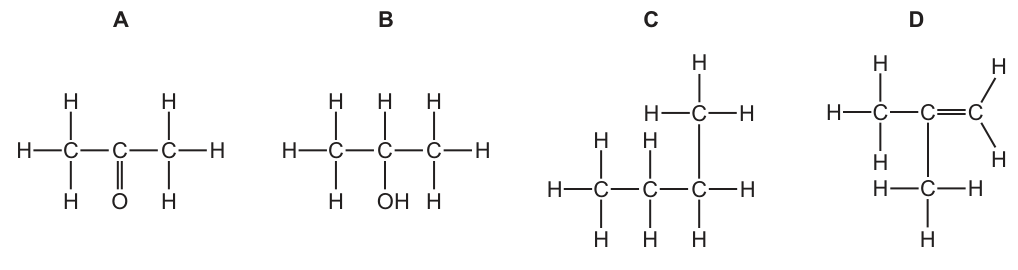
Working
- Structure A contains a carbonyl group () bonded between two carbon atoms (a ketone, propanone). It is not an alkane, alkene, alcohol, or carboxylic acid.
- Structure B contains a hydroxyl group () attached to a saturated carbon, which makes it an alcohol (propan-2-ol).
- Structure C contains only carbon and hydrogen atoms joined by single bonds ( and ), so it is a branched alkane (methylpropane).
- Structure D contains a carbon-carbon double bond (), so it is an alkene (2-methylpropene).
Therefore, compound A is the only one that does not belong to any of the four named homologous series.
Answer
A
A
Walkthrough
To determine which molecule is not an alkane, alkene, alcohol, or carboxylic acid, examine the characteristic bonding and functional groups present in each given displayed formula:
- Alkane: Saturated hydrocarbon containing only single covalent bonds ( and ). Option C is an alkane (methylpropane / isobutane).
- Alkene: Unsaturated hydrocarbon containing at least one carbon-carbon double bond (). Option D contains a bond and is an alkene (2-methylpropene).
- Alcohol: Contains a hydroxyl functional group () attached to a carbon atom. Option B contains an group on the central carbon, making it an alcohol (propan-2-ol).
- Carboxylic acid: Contains a carboxyl group (, i.e., a and an on the same carbon atom).
Structure A contains a group bonded to two alkyl groups. This functional group is a ketone (specifically propanone), which is none of the four listed classes.
Hence, A is the correct answer.
Key Takeaways
- Alkanes have only single and bonds.
- Alkenes contain a double bond.
- Alcohols contain an functional group.
- Carboxylic acids contain a group.
Common Mistakes
- Mistaking the in a ketone (A) for a carboxylic acid, overlooking that a carboxylic acid must have an group attached to the same carbonyl carbon atom ().
- Confusing branched structures (such as C) as belonging to a different family rather than recognising them as alkanes.
Things to Be Careful About
- Ensure you check every atom and bond in the displayed formula: a carbonyl group alone () flanked by carbon atoms is a ketone, not an acid or alcohol.
Alkenes can be produced by the cracking of alkanes, such as decane, C₁₀H₂₂.
Which equation shows the cracking of decane to produce two different alkenes and at least one other product?
Options
A C₁₀H₂₂ → 2C₂H₄ + C₃H₆ + C₄H₁₀
B C₁₀H₂₂ → H₂ + 2C₂H₄ + C₃H₆ + C₅H₁₀
C C₁₀H₂₂ → 2C₃H₆ + C₄H₁₀
D C₁₀H₂₂ → H₂ + 2C₂H₄ + 2C₃H₆
Working
To find the correct equation, check the conditions stated:
- The equation must be balanced for and atoms (starting from ).
- It must produce two different alkenes (general formula ).
- It must produce at least one other product (e.g., an alkane or ).
-
A:
- Products: (ethene, alkene), (propene, alkene), (butane, alkane).
- Check balance: . Not balanced.
-
B:
- Products: (alkene), (alkene), (alkene) — this gives three different alkenes, not two.
- Also check balance: . Not balanced.
-
C:
- Products: (propene, alkene) and (butane, alkane).
- Contains only one type of alkene (propene), not two different alkenes.
-
D:
- Check balance:
- Carbon:
- Hydrogen:
- Products:
- (ethene, alkene)
- (propene, alkene) two different alkenes
- (hydrogen gas) at least one other product
- Check balance:
Therefore, option D satisfies all conditions.
Answer
D
D
Walkthrough
Cracking is the thermal decomposition of longer-chain alkanes into shorter, more useful molecules, which typically include smaller alkanes, alkenes, and hydrogen gas.
Let's evaluate each condition required by the question:
- Two different alkenes: An alkene has the general formula . Ethene () and propene () are two different alkenes.
- At least one other product: A product that is not one of those two alkenes, such as hydrogen gas () or an alkane ().
- Conservation of mass: The total number of carbon and hydrogen atoms in the products must equal 10 carbons and 22 hydrogens (from ).
Checking option D:
- Total atoms on right-hand side: .
- Total atoms on right-hand side: .
- The products are ethene (alkene), propene (alkene), and hydrogen gas (other product).
All criteria are met, so D is correct.
Key Takeaways
- Alkenes contain a double bond and have the general formula .
- Alkanes have the general formula .
- Cracking always conserves the total number of carbon and hydrogen atoms.
- Cracking can produce smaller alkanes, alkenes, and/or hydrogen gas ().
Common Mistakes
- Forgetting to check that the equation is balanced in both carbon and hydrogen atoms (options A and B fail on balancing alone).
- Misidentifying the number of different alkenes formed (option C only forms one type of alkene, propene).
Things to Be Careful About
- Count the coefficients carefully when summing up atoms: contains carbons and hydrogens.
Alkenes undergo addition reactions with bromine to form dibromoalkanes.
Which statement is correct?
Options
A Ethene and bromine react to produce 1,1-dibromoethane.
B Propene and bromine react to produce 1,3-dibromopropane.
C But-2-ene and bromine react to produce 2,2-dibromobutane.
D But-1-ene and bromine react to produce 1,2-dibromobutane.
Working
In an addition reaction of an alkene with bromine (), the carbon-carbon double bond () breaks and one bromine atom attaches to each of the two previously double-bonded carbon atoms:
- A: Ethene () reacts with to form 1,2-dibromoethane (), not 1,1-dibromoethane.
- B: Propene () reacts with to form 1,2-dibromopropane (), not 1,3-dibromopropane.
- C: But-2-ene () reacts with to form 2,3-dibromobutane (), not 2,2-dibromobutane.
- D: But-1-ene () reacts with across carbons 1 and 2 to form 1,2-dibromobutane ().
Therefore, statement D is correct.
Answer
D
D
Walkthrough
An addition reaction occurs when atoms or groups of atoms add across the double bond of an unsaturated hydrocarbon (alkene), breaking the double bond to form a saturated compound (alkane derivative) containing only single bonds.
When aqueous or liquid bromine () reacts with an alkene:
- The double bond opens up into a single bond.
- One bromine atom bonds to each of the two adjacent carbon atoms that originally shared the double bond.
Let us analyse each option:
- Ethene: (1,2-dibromoethane). Both carbons (1 and 2) gain a bromine atom.
- Propene: (1,2-dibromopropane). Carbons 1 and 2 gain bromine atoms.
- But-2-ene: (2,3-dibromobutane). Carbons 2 and 3 gain bromine atoms.
- But-1-ene: (1,2-dibromobutane). Carbons 1 and 2 gain bromine atoms.
Thus, only option D gives the correct IUPAC name of the addition product.
Key Takeaways
- In addition reactions of halogens to alkenes, the halogen atoms always add to adjacent carbon atoms (the two carbons of the original double bond).
- The positional numbers in the name of the product directly reflect the positions of the two carbons involved in the original double bond.
Common Mistakes
- Confusing addition with substitution (assuming both bromine atoms could attach to the same carbon atom, e.g., forming 1,1-dibromoethane or 2,2-dibromobutane).
- Misnumbering the carbon chain and thinking bromine atoms add to the ends of the molecule rather than across the double bond (e.g., forming 1,3-dibromopropane from propene).
Things to Be Careful About
- Always identify the exact position of the double bond from the name of the starting alkene (e.g., but-1-ene has the double bond between carbons 1 and 2; but-2-ene between carbons 2 and 3).
- Ensure the product is numbered from the end of the chain that gives the substituent halogen atoms the lowest possible locant numbers.
How many moles of oxygen are required for the complete combustion of 2 moles of ethanol?
Options
A 3
B 4
C 6
D 7
Working
Write the balanced chemical equation for the complete combustion of ethanol, :
From the equation, reacts completely with .
For :
- A (3): This is the moles of oxygen needed for only of ethanol.
- B (4): Incorrect balancing result.
- D (7): Corresponds to assuming hydrocarbon combustion without accounting for the oxygen atom already present in ethanol (, scaled to ).
Answer
C
C
Walkthrough
To find the number of moles of oxygen gas required:
- Identify the formula of the alcohol: Ethanol has the molecular formula (or ).
- Write and balance the complete combustion equation:
- Combustion produces carbon dioxide () and water ().
- 2 carbon atoms give .
- 6 hydrogen atoms give .
- Total oxygen atoms on the right-hand side: .
- The ethanol molecule already contains , so the remaining must come from gas:
- The balanced equation is:
- Use the molar ratio: The mole ratio of ethanol to oxygen is .
- For of ethanol, the oxygen required is .
This matches option C.
Key Takeaways
- Complete combustion of any alcohol produces and .
- Always remember to subtract the oxygen atom already present inside the alcohol molecule when balancing the term.
- Multiply the stoichiometric coefficient by the given amount in moles to obtain the required quantity.
Common Mistakes
- Forgetting the oxygen atom inside ethanol (), leading to balancing as if it were ethane (), which would give per mole of fuel and incorrectly lead to (option D).
- Finding the correct stoichiometric coefficient () for of ethanol but forgetting that the question specifies of ethanol (option A).
Things to Be Careful About
- Ensure you check whether the question specifies complete or incomplete combustion (complete combustion always gives , not or ).
- Double-check that all coefficients are balanced for both reactants and products before taking stoichiometric ratios.
Two reactions are shown.
Which row is correct?
Options
| name of compound X | type of compound Y | |
|---|---|---|
| A | propan-1-ol | carboxylic acid |
| B | propan-1-ol | ester |
| C | butan-1-ol | carboxylic acid |
| D | butan-1-ol | ester |
Working
- Identify compound X:
- The starting material has a 3-carbon chain with a double bond and an group on carbon 1: (prop-2-en-1-ol).
- Reaction 1 is the catalytic addition of hydrogen ( with a nickel catalyst) across the double bond:
- has 3 carbon atoms and is propan-1-ol.
- Identify the type of compound Y:
- Reaction 2 is the oxidation of propan-1-ol using acidified potassium manganate(VII), , which is a strong oxidising agent.
- Oxidation of a primary alcohol produces a carboxylic acid (propanoic acid, ).
Therefore, compound X is propan-1-ol and compound Y is a carboxylic acid, matching row A.
Answer
A
A
Walkthrough
-
Reaction 1 (Hydrogenation):
The reactant molecule is an unsaturated alcohol containing 3 carbon atoms. When hydrogen gas () reacts in the presence of a nickel catalyst, an addition reaction takes place across the carbon–carbon double bond (). The double bond becomes a single bond (), saturating the carbon skeleton while leaving the functional group unchanged. The resulting product is , which is propan-1-ol (a 3-carbon chain, ruling out options C and D). -
Reaction 2 (Oxidation):
Acidified aqueous potassium manganate(VII), , is a powerful oxidising agent used in organic chemistry to oxidise alcohols. When a primary alcohol like propan-1-ol is heated with an oxidising agent, it is oxidised to form a carboxylic acid (propanoic acid, ).
Combining both conclusions:
- Compound X is propan-1-ol.
- Compound Y is a carboxylic acid.
This corresponds to option A.
Key Takeaways
- Alkenes undergo catalytic hydrogenation (addition of over a catalyst) to form alkanes/saturated chains.
- Primary alcohols are oxidised by acidified or acidified to form carboxylic acids.
- Count the number of carbon atoms carefully: prop- represents a 3-carbon chain, whereas but- represents a 4-carbon chain.
Common Mistakes
- Miscounting the carbon atoms in the formula and assuming it is a 4-carbon compound (butan-1-ol).
- Confusing the formation of an ester (which requires an alcohol reacting with a carboxylic acid in the presence of an acid catalyst) with oxidation to a carboxylic acid.
Things to Be Careful About
- Remember that hydrogenation targets the bond and does not reduce or alter the alcohol () functional group under these conditions.
- Note that acidified potassium manganate(VII) turns from purple to colourless when it oxidises an alcohol, confirming the reaction has taken place.
A section of the structure of a protein is shown.
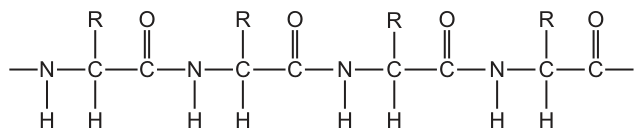
How many amino acid monomer molecules have been used to make this section of the structure?
Options
A 2
B 3
C 4
D 5
Working
Each amino acid monomer unit has the general structure .
Counting the units along the displayed section from left to right:
- (Unit 1)
- (Unit 2)
- (Unit 3)
- (Unit 4)
There are 4 distinct groups and 4 corresponding carbonyl () groups, meaning 4 amino acid molecules were used to form this section.
Answer
C
C
Walkthrough
Proteins are natural condensation polymers (polyamides) made by linking together amino acid monomers. Each amino acid contains an amine group () and a carboxylic acid group () attached to a central carbon atom that also bears a hydrogen atom and a side chain ().
When amino acids join during condensation polymerisation, a water molecule is eliminated between the carboxylic acid group of one amino acid and the amine group of the next, forming an amide (peptide) link ().
Therefore, each amino acid residue remaining in the polymer backbone consists of:
To find the number of amino acid monomers present in the given structure:
- Look for the central carbon atoms bonded to the groups: there are 4 groups shown.
- Look for the carbonyl groups (): there are 4 groups shown.
- Look for the groups: there are 4 groups shown.
Since each complete monomer unit contributes one group and one carbonyl group, exactly 4 amino acid monomers were joined to create this section.
Key Takeaways
- Proteins are polyamides formed from amino acid monomers by condensation polymerisation.
- The repeat unit for an amino acid residue in a protein backbone is .
- Counting either the number of central carbon atoms (), the side chains (), or the carbonyl groups () gives the number of monomer units.
Common Mistakes
- Counting the number of internal peptide bonds (which is 3) instead of counting the total number of amino acid monomer units (which is 4).
Things to Be Careful About
- Do not confuse the number of peptide bonds formed with the number of monomer residues. In an open chain of monomers, there are peptide bonds between them, but the total number of monomer residues shown is .
Which piece of apparatus is used to measure exactly 27.3 of a liquid?
Options
A a burette
B a condenser
C a measuring cylinder
D a volumetric pipette
Working
- A burette can measure variable volumes of liquid accurately to the nearest (or to one decimal place, such as ).
- A condenser is used to cool and condense vapours back into liquids, not to measure volume.
- A measuring cylinder is used to measure approximate volumes of liquid, not exact decimal volumes.
- A volumetric pipette only measures fixed volumes accurately (typically or ).
Therefore, a burette (A) is the correct apparatus.
Answer
A
A
Walkthrough
In chemistry laboratories, different apparatus are used depending on the precision and type of volume being measured:
- Burette: Designed to deliver accurately measured, variable volumes of liquids up to , with graduations typically allowing readings to the nearest (giving measurements to one or two decimal places, such as or ).
- Volumetric Pipette: Delivers a single fixed, exact volume accurately (most commonly or ). It cannot deliver variable non-standard volumes like .
- Measuring Cylinder: Used to measure variable volumes reasonably quickly, but is only suitable for approximate measurements rather than exact or precise titration quantities.
- Condenser: Used in distillation and reflux apparatus to condense vapours back into liquid; it is not a measuring instrument.
Thus, measuring exactly requires a burette (A).
Key Takeaways
- Use a burette for measuring accurate variable volumes of liquids (e.g., in titrations).
- Use a volumetric pipette for measuring accurate fixed volumes (e.g., ).
- Use a measuring cylinder for approximate volumes.
- Use a gas syringe for measuring volumes of gases.
Common Mistakes
- Confusing a volumetric pipette with a burette: pipettes only measure specific pre-calibrated fixed volumes.
- Choosing a measuring cylinder: while measuring cylinders can measure variable volumes, they lack the high precision denoted by the word "exactly".
Things to Be Careful About
- Pay attention to keywords like "exact" / "accurate" versus "approximate", and "fixed" versus "variable" volume.
A student titrates aqueous sodium hydroxide with 0.1 hydrochloric acid. The titration results are used to calculate the concentration of the aqueous sodium hydroxide.
Which row is correct?
Options
| apparatus to measure the volume of dilute hydrochloric acid | apparatus to measure the volume of aqueous sodium hydroxide | |
|---|---|---|
| A | burette | measuring cylinder |
| B | burette | volumetric pipette |
| C | measuring cylinder | burette |
| D | volumetric pipette | volumetric pipette |
Working
- In an acid-base titration, a fixed, accurate volume of one solution (often the alkali, aqueous sodium hydroxide) is measured into the conical flask using a volumetric pipette (usually ).
- The other solution (the titrant, dilute hydrochloric acid) is added dropwise from a burette so that the variable volume required to reach the end-point can be measured accurately (to the nearest or ).
- A measuring cylinder is not sufficiently accurate for quantitative titration work.
Matching the columns:
- Apparatus for dilute hydrochloric acid: burette
- Apparatus for aqueous sodium hydroxide: volumetric pipette
This corresponds to row B.
Answer
B
B
Walkthrough
In quantitative chemical analysis, particularly acid-base titrations, precision is crucial:
- Volumetric Pipette: Used to deliver an exact, fixed aliquot of solution (commonly or ) into a conical flask. In standard procedures, this is used to measure the alkali (aqueous ).
- Burette: A calibrated tube with a stopcock used to dispense and measure variable volumes of liquid accurately up to . It is used to deliver the acid (dilute ) gradually until the indicator changes colour at the neutralisation end-point.
- Measuring Cylinder: Measures approximate volumes (typically to ), which is not precise enough for titration calculations requiring high accuracy.
Therefore, the dilute hydrochloric acid is placed in and measured from a burette, while the sodium hydroxide is measured accurately using a volumetric pipette (row B).
Key Takeaways
- A volumetric pipette is designed for measuring a single, precise, fixed volume of liquid.
- A burette is designed to measure accurate variable delivered volumes during a titration.
- A measuring cylinder is used for approximate volume measurements and is not suitable for accurate titration analysis.
Common Mistakes
- Confusing the roles of the burette and pipette, or thinking a measuring cylinder provides adequate accuracy for titration calculations.
- Choosing row D by failing to realise that the titrant volume varies until the end-point is reached, so it cannot be measured using a fixed-volume pipette.
Things to Be Careful About
- Ensure you identify which substance is delivered variably (the acid in the burette) and which is measured as a fixed volume (the alkali via pipette).
A mixture of four coloured dyes is analysed by chromatography.
The result is shown.
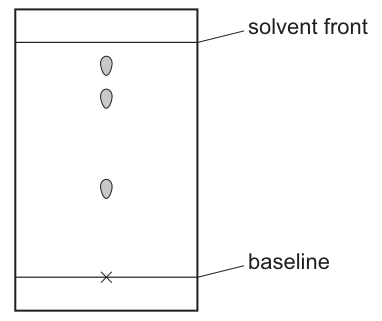
Which change allows the four coloured dyes to be seen separately?
Options
A Measure the values of the spots carefully.
B Run the chromatogram for a longer time.
C Run the chromatogram using a different solvent.
D Use a locating agent.
Working
- The mixture contains four coloured dyes, but only three distinct spots are visible on the chromatogram. This indicates that two of the dyes have very similar solubilities in the chosen solvent and have moved together as a single spot.
- Changing the solvent (option C) alters the relative solubilities and affinities of the dyes, allowing all four components to separate into individual spots.
- Option A is incorrect because calculating values cannot make an unresolved spot split into two.
- Option B is incorrect because the solvent front has already almost reached the top of the paper; running it longer will cause the solvent to run off the edge and blur the spots.
- Option D is incorrect because the dyes are already coloured and clearly visible without a locating agent.
Answer
C
C
Walkthrough
In paper chromatography, substances separate based on differences in their relative solubilities in the mobile phase (the solvent) and their attraction to the stationary phase (the chromatography paper):
- Identify the problem: The question states that the sample is a mixture of four coloured dyes, yet the chromatogram displays only three spots. This means that two of the dyes have identical or nearly identical partition between the mobile and stationary phases in this particular solvent, causing them to travel the same distance and overlap.
- Evaluate the solution: To achieve complete separation (resolution) of all four dyes, the solvent must be changed. A different solvent will interact differently with each dye's molecular structure, changing their relative solubilities so that the overlapping dyes travel at different rates and separate into four distinct spots.
- Eliminate incorrect options:
- A: Calculating values is a measurement tool; it does not change the physical separation of the dyes.
- B: The solvent front is already near the top. Allowing the solvent to run off the top of the paper causes the spots to diffuse and merge, ruining the separation.
- D: Locating agents are used to make colourless substances (such as amino acids) visible. Since the dyes are already coloured and visible, a locating agent is unnecessary.
Key Takeaways
- When the number of spots on a chromatogram is fewer than the known number of components in a mixture, two or more substances have overlapped.
- Overlapping components can be separated by repeating chromatography with a different solvent.
- Locating agents are only needed for colourless substances.
Common Mistakes
- Confusing the purpose of a locating agent (used to visualise colourless spots) with a method to improve separation.
- Assuming running the experiment for longer will always improve separation; once the solvent front reaches the top, running it longer leads to over-elution and loss of data.
Things to Be Careful About
- Ensure you check whether the substances are described as "coloured" or "colourless" in the stem before considering locating agents.
- The solvent front must never be allowed to run off the top edge of the paper, as values can no longer be determined accurately.
An aqueous solution contains cations of metal X.
A precipitate forms when a few drops of aqueous sodium hydroxide are added to the solution.
The precipitate dissolves in excess aqueous sodium hydroxide.
What is a possible identity of metal X?
Options
| aluminium | ammonium | zinc | key | |
|---|---|---|---|---|
| A | ✓ | ✗ | ✓ | ✓ = yes |
| B | ✓ | ✓ | ✗ | ✗ = no |
| C | ✗ | ✗ | ✓ | |
| D | ✗ | ✓ | ✗ |
Working
With a few drops of aqueous sodium hydroxide:
- forms a white precipitate of , which dissolves in excess sodium hydroxide.
- forms a white precipitate of , which also dissolves in excess sodium hydroxide.
- does not form a precipitate with sodium hydroxide; it gives ammonia gas.
So metal X could be aluminium or zinc, but not ammonium.
Answer
A
A
Walkthrough
The question describes a cation test using aqueous sodium hydroxide. When a few drops of sodium hydroxide are added to a solution containing or , a white precipitate forms because the metal hydroxide is insoluble in water:
Both of these hydroxides are amphoteric, meaning they react with excess hydroxide ions to form a soluble complex. So in excess sodium hydroxide, both precipitates dissolve.
Ammonium ions do not form a precipitate with sodium hydroxide. Instead, warming the mixture gives ammonia gas:
Therefore the metal X could be aluminium or zinc. Looking at the options, only option A shows aluminium = yes, ammonium = no, and zinc = yes.
Key Takeaways
- Aqueous sodium hydroxide is used to test for cations.
- and both give white precipitates that dissolve in excess sodium hydroxide.
- Ammonium ions give no precipitate with sodium hydroxide; they produce ammonia gas.
- Questions like this often test whether you know more than one cation can behave in the same way.
Common Mistakes
- Thinking ammonium forms a precipitate with sodium hydroxide. It does not; it produces ammonia gas.
- Thinking only one of aluminium or zinc dissolves in excess sodium hydroxide. With sodium hydroxide, both do.
- Confusing this test with the test using aqueous ammonia, where aluminium hydroxide does not dissolve in excess ammonia but zinc hydroxide does.
Things to Be Careful About
- The reagent is aqueous sodium hydroxide, not aqueous ammonia. This matters because the behaviour in excess is different.
- The precipitate is white for both aluminium and zinc hydroxide; the colour alone does not distinguish them.
- In the table, a tick means the cation gives the described result, and a cross means it does not. Read the key carefully.
Your score so far
Answer a question to start scoring
Your marks add up here as you work through the paper.