Chemistry 5070/22 — May/June 2024
Cambridge O-Level · Theory · worked solutions for every part, with the mark scheme
Topics Stoichiometry · Chemical Reactions · Acids, Bases and Salts · Chemistry of the Environment · Organic Chemistry · Atoms, Elements and Compounds · +4 more
Choose from the following substances to answer the questions.
anhydrous copper(II) sulfate
calcium carbonate
carbon monoxide
chlorine
ethanoic acid
iron
methanoic acid
methanol
nickel
silicon(IV) oxide
vanadium(V) oxide
Each substance can be used once, more than once or not at all.
State which substance:
Answer
vanadium(V) oxide
vanadium(V) oxide
Walkthrough
The Contact process is used to manufacture sulfur trioxide for sulfuric acid. A catalyst is needed to speed up this reaction without being used up. The substance from the list that is the catalyst in the Contact process is vanadium(V) oxide.
Key Takeaways
- A catalyst speeds up a reaction without being used up.
- The Contact process uses vanadium(V) oxide as its catalyst.
- Catalysts are specific to particular industrial processes.
Common Mistakes
- Choosing iron: iron is the catalyst for the Haber process, not the Contact process.
- Writing only 'vanadium' instead of 'vanadium(V) oxide'.
Things to Be Careful About
- The oxidation state (V) is part of the name; do not confuse this with other vanadium oxides.
- Do not confuse the Contact process with the Haber process.
Answer
carbon monoxide
carbon monoxide
Walkthrough
In the blast furnace, coke is burned to form carbon dioxide, which is then reduced to carbon monoxide. Carbon monoxide is the reducing agent because it removes oxygen from iron(III) oxide, leaving iron. Therefore the substance from the list is carbon monoxide.
Key Takeaways
- A reducing agent removes oxygen from another substance.
- Carbon monoxide is the active reducing agent in the blast furnace.
- The extraction of iron is a reduction process.
Common Mistakes
- Choosing iron because it is the product.
- Choosing carbon or coke instead of carbon monoxide.
- Saying carbon dioxide is the reducing agent.
Things to Be Careful About
- Carbon monoxide is toxic gas, but it is essential in the blast furnace.
- The reducing agent is carbon monoxide, not carbon dioxide.
Answer
anhydrous copper(II) sulfate
anhydrous copper(II) sulfate
Walkthrough
Anhydrous copper(II) sulfate has no water of crystallisation, so it is a white solid. When water is added, it becomes hydrated copper(II) sulfate, which is blue. This colour change is a standard test for water.
Key Takeaways
- Anhydrous means without water.
- Hydrated copper(II) sulfate is blue; anhydrous copper(II) sulfate is white.
- This reaction is used as a chemical test for water.
Common Mistakes
- Writing 'copper sulfate' without 'anhydrous'.
- Reversing the colour change: anhydrous is white, hydrated is blue.
Things to Be Careful About
- The word 'anhydrous' is essential because the clue says the white solid changes to blue.
- Heating blue hydrated copper(II) sulfate removes water and turns it white again.
Answer
chlorine
chlorine
Walkthrough
During treatment of the domestic water supply, chlorine is added to kill microbes. It acts as a disinfectant. Therefore the correct substance from the list is chlorine.
Key Takeaways
- Chlorine is used to kill microbes in water treatment.
- Water treatment includes filtration and disinfection.
- Chlorine is added in carefully controlled amounts.
Common Mistakes
- Choosing calcium carbonate or iron, which are not used to kill microbes.
- Thinking chlorine is only used in bleach.
Things to Be Careful About
- Chlorine is a toxic gas, but the amount added to water is small and safe.
- Do not choose another chemical that is not a disinfectant.
Answer
ethanoic acid
ethanoic acid
Walkthrough
Ethanoic acid has the molecular formula , which is . The empirical formula is the simplest whole-number ratio, so divide each subscript by 2: , written as . Methanoic acid is , not , and methanol is . So the correct answer is ethanoic acid.
Key Takeaways
- The empirical formula is the simplest whole-number ratio of atoms in a compound.
- To find it, divide the molecular formula subscripts by the highest common factor.
- Different compounds can have the same empirical formula.
Common Mistakes
- Choosing methanoic acid because its name contains 'meth' and it has one carbon atom.
- Forgetting to reduce to .
- Thinking empirical formula is always the same as molecular formula.
Things to Be Careful About
- Write the formula of ethanoic acid correctly before reducing it.
- Check each option's formula before deciding.
- The empirical formula does not show the full number of atoms in the molecule.
Aluminium carbide, , reacts with water to form methane, , and aluminium hydroxide.
Answer
Al4C3 + 12H2O -> 4Al(OH)3 + 3CH4
Walkthrough
The question states the reactants are aluminium carbide () and water (), and the products are methane () and aluminium hydroxide. Aluminium hydroxide is formed from the ion and the ion, giving the formula .
To balance the equation:
- Aluminium: There are 4 Al atoms in , so we need 4 on the right.
- Carbon: There are 3 C atoms in , so we need 3 on the right.
- Hydrogen: On the right, we have hydrogen atoms. Therefore, we need 12 on the left to provide 24 H atoms.
- Oxygen: On the left, 12 gives 12 O atoms. On the right, 4 gives O atoms. The equation is balanced.
Key Takeaways
When constructing symbol equations, ensure you know the correct formulae for common ions (like and ). Balancing often requires adjusting coefficients for water or oxygen last.
Common Mistakes
- Writing the wrong formula for aluminium hydroxide (e.g., instead of ).
- Forgetting to multiply the subscripts when balancing (e.g., counting 3 H in instead of 3).
Things to Be Careful About
The mark scheme awards one mark for the correct formula of aluminium hydroxide and one for the balanced equation. Ensure the equation is fully balanced with integer coefficients.
Methane is a saturated hydrocarbon.
Answer
Methane contains only carbon and hydrogen.
contains only carbon and hydrogen
Walkthrough
A hydrocarbon is defined as a compound made up of only two elements: carbon and hydrogen. Since methane () consists solely of C and H, it fits this definition.
Key Takeaways
The term 'hydrocarbon' strictly limits the composition to carbon and hydrogen only.
Common Mistakes
Saying it contains 'carbon and water' or listing other elements. The definition is strict: only C and H.
Things to Be Careful About
Do not just say 'it has carbon and hydrogen'; specify 'only' or 'exclusively'.
Answer
It contains only single bonds.
contains single bonds only
Walkthrough
A saturated hydrocarbon contains only single covalent bonds between the carbon atoms and between carbon and hydrogen atoms. There are no double or triple bonds (which would make it unsaturated). Methane has four C-H single bonds.
Key Takeaways
Saturation refers to the maximum number of hydrogen atoms attached, implying only single bonds are present.
Common Mistakes
Saying 'it has no double bonds' is often accepted, but 'contains single bonds only' is the precise definition. Avoid saying 'it is full of hydrogen' as that is not the technical reason.
Things to Be Careful About
Ensure you mention 'single bonds'. Mentioning 'no double bonds' is usually acceptable (ORA), but 'single bonds only' is the primary mark.
Methane reacts with chlorine in the presence of ultraviolet light.
State the formulae of two products of this reaction.
______ and ______
Answer
and
(Other acceptable pairs include , , with )
HCl and CH3Cl
Walkthrough
Methane reacts with chlorine in the presence of ultraviolet light via a substitution reaction. A hydrogen atom in methane is replaced by a chlorine atom. The displaced hydrogen combines with another chlorine atom to form hydrogen chloride ().
The organic products depend on how many substitutions occur:
- 1 substitution: (chloromethane)
- 2 substitutions: (dichloromethane)
- 3 substitutions: (trichloromethane / chloroform)
- 4 substitutions: (tetrachloromethane / carbon tetrachloride)
The question asks for two products. is always produced. One organic product must be named.
Key Takeaways
Free radical substitution of alkanes with halogens produces a mixture of substituted organic products and hydrogen halide gas ().
Common Mistakes
- Writing addition products (alkanes do not undergo addition).
- Forgetting as a product.
- Writing incorrect formulae like .
Things to Be Careful About
Any two from the list score. is a necessary product alongside any of the chloromethanes.
Draw a dot-and-cross diagram to show the electronic configuration in a molecule of methane.
Show only the outer shell electrons.
Answer
A central Carbon atom (C) surrounded by four Hydrogen atoms (H). Each C-H bond is a shared pair of electrons (one dot, one cross). Carbon has 4 outer electrons, each Hydrogen has 1. No lone pairs on any atom.
Dot-and-cross diagram showing central C bonded to 4 H atoms via shared pairs, no lone pairs
Walkthrough
Methane () is a simple covalent molecule.
- Carbon is in Group 4, so it has 4 outer shell electrons (configuration 2,4).
- Hydrogen is in Group 1, so it has 1 outer shell electron (configuration 1).
- Carbon shares one electron with each of the four hydrogen atoms to form four single covalent bonds.
- In a dot-and-cross diagram, use dots for carbon's electrons and crosses for hydrogen's electrons (or vice versa, but be consistent).
- The result is four shared pairs around the carbon. Hydrogen achieves a duplet (2 electrons), Carbon achieves a octet (8 outer electrons).
- Crucially, there are no lone pairs on the carbon or the hydrogens.
Key Takeaways
Dot-and-cross diagrams must show the origin of electrons (dots vs crosses) and clearly indicate shared pairs vs lone pairs.
Common Mistakes
- Drawing lone pairs on Carbon (it has 4 bonds, using all 4 outer electrons).
- Drawing lone pairs on Hydrogen (it has 1 bond, using its only electron).
- Not showing the shared pairs clearly as overlapping circles or distinct pairs between atoms.
Things to Be Careful About
The question asks to show 'only the outer shell electrons'. Carbon's inner shell (2 electrons) is not shown. Ensure the diagram matches Fig 1 from the mark scheme: central C, 4 H around it, shared pairs in the overlap regions.
The equation for the complete combustion of methane is shown.
This reaction is exothermic.
Explain, using ideas about bond breaking and bond making, why this reaction is exothermic.
______
Answer
Breaking bonds is endothermic (absorbs energy) and making bonds is exothermic (releases energy). More energy is released when the new bonds form ( and ) than is absorbed to break the old bonds ( and ).
more energy released making bonds than absorbed breaking bonds
Walkthrough
Chemical reactions involve two energy changes:
- Breaking bonds in the reactants ( and ) requires energy input (endothermic).
- Making bonds in the products ( and ) releases energy (exothermic).
For a reaction to be overall exothermic, the energy released during bond formation must be greater than the energy absorbed during bond breaking.
Key Takeaways
Exothermic = Net release of energy. Endothermic = Net absorption of energy. Always link this to the specific processes of breaking (absorb) and making (release) bonds.
Common Mistakes
- Saying 'bonds break releasing energy' (wrong, breaking requires energy).
- Saying 'bonds form absorbing energy' (wrong, forming releases energy).
- Not comparing the two amounts of energy.
Things to Be Careful About
The mark scheme specifically looks for 'bond breaking endothermic' and 'bond making exothermic' (or equivalent wording about absorbing/releasing energy) AND the comparison that more is released than absorbed.
Complete the reaction pathway diagram in Fig. 2.1 for the complete combustion of methane.
Label the:
- reactants
- products
- enthalpy change of the reaction,
- activation energy, .
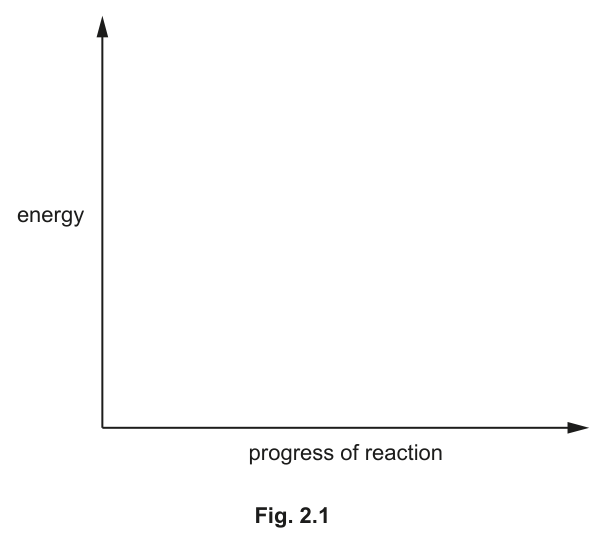
Answer
- Reactants level: Higher horizontal line on the left, labeled ''.
- Products level: Lower horizontal line on the right, labeled ''.
- Curve: Rises from reactants to a peak, then falls to products.
- : Upward arrow from reactant level to the peak, labeled ''.
- : Downward arrow from reactant level to product level, labeled ''.
Energy profile with reactants higher than products, peak labeled Ea, difference labeled Delta H
Walkthrough
The reaction is exothermic, meaning the products have less energy than the reactants.
- Axes: Vertical axis is 'energy', horizontal is 'progress of reaction'.
- Levels: Draw a horizontal line for reactants () at a higher energy level. Draw a horizontal line for products () at a lower energy level.
- Curve: Draw a curve starting at the reactant level, going up to a maximum (the transition state/activated complex), and then going down to the product level.
- Labels:
- Activation Energy (): The energy difference between the reactants and the peak. Draw an upward arrow from the reactant line to the peak and label it ''.
- Enthalpy Change (): The energy difference between reactants and products. Since it's exothermic, energy is lost. Draw a downward arrow from the reactant line to the product line and label it ''.
Key Takeaways
Exothermic profiles have reactants higher than products. is always from reactants to peak. is from reactants to products (downward for exothermic).
Common Mistakes
- Drawing products higher than reactants (that would be endothermic).
- Labeling from the bottom of the graph (origin) instead of the reactant level.
- Labeling as an upward arrow.
- Forgetting to label the chemical species at the reactant and product levels.
Things to Be Careful About
The mark scheme requires:
- Products to the right of reactants AND reactant level above product level.
- Enthalpy change shown as downward arrow AND labeled.
- Activation energy drawn to maximum with upward arrow AND labeled.
Ensure the labels match the chemical equation given: and .
Aqueous hydrogen peroxide decomposes when heated to form oxygen.
A sample of is completely decomposed.
Calculate the volume of oxygen formed, measured at room temperature and pressure.
Give your answer to two significant figures.
volume of oxygen = ______
Working
Amount of :
From the equation, :
Volume of oxygen at r.t.p.:
Answer
0.11 dm3
Walkthrough
The concentration is given in , so the volume must be in . Convert to by dividing by 1000: .
Then find the amount of hydrogen peroxide:
The balanced equation shows gives , so divide by 2 to get .
At r.t.p. one mole of any gas occupies . Multiply the amount of oxygen by 24:
Round to two significant figures: .
Key Takeaways
- Moles of solute = concentration volume in .
- The balanced equation gives the mole ratio between reactants and products.
- Volume of gas at r.t.p. = moles .
- Round only at the end to the required number of significant figures.
Common Mistakes
- Forgetting to convert to before using concentration.
- Using the mole ratio the wrong way round and multiplying by 2 instead of dividing.
- Quoting instead of rounding to two significant figures.
- Writing the final answer without the unit .
Things to Be Careful About
- The volume in concentration must be in .
- "Completely decomposed" means all the hydrogen peroxide reacts, so there is no limiting reactant to worry about.
- At r.t.p. the molar gas volume is , not (that is s.t.p.).
- Two significant figures: the leading zero after the decimal point is not significant, so has two significant figures.
Describe and explain the effect of decreasing the temperature on the rate of this reaction.
______
Answer
Decreasing the temperature decreases the rate of the reaction.
- The particles move more slowly / have less kinetic energy.
- There are fewer successful collisions per second / fewer collisions with energy equal to or greater than the activation energy.
Rate decreases; particles have less kinetic energy, so fewer successful collisions per second.
Walkthrough
For a reaction to happen, particles must collide with enough energy (at least the activation energy). Lowering the temperature removes energy from the particles, so they move more slowly and have less kinetic energy. This means they collide less often, and a smaller proportion of collisions have enough energy to react. The rate therefore decreases.
The mark scheme wants two ideas: (1) particles move slower / less kinetic energy, and (2) fewer successful collisions / fewer collisions with energy equal to or greater than activation energy.
Key Takeaways
- Temperature affects the average kinetic energy of particles.
- Rate depends on collision frequency and the fraction of collisions with energy equal to or greater than activation energy.
- Decreasing temperature lowers both, so rate decreases.
Common Mistakes
- Saying "the activation energy increases" — activation energy is a fixed property of the reaction; temperature changes how many particles have enough energy.
- Only saying "fewer collisions" without mentioning energy or success — the mark scheme accepts "fewer collisions" but the explanation is stronger with "successful" or "with energy equal to or greater than activation energy".
- Missing the direction: the question asks for the effect of decreasing temperature, so the answer must say rate decreases.
Things to Be Careful About
- Use "successful collisions" or "effective collisions" rather than just "collisions" to be safe.
- The mark scheme allows "particles move slower" or "particles have less kinetic energy"; either wording scores.
- Do not say "less frequent collisions" alone if the mark scheme wants both kinetic energy and collision success; here two marks are available.
Describe and explain the effect of increasing the concentration of hydrogen peroxide on the rate of this reaction.
______
Answer
Increasing the concentration of hydrogen peroxide increases the rate of the reaction.
- The particles are more crowded / there are more particles per unit volume.
- There are more collisions per second / a greater collision frequency.
Rate increases; more particles per unit volume, so more collisions per second.
Walkthrough
Concentration is the amount of solute in a given volume. Increasing the concentration of hydrogen peroxide puts more reactant particles in the same volume, so they are closer together. This makes collisions between particles more frequent. More collisions per second means more successful collisions per second, so the rate increases.
The mark scheme wants: (1) particles more crowded / more particles per unit volume, and (2) more collisions per second / greater collision frequency.
Key Takeaways
- Concentration affects how crowded the particles are.
- Higher concentration leads to higher collision frequency and a faster reaction.
- Unlike temperature, concentration does not change the average kinetic energy of particles.
Common Mistakes
- Saying "particles move faster" — increasing concentration does not make particles move faster; it makes them closer together.
- Saying "more successful collisions" without first saying "more collisions" or "greater frequency" — the mark scheme specifically wants collision frequency.
- Forgetting to state that the rate increases.
Things to Be Careful About
- The mark scheme accepts "more particles per unit volume" or "particles are more crowded".
- "More collisions per second" and "greater collision frequency" are equivalent; use one.
- Do not confuse concentration with temperature effects.
A sample of aqueous hydrogen peroxide has a pH of 5.5.
Answer
ions (hydrogen ions)
H+
Walkthrough
A pH below 7 is acidic. In aqueous solution, acidity is caused by hydrogen ions, . A pH of 5.5 is slightly acidic, so the ion responsible is .
Key Takeaways
- pH measures the concentration of hydrogen ions in solution.
- Lower pH means higher concentration.
Common Mistakes
- Writing — hydroxide ions make solutions alkaline, not acidic.
- Writing — the compound itself is not the ion responsible for pH.
Things to Be Careful About
- The mark scheme accepts ; some syllabuses also accept , but is the expected answer here.
- Do not write "hydrogen" without the charge.
A pH meter is used to measure the pH of an aqueous solution.
Describe one other way to measure the pH of an aqueous solution.
______
Answer
Use universal indicator (paper or solution). Add it to the solution and compare the colour with a pH colour chart.
Universal indicator; compare colour with pH colour chart.
Walkthrough
A pH meter is one way to measure pH. Another common method is to use universal indicator, which changes colour over a range of pH values. The indicator is added to the solution (or a drop is put on indicator paper), and the resulting colour is compared with a pH colour chart to read the pH.
The mark scheme gives one mark for naming universal indicator and one mark for comparing the colour with a pH colour chart.
Key Takeaways
- Universal indicator is a mixture of dyes that gives different colours at different pH values.
- The colour must be matched to a pH colour chart to get a numerical pH.
Common Mistakes
- Naming litmus paper — litmus only tells you whether a solution is acidic or alkaline, not the pH value.
- Saying "use a pH meter" again — the question asks for one other way.
- Forgetting the colour chart step, which is the second mark.
Things to Be Careful About
- The mark scheme accepts "universal indicator (paper or solution)".
- "Match colour with pH colour chart" is the exact wording that scores the second mark.
- Universal indicator gives an approximate pH, not as precise as a pH meter.
Calcium bromide, , is an ionic solid composed of a lattice of calcium ions and bromide ions.
Answer
Calcium bromide has a high melting point because there is a strong electrostatic attraction between the positive calcium ions and the negative bromide ions. A lot of energy is needed to overcome these forces.
Strong electrostatic attraction between positive and negative ions
Walkthrough
Calcium bromide is an ionic compound. In the solid it forms a giant lattice of alternating and ions. To melt it, the lattice must be broken apart. The ions are held together by strong electrostatic forces of attraction between opposite charges. Melting therefore needs a large amount of energy, giving a high melting point.
Key Takeaways
- Ionic compounds have giant lattices, not molecules.
- Their high melting points are explained by strong electrostatic attraction between positive and negative ions.
Common Mistakes
- Saying strong covalent bonds or strong forces between molecules, because ionic compounds contain ions, not molecules.
- Not mentioning that the attraction is between positive and negative ions; the mark is for a strong attraction between oppositely charged ions.
Things to Be Careful About
Use the words strong electrostatic attraction. The mark scheme accepts strong attraction between positive and negative ions, so state the charges of the ions if you can.
Describe how calcium atoms and bromine molecules react to form calcium ions and bromide ions.
Use ideas about electron transfer.
______
Answer
A calcium atom loses its two outer electrons to form a ion:
A bromine molecule gains these two electrons, one for each bromine atom, to form two bromide ions:
Calcium atoms lose two electrons to form Ca2+ ions; bromine molecules gain two electrons to form two bromide ions.
Walkthrough
Calcium is a Group II metal with the electron configuration 2,8,8,2. It needs to lose its two outer electrons to reach a stable 2,8,8 noble-gas configuration, so each calcium atom loses 2 electrons and becomes .
Bromine is a Group VII non-metal with configuration 2,8,8,7. Each bromine atom needs one electron to complete its outer shell. A bromine molecule is , so two bromine atoms together need two electrons. The electrons lost by calcium are gained by the bromine molecule, producing two ions.
This is electron transfer: the calcium atom gives electrons, and the bromine molecule accepts them. The ions formed are then held in an ionic lattice by electrostatic attraction.
Key Takeaways
- Metals lose electrons to form positive ions; non-metals gain electrons to form negative ions.
- Electron transfer creates ions with noble-gas electron configurations.
- A bromine molecule needs two electrons because it contains two bromine atoms.
Common Mistakes
- Saying calcium gains electrons.
- Saying bromine atoms lose electrons.
- Forgetting that the question asks about a bromine molecule, not a single bromine atom; the molecule gains two electrons.
Things to Be Careful About
Use the phrase loses electrons for calcium and gains electrons for bromine. Both statements are needed for full marks. The final ions are and .
Predict the products at each electrode during the electrolysis of dilute aqueous calcium bromide.
at anode ______
at cathode ______
Answer
at anode: oxygen,
at cathode: hydrogen,
anode: oxygen; cathode: hydrogen
Walkthrough
Dilute aqueous calcium bromide contains and ions from the salt, and and ions from water.
At the cathode, positive ions are attracted. Between and , hydrogen is discharged because calcium is more reactive than hydrogen. So hydrogen gas, , is produced.
At the anode, negative ions are attracted. Bromide ions can be oxidised to bromine, but in a dilute solution hydroxide ions/water are discharged in preference to bromide ions. The product is oxygen gas, , formed from water.
Key Takeaways
- In aqueous electrolysis, water supplies and .
- At the cathode, hydrogen is discharged instead of a more reactive metal such as calcium.
- At the anode, dilute halide solutions give oxygen rather than the halogen.
Common Mistakes
- Writing bromine at the anode; this is only favoured in concentrated solutions.
- Writing calcium at the cathode; calcium is too reactive, so hydrogen is discharged.
Things to Be Careful About
Read the word dilute carefully, because it changes the anode product. The mark scheme accepts oxygen or for the anode and hydrogen or for the cathode.
Ozone is an oxidising agent.
Describe the colour change when ozone gas is bubbled through aqueous potassium iodide.
______
Answer
The colourless solution turns brown.
colourless to brown
Walkthrough
The ozone acts as an oxidising agent, removing electrons from iodide ions and turning them into iodine. Aqueous potassium iodide is colourless, but iodine in aqueous solution is brown. Therefore the colour changes from colourless to brown.
Key Takeaways
- An oxidising agent oxidises another species, causing it to lose electrons.
- Iodide to iodine is an oxidation, and the brown colour is a test for iodine.
Common Mistakes
- Writing brown to colourless, which is the reverse order.
- Writing blue-black; that would only be seen if starch were added.
Things to Be Careful About
The answer is colourless to brown, not yellow. Keep the order of colours in the direction the reaction happens.
Zinc is a reducing agent.
Describe the colour change when excess zinc is added to acidified potassium manganate(VII).
______
Answer
The purple solution becomes colourless.
purple to colourless
Walkthrough
Acidified potassium manganate(VII), , is a strong purple oxidising agent. Zinc is a reducing agent, so it gives electrons to the manganate(VII) ions, reducing them to ions, which are almost colourless. Because excess zinc is used, all the manganate(VII) is reduced, so the purple colour disappears completely.
Key Takeaways
- Acidified manganate(VII) changes purple to colourless when it is reduced.
- A reducing agent itself is oxidised while the manganate(VII) is reduced.
Common Mistakes
- Saying the solution turns purple, because the is already purple.
- Saying purple to pink; the expected mark-scheme answer is purple to colourless.
Things to Be Careful About
Acidified conditions are important because they make the product colourless . Without acid, a brown precipitate could form.
The ionic equation for the reaction between aqueous calcium bromide and aqueous chlorine is shown.
Explain, in terms of electrons, why this reaction involves both oxidation and reduction.
______
Answer
Bromide ions lose electrons to form bromine, so they are oxidised:
Chlorine gains electrons to form chloride ions, so it is reduced:
Because oxidation and reduction happen together, this is a redox reaction.
Bromide ions lose electrons (oxidised); chlorine gains electrons (reduced).
Walkthrough
Look at the electron transfer in the ionic equation. Two bromide ions each lose one electron, producing a bromine molecule. Loss of electrons is oxidation, so bromide ions are oxidised.
Chlorine molecules gain those two electrons, producing two chloride ions. Gain of electrons is reduction, so chlorine is reduced.
The two changes must happen together: the electrons lost by bromide are gained by chlorine. That is why the reaction involves both oxidation and reduction.
The half-equations make this clear:
Adding these cancels the electrons and gives the original equation.
Key Takeaways
- Oxidation is loss of electrons.
- Reduction is gain of electrons.
- A reaction with simultaneous oxidation and reduction is called redox.
Common Mistakes
- Saying bromine is reduced or chlorine is oxidised.
- Only writing oxidation and reduction occur, without saying which species gains or loses electrons.
Things to Be Careful About
The mark scheme gives one mark for bromide losing electrons/oxidised and one for chlorine gaining electrons/reduced. Use the words loses electrons and gains electrons clearly, and name the species.
When a sample of zinc carbonate is heated in a closed system, an equilibrium mixture is formed.
The forward reaction is endothermic.
The temperature of the closed system is decreased and the pressure is kept constant.
Predict how the position of equilibrium of this reaction is affected.
Explain your answer.
______
Answer
- Position of equilibrium moves to the left / reactant side / zinc carbonate side.
- Because the forward reaction is endothermic, decreasing temperature favours the exothermic (reverse) direction, releasing thermal energy.
Moves to the left / reactant side / zinc carbonate side, to release thermal energy.
Walkthrough
When the temperature is decreased, the system responds to oppose the change. Since the forward reaction is endothermic (absorbs heat), the reverse reaction is exothermic (releases heat). Lowering the temperature favours the exothermic direction, so the equilibrium shifts to the left, producing more zinc carbonate and releasing thermal energy.
Key Takeaways
- Le Chatelier's principle: a system at equilibrium responds to a change by counteracting it.
- For an endothermic forward reaction, decreasing temperature shifts equilibrium to the left (exothermic direction).
Common Mistakes
- Saying the equilibrium moves to the right because the forward reaction is endothermic — this would be correct for an increase in temperature, not a decrease.
- Omitting the energy explanation; the mark requires both the direction and the reason.
Things to Be Careful About
- Use the correct terminology: 'position of equilibrium moves to the left' or 'reactant side'.
- The explanation must explicitly mention 'release thermal energy' or 'favours the exothermic reaction'.
The pressure of the closed system is increased and the temperature is kept constant.
Predict how the position of equilibrium of this reaction is affected.
Explain your answer.
______
Answer
- Position of equilibrium moves to the left / reactant side / zinc carbonate side.
- Because there are fewer moles of gas on the left-hand side (0 moles of gas) than on the right-hand side (1 mole of CO₂), increasing pressure favours the side with fewer gas moles.
Moves to the left / reactant side / zinc carbonate side, because fewer moles of gas on the left-hand side.
Walkthrough
Increasing pressure favours the side with fewer moles of gas. On the left, ZnCO₃ is a solid, so there are 0 moles of gas. On the right, there is 1 mole of CO₂ gas. Therefore, the equilibrium shifts to the left, reducing the number of gas moles and thus opposing the pressure increase.
Key Takeaways
- Le Chatelier's principle: increasing pressure shifts equilibrium to the side with fewer gas moles.
- Solids do not count as gas moles; only gaseous species matter.
Common Mistakes
- Forgetting that ZnCO₃ and ZnO are solids, so they contribute zero gas moles.
- Saying the equilibrium moves to the right because there is only one gas on the right — the correct comparison is left (0) vs right (1).
Things to Be Careful About
- Explicitly state 'fewer moles of gas on the left-hand side'.
- The mark is for the direction and the gas mole comparison.
Calculate the maximum mass of zinc oxide that can be made from of zinc carbonate.
mass of zinc oxide = ______
Working
- Calculate of :
- Calculate of :
- Calculate moles of :
-
From the equation, 1 mol ZnCO₃ produces 1 mol ZnO, so moles of ZnO = 0.03384 mol.
-
Calculate mass of ZnO:
Answer
(to 3 significant figures)
2.74 g
Walkthrough
First, find the relative formula masses: ZnCO₃ = 65 + 12 + 48 = 125, and ZnO = 65 + 16 = 81. Then convert the given mass of zinc carbonate to moles: 4.23 g ÷ 125 g/mol = 0.03384 mol. The balanced equation shows a 1:1 mole ratio, so the same number of moles of ZnO is produced. Finally, multiply by the Mr of ZnO: 0.03384 × 81 = 2.74104 g. Round to 3 significant figures (since 4.23 has 3 sig figs) to get 2.74 g.
Key Takeaways
- Moles = mass / Mr.
- Use the balanced equation to find mole ratios.
- Mass = moles × Mr.
- Round the final answer to the appropriate number of significant figures.
Common Mistakes
- Using the wrong Mr (e.g., forgetting the oxygen atoms in ZnCO₃).
- Incorrect mole ratio (e.g., assuming 2 moles of ZnO per mole of ZnCO₃).
- Not rounding to the correct significant figures.
Things to Be Careful About
- Check the formula of zinc carbonate: ZnCO₃, not ZnCO₄.
- The final answer should be in grams with the unit.
- The mark scheme allows intermediate values; show them clearly.
Zinc oxide reacts with both aqueous sodium hydroxide and dilute hydrochloric acid, but carbon dioxide only reacts with aqueous sodium hydroxide.
Explain why.
______
Answer
- Zinc oxide is amphoteric, so it reacts with both acids and bases.
- Carbon dioxide is an acidic oxide, so it reacts only with bases (alkalis).
Zinc oxide is amphoteric; carbon dioxide is acidic.
Walkthrough
Zinc oxide is a classic amphoteric oxide: it reacts with acids (e.g., HCl) to form a salt and water, and with bases (e.g., NaOH) to form a zincate salt. Carbon dioxide is an acidic oxide: it dissolves in water to form carbonic acid and reacts with alkalis to form carbonates. Therefore, CO₂ does not react with acids.
Key Takeaways
- Amphoteric oxides react with both acids and bases.
- Acidic oxides react with bases but not with acids.
- Examples: ZnO, Al₂O₃ are amphoteric; CO₂, SO₂ are acidic.
Common Mistakes
- Calling zinc oxide basic only, ignoring its reaction with NaOH.
- Saying carbon dioxide is neutral; it is acidic.
Things to Be Careful About
- Use the correct terms: 'amphoteric' and 'acidic'.
- The explanation should link the property to the observed reactions.
Solid zinc carbonate reacts with dilute nitric acid to give a colourless solution and bubbles of a gas.
Construct the symbol equation for this reaction.
Include state symbols.
______
Answer
ZnCO3(s) + 2HNO3(aq) -> Zn(NO3)2(aq) + H2O(l) + CO2(g)
Walkthrough
Zinc carbonate is a solid. Nitric acid is aqueous. The products are zinc nitrate (aqueous), water (liquid), and carbon dioxide (gas). Write the unbalanced equation: ZnCO₃ + HNO₃ → Zn(NO₃)₂ + H₂O + CO₂. Balance: there are 2 nitrate groups on the right, so need 2 HNO₃ on the left. Check atoms: Zn:1, C:1, O:3+6=9 on left; on right: O in Zn(NO₃)₂=6, H₂O=1, CO₂=2, total 9. H:2 on both sides. Balanced.
Key Takeaways
- Carbonates react with acids to give salt, water, and carbon dioxide.
- Nitric acid produces nitrate salts.
- State symbols: (s) solid, (aq) aqueous, (l) liquid, (g) gas.
Common Mistakes
- Forgetting the 2 in front of HNO₃.
- Writing ZnNO₃ instead of Zn(NO₃)₂.
- Missing state symbols.
Things to Be Careful About
- The nitrate ion is NO₃⁻, so zinc nitrate is Zn(NO₃)₂.
- State symbols are essential for the second mark.
Methane, nitrogen monoxide and sulfur dioxide are air pollutants.
Answer
(increased) global warming / (enhanced) greenhouse effect / climate change
Increased global warming / enhanced greenhouse effect / climate change
Walkthrough
Methane is a greenhouse gas. When its concentration in the atmosphere rises, it traps more heat radiated from the Earth's surface, strengthening the greenhouse effect and causing global warming and climate change. The mark is awarded for naming this effect.
Key Takeaways
Methane is a potent greenhouse gas; higher levels enhance the natural greenhouse effect, leading to global warming and climate change.
Common Mistakes
- Saying "air pollution" or "acid rain" — methane does not cause acid rain.
- Giving a vague answer like "it is bad for the environment" without naming the greenhouse effect or global warming.
Things to Be Careful About
The mark scheme accepts any one of: increased global warming, enhanced greenhouse effect, or climate change. Any of these is sufficient.
The combustion of fossil fuels that contain sulfur produces sulfur dioxide.
Describe two strategies to reduce the emission of sulfur dioxide from the combustion of fossil fuels.
- ______
- ______
Answer
Any two from:
- flue gas desulfurisation / reacting sulfur dioxide with calcium oxide or calcium carbonate
- use low-sulfur fuels
- burn or use less fossil fuels / use renewable energy sources (e.g. solar)
Any two: flue gas desulfurisation / reacting with calcium oxide or calcium carbonate; use low-sulfur fuels; burn less fossil fuels / use renewable energy
Walkthrough
Sulfur dioxide is produced when sulfur-containing fossil fuels burn. To reduce its emission:
- Flue gas desulfurisation — the waste gases (flue gases) are passed through calcium oxide or calcium carbonate, which reacts with and removes sulfur dioxide before it reaches the atmosphere.
- Use low-sulfur fuels — choosing fuels with less sulfur means less sulfur dioxide is formed in the first place.
- Burn less fossil fuel / use renewables — reducing the amount of fossil fuel burned directly reduces the total sulfur dioxide produced.
Any two of these score the two marks.
Key Takeaways
Strategies to reduce sulfur dioxide emissions target either removing it after combustion or preventing its formation by using cleaner fuels or less fuel overall.
Common Mistakes
- Saying "use a catalytic converter" — that removes nitrogen oxides, not sulfur dioxide.
- Giving only one strategy when two are required.
- Saying "filter the gases" without naming a reactive substance — filtering does not remove a gas.
Things to Be Careful About
The mark scheme allows any two from the three listed. "Reacting with calcium oxide" and "reacting with calcium carbonate" are two separate acceptable points, but do not count as two different strategies — they are both forms of flue gas desulfurisation.
Nitrogen monoxide, , is linked to acid rain.
This pollutant is present in the gases made in car engines.
Describe how nitrogen monoxide is removed from these gases.
Include a word equation in your answer.
______
Answer
Use of a catalytic converter.
nitrogen monoxide + carbon monoxide → carbon dioxide + nitrogen
Catalytic converter; nitrogen monoxide + carbon monoxide → carbon dioxide + nitrogen
Walkthrough
Car engines produce nitrogen monoxide when nitrogen and oxygen react at high temperatures inside the engine. The exhaust gases pass through a catalytic converter, which provides a surface for the reaction between nitrogen monoxide and carbon monoxide (another pollutant). The nitrogen monoxide is reduced to harmless nitrogen gas, and the carbon monoxide is oxidised to carbon dioxide. The word equation is:
nitrogen monoxide + carbon monoxide → carbon dioxide + nitrogen
One mark is for naming the catalytic converter; the second is for the correct word equation.
Key Takeaways
Catalytic converters remove nitrogen monoxide by reacting it with carbon monoxide, converting both pollutants into harmless gases (nitrogen and carbon dioxide).
Common Mistakes
- Writing the equation with the wrong products (e.g. nitrogen dioxide instead of nitrogen).
- Forgetting the word equation entirely — it is specifically required by the question.
- Saying the nitrogen monoxide is "filtered out" — it is chemically converted, not filtered.
Things to Be Careful About
The word equation must show nitrogen monoxide reacting with carbon monoxide. The products must be carbon dioxide and nitrogen. The mark scheme gives exactly this equation; no other reactants or products are accepted.
State two other adverse effects of oxides of nitrogen pollutants in the air.
- ______
- ______
Answer
Any two from:
- respiratory problems
- (photochemical) smog
Any two: respiratory problems; photochemical smog
Walkthrough
Oxides of nitrogen in the air have several adverse effects. Two are:
- Respiratory problems — they irritate the lungs and airways, aggravating conditions like asthma.
- (Photochemical) smog — in sunlight, nitrogen oxides react with other pollutants to form a brown haze that reduces visibility and harms health.
The question asks for two effects; the mark scheme accepts exactly these two.
Key Takeaways
Nitrogen oxides are harmful both directly (respiratory irritation) and indirectly (forming photochemical smog).
Common Mistakes
- Giving "acid rain" as an answer — the question already states that nitrogen monoxide is linked to acid rain, so this would not score.
- Giving only one effect when two are required.
- Saying "global warming" — nitrogen oxides are not significant greenhouse gases in this context.
Things to Be Careful About
The mark scheme lists exactly two acceptable answers here: respiratory problems and photochemical smog. Since the question stem already mentions acid rain, that cannot be repeated as an answer.
Oxygen is a gas at room temperature.
Sulfur is a solid at room temperature.
A sample of oxygen has a volume of at room temperature and pressure.
The temperature of the sample is increased but the pressure is unchanged.
Describe and explain, in terms of kinetic particle theory, what happens to the volume of the sample.
______
Answer
The volume increases.
When the temperature is increased, the gas particles gain kinetic energy and move faster. They hit the walls of the container harder and more often, so at constant pressure the gas expands. The particles spread further apart / the distance between particles increases.
Volume increases; particles spread further apart.
Walkthrough
The sample is a gas at room temperature and pressure. When its temperature increases at constant pressure, the particles gain kinetic energy and move faster. They collide with the walls harder and more often. If the pressure is kept the same, the gas must be allowed to expand, so the volume increases. In kinetic particle theory terms, the particles spread further apart and the distance between them increases. The mark scheme gives one mark for "volume increases" and one mark for "particles spread out / distance between particles increases."
Key Takeaways
- Heating a gas increases the kinetic energy of its particles.
- At constant pressure, a hotter gas occupies a larger volume.
- The volume change is explained by particles spreading out, not by particles getting bigger.
Common Mistakes
- Saying the pressure increases instead of the volume. The question states pressure is unchanged.
- Saying the particles themselves expand. Particles do not change size; the space between them increases.
- Missing the phrase "spread out" or "distance between particles increases", which is the second marking point.
Things to Be Careful About
- The mark scheme wants both the observation (volume increases) and the particle explanation.
- Use kinetic particle theory language: kinetic energy, move faster, collide with walls, spread out.
- No calculation is needed; this is a qualitative explanation.
Sulfur is a gas above .
Describe the changes in particle separation, arrangement and motion when a sample of sulfur gas is cooled down to room temperature.
separation ______
arrangement ______
motion ______
Answer
- separation: the particles move closer together
- arrangement: from random/disordered to ordered/regular
- motion: from moving freely/randomly to vibrating about fixed positions
separation: closer together; arrangement: random to ordered; motion: moving freely to vibrating about fixed positions
Walkthrough
Sulfur is a gas above 445 °C and a solid at room temperature, so cooling the gas to room temperature means it changes from gas to solid. As particles cool, they lose kinetic energy. Their separation decreases: they move closer together. Their arrangement changes from random/disordered in the gas to ordered/regular in the solid. Their motion changes from moving freely from place to place to vibrating about fixed positions. The mark scheme awards one mark for each of these three changes.
Key Takeaways
- Cooling removes kinetic energy from particles.
- Gas to solid involves decreasing separation, increasing order, and loss of free movement.
- Particles in a solid are not still; they vibrate about fixed positions.
Common Mistakes
- Reversing the changes, e.g. saying particles move further apart.
- Saying particles stop moving in a solid. They vibrate.
- Describing arrangement as "ordered to random" instead of "random to ordered".
Things to Be Careful About
- Match each of the three headings: separation, arrangement, motion.
- Use "closer together", "random to ordered", "moving freely to vibrating".
- Room temperature is below sulfur's melting point, so the final state is solid, not liquid.
Answer
Diffusion is the movement of particles from a region of higher concentration to a region of lower concentration, caused by their continuous random motion.
Particles move from high concentration to low concentration.
Walkthrough
Diffusion is explained by the continuous random motion of particles. In a region where there is a higher concentration of particles, more particles are moving randomly into the lower-concentration region than in the opposite direction. The net result is that particles move from high concentration to low concentration. This is the one-mark definition required.
Key Takeaways
- Diffusion is a net movement down a concentration gradient.
- It happens because particles are in constant random motion.
- It applies to gases and liquids.
Common Mistakes
- Saying particles move from low to high concentration, which is the opposite.
- Saying particles move until they stop; they continue moving but concentrations become equal.
- Omitting "random motion" if asked to explain in terms of kinetic particle theory.
Things to Be Careful About
- The mark scheme accepts the simple idea: particles move from high concentration to low concentration.
- If the question says "in terms of kinetic particle theory", include random motion.
The symbol of a sulfide ion is shown.
Complete Table 7.1 about this sulfide ion.
Table 7.1
| particle | number of particles |
|---|---|
| electrons | |
| neutrons | |
| protons |
Answer
| particle | number of particles |
|---|---|
| electrons | 18 |
| neutrons | 17 |
| protons | 16 |
electrons = 18, neutrons = 17, protons = 16
Walkthrough
The notation tells us the mass number is 33 and the proton number (atomic number) is 16. The proton number equals the number of protons, so there are 16 protons. In a neutral sulfur atom there would also be 16 electrons. However, the 2- charge means the ion has gained two extra electrons, so it has 18 electrons. The number of neutrons is found by subtracting the proton number from the mass number: . The completed table is electrons 18, neutrons 17, protons 16.
Key Takeaways
- Mass number = protons + neutrons.
- Proton number = number of protons = number of electrons in a neutral atom.
- A negative ion has gained electrons; a 2- ion has two extra electrons.
Common Mistakes
- Writing 16 electrons for the sulfide ion, forgetting the 2- charge.
- Writing 33 neutrons, using the mass number as the neutron number.
- Confusing the top and bottom numbers: top is mass number, bottom is proton number.
Things to Be Careful About
- The charge is written as a superscript after the symbol: .
- Neutrons = mass number - proton number.
- Protons never change when an ion forms; only electrons change.
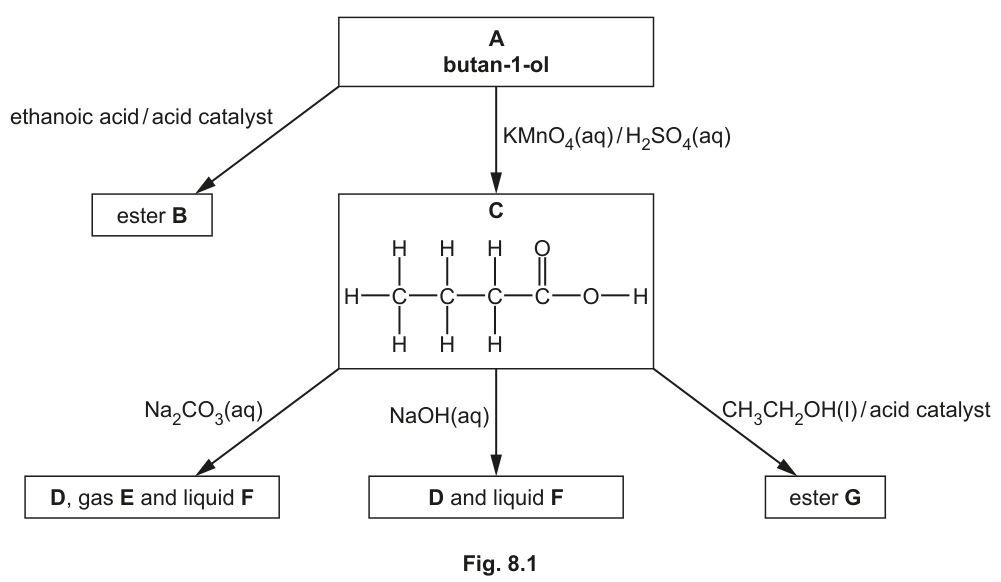
Fig. 8.1 is a flow diagram showing information about some organic chemical reactions.
Answer
A displayed formula shows every atom and every bond. For butan-1-ol (), draw a chain of four carbon atoms single-bonded to each other. The first three carbons each have three hydrogen atoms attached. The fourth carbon (attached to the oxygen) has two hydrogen atoms. The oxygen is single-bonded to the fourth carbon and to a hydrogen atom.
Displayed formula of butan-1-ol: a four-carbon chain with all H atoms and the O-H bond shown explicitly.
Walkthrough
The question asks for the displayed formula of compound A, which is identified in the diagram as butan-1-ol. A displayed formula must show every atom and every covalent bond. Butan-1-ol has a four-carbon chain (butane backbone) with an group on the first carbon. We draw four carbon atoms in a row, single-bonded. Carbon 1 is bonded to two hydrogens and the oxygen. Carbons 2 and 3 are bonded to two hydrogens each. Carbon 4 is bonded to three hydrogens. The oxygen is bonded to carbon 1 and one hydrogen.
Key Takeaways
A displayed formula is different from a structural or formula representation: it shows every single bond. For alcohols, the linkage must be fully drawn out, not written as .
Common Mistakes
- Writing (this is a structural/condensed formula, not displayed).
- Forgetting the hydrogen on the oxygen (writing instead of ).
- Drawing a double bond anywhere in the carbon chain (it is an alcohol, not an alkene).
Things to Be Careful About
Ensure all carbon valencies are four. The terminal methyl group () needs three hydrogens. The carbon attached to oxygen () needs two hydrogens plus the bond.
Answer
Butyl ethanoate
Butyl ethanoate
Walkthrough
Compound A is butan-1-ol (a 4-carbon alcohol, providing the 'butyl' group). It reacts with ethanoic acid (a 2-carbon acid, providing the 'ethanoate' group) in the presence of an acid catalyst. This is esterification. The name of the ester is formed by taking the alkyl group name from the alcohol (butyl) and the carboxylate group name from the acid (ethanoate).
Key Takeaways
Ester naming: [Alkyl from alcohol] [Carboxylate from acid]. Butan-1-ol gives 'butyl'. Ethanoic acid gives 'ethanoate'.
Common Mistakes
- Reversing the order (writing 'ethanoate butyl').
- Confusing the carbon count (butan-1-ol has 4 carbons, ethanoic acid has 2).
Things to Be Careful About
The alcohol is butan-1-ol, so the alkyl group is 'butyl', not 'butane'. The acid is ethanoic acid, so the suffix is '-oate'.
Answer
Butanoic acid
Butanoic acid
Walkthrough
Compound C is shown in the flow diagram with the displayed formula . This is a carboxylic acid with a four-carbon chain. The IUPAC name for a 4-carbon carboxylic acid is butanoic acid. It is formed by the oxidation of butan-1-ol (compound A) using acidified potassium manganate(VII) ().
Key Takeaways
Primary alcohols are oxidised to carboxylic acids. The carbon chain length is preserved. 4 carbons = butanoic acid.
Common Mistakes
- Naming it as 'butyric acid' (common name, not IUPAC).
- Calling it 'butanol' (that's the alcohol).
Things to Be Careful About
The functional group is (carboxyl), not (hydroxyl). The name ends in '-oic acid'.
Answer
C4H8O2
Walkthrough
Look at the displayed formula of C in the diagram: .
Count the carbons: 4 ().
Count the hydrogens: 3 + 2 + 2 + 1 = 8 ().
Count the oxygens: 2 in the group ().
Molecular formula is .
Key Takeaways
Molecular formula gives the total number of each atom. For carboxylic acids , here , so .
Common Mistakes
- Miscounting hydrogens on the carboxyl carbon (it has none, only bonds to C, =O, and -OH).
Things to Be Careful About
Ensure the formula is balanced. is correct.
Answer
Name: Sodium butanoate
Formula:
Name: sodium butanoate; Formula: CH3CH2CH2COONa
Walkthrough
Compound C is butanoic acid (). It reacts with sodium hydroxide (), a base. This is a neutralisation reaction.
The salt D is sodium butanoate. The formula is formed by replacing the H of the group with .
Key Takeaways
Carboxylic acids react with alkalis to form carboxylate salts and water. The cation comes from the base (), the anion from the acid (butanoate, ).
Common Mistakes
- Writing the formula as (confusing with carbonate).
- Naming it 'sodium butyrate' (common name).
Things to Be Careful About
The formula must show the sodium attached to the oxygen of the carboxylate group: or .
Answer
E:
F:
E: CO2; F: H2O
Walkthrough
Compound C (butanoic acid) reacts with sodium carbonate (). Carboxylic acids react with carbonates to produce a salt, water, and carbon dioxide gas.
From the diagram, the products are D (sodium butanoate), gas E, and liquid F.
Therefore, gas E is carbon dioxide () and liquid F is water ().
This is consistent with part (d) where C + NaOH gives D and F (water).
Key Takeaways
Acids + Carbonates -> Salt + Water + Carbon dioxide. This is a standard test for acids (effervescence of ).
Common Mistakes
- Thinking the gas is hydrogen (that's acid + metal).
- Forgetting water is a product.
Things to Be Careful About
State symbols: E is a gas (), F is a liquid (). The question asks for formulas.
Answer
CH3CH2CH2COOCH2CH3
Walkthrough
Compound C is butanoic acid (). It reacts with ethanol () in the presence of an acid catalyst. This is esterification.
The ester G is ethyl butanoate. The structural formula shows the alkyl chain from the acid and the alkyl group from the alcohol linked by the ester group ().
Key Takeaways
Esterification: Carboxylic acid + Alcohol -> Ester + Water. The from the acid and the from the alcohol combine to form water. The remaining parts join at the oxygen.
Common Mistakes
- Writing the formula backwards (e.g., putting the ethyl group on the carbonyl carbon side incorrectly).
- Forgetting the ester linkage .
Things to Be Careful About
Structural formula can be written semi-structurally as . Ensure the (ethyl) is clearly attached to the single-bonded oxygen of the ester group.
Polymers are made by either an addition reaction or a condensation reaction.
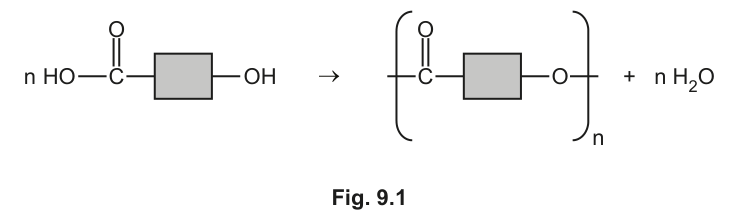
Fig. 9.1 shows the equation for the reaction used to prepare a polymer.
The monomer is both an alcohol and a carboxylic acid.
Name the type of linkage that bonds the repeat units to one another in this polymer.
______
Answer
ester
ester
Walkthrough
The monomer in Fig. 9.1 contains both an alcohol group (-OH) and a carboxylic acid group (-COOH). When these functional groups react together, they form an ester linkage (-COO-) and release a small molecule (water). This type of polymer is called a polyester, and the bond joining the repeat units is specifically called an ester linkage.
Key Takeaways
Condensation polymerisation forms a polymer and a small molecule by-product (usually water). The linkage between monomers in a polyester is an ester linkage.
Common Mistakes
Candidates often write "polyester" or "polymerisation" instead of the specific linkage name "ester". "Amide" is incorrect here as that is for polyamides like nylon.
Things to Be Careful About
The question asks for the type of linkage, not the name of the polymer or the reaction. The exact word required is "ester".
Explain how the equation shows that the polymer is made by a condensation reaction.
______
Answer
The equation shows that a small molecule (water) is produced as a by-product alongside the polymer. Addition polymerisation has only one product (the polymer itself).
Polymer made together with a water molecule
Walkthrough
There are two main types of polymerisation: addition and condensation. In addition polymerisation, many monomer molecules join together to form a single polymer product with no other by-products. In condensation polymerisation, the monomers join together to form the polymer and a small molecule by-product, typically water (or sometimes hydrogen chloride). Fig. 9.1 clearly shows as a product alongside the polymer chain, which is the defining feature of a condensation reaction.
Key Takeaways
Condensation polymerisation is defined by the formation of a small molecule by-product (like water) when the monomers join.
Common Mistakes
Saying only "water is produced" is not enough; the explanation must contrast it with addition polymerisation by noting the polymer is made together with the small molecule. Saying "two different monomers react" is also incorrect, as this question uses a single monomer with two different functional groups.
Things to Be Careful About
The mark scheme specifically accepts "polymer made together with a water molecule". Ensure you mention both the polymer and the water to show the contrast with addition polymerisation.
A polymer contains carbon, fluorine and bromine by mass.
Calculate the empirical formula of this polymer.
empirical formula ______
Working
Assume a 100 g sample, so the masses are 10.8 g C, 17.1 g F, and 72.1 g Br.
Divide each by the smallest number of moles (0.90):
Answer
CFBr
CFBr
Walkthrough
To find the empirical formula from percentage composition, assume a 100 g sample. This converts the percentages directly into masses in grams: 10.8 g of carbon, 17.1 g of fluorine, and 72.1 g of bromine. Next, divide each mass by the relative atomic mass () of the element to find the number of moles: C = 10.8 / 12 = 0.90 mol; F = 17.1 / 19 = 0.90 mol; Br = 72.1 / 80 = 0.90125 mol. Finally, divide all mole values by the smallest mole value (0.90) to get the simplest whole-number ratio: 1 : 1 : 1. Write the empirical formula using these whole numbers.
Key Takeaways
The empirical formula is the simplest whole-number ratio of atoms in a compound. Convert % to mass (assume 100g), then to moles using , then find the ratio by dividing by the smallest value.
Common Mistakes
Forgetting to divide by and using the percentages directly as the ratio. Rounding Br to 0.9 too early and losing precision, though in this case 72.1 / 80 = 0.90125 which rounds cleanly to 0.90. Writing the formula with incorrect subscripts (e.g., ) when the simplest ratio is 1:1:1.
Things to Be Careful About
Use the correct values from the Periodic Table: C = 12, F = 19, Br = 80. The ratio must be reduced to the simplest whole numbers. The formula is written as CFBr.
Some plastics are made from polymers that are hydrocarbons.
There are many environmental challenges caused by plastics.
Explain why there is an accumulation of plastics in the oceans.
Use ideas about the properties of plastics.
______
Answer
Plastics are chemically unreactive (inert) and do not dissolve in water. Therefore, they do not break down or wash away when they enter the ocean, leading to accumulation.
Polymers or plastic are unreactive / do not dissolve in water
Walkthrough
Plastics are synthetic polymers held together by strong covalent bonds. Because of this, they are chemically unreactive (inert) and do not dissolve in water. When plastic waste enters the ocean, these properties mean it does not degrade naturally or dissolve, so it persists in the environment for a very long time and accumulates.
Key Takeaways
The chemical inertness and insolubility of plastics mean they accumulate in the environment rather than breaking down naturally.
Common Mistakes
Saying "plastics are heavy" or "plastics don't biodegrade". While biodegradability is related, the mark scheme specifically looks for the fundamental chemical properties: unreactive/inert and/or insoluble in water.
Things to Be Careful About
The question asks to "Use ideas about the properties of plastics". You must explicitly mention that they are unreactive (or inert) and/or do not dissolve in water to earn the mark.
Answer
Any two of the following:
- Incomplete combustion of plastics produces carbon monoxide, a toxic gas.
- Burning plastics produces carbon dioxide, a greenhouse gas that causes global warming / climate change.
- Burning plastics may produce other toxic or poisonous gases.
- Disposal of plastics requires more land-fills, using up land needed for other purposes.
Incomplete combustion produces CO; burning produces CO2 (greenhouse gas) or toxic gases; more land-fills needed
Walkthrough
Plastics are hydrocarbons or contain other elements. When disposed of by burning (incineration), incomplete combustion produces carbon monoxide (a toxic gas), and complete combustion produces carbon dioxide (a greenhouse gas that contributes to global warming). Some plastics may also release other poisonous gases when burned. Alternatively, if plastics are not burned, they must be buried in land-fills. Since plastics do not biodegrade, they take up land space for a very long time, reducing the land available for other uses.
Key Takeaways
Plastic disposal causes environmental challenges through toxic/greenhouse gas emissions during combustion and through the consumption of land space in land-fills.
Common Mistakes
Saying "plastics cause pollution" without specifying how. The mark scheme requires specific environmental impacts like toxic gases, greenhouse gases, or land-fill space. Saying "plastics kill animals" is not a direct chemical disposal challenge and will not score.
Things to Be Careful About
You only need to provide any two valid points from the mark scheme. Ensure your answers are specific: mention "carbon monoxide" or "toxic gas" for incomplete combustion, "carbon dioxide" or "greenhouse gas" for complete combustion, or "land-fills" for disposal. Do not just say "burning is bad".