Chemistry 5070/21 — May/June 2024
Cambridge O-Level · Theory · worked solutions for every part, with the mark scheme
Topics Chemical Reactions · Stoichiometry · Atoms, Elements and Compounds · Acids, Bases and Salts · Organic Chemistry · Chemistry of the Environment · +3 more
Choose from the following substances to answer the questions.
carbon
chlorine
glucose
hydrated copper(II) sulfate
iron
magnesium sulfate
methanoic acid
methanol
nickel
silicon(IV) oxide
vanadium(V) oxide
Each substance can be used once, more than once or not at all.
State which substance:
Answer
iron
iron
Walkthrough
The Haber process combines nitrogen and hydrogen to make ammonia. The reaction is slow without a catalyst, so iron is used to speed it up. Iron is a transition metal and is a common catalyst. From the list, iron is the only substance that fits.
Key Takeaways
The Haber process uses an iron catalyst to increase the rate of reaction without being used up.
Common Mistakes
Choosing vanadium(V) oxide – that is the catalyst for the Contact process (making sulfuric acid), not the Haber process.
Things to Be Careful About
Remember the specific catalyst for each industrial process: iron for Haber, vanadium(V) oxide for Contact.
Answer
silicon(IV) oxide / carbon
silicon(IV) oxide / carbon
Walkthrough
A giant covalent structure is a network of atoms held together by covalent bonds in a giant lattice. Diamond and graphite are forms of carbon with giant covalent structures. Silicon(IV) oxide (silica) also has a giant covalent structure, similar to diamond. From the list, both carbon and silicon(IV) oxide qualify. The mark scheme allows either.
Key Takeaways
Giant covalent structures include diamond, graphite, and silicon(IV) oxide. They have high melting points and are hard (except graphite is soft).
Common Mistakes
Choosing glucose or methanol – these are simple molecular substances with low melting points.
Things to Be Careful About
Carbon exists in several forms; the question does not specify which, so carbon is acceptable. Silicon(IV) oxide is also correct.
Answer
hydrated copper(II) sulfate
hydrated copper(II) sulfate
Walkthrough
Hydrated copper(II) sulfate contains water of crystallisation. When heated, the water is driven off, leaving anhydrous copper(II) sulfate. The blue hydrated salt turns white when anhydrous. This is a classic test for water: adding water to white anhydrous copper(II) sulfate turns it blue.
Key Takeaways
Hydrated copper(II) sulfate is blue; anhydrous copper(II) sulfate is white. Heating removes water of crystallisation.
Common Mistakes
Confusing hydrated and anhydrous forms – the question specifies 'hydrated', so the blue one.
Things to Be Careful About
The colour change is blue to white on heating, and white to blue on adding water.
Answer
carbon
carbon
Walkthrough
During treatment of domestic water, carbon (often activated carbon) is used to remove tastes and odours. It adsorbs impurities onto its surface. From the list, carbon is the correct substance.
Key Takeaways
Activated carbon is used in water treatment to remove tastes and odours by adsorption.
Common Mistakes
Choosing chlorine – chlorine is used to kill bacteria, not to remove tastes and odours.
Things to Be Careful About
Carbon removes tastes and odours; chlorine disinfects. The question specifically asks for tastes and odours.
Answer
glucose
glucose
Walkthrough
The empirical formula is the simplest whole-number ratio of atoms in a compound. Glucose has the molecular formula . Dividing all subscripts by 6 gives . Methanoic acid is , which is already simplest and does not match. Methanol is , which also does not match. So glucose is the only one with empirical formula .
Key Takeaways
The empirical formula is the simplest ratio; the molecular formula is a multiple of it. Glucose's empirical formula is .
Common Mistakes
Choosing methanoic acid – its formula is , not .
Things to Be Careful About
Check the ratio of C:H:O in the molecular formula before deciding.
Calcium carbide, , reacts with water to form a flammable gas ethyne, , and calcium hydroxide.
Answer
- Formula for calcium hydroxide:
- Balanced equation:
CaC2 + 2H2O -> Ca(OH)2 + C2H2
Walkthrough
The question states that calcium carbide () reacts with water () to form ethyne () and calcium hydroxide. We need to write the formula for calcium hydroxide and balance the equation.
- Identify formulae: Calcium is in Group II, so it forms . Hydroxide is . To balance charges, calcium hydroxide is . Water is . Ethyne is given as . Calcium carbide is given as .
- Write unbalanced equation: .
- Balance: There are 2 hydrogens and 1 oxygen on the left (in water) but 2 hydroxide groups (2 O, 2 H) and 2 H in ethyne on the right. Total H on right = 2 (from hydroxide) + 2 (from ethyne) = 4. Total O on right = 2. So we need 2 water molecules on the left: .
- Check balance:
- Ca: 1 left, 1 right.
- C: 2 left, 2 right.
- H: 4 left (), 4 right (2 in hydroxide + 2 in ethyne).
- O: 2 left, 2 right.
The equation is balanced.
Key Takeaways
- Know the formula for common ions like hydroxide () and combine them with metal ions (e.g., ).
- Balancing equations involves checking atom counts for each element on both sides.
Common Mistakes
- Writing the formula for calcium hydroxide as or instead of .
- Forgetting to balance the water molecules (using 1 instead of 2).
- Writing state symbols where not required (though often good practice, the mark scheme here focuses on formulae and balance).
Things to Be Careful About
- Ensure the formula for calcium hydroxide includes brackets around the hydroxide group: , not .
- The mark scheme awards one mark for the correct formula of calcium hydroxide as a product and one for the balanced equation. Both are needed for full marks.
Answer
Calcium is in Group II and forms a ion. In , the compound is neutral, so the two carbon atoms together must carry a charge. The carbide ion is .
C2^2-
Walkthrough
The problem states calcium carbide is ionic and gives the formula .
- Identify cation charge: Calcium is in Group II of the Periodic Table. It loses 2 electrons to achieve a stable octet, forming the ion.
- Determine anion charge: The formula is . Since the compound is electrically neutral, the total positive charge must equal the total negative charge. We have one ( charge). Therefore, the part must have a charge of .
- Write ion formula: The ion is the carbide ion, consisting of two carbon atoms with a charge: .
Key Takeaways
- Ionic compounds are neutral; total positive charge = total negative charge.
- Group II metals form ions.
- Some anions are polyatomic (like or ).
Common Mistakes
- Assuming the carbide ion is just . The formula shows two carbon atoms per calcium atom, so the ion must contain two carbons.
- Forgetting the charge on the ion.
Things to Be Careful About
- The question asks for the formula of the carbide ion, not the element. Include the charge: .
Fig. 2.1 shows the displayed formula of ethyne.
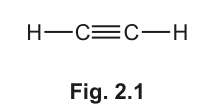
Ethyne is an unsaturated hydrocarbon.
Answer
Ethyne is a hydrocarbon because it contains only carbon and hydrogen atoms.
contains only carbon and hydrogen
Walkthrough
A hydrocarbon is defined as a compound containing only carbon and hydrogen. Looking at the formula for ethyne, , it consists solely of C and H atoms.
Key Takeaways
- Hydrocarbons contain only C and H.
- If other elements (O, N, S, halogens) are present, it is not a hydrocarbon (it would be a hydrocarbon derivative).
Common Mistakes
- Saying "it contains carbon and hydrogen" (missing the word 'only'). Methane () is a hydrocarbon, but methanol () contains oxygen and is not.
Things to Be Careful About
- The definition is strict: only carbon and hydrogen.
Answer
Ethyne is unsaturated because it contains a carbon-carbon triple bond (or does not contain only carbon-carbon single bonds).
contains a carbon-carbon triple bond
Walkthrough
Saturation in hydrocarbons refers to the types of bonds between carbon atoms.
- Saturated: Only single carbon-carbon bonds (C-C). Alkanes are saturated.
- Unsaturated: Contains at least one double (C=C) or triple (C≡C) carbon-carbon bond.
In Fig 2.1, ethyne is shown as . The triple bond means there are fewer hydrogen atoms than the maximum possible for two carbons (which would be ethane, ). Thus, it is unsaturated.
Key Takeaways
- Unsaturated = double or triple bonds between carbons.
- Saturated = only single bonds between carbons.
Common Mistakes
- Saying "it has double bonds" (ethyne has a triple bond).
- Not mentioning the carbon-carbon bond specifically.
Things to Be Careful About
- The mark scheme accepts "does not contain a carbon-carbon single bond" or "contains a triple bond". Be specific about the bond type.
Aqueous bromine reacts with ethyne.
Predict the colour change that happens during this reaction.
______
Answer
The colour change is orange (or brown) to colourless.
orange to colourless
Walkthrough
Aqueous bromine (bromine water) is orange/brown. When it reacts with an unsaturated hydrocarbon (like ethyne or ethene), an addition reaction occurs across the multiple bond. The bromine is used up in the reaction, so the orange colour disappears, leaving a colourless solution.
Key Takeaways
- Bromine water test is used to detect unsaturation (C=C or C≡C bonds).
- Positive test: orange/brown to colourless.
- Negative test (saturated): remains orange/brown.
Common Mistakes
- Saying "brown to white" (the solution becomes colourless, not white).
- Saying "decolourises" without stating the starting colour (though often accepted, "orange to colourless" is precise).
Things to Be Careful About
- Ethyne reacts with bromine water, decolourising it. The reaction is similar to alkenes but can add two molecules of bromine (though the question just asks for the colour change).
Draw a dot-and-cross diagram to show the electronic configuration in a molecule of ethyne.
Show only the outer shell electrons.
Answer
A dot-and-cross diagram for ethyne ():
- Two central overlapping circles (carbon atoms). In the overlap, 3 pairs of electrons (6 electrons total, alternating dots and crosses) representing the triple bond.
- Two outer overlapping circles (hydrogen atoms) on either side. In each overlap with carbon, 1 pair of electrons (2 electrons, one dot and one cross) representing the single bond.
- No lone pairs on any atom.
(visual representation: H-C≡C-H with electron dots)
Description:
- Left H circle overlaps with left C circle: 2 electrons (1 dot, 1 cross).
- Left C circle overlaps with right C circle: 6 electrons (3 dots, 3 crosses).
- Right C circle overlaps with right H circle: 2 electrons (1 dot, 1 cross).
- Total outer electrons: H(1)+C(4)+C(4)+H(1) = 10. Shown: 2+6+2 = 10. Correct.
Dot-and-cross diagram showing H-C≡C-H with 3 shared pairs between carbons and 1 shared pair between each C and H, no lone pairs.
Walkthrough
We need to draw the electronic structure of ethyne, .
-
Count outer electrons:
- Hydrogen (Group I): 1 outer electron each. Total = 2.
- Carbon (Group IV): 4 outer electrons each. Total = 8.
- Grand total = 10 outer electrons.
-
Determine bonding:
- Structure is H-C≡C-H.
- C-C bond is a triple bond: 3 shared pairs (6 electrons).
- C-H bonds are single bonds: 1 shared pair each (2 electrons total).
- Total bonding electrons = 6 + 2 + 2 = 10. All outer electrons are used in bonding.
-
Draw diagram:
- Draw circles for atoms. H (small), C (larger).
- Overlap H and C circles: 2 electrons (one dot from H, one cross from C).
- Overlap C and C circles: 6 electrons (three dots, three crosses).
- No lone pairs remain on Carbon (4 bonds = 8 electrons in outer shell) or Hydrogen (1 bond = 2 electrons in outer shell).
Key Takeaways
- Dot-and-cross diagrams show shared pairs (bonds) and lone pairs.
- Triple bond = 3 shared pairs.
- Hydrogen needs 2 electrons (duet), Carbon needs 8 (octet).
Common Mistakes
- Drawing lone pairs on Carbon (Carbon has 4 bonds, so 8 electrons, full shell).
- Drawing lone pairs on Hydrogen (Hydrogen has 1 bond, so 2 electrons, full shell).
- Not alternating dots and crosses to show which atom contributed which electron (though often just showing pairs is accepted, alternating is best practice).
- Drawing only 2 shared pairs between carbons (double bond) instead of 3.
Things to Be Careful About
- The question says "Show only the outer shell electrons". Do not draw inner shells (Carbon has inner shell of 2, but we ignore it).
- Ensure the diagram clearly shows the triple bond (3 pairs) between carbons.
The equation for the complete combustion of ethyne is shown.
This reaction is exothermic.
Explain, using ideas about bond breaking and bond making, why this reaction is exothermic.
______
Answer
- Bond breaking is endothermic (energy is absorbed/required to break bonds).
- Bond making is exothermic (energy is released when bonds form).
- In this reaction, more energy is released on making the new bonds (in and ) than is absorbed to break the bonds in the reactants ( and ).
This net release of energy makes the reaction exothermic.
Bond breaking is endothermic (absorbs energy) and bond making is exothermic (releases energy). More energy is released making bonds than absorbed breaking bonds.
Walkthrough
Combustion reactions are exothermic. We explain this using bond energies.
- Reactants: and . Bonds must be broken: C≡C, C-H, O=O. Breaking bonds requires energy input (endothermic).
- Products: and . Bonds are formed: C=O, O-H. Forming bonds releases energy (exothermic).
- Net Energy Change: For the reaction to be exothermic overall, the energy released by forming the strong bonds in and must be greater than the energy required to break the bonds in the reactants.
Key Takeaways
- Breaking bonds = energy in (endothermic).
- Making bonds = energy out (exothermic).
- Exothermic reaction: Energy out > Energy in.
- Endothermic reaction: Energy in > Energy out.
Common Mistakes
- Saying "energy is released when bonds are broken" (wrong, energy is absorbed).
- Saying "energy is absorbed when bonds are made" (wrong, energy is released).
- Not comparing the two quantities (just saying one is endothermic and the other exothermic is not enough; must say which is larger).
Things to Be Careful About
- Use the terms "absorbed" and "released" or "endothermic" and "exothermic" correctly.
- The mark scheme specifically looks for: "bond breaking endothermic AND bond making exothermic" AND "more energy released than absorbed".
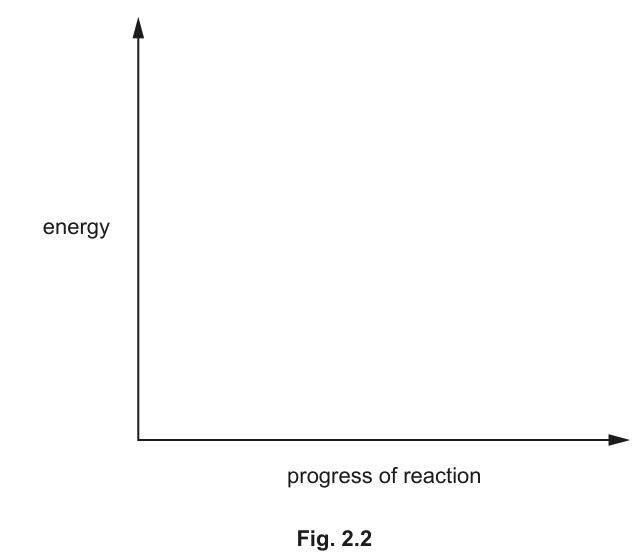
Complete the reaction pathway diagram in Fig. 2.2 for the complete combustion of ethyne.
Label the:
- reactants
- products
- enthalpy change of the reaction,
- activation energy, .
Answer
Diagram Description:
- Axes: Vertical axis = 'energy', Horizontal axis = 'progress of reaction'.
- Reactants level: Horizontal line on the left at a higher energy level. Label: ''.
- Products level: Horizontal line on the right at a lower energy level (below reactants). Label: ''.
- Curve: Starts at reactant level, rises to a peak (transition state), then falls to product level.
- Activation Energy (): Vertical upward arrow from reactant level to the peak of the curve. Label: ''.
- Enthalpy Change (): Vertical downward arrow from reactant level to product level. Label: ''.
(Note: Since the reaction is exothermic, products are lower than reactants, and is negative, represented by the downward arrow).
Energy profile showing reactants higher than products, curve with hump, Ea arrow up from reactants to peak, Delta H arrow down from reactants to products.
Walkthrough
We need to complete the reaction pathway diagram for the exothermic combustion of ethyne.
- Reactants and Products Levels: The reaction is exothermic, so the products have lower energy than the reactants. Draw a horizontal line for reactants () at a higher energy level on the left. Draw a horizontal line for products () at a lower energy level on the right.
- Reaction Pathway (Curve): Draw a curve starting from the reactant line, going up to a maximum (the activation energy barrier/transition state), and then going down to the product line. The curve should not go below the product line.
- Activation Energy (): This is the energy needed to start the reaction. Draw an upward vertical arrow from the reactant energy level to the top of the curve (the peak). Label it ''.
- Enthalpy Change (): This is the overall energy difference. Draw a downward vertical arrow from the reactant energy level to the product energy level. Label it ''. (Since it's exothermic, energy is lost, so the arrow points down).
Key Takeaways
- Exothermic: Products lower than reactants.
- Endothermic: Products higher than reactants.
- is always the energy from reactants to the peak (upward arrow).
- is the energy difference between reactants and products.
Common Mistakes
- Drawing products higher than reactants (this would be endothermic).
- Drawing arrow from products to reactants (should be reactants to products for the change of the system, or just indicate the difference. Mark scheme says 'downward arrow' from reactants level).
- Drawing arrow from products to peak (wrong, it's from reactants).
- Forgetting to label the reactants and products with their chemical formulas.
Things to Be Careful About
- The mark scheme specifies: 'products to right of reactants', 'reactant level above product level', 'enthalpy change shown as downward arrow', 'activation energy drawn to maximum... with upward arrow'.
- Ensure labels are clear: '' and ''.
Aqueous ammonium nitrite decomposes when heated to form nitrogen.
A sample of is completely decomposed.
Calculate the volume of nitrogen formed, measured at room temperature and pressure.
Give your answer to two significant figures.
volume of nitrogen = ______
Working
Convert the volume to :
Amount of :
From the equation, gives , so:
Volume at r.t.p. ():
Answer
0.080 dm3
Walkthrough
This is a three-step mole calculation. First convert the volume of solution from to because concentration is in . Then multiply concentration by volume to find the amount of ammonium nitrite. The equation shows a 1:1 mole ratio between and , so the amount of nitrogen is the same. Finally multiply this amount by the molar gas volume at r.t.p., , to get the volume of gas. Round to two significant figures at the end.
Key Takeaways
- Amount (mol) = concentration () x volume ().
- At r.t.p., one mole of any gas occupies .
- The balanced equation gives the mole ratio needed to convert amount of reactant to amount of product.
Common Mistakes
- Forgetting to convert to before using the concentration.
- Using the wrong mole ratio (the equation is 1:1 here).
- Rounding to two significant figures too early; keep the full value until the final step.
- Omitting the unit in the final answer.
Things to Be Careful About
- The answer must be given to two significant figures, so becomes .
- Use the molar gas volume at r.t.p. (), not s.t.p. ().
- The mark scheme awards one mark for the amount of ammonium nitrite, one for the volume calculation, and one for the final rounded answer.
Describe and explain the effect of increasing the temperature on the rate of this reaction.
______
Answer
Increasing the temperature increases the rate.
- Particles gain kinetic energy and move faster.
- There are more successful collisions / more collisions with energy equal to or greater than the activation energy.
Rate increases; particles gain kinetic energy; more successful collisions.
Walkthrough
Increasing the temperature gives the particles more kinetic energy, so they move faster. This has two effects: collisions happen more often, and a greater proportion of collisions have energy at least equal to the activation energy. The mark scheme accepts either 'more successful collisions' or 'more collisions with energy equal to or greater than the activation energy' as the second point.
Key Takeaways
- Temperature affects rate through particle kinetic energy and collision frequency.
- Only collisions with energy equal to or greater than the activation energy lead to reaction.
Common Mistakes
- Saying only 'particles move faster' without linking it to successful collisions.
- Saying 'more collisions' without mentioning energy/activation energy; the mark scheme wants the successful/effective collision idea.
Things to Be Careful About
- The question asks to 'describe and explain', so both the effect on rate and the reason are needed.
- Use the phrase 'successful collisions' or 'collisions with energy equal to or greater than the activation energy'.
Describe and explain the effect of decreasing the concentration of ammonium nitrite on the rate of this reaction.
______
Answer
Decreasing the concentration decreases the rate.
- There are fewer particles per unit volume / particles are less crowded.
- There are fewer collisions per second / lower collision frequency.
Rate decreases; fewer particles per unit volume; lower collision frequency.
Walkthrough
Decreasing the concentration means fewer ammonium nitrite particles in the same volume, so the particles are less crowded. As a result, collisions between reactant particles happen less frequently, so the rate decreases. The mark scheme separates these into two points: fewer particles per unit volume, and lower collision frequency.
Key Takeaways
- Concentration affects rate through the frequency of collisions.
- Lower concentration leads to fewer particles per unit volume, fewer collisions per second, and a lower rate.
Common Mistakes
- Saying 'fewer particles' without specifying 'per unit volume' or 'less crowded'.
- Confusing concentration with temperature; concentration does not change particle energy.
Things to Be Careful About
- The mark scheme wants two distinct ideas: crowding and collision frequency.
- Do not say particles move more slowly; decreasing concentration does not change their speed.
One way to measure the pH of aqueous ammonium nitrite is to use a pH meter.
Describe one other way to measure the pH of aqueous ammonium nitrite.
______
Answer
Use universal indicator paper. Match the colour produced with a pH colour chart.
Use universal indicator paper and match the colour with a pH colour chart.
Walkthrough
A pH meter is one way to measure pH. Another standard method is to use universal indicator paper (or universal indicator solution): add a drop of the solution to the paper, then compare the colour produced with the colour chart supplied with the indicator. The colour corresponds to a pH value.
Key Takeaways
- pH can be measured with a pH meter or with an indicator and a colour chart.
- Universal indicator gives a colour that changes gradually across the pH range.
Common Mistakes
- Naming litmus paper, which only distinguishes acid/alkali and does not give a pH value.
- Saying 'use universal indicator' without mentioning comparing the colour to a pH chart; the chart is the part that gives the pH.
Things to Be Careful About
- The mark scheme awards one mark for universal indicator paper and one for matching the colour with a pH colour chart.
- 'Other way' means not a pH meter, so do not describe using a pH meter.
Potassium iodide, , is an ionic solid composed of a lattice of potassium ions and iodide ions.
Answer
Strong electrostatic attraction between the positive potassium ions and negative iodide ions requires much energy to overcome.
Strong electrostatic attraction between positive and negative ions
Walkthrough
Potassium iodide is ionic. In the solid, a giant lattice of K⁺ and I⁻ ions is held together by strong electrostatic forces. Melting means breaking these forces, which needs a large amount of energy, hence a high melting point.
Key Takeaways
- Ionic compounds have high melting points because of strong ionic bonds.
- The forces are electrostatic attractions between oppositely charged ions.
Common Mistakes
- Saying 'strong bonds between molecules' – ionic compounds do not have molecules.
- Omitting that the attraction is between positive and negative ions.
Things to Be Careful About
- Use 'electrostatic' not just 'attraction' to be precise.
- Mention that breaking these forces requires energy.
Describe how potassium atoms and iodine molecules react to form potassium ions and iodide ions. Use ideas about electron transfer.
______
Answer
Each potassium atom loses one electron to form a K⁺ ion. The iodine molecule gains two electrons (one for each iodine atom) to form two I⁻ ions.
Each potassium atom loses one electron; iodine molecule gains two electrons.
Walkthrough
Potassium is a Group I metal with one outer electron. Iodine is a Group VII non-metal that needs one electron to complete its octet. In the reaction, two potassium atoms each transfer one electron to one iodine molecule. The iodine molecule splits into two iodide ions, each having gained one electron. This electron transfer forms K⁺ and I⁻ ions.
Key Takeaways
- Metals lose electrons to form positive ions.
- Non-metals gain electrons to form negative ions.
- Electron transfer must be balanced.
Common Mistakes
- Saying 'iodine gains one electron' – must be per molecule (two electrons).
- Not specifying that each potassium atom loses one electron.
Things to Be Careful About
- Use 'lose' and 'gain' correctly.
- Mention the number of electrons per atom and per molecule.
Predict the products at each electrode during the electrolysis of concentrated aqueous potassium iodide.
at anode ______
at cathode ______
Answer
At anode: iodine (I₂)
At cathode: hydrogen (H₂)
Anode: iodine (I₂); cathode: hydrogen (H₂)
Walkthrough
In concentrated aqueous potassium iodide, the ions present are K⁺, I⁻, H⁺ and OH⁻. At the anode, iodide ions are discharged in preference to hydroxide ions because iodide is higher in the discharge series (easier to oxidise). At the cathode, hydrogen ions are discharged in preference to potassium ions because hydrogen is lower in the reactivity series (easier to reduce). Thus iodine forms at the anode and hydrogen at the cathode.
Key Takeaways
- In aqueous electrolysis, the ion that is easier to discharge is selected.
- Halide ions (except fluoride) are discharged at the anode over hydroxide.
- Hydrogen is discharged at the cathode over metals above hydrogen in reactivity series.
Common Mistakes
- Predicting potassium at the cathode – incorrect because potassium is too reactive.
- Predicting oxygen at the anode – only if iodide is not present.
Things to Be Careful About
- State symbols: iodine is (aq) or (s) depending on concentration; hydrogen is (g).
- Remember the discharge series order.
Aqueous potassium iodide reacts with aqueous acidified potassium manganate(VII).
Suggest the colour changes that happen during this reaction.
______
Answer
The purple colour of acidified potassium manganate(VII) changes to colourless, and the solution turns brown due to iodine formed.
Purple to colourless; solution turns brown
Walkthrough
Acidified potassium manganate(VII) is a strong oxidising agent. It oxidises iodide ions to iodine. The manganate(VII) ion is reduced to Mn²⁺, which is almost colourless in aqueous solution. The iodine produced gives a brown colour. Therefore, the purple colour fades to colourless and a brown colour appears.
Key Takeaways
- Manganate(VII) is purple; its reduced form is colourless.
- Iodine in aqueous solution is brown.
- This is a redox reaction.
Common Mistakes
- Saying 'purple to brown' – the manganate becomes colourless, not brown.
- Missing the brown colour from iodine.
Things to Be Careful About
- Acidified manganate(VII) is required for the reaction.
- The brown colour may be described as 'yellow-brown'.
The ionic equation for the reaction between aqueous potassium iodide and aqueous chlorine is shown.
Explain, in terms of electrons, why this reaction involves both oxidation and reduction.
______
Answer
I⁻ (iodide) is oxidised because it loses electrons to form I₂. Cl₂ (chlorine) is reduced because it gains electrons to form Cl⁻.
I⁻ loses electrons (oxidised); Cl₂ gains electrons (reduced)
Walkthrough
In the equation, each iodide ion loses one electron to become an iodine atom; two iodide ions lose two electrons overall to form one I₂ molecule. Loss of electrons is oxidation. Meanwhile, each chlorine atom in Cl₂ gains one electron to become Cl⁻; the chlorine molecule gains two electrons overall. Gain of electrons is reduction. Thus the reaction involves both oxidation and reduction.
Key Takeaways
- Oxidation = loss of electrons.
- Reduction = gain of electrons.
- Redox reactions involve simultaneous oxidation and reduction.
Common Mistakes
- Confusing which species is oxidised/reduced.
- Not stating the electron transfer explicitly.
Things to Be Careful About
- Use 'loses electrons' and 'gains electrons' precisely.
- Mention both species and the electron change.
When a sample of zinc sulfite is heated in a closed system, an equilibrium mixture is formed.
The forward reaction is endothermic.
The temperature of the closed system is increased and the pressure is kept constant.
Predict how the position of equilibrium of this reaction is affected.
Explain your answer.
______
Answer
The position of equilibrium moves to the right (toward the products / toward zinc oxide and sulfur dioxide).
The forward reaction is endothermic, so the equilibrium shifts to absorb the extra thermal energy.
Moves to the right (product side); forward reaction is endothermic so heat is absorbed
Walkthrough
The system is at equilibrium, meaning the forward and backward reactions happen at the same rate. When we change the conditions, the position of equilibrium shifts to oppose the change — this is Le Chatelier's principle.
Increasing the temperature adds heat energy to the system. The forward reaction is endothermic, which means it absorbs heat energy. So the equilibrium shifts in the forward direction to use up the added heat. That moves the position of equilibrium to the right, toward the products (zinc oxide and sulfur dioxide).
The question says the pressure is kept constant, so we only need to think about the temperature change — no pressure effect to consider here.
Key Takeaways
- Le Chatelier's principle: a system at equilibrium opposes any change made to it.
- Increasing temperature favours the endothermic direction (the direction that absorbs heat).
- The forward reaction being endothermic is the clue that tells you which way the shift goes.
Common Mistakes
- Saying the equilibrium moves to the left — increasing temperature favours the endothermic direction, which here is the forward (right) direction.
- Confusing endothermic (absorbs heat) with exothermic (releases heat).
- Forgetting to give the reason (to absorb thermal energy) — the mark scheme awards a separate mark for it.
Things to Be Careful About
The mark scheme wants two points: (1) the position moves to the right / product side, and (2) the reason — to absorb thermal energy. Both are needed for the 2 marks. The phrase 'to absorb thermal energy' (or equivalent) is the second mark, so don't leave it out.
The pressure of the closed system is decreased and the temperature is kept constant.
Predict how the position of equilibrium of this reaction is affected.
Explain your answer.
______
Answer
The position of equilibrium moves to the right (toward the products / toward sulfur dioxide).
The right-hand side has more moles of gas (1 mole of SO) than the left-hand side (no gas), and decreasing pressure favours the side with more gas.
Moves to the right (product side); more moles of gas on the product side
Walkthrough
Decreasing the pressure favours the side of the equilibrium with more moles of gas — the system shifts to increase the pressure again by producing more gas.
Count the moles of gas on each side. On the left, ZnSO is a solid, so it contributes zero moles of gas. On the right, ZnO is a solid but SO is a gas, so there is 1 mole of gas. The right-hand side therefore has more moles of gas.
So decreasing the pressure shifts the equilibrium to the right, toward the products.
Key Takeaways
- Decreasing pressure favours the side with more moles of gas.
- Only gaseous species count when considering pressure changes — solids and liquids are ignored.
Common Mistakes
- Counting the solids (ZnSO and ZnO) as gas — they don't count for pressure effects.
- Saying the equilibrium moves to the left.
- Giving the direction without the reason; the mark scheme wants 'more moles of gas on the right-hand side'.
Things to Be Careful About
The two marks are for (1) the direction (to the right / product side) and (2) the reason (more moles of gas on the right-hand side). Both points must be stated. Note that even though there is only one mole of gas on the product side, the reactant side has none, so the product side has more gas.
Calculate the maximum mass of zinc oxide that can be made from of zinc sulfite.
mass of zinc oxide = ______
Working
Mole ratio ZnSO : ZnO = 1 : 1, so moles of ZnO = 0.1759 mol.
Answer
14.2 g
14.2 g
Walkthrough
The balanced equation is:
The mole ratio of ZnSO to ZnO is 1 : 1, so the number of moles of ZnO formed equals the number of moles of ZnSO used.
First, find the relative formula masses:
Convert the mass of ZnSO to moles:
Since the ratio is 1 : 1, 0.1759 mol of ZnO is formed. Convert to mass:
Key Takeaways
- Reacting-mass calculations: mass → moles (divide by ), use the mole ratio from the balanced equation, then moles → mass (multiply by ).
- The balanced equation tells you the mole ratio — here it's 1 : 1.
Common Mistakes
- Using the wrong — check each element's atomic mass (Zn = 65, S = 32, O = 16).
- Forgetting the 1 : 1 ratio.
- Rounding too early and getting a slightly different final answer (the mark scheme gives 14.2448 g; 14.2 g to 3 significant figures is correct).
- Omitting the unit 'g' in the final answer.
Things to Be Careful About
The mark scheme awards a mark for each of: correct values, correct moles (25.5/145 = 0.1759 mol), and correct final mass (14.2448 g ≈ 14.2 g). Show all three stages of working to be sure of all three marks. Answer to 3 significant figures, since 25.5 has 3 significant figures.
Zinc oxide reacts with both aqueous sodium hydroxide and dilute hydrochloric acid, but sulfur dioxide only reacts with aqueous sodium hydroxide.
Explain why.
______
Answer
Zinc oxide is amphoteric — it reacts with both acids and bases (alkalis).
Sulfur dioxide is an acidic oxide — it reacts only with bases (alkalis), not with acids.
Zinc oxide is amphoteric; sulfur dioxide is an acidic oxide
Walkthrough
Zinc oxide reacts with both an acid (dilute hydrochloric acid) and a base (aqueous sodium hydroxide). An oxide that reacts with both acids and bases is called amphoteric. Zinc oxide is a well-known amphoteric oxide.
Sulfur dioxide is the oxide of a non-metal (sulfur). Non-metal oxides are generally acidic — they react with bases (alkalis) such as sodium hydroxide, but not with acids. So sulfur dioxide reacts with aqueous sodium hydroxide but not with dilute hydrochloric acid.
Key Takeaways
- Amphoteric oxides react with both acids and bases — zinc oxide is an example.
- Acidic oxides (usually non-metal oxides) react with bases but not with acids — sulfur dioxide is an example.
Common Mistakes
- Calling zinc oxide simply 'basic' — it is amphoteric because it reacts with both acids and alkalis.
- Calling sulfur dioxide amphoteric — it is acidic, reacting only with bases.
- Not naming both oxides' behaviour; the mark scheme awards one mark for each.
Things to Be Careful About
The two marks are for 'zinc oxide is amphoteric' and 'sulfur dioxide is acidic'. Use the correct terms — 'amphoteric' and 'acidic' — as the mark scheme accepts these exact descriptors.
Solid zinc sulfite reacts with dilute nitric acid to give sulfur dioxide gas, an aqueous zinc salt and a colourless liquid.
Construct the symbol equation for this reaction.
Include state symbols.
______
Answer
ZnSO3(s) + 2HNO3(aq) -> Zn(NO3)2(aq) + H2O(l) + SO2(g)
Walkthrough
Write the word equation first: zinc sulfite + nitric acid → zinc nitrate + water + sulfur dioxide.
Identify the formulae:
- Zinc sulfite: ZnSO
- Nitric acid: HNO
- Zinc nitrate: Zn(NO) (zinc is Zn, nitrate is NO, so two nitrates are needed)
- Water: HO
- Sulfur dioxide: SO
Now balance the equation. There are two nitrate groups on the right, so we need 2 HNO on the left:
Check the balance: Zn 1:1, S 1:1, N 2:2, H 2:2, O: left 3 + 6 = 9, right 6 + 1 + 2 = 9. Balanced.
State symbols: zinc sulfite is a solid (s), nitric acid is aqueous (aq), zinc nitrate is aqueous (aq), water is a liquid (l), sulfur dioxide is a gas (g).
Key Takeaways
- To construct an equation from a description: identify each substance's formula, then balance.
- The nitrate ion is NO, so zinc nitrate is Zn(NO).
- State symbols: (s) solid, (l) liquid, (g) gas, (aq) aqueous solution.
Common Mistakes
- Writing the wrong formula for zinc nitrate (e.g. ZnNO instead of Zn(NO)).
- Forgetting state symbols — the mark scheme gives a mark for them.
- Leaving the equation unbalanced.
Things to Be Careful About
The mark scheme says the state-symbol mark is dependent on correct formulae — so if the formulae are wrong, the state symbols mark is lost too. Make sure the equation is balanced and every species has its correct state symbol. The colourless liquid is water; the aqueous zinc salt is zinc nitrate.
Carbon dioxide is a greenhouse gas that is linked to increased global warming.
Answer
climate change
climate change
Walkthrough
The question asks for one adverse effect of increased global warming. The mark scheme accepts 'climate change' as a direct answer. This is a straightforward recall point.
Key Takeaways
Global warming leads to climate change, which includes rising sea levels, extreme weather, and habitat loss.
Common Mistakes
- Giving a cause of global warming instead of an effect (e.g., 'burning fossil fuels').
- Giving a vague answer like 'bad for the environment' without specifying an effect.
Things to Be Careful About
The answer must be an adverse effect, not a cause or a general statement. 'Climate change' is the safest concise answer.
Answer
- Carbon dioxide absorbs thermal energy (from the Earth).
- This thermal energy is reflected/emitted back towards the Earth.
- This reduces/stops the loss of thermal energy into space.
Carbon dioxide absorbs thermal energy from the Earth, reflects/emits it back, and reduces loss of thermal energy into space.
Walkthrough
The mark scheme awards three separate marks: (1) carbon dioxide absorbs thermal energy from the Earth, (2) that energy is reflected or emitted back towards the Earth, and (3) this reduces or stops the loss of thermal energy into space. Each step is a distinct point; a candidate must write all three to score full marks.
Key Takeaways
Greenhouse gases trap heat by absorbing outgoing thermal radiation and re-emitting it back to the surface, preventing it from escaping to space.
Common Mistakes
- Only stating 'carbon dioxide traps heat' without the three-step mechanism.
- Confusing absorption with reflection of sunlight (the mechanism concerns thermal/infrared radiation from the Earth, not visible light).
- Missing the final point about reduced loss to space.
Things to Be Careful About
Use the term 'thermal energy' (or 'infrared radiation') rather than 'heat' alone. The mark scheme specifically mentions 'from the Earth' and 'into space' — include these direction phrases.
Photosynthesis removes carbon dioxide from the atmosphere.
Answer
carbon dioxide + water → glucose + oxygen
carbon dioxide + water -> glucose + oxygen
Walkthrough
The word equation for photosynthesis is a standard recall: carbon dioxide and water react in the presence of light and chlorophyll to produce glucose and oxygen. The mark scheme requires exactly this word equation.
Key Takeaways
Photosynthesis converts carbon dioxide and water into glucose and oxygen using light energy.
Common Mistakes
- Reversing reactants and products.
- Missing 'water' as a reactant.
- Including 'sunlight' or 'chlorophyll' in the equation (these are conditions, not substances).
Things to Be Careful About
The equation must be a word equation, not a symbol equation. Ensure the arrow points from reactants to products.
Answer
chlorophyll and light energy
chlorophyll and light energy
Walkthrough
The mark scheme awards the mark for both chlorophyll and light energy. Chlorophyll is the green pigment that absorbs light; light provides the energy for the reaction. Both must be stated.
Key Takeaways
Photosynthesis requires chlorophyll (the catalyst/pigment) and light energy (the energy source).
Common Mistakes
- Only giving one of the two conditions.
- Giving 'carbon dioxide and water' as conditions (these are reactants).
- Giving 'warmth' instead of light energy — warmth alone is not sufficient.
Things to Be Careful About
'Light energy' must be mentioned, not just 'light'. 'Chlorophyll' must be explicitly named.
Answer
reforestation / afforestation to absorb more carbon dioxide (by photosynthesis)
reforestation / afforestation to absorb more carbon dioxide
Walkthrough
The mark scheme lists three acceptable strategies: reforestation/afforestation (increases carbon dioxide absorption), decreasing use of fossil fuels (reduces emissions), and using renewable energy or hydrogen fuel (reduces carbon dioxide emissions). Any one of these scores the mark.
Key Takeaways
Global warming can be reduced by either removing carbon dioxide from the atmosphere (e.g., planting trees) or reducing carbon dioxide emissions (e.g., using renewable energy).
Common Mistakes
- Giving a strategy that does not directly address carbon dioxide (e.g., 'recycling' without linking to emissions).
- Giving a vague answer like 'stop pollution' without specifying how.
- Confusing adaptation (e.g., building flood defences) with mitigation.
Things to Be Careful About
The strategy must be specifically about carbon dioxide. If using reforestation, mention that it absorbs carbon dioxide; if using renewable energy, mention it reduces carbon dioxide emissions.
Chlorine is a gas at room temperature.
Iodine is a solid at room temperature.
A sample of chlorine has a volume of at room temperature and pressure.
The pressure of the sample is increased at room temperature.
Describe and explain, in terms of kinetic particle theory, what happens to the volume of the sample.
______
Answer
The volume decreases. The same number of particles are pushed closer together because increasing the pressure at constant temperature compresses the gas, so the distance between the particles decreases.
The volume decreases; particles are pushed closer together so the distance between them decreases.
Walkthrough
A gas is made up of particles moving randomly and freely. Pressure comes from particles colliding with the walls of the container. At fixed temperature the particles keep the same average kinetic energy, so increasing the pressure must reduce the space in which the particles move. This makes the gas occupy a smaller volume. In terms of kinetic particle theory, the particles are pushed closer together and the average distance between particles decreases. The first mark is for the volume decrease; the second is for the particle separation explanation.
Key Takeaways
- Gas particles are widely spaced and in rapid random motion.
- At constant temperature, increasing pressure decreases the volume of a gas.
- The explanation uses particle separation, not particle speed.
Common Mistakes
- Saying the particles move faster; temperature is unchanged.
- Only stating the volume decreases without explaining that the particles are pushed closer together.
- Using 'more collisions' alone when the question asks for a kinetic particle theory explanation.
Things to Be Careful About
- The pressure is increased at room temperature, so temperature must be treated as constant.
- The answer should describe both the observed change (volume decreases) and the particle reason (separation decreases).
When heated at atmospheric pressure, iodine changes directly into a gas without becoming a liquid.
Describe the changes in particle separation, arrangement and motion during this change.
separation ______
arrangement ______
motion ______
Answer
separation: particles move further apart
arrangement: ordered / regular arrangement changes to random arrangement
motion: particles change from vibrating about fixed positions to moving freely from one place to another
separation increases; arrangement changes from ordered to random; motion changes from vibrating in place to moving freely.
Walkthrough
Iodine sublimes, so it changes directly from a solid to a gas. In the solid, particles are close together in a regular arrangement and can only vibrate about fixed positions. When heated, the particles gain energy, overcome the forces holding them in place, and break away from their fixed positions. They move freely and randomly, so the separation increases and the arrangement becomes random. The mark scheme awards one mark for each of separation, arrangement and motion.
Key Takeaways
- Sublimation is a change from solid directly to gas.
- In a solid particles vibrate in fixed positions; in a gas they move freely and randomly.
- Increasing separation, changing from ordered to random, and changing from vibrating to moving are the three key changes.
Common Mistakes
- Saying the solid changes to a liquid first; the question specifies no liquid is formed.
- Writing 'arrangement changes from random to ordered'.
- Confusing vibration in fixed positions with free movement.
Things to Be Careful About
- Give the change in each column separately.
- Use the exact idea pair: ordered to random, and vibrating to moving from one place to another.
- 'Particles move apart' is the separation point; do not lose it by only discussing arrangement.
At the same temperature and pressure, the rate of diffusion of chlorine gas is greater than that of iodine gas.
Explain why.
______
Answer
Chlorine has a lower relative molecular mass than iodine, so its particles diffuse faster at the same temperature and pressure.
Chlorine has a lower relative molecular mass than iodine.
Walkthrough
At the same temperature, gas particles have the same average kinetic energy. Lighter particles must therefore move faster than heavier particles. Chlorine molecules have a lower relative molecular mass than iodine molecules, so the chlorine particles move more quickly and diffuse more quickly. The mark is awarded for identifying that chlorine has the lower relative molecular mass.
Key Takeaways
- Rate of diffusion depends on the mass of the particles.
- Lighter particles diffuse faster than heavier particles at the same temperature.
- Chlorine gas has a lower relative molecular mass than iodine gas.
Common Mistakes
- Saying chlorine diffuses faster because it has a higher molecular mass.
- Giving a description of diffusion without mentioning relative molecular mass.
- Comparing atoms instead of molecules; both are diatomic molecules, and the mark scheme says 'molecular mass'.
Things to Be Careful About
- The temperature and pressure are the same, so the only difference affecting the rate is the mass of the particles.
- Do not write 'less dense' alone; the expected idea is lower relative molecular mass.
The symbol of an iodide ion is shown.
Complete Table 7.1 about this iodide ion.
Table 7.1
| particle | number of particles |
|---|---|
| electrons | |
| neutrons | |
| protons |
Working
protons = atomic number = 53
neutrons = mass number - atomic number = 126 - 53 = 73
electrons = number of protons + 1 (for the 1- charge) = 53 + 1 = 54
Answer
| particle | number of particles |
|---|---|
| electrons | 54 |
| neutrons | 73 |
| protons | 53 |
electrons: 54; neutrons: 73; protons: 53
Walkthrough
The notation shows the mass number (126) above the proton number (53). The proton number tells us the number of protons, so there are 53 protons. Neutrons are found by subtracting the proton number from the mass number: 126 - 53 = 73. A neutral iodine atom has the same number of electrons as protons, but the iodide ion has a 1- charge, so it has one extra electron: 53 + 1 = 54.
Key Takeaways
- Mass number = protons + neutrons.
- Proton number = number of protons.
- A negative ion has more electrons than protons; a positive ion has fewer.
- For iodide, the charge is 1-, so add one electron to the neutral atom count.
Common Mistakes
- Putting 53 electrons because the ion is confused with the neutral atom.
- Calculating neutrons as mass number + proton number.
- Swapping the proton number and mass number.
Things to Be Careful About
- The top number in the notation is the mass number; the bottom left number is the proton number.
- A 1- ion gains one electron; do not subtract it.
- The numbers should be integers; there are no units needed in the table.
Fig. 8.1 is a flow diagram showing information about some organic chemical reactions.
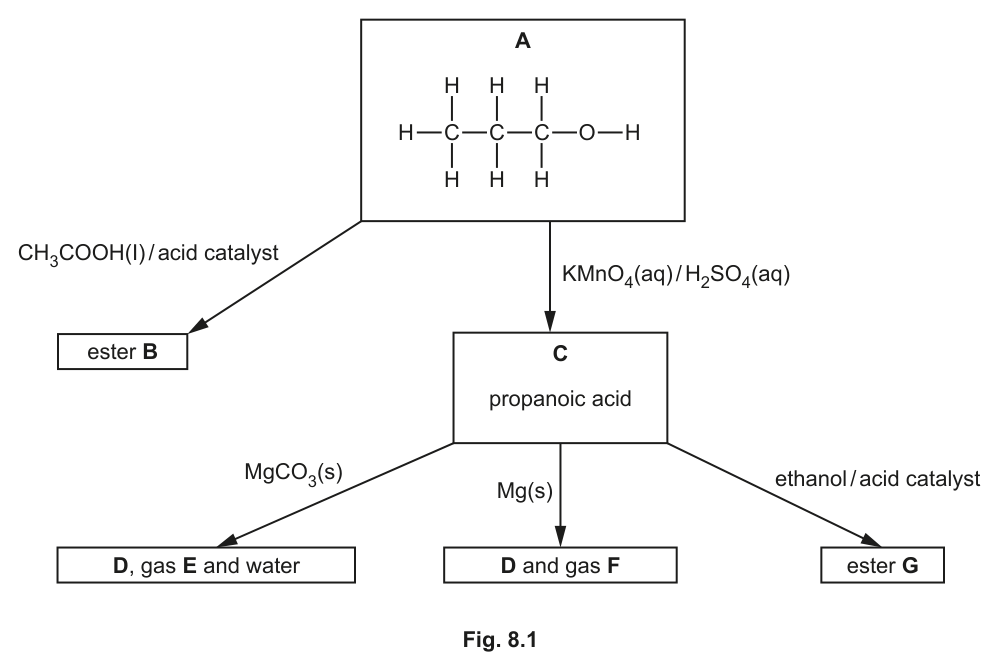
Compound A is one of the structural isomers of alcohols with molecular formula .
Answer
propan-1-ol
propan-1-ol
Walkthrough
Compound A is given as a displayed formula with the hydroxyl (–OH) group on the first carbon of a three-carbon chain. The molecular formula is . A three-carbon alcohol with the –OH on the end carbon is named propan-1-ol.
Key Takeaways
Alcohols are named based on the longest carbon chain (propane -> propan-) and the position of the –OH group (on carbon 1 -> -1-ol).
Common Mistakes
Writing "propyl alcohol" (common name) instead of the IUPAC name "propan-1-ol". Forgetting the number if it were not propan-1-ol, though for propan-1-ol the number is often required to distinguish it from propan-2-ol.
Things to Be Careful About
Ensure the name matches the displayed formula exactly. The –OH is on the terminal carbon, making it a primary alcohol.
Answer
Displayed formula of propan-2-ol: a three-carbon chain with the OH group on the middle carbon, all C-H and C-C bonds shown.
Walkthrough
The question asks for the other structural isomer of that is an alcohol. The first isomer is propan-1-ol (OH on carbon 1). The other isomer is propan-2-ol (OH on carbon 2). A displayed formula must show every single bond and every atom.
Key Takeaways
Structural isomers have the same molecular formula but different structural formulae. For propanol, the isomers are propan-1-ol and propan-2-ol.
Common Mistakes
Drawing a condensed formula () instead of a displayed formula. Forgetting to show the O–H bond explicitly. Drawing an ether (like methoxyethane) instead of an alcohol.
Things to Be Careful About
A displayed formula requires every bond to be drawn as a line. The central carbon is bonded to H, OH, , and .
Answer
Displayed formula of propyl ethanoate: with all bonds shown.
Walkthrough
Compound A is propan-1-ol. It reacts with ethanoic acid () in the presence of an acid catalyst. This is an esterification reaction. The alcohol provides the propyl group () and the acid provides the ethanoate group (). The ester is propyl ethanoate.
Key Takeaways
Esterification: acid + alcohol ester + water. The name is alkyl (from alcohol) alkanoate (from acid).
Common Mistakes
Writing the condensed formula instead of the displayed formula. Mixing up the alkyl and alkanoate parts (e.g., ethyl propanoate).
Things to Be Careful About
The displayed formula must show the C=O double bond and the C–O single bond in the ester linkage. All C–H bonds must be drawn.
Answer
CH3CH2COOH
Walkthrough
Compound C is identified in the diagram as propanoic acid. The structural formula shows the carbon chain and the functional group without drawing every bond.
Key Takeaways
Carboxylic acids have the functional group –COOH. Propanoic acid has a 3-carbon chain.
Common Mistakes
Writing (acceptable but less common in 5070) or missing the H in the COOH group.
Things to Be Careful About
The question asks for the structural formula, not the displayed formula. is sufficient.
Answer
name: magnesium propanoate
formula:
name: magnesium propanoate; formula: Mg(CH3CH2COO)2
Walkthrough
Propanoic acid reacts with magnesium carbonate (). Acid + carbonate salt + water + carbon dioxide. The acid is propanoic acid (), so the anion is propanoate (). The metal is magnesium (). To balance charges, two propanoate ions are needed for one magnesium ion. The salt is magnesium propanoate.
Key Takeaways
Carboxylic acids react like mineral acids with carbonates and metals, forming carboxylate salts.
Common Mistakes
Writing the formula as (missing the subscript 2). Naming it "magnesium propionate" (common name, not IUPAC).
Things to Be Careful About
Magnesium has a 2+ charge (). The propanoate ion has a 1- charge (). The formula must be or .
Answer
E: carbon dioxide
F: hydrogen
E: carbon dioxide; F: hydrogen
Walkthrough
Reaction with : acid + carbonate salt + water + carbon dioxide. So gas E is carbon dioxide ().
Reaction with Mg: acid + metal salt + hydrogen. So gas F is hydrogen ().
Key Takeaways
Acids react with carbonates to release . Acids react with reactive metals (above H in reactivity series) to release .
Common Mistakes
Confusing the gases. Thinking is produced from carbonates.
Things to Be Careful About
Name the gas, not just the formula, unless asked for formula. "Carbon dioxide" and "hydrogen".
Answer
ethyl propanoate
ethyl propanoate
Walkthrough
Propanoic acid (C) reacts with ethanol in the presence of an acid catalyst. This is esterification. The alcohol (ethanol) provides the alkyl group "ethyl". The acid (propanoic acid) provides the alkanoate group "propanoate". The ester is ethyl propanoate.
Key Takeaways
Ester naming: alkyl group from the alcohol, alkanoate group from the carboxylic acid.
Common Mistakes
Writing "propyl ethanoate" (this is ester B, formed from propanol and ethanoic acid). Swapping the names.
Things to Be Careful About
Ethanol has 2 carbons -> ethyl. Propanoic acid has 3 carbons -> propanoate.
Polymers are made by either an addition reaction or a condensation reaction.
Answer
Addition polymerisation: monomers join together with no other product formed.
Condensation polymerisation: monomers join together with the formation of a simple molecule, e.g. water.
Addition: monomers join with no other product formed. Condensation: monomers join with formation of a simple molecule, e.g. water.
Walkthrough
This question tests your knowledge of the two ways polymers are made.
Addition polymerisation uses monomers that contain a carbon–carbon double bond, such as alkenes. The double bond opens and the monomers join end to end. No other substance is released, so the only product is the polymer. Because no atoms are lost, the polymer has the same empirical formula as the monomer.
Condensation polymerisation uses monomers with two functional groups, such as a carboxylic acid group and an alcohol group. As the monomers join, a small molecule is produced and removed; this is usually water, but the mark scheme simply says a simple molecule. Because atoms are lost as the small molecule, the polymer does not have the same empirical formula as the monomers.
For full marks you only need one correct comment about each type.
Key Takeaways
- Addition polymerisation: monomers with C=C bond, no other product, same empirical formula.
- Condensation polymerisation: two functional groups, small molecule formed, empirical formula changes.
- The mark scheme accepts any one correct statement about each type.
Common Mistakes
- Giving two comments about addition but only one about condensation, so a mark is lost.
- Saying water is always formed in condensation polymerisation; the mark scheme accepts a simple molecule, with water as the common example.
- Stating that addition polymers have a different empirical formula; it is the same because no atoms are lost.
- Suggesting condensation uses a C=C bond; that is addition polymerisation.
Things to Be Careful About
- The command word is describe, so the answer should be in words, not equations.
- Make sure the no-other-product idea is clear for addition, and say simple molecule formed for condensation.
- You do not need both examples from the list; one valid point on each side scores full marks.
PET is a condensation polymer.
Name the type of linkage that bonds the repeat units to one another in PET.
______
Answer
ester
ester
Walkthrough
PET stands for poly(ethylene terephthalate). It is made by condensation polymerisation between a dicarboxylic acid and a diol. The functional group that joins the repeat units is the same ester group found in esters. You only need to name the linkage: ester.
Key Takeaways
- PET is a polyester.
- The ester linkage is formed when a carboxylic acid group reacts with an alcohol group, eliminating water.
- Condensation polymers have characteristic linkages: PET has ester linkages; nylon has amide linkages.
Common Mistakes
- Writing amide or peptide — those are linkages in polyamides such as nylon, not PET.
- Writing the name of the monomer, ethylene terephthalate, instead of the linkage type.
Things to Be Careful About
- The question asks for the type of linkage, not a drawing or a monomer.
- The ester linkage contains the –COO– arrangement; remembering this stops you confusing it with an amide.
A polymer contains carbon, hydrogen and chlorine by mass.
Calculate the empirical formula of this polymer.
empirical formula ______
Working
Assume 100 g of polymer, so the percentages become masses in grams.
Amounts in mol:
C:
H:
Cl:
Divide by the smallest amount (1.31):
C:
H:
Cl:
Answer
C3H5Cl
Walkthrough
The percentages are by mass, so we can assume 100 g of polymer. That turns each percentage directly into a mass in grams.
Amounts in moles:
: mol
: mol
: mol
Divide by the smallest amount (1.31 mol):
C:
H:
Cl:
So the simplest whole-number ratio is C : H : Cl = 3 : 5 : 1, giving the empirical formula .
Key Takeaways
- Percentage composition by mass can be treated as grams when finding an empirical formula.
- Convert mass to moles by dividing by relative atomic mass.
- Divide all mole amounts by the smallest value to get the simplest whole-number ratio.
Common Mistakes
- Using 35 for chlorine instead of 35.5.
- Rounding 3.925 to 4 before dividing; divide first, then round the final ratio.
- Forgetting to divide by the smallest number, so the formula is not in simplest whole-number ratio.
- Writing the formula in the wrong order; here the empirical formula is written C then H then Cl.
Things to Be Careful About
- Use values carefully: C = 12, H = 1, Cl = 35.5.
- Carry enough decimal places through the working; the ratio comes out at almost exactly 3 : 5 : 1.
- The percentages sum to 100.0 here, so no extra element such as oxygen needs to be considered.
Plastics are made from polymers.
Describe two environmental challenges caused by plastics.
- ______
- ______
Answer
- Plastics can fill up landfill sites.
- Plastics accumulate in the oceans.
Plastics fill up landfill sites; plastics accumulate in oceans.
Walkthrough
This is a recall question where you must give two distinct environmental problems caused by plastics. The mark scheme allows any two from: landfill sites may fill up, plastics accumulate in oceans, and burning plastics produces toxic gases. The answer above chooses the first two; either alternative is also accepted.
Key Takeaways
- Plastics are non-biodegradable and take up space in landfill.
- They can accumulate in oceans and harm marine life.
- Burning plastics can release toxic gases.
Common Mistakes
- Giving only one environmental problem when two are asked.
- Giving vague answers such as plastic is bad for the environment — the marks are for specific problems.
- Mentioning the same idea twice in different words, such as fills landfill and takes up space in landfill; this may be treated as one point.
Things to Be Careful About
- The mark scheme says any two from, so list two separate, recognisable problems.
- Acceptable alternatives may be phrased differently from the mark scheme, but they must clearly describe an environmental challenge.