Chemistry 5070/12 — May/June 2024
Cambridge O-Level · Multiple Choice · answer key with instant marking and worked solutions
Topics Atoms, Elements and Compounds · Stoichiometry · Organic Chemistry · Chemical Reactions · Acids, Bases and Salts · Electrochemistry · +6 more
Tap an option under each question to check it — your score builds as you go.
Which physical changes are both exothermic?
Options
A condensation and evaporation
B evaporation and melting
C freezing and condensation
D melting and freezing
Working
An exothermic change releases heat energy to the surroundings.
- Freezing: liquid → solid, particles slow down and energy is released.
- Condensation: gas → liquid, particles slow down and energy is released.
- Evaporation and melting require energy input, so they are endothermic.
Therefore the pair that are both exothermic is freezing and condensation.
Answer
C
C
Walkthrough
This question asks which two physical changes release heat, i.e. are exothermic.
Recall the three changes of state:
- Melting: solid → liquid, needs energy to break some forces between particles, so it is endothermic.
- Evaporation (boiling): liquid → gas, needs energy to overcome forces between particles, so it is endothermic.
- Freezing: liquid → solid, particles lose energy and come closer together, so heat is released, making it exothermic.
- Condensation: gas → liquid, particles lose energy and come closer together, so heat is released, making it exothermic.
Option C is the only pair that contains two exothermic changes: freezing and condensation. The other options each contain at least one endothermic change.
Key Takeaways
- Exothermic changes release heat; endothermic changes absorb heat.
- Changes that involve particles slowing down and coming closer together (gas → liquid → solid) are exothermic.
- Changes that involve particles speeding up and moving further apart (solid → liquid → gas) are endothermic.
Common Mistakes
- Thinking that evaporation feels cold so it must be exothermic. In fact evaporation absorbs heat from the surroundings, so it is endothermic.
- Confusing freezing with melting. Freezing releases heat; melting absorbs heat.
- Forgetting that condensation also releases heat, just like freezing.
Things to Be Careful About
- The question asks for physical changes, so all four options are changes of state.
- Read each option carefully: two changes must both be exothermic, not one exothermic and one endothermic.
What is tap water?
Options
A a compound
B a mixture of compounds and elements
C a mixture of elements
D an element
Working
Tap water is not a single substance. It contains water (a compound) and small amounts of dissolved gases and dissolved minerals, such as calcium and magnesium compounds. A substance made of two or more different substances physically mixed together is a mixture, so tap water is a mixture of compounds and elements.
Answer
B
B
Walkthrough
Tap water looks like a single substance, but chemically it is not. Pure water is always water only: , a compound made from hydrogen and oxygen. Tap water, however, also contains dissolved substances: dissolved gases such as oxygen and nitrogen, dissolved minerals such as calcium compounds, and sometimes added chlorine. Because it is made of different substances mixed together, it is a mixture.
The options can be judged as follows:
- A compound — a compound is a single substance made of two or more elements joined chemically, such as pure water. Tap water contains water but also other substances, so it is not a compound.
- B mixture of compounds and elements — correct. Tap water contains water (a compound) and dissolved substances, some of which may be compounds (e.g. calcium salts) and some elements (e.g. dissolved oxygen or chlorine).
- C a mixture of elements — the main component, water, is a compound, so this is not correct.
- D an element — an element contains only one type of atom. Tap water clearly contains hydrogen, oxygen and other substances, so this is not correct.
Key Takeaways
A mixture contains two or more different things, and each keeps its own properties. Elements consist of atoms of only one kind. Compounds are made from two or more elements chemically joined. Tap water is a natural example of a mixture because several dissolved ingredients are present.
Common Mistakes
- Thinking that because tap water looks uniform it must be pure water. A mixture can be uniform in appearance; that kind of mixture is called a solution.
- Confusing a compound with a mixture. A compound is chemically joined and has a fixed ratio; a mixture is simply substances side by side.
- Choosing A because water is a compound. Tap water is not pure water.
Things to Be Careful About
In MCQs about classifying materials, the key is to consider the actual composition of the substance, not just its deceptively clean appearance. Terms "element", "compound" and "mixture" are tested from definitions.
In which pair of particles is:
- the sum of their charges equal to zero
- the sum of their masses almost the same as of the mass of an atom of ?
Options
A one electron and one neutron
B one electron and one proton
C one neutron and one proton
D two neutrons
Working
The mass condition refers to of the mass of a atom, which is defined as 1 atomic mass unit (1 u). So we need a pair whose total mass is approximately 1 u.
The charge condition requires the charges to cancel: . This means we need one particle with charge (a proton) and one with charge (an electron). Their combined mass is about (the electron's mass is negligible).
- A: electron () + neutron () = → not zero.
- B: electron () + proton () = → correct.
- C: neutron () + proton () = → not zero.
- D: two neutrons = → not zero.
Answer
B
B
Walkthrough
The question gives two conditions and asks which pair of particles satisfies both. First, recall the properties of the three subatomic particles: protons (charge +1, mass ≈ 1 u), neutrons (charge 0, mass ≈ 1 u), and electrons (charge -1, mass ≈ 1/1840 u, essentially negligible). The phrase "1/12 of the mass of a 12C atom" is the definition of the atomic mass unit (u). So the second condition is that the pair's total mass is about 1 u. The first condition, charges sum to zero, forces us to have one positive and one negative charge, i.e., one proton and one electron. This pair also satisfies the mass condition because the proton provides ~1 u and the electron adds almost nothing. The other pairs either don't cancel charge (A, C, D) or don't have the right mass (D). Therefore, B is the answer.
Key Takeaways
- Know the relative charges and masses of protons, neutrons, and electrons.
- Understand that 1/12 of the mass of a 12C atom is defined as 1 atomic mass unit (u).
- The mass of an electron is negligible compared to that of a proton or neutron.
Common Mistakes
- Forgetting that the charge of an electron is -1 and that of a proton is +1, so they cancel.
- Thinking that a neutron and a proton have the same charge (they don't: neutron is neutral).
- Overlooking that the electron's mass is negligible, so the mass of an electron-proton pair is essentially just the proton's mass.
Things to Be Careful About
- The definition of the atomic mass unit is based on 12C, not the most common isotope of hydrogen.
- Charges are integers: +1, -1, 0.
- The mass condition is "almost the same as" 1 u, so we can ignore the electron's mass.
An element has two isotopes of relative isotopic masses and .
The diagram shows the composition of atoms in a sample of the element.
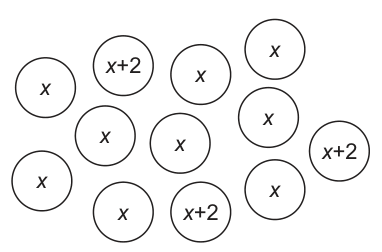
What is the relative atomic mass of the sample of the element?
Options
A
B
C
D
Working
Number of atoms with mass = 9
Number of atoms with mass = 3
Total number of atoms = 12
Relative atomic mass =
Answer
A
A
Walkthrough
The relative atomic mass is the weighted average of the relative isotopic masses, based on their relative abundance in the sample.
First, count the atoms of each isotope from the diagram. There are 9 atoms with mass and 3 atoms with mass , giving a total of 12 atoms.
Next, calculate the sum of the masses: .
Finally, divide by the total number of atoms to find the average: .
This matches option A.
Key Takeaways
- The relative atomic mass of a sample is the weighted average of the masses of its isotopes.
- When given a diagram of atoms, count each isotope to determine the relative abundance.
- The formula is: relative atomic mass = .
Common Mistakes
- Forgetting to divide by the total number of atoms and simply averaging the two isotope masses (, which is option B). This is wrong because the isotopes are not present in equal amounts.
- Miscounting the atoms in the diagram.
- Forgetting to distribute the 3 into , leading to , and then .
Things to Be Careful About
- Always check the relative abundance (number of atoms) of each isotope; do not assume a 50:50 mixture unless stated.
- Ensure the equation is fully simplified before matching it to the options.
- In Paper 1 multiple-choice questions, the mark scheme gives only the correct option letter, so you must construct all the reasoning yourself.
Which molecule has only four electrons involved in covalent bonds?
Options
A Cl₂
B CO₂
C H₂S
D N₂
Working
Each covalent bond is a shared pair of electrons, so 2 electrons are involved per bond. Four electrons involved means the molecule contains two shared pairs of electrons.
- A : one single bond — 2 electrons involved.
- B : two double bonds, — 8 electrons involved.
- C : two single S–H bonds — 4 electrons involved.
- D : one triple bond — 6 electrons involved.
Answer
C
C
Walkthrough
A covalent bond is formed when two atoms share a pair of electrons. That shared pair contains 2 electrons, so the number of electrons involved in covalent bonds is always twice the number of shared pairs.
The question asks for a molecule with only four electrons involved in covalent bonds, which means it must contain two shared pairs of electrons.
- has one shared pair, so only 2 electrons are involved in bonding.
- has two double bonds. Each double bond is two shared pairs, so there are four shared pairs in total, meaning 8 electrons are involved.
- has two single S–H bonds, so there are two shared pairs, meaning 4 electrons are involved.
- has one triple bond, which is three shared pairs, meaning 6 electrons are involved.
Therefore, is the correct answer.
Key Takeaways
- A covalent bond is a shared pair of electrons.
- The number of electrons involved in covalent bonds = 2 × number of shared pairs.
- A single bond has 2 electrons, a double bond has 4 electrons, and a triple bond has 6 electrons.
Common Mistakes
- Confusing the number of shared pairs with the number of electrons involved. Each shared pair contains 2 electrons.
- Thinking has only two bonds in total and therefore only 4 electrons. In fact, each C=O bond is a double bond, so has 8 electrons involved in bonding.
- Counting lone pairs as electrons involved in covalent bonds. Lone pairs are not shared and are not involved in covalent bonds.
Things to Be Careful About
- Read the question carefully: it asks for electrons involved in covalent bonds, not the number of bonds.
- has two single bonds, not a double bond.
- has a triple bond, which involves 6 electrons, not 4.
The melting points and boiling points of four compounds, W, X, Y and Z, are given in the table.
| melting point / | boiling point / | |
|---|---|---|
| W | 63 | 354 |
| X | –7 | 59 |
| Y | 1728 | 2230 |
| Z | –183 | –89 |
The four compounds are silicon(IV) oxide, ethane, bromine and a carboxylic acid of formula C₁₆H₃₂O₂.
Which row identifies W, X, Y and Z?
Options
| silicon(IV) oxide | ethane | bromine | carboxylic acid C₁₆H₃₂O₂ | |
|---|---|---|---|---|
| A | W | X | Z | Y |
| B | W | Y | Z | X |
| C | Y | Z | W | X |
| D | Y | Z | X | W |
Working
Silicon(IV) oxide has a giant covalent structure, so many strong covalent bonds must be broken when it melts/boils; its melting point is very high, . Therefore Y = silicon(IV) oxide.
Ethane is a simple molecule with only weak intermolecular forces, giving the lowest melting and boiling points. Z has mp −183°C and bp −89°C, so Z = ethane.
Bromine is also a simple molecule; its melting point of −7°C and boiling point of 59°C are slightly higher than ethane's, so X = bromine.
The carboxylic acid C₁₆H₃₂O₂ contains hydrogen bonding between its –COOH groups, so its melting and boiling points are much higher than the simple molecular substances but not as high as a giant covalent network. W = carboxylic acid.
This matches row D.
Answer
D
D
Walkthrough
The question gives a table of melting and boiling points for four compounds and asks us to match each letter to the correct substance.
-
Silicon(IV) oxide, SiO₂ – This is a giant covalent structure in which many strong covalent bonds hold the atoms in a large lattice. To melt or boil it, many of these strong bonds must be broken, which takes a great deal of energy. So it must have the highest melting and boiling points: Y (1728°C, 2230°C).
-
Ethane, C₂H₆ – This is a simple molecular covalent substance. The covalent bonds within each molecule are strong, but the forces between molecules are only weak intermolecular forces. Therefore it melts and boils at very low temperatures: Z (−183°C, −89°C).
-
Bromine, Br₂ – Also a simple molecular substance. The bromine molecule is larger than ethane, so its intermolecular forces are a little stronger and its melting/boiling points are a little higher: X (−7°C, 59°C). It is a liquid at room temperature.
-
Carboxylic acid C₁₆H₃₂O₂ – This is also covalent, but each molecule has a –COOH group. The O–H bond is highly polar, so molecules can form hydrogen bonds with each other. Hydrogen bonding is the strongest intermolecular force, so this substance has the highest melting/boiling points among the simple molecular compounds: W (63°C, 354°C).
Only row D correctly matches all four: W = carboxylic acid, X = bromine, Y = silicon(IV) oxide, Z = ethane.
Key Takeaways
- The type of structure (“giant covalent” or “simple molecular”) strongly affects melting and boiling points.
- Giant covalent structures melt and boil at very high temperatures because covalent bonds must be broken throughout the lattice.
- Simple molecular substances have low melting and boiling points because only weak intermolecular forces need to be overcome.
- Hydrogen bonding between carboxylic acid molecules makes their melting and boiling points higher than those of similar alkanes.
Common Mistakes
- Calling silicon(IV) oxide ionic. It has a giant covalent structure, not an ionic lattice.
- Forgetting that ethane is a simple molecule and giving it too high a melting point.
- Ignoring the role of hydrogen bonding in the carboxylic acid and assuming it behaves like an alkane.
- Matching only one substance and choosing an option without checking all four.
Things to Be Careful About
- The table is in °C; make sure you use the correct negative/positive values.
- Silicon(IV) oxide is the only giant covalent substance here, so it has by far the highest values.
- The presence of a –COOH group makes the carboxylic acid hydrogen-bonding, so it must have a much higher boiling point than bromine.
- Check every row before choosing; option D is the only one in which all four match.
What is the formula of zinc oxide?
Options
A Zn₂O
B ZnO
C Zn₂O₃
D ZnO₂
Working
Zinc forms a ion and oxide is . One ion balances one ion, so the formula is .
Answer
B
B
Walkthrough
Zinc forms a ion. The oxide ion is . An ionic compound must be neutral overall, so the total positive charge must equal the total negative charge. One ion and one ion give equal and opposite charges, so the formula is .
Check the other options by adding up charges:
- : , not neutral.
- : , not neutral.
- : , not neutral.
Only has zero total charge.
Key Takeaways
- Ionic compounds are neutral: total positive charge equals total negative charge.
- Know common ion charges, especially and .
- Writing a formula is balancing charges, not copying numbers without thinking.
Common Mistakes
- Choosing by incorrectly treating zinc as a ion.
- Forgetting that oxide is , not .
- Not checking that the total charge of the formula is zero.
Things to Be Careful About
- No state symbols are needed here.
- In a multiple-choice question, quickly verify the total charge of each option.
- Zinc always forms in its common compounds at this level.
Which statement is correct?
Options
A If the relative formula mass of hydrated sodium carbonate, Na₂CO₃•H₂O, is 286, then is 10.
B Phosphoric(V) acid, H₃PO₄, has a relative molecular mass of 50.
C The relative atomic mass of a sample of an element with isotopes of masses 20 and 22 can only be equal to 21.
D The relative atomic mass of an element is the average mass of atoms of isotopes of the element compared with the mass of a hydrogen atom.
Working
Statement A
For :
The hydrated salt has formula mass 286, so the water of crystallisation contributes:
Each has formula mass 18, so:
Statement A is correct.
Statement B
:
So it is not 50.
Statement C
The relative atomic mass of an element depends on the abundance of its isotopes. With isotope masses 20 and 22, the relative atomic mass can be any value between 20 and 22, not only 21.
Statement D
Relative atomic mass is the average mass of atoms of isotopes compared with one-twelfth of the mass of a carbon-12 atom, not a hydrogen atom.
Answer
A
A
Walkthrough
This question gives four statements about relative masses and asks which one is correct. Test each statement in turn.
- A Hydrated sodium carbonate has the formula . The anhydrous part, , has formula mass . The total formula mass is 286, so the water of crystallisation contributes . Since one water molecule has mass 18, . So A is correct.
- B Phosphoric(V) acid, , has formula mass , not 50. So B is wrong.
- C If an element has isotopes of masses 20 and 22, its relative atomic mass is a weighted average. It depends on how much of each isotope is present, so it can be any value between 20 and 22. It is not forced to be 21. So C is wrong.
- D The standard used for relative atomic mass is one-twelfth of the mass of one carbon-12 atom, not a hydrogen atom. So D is wrong.
Therefore, the correct answer is A.
Key Takeaways
- Relative formula mass is the sum of all the relative atomic masses of the atoms in the formula.
- When a salt is hydrated, the water molecules are part of the formula and must be included in the formula mass.
- Relative atomic mass is a weighted average of isotope masses, so it depends on the abundance of each isotope.
- The standard reference for relative atomic mass is carbon-12.
Common Mistakes
- Forgetting to include the water of crystallisation when calculating the formula mass of a hydrated salt.
- Assuming the relative atomic mass of two isotopes is simply the average of their mass numbers.
- Choosing hydrogen as the reference atom for relative atomic mass, instead of carbon-12.
- Misreading the atomic masses, for example giving phosphorus a mass of 15 instead of 31.
Things to Be Careful About
- Use the correct atomic masses: , , , , .
- In hydrated salts, the water molecules are chemically included in the formula, so they contribute to the formula mass.
- Relative atomic mass is a weighted average, so it can be a non-integer and is not simply the average of two isotope mass numbers.
- Relative atomic mass is measured on a scale where one-twelfth of a carbon-12 atom has a mass of exactly 1.
In a volumetric experiment, of sodium hydroxide reacts exactly with of dilute sulfuric acid.
What is the concentration of the dilute sulfuric acid?
Options
A
B
C
D
Working
Moles of sodium hydroxide used:
From the equation, 2 mol of NaOH reacts with 1 mol of , so:
Concentration of the dilute sulfuric acid:
Option C would arise if the 2:1 mole ratio were ignored; A is the correct value.
Answer
A
A
Walkthrough
Step 1 — Find the moles of sodium hydroxide that actually react. The volume is 25.0 cm³, so convert to dm³ by dividing by 1000, then multiply by the concentration 0.100 mol/dm³. This gives 0.00250 mol of NaOH.
Step 2 — Use the balanced equation to relate NaOH to H₂SO₄. The equation shows 2 mol NaOH react with 1 mol H₂SO₄, so the moles of acid must be half the moles of alkali: 0.00250 ÷ 2 = 0.00125 mol.
Step 3 — Find the concentration of the sulfuric acid. It is the moles dissolved divided by the volume of solution in dm³. The acid volume is 20.0 cm³, so divide by 1000 to get 0.0200 dm³. Then:
concentration = 0.00125 ÷ 0.0200 = 0.0625 mol/dm³.
This matches option A. The most common trap is forgetting the limiting ratio: if you divided 0.00250 by 0.0200 without halving, you would get 0.125 mol/dm³ (option C). Options B and D come from mixing up the volumes or using the wrong numerator.
Key Takeaways
- A titration calculation always follows three steps: (1) moles from a known solution, (2) the mole ratio from the balanced equation, (3) the concentration of the other solution.
- The balanced equation, not the volumes, gives the mole ratio.
- Every volume used must be converted from cm³ to dm³ before placing it in a concentration calculation.
Common Mistakes
- Forgetting to halve the moles of NaOH according to the 2:1 stoichiometry. This gives 0.125 mol/dm³ and is option C.
- Working in cm³ instead of dm³ when doing the division by the acid volume.
- Mixing up the two volumes in the final concentration step, which leads to option B or D.
Things to Be Careful About
- Always check the mole ratio from the balanced equation; NaOH is in a 2:1 ratio with H₂SO₄, not 1:1.
- Volumes must be in dm³: divide each by 1000.
- Write the final answer with the correct unit: mol / dm³.
- The gas volume at r.t.p. is not relevant here; this is a volumetric (titration) calculation, not a gas calculation.
The equation for the reaction between ammonium chloride and calcium hydroxide is shown.
of ammonium chloride and of calcium hydroxide are mixed and warmed.
of calcium chloride is obtained from the reaction.
What is the percentage yield of calcium chloride?
[: NH₄Cl, 53.5; Ca(OH)₂, 74; CaCl₂, 111]
Options
A 39.2%
B 45.0%
C 67.6%
D 90.1%
Working
Moles of ammonium chloride:
Moles of calcium hydroxide:
From the equation, 2 mol reacts with 1 mol , so 0.200 mol needs only 0.100 mol . Calcium hydroxide is in excess and ammonium chloride is the limiting reactant.
Theoretical moles of formed = 0.100 mol.
Answer
D
D
Walkthrough
This is a limiting reactant and percentage yield question. Start by converting both reactant masses to moles using their relative formula masses.
The balanced equation shows a 2:1 mole ratio between ammonium chloride and calcium hydroxide:
So 0.200 mol of needs only 0.100 mol of . Since 0.200 mol of calcium hydroxide is present, calcium hydroxide is in excess and ammonium chloride is the limiting reactant.
The limiting reactant controls how much product can form. From the equation, 2 mol of gives 1 mol of , so 0.200 mol of gives 0.100 mol of .
The actual mass obtained is 10.0 g. Percentage yield compares the actual yield with the theoretical yield:
Therefore the correct option is D.
Key Takeaways
- Always identify the limiting reactant before calculating the amount of product.
- Use the mole ratio from the balanced equation, not just the masses given.
- Theoretical yield is the maximum mass of product possible from the limiting reactant.
- Percentage yield is calculated using:
Common Mistakes
- Assuming calcium hydroxide is limiting just because both masses give 0.200 mol. The 2:1 ratio in the equation must be used.
- Using the mass of reactants directly in the percentage yield formula instead of the theoretical mass of product.
- Forgetting that 2 mol of gives only 1 mol of .
- Rounding too early and getting 90.0% instead of 90.1%.
Things to Be Careful About
- Use the given values carefully: is 53.5, is 74 and is 111.
- Keep the calculation exact until the final step, then round to the precision asked for.
- Include the unit (%) in the final answer.
- The actual yield is always less than or equal to the theoretical yield, so a percentage yield above 100% would signal an error.
The diagram shows a simple electrolytic cell.
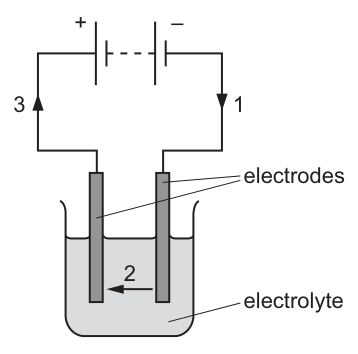
Which arrows show the movement of electrons?
Options
A 1, 2 and 3
B 1 and 2 only
C 1 and 3 only
D 2 only
Answer
C
In an electrolytic cell, electrons flow through the external circuit (the wires and electrodes) but not through the electrolyte. Charge in the electrolyte is carried by the movement of ions.
- Electrons leave the negative terminal of the power supply and travel down the wire to the cathode (negative electrode). Arrow 1 shows this correct direction.
- Electrons are removed from the anode (positive electrode) and travel up the wire to the positive terminal of the power supply. Arrow 3 shows this correct direction.
- Arrow 2 suggests electrons move through the electrolyte, which is incorrect; ions move in the electrolyte, not electrons.
Therefore, arrows 1 and 3 show the movement of electrons.
C
Walkthrough
To determine which arrows show the movement of electrons, we must consider how an electrolytic cell operates.
-
External circuit (wires and electrodes): Electrons flow through the metal wires and electrodes. They are pushed out of the negative terminal of the DC power supply and travel towards the cathode (the electrode connected to the negative terminal). In the diagram, arrow 1 points downwards in the wire connected to the negative terminal, which correctly shows electrons moving towards the cathode. At the anode (connected to the positive terminal), electrons are drawn into the positive terminal. Arrow 3 points upwards in the wire connected to the positive terminal, correctly showing electrons moving away from the anode and towards the positive terminal.
-
Electrolyte (solution or molten compound): Electrons do NOT flow through the electrolyte. The electrolyte conducts electricity via the movement of ions (cations move towards the cathode, anions move towards the anode). Arrow 2 shows a movement from the negative electrode to the positive electrode through the electrolyte, which represents the wrong charge carrier (electrons instead of ions) and the wrong direction for anions anyway. Therefore, arrow 2 does not show electron movement.
Since only arrows 1 and 3 correctly depict electron flow, the correct option is C.
Key Takeaways
- In electrolysis, electrons flow only in the external circuit (wires and electrodes), never through the electrolyte.
- Electrons flow from the negative terminal of the power supply to the cathode, and from the anode to the positive terminal.
- Charge in the electrolyte is carried by ions, not electrons.
Common Mistakes
- Thinking electrons flow through the electrolyte: Arrow 2 is a common distractor. Students may confuse the flow of electrons in the wires with the flow of charge in the solution. Remember, ions carry charge in the electrolyte.
- Confusing electron flow with conventional current: Conventional current flows from positive to negative, which is opposite to electron flow. However, the question specifically asks for the movement of electrons, so we follow the electron flow (negative to positive through the external circuit).
Things to Be Careful About
- Always check whether the question asks for electron flow or conventional current flow.
- Remember that the physical location of charge carriers is: electrons in metals, ions in electrolytes.
- Arrow 2 might be tempting if one thinks of 'current' flowing from positive to negative, but even then, the direction through the electrolyte for conventional current would be anode to cathode (positive to negative), not negative to positive. Regardless, electrons definitely do not flow through the electrolyte.
Which changes are observed during the electrolysis of aqueous copper(II) sulfate using copper electrodes?
- A pink solid is deposited on the negative electrode.
- Bubbles form on the positive electrode.
- The colour of the solution does not change.
Options
A 1, 2 and 3
B 1 and 2 only
C 1 and 3 only
D 2 and 3 only
Working
In aqueous copper(II) sulfate the ions present are Cu²⁺, SO₄²⁻, H⁺ and OH⁻.
Negative electrode (cathode): Cu²⁺ ions are discharged in preference to H⁺ because copper is less reactive than hydrogen.
Pink/brown copper metal is deposited, so statement 1 is correct.
Positive electrode (anode): The copper electrode is an active electrode, so the copper atoms dissolve:
No gas is produced, so no bubbles form; statement 2 is incorrect.
Colour of the solution: The Cu²⁺ ions removed at the cathode are replaced by those dissolving from the anode, so the blue colour does not change; statement 3 is correct.
Answer
C
C
Walkthrough
This question tests your understanding of the electrolysis of aqueous copper(II) sulfate when copper electrodes are used — the same set-up used to purify copper.
Statement 1 — A pink solid is deposited on the negative electrode.
The negative electrode (cathode) attracts the positive Cu²⁺ ions. Because copper is lower than hydrogen in the reactivity series, Cu²⁺ is discharged in preference to H⁺ from the water:
The copper metal that plates out is pink/brown in colour. Statement 1 is correct.
Statement 2 — Bubbles form on the positive electrode.
This is the key distinguishing feature of using copper (active) electrodes. If the electrodes were inert (e.g. carbon), oxygen gas would bubble off at the anode. But because the anode is made of copper, the copper atoms themselves dissolve instead:
No gas is produced, so no bubbles form. Statement 2 is incorrect.
Statement 3 — The colour of the solution does not change.
For every Cu²⁺ ion removed from solution at the cathode, one Cu²⁺ ion is added at the anode. The concentration of blue Cu²⁺ ions stays constant, so the blue colour does not change. Statement 3 is correct.
Statements 1 and 3 are correct, so the answer is C.
Key Takeaways
- With copper (active) electrodes, the anode dissolves rather than producing oxygen gas — this is the basis of copper purification and electroplating.
- At the cathode, Cu²⁺ is preferentially discharged over H⁺ because copper is less reactive than hydrogen.
- The blue colour of copper(II) sulfate solution stays constant during electrolysis with copper electrodes because Cu²⁺ is removed and replenished at equal rates.
Common Mistakes
- Choosing statement 2 as correct: This is the most common error. Students forget that with copper electrodes, the anode dissolves instead of producing oxygen gas. Bubbles would only form if the electrodes were inert (carbon or platinum).
- Thinking the solution fades: Some students think the blue colour fades because copper is being removed. But the dissolving anode replaces the Cu²⁺, so the colour is unchanged.
- Confusing the product at the cathode: Remember the pink/brown colour of freshly deposited copper metal — this is a giveaway that statement 1 is correct.
Things to Be Careful About
- Active vs inert electrodes: Always check the electrode material. Copper electrodes behave completely differently from carbon/platinum electrodes.
- The colour of copper metal: Copper is described as pink, brown, or reddish-brown — these are all acceptable descriptions of the deposited solid.
- Concentration of the electrolyte: The concentration of Cu²⁺ stays constant here only because both electrodes are copper. If the anode were inert, the solution would gradually lose its blue colour.
Which row describes a hydrogen-oxygen fuel cell?
Options
| chemical product | comparison of fuel cell with petrol engine | |
|---|---|---|
| A | hydrogen and oxygen | hydrogen has a lower energy content by mass than petrol |
| B | hydrogen and oxygen | a renewable fuel may be used in a fuel cell, a petrol engine uses a non-renewable fuel |
| C | water only | hydrogen has a lower energy content by mass than petrol |
| D | water only | a renewable fuel may be used in a fuel cell, a petrol engine uses a non-renewable fuel |
Working
A hydrogen-oxygen fuel cell combines hydrogen with oxygen to produce water as the only chemical product, releasing electrical energy. So the chemical product is water only, not hydrogen and oxygen. This eliminates A and B.
Between C and D, the statement "hydrogen has a lower energy content by mass than petrol" is false — hydrogen actually has a higher energy content by mass than petrol. The correct comparison is that hydrogen can be produced from renewable sources, whereas petrol is a non-renewable fuel. Therefore D is correct.
Answer
D
D
Walkthrough
A fuel cell is an electrochemical cell that converts the chemical energy of a fuel directly into electrical energy. In a hydrogen-oxygen fuel cell:
- Hydrogen is the fuel (oxidised at the anode).
- Oxygen is the oxidising agent (reduced at the cathode).
- The only chemical product is water.
The overall reaction is:
2H2 + O2 -> 2H2O
So the "chemical product" column should say water only, not hydrogen and oxygen. Hydrogen and oxygen are the reactants, not the products. This rules out options A and B.
Now we compare C and D. The two comparison statements are:
-
"Hydrogen has a lower energy content by mass than petrol" — this is false. Hydrogen has a very high energy content per kilogram compared with petrol. This is why hydrogen is attractive as a fuel, even though it is hard to store.
-
"A renewable fuel may be used in a fuel cell, a petrol engine uses a non-renewable fuel" — this is true. Hydrogen can be made by electrolysis of water using electricity from renewable sources such as wind or solar, so it can be a renewable fuel. Petrol is obtained from crude oil, a finite, non-renewable fossil fuel.
Therefore the correct row is D: water only, and the renewable/non-renewable comparison.
Key Takeaways
- A hydrogen-oxygen fuel cell produces only water as its chemical product.
- Hydrogen and oxygen are the reactants, not the products.
- Hydrogen has a higher energy content by mass than petrol.
- Hydrogen can be a renewable fuel if produced using renewable energy; petrol is non-renewable.
Common Mistakes
- Choosing A or B because they think hydrogen and oxygen are the products. Remember, the fuel cell consumes hydrogen and oxygen and makes water.
- Choosing C because it has "water only" but ignoring the false energy comparison. Always check every part of the row.
- Confusing "energy content by mass" with "energy content by volume". Hydrogen has a high energy per kilogram but a low energy per litre at normal pressure.
Things to Be Careful About
- Read the table carefully: the first column asks for the chemical product, not the reactants.
- The word "renewable" refers to the source of the fuel, not the fuel itself. Hydrogen is only renewable if it is made using renewable energy.
- In multiple-choice questions, both columns must be correct for the row to be the answer. If one column is wrong, the whole row is wrong.
Which statements about endothermic reactions are correct?
- Energy is absorbed from the surroundings.
- Energy is released to the surroundings.
- The temperature of the reaction mixture falls.
- The temperature of the reaction mixture rises.
Options
A 1 and 3
B 1 and 4
C 2 and 3
D 2 and 4
Working
For an endothermic reaction, energy is absorbed from the surroundings, so the temperature of the reaction mixture falls.
- Statement 1: correct.
- Statement 2: incorrect.
- Statement 3: correct.
- Statement 4: incorrect.
Therefore the correct pair is 1 and 3.
Answer
A
A
Walkthrough
An endothermic reaction takes in energy from its surroundings. That energy is used to break bonds or to overcome forces between particles, so the surroundings lose energy and their temperature falls.
Statement 1 says energy is absorbed from the surroundings — this is true by definition.
Statement 2 says energy is released to the surroundings — this describes an exothermic reaction, not an endothermic one.
Statement 3 says the temperature of the reaction mixture falls — this follows directly from energy being absorbed, so it is true.
Statement 4 says the temperature of the reaction mixture rises — this is the opposite of what happens, so it is false.
The correct pair is 1 and 3, which is option A.
Key Takeaways
- Endothermic reactions absorb energy from the surroundings.
- Because energy is taken in, the reaction mixture cools down.
- Exothermic reactions release energy to the surroundings and the mixture warms up.
- Terms such as "absorb" and "release" are the defining words for these two reaction types.
Common Mistakes
- Confusing endothermic with exothermic: endothermic absorbs energy, exothermic releases energy.
- Thinking that "energy is involved" means the temperature must rise; energy can be absorbed instead.
- Choosing B (1 and 4) by pairing "absorbed" with "rises", or C (2 and 3) by pairing "released" with "falls".
Things to Be Careful About
- Read the direction of energy transfer carefully: absorbed means into the reaction, released means out of it.
- Link the temperature change directly to this energy transfer: absorbed energy cools the surroundings, released energy warms them.
- In this type of MCQ, evaluate each numbered statement before matching it to the options.
Hydrogen and chlorine react to form hydrogen chloride.
Bond energy data is given in the table.
| bond | bond energy in |
|---|---|
| H–H | 436 |
| Cl–Cl | 242 |
| H–Cl | 431 |
What is the enthalpy change, , for this reaction?
Options
A –247 kJ / mol
B –184 kJ / mol
C +184 kJ / mol
D +247 kJ / mol
Working
Energy needed to break bonds in reactants:
Total energy needed to break bonds
Energy released when product bonds form:
Using
Answer
B
B
Walkthrough
The equation is
In an enthalpy change using bond energy data, first find the total energy absorbed when bonds in the reactants are broken. Breaking bonds is endothermic, so this energy is written positively.
For , one H–H bond is broken: .
For , one Cl–Cl bond is broken: .
Total energy absorbed when bonds break
Next, find the energy released when bonds in the products form. Forming bonds is exothermic. Since the balanced symbol equation gives , there are two H–Cl bonds formed.
Now combine these using
The negative sign shows the reaction is exothermic, so the correct choice is B.
.
Key Takeaways
Bond breaking is endothermic and bond forming is exothermic.
The enthalpy change is always
A negative indicates an exothermic reaction and a positive indicates an endothermic reaction.
The coefficient in the equation tells us how many identical bonds are involved. In , the two H–Cl bonds release twice the bond energy given for one H–Cl bond.
.
Common Mistakes
- Only counting one H–Cl bond: forgetting that the equation produces , so two H–Cl bonds are formed. This gives and would lead to option A or D.
- Reversing the direction of energy change: using "energy to form bonds minus energy to break bonds" gives , which is option C. The sign is the reverse of the correct answer.
- Forgetting the sign: an exothermic reaction must have a negative , so any positive answer should be viewed with suspicion.
- Adding bond energies without considering the numbers of bonds: bond energy data is per mole of bonds, so it must be multiplied by the number of those bonds in the balanced equation.
.
Things to Be Careful About
The balanced equation is important: it shows two moles of hydrogen chloride, so two H–Cl bonds are formed.
The unit for bond energy is and the enthalpy change should also be given in , with the negative sign included for an exothermic reaction.
Do not mix up the two directions of change. Breaking bonds always requires energy; making bonds always releases energy.
The correct calculation is
. The final answer is B.
Which statement is correct?
Options
A Both physical changes and chemical changes produce new substances.
B Chemical changes are irreversible.
C During a chemical change, atoms rearrange themselves to form new chemical bonds.
D The only way to reverse a physical change is with a chemical reaction.
Working
A is incorrect: physical changes, such as melting or dissolving, do not produce new substances.
B is incorrect: chemical changes can be reversed by another chemical reaction, so they are not necessarily irreversible.
C is correct: during a chemical change, atoms are rearranged and new bonds are formed.
D is incorrect: physical changes are reversed by physical methods such as heating or cooling, not by a chemical reaction.
Answer
C
C
Walkthrough
Read each statement carefully and compare it with the definitions of physical and chemical changes.
- A says both physical and chemical changes produce new substances. This is wrong because physical changes only change the form or state of a substance; no new substance is made. For example, ice melting still gives water.
- B says chemical changes are irreversible. Some chemical changes can be reversed by a different chemical reaction or by changing conditions, so the word “irreversible” is too strong. For example, heating a compound often decomposes it back into simpler substances.
- C says that during a chemical change atoms rearrange and form new bonds. This is the key feature of chemical change: atoms are not created or destroyed, but old bonds break and new bonds form, giving new substances.
- D says the only way to reverse a physical change is with a chemical reaction. This is false because physical changes are usually reversed by changing conditions, such as cooling a liquid to freeze it or heating a solid to melt it.
So the only correct statement is C.
Key Takeaways
- Physical changes involve the same substances changing form or state.
- Chemical changes involve atoms being rearranged to form new substances through the breaking and making of bonds.
- Atoms are conserved in both physical and chemical changes.
- Chemical changes can be reversible under the right conditions, even though they are often hard to reverse.
Common Mistakes
- Choosing A based on the idea that a change always makes something new.
- Believing that all chemical changes are irreversible if no reverse reaction is mentioned.
- Thinking atoms are destroyed during a chemical change; they are only rearranged.
Things to Be Careful About
- Look for the precise wording of the correct definition: chemical change involves new bonds being formed.
- Learn how to reverse physical changes by simple processes such as heating, cooling, melting or freezing.
- Remember that the word “irreversible” is only used loosely; reversible chemical changes do exist.
Two reactions each produce a gaseous product.
The reactions are performed separately using the same conditions of temperature and pressure.
The volume of gas formed in each experiment is measured over time and the results are plotted in the graph shown.
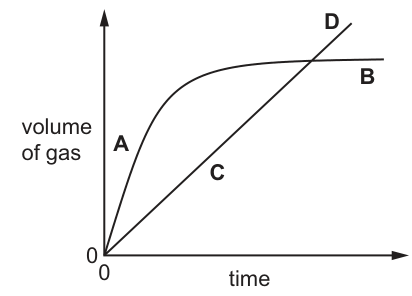
At which point is the rate of production of gas the greatest?
Options
A A
B B
C C
D D
Answer
A
The rate of reaction at any point on a volume–time graph is given by the gradient of the curve at that point.
- At A, the curve is at its steepest, so the gradient is greatest and the rate is fastest.
- At B, the curve has flattened out (gradient is zero), so the reaction has finished.
- At C and D, the graph is a straight line with a constant, shallower gradient than at A.
Therefore, the rate of production of gas is greatest at point A.
A
Walkthrough
The question asks where the rate of production of gas is greatest. On a graph of volume of gas against time, the rate of reaction at any given moment is equal to the gradient (slope) of the curve at that point.
Looking at the four points:
- Point A lies on the initial, very steep part of the curved line. The gradient here is the largest, meaning the volume of gas is increasing most rapidly. This corresponds to the start of the reaction when the concentration of reactants is highest.
- Point B lies on the flat, horizontal part of the curve. The gradient is zero, meaning no more gas is being produced and the reaction has stopped.
- Points C and D lie on a straight line with a constant, shallower slope. The rate is constant here, but it is less steep than the initial slope at A.
Since the steepest gradient is at A, the rate of gas production is greatest at A.
Key Takeaways
- The rate of reaction is represented by the gradient of a volume-time or concentration-time graph.
- A steeper gradient means a faster rate; a horizontal line (zero gradient) means the reaction has finished.
- For reactions where reactants are consumed, the rate is fastest at the beginning (steepest initial gradient) and slows down as reactants are used up (gradient decreases).
Common Mistakes
- Confusing total volume with rate: Choosing point B because it has the highest total volume of gas. The question asks for the rate of production, not the total amount produced. Total volume is the y-value; rate is the gradient.
- Misinterpreting the straight line: Assuming the straight line (C to D) represents the fastest rate because it keeps rising. A straight line means a constant rate, not necessarily the fastest rate.
Things to Be Careful About
- Always remember that rate = gradient on a volume-time graph. Do not read the y-axis value as the rate.
- Ensure you are looking at the slope (steepness) of the line at the specific point, not the overall trend of the curve.
The reaction between calcium oxide and carbon dioxide is reversible and the forward reaction is exothermic.
A mixture of calcium oxide and carbon dioxide is placed in a heated flask and the reaction reaches equilibrium.
Which statement about this equilibrium is correct?
Options
A Less calcium carbonate is produced if the pressure in the flask increases.
B More calcium carbonate is produced when the temperature is increased.
C The flask must be sealed if equilibrium is to be reached.
D When equilibrium is reached, the reaction stops.
Working
The forward reaction is exothermic. Increasing temperature favours the endothermic reverse reaction, so less calcium carbonate would be formed, not more. B is false.
There is one mole of gas on the left () and no gaseous substance on the right. Increasing pressure favours the side with fewer moles of gas, which is the forward side. So more calcium carbonate is produced, not less. A is false.
Equilibrium is dynamic: the forward and reverse reactions continue to happen at equal rates, so the reaction does not stop. D is false.
Equilibrium can be reached only if the system is closed, so that no substance is lost. Because carbon dioxide is a gas, the flask must be sealed to prevent it escaping. Therefore C is correct.
Answer
C
C
Walkthrough
This question tests the conditions needed for equilibrium and the effect of changing conditions on a reversible reaction.
-
Closed system: Equilibrium is only possible when the reaction is carried out in a closed system. If the flask is not sealed, carbon dioxide gas can escape into the air. As it leaves, the equilibrium cannot be maintained, so true equilibrium is impossible. That is why C is correct.
-
Temperature: The forward reaction is exothermic. Increasing the temperature adds heat, which favours the endothermic reverse reaction. That reaction produces less calcium carbonate, so B is wrong.
-
Pressure: For pressure changes, only gaseous substances matter. The equation has 1 mol of gas on the left and 0 mol on the right. Increasing the pressure shifts the equilibrium towards the side with fewer gas moles, which is the right-hand side. So more calcium carbonate is produced, not less. A is wrong.
-
Dynamic equilibrium: At equilibrium the forward and reverse reactions still occur, but at the same rate. The concentrations remain constant, and the reaction does not stop. So D is wrong.
The only correct statement about this equilibrium is C.
Key Takeaways
- Equilibrium is reached only in a closed system.
- At equilibrium, forward and reverse reactions continue at equal rates.
- Increasing temperature favours the endothermic reaction.
- Increasing pressure favours the side with fewer moles of gas.
- Solid substances are ignored when counting gaseous moles in pressure changes.
Common Mistakes
- Thinking that equilibrium means reactions have stopped. It is dynamic, not static.
- Forgetting that pressure changes only affect gases, not solids.
- Counting the solid substances CaO and CaCO3 as gases when applying pressure changes.
- Mixing up “exothermic” and “endothermic”: increasing temperature favours the endothermic direction, not the exothermic one.
- Not realising that a vessel must be closed (sealed) for equilibrium to be established when a gas is involved.
Things to Be Careful About
- The mark scheme only credits the correct statement: C.
- Use “closed system” rather than “sealed” where the mark scheme phrase is “sealed” is accepted.
- Do not say the reaction “stops” at equilibrium; say it continues at equal rates.
- When considering a reversible reaction, always think about which direction the equilibrium will shift in response to a specific change.
In the Haber process, hydrogen and nitrogen react to form ammonia in the presence of a catalyst.
Which reactant is obtained by fractional distillation and what is the catalyst used in the Haber process?
Options
| obtained by fractional distillation | catalyst | |
|---|---|---|
| A | hydrogen | nickel |
| B | hydrogen | iron |
| C | nitrogen | nickel |
| D | nitrogen | iron |
Working
Nitrogen is obtained by fractional distillation of liquid air. The catalyst used in the Haber process is iron, not nickel.
Therefore the correct option is D.
Answer
D
D
Walkthrough
The Haber process makes ammonia from nitrogen and hydrogen:
The nitrogen needed is obtained from air. Air is a mixture of gases, and its main component is nitrogen (about 78% by volume). To get pure nitrogen, air is first changed into a liquid and then separated by fractional distillation. Nitrogen has a lower boiling point than oxygen, so it boils off first.
Hydrogen, however, is not obtained by fractional distillation of air. It is usually made from natural gas or from reacting methane with steam.
The catalyst used in the Haber process is iron. Nickel is a catalyst for other reactions, such as turning vegetable oils into margarine, but it is not used in the Haber process.
Comparing the options:
- A and B say hydrogen is obtained by fractional distillation — this is wrong.
- A and C say the catalyst is nickel — this is wrong.
- D correctly says nitrogen is obtained by fractional distillation and the catalyst is iron.
Key Takeaways
- Air is the main source of nitrogen; nitrogen is obtained from air by fractional distillation.
- The Haber process requires an iron catalyst to speed up the reaction between nitrogen and hydrogen.
- This is a recall question, expect two basic facts: the source of each reactant and the catalyst.
Common Mistakes
- Choosing nickel because it is a familiar catalyst. The Haber process uses iron.
- Choosing hydrogen because hydrogen is also found in air in tiny amounts. In industry, hydrogen is not obtained by fractional distillation of air; nitrogen is the dominant component and is collected that way.
Things to Be Careful About
- Always check both rows of the table, not only one reactant. Both substances in the option must be correct.
- Remember that fractional distillation of liquid air is used to obtain nitrogen (and oxygen), not hydrogen.
Chlorine reacts with aqueous sodium bromide to form aqueous sodium chloride and bromine.
Which statement about this reaction is correct?
Options
A Bromide ions are oxidised because they lose electrons.
B Chlorine atoms are oxidised because they gain electrons.
C Sodium ions are oxidised because they lose electrons.
D This reaction does not involve oxidation or reduction.
Working
Chlorine is more reactive than bromine, so it displaces bromine from sodium bromide.
In ionic form:
Bromide ions, , each lose an electron to become neutral bromine atoms:
Loss of electrons is oxidation, so bromide ions are oxidised.
Chlorine gains electrons, so chlorine atoms are reduced. Sodium ions are unchanged throughout the reaction.
Answer
A
A
Walkthrough
The reaction is a halogen displacement: chlorine is above bromine in Group VII, so it is more reactive and can displace bromide ions from their aqueous solution. The balanced ionic equation is
Each bromide ion starts with a 1− charge and ends as a neutral bromine atom in . To do this it must lose one electron. Losing electrons is oxidation, which matches option A. Meanwhile each chlorine atom in gains an electron to form , so chlorine is reduced. The sodium ions are present but unchanged, so they are spectator ions and play no part in the electron transfer. Since electrons are transferred between reactants, the reaction is definitely redox, so option D is false.
Key Takeaways
- In the halogen group, a more reactive halogen (higher up) displaces a less reactive halogen (lower down) from its halide salt.
- Oxidation is loss of electrons, reduction is gain of electrons (OIL RIG).
- The displaced halide ions are the reducing agents; the halogen that reacts is the oxidising agent.
- Ionic half-equations are a fast way to see which species loses or gains electrons.
Common Mistakes
- Saying chlorine is oxidised—it actually gains electrons, so it is reduced.
- Saying sodium ions are oxidised—they stay as throughout and are spectator ions.
- Thinking no redox occurs because it looks like a simple displacement. Electron transfer happens, so it is a redox reaction.
Things to Be Careful About
- Use the correct ionic charges: bromide is , chloride is .
- Balance the electron change: two bromide ions together lose two electrons, and one chlorine molecule gains two electrons.
- In an MCQ, after identifying the species involved, be sure to check the electron change word (gain/loss) before choosing the statement.
One mole of compound X gives two moles of ions in aqueous solution. X reacts with ammonium carbonate to give an acidic gas.
What is compound X?
Options
A calcium hydroxide
B ethanoic acid
C nitric acid
D sodium hydroxide
Working
One mole of must produce exactly two moles of ions in solution.
- Calcium hydroxide: , so one mole gives 3 moles of ions — A is eliminated.
- Ethanoic acid is a weak acid and only partially ionises, so one mole gives fewer than 2 moles of ions — B is eliminated.
- Nitric acid: , so one mole gives 2 moles of ions.
- Sodium hydroxide: , so one mole also gives 2 moles of ions.
Acids react with carbonates to give carbon dioxide, an acidic gas. Sodium hydroxide (D) is an alkali, so it does not give this gas with ammonium carbonate. Nitric acid does:
Therefore is nitric acid.
Answer
C
C
Walkthrough
Start with the first clue: one mole of compound gives two moles of ions in aqueous solution. This means that when one formula unit dissolves, it must split into exactly two charged particles.
- Calcium hydroxide, , dissociates into and two ions, so one mole gives three moles of ions, not two. A is wrong.
- Ethanoic acid, , is a weak acid. It only partially ionises in water, so one mole does not give two full moles of ions. B is wrong.
- Nitric acid, , is a strong acid and fully ionises to and , giving exactly two moles of ions per mole. This fits the first clue.
- Sodium hydroxide, , also gives two ions per formula unit ( and ), so it also fits the first clue.
Now use the second clue. Acids react with carbonates to give carbon dioxide, water and a salt. Carbon dioxide is an acidic gas. Sodium hydroxide is an alkali, not an acid, so it will not produce carbon dioxide with ammonium carbonate. Nitric acid is an acid and does react with ammonium carbonate, releasing . Therefore the only compound that satisfies both clues is nitric acid, option C.
Key Takeaways
- Ionic compounds and strong acids can be represented by dissociation equations; count the total number of ions produced per formula unit.
- Weak acids do not fully ionise, so one mole of a weak acid gives fewer than two moles of ions.
- Acids react with carbonates to give carbon dioxide, an acidic gas, plus water and a salt.
- Use both clues to eliminate options rather than deciding from one clue alone.
Common Mistakes
- Counting calcium hydroxide as giving two ions because it has two hydroxide ions; it actually gives three ions in total.
- Assuming ethanoic acid gives two moles of ions because it is an acid; it is weak and only partially ionises.
- Choosing sodium hydroxide because it gives two ions, while forgetting that it is an alkali and does not give carbon dioxide with a carbonate.
- Forgetting that carbon dioxide is the acidic gas produced when an acid reacts with a carbonate.
Things to Be Careful About
- The phrase 'two moles of ions' means the total number of ions, not the number of different types of ions.
- Strong acids fully ionise; weak acids only partially ionise.
- The reaction of an acid with a carbonate is a standard test: effervescence of carbon dioxide, which turns limewater milky.
- In an MCQ, an option can satisfy one clue but fail the other; check every option against both clues.
Which statement about weak acids is correct?
Options
A Some molecules are not dissociated.
B Weak acids do not react with carbonates.
C Weak acids always form more dilute solutions than strong acids.
D Weak acids always have lower pH values than strong acids.
Working
A weak acid is one that is only partially dissociated into ions in aqueous solution. Therefore, in a solution of a weak acid, some acid molecules remain undissociated.
- A is correct: some molecules are not dissociated.
- B is incorrect: weak acids do react with carbonates, producing a salt, water and carbon dioxide.
- C is incorrect: acid strength is not the same as concentration; a weak acid can be concentrated and a strong acid can be dilute.
- D is incorrect: pH depends on both strength and concentration, so a weak acid does not always have a lower pH than a strong acid.
Answer
A
A
Walkthrough
A weak acid, such as ethanoic acid, only partially dissociates in water. This means only a small fraction of its molecules split into ions:
Because the dissociation is incomplete, some molecules of the acid are still present undissociated in the solution. This is exactly what option A says.
Now eliminate the other options:
- B says weak acids do not react with carbonates. This is false. All acids, weak or strong, react with carbonates to give a salt, water and carbon dioxide. For example, ethanoic acid reacts with sodium carbonate to form sodium ethanoate, water and carbon dioxide.
- C confuses strength with concentration. Strength describes how completely an acid dissociates; concentration describes how much acid is dissolved in a given volume. A weak acid can be concentrated, and a strong acid can be dilute. So a weak acid does not always form more dilute solutions.
- D confuses pH with strength alone. pH depends on the concentration of hydrogen ions, which depends on both the strength of the acid and its concentration. At the same concentration, a weak acid has a higher pH (less acidic) than a strong acid. But if concentrations differ, a concentrated weak acid could have a lower pH than a very dilute strong acid. Therefore the word "always" makes D incorrect.
Key Takeaways
- A weak acid is only partially dissociated in water, so both ions and undissociated molecules are present.
- Acid strength is about the extent of dissociation, not how concentrated the solution is.
- pH depends on the actual hydrogen ion concentration, which is affected by both strength and concentration.
- All acids react with carbonates to produce a salt, water and carbon dioxide.
Common Mistakes
- Choosing C because of confusing "strong" with "concentrated". Strong and weak refer to dissociation; concentrated and dilute refer to the amount of acid in solution.
- Choosing D because of thinking that a weak acid must always be less acidic than a strong acid. This is only true at the same concentration.
- Thinking that weak acids do not react with carbonates. They do react, just often more slowly because fewer hydrogen ions are present.
Things to Be Careful About
- Read the word "always" carefully in option D. A single counterexample makes the statement false.
- Remember that the dissociation of a weak acid is reversible, shown with .
- Do not use concentration and strength interchangeably; they are different ideas in chemistry.
Which compound is the least soluble in water?
Options
A calcium chloride
B lead nitrate
C magnesium carbonate
D potassium sulfate
Working
Recall the common solubility rules:
- all common chlorides are soluble except silver and lead chlorides
- all common nitrates are soluble
- all common potassium, sodium and ammonium salts are soluble
- all common carbonates are insoluble except those of sodium, potassium and ammonium
Calcium chloride is a soluble chloride, lead nitrate is a soluble nitrate, and potassium sulfate is a soluble potassium salt. Magnesium carbonate is a carbonate that is not an alkali-metal carbonate, so it is insoluble.
Answer
C
C
Walkthrough
The question asks which compound is the least soluble in water. You need to use the solubility rules for common salts.
First look at each option:
- A, calcium chloride — calcium chloride is a chloride. Chlorides are generally soluble in water, with only silver and lead chlorides being insoluble. So calcium chloride is soluble.
- B, lead nitrate — all nitrates are soluble in water, and lead nitrate is no exception. So it is soluble.
- D, potassium sulfate — potassium salts are almost always soluble, and sulfates are also generally soluble. So this is soluble as well.
- C, magnesium carbonate — carbonate compounds are generally insoluble in water, except the carbonates of sodium, potassium and ammonium. Magnesium carbonate is not one of these exceptions, followed by most common carbonates being insoluble.
Since calcium chloride, lead nitrate and potassium sulfate are all soluble, the only insoluble compound listed is magnesium carbonate. Therefore the answer is C.
Key Takeaways
- You should know the standard solubility rules for ionic compounds:
- Most chlorides are soluble except silver chloride and lead chloride.
- Most nitrates are soluble.
- Most potassium, sodium and ammonium salts are soluble.
- Most carbonates are insoluble, except those of sodium, potassium and ammonium.
- A question like this only needs you to recognise which class of compound (chloride, nitrate, sulfate, carbonate) is likely to be soluble or insoluble.
Common Mistakes
- Thinking all carbonates are soluble because some (like sodium carbonate) are. The rule is: most are insoluble, with only the sodium, potassium and ammonium carbonates as exceptions.
- Believing that lead salts are always insoluble. Lead nitrate is an important exception because all nitrates are soluble.
- Assuming that calcium compounds are insoluble because calcium carbonate is insoluble. Calcium chloride is soluble.
Things to Be Careful About
- Read whether the question says "least soluble" (the most insoluble) rather than "most soluble" — this changes which option you pick.
- In 5070, "insoluble" usually means "very low solubility in water", and the solubility rules are expected as recall knowledge.
- When answering, state which rule you applied rather than guessing from one example.
Which statement about water of crystallisation is correct?
Options
A The ratio of in hydrated cobalt(II) chloride is .
B The ratio of in hydrated copper(II) sulfate is .
C When a saturated solution is heated, the water that evaporates is called the water of crystallisation.
D When white copper(II) sulfate is heated, blue crystals are formed.
Working
Water of crystallisation is the water chemically combined within the crystal lattice of a hydrated salt.
- A — Hydrated cobalt(II) chloride is , so the ratio is , not . False.
- B — Hydrated copper(II) sulfate is , so the ratio is . True.
- C — Water of crystallisation is the water trapped inside the crystal structure; water evaporating from a heated saturated solution is just solvent water. False.
- D — Heating blue hydrated copper(II) sulfate drives off water of crystallisation to give white anhydrous copper(II) sulfate — the reverse of the statement. False.
Answer
B
B
Walkthrough
This question tests your knowledge of water of crystallisation — the fixed number of water molecules chemically bound inside the crystal lattice of a hydrated salt. You need to check each statement against known facts.
Option A — Hydrated cobalt(II) chloride has the formula . This means one formula unit of cobalt(II) chloride is associated with six water molecules, so the ratio is , not . The statement has the ratio reversed, so it is false.
Option B — Hydrated copper(II) sulfate has the formula (often written as blue crystals). One formula unit of copper(II) sulfate carries five water molecules, so the ratio is indeed . This statement is correct, so B is the answer.
Option C — Water of crystallisation is not the water that evaporates when a solution is heated. When a saturated solution is heated, ordinary solvent water evaporates. Water of crystallisation is the water already built into the crystal structure of a hydrated salt. So this statement is false.
Option D — The colour change is the wrong way round. Blue hydrated copper(II) sulfate () turns white when heated, because the water of crystallisation is driven off leaving white anhydrous copper(II) sulfate. The statement says white copper(II) sulfate heated forms blue crystals, which is the reverse. False.
Only B is correct.
Key Takeaways
- A hydrated salt contains a fixed number of water molecules per formula unit — this is the water of crystallisation.
- Hydrated copper(II) sulfate is , blue in colour.
- Heating a hydrated salt drives off water of crystallisation, leaving the white anhydrous salt.
- Hydrated cobalt(II) chloride is .
Common Mistakes
- Reversing the ratio: is , not .
- Confusing solvent water evaporating from a solution with water of crystallisation inside a crystal.
- Reversing the colour change: it is blue white on heating a hydrated salt, not white blue.
Things to Be Careful About
- Read the order of the ratio in the statement carefully — "" is not the same as "".
- Remember that water of crystallisation is part of the crystal structure, not water that simply evaporates from a solution.
The diagram shows a section of the Periodic Table.
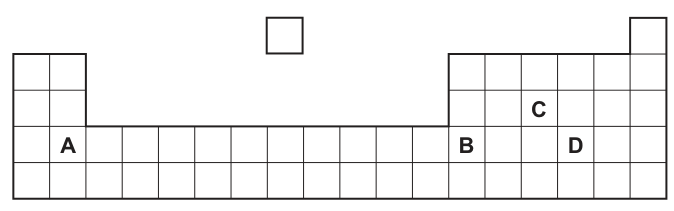
Which element is a metal that has exactly three outer shell electrons?
Options
A A
B B
C C
D D
Answer
B
B
Walkthrough
The number of outer shell electrons for a main-group element (Groups I to VII) is equal to its group number. We can check each labelled position:
- A is in Group II, Period 4 (calcium). It is a metal, but has 2 outer shell electrons.
- B is in Group III, Period 4 (gallium). It is a metal and has 3 outer shell electrons.
- C is in Group VI, Period 3 (sulfur). It is a non-metal with 6 outer shell electrons.
- D is in Group VII, Period 4 (bromine). It is a non-metal with 7 outer shell electrons.
The question asks for a metal with exactly three outer shell electrons, which matches position B.
Key Takeaways
- For main-group elements (Groups I to VII), the group number tells you the number of outer shell electrons.
- Metals are located on the left and centre of the periodic table, while non-metals are on the right side.
Common Mistakes
- Confusing the group number with the period number (which gives the number of electron shells).
- Assuming all metals have only one or two outer electrons, and forgetting that Group III elements like aluminium and gallium are metals with three outer electrons.
Things to Be Careful About
- The group number directly gives the number of outer shell electrons only for Groups I to VII. Transition metals (the d-block) do not follow this simple rule.
- Always verify both conditions in the question: the element must be a metal AND have exactly three outer shell electrons.
The table compares two properties of lithium and potassium.
Which row is correct?
Options
| greater density | greater tendency to form a positive ion | |
|---|---|---|
| A | lithium | lithium |
| B | lithium | potassium |
| C | potassium | lithium |
| D | potassium | potassium |
Working
Down Group I, density generally increases, so potassium has the greater density.
Down Group I, the outer electron is further from the nucleus and more shielded, so it is easier to remove. Potassium therefore has the greater tendency to form a positive ion.
Answer
D
D
Walkthrough
Lithium and potassium are both in Group I, so they each have one outer electron. Lithium has the electron arrangement 2,1 and potassium has 2,8,8,1.
For density, the general trend down Group I is that density increases. Comparing lithium and potassium, potassium is the denser metal, so the first column must say potassium.
For the tendency to form a positive ion, we are really asking which metal loses its outer electron more easily. In potassium the outer electron is in a higher shell, so it is further from the nucleus. It is also shielded from the nuclear charge by more inner electrons. The attraction holding the outer electron is therefore weaker, so potassium loses that electron more readily. Potassium has the greater tendency to form a positive ion.
Both columns say potassium, so the correct row is D.
Key Takeaways
- Down Group I, the atoms become larger and the outer electron is easier to remove.
- A greater tendency to form a positive ion means a lower ionisation energy, not a larger positive charge.
- Density generally increases down Group I, so potassium is denser than lithium.
Common Mistakes
- Choosing lithium for the greater tendency to form a positive ion because lithium is smaller. A smaller atom holds its outer electron more strongly, so lithium loses it less easily.
- Confusing density with reactivity. Potassium is more reactive and also denser than lithium.
- Thinking that both metals form positive ions equally easily because they are in the same group. The ease of losing the electron changes down the group.
Things to Be Careful About
- The question asks for the greater tendency to form a positive ion, not the charge of the ion. Both metals form a +1 ion.
- Use the electron arrangements 2,1 for lithium and 2,8,8,1 for potassium to explain the shielding and distance of the outer electron.
- Read the table carefully: the first column is density and the second column is tendency to form a positive ion. Both must be matched to the same element.
Which properties are correct for the element copper?
Options
| melting point / | malleability | |
|---|---|---|
| A | 83 | low |
| B | 83 | high |
| C | 1083 | low |
| D | 1083 | high |
Working
Copper is a metal, so it has a high melting point because of the strong attraction between the positive metal ions and the sea of delocalised electrons.
Copper is also very malleable because the layers of positive ions can slide over each other without breaking the metallic bond.
The correct row must show a high melting point and high malleability.
Answer
D
D
Walkthrough
Copper is a typical transition metal. Metals have high melting points because their atoms are held together by strong metallic bonds: positive metal ions attract a sea of delocalised electrons. So the melting point of copper is high, around , not a low value like 83°C.
Malleability is the ability of a metal to be hammered or pressed into shape without breaking. In a metal, the layers of ions can slide over one another while the delocalised electrons still hold the structure together. Copper is highly malleable.
Options A and B both give the low melting point, so they can be rejected because copper does not have a melting point of 83°C. Options C and D both give the correct high melting point, but only option D also has high malleability. Therefore the correct answer is D.
Key Takeaways
- Metals generally have high melting points because of strong metallic bonding.
- Metals are malleable because layers of positive ions can slide without breaking the bond.
- Copper is a transition metal with both a high melting point and high malleability.
Common Mistakes
- Choosing C because the melting point is correct but forgetting that the malleability must also be high.
- Confusing copper with a non-metal like sulfur. Sulfur has a low melting point, but copper does not.
- Thinking that a metal can be hard but not malleable. Most metals, including copper, are malleable.
Things to Be Careful About
- Read both columns of the table carefully. The marks is only gained if both the melting point and the malleability are correct.
- Remember that temperature may be given in , and is a high value for a metal.
- Do not confuse the property of a metal with a non-metal; metallic structure explains the high melting point and the sliding layers explain malleability.
Which statement is correct?
Options
A Copper is unreactive because of an oxide layer.
B Gold and silver are used to make jewellery because they corrode very slowly.
C Magnesium can be displaced from aqueous solutions of its ions by adding aluminium.
D Zinc gains electrons more readily than magnesium gains electrons.
Working
Use the reactivity series: potassium > sodium > calcium > magnesium > aluminium > zinc > iron > copper > silver > gold.
A — Copper is not unreactive because of an oxide layer. It is relatively unreactive because of its low position in the reactivity series. False.
B — Silver and gold are low in the reactivity series, so they corrode very slowly. This is why they are used to make jewellery. Correct.
C — A more reactive metal displaces a less reactive metal from an aqueous solution of its ions. Magnesium is more reactive than aluminium, so adding aluminium cannot displace magnesium. False.
D — Metal atoms become positive ions by losing electrons. Magnesium loses electrons more readily than zinc does, so zinc does not gain electrons more readily than magnesium. False.
Answer
B
B
Walkthrough
This question checks whether you can apply the reactivity series in several different ways at once.
-
Option A confuses copper with metals such as aluminium. Aluminium has a tough oxide layer, but that does not explain copper’s low reactivity. Copper is a fairly unreactive metal because it is low in the reactivity series.
-
Option B is the correct one. Gold and silver are among the least reactive metals. Because they corrode very slowly, they keep their colour and shine, which makes them suitable for jewellery. Corrosion here means reactions such as tarnishing with oxygen or sulfur compounds in the air.
-
Option C applies the displacement rule. A metal only displaces another metal from its salt solution when the displacing metal is more reactive. Magnesium is above aluminium in the reactivity series, so aluminium cannot displace magnesium from a solution containing magnesium ions.
-
Option D is a tempting statement about ions. When reactive metals react, their atoms lose electrons to become positive ions. Magnesium is more reactive than zinc, so magnesium atoms lose electrons more readily. On the other hand, it is true that zinc ions gain electrons more readily than magnesium ions, but the statement says "zinc", not "zinc ions". The metal atom itself does not gain electrons more readily.
Key Takeaways
- The reactivity series orders metals according to how readily their atoms lose electrons.
- A more reactive metal displaces a less reactive metal from an aqueous solution of its ions.
- Less reactive metals tend to corrode more slowly, which is why gold and silver are used in jewellery.
- Be careful about the difference between a metal atom losing electrons and a metal ion gaining electrons.
Common Mistakes
- Two statements close but misleading. Students often choose option D because zinc ions gain electrons more readily than magnesium ions. But option D does not say ions, it says zinc as a metal. The metal atoms lose electrons; they do not gain them.
- Students sometimes think copper has an oxide layer making it unreactive. That is a confusion with aluminium.
- For displacement, students sometimes reverse the order and think aluminium can displace magnesium. Aluminium is below magnesium in the series, so it cannot.
Things to Be Careful About
- Learn the "battery" piece of the reactivity series exactly: magnesium above aluminium above zinc above iron. Aluminium and magnesium are easy to swap.
- Remember that a metal's reactivity is not about the surface oxide film. The statement must refer to the metal's inherent tendency to lose electrons.
- For jewellery uses, the relevant property is slow corrosion, which itself comes from low reactivity. Stating only "unreactive" is acceptable, but "corrode very slowly" is even more exact.
- No calculation or equation is needed here; only the correct application of the reactivity series and careful reading of each option.
Which reaction takes place in the blast furnace?
Options
A
B
C
D
Working
In the blast furnace, limestone () decomposes to calcium oxide and carbon dioxide:
The calcium oxide then reacts with sandy impurities (silicon dioxide) to form slag:
This is option C.
- A is the reduction of chromite with carbon, used in the extraction of chromium, not iron.
- B is the reaction of iron with steam, not a blast furnace reaction.
- D is the reaction of silicon dioxide with sodium hydroxide, a laboratory reaction.
Answer
C
C
Walkthrough
The blast furnace extracts iron from its ore. The main steps are:
- Coke burns in hot air to form carbon dioxide: .
- Carbon dioxide reacts with more coke to form carbon monoxide: .
- Carbon monoxide reduces the iron ore (mainly ) to iron: .
- Limestone () decomposes to calcium oxide and carbon dioxide.
- The calcium oxide reacts with sandy impurities, mainly silicon dioxide, to form slag: .
The slag is calcium silicate. It is less dense than molten iron, so it floats on top and can be tapped off separately. Option C is exactly this slag-forming reaction.
Option A is not the blast furnace reaction because the starting material is chromite, , which is an ore of chromium. Option B is the reaction of iron with steam, which is a laboratory reaction of metals with steam. Option D is the reaction of silicon dioxide with sodium hydroxide, also not part of the blast furnace process.
Key Takeaways
- The blast furnace has three main raw materials: iron ore, coke, and limestone.
- Limestone is not just a source of carbon dioxide; it removes acidic sandy impurities by forming slag.
- Slag is calcium silicate, , and it floats on the molten iron.
- Being able to identify the slag-forming reaction is a common O Level question on iron extraction.
Common Mistakes
- Choosing B because it involves iron. B is the reaction of iron with steam, not a blast furnace reaction.
- Choosing A because it looks like a reduction with carbon. A uses chromite and produces chromium, not iron from iron ore.
- Forgetting the purpose of limestone. Limestone provides , which removes impurities.
- Thinking the blast furnace reaction is only the reduction of iron oxide, and not recognising the separate slag reaction.
Things to Be Careful About
- The slag reaction is balanced: one silicon atom, three oxygen atoms, and one calcium atom on each side.
- The main reduction of iron ore uses carbon monoxide, not carbon directly: .
- Slag is a waste product that is useful in road building, but in the blast furnace its main job is to remove the acidic impurity .
- In multiple-choice questions, read every option carefully; several may involve iron or silicon dioxide, but only one is the actual blast furnace reaction.
The presence of water can be confirmed by the use of either anhydrous cobalt(II) chloride or anhydrous copper(II) sulfate.
Which observation is correct if water is present?
Options
A Anhydrous cobalt(II) chloride turns from blue to white.
B Anhydrous cobalt(II) chloride turns from pink to blue.
C Anhydrous copper(II) sulfate turns from blue to pink.
D Anhydrous copper(II) sulfate turns from white to blue.
Working
Anhydrous copper(II) sulfate is white. In the presence of water it forms hydrated copper(II) sulfate, which is blue:
Anhydrous cobalt(II) chloride is blue and turns pink when hydrated, so A, B and C are incorrect.
Answer
D
D
Walkthrough
The question tests the two standard chemical tests for water. “Anhydrous” means without water. Anhydrous copper(II) sulfate is white; when water is added it becomes blue hydrated copper(II) sulfate. Anhydrous cobalt(II) chloride is blue; when water is added it becomes pink hydrated cobalt(II) chloride. Therefore D is correct. A and B give the wrong colour changes for cobalt, and C gives the wrong colour change for copper(II) sulfate.
Key Takeaways
- Anhydrous copper(II) sulfate: white → blue with water.
- Anhydrous cobalt(II) chloride: blue → pink with water.
- “Anhydrous” means no water is present; hydrated salts often have different colours from their anhydrous forms.
Common Mistakes
- Confusing the two tests and their colours.
- Thinking cobalt(II) chloride turns blue when water is added; it is anhydrous cobalt(II) chloride that is blue and it turns pink when hydrated.
- Forgetting that anhydrous copper(II) sulfate is white, not blue.
Things to Be Careful About
- Read the initial colour of the anhydrous salt carefully.
- The hydration equation shows that anhydrous copper(II) sulfate forms hydrated copper(II) sulfate with water.
- A common trap is option C: copper(II) sulfate blue to pink. Blue is the colour of the hydrated form, not the anhydrous form.
Ammonium phosphate, , may be used as a fertiliser.
What is the percentage by mass of elements that improve plant growth in ammonium phosphate?
Options
A 9
B 21
C 28
D 49
Working
Ammonium phosphate is .
The elements that improve plant growth are nitrogen and phosphorus; the compound contains no potassium.
Relative formula mass:
Mass of nitrogen and phosphorus present:
Percentage by mass of the elements that improve plant growth:
Answer
D
D
Walkthrough
The question asks for the percentage by mass of the elements that improve plant growth. Fertilisers need nitrogen, phosphorus and potassium, so look at the formula of ammonium phosphate, .
There is no potassium here, but the compound contains both nitrogen and phosphorus. So the percentage needed is the combined mass of all nitrogen atoms plus all phosphorus atoms, divided by the total relative formula mass, multiplied by 100.
Calculate the relative formula mass:
- Each group has and , so one group has mass .
- Three such groups contribute of nitrogen and of hydrogen.
- The group contributes of phosphorus and of oxygen.
- Total relative formula mass .
The mass of nitrogen plus phosphorus is . So the percentage is
Hence option D is correct.
The other options all correspond to common mistakes:
- A, 9%, could come from dividing the mass of hydrogen or possibly another single small component by the total.
- B, 21%, is the percentage of phosphorus alone: , close to 21.
- C, 28%, is the percentage of nitrogen alone: .
Key Takeaways
- Fertilisers generally need nitrogen, phosphorus and potassium; in this compound only N and P are present.
- To find the percentage by mass of an element (or group of elements) in a compound:
- Remember to multiply each subscript by the number of atoms present, for example three N atoms in .
Common Mistakes
- Only counting nitrogen and forgetting to include phosphorus; that gives 28% (option C).
- Only counting phosphorus; that gives approximately 21% (option B).
- Forgetting to use all atoms of an element. There are three nitrogen atoms, not one, because of the subscript 3.
- Treat hydrogen and oxygen as elements that improve plant growth; they are not generally considered fertiliser nutrients in this context.
- Calculating a ratio of atoms rather than a ratio of masses. Percentages by mass always use masses.
Things to Be Careful About
- Use the correct relative atomic masses; for O Level take , , , .
- The subscript 3 outside the parentheses applies equally to all atoms inside the brackets, so there are 12 hydrogen atoms and 3 nitrogen atoms.
- The answer is a percentage, not a relative formula mass.
- Check that the unit in the question is “% by mass” and not moles or atom count.
- The compound contains no potassium. including a mass for potassium would be incorrect because it is not present.
Which statement is correct?
Options
A An unsaturated hydrocarbon is one in which more solute can dissolve.
B Members of a homologous series each differ from the next by a –CH₂– unit.
C Structural isomers have the same displayed formula but different structural formulae.
D The general formula of the carboxylic acid homologous series is .
Working
A is incorrect: an unsaturated hydrocarbon is one containing carbon–carbon double bonds, not a solution in which more solute can dissolve.
B is correct: each member of a homologous series differs from the next by a unit.
C is incorrect: structural isomers have the same molecular formula but different structural formulae.
D is incorrect: the general formula of a carboxylic acid is .
Answer
B
B
Walkthrough
The question asks which statement is correct, so test each option against the definitions from organic chemistry.
- A confuses two different meanings of 'saturated'. In hydrocarbons, 'saturated' means only single carbon–carbon bonds (alkanes). In solutions, 'saturated' means no more solute can dissolve. An unsaturated hydrocarbon is one with a carbon–carbon double bond, so A is wrong.
- B is the definition of a homologous series: a family of compounds with the same functional group, similar chemical properties, and successive members differing by a unit. This is correct.
- C gets isomerism backwards. Structural isomers have the same molecular formula but different structural (displayed) formulae. They cannot have the same displayed formula and different structural formulae, so C is wrong.
- D has the wrong general formula. Saturated monocarboxylic acids have general formula , for example ethanoic acid is . The formula given, , would not fit the members correctly.
Key Takeaways
- A homologous series is a family of organic compounds with the same functional group, each member differing from the next by a unit.
- 'Saturated' has different meanings in hydrocarbons and in solutions.
- Structural isomers have the same molecular formula but different structural formulae.
- Know the general formulae of homologous series: alkanes , alkenes , alcohols , carboxylic acids .
Common Mistakes
- Confusing 'unsaturated hydrocarbon' with 'unsaturated solution'.
- Reversing the definition of structural isomers.
- Misremembering the general formula of carboxylic acids as instead of .
Things to Be Careful About
- In option D the formula must include the correct number of hydrogen atoms for a saturated acid; the extra makes the difference.
- Read each statement carefully — option C contains a contradiction ('same displayed formula but different structural formulae').
- For multiple-choice questions, eliminate clearly wrong options first before selecting the correct one.
What is the name of the ester C₃H₇COOC₂H₅?
Options
A butyl ethanoate
B ethyl butanoate
C ethyl propanoate
D propyl ethanoate
Working
An ester has the general structure : the part on the left of the group comes from the carboxylic acid, and the part on the right comes from the alcohol.
contains:
- — the acid chain has 4 carbon atoms, so it is butanoate
- — the alcohol part is ethyl
So the ester is ethyl butanoate.
Answer
B
B
Walkthrough
The ester functional group is . In a condensed formula such as , the carbon atom of the carbonyl group belongs to the acid part of the ester.
Split the formula at the group:
- Left side: — the carbonyl carbon is included, so there are 4 carbons in the acid chain. The acid is butanoic acid, so the ester part is butanoate.
- Right side: — this comes from ethanol, so the alkyl group is ethyl.
Esters are named with the alcohol part first and the acid part second: ethyl butanoate.
Checking the other options:
- A butyl ethanoate would be .
- C ethyl propanoate would be .
- D propyl ethanoate would be .
Only option B matches the given formula.
Key Takeaways
- An ester is named as alkyl alkanoate.
- The alkyl part comes from the alcohol and is written first.
- The alkanoate part comes from the carboxylic acid and is written second.
- When counting carbons in the acid part, include the carbonyl carbon of the group.
Common Mistakes
- Naming the left part as propyl instead of butanoate. The carbonyl carbon must be counted as part of the acid chain.
- Reversing the order and writing butanoate ethyl instead of ethyl butanoate.
- Choosing ethyl propanoate by counting only the three carbons in and forgetting the carbonyl carbon.
- Confusing butyl ethanoate with ethyl butanoate: butyl ethanoate has a four-carbon alkyl group from the alcohol and a two-carbon acid part.
Things to Be Careful About
- The group is the dividing line: everything to its left is the acid part, everything to its right is the alcohol part.
- Count the carbonyl carbon when naming the acid part.
- No state symbols or balancing are needed here because the question only asks for the name of the ester.
Petroleum is separated into useful products by fractional distillation.
Which of these fractions has the lowest boiling point?
Options
A bitumen
B fuel oil
C gasoline / petrol
D kerosene / paraffin
Working
Petroleum is separated in a fractional distillation column because different fractions have different boiling points. The fraction with the lowest boiling point has the smallest molecules and is collected at the top of the column.
Among the options, gasoline / petrol has the lowest boiling point. Kerosene has a higher boiling point, fuel oil a higher one still, and bitumen the highest.
Answer
C
C
Walkthrough
Crude oil is a mixture of many different hydrocarbons. In a fractional distillation column, the temperature decreases from bottom to top. Each fraction condenses at the point where the temperature is just below its boiling point. Larger molecules have stronger intermolecular forces and higher boiling points, so they condense near the bottom. Smaller molecules have weaker intermolecular forces and lower boiling points, so they stay as vapour and are collected near the top.
Looking at the options:
- Bitumen is collected at the very bottom and has the highest boiling point.
- Fuel oil is collected lower down and has a high boiling point.
- Kerosene / paraffin is collected above fuel oil and has a lower boiling point.
- Gasoline / petrol is collected near the top and has the lowest boiling point of the four.
Therefore the answer is C.
Key Takeaways
- Fractional distillation separates crude oil into fractions because each fraction has a different boiling point.
- Smaller molecules with weaker intermolecular forces have lower boiling points and are obtained near the top of the column.
- Larger molecules with stronger intermolecular forces have higher boiling points and are obtained lower down.
- The relative order of fractions is a useful tool: petrol is a light fraction, kerosene is a middle fraction, and fuel oil and bitumen are heavy fractions.
Common Mistakes
- Choosing kerosene: kerosene has a lower boiling point than fuel oil or bitumen, but it is not lower than petrol.
- Choosing fuel oil or bitumen because they are familiar products from large-scale use, while forgetting their physical positions in the column.
- Confusing the direction of the column: the lowest boiling fraction is at the top, not the bottom.
- However, only the boiling-point comparison is asked, so try not to mix up related properties such as viscosity or colour.
Things to Be Careful About
- Practice recalling the column order from top to bottom: gas, petrol, kerosene, diesel, fuel oil, bitumen.
- Petrol and gasoline are the same fraction, so either name is acceptable.
- Focus only on boiling point here; a higher boiling fraction is more viscous and darker, but those extra facts are not needed for this question.
- The fraction with the lowest boiling point appears nearest the top of the column, not at the bottom.
Which equation represents a substitution reaction?
Options
A
B
C
D
Working
A substitution reaction replaces one atom (or group) in a molecule with another atom. In option A, one hydrogen atom in propane is replaced by a chlorine atom:
This is the reaction of an alkane with chlorine, a substitution reaction.
- B is combustion: ethanol burning in oxygen.
- C is addition: the C=C double bond in ethene opens and bromine adds across it.
- D is fermentation: glucose breaking down into ethanol and carbon dioxide.
Answer
A
A
Walkthrough
A substitution reaction is one in which an atom or group in a molecule is replaced by another atom or group. Alkanes are saturated hydrocarbons, containing only single C–C and C–H bonds. They do not easily add reagents, but they do undergo substitution with halogens, especially in ultraviolet light.
Option A shows propane, , reacting with chlorine, . One hydrogen atom is replaced by one chlorine atom, forming chloropropane, , and hydrogen chloride, . This is exactly a substitution reaction.
Option B is combustion: ethanol reacts with oxygen to produce carbon dioxide and water. No atom is being replaced; the molecule is being oxidised completely.
Option C is addition: ethene, , has a double bond. Bromine adds across the double bond to give a single product, . In addition, two reactants combine to form one product, with no small molecule lost.
Option D is fermentation: glucose breaks down into ethanol and carbon dioxide. This is a decomposition reaction, not a substitution.
Key Takeaways
- Alkanes are saturated and undergo substitution reactions with halogens.
- Alkenes are unsaturated and undergo addition reactions, such as with bromine.
- Combustion is the reaction of a substance with oxygen to form oxides.
- Fermentation is the breakdown of glucose to ethanol and carbon dioxide.
- In substitution, an atom is replaced and a small molecule such as is also formed.
Common Mistakes
- Confusing substitution with addition: in addition the two reactants form one product only; in substitution a small molecule is also produced.
- Thinking option C is substitution because a halogen is involved; it is addition across the C=C double bond.
- Calling option B a substitution because oxygen is involved; it is combustion.
- Forgetting that alkanes need ultraviolet light for substitution with chlorine, although the equation alone does not show this.
Things to Be Careful About
- Look at the functional group: alkanes have only single bonds, alkenes have a C=C double bond.
- Check whether the product count shows one product (addition) or two products (substitution).
- Recognise common reaction types by their reactants and products: burning with oxygen is combustion, glucose to ethanol is fermentation.
Which row shows the minimum number of moles of oxygen needed for the complete combustion of 1 mole of the named alcohol?
Options
| alcohol | moles of oxygen | |
|---|---|---|
| A | butan-1-ol | 6 |
| B | butan-2-ol | 12 |
| C | propan-1-ol | 3 |
| D | propan-2-ol | 6 |
Working
Complete combustion of an alcohol produces carbon dioxide and water. Butan-1-ol has the formula , so its combustion equation is
Therefore, 1 mol of butan-1-ol requires 6 mol of , which matches option A.
Butan-2-ol has the same molecular formula, , so it also requires 6 mol of , not 12. Propan-1-ol and propan-2-ol both have the formula ; their balanced combustion is:
so they require 4.5 mol of , not 3 or 6.
Answer
A
A
Walkthrough
First decide what "complete combustion" means: all the carbon becomes and all the hydrogen becomes , with no CO or carbon left behind. This is a balancing exercise.
For butan-1-ol, the formula is because the molecule is . Balance carbon first: 4 carbon atoms mean 4 . Then balance hydrogen: 10 hydrogen atoms mean 5 . Finally count oxygen on the right: oxygen atoms. The alcohol already provides 1 oxygen atom, so 12 more oxygen atoms are needed, which is 6 molecules. That is exactly option A.
A key clue is that butan-1-ol and butan-2-ol are isomers: both have the formula . Therefore they need the same number of oxygen moles. The correct number is 6, not 12.
For the propanols, both are . Balancing: , giving 7 oxygen atoms on the right minus the 1 already in the alcohol = 6 oxygen atoms, i.e. 3 ? This is wrong if counted naively; let's count carefully. : products are and . Right side oxygen = ? Wait that is not correct for O atom counting. The correct count is O atoms: from carbon dioxide, plus from water, total 10 oxygen atoms. The alcohol provides 1 oxygen, so 9 more are needed: . So the propanols need 4.5 mol . The only option that is correct for all named alcohols is A.
Key Takeaways
- Complete combustion of any alcohol gives and only.
- To find the oxygen needed, work through the balanced equation rather than guessing.
- Isomers share the same molecular formula and therefore need the same amount of oxygen for complete combustion.
- For a saturated monohydric alcohol , complete combustion has oxygen coefficient .
Common Mistakes
- Using the wrong formula for the alcohol, e.g. treating butan-1-ol as but forgetting the OH atom in the O count.
- Thinking that butan-1-ol and butan-2-ol need different amounts of oxygen because their structural formulas differ. They are isomers, so their molecular formulas and combustion equations are identical.
- Expecting every combustion coefficient to become a whole number. Propanols give 4.5 for one mole.
- Reading "minimum" as "highest" or assuming the largest listed number is the answer.
Things to Be Careful About
- Write the alcohol formula carefully: saturated monohydric alcohols are , so butanol is and propanol is .
- Balance the equation fully before comparing coefficients.
- Here "minimum" just means the mole ratio in the correctly balanced equation; not the maximum amount that could react.
The diagram shows the partial structure of a polymer.
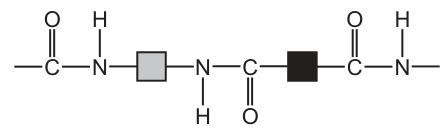
Which pair of reagents is used to form this polymer?
Options
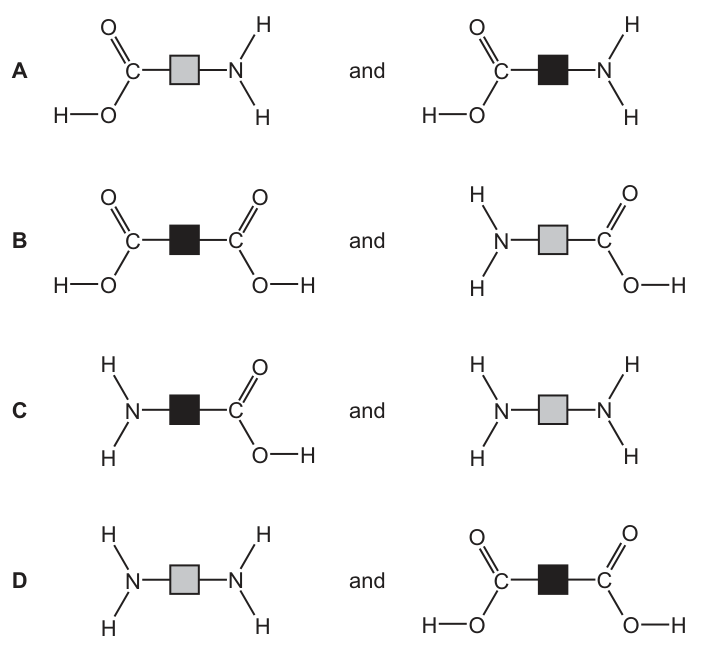
Answer
D
The polymer contains amide linkages, , indicating it is a polyamide formed by condensation polymerisation. Looking at the repeat unit in Fig. 1:
- The grey square is bonded to two nitrogen atoms (), meaning it comes from a diamine: .
- The black square is bonded to two carbonyl groups (), meaning it comes from a dicarboxylic acid: .
Option D shows exactly this pair of monomers. When they react, the amine groups lose hydrogen and the carboxyl groups lose hydroxyl, forming water and leaving the amide linkages seen in the polymer chain.
D
Walkthrough
The polymer in Fig. 1 is built from repeating units joined by amide bonds (). This tells us the polymer is a polyamide, made by condensation polymerisation between monomers that have two functional groups each.
To find the monomers, we look at what is attached to the squares in the repeat unit:
- The grey square is connected to an group on its left and an group on its right. This means the grey square must have come from a molecule with two amine groups (). This is a diamine: .
- The black square is connected to a group on its left and a group on its right. This means the black square must have come from a molecule with two carboxyl groups (). This is a dicarboxylic acid: .
Checking the options:
- Option A shows two amino acids, which would give a different linkage pattern.
- Option B shows a dicarboxylic acid and an amino acid, which would leave a attached to the grey square.
- Option C shows an amino acid and a diamine, but the amino acid is attached to the black square, which would leave an attached to the black square instead of two carbonyls.
- Option D shows a diamine with the grey square and a dicarboxylic acid with the black square. This perfectly matches the required monomers to produce the polymer in Fig. 1.
Key Takeaways
- Polyamides are formed by condensation polymerisation between diamines and dicarboxylic acids (or from amino acids / hydroxy acids that contain both groups).
- The repeat unit of a condensation polymer reveals the monomers: look at the atoms attached to the central groups in the repeat unit. If a group has two attachments, it came from a diamine. If it has two attachments, it came from a dicarboxylic acid.
- Condensation polymerisation releases a small molecule (usually water) as the monomers join.
Common Mistakes
- Confusing the monomers for nylon-6,6 (diamine + dicarboxylic acid) with those for nylon-6 (a single amino acid monomer like 6-aminohexanoic acid).
- Misreading the connections on the squares: assuming the grey square is an amino acid because it has , but forgetting that it has on both sides, which requires two amine groups.
- Forgetting that condensation polymerisation requires monomers with at least two functional groups to form a continuous chain.
Things to Be Careful About
- State the functional groups correctly: diamine (two amine groups, ) and dicarboxylic acid (two carboxyl groups, ).
- Ensure the number of functional groups on each monomer matches the number of bonds in the polymer repeat unit. A monomer forming two linkages must have two reactive groups.
- In the options, pay close attention to which square (grey or black) is attached to which functional group. Swapping the squares changes the identity of the monomers entirely.
A student measures the rate at which a fixed mass of magnesium reacts with a fixed volume of dilute hydrochloric acid.
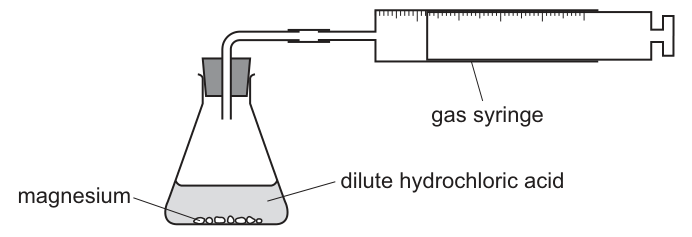
Which additional pieces of apparatus are required for this experiment?
Options
A a balance, a measuring cylinder and a stop-watch only
B a balance, a measuring cylinder and a thermometer only
C a balance, a stop-watch and a thermometer only
D a measuring cylinder, a stop-watch and a thermometer only
Working
To measure the rate of reaction, the student needs to measure the volume of gas produced over time.
- The gas syringe measures the volume of gas.
- A stop-watch is needed to measure the time taken for the gas to be produced.
- The question specifies a "fixed mass of magnesium". To measure this mass, a balance is required.
- The question specifies a "fixed volume of dilute hydrochloric acid". To measure this volume, a measuring cylinder is required.
- A thermometer is not required because the temperature is not being measured or controlled in this experiment.
Therefore, the additional apparatus required are a balance, a measuring cylinder, and a stop-watch.
Answer
A
A
Walkthrough
The experiment is designed to measure the rate of reaction between magnesium and dilute hydrochloric acid. The rate is determined by measuring the volume of gas produced (hydrogen) at regular time intervals using the gas syringe.
- Time: To calculate rate (volume / time), the student must record the time elapsed. This requires a stop-watch.
- Mass of magnesium: The question states a "fixed mass" is used. To obtain a specific mass of solid magnesium, the student must weigh it. This requires a balance.
- Volume of acid: The question states a "fixed volume" of dilute hydrochloric acid is used. To measure a specific volume of liquid, the student must use a measuring cylinder.
- Temperature: While temperature affects the rate of reaction, the question does not ask the student to measure or control temperature, nor is it mentioned as a variable. Thus, a thermometer is not required for this specific setup.
Key Takeaways
- Measuring the rate of a reaction that produces a gas requires a gas syringe (for volume) and a stop-watch (for time).
- "Fixed mass" and "fixed volume" in a question stem indicate that mass and volume must be measured using a balance and a measuring cylinder, respectively.
- Apparatus not related to the stated variables (like a thermometer for temperature) is not required unless the experiment specifically investigates that variable.
Common Mistakes
- Forgetting that "fixed mass" and "fixed volume" imply the need for a balance and a measuring cylinder.
- Assuming a thermometer is always needed in rate experiments, even when temperature is not the variable being investigated or controlled.
Things to Be Careful About
- Read the question carefully for the words "fixed mass" and "fixed volume". These are direct clues for the apparatus needed.
- Distinguish between apparatus needed to measure the rate (gas syringe, stop-watch) and apparatus needed to prepare the reactants to the specified amounts (balance, measuring cylinder).
Two titrations of dilute hydrochloric acid with aqueous sodium hydroxide are done using two different indicators, methyl orange and thymolphthalein. The equation for the reaction is shown.
Using a volumetric pipette, dilute hydrochloric acid is added to a conical flask with a few drops of indicator. Aqueous sodium hydroxide is added from a burette to the dilute hydrochloric acid until the end-point is reached.
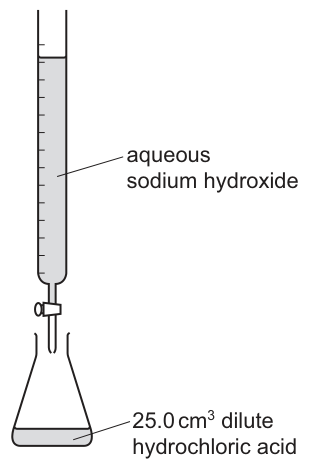
The end-point of the titration with each indicator occurs when of aqueous sodium hydroxide is added.
Which statements about this experiment are correct?
- The methyl orange changes colour from red to yellow.
- The thymolphthalein changes colour from blue to colourless.
- The dilute hydrochloric acid is less concentrated than the aqueous sodium hydroxide.
Options
A 1, 2 and 3
B 1 and 2 only
C 1 and 3 only
D 2 and 3 only
Working
Statement 1: The conical flask contains dilute hydrochloric acid (an acid). Methyl orange is red in acid and yellow in alkali. As aqueous sodium hydroxide (alkali) is added from the burette, the solution changes from red to yellow. Statement 1 is correct.
Statement 2: Thymolphthalein is colourless in acid and blue in alkali. The solution in the flask starts as acid (colourless) and becomes alkali at the end-point (blue). The colour change is colourless to blue, not blue to colourless. Statement 2 is incorrect.
Statement 3: The equation shows a 1:1 mole ratio between HCl and NaOH:
At the end-point, moles of acid = moles of alkali.
Given and :
Since a smaller volume of alkali is needed to neutralise the larger volume of acid, the alkali must be more concentrated (or the acid less concentrated). . Statement 3 is correct.
Statements 1 and 3 are correct.
Answer
C
C
Walkthrough
The question describes a titration where dilute hydrochloric acid is in the conical flask and aqueous sodium hydroxide is in the burette. We must evaluate three statements.
Statement 1: Methyl orange is an indicator. In acidic solution (the HCl in the flask), it is red. As the alkali (NaOH) is added, the pH rises. In alkaline solution, methyl orange is yellow. The change is from red to yellow. This statement is correct.
Statement 2: Thymolphthalein is colourless in acidic solution and blue in alkaline solution. Since we start with acid and add alkali, the colour change is from colourless to blue. The statement says 'blue to colourless', which would happen if we were adding acid to alkali. This statement is incorrect.
Statement 3: The balanced equation is . This is a 1:1 reaction. At the end-point, the number of moles of HCl equals the number of moles of NaOH.
Using the formula :
Rearranging for the concentration of HCl:
Since , the concentration of HCl is less than the concentration of NaOH. This statement is correct.
Only statements 1 and 3 are correct, which corresponds to option C.
Key Takeaways
- Indicator colour changes: Know the colours of common indicators (methyl orange, phenolphthalein, thymolphthalein, universal indicator) in acid and alkali. Note the direction of change depends on which solution is in the flask and which is in the burette.
- Titration concentration comparison: For a 1:1 reaction, if a smaller volume of titrant is used to neutralise a larger volume of analyte, the titrant is more concentrated.
Common Mistakes
- Reversing indicator colour changes: Students often memorise 'red to yellow' for methyl orange without thinking about the direction of titration. Here, acid is in the flask, so it starts red. If alkali were in the flask, it would start yellow and go to red.
- Thymolphthalein direction: Thymolphthalein goes colourless (acid) to blue (alkali). Statement 2 has this backwards.
- Ignoring the mole ratio: If the equation were not 1:1 (e.g., ), the simple volume comparison would need adjustment. Here, 1:1 makes it straightforward.
Things to Be Careful About
- Direction of titration: Always check which solution is in the conical flask (analyte) and which is in the burette (titrant). The colour change starts with the analyte's indicator colour.
- Units: Volumes are both in , so they cancel out in the ratio; no need to convert to for a simple concentration comparison.
- Statement 2 wording: 'Blue to colourless' implies starting with alkali and adding acid. The setup is acid in flask, alkali in burette.
What is used to separate a solid mixture of copper powder and sodium chloride to obtain pure, solid samples of each compound?
- a suitable solvent
- distillation
- crystallisation
- filtration
Options
A 1, 2 and 4
B 1 and 2 only
C 1, 3 and 4
D 3 and 4 only
Working
Copper powder is insoluble in water, while sodium chloride is soluble. Add water (the suitable solvent) to dissolve the sodium chloride. Filter the mixture to collect the insoluble copper powder as the residue. Crystallise the filtrate by evaporation and cooling to obtain pure solid sodium chloride. Distillation would separate the solvent from the solution, not give the solid salt, so it is not needed.
Therefore the methods used are 1, 3 and 4.
Answer
C
C
Walkthrough
This question asks for the sequence of techniques needed to separate a solid mixture into two pure solids. The key fact is that copper powder does not dissolve in water, but sodium chloride does.
- Add a suitable solvent (water) to the mixture. The sodium chloride dissolves, leaving the copper powder undissolved.
- Filter the mixture. The copper powder is collected as the residue on the filter paper, and the sodium chloride solution passes through as the filtrate.
- Crystallise the filtrate. Evaporate some of the water and allow the solution to cool, so that solid sodium chloride crystals form. These can then be dried.
Distillation is not needed because it would separate the solvent (water) from the dissolved salt, but the question asks for pure solid samples of both original substances, not for the water. So the correct combination is 1, 3 and 4, which is option C.
Key Takeaways
- A mixture of an insoluble solid and a soluble solid can be separated by dissolving, filtering and crystallising.
- Filtration separates an insoluble solid from a liquid.
- Crystallisation recovers a dissolved solid from its solution.
- Distillation is used to obtain a pure solvent from a solution, not to obtain a dissolved solid.
Common Mistakes
- Choosing distillation because it is a separation technique, without noticing that it would give the solvent rather than the solid salt.
- Thinking filtration alone is enough to obtain both solids; filtration only separates the insoluble copper powder.
- Assuming copper powder dissolves in water; copper is an insoluble metal, so it stays as a solid.
Things to Be Careful About
- Read the question carefully: it asks for pure solid samples of both substances, so the method must end with two solids.
- The 'suitable solvent' is water, because sodium chloride is soluble in water but copper is not.
- In crystallisation, the solution is usually evaporated to a smaller volume and then cooled so crystals form; the remaining solution is poured off and the crystals are dried.
Your score so far
Answer a question to start scoring
Your marks add up here as you work through the paper.