Chemistry 5070/11 — May/June 2024
Cambridge O-Level · Multiple Choice · answer key with instant marking and worked solutions
Topics Stoichiometry · Atoms, Elements and Compounds · Organic Chemistry · Chemical Reactions · Metals · Electrochemistry · +6 more
Tap an option under each question to check it — your score builds as you go.
A scientist heats a sample of a liquid. The scientist measures the temperature of the sample and plots a graph of the temperature against time.
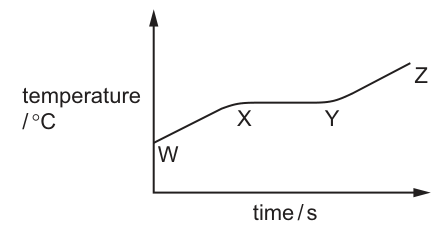
Which statements are correct?
- Between points W and X, the temperature increases and the particles move faster.
- Between points X and Y, there is no change in the temperature because energy is needed to change a liquid into a gas.
- Between points Y and Z, the particles move further apart.
Options
A 1, 2 and 3
B 1 and 2 only
C 1 and 3 only
D 2 only
Answer
Statement 1 is correct. Between points W and X, the graph shows an increase in temperature. Temperature is a measure of the average kinetic energy of the particles. As the temperature rises, the particles gain kinetic energy and move faster.
Statement 2 is correct. Between points X and Y, the graph is a horizontal plateau, meaning the temperature is constant. This represents a change of state from liquid to gas (boiling). The heat energy supplied is used to overcome the forces of attraction between the particles rather than to increase their kinetic energy (temperature).
Statement 3 is correct. Between points Y and Z, the substance is now a gas and the temperature is rising. In the gaseous state, particles are already far apart. As the gas is heated, it expands, causing the particles to move further apart (and also move faster).
Since all three statements are correct, the answer is A.
Answer
A
A
Walkthrough
The question provides a heating curve (temperature against time) for a liquid being heated. We need to evaluate three statements about particle behaviour and energy during different stages of this process.
Stage 1: W to X (Liquid Heating)
- The graph slopes upwards, meaning temperature is increasing.
- In a liquid, as temperature rises, the particles gain kinetic energy. This means they move faster and vibrate more vigorously.
- Therefore, Statement 1 is correct.
Stage 2: X to Y (Change of State: Boiling)
- The graph is flat (horizontal), meaning temperature is constant.
- This plateau represents the boiling point where the liquid is turning into a gas.
- During a change of state, the heat energy supplied does not increase the temperature (kinetic energy). Instead, it is used to break or overcome the intermolecular forces of attraction holding the liquid particles together.
- Therefore, Statement 2 is correct.
Stage 3: Y to Z (Gas Heating)
- The graph slopes upwards again, meaning temperature is increasing.
- By point Y, all the liquid has turned into gas. The substance is now a gas being heated.
- In a gas, particles are far apart and move freely. As the gas is heated, the particles gain kinetic energy and move faster. Additionally, gases expand when heated (Charles's Law), so the average distance between particles increases — they move further apart.
- Therefore, Statement 3 is correct.
Since statements 1, 2, and 3 are all correct, the correct option is A.
Key Takeaways
- Heating curves show temperature changes over time. Rising slopes indicate temperature change (kinetic energy change); flat plateaus indicate change of state (potential energy change).
- Temperature is a measure of average kinetic energy. Higher temperature = faster moving particles.
- During a change of state (melting or boiling), temperature remains constant because energy is used to overcome forces of attraction between particles, not to increase speed.
- Gas particles are much further apart than liquid particles. Heating a gas causes it to expand, increasing the distance between particles further.
Common Mistakes
- Thinking temperature rises during boiling: Candidates often assume that adding heat always raises temperature. Remember that during a phase change (plateau on the graph), temperature is constant.
- Confusing particle speed with separation: In the gas phase (Y to Z), particles move faster and move further apart (as the gas expands). Some candidates think particles only move faster in the gas phase and forget about the expansion.
- Misinterpreting the graph axes: Ensure you are reading temperature on the y-axis and time on the x-axis. A rising line means temperature is increasing with time.
Things to Be Careful About
- State symbols and phases: W-X is liquid, X-Y is liquid + gas equilibrium, Y-Z is gas.
- Energy types: Distinguish between kinetic energy (related to temperature and speed) and potential energy (related to particle separation and state change). Energy added during the plateau increases potential energy, not kinetic energy.
- Particle arrangement: In liquids, particles are close together but can move past each other. In gases, particles are far apart and move randomly at high speeds.
A sample of substance X contains iron and sulfur only.
[: Fe, 56; S, 32]
In which row is it possible for both statements about X to be correct?
Options
| statement 1 | statement 2 | |
|---|---|---|
| A | X is a mixture with the ratio 4 : 7 by mass of iron and sulfur | X is a compound with the ratio 4 : 7 by mass of iron and sulfur |
| B | X is a mixture with the ratio 7 : 4 by mass of iron and sulfur | X is a compound with the ratio 7 : 4 by mass of iron and sulfur |
| C | X is a mixture with the formula FeS | X is a compound with the formula FeS |
| D | X is a mixture with the formula FeSO₄ | X is a compound with the formula FeSO₄ |
Working
A compound of iron and sulfur has a fixed composition. In :
So a compound with a 7 : 4 mass ratio is possible. A mixture of iron and sulfur can be made in any proportion, so a 7 : 4 mixture is also possible.
Row A is wrong because no iron–sulfur compound has a 4 : 7 mass ratio. Row C is wrong because a mixture does not have a formula. Row D is wrong because contains oxygen, but X contains only iron and sulfur.
Answer
B
B
Walkthrough
Start with the key difference: a compound has a fixed composition, while a mixture can have any composition. Since X contains only iron and sulfur, any compound of X must contain only Fe and S atoms. The simplest iron sulfide is . Using and , the mass of Fe compared with S in is , which simplifies to . So a compound with a 7 : 4 mass ratio is possible. A mixture of iron and sulfur can be made in exactly that same ratio by weighing out 7 g of iron and 4 g of sulfur, so a 7 : 4 mixture is also possible. Therefore B is the row in which each statement could describe a sample of X.
Row A fails because no iron–sulfur compound has a 4 : 7 mass ratio. Row C fails because a mixture does not have a chemical formula. Row D fails because contains oxygen, which contradicts the statement that X contains iron and sulfur only.
Key Takeaways
- A compound is a pure substance with a fixed composition; a mixture can have any composition.
- The mass ratio of elements in a compound is found from its formula and the relative atomic masses.
- gives an Fe : S mass ratio of 7 : 4.
- A mixture can be made with the same mass ratio as a compound.
Common Mistakes
- Choosing A because 4 : 7 is a possible mixture ratio, without checking whether it is a possible compound ratio.
- Thinking a mixture cannot have the same composition as a compound; it can.
- Giving a chemical formula to a mixture; mixtures do not have formulae.
- Overlooking the phrase 'iron and sulfur only' and accepting .
- Reversing the ratio and writing 4 : 7 instead of 7 : 4.
Things to Be Careful About
- Read the ratio order carefully: Fe : S = 7 : 4, not S : Fe.
- A formula gives the atom ratio; convert to mass ratio using relative atomic masses.
- In multiple-choice questions, eliminate any row containing an impossible statement.
- The word 'possible' means each statement could describe some sample of X; it does not require one sample to be both a mixture and a compound at the same time.
A chlorine atom, Z, has a nucleon number of 37.
Which row is correct?
Options
| number of neutrons in Z | number of electrons in the second shell of Z | |
|---|---|---|
| A | 17 | 7 |
| B | 17 | 8 |
| C | 20 | 7 |
| D | 20 | 8 |
Working
Chlorine has proton number 17. For a neutral atom, the number of electrons is also 17.
Number of neutrons .
The electron configuration of chlorine is , so the second shell contains 8 electrons.
Row D gives both values correctly.
Answer
D
D
Walkthrough
Chlorine is element 17, so its proton number is 17. The nucleon number (mass number) is given as 37. The nucleon number is the total number of protons plus neutrons, so the number of neutrons is found by subtracting the proton number from the nucleon number:
A neutral chlorine atom has the same number of electrons as protons, so it has 17 electrons. These electrons fill the shells in order: the first shell holds 2, the second shell holds 8, and the remaining 7 go into the third shell. So the electron configuration is .
The question asks specifically for the number of electrons in the second shell, which is 8, not the number in the outer shell, which is 7.
Comparing with the table:
- neutrons = 20
- electrons in the second shell = 8
This matches row D.
Key Takeaways
- The nucleon number is the sum of protons and neutrons.
- In a neutral atom, the number of electrons equals the proton number.
- Electron shells fill as 2, 8, 8 for the first three shells.
- Read the question carefully: the second shell is not the same as the outermost shell.
Common Mistakes
- Choosing A or B: using 17 as the number of neutrons. This happens when the proton number is mistaken for the neutron number.
- Choosing C: getting the neutrons correct but writing the second shell as 7. This confuses the outer shell with the second shell.
- Forgetting that chlorine is neutral, so electrons = protons = 17.
Things to Be Careful About
- Nucleon number protons neutrons, so neutrons .
- Chlorine has 17 protons, not 18; argon has 18.
- The second shell can hold up to 8 electrons, so it is fully filled in chlorine.
- The electron configuration of chlorine is , not or .
Which particles are isotopes of the same element?
| particle | electrons | neutrons | protons |
|---|---|---|---|
| W | 22 | 28 | 25 |
| X | 23 | 28 | 25 |
| Y | 26 | 30 | 26 |
| Z | 26 | 28 | 26 |
Options
A W and X
B W and Z
C X and Z
D Y and Z
Working
Isotopes are atoms of the same element, so they have the same number of protons but different numbers of neutrons.
- W and X both have 25 protons, but both have 28 neutrons — same nuclide, not isotopes.
- Y and Z both have 26 protons; Y has 30 neutrons and Z has 28 neutrons.
Therefore Y and Z are isotopes.
Answer
D
D
Walkthrough
Isotopes are atoms of the same element. An element is defined by its proton number, so isotopes must have the same number of protons. They differ in the number of neutrons, which changes the mass number but not the identity of the element.
Look down the proton column in the table:
- W has 25 protons and X has 25 protons, so W and X are the same element. But W and X both have 28 neutrons, so they are actually the same isotope, just with different numbers of electrons (22 and 23). Different electron numbers mean they are ions of the same nuclide, not isotopes.
- Y has 26 protons and Z has 26 protons, so Y and Z are also the same element. Y has 30 neutrons while Z has 28 neutrons — different neutron numbers. This is exactly the definition of isotopes.
Hence the correct pair is Y and Z, option D.
Key Takeaways
- Isotopes are atoms of the same element: same proton number, different neutron number.
- The number of electrons can change without changing the element; that makes an ion, not a different isotope.
- When identifying isotopes from a table, compare the proton numbers first.
Common Mistakes
- Choosing W and X because they have the same proton number but forgetting that they also have the same neutron number — they are the same isotope, not a pair of isotopes.
- Thinking that different electron numbers make isotopes. Electrons do not define the element or the isotope.
- Confusing neutron number with mass number. Mass number = protons + neutrons, but isotopes are distinguished by neutron number alone when proton number is fixed.
Things to Be Careful About
- Read the table headings carefully: electrons, neutrons, protons. Isotopes differ only in neutrons.
- A neutral atom would have electrons equal to protons, but the table shows charged particles, so do not use electrons to decide the element.
- The mark scheme answer is D only; no other pair satisfies the isotope definition.
Statements about graphite and silicon(IV) oxide, SiO₂, are given.
Which statement is correct?
Options
A Silicon(IV) oxide is found as an impurity in iron ore.
B The angles between the atoms in silicon(IV) oxide and graphite are the same.
C The melting points of silicon(IV) oxide and graphite are high because ionic bonds are stronger than covalent bonds.
D When graphite acts as a lubricant, the covalent bonds between the layers are broken.
Working
A is correct. In the blast furnace, iron ore contains impurities such as sand and silicon(IV) oxide, . These are removed as slag by reaction with limestone.
B is incorrect. In graphite each carbon atom is bonded to three others, giving bond angles of 120°. In each silicon atom is bonded tetrahedrally to four oxygen atoms, giving bond angles of about 109.5°. The angles are not the same.
C is incorrect. Both have high melting points because they are giant covalent structures with many strong covalent bonds. They are not ionic compounds, so ionic bonding is not the reason.
D is incorrect. Graphite acts as a lubricant because the weak forces between the layers are overcome, allowing the layers to slide over each other. The strong covalent bonds within each layer are not broken.
Answer
A
A
Walkthrough
This is a 'which statement is correct' multiple-choice question, so check each option in turn.
Option A is the correct statement. In the blast furnace, iron ore is not pure iron oxide; it contains rocky impurities such as sand, which is mainly silicon(IV) oxide, . These impurities are removed by reaction with limestone, forming slag. This is a standard fact about iron extraction.
Option B is wrong because the two structures are different. Graphite is made of flat layers in which each carbon atom is bonded to three other carbon atoms, so the bond angles are 120°. Silicon(IV) oxide is a giant covalent structure in which each silicon atom is bonded to four oxygen atoms in a tetrahedral arrangement, so the bond angles are about 109.5°. Therefore the angles are not the same.
Option C is wrong because it gives the wrong reason for the high melting points. Both graphite and silicon(IV) oxide are giant covalent structures. Their melting points are high because a large amount of energy is needed to break many strong covalent bonds. They do not contain ionic bonds, so the statement about ionic bonds being stronger than covalent bonds is irrelevant and incorrect.
Option D is wrong because it confuses the forces that are overcome when graphite is used as a lubricant. Within each layer of graphite, the carbon atoms are joined by strong covalent bonds. Between the layers there are only weak forces of attraction. When graphite lubricates, the layers slide over each other because these weak inter-layer forces are overcome. The covalent bonds between atoms within a layer are not broken.
Key Takeaways
- Graphite and silicon(IV) oxide are both giant covalent structures, so they have very high melting points.
- Graphite has a layered structure: strong covalent bonds within layers and weak forces between layers, which explains its use as a lubricant.
- Silicon(IV) oxide has a tetrahedral structure, so its bond angles are about 109.5°, not 120°.
- Iron ore often contains silicon(IV) oxide as an impurity, which is removed as slag in the blast furnace.
Common Mistakes
- Saying that high melting points are due to ionic bonds when the substance is covalent. Graphite and are not ionic.
- Thinking that graphite lubricates because covalent bonds break. The covalent bonds stay intact; only weak forces between layers are overcome.
- Assuming that all giant covalent structures have the same bond angles. The structure must be considered: graphite is layered with 120° angles, while is tetrahedral with 109.5° angles.
Things to Be Careful About
- Read each statement carefully and look for the reason given, not just the property. Option C mentions a true property (high melting point) but gives a false reason.
- Remember that in a giant covalent structure, melting involves breaking covalent bonds, which requires a lot of energy.
- For the blast furnace, recall that limestone removes the sandy impurity as slag, so the presence of in iron ore is a real and important fact.
Statements about empirical and molecular formulae are given.
Which statement is correct?
Options
A The empirical and molecular formulae of a compound are always different.
B The empirical formulae of ethyne, C₂H₂, and of benzene, C₆H₆, are the same.
C The molecular formula always shows the simplest whole-number ratio of the different atoms or ions in a compound.
D The empirical formula always shows the numbers and types of different atoms in one molecule of a compound.
Working
A is incorrect because the empirical and molecular formulae can be the same, e.g. has the same empirical and molecular formula.
B is correct: ethyne, , has an empirical formula of ; benzene, , also has an empirical formula of . They are the same.
C is incorrect because the molecular formula shows the actual number of atoms of each element in a molecule, not the simplest ratio. The empirical formula shows the simplest whole-number ratio.
D is incorrect because the empirical formula shows the simplest whole-number ratio of atoms, not the numbers and types of atoms in one molecule (which is the molecular formula).
Answer
B
B
Walkthrough
This question tests your understanding of the difference between empirical and molecular formulae.
- The empirical formula shows the simplest whole-number ratio of atoms of each element in a compound.
- The molecular formula shows the actual number of atoms of each element in one molecule of the compound.
Let's evaluate each statement:
A says the empirical and molecular formulae are always different. This is false because for many compounds like water () or carbon dioxide (), the empirical and molecular formulae are identical. So A is wrong.
B says the empirical formulae of ethyne and benzene are the same. Ethyne is . Divide both subscripts by 2 to get the simplest ratio, which is . Benzene is . Divide by 6 to get . Both simplify to , so they have the same empirical formula. This statement is correct.
C says the molecular formula always shows the simplest whole-number ratio. That is actually the definition of an empirical formula, not a molecular formula. The molecular formula shows the actual numbers of atoms. So C is false.
D says the empirical formula always shows the numbers and types of different atoms in one molecule. That is the definition of a molecular formula. The empirical formula only gives the simplest ratio. So D is false.
Therefore, the only correct statement is B.
Key Takeaways
- Know the definitions of empirical and molecular formulae.
- Be able to simplify a molecular formula to its empirical formula by dividing by the highest common factor.
- Understand that the empirical formula and molecular formula can be the same for some compounds.
- Read each statement carefully and test it against the definitions.
Common Mistakes
- Confusing the definitions of empirical and molecular formulae. Remember: empirical = simplest ratio, molecular = actual numbers.
- Thinking that empirical and molecular formulae are always different. They can be the same.
- Forgetting to simplify both subscripts in a molecular formula when finding the empirical formula.
Things to Be Careful About
- When simplifying, ensure you divide all subscripts by the same whole number to get the smallest integer ratio.
- In option B, both compounds contain only carbon and hydrogen, and both simplify to . Double-check your arithmetic.
- The term "always" in options A, C, and D is a strong indicator that the statement might be false, as many absolute statements in chemistry have exceptions.
What is the relative formula mass, , of aluminium oxide?
Options
A 43
B 75
C 102
D 113
Working
Answer
C
C
Walkthrough
Aluminium oxide contains the aluminium ion and the oxide ion . To balance the charges, the formula has two aluminium ions and three oxide ions: .
Next, find the relative formula mass. Use the standard relative atomic masses: aluminium is 27 and oxygen is 16.
So the correct option is C.
Key Takeaways
- Ionic compound formulae are found by balancing positive and negative charges.
- Relative formula mass is the sum of the relative atomic masses of all atoms in the formula.
- For a compound like , you must multiply each atomic mass by its subscript.
Common Mistakes
- Forgetting the subscript 2 on aluminium and 3 on oxygen; using the formula AlO would give 43.
- Using aluminium's atomic number (13) instead of its relative atomic mass (27).
- Adding the atomic masses without multiplying by the subscripts.
Things to Be Careful About
- Always write the formula correctly before calculating .
- The question asks for , which is a number with no units.
- Option B (75) would come from if the 2 is missed on aluminium; option A (43) would come from assuming one aluminium and one oxygen.
How many ions are there in 16.0 g of anhydrous copper sulfate?
Options
A
B
C
D
Working
Anhydrous copper sulfate is .
Each formula unit contains one ion and one ion, so there are 2 ions per formula unit.
Answer
A
A
Walkthrough
The first step is to identify the formula of anhydrous copper sulfate. The word anhydrous means 'without water', so the formula is , not the hydrated form .
Next, calculate the relative formula mass:
So 16.0 g is:
The key point is that the question asks for the number of ions, not the number of formula units. In an ionic compound, a formula unit is the smallest electrically neutral group of ions. is made of one ion and one ion, so each formula unit contains 2 ions. Therefore:
Finally, use the Avogadro constant, particles per mole:
This matches option A.
Key Takeaways
- Anhydrous means no water of crystallisation; hydrated copper sulfate would be .
- The mole connects mass to number of particles: .
- For ionic compounds, count ions per formula unit, not just formula units.
- The Avogadro constant converts moles of any particle to the actual number of particles.
Common Mistakes
- Forgetting to multiply by 2 ions per formula unit. This would give ions, which is not one of the options.
- Using the hydrated formula , which gives a larger and a wrong answer.
- Using the mass as if it were one mole: 160 g would contain ions, which is option C.
- Confusing ions with molecules or atoms; the question specifically asks for ions.
Things to Be Careful About
- Use the correct relative atomic masses (Cu = 64, S = 32, O = 16) to get .
- Keep track of units: the answer is a pure number of ions, not a mass or volume.
- Give the final answer to the same number of significant figures as the data (16.0 has 3 significant figures), so is appropriate.
- In the options, all answers are in the form or , so check the power of ten carefully.
Which sample contains the most atoms?
Options
A 0.5 mol of water
B 1.0 mol of carbon dioxide
C 1.0 mol of methane
D 2.0 mol of hydrogen chloride
Working
Each molecule contains:
- water, : 3 atoms per molecule
- carbon dioxide, : 3 atoms per molecule
- methane, : 5 atoms per molecule
- hydrogen chloride, : 2 atoms per molecule
Multiply by the number of moles:
A: mol of atoms
B: mol of atoms
C: mol of atoms
D: mol of atoms
The largest number of moles of atoms is in methane.
Answer
C
C
Walkthrough
The mole is a counting unit: one mole of any substance contains the same number of particles, about . So to compare the total number of atoms in different samples, we cannot simply compare the numbers of moles. We must multiply by how many atoms are in one molecule of each substance.
-
Water, , contains 2 hydrogen atoms and 1 oxygen atom, so 3 atoms per molecule.
mol of water gives mol of atoms. -
Carbon dioxide, , contains 1 carbon atom and 2 oxygen atoms, so 3 atoms per molecule.
mol of carbon dioxide gives mol of atoms. -
Methane, , contains 1 carbon atom and 4 hydrogen atoms, so 5 atoms per molecule.
mol of methane gives mol of atoms. -
Hydrogen chloride, , contains 1 hydrogen atom and 1 chlorine atom, so 2 atoms per molecule.
mol of hydrogen chloride gives mol of atoms.
Methane gives 5.0 mol of atoms, which is more than all the other samples, so the correct option is C.
Key Takeaways
- The number of moles alone does not tell you the number of atoms; you must also know how many atoms are in each molecule.
- Total moles of atoms = moles of substance number of atoms per molecule.
- Always compare the same thing, for example mol of atoms, before deciding which sample has the most atoms.
Common Mistakes
- Choosing D because 2.0 mol is the largest number of moles, without realising that each molecule contains only 2 atoms.
- Forgetting to count all atoms in a molecule, such as counting water as 2 atoms instead of 3.
- Comparing moles of molecules instead of moles of atoms.
Things to Be Careful About
- Write the formula before counting: has 3 atoms, has 3, has 5, and has 2.
- Remember that the mole is a fixed number of particles, so the comparison is still valid even though the samples are different substances.
- There is no need to convert to an actual number of atoms here because all options can be compared using mol of atoms.
No diagram is needed; the comparison is numerical.
The reactions shown all produce hydrogen.
Which reaction produces the greatest volume of hydrogen, measured at room temperature and pressure?
Options
A 1.4 g carbon reacts with excess steam.
B 2.4 g calcium hydride, CaH₂, reacts with excess water.
C 4.0 g calcium reacts with excess dilute hydrochloric acid.
D of sulfuric acid reacts with excess zinc.
Working
At r.t.p., 1 mol of any gas has a volume of , so the reaction that gives the greatest number of moles of gives the greatest volume.
A — has :
The equation shows 1 mol C gives 1 mol , so moles of mol.
B — has :
The equation shows 1 mol gives 2 mol , so moles of mol.
C — has :
1 mol Ca gives 1 mol , so moles of mol.
D — moles of :
1 mol acid gives 1 mol , so moles of mol.
The greatest amount of hydrogen is produced by A.
Answer
A
A
Walkthrough
All four reactions have the other reactant in excess, so the amount of hydrogen is controlled only by the quantity given in each option. At r.t.p. the molar gas volume is , so comparing volumes is the same as comparing moles of hydrogen.
For each option, convert the given quantity into moles, then use the balanced equation to find the moles of hydrogen produced.
- A: g of carbon is mol. Since the equation shows 1 mol C 1 mol , this gives mol .
- B: g of is mol. The equation shows 1 mol 2 mol , so this gives mol .
- C: g of calcium is mol. The equation shows 1 mol Ca 1 mol , so this gives mol .
- D: , so moles of acid mol. The equation shows 1 mol acid 1 mol , so this gives mol .
A gives mol, which is greater than B's mol and greater than C and D's mol. Therefore A produces the greatest volume of hydrogen.
Key Takeaways
- To compare gas volumes at r.t.p., compare moles: 1 mol of any gas occupies at r.t.p.
- Convert masses to moles using , and convert to by dividing by 1000 before using concentration.
- Always use the mole ratio from the balanced equation.
- The reactant in excess does not limit the amount of product; the given reactant does.
Common Mistakes
- Comparing the masses directly instead of converting to moles. For example, g of and g of Ca are not compared by mass alone.
- Forgetting the 2:1 ratio in option B: 1 mol gives 2 mol , not 1 mol.
- Using of as 40 instead of 42.
- In option D, forgetting to convert into before multiplying by concentration.
- Using the molar volume at s.t.p. () instead of r.t.p. (). Here it would not change the answer, but it is a common slip.
Things to Be Careful About
- The question says "measured at room temperature and pressure", so use .
- Options A and B are very close: A gives mol and B gives mol. A careless rounding could make B look larger, so keep enough decimal places until the final comparison.
- The equations are already balanced, but you still need to read the coefficients carefully, especially the 2 in front of in option B.
- All other reactants are in excess, so the amount of hydrogen is fixed by the substance named in each option.
Four solutions of NaOH are made by dissolving solid NaOH in distilled water.
Which method makes a solution with a concentration of ?
[: NaOH, 40]
Options
A 1.6 g of NaOH(s) to make of solution
B 3.2 g of NaOH(s) to make of solution
C 4.0 g of NaOH(s) to make of solution
D 8.0 g of NaOH(s) to make of solution
Working
For NaOH, .
Moles of NaOH in option A:
Volume in :
Concentration:
This matches the required concentration.
Option B: mol in gives .
Option C: mol in gives .
Option D: mol in gives .
Answer
A
A
Walkthrough
The question asks which method gives a solution of concentration .
Concentration is the amount of solute divided by the volume of solution, with volume measured in :
where is the number of moles and is the volume in .
For NaOH, , so 1 mole of NaOH has a mass of 40 g. To find the number of moles in each option, divide the mass by 40.
Option A: g of NaOH is mol. The volume is . Dividing moles by volume:
This exactly matches the required concentration, so A is correct.
Checking the other options:
- B: mol in gives .
- C: mol in gives .
- D: mol in gives .
Only A gives the target concentration.
Key Takeaways
- Concentration in is calculated as moles of solute divided by volume of solution in .
- Convert to by dividing by 1000.
- Convert mass to moles using .
- In a multiple-choice question, it is safest to check each option rather than assume the first one is correct.
Common Mistakes
- Forgetting to convert to before calculating concentration.
- Using the mass in grams as if it were the number of moles.
- Mixing up and ; both are correct, but the volume must be in when using .
- Stopping after finding one option that seems close, without checking the exact calculation.
Things to Be Careful About
- Use the given value, 40, for NaOH.
- Write the final concentration with the correct unit, .
- The answer required is the option letter, A, not the mass or volume.
- In this question there is only one correct option, and the calculation for A is exact, not rounded.
Which row shows the substances that can be electrolysed?
Options
| aqueous sodium chloride | copper | graphite | molten lead(II) bromide | |
|---|---|---|---|---|
| A | ✓ | ✓ | ✗ | ✓ |
| B | ✓ | ✗ | ✗ | ✓ |
| C | ✗ | ✓ | ✓ | ✗ |
| D | ✗ | ✓ | ✗ | ✓ |
Working
Electrolysis needs an electrolyte: a compound that conducts electricity when molten or in aqueous solution and is decomposed by it.
- Aqueous sodium chloride: contains free-moving ions in solution, so it can be electrolysed. ✓
- Copper: a metal; conducts electricity by free-moving electrons, but it is not an electrolyte and is not decomposed. ✗
- Graphite: a non-metal that conducts electricity, but it is not an electrolyte and is not decomposed. ✗
- Molten lead(II) bromide: contains free-moving Pb2+ and Br- ions, so it can be electrolysed. ✓
Only row B shows this pattern.
Answer
B
B
Walkthrough
Electrolysis is the decomposition of a compound using electricity. For electrolysis to happen, the substance must be an electrolyte: an ionic compound that conducts electricity when molten or in aqueous solution because its ions are free to move.
Check each substance:
- Aqueous sodium chloride contains Na+ and Cl- ions free to move in water, so it can be electrolysed.
- Copper is a metal. It conducts electricity, but the charge is carried by delocalised electrons, not ions. Passing electricity through copper does not decompose it, so copper cannot be electrolysed.
- Graphite is a form of carbon. Like a metal, it conducts electricity using delocalised electrons, but it is not an electrolyte and is not decomposed by electricity.
- Molten lead(II) bromide contains Pb2+ and Br- ions free to move, so it can be electrolysed.
Only row B has aqueous sodium chloride and molten lead(II) bromide correct, with copper and graphite marked as not electrolysed.
Key Takeaways
- Electrolysis requires an electrolyte: an ionic compound that is molten or in aqueous solution.
- Electrolytes conduct electricity because they contain free-moving ions.
- Metals and graphite conduct electricity using free-moving electrons, but they are not electrolytes and cannot be electrolysed.
- Solid ionic compounds do not conduct electricity because their ions are held in a fixed lattice.
Common Mistakes
- Thinking that any electrical conductor can be electrolysed. Copper and graphite conduct electricity but are not decomposed by it.
- Confusing electronic conduction (metals and graphite) with ionic conduction (molten or aqueous ionic compounds).
- Thinking that solid ionic compounds can be electrolysed. In the solid state the ions are not free to move.
Things to Be Careful About
- The question asks which substances can be electrolysed, not which substances can conduct electricity.
- Aqueous sodium chloride can be electrolysed, but water also takes part in the electrolysis; this does not change the fact that the solution is an electrolyte.
- Molten lead(II) bromide is a classic example of an electrolyte because its ions are free to move when molten.
The apparatus shown is set up to electroplate a steel key with copper.
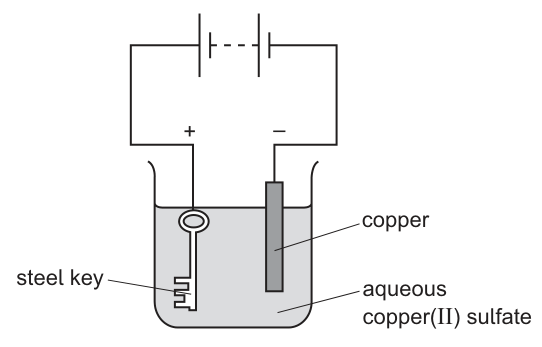
The key does not get coated with copper.
Which change needs to be made to electroplate the key?
Options
A increase the concentration of the aqueous copper(II) sulfate
B increase the electric current
C replace the solution with dilute sulfuric acid
D reverse the electrical connections
Working
In electroplating, the object to be coated (the steel key) must be the cathode, connected to the negative terminal of the power supply. This ensures that positive metal ions (Cu²⁺) from the solution are attracted to it and reduced to form a copper coating.
In the given diagram, the steel key is connected to the positive terminal (+) and the copper electrode to the negative terminal (–). This means the key is the anode (it will dissolve) and the copper electrode is the cathode (copper will plate onto it instead).
To electroplate the key, the connections must be reversed: the key to the negative terminal and the copper electrode to the positive terminal.
Answer
D
D
Walkthrough
- Recall the requirements for electroplating: the object to be plated must be the cathode, connected to the negative terminal of the power supply. This ensures that positive metal ions (Cu²⁺) from the electrolyte are attracted to it and gain electrons (reduction) to form a metal coating.
- The anode (positive electrode) is usually made of the plating metal (copper) so that it dissolves to replenish the metal ions in the solution.
- The electrolyte must contain ions of the plating metal (aqueous copper(II) sulfate is correct for copper plating).
- In the given figure, the steel key is connected to the positive terminal (+) and the copper block to the negative terminal (–).
- Because the key is positive, it acts as the anode. Instead of being coated, the steel would dissolve or oxygen gas would be produced at its surface. The copper block is negative, so copper ions would plate onto the copper block instead of the key.
- The correct fix is to reverse the connections: connect the key to the negative terminal and the copper electrode to the positive terminal.
Key Takeaways
- In electroplating, the object to be plated is always the cathode (connected to the negative terminal).
- The plating metal is the anode (connected to the positive terminal) so it can replenish the electrolyte.
- Positive ions (cations) in the electrolyte always move to and are reduced at the cathode.
Common Mistakes
- Thinking that the positive terminal attracts metal ions. (Metal ions are positive, so they are repelled by the positive anode and attracted to the negative cathode).
- Confusing the roles of anode and cathode in electrolysis.
- Assuming that changing the concentration or current will fix a polarity error.
Things to Be Careful About
- Remember that in electrolysis, positive ions (cations) move to the cathode (negative electrode) and negative ions (anions) move to the anode (positive electrode).
- The electrolyte must contain the metal ions of the plating metal; replacing it with dilute sulfuric acid (Option C) would not provide copper ions for plating.
Ammonium nitrate dissolves in water.
Which statements are correct?
- The process is endothermic.
- The water gets colder during the process.
- Thermal energy is absorbed by the ammonium nitrate from the water.
Options
A 1, 2 and 3
B 1 and 2 only
C 1 and 3 only
D 2 and 3 only
Working
The equation shows .
- A positive means the process is endothermic, so statement 1 is correct.
- In an endothermic process, thermal energy is absorbed from the surroundings. The surroundings here are the water, so the water cools, making statement 2 correct.
- The thermal energy is absorbed by the ammonium nitrate from the water, so statement 3 is also correct.
Therefore all three statements are correct.
Answer
A
A
Walkthrough
The equation given is the dissolving of ammonium nitrate in water, with a positive enthalpy change. In energetic terms, a positive always means endothermic: the process takes in more thermal energy than it gives out. Because the thermal energy must come from somewhere, it is absorbed from the surrounding water. When thermal energy leaves the water, the water becomes colder. So all three statements follow from the single fact that is positive.
No calculation is needed. The key is remembering that the sign of controls both the direction of energy transfer and whether the surroundings warm up or cool down.
Key Takeaways
- A positive means endothermic; a negative means exothermic.
- In an endothermic change, thermal energy is absorbed from the surroundings.
- Because the water is the surroundings, absorbing thermal energy from the water makes the water colder.
- All three statements in the question are logically connected, so if one is true, the others are also true.
Common Mistakes
- Thinking a positive means exothermic. The sign tells the direction: positive is energy absorbed, negative is energy released.
- Choosing only statement 1 without realising that statements 2 and 3 are direct consequences.
- Thinking that endothermic processes always make their surroundings hotter, which is the opposite of what happens.
Things to Be Careful About
- The unit is the thermal energy change per mole of ammonium nitrate dissolved, but you do not need to use this value here.
- The water is the surroundings, so if thermal energy is taken from it, the temperature of the water falls.
- When several statements are joined with "and", every statement must be true before you select the option that includes all of them.
Hydrogen reacts with oxygen to produce water.
Some bond energies are shown.
| bond | bond energy in |
|---|---|
| H–H | 436 |
| O–O | 146 |
| O=O | 496 |
| O–H | 463 |
Using the data in the table, what is the enthalpy change of reaction?
Options
A –920 kJ / mol
B –834 kJ / mol
C –484 kJ / mol
D +442 kJ / mol
Working
Bonds broken:
- 2 H–H
- 1 O=O
Total energy absorbed
Bonds formed:
- 4 O–H
Answer
C
C
Walkthrough
The displayed equation shows two hydrogen molecules reacting with one oxygen molecule to form two water molecules:
In a reaction, bonds are first broken and then new bonds are formed. Bond breaking requires energy (endothermic), while bond making releases energy (exothermic). The enthalpy change is found by subtracting the energy released when new bonds form from the energy absorbed when old bonds break.
Count the bonds broken:
- Two H–H bonds:
- One O=O bond:
The O–O bond energy given in the table is not used because there is no single O–O bond in this reaction.
Total energy absorbed .
Count the bonds formed:
- Each water molecule has two O–H bonds, and two water molecules are formed, so O–H bonds are made.
- Energy released .
Therefore:
The negative sign shows the reaction is exothermic, so the correct option is C.
Key Takeaways
- For a bond-energy calculation, use:
- Count every bond in the balanced equation, not just one molecule's bonds.
- A negative means the reaction is exothermic; a positive means it is endothermic.
Common Mistakes
- Using the O–O bond energy of instead of the O=O bond energy of . The reaction contains an oxygen–oxygen double bond, not a single bond.
- Counting only two O–H bonds formed because one water molecule has two O–H bonds, but two water molecules are produced, so four O–H bonds are formed.
- Subtracting in the wrong order and obtaining . Bond breaking absorbs energy and bond making releases it, so the correct order is broken minus formed.
- Forgetting the negative sign, which indicates an exothermic reaction.
Things to Be Careful About
- Use the balanced equation shown in the question: .
- Keep the unit throughout.
- Only use bond energies for bonds that actually appear in the reaction.
- The sign of the enthalpy change matters: energy released is greater than energy absorbed, so the answer must be negative.
Silicon(IV) chloride, SiCl₄, boils at .
Which row shows the type of change when silicon(IV) chloride boils and the explanation?
Options
| type of change | explanation | |
|---|---|---|
| A | chemical | intermolecular forces break |
| B | chemical | Si–Cl covalent bonds break |
| C | physical | intermolecular forces break |
| D | physical | Si–Cl covalent bonds break |
Working
Silicon(IV) chloride, , is a simple molecular substance. Within each molecule the Si–Cl atoms are joined by strong covalent bonds, but between molecules there are only weak intermolecular forces.
Boiling is a change of state: the molecules are separated from each other, but the covalent bonds inside each molecule are not broken. No new substance is formed, so boiling is a physical change. The explanation is that intermolecular forces break.
Options A and B are wrong because boiling is not a chemical change. Option D is wrong because boiling does not break the Si–Cl covalent bonds.
Answer
C
C
Walkthrough
Silicon(IV) chloride, , is a covalent molecular substance. Each molecule is held together by strong covalent bonds between the silicon atom and the chlorine atoms. However, the molecules are only attracted to each other by weak intermolecular forces.
When boils, it changes from a liquid to a gas. This is a change of state, not a change of substance. The particles gain enough energy to overcome the weak intermolecular forces and move apart, but the covalent bonds inside each molecule remain intact. Since no new substance is formed, the change is physical.
Now look at the options:
- A says chemical and intermolecular forces break. Boiling is not chemical, so A is wrong.
- B says chemical and Si–Cl covalent bonds break. Boiling is not chemical, and the covalent bonds are not broken, so B is wrong.
- C says physical and intermolecular forces break. This is correct.
- D says physical and Si–Cl covalent bonds break. The change is physical, but the covalent bonds are not broken, so D is wrong.
Therefore the correct answer is C.
Key Takeaways
- A physical change is a change of state or shape in which no new substance is formed.
- A chemical change produces one or more new substances.
- Simple molecular substances, such as , have weak intermolecular forces between molecules.
- Boiling or melting only breaks the weak intermolecular forces; the covalent bonds inside the molecule stay intact.
- The strength of intermolecular forces explains why simple molecular substances have low melting and boiling points.
Common Mistakes
- Choosing D because the change is physical, but incorrectly saying that covalent bonds break. Boiling does not break covalent bonds.
- Choosing A or B because the student thinks bubbles or a gas formed means a chemical change. Boiling is still a physical change.
- Confusing intermolecular forces with covalent bonds. Intermolecular forces act between molecules; covalent bonds act between atoms inside a molecule.
Things to Be Careful About
- The word “break” in the explanation means the forces are overcome or overcome. In the mark scheme, either “break” or “overcome” is usually accepted for intermolecular forces.
- Do not say that covalent bonds break during boiling; this would give the wrong explanation.
- Remember that silicon(IV) chloride is a simple molecular compound, not a giant covalent structure. Its low boiling point is evidence of weak intermolecular forces.
A 2 g sample of calcium carbonate reacts with dilute hydrochloric acid as shown.
Which change in conditions makes the reaction proceed more slowly?
Options
A increasing the acid concentration
B increasing the size of the solid particles
C increasing the surface area of the solid particles
D increasing the temperature
Working
Increasing the acid concentration, increasing the surface area, or increasing the temperature all speed up the reaction because they increase the frequency of successful collisions.
Increasing the size of the solid particles reduces the surface area of the calcium carbonate, so fewer acid particles can collide with it each second. The reaction therefore proceeds more slowly.
Answer
B
B
Walkthrough
This question asks which change makes the reaction go more slowly, so we need the factor that decreases the rate.
For a reaction to happen, particles must collide with enough energy. This is collision theory.
- Increasing acid concentration puts more acid particles in the same volume, so collisions happen more often and the reaction is faster.
- Increasing temperature gives the particles more kinetic energy, so more collisions have enough energy to react and the reaction is faster.
- Increasing the surface area of the solid exposes more calcium carbonate to the acid, so there are more collisions per second and the reaction is faster.
- Increasing the size of the solid particles does the opposite: larger lumps have a smaller surface area for the same mass, so fewer acid particles can collide with the solid each second and the reaction is slower.
Therefore the correct option is B.
Key Takeaways
- The rate of a reaction depends on how often successful collisions happen.
- Concentration, temperature, surface area and catalysts all affect the rate.
- For a fixed mass of solid, larger particles mean smaller surface area.
- "Increasing particle size" and "increasing surface area" are opposite changes.
Common Mistakes
- Choosing C because surface area is mentioned, without noticing that the question asks for a slower reaction.
- Thinking that increasing particle size increases surface area. In fact, larger particles have less surface area for the same mass.
- Selecting a factor that speeds up the reaction instead of slowing it down.
Things to Be Careful About
- Read whether the question asks for faster or slower.
- In rate questions, the precise explanation should mention successful collisions per second.
- For a solid reactant, "surface area" and "particle size" are inversely related for a fixed mass of solid.
Excess aluminium reacts with dilute hydrochloric acid.
The hydrogen given off is collected in a gas syringe. The total volume of hydrogen in the gas syringe is recorded every two minutes. The results of this experiment are shown.
| time / min | total volume / |
|---|---|
| 0 | 0 |
| 2 | 3 |
| 4 | 53 |
| 6 | 103 |
| 8 | 131 |
| 10 | 141 |
| 12 | 143 |
| 14 | 143 |
Which statement is correct?
Options
A The mass of aluminium added is 0.107 g.
B The mass of aluminium added cannot be determined from the information given.
C The highest rate of reaction is .
D The highest rate of reaction is when the acid concentration is highest.
Working
The final volume of hydrogen is .
From the equation, , so
This is the mass of aluminium that reacted, not the mass added, because aluminium is in excess. So A is false and B is true.
Rates between readings: min: ; min: ; min: ; later rates are lower. The highest rate is , not , so C is false.
The highest rate does not occur at the start, when the acid concentration is highest, so D is false.
Answer
B
B
Walkthrough
The table gives the total volume of hydrogen collected. The reaction stops when the acid is used up because aluminium is in excess. Therefore the final volume, , tells us how much aluminium reacted, not how much was added.
Convert the volume to moles using the molar gas volume at r.t.p., :
The equation shows gives , so:
Option A quotes , but this is only the mass that reacted. Since the aluminium was in excess, the mass added is larger and unknown, so B is correct.
For the rate options, calculate the rate in each two-minute interval:
- min:
- min:
- min:
- min:
- later intervals are smaller.
The highest rate is , not , so C is false. Also, the highest rate is not at the start, even though the acid concentration is highest at the start; the data show the rate increases after the first two minutes, so D is false.
Key Takeaways
- In a reaction with one reactant in excess, the amount of product is limited by the other reactant; the amount of the excess reactant added cannot be found from product volume.
- Molar gas volume at r.t.p. is .
- Rates are calculated from differences between consecutive readings, not by dividing the final total by the total time.
- A higher concentration usually gives a higher rate, but other factors, such as a surface oxide layer, can make the highest rate occur later.
Common Mistakes
- Quoting as the mass of aluminium added. It is the mass of aluminium reacted.
- Calculating the rate as ; rates must be found between consecutive readings.
- Assuming D is correct because concentration is highest at the start; the data contradict this.
- Forgetting to convert to before using the molar gas volume.
Things to Be Careful About
- Read "excess aluminium" carefully: it means some aluminium is left over.
- Use the balanced equation ratio .
- Use .
- The volume stops changing after 12 min, showing the acid has been used up.
- The units of rate are .
157.75 g of bismuth(III) chloride, BiCl₃, is used to make of solution using distilled water.
The aqueous bismuth(III) chloride slowly becomes cloudy as it reacts with water to form insoluble BiOCl.
The reaction is reversible.
Which statements are correct?
- The initial concentration of the bismuth(III) chloride solution is .
- At equilibrium, the rate of the forward reaction equals the rate of the reverse reaction.
- When more hydrochloric acid is added, the position of equilibrium moves to the left.
[: Bi, 209; Cl, 35.5]
Options
A 1, 2 and 3
B 1 and 2 only
C 1 and 3 only
D 2 and 3 only
Working
Calculate the relative formula mass of :
Moles of :
Volume , so:
Statement 1 is correct.
At equilibrium, the forward and reverse reactions continue at the same rate, so statement 2 is correct.
Adding increases the concentration of a product. The equilibrium shifts in the direction that removes some added , which is the reverse direction, so the position moves to the left. Statement 3 is correct.
All three statements are correct.
Answer
A
A
Walkthrough
Start by finding the concentration of the bismuth(III) chloride solution. The relative formula mass is . The mass used is g, so the amount is mol. Since is , concentration is . Statement 1 is true.
Statement 2 concerns equilibrium. In any reversible reaction at equilibrium, the rate of the forward reaction equals the rate of the reverse reaction. This is the definition of dynamic equilibrium; it does not mean concentrations of reactants and products are equal. Statement 2 is true.
Statement 3: the equation has on the right. Adding more increases the concentration of a product. According to Le Chatelier's principle, the equilibrium shifts in the direction that reduces this increase, i.e. it uses up , so it shifts to the left, forming more and . Statement 3 is true.
Since all three statements are correct, option A is the answer. Option B misses statement 3, option C misses statement 2, and option D misses statement 1.
Key Takeaways
- Concentration is calculated as moles divided by volume in .
- At equilibrium, forward and reverse rates are equal.
- Adding a product to a system at equilibrium shifts the position to the left (towards reactants).
Common Mistakes
- Forgetting to convert to ; using would give the wrong concentration.
- Thinking that at equilibrium the amounts or concentrations of reactants and products are equal; only the rates are equal.
- Thinking that adding shifts equilibrium to the right because it is a reactant; is a product here, so the shift is to the left.
Things to Be Careful About
- contains three chlorine atoms, so , not .
- The volume must be in for concentration in : .
- The solid appears in the equation but does not change the reasoning here; the added is aqueous and affects the equilibrium.
- In a multiple-choice question, check each statement independently before choosing the option.
The flow chart shows some of the processes and reactions in the formation of ammonia.
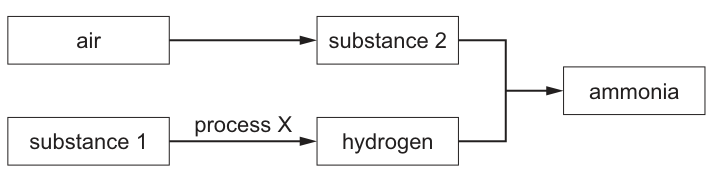
What are the names of process X, substance 1 and substance 2?
Options
| process X | substance 1 | substance 2 | |
|---|---|---|---|
| A | cracking | long-chain alkanes | nitrogen |
| B | cracking | long-chain alkenes | oxygen |
| C | fractional distillation | long-chain alkanes | nitrogen |
| D | fractional distillation | long-chain alkenes | oxygen |
Answer
A
Ammonia is produced by the Haber process, which requires nitrogen and hydrogen as reactants. Therefore, substance 2 must be nitrogen. Nitrogen is obtained from air, which matches the flow chart.
Hydrogen is required for the Haber process. In the context of fossil fuels and organic chemistry, hydrogen can be obtained by cracking long-chain alkanes (substance 1). Process X is therefore cracking.
A
Walkthrough
The flow chart illustrates the industrial preparation of ammonia. The final product is ammonia, which is formed via the Haber process. The Haber process combines nitrogen gas and hydrogen gas under high temperature, high pressure, and in the presence of an iron catalyst. Therefore, the two inputs to the ammonia box must be nitrogen and hydrogen.
Looking at the flow chart, 'substance 2' and 'hydrogen' combine to form 'ammonia'. This means 'substance 2' must be nitrogen. The arrow leading to 'substance 2' comes from 'air'. Air is approximately 78% nitrogen, and nitrogen is separated from air by fractional distillation of liquid air. This confirms substance 2 is nitrogen.
The other reactant is hydrogen. The flow chart shows 'substance 1' going through 'process X' to produce 'hydrogen'. In the organic chemistry syllabus, hydrogen is often associated with the cracking of petroleum fractions. Cracking is the process of breaking down long-chain alkanes (substance 1) into shorter, more useful molecules, including shorter alkanes, alkenes, and hydrogen gas. Therefore, process X is cracking and substance 1 is long-chain alkanes.
Matching these findings to the options:
- process X: cracking
- substance 1: long-chain alkanes
- substance 2: nitrogen
This corresponds to option A.
Key Takeaways
- The Haber process requires nitrogen and hydrogen.
- Nitrogen is sourced from air.
- Hydrogen can be sourced from the cracking of long-chain alkanes (petroleum fractions) in simplified industrial flow charts.
- Cracking breaks large hydrocarbon molecules into smaller ones.
Common Mistakes
- Confusing the sources of nitrogen and hydrogen. Nitrogen comes from air; hydrogen comes from hydrocarbons (natural gas or petroleum fractions).
- Misidentifying process X. Fractional distillation separates mixtures (like crude oil into fractions) but does not chemically break down alkanes to produce hydrogen. Cracking is the chemical breakdown process.
- Assuming substance 1 is an alkene. Alkenes are products of cracking, not the starting material (substance 1) for producing hydrogen in this context.
Things to Be Careful About
- Ensure you identify the reactants for the final product (ammonia) first. This is the anchor point (nitrogen and hydrogen).
- Remember that air separation gives nitrogen (and oxygen, but oxygen is not needed for ammonia). Substance 2 is nitrogen, not oxygen.
- Cracking produces alkenes and shorter alkanes, but in the context of hydrogen production for ammonia, it is the process that breaks down the long-chain alkanes (substance 1).
Many reactions involve oxidation and reduction.
Which statement is correct?
Options
A Acidified manganate(VII) ions change colour from colourless to purple when reduced.
B All reactions that involve oxidation also involve reduction.
C During a reaction, oxidising agents lose electrons.
D Reduction is the loss of hydrogen from a compound.
Working
- Acidified manganate(VII) ions are purple. When they are reduced the purple colour fades, not the other way round, so A is wrong.
- In any redox reaction, one species loses electrons (is oxidised) and another species gains those electrons (is reduced). So oxidation and reduction always happen together, making B correct.
- An oxidising agent accepts electrons and is itself reduced; it does not lose electrons, so C is wrong.
- Reduction is the gain of hydrogen, not the loss; loss of hydrogen is oxidation, so D is wrong.
Answer
B
B
Walkthrough
Look at each statement in turn.
- A: Acidified manganate(VII) ions are purple. When reduced they are changed to a colourless or very pale pink solution. The statement says the opposite, so A is incorrect.
- B: Redox reactions always involve both oxidation and reduction: one species gives electrons while another gains them. This is correct.
- C: An oxidising agent takes electrons from another substance, so it gains electrons and is itself reduced. Stating that it loses electrons is wrong.
- D: Reduction is gaining hydrogen, not losing hydrogen. Loosing hydrogen is a sign of oxidation, so D is incorrect.
Key Takeaways
- Remember oil rig: Oxidation Is Loss, Reduction Is Gain (of electrons).
- Oxidation and reduction always occur together in a redox reaction.
- An oxidising agent gains electrons; a reducing agent loses electrons.
- In a redox reaction, the oxidising agent is also reduced, and the reducing agent is also oxidised.
Common Mistakes
- Mistaking the colour change of acidified manganate(VII): it is purple and goes colourless or pale pink when reduced, not the reverse.
- Saying an oxidising agent loses electrons — it actually gains electrons.
- confusing reduction with the loss of hydrogen. Reduction is the gain of hydrogen, while oxidation can be the loss of hydrogen.
Things to Be Careful About
- Always know the direction of electron transfer: use OIL RIG.
- Do not confuse oxidising agent with reducing agent. The oxidising agent is reduced, the reducing agent is oxidised.
- When a question talks about hydrogen, remember that gaining hydrogen is reduction, losing hydrogen is oxidation.
The equation for a reaction is shown.
Which statement about this reaction is correct?
Options
A Bromide ions are the oxidising agent.
B Bromine is the reducing agent.
C Chloride ions are the reducing agent.
D Chlorine is the oxidising agent.
Working
Chlorine is more than chlorine, so it takes electrons from bromide ions.
Chlorine gains electrons and is reduced, so it is the oxidising agent. Bromide ions lose electrons and are oxidised, so they are the reducing agent.
- A is wrong because bromide ions are the reducing agent, not the oxidising agent.
- B is wrong because bromine is a product, not the reducing agent.
- C is wrong because chloride ions are a product.
Answer
D
D
Walkthrough
This question tests a halogen displacement reaction. Chlorine is more reactive than bromine, so chlorine displaces bromine from potassium bromide. Chlorine is converted into chloride ions by gaining an electron. Gaining electrons is reduction, so chlorine is reduced. The substance that brings about oxidation by removing electrons from another substance is the oxidising agent. Because chlorine is reduced, chlorine is the oxidising agent.
The bromide ions lose an electron and are oxidised to bromine. Losing electrons is oxidation, and the substance that provides the electrons is the reducing agent. Hence bromide ions are the reducing agent.
Option A is not correct because bromide ions are the reducing agent, not the oxidising agent. Option B is not correct because bromine is the product, not a reactant acting as a reducing agent. Option C is not correct because chloride ions are also products and have not acted as a reducing agent.
Key Takeaways
- In a halogen displacement, the more reactive halogen oxidises the less reactive halide ion.
- The oxidising agent is reduced; the reducing agent is oxidised.
- The identity of the oxidising and reducing agents must be decided from electron transfer, not from the names of the substances.
Common Mistakes
- Confusing "oxidising agent" with"being oxidised". The oxidising agent is the substance that gets reduced, not oxidised.
- Calling bromine the reducing agent when bromine is a product, not a reactant.
- Confusing chloride ions with bromide ions. The ions are involved in the electron transfer.
Things to Be Careful About
- Use the terms "oxidising agent" and "reducing agent" in the correct order: the agent accepts/ donates electrons accordingly.
- Make sure the half-equations are balanced in charge and in atoms.
- This question relies on the old Group VII displacement trend: chlorine is more reactive than bromine.
Which row describes both the pH and the ion with the greatest concentration in an aqueous alkali?
Options
| pH | or ion with greatest concentration | |
|---|---|---|
| A | greater than 7 | |
| B | greater than 7 | |
| C | less than 7 | |
| D | less than 7 |
Working
An aqueous alkali is a base that dissolves in water, releasing hydroxide ions, . Alkalis have a pH greater than 7. In an alkali, the concentration of ions is greater than the concentration of ions.
Row B matches both requirements: pH greater than 7 and greatest ion concentration is .
Answer
B
B
Walkthrough
The question asks for the row that correctly describes an aqueous alkali in two ways: its pH, and which ion, or , is present in the greatest concentration.
An alkali is a soluble base. When dissolved in water it produces hydroxide ions, . Because of these hydroxide ions, an alkali is not acidic, so its pH must be greater than 7. The pH scale runs from below 7 for acids to above 7 for alkalis, with 7 being neutral.
In any aqueous solution there are always some and ions, but their relative amounts decide whether the solution is acidic or alkaline. In an alkali, the concentration of ions is greater than the concentration of ions. That is exactly what makes the solution alkaline.
Row B is the only row that has both pH greater than 7 and as the ion with the greatest concentration.
Key Takeaways
- An alkali is a soluble base that releases hydroxide ions, , in water.
- Alkalis have pH greater than 7.
- The ion present in the greatest concentration in an alkali is , not .
Common Mistakes
- Choosing A: it correctly says pH greater than 7 but incorrectly states that has the greatest concentration. That would describe an acid, not an alkali.
- Choosing C or D: these say pH less than 7, which describes an acid, not an alkali.
Things to Be Careful About
The question asks for the ion with the greatest concentration, not the ion that is present at all. Both and are present in water, but their relative amounts decide whether the solution is acidic or alkaline.
The water in a lake is acidic and the fish are dying. The water in the lake needs to be neutralised so that its pH is close to 7.
Which compound is added in excess to neutralise the water in the lake?
Options
A calcium carbonate
B phosphoric acid
C potassium hydroxide
D sodium nitrate
Working
To raise the pH of acid lake water to 7, an acid-neutralising compound must be added. Calcium carbonate is a basic substance that reacts with H⁺ ions:
It is suitable to add in excess because the extra calcium carbonate is insoluble and does not by itself make the water strongly alkaline.
Phosphoric acid would add more H⁺ ions and cannot neutralise the lake. Potassium hydroxide is a strongly soluble alkali, so excess would make the pH far above 7. Sodium nitrate is a neutral salt; it does not remove H⁺ ions.
Answer
A
A
Walkthrough
This question asks how to neutralise acid lake water rather than merely dilute it. Neutralisation means removing H⁺ ions using a base or carbonate.
Calcium carbonate is a basic carbonate. It reacts with acids to form a salt, water and carbon dioxide. Because it is insoluble, any calcium carbonate still present after the acid has reacted just remains as a solid at the bottom of the lake; it does not keep raising the pH into the alkaline range. This makes it suitable to add in excess.
Phosphoric acid is itself an acid, so it would lower the pH still further and poison the fish even more. Potassium hydroxide is a strong, soluble alkali; if added in excess it would neutralise the acid first but then make the water much too alkaline. Sodium nitrate is a neutral salt, but it has no acid-neutralising ability, so the lake would remain acidic.
The equation shows the key reaction between hydrogen ions and calcium carbonate:
For each mole of calcium carbonate, two moles of H⁺ are removed, so the pH rises towards 7.
Key Takeaways
- Acid neutralisation can be done with an alkaline, a base or a carbonate.
- Calcium carbonate is an insoluble carbonate, so it neutralises acid without making the environment strongly alkaline when used in excess.
- Supplying only acidic or neutral compounds cannot neutralise acidic water.
Common Mistakes
- Choosing potassium hydroxide because it is an alkali, and failing to notice the word “excess” in the question. Excess potassium hydroxide would leave pH too high.
- Choosing sodium nitrate because it is neutral. A neutral salt does not react significantly with the acid, so it does not neutralise it.
- Choosing phosphoric acid, which is an acid and would add more H⁺ ions.
Things to Be Careful About
- “In excess” is an important condition: an alkali that is completely soluble and strong would overshoot pH7 if present in excess.
- Calcium carbonate is insoluble in water, so the excess remains as an insoluble solid; this is why it is the best choice for lake treatment.
- If the equation were needed, for two H⁺ ions are present, giving Ca²⁺ and CO₂, balance all atoms and charges. State symbols should be included: solid carbonate, aqueous hydrogen ions, aqueous salt, carbon dioxide gas and liquid water.
Which pair of reagents is used in a school laboratory to prepare a sample of pure barium sulfate?
Options
A barium carbonate and dilute sulfuric acid
B barium carbonate and sodium sulfate
C barium chloride and sodium sulfate
D barium hydroxide and concentrated sulfuric acid
Working
To prepare an insoluble salt by precipitation, both reagents must be soluble so that the required salt can form as a solid. Barium sulfate is insoluble.
Barium chloride and sodium sulfate are both soluble, and mixing their solutions gives a white precipitate of barium sulfate:
The precipitate is filtered, washed with distilled water and dried to give a pure sample.
Options A, B and D are not suitable: barium carbonate is insoluble, so it cannot supply barium ions in solution, and concentrated sulfuric acid is not used in a school laboratory for this preparation.
Answer
C
C
Walkthrough
Barium sulfate is an insoluble salt. In the school laboratory, an insoluble salt is made by precipitation: mix two soluble salts, one providing the positive ion and the other providing the negative ion, and the insoluble salt appears as a solid.
- Barium chloride is soluble, so it provides ions in solution.
- Sodium sulfate is soluble, so it provides ions.
- When the two solutions are mixed, precipitates and sodium chloride stays dissolved.
This makes option C correct. The solid is then separated by filtration, washed with distilled water and dried, giving a pure sample.
Why the other options are wrong:
- A: barium carbonate is insoluble, so it does not give barium ions in solution. This is not a clean precipitation method.
- B: barium carbonate is insoluble and sodium sulfate is soluble, so no reaction occurs.
- D: barium hydroxide is not a suitable soluble source of barium ions here, and concentrated sulfuric acid is not appropriate for a school laboratory.
Key Takeaways
- Insoluble salts are prepared by precipitation from two soluble reagents.
- Solubility rules: all sodium salts are soluble, most chlorides are soluble, and barium sulfate is insoluble.
- The precipitate is collected by filtration, washed and dried.
Common Mistakes
- Choosing A because a carbonate and an acid react: barium carbonate is insoluble, so it cannot supply barium ions in solution.
- Forgetting that both reagents must be soluble for a clean precipitation.
- Using concentrated sulfuric acid: this is not the school-laboratory method.
Things to Be Careful About
- Know the solubility rules: sulfates are soluble except barium sulfate (lead sulfate is also insoluble, and calcium sulfate is slightly soluble).
- The equation must be balanced and include state symbols.
- The precipitate must be washed with distilled water and dried to remove soluble impurities.
The total number of electrons in one atom of element Q is 17 and in one atom of element R is 19.
Which statement about elements Q and R is correct?
Options
A Q and R react together to form a covalent compound.
B Q forms positive ions.
C R has more outer shell electrons than Q.
D R is more metallic than Q.
Working
An atom with 17 electrons has the configuration 2,8,7, so Q is chlorine, a Group VII non-metal. An atom with 19 electrons has the configuration 2,8,8,1, so R is potassium, a Group I metal.
- A is incorrect — potassium and chlorine react to form an ionic compound, not a covalent compound.
- B is incorrect — chlorine gains one electron to form a negative ion, .
- C is incorrect — Q has 7 outer-shell electrons; R has only 1.
- D is correct — potassium (R) is a metal, chlorine (Q) is a non-metal, so R is more metallic than Q.
Answer
D
D
Walkthrough
For a neutral atom, the number of electrons equals the proton number. So Q has proton number 17 and R has proton number 19.
- Q with 17 electrons has the electron configuration 2,8,7. This places it in Group VII of the Periodic Table; it is chlorine, a non-metal.
- R with 19 electrons has the electron configuration 2,8,8,1. This places it in Group I; it is potassium, a metal.
Now check each statement.
- A: A metal and a non-metal usually form an ionic compound. Potassium chloride is ionic, not covalent, so A is wrong.
- B: Non-metals in Group VII gain one electron to form negative ions such as . Q does not form positive ions, so B is wrong.
- C: Outer-shell electrons are the electrons in the highest occupied shell. Q has 7 outer-shell electrons, while R has only 1, so R does not have more outer-shell electrons than Q. C is wrong.
- D: Metallic character is associated with elements that lose electrons and form positive ions. Potassium is a metal, while chlorine is a non-metal, so R is more metallic than Q. D is correct.
Key Takeaways
- In a neutral atom, the number of electrons equals the proton number.
- The electron configuration can be written in shells, e.g. 2,8,7 or 2,8,8,1.
- For main-group elements, the group number often tells you the number of outer-shell electrons.
- Metals tend to form positive ions; non-metals tend to form negative ions.
- A metal and a non-metal generally form an ionic compound, not a covalent compound.
Common Mistakes
- Assuming that an element with 17 electrons must form positive ions because it is an element. In fact, chlorine is a non-metal and forms a negative ion.
- Confusing the outer-shell electron counts: Q has 7 outer-shell electrons, not fewer than R.
- Thinking that any reaction between two elements produces a covalent compound. Metal + non-metal usually gives an ionic compound.
Things to Be Careful About
- The phrase “total number of electrons” only gives the proton number if the atom is neutral.
- Write the electron configuration shell by shell (2,8,7 and 2,8,8,1) before comparing outer-shell electrons.
- Metallic character is a periodic trend: Group I metals are strongly metallic, while Group VII elements are non-metals.
- In multiple-choice questions, eliminate each wrong statement using a clear reason before selecting the correct option.
Which statements about the Group VIII noble gases are correct?
- They are unreactive.
- They all have a full outer shell of electrons.
- They are all diatomic gases at room temperature and pressure.
Options
A 1, 2 and 3
B 1 and 2 only
C 1 and 3 only
D 2 and 3 only
Working
Statement 1 is correct: noble gases are unreactive because they have a full outer shell of electrons.
Statement 2 is correct: they all have a full outer shell of electrons.
Statement 3 is incorrect: noble gases exist as single atoms (monatomic), not diatomic molecules.
Therefore, the correct statements are 1 and 2 only.
Answer
B
B
Walkthrough
This question tests your knowledge of the noble gases (Group VIII/18). Let's examine each statement:
-
Statement 1: They are unreactive. This is correct. Noble gases have a full outer shell of electrons, making them very stable and unreactive. They do not easily form compounds.
-
Statement 2: They all have a full outer shell of electrons. This is also correct. This is the fundamental reason for their lack of reactivity. Helium has 2 electrons in its only shell, and the rest have 8 in their outermost shell.
-
Statement 3: They are all diatomic gases at room temperature and pressure. This is incorrect. Noble gases exist as single atoms (monatomic), not diatomic molecules. Diatomic molecules, like hydrogen (H₂), oxygen (O₂), and chlorine (Cl₂), consist of two atoms bonded together. Noble gases do not form bonds with each other.
Since statements 1 and 2 are correct, the answer is B.
Key Takeaways
- Noble gases are unreactive due to their full outer shell of electrons.
- They are monatomic, not diatomic.
- The term 'diatomic' means two atoms of the same element bonded together.
Common Mistakes
- Choosing statement 3 as correct because some students confuse noble gases with other gases like chlorine or oxygen, which are diatomic.
- Forgetting that helium has a full outer shell with only 2 electrons, not 8.
Things to Be Careful About
- Remember that 'unreactive' does not mean 'not present as single atoms'. Noble gases are monatomic.
- The term 'diatomic' is a specific term referring to two atoms bonded together, which is not the case for noble gases.
Iron has a high melting point.
Which statement explains the high melting point of iron?
Options
A Each iron cation has a strong electrostatic attraction to a ‘sea’ of delocalised electrons.
B In every iron atom there is a strong attraction between the protons and the electrons.
C Iron has the same structure as diamond which has a very high melting point.
D Iron is an alloy and alloys have different physical properties from the elements they contain.
Working
Iron is a metal, so its atoms lose electrons to form positive ions in a lattice. The high melting point is caused by the strong electrostatic attraction between these positive ions and the sea of delocalised electrons. This matches option A.
Option B is about forces inside an atom, not between metal particles. Option C is wrong because iron has metallic bonding, not diamond's giant covalent structure. Option D is wrong because iron is an element, not an alloy.
Answer
A
A
Walkthrough
In a metal such as iron, each atom contributes its outer electrons to a shared 'sea' of delocalised electrons. The metal atoms become positive ions arranged in a regular lattice. The high melting point is explained by the strong electrostatic attraction between the positive ions and the delocalised electrons. To melt iron, this attraction must be overcome, which needs a lot of energy. Option A states exactly this. Option B talks about attraction between protons and electrons within one atom, which is not what determines melting point. Option C confuses iron's metallic structure with diamond's giant covalent structure. Option D is incorrect because iron is an element, not an alloy.
Key Takeaways
- Metals have a giant metallic structure: positive ions in a lattice surrounded by a sea of delocalised electrons.
- The strength of metallic bonding explains high melting and boiling points and electrical conductivity.
- A high melting point means strong forces between particles must be overcome.
Common Mistakes
- Choosing C: diamond has a high melting point due to giant covalent bonding, not metallic bonding; iron and diamond have different structures.
- Choosing B: forces inside an atom are not the reason for melting point; melting involves breaking bonds between particles.
- Choosing D: iron is an element, not an alloy; steel is an alloy containing iron.
Things to Be Careful About
- Use precise wording: 'electrostatic attraction between positive ions and delocalised electrons'.
- Do not say 'attraction between atoms' or 'attraction inside atoms'.
- In metallic bonding, the outer electrons are delocalised, not held by individual atoms.
Which statement about alloys is correct?
Options
A Alloys are not electrical or thermal conductors.
B Alloys are softer than pure metals because the layers in the alloy slip over each other more easily.
C Brass is a mixture of copper with small amounts of chromium, nickel and carbon.
D The percentage of each metal in an alloy may vary.
Working
Alloys are mixtures of metals (or a metal with another element), and the percentage of each metal in an alloy may be varied to give the desired properties. So D is correct.
A is incorrect because alloys are good conductors of electricity and heat, like pure metals.
B is incorrect because alloys are usually harder and stronger than pure metals, since different-sized atoms distort the layers and prevent them from slipping easily.
C is incorrect because brass is an alloy of copper and zinc, not copper with chromium, nickel and carbon.
Answer
D
D
Walkthrough
This question tests basic knowledge about alloys. Read each statement and decide whether it is true.
- Option A says alloys are not conductors. This is false: metals conduct electricity and heat because of their delocalised electrons, and alloys still contain metals, so they also conduct.
- Option B says alloys are softer because layers slip more easily. This is the opposite of the truth. In a pure metal, layers of atoms can slide over each other, making the metal soft and malleable. In an alloy, atoms of different sizes are mixed in, which distorts the layers and makes it harder for them to slip. So alloys are usually harder and stronger than pure metals.
- Option C says brass contains copper with chromium, nickel and carbon. Brass is actually made from copper and zinc. The description given is closer to stainless steel, which contains iron, chromium, nickel and carbon.
- Option D says the percentage of each metal in an alloy may vary. This is true. By changing the proportions of the metals, manufacturers can change the properties of the alloy, such as hardness, strength or resistance to corrosion.
Therefore the correct answer is D.
Key Takeaways
- An alloy is a mixture of a metal with one or more other elements, usually other metals.
- Alloys are generally harder and stronger than pure metals because different-sized atoms distort the layers and stop them from sliding.
- The composition of an alloy can be adjusted to give particular properties.
- Common examples include brass (copper and zinc) and steel (iron with carbon and other elements).
Common Mistakes
- Thinking alloys are softer than pure metals. Remember: the distorted layers make alloys harder.
- Thinking alloys do not conduct electricity. They still contain metals and therefore conduct.
- Mixing up the composition of brass. Brass is copper and zinc, not copper with chromium and nickel.
Things to Be Careful About
- Read each statement carefully and compare it with the correct model of metallic structure.
- In an alloy, the key idea is that atoms of different sizes disrupt the regular layers, which increases hardness.
- The percentage composition of an alloy is not fixed; it can be varied by design.
The table shows the reactions of four metals, P, Q, R and S, and their oxides.
| reaction with water | reaction with dilute acid | reaction of oxide with carbon | |
|---|---|---|---|
| P | reacts only with steam | reacts rapidly | no reaction |
| Q | no reaction | reacts slowly | reacts when heated strongly |
| R | no reaction | no reaction | reacts when heated |
| S | reacts rapidly | reacts rapidly | no reaction |
What is the order of reactivity, from the most reactive to the least reactive metal?
Options
A P > S > Q > R
B P > S > R > Q
C S > P > Q > R
D S > P > R > Q
Working
A more reactive metal reacts more readily with water and with dilute acid.
- S reacts rapidly with water, so S is the most reactive metal.
- P reacts only with steam, so P is less reactive than S but more reactive than Q and R.
- Q reacts slowly with dilute acid, so Q is more reactive than R, which does not react with dilute acid at all.
- Therefore R is the least reactive metal.
Order from most reactive to least reactive: S > P > Q > R.
Answer
C
C
Walkthrough
The reactivity series tells us how readily metals react with water, steam and dilute acids. The more reactive the metal, the more easily it reacts.
- S reacts rapidly with water. Reacting with cold water is a sign of a very reactive metal, so S must be the most reactive metal.
- P reacts only with steam, not with cold water. This means P is less reactive than S, but P still reacts with dilute acid rapidly, so P is more reactive than Q and R.
- Q does not react with water but reacts slowly with dilute acid. This places Q above hydrogen in the reactivity series, but below P.
- R does not react with water or dilute acid at all. This places R below hydrogen and makes it the least reactive metal.
Combining these gives S > P > Q > R, which is option C.
The column about the oxide reacting with carbon is not needed to rank the metals here. It mainly tells us that Q and R are less reactive than carbon, because their oxides can be reduced by carbon.
Key Takeaways
- Metals that react with cold water are more reactive than metals that react only with steam.
- Metals that react with dilute acid are more reactive than metals that do not react with acid.
- The reactivity series can be used to predict and compare how metals react with water and acids.
- When ranking metals, always read the clue that separates them clearly; here, water reactivity separates S from P, and acid reactivity separates Q from R.
Common Mistakes
- Thinking P is more reactive than S because P "reacts only with steam" while S reacts with water. Reacting with cold water is a stronger sign of reactivity than reacting with steam.
- Ranking Q and R using the oxide column alone. The acid column is the clearer clue: Q reacts slowly with acid, while R does not react at all.
- Reversing the order and giving least reactive to most reactive instead of most to least.
Things to Be Careful About
- Read the question direction carefully: it asks for most reactive to least reactive.
- "No reaction" with dilute acid usually means the metal is below hydrogen in the reactivity series.
- "Reacts only with steam" means it does not react with cold water, so it is less reactive than a metal that reacts with cold water.
- The same metal can react rapidly with acid but only with steam with water, so use both clues together when ranking.
Which reactions take place during the extraction of aluminium from aluminium oxide using carbon electrodes?
Options
A 1, 2 and 3
B 1 and 2 only
C 1 only
D 2 and 3 only
Working
In the electrolysis of molten aluminium oxide:
- At the anode, oxide ions are oxidised: .
- The oxygen produced attacks the carbon anode: .
- At the cathode, aluminium ions are reduced. The aluminium ion is , not , so reaction 3 is incorrect. The correct cathode reaction is .
Therefore reactions 1 and 2 take place.
Answer
B
B
Walkthrough
The extraction of aluminium uses electrolysis of molten aluminium oxide (alumina) dissolved in molten cryolite. The molten mixture contains aluminium ions and oxide ions. At the cathode, positive aluminium ions gain electrons to form aluminium metal. At the anode, negative oxide ions lose electrons to form oxygen gas. The carbon anodes are not inert in practice: the oxygen produced reacts with the hot carbon to form carbon dioxide, so the anodes are gradually burnt away.
Now check each reaction:
- is the correct anode reaction: oxide ions lose electrons.
- is the correct reaction of oxygen with the carbon anode.
- is wrong because aluminium ions in the melt are , not . The correct cathode reaction is .
So only 1 and 2 are correct, giving option B.
Key Takeaways
- In electrolysis, cations are reduced at the cathode and anions are oxidised at the anode.
- Aluminium is extracted by electrolysis of molten aluminium oxide; the ion is .
- Carbon anodes react with the oxygen produced, so they are consumed and need replacing.
Common Mistakes
- Choosing reaction 3 as correct without checking the charge on the aluminium ion. Aluminium always forms , not .
- Forgetting that the carbon anode reacts with oxygen, so reaction 2 is part of the process.
- Thinking the anode is inert; in aluminium extraction the carbon anode is not inert.
Things to Be Careful About
- Pay attention to charges and balancing in half-equations: .
- The oxygen produced at the anode is not released as a pure gas; it reacts with the carbon electrode to form (and some ).
- In multiple-choice questions, check each numbered statement individually before choosing the combination.
NPK fertilisers are used to improve plant growth.
A solid NPK fertiliser has the properties listed:
- water soluble
- has an aqueous solution with pH 7.
Which substances are mixed to make a solid NPK fertiliser?
Options
A ammonium nitrate, potassium sulfate and phosphorus oxide
B ammonium phosphate and potassium hydroxide
C ammonium sulfate, calcium nitrate and sodium phosphate
D potassium nitrate and sodium phosphate
Working
An NPK fertiliser must supply N (nitrogen), P (phosphorus) and K (potassium).
- Option A contains nitrogen, phosphorus and potassium, but phosphorus oxide reacts with water to form an acidic solution, so the pH would not be 7.
- Option B contains nitrogen, phosphorus and potassium, but potassium hydroxide is an alkali and would make the solution alkaline, not pH 7.
- Option C contains nitrogen and phosphorus but no potassium.
- Option D contains potassium nitrate, which supplies both N and K, and sodium phosphate, which supplies P. Both are water-soluble salts, and the mixture gives the stated pH 7.
Answer
D
D
Walkthrough
An NPK fertiliser is named after the three elements it must supply: N for nitrogen, P for phosphorus and K for potassium. The letters are a checklist, not a chemical formula. A solid fertiliser marked NPK must contain all three.
Next, you need a source for each element:
- Nitrogen can come from nitrate ions or ammonium ions.
- Phosphorus can come from phosphate ions.
- Potassium comes from potassium salts.
Now check each option.
Option A: ammonium nitrate, potassium sulfate and phosphorus oxide.
At first this mixture seems complete: ammonium nitrate gives N, potassium sulfate gives K, and phosphorus oxide gives P. But phosphorus oxide reacts with water to form an acidic solution. The question states that the aqueous solution has pH 7, so this option cannot be correct.
Option B: ammonium phosphate and potassium hydroxide.
This also has N, P and K, but potassium hydroxide is a strong alkali. An aqueous solution containing it would be alkaline, not pH 7. Also, mixing an ammonium salt with hydroxide can release ammonia gas, which would also be undesirable.
Option C: ammonium sulfate, calcium nitrate and sodium phosphate.
This contains nitrogen in two places and phosphorus, but it contains no potassium. So it is not an NPK fertiliser.
Option D: potassium nitrate and sodium phosphate.
Potassium nitrate supplies both K and N, and sodium phosphate supplies P. Both compounds are water-soluble salts, and the mixture matches the stated property of giving pH 7. Therefore D is the correct answer.
Key Takeaways
The letters N, P and K are a checklist of the elements an NPK fertiliser must supply: nitrogen, phosphorus and potassium. The three elements do not have to be in one compound; a mixture of suitable salts is fine. The fertiliser must also be water-soluble so that plants can absorb the nutrient ions, and its aqueous solution must have the stated pH.
Common Mistakes
- Choosing option A or B because both contain all three elements N, P and K, while ignoring the pH condition. A fertiliser can contain the right elements but still be unsuitable if its solution is not neutral.
- Thinking that 'P' and 'K' are interchangeable; they are two different elements. Phosphorus is P, potassium is K in the chemical symbol.
- Overlooking that option C has no potassium despite containing nitrogen and phosphorus.
- Associating 'phosphate' only with P and forgetting that nitrate and ammonium compounds are important nitrogen sources.
Things to Be Careful About
- The potassium symbol is K, not P.
- The condition 'pH 7' means a neutral solution; acidic oxides and strong alkalis must be ruled out.
- The water-soluble condition means every substance used should be able to dissolve and provide ions.
- When identifying the correct choice, use all three facts from the question: contains N, P and K, water-soluble, and pH 7.
Alkanes are saturated compounds containing carbon and hydrogen only.
Structures 1, 2, 3 and 4 are saturated hydrocarbons.
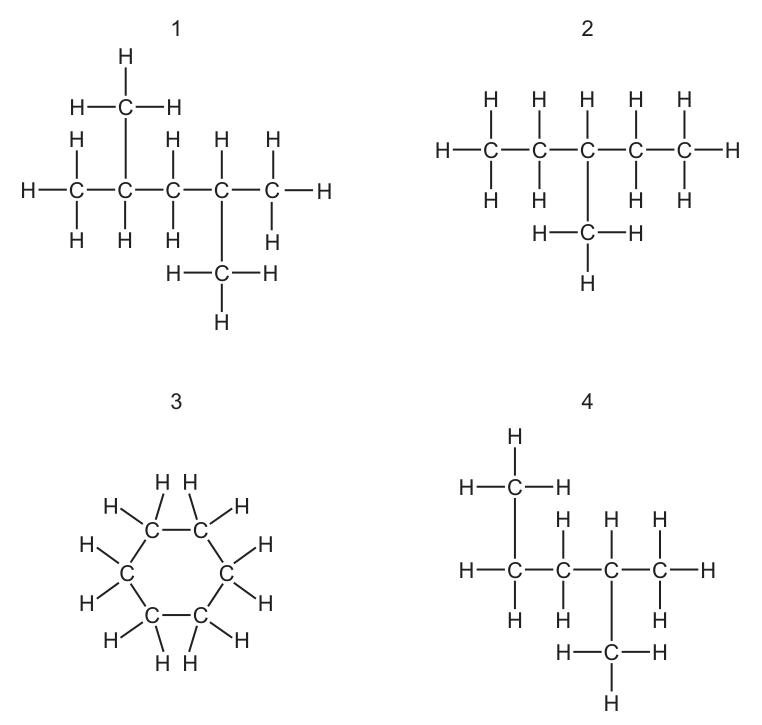
Which pair of structures are isomers?
Options
A 1 and 2
B 1 and 4
C 2 and 3
D 2 and 4
Working
Isomers are compounds with the same molecular formula but different structural formulae. We determine the molecular formula for each structure by counting the carbon and hydrogen atoms.
- Structure 1: Main chain of 5 carbons with methyl branches on carbons 2 and 4. Total carbons = 7. Hydrogens = 16. Formula: (2,4-dimethylpentane).
- Structure 2: Main chain of 5 carbons with a methyl branch on carbon 3. Total carbons = 6. Hydrogens = 14. Formula: (3-methylpentane).
- Structure 3: Ring of 6 carbons. Total carbons = 6. Hydrogens = 12. Formula: (cyclohexane).
- Structure 4: Main chain of 4 carbons with methyl branches on carbons 2 and 3. Total carbons = 6. Hydrogens = 14. Formula: (2,3-dimethylbutane).
Structures 2 and 4 both have the molecular formula but different arrangements of atoms, making them structural isomers.
Answer
D
D
Walkthrough
To identify isomers, we must find two structures that share the same molecular formula (same number of each type of atom) but have different structural formulae (different connectivity).
- Analyze Structure 1: Count the carbon atoms. There is a horizontal chain of 5 carbons, with one methyl group () attached to the second carbon and another to the fourth carbon. Total carbons = . For a saturated alkane with 7 carbons, the formula is . This is 2,4-dimethylpentane.
- Analyze Structure 2: Count the carbon atoms. There is a horizontal chain of 5 carbons, with one methyl group attached to the third carbon. Total carbons = . For a saturated alkane with 6 carbons, the formula is . This is 3-methylpentane.
- Analyze Structure 3: Count the carbon atoms. There is a ring of 6 carbons. Total carbons = 6. Each carbon is bonded to 2 hydrogens. Formula is . This is cyclohexane.
- Analyze Structure 4: Count the carbon atoms. There is a horizontal chain of 4 carbons, with one methyl group attached to the second carbon and another to the third carbon. Total carbons = . For a saturated alkane with 6 carbons, the formula is . This is 2,3-dimethylbutane.
Comparing the formulae:
- Structure 1:
- Structure 2:
- Structure 3:
- Structure 4:
Structures 2 and 4 have the same molecular formula () but different structures (branched differently). Therefore, they are isomers. This corresponds to option D.
Key Takeaways
- Isomers must have the same molecular formula. Always count atoms carefully in displayed formulae.
- Saturated alkanes follow the general formula . Rings or double bonds reduce the hydrogen count.
- Structural isomers have the same atoms but connected in a different order.
Common Mistakes
- Miscounting atoms: In displayed formulae, every vertex and end of a line is a carbon. Branches add to the total count. Students often miss branch carbons.
- Confusing isomers with the same compound: 2,3-dimethylbutane and 3-methylpentane are different compounds (isomers), not the same. Writing the IUPAC name helps confirm.
- Ignoring the hydrogen count: Structure 3 (cyclohexane) has 6 carbons but only 12 hydrogens, so it cannot be an isomer of the alkanes with 6 carbons ().
Things to Be Careful About
- State symbols and formulas: Ensure you write the molecular formula correctly as for acyclic alkanes.
- Reading displayed formulae: Every 'C' is a carbon atom. In the diagrams, some 'C's are explicit, others are implied at vertices. Count every 'C' symbol and every branch end.
- Option matching: The question asks for the pair, so ensure you select the option that lists both correct structures (2 and 4), not just one.
Which statement is correct?
Options
A Any compound that contains both hydrogen and carbon is a hydrocarbon.
B Petroleum is a compound formed from many different hydrocarbons.
C The boiling points of hydrocarbons increase when the chain length increases.
D The naphtha fraction obtained from petroleum is used for making roads.
Working
Statement A is incorrect because a hydrocarbon contains hydrogen and carbon only. A compound that contains both hydrogen and carbon may also contain other elements, such as oxygen, so it is not necessarily a hydrocarbon.
Statement B is incorrect because petroleum is a mixture of many different hydrocarbons, not a single compound.
Statement C is correct: as the hydrocarbon chain length increases, the intermolecular forces between molecules become stronger, so more energy is needed to separate them and the boiling point increases.
Statement D is incorrect because the naphtha fraction is used as a feedstock for making petrol and chemicals; the bitumen fraction is used for making roads.
Answer
C
C
Walkthrough
Read each statement and test it against the chemistry you know.
- A says any compound containing both hydrogen and carbon is a hydrocarbon. This is too broad. A hydrocarbon must contain hydrogen and carbon only. Many organic compounds, such as ethanol, contain hydrogen and carbon but also contain oxygen, so they are not hydrocarbons. Therefore A is false.
- B says petroleum is a compound formed from many hydrocarbons. Petroleum is not a compound; it is a mixture of many different hydrocarbons. A compound has a fixed formula and fixed composition, but petroleum is a variable mixture separated into fractions. Therefore B is false.
- C says the boiling points of hydrocarbons increase when the chain length increases. This is true. Longer hydrocarbon chains have more electrons and larger surface areas, so the intermolecular forces between molecules are stronger. More energy is needed to overcome these forces, so the boiling point is higher. This is why petroleum fractions are separated by fractional distillation in order of increasing boiling point.
- D says the naphtha fraction is used for making roads. Naphtha is actually used as a feedstock for making petrol and other chemicals. The bitumen fraction, which has the highest boiling point, is used for making roads. Therefore D is false.
The only correct statement is C.
Key Takeaways
- A hydrocarbon is a compound containing hydrogen and carbon only.
- Petroleum is a mixture of many hydrocarbons, not a compound.
- Boiling point increases with hydrocarbon chain length because intermolecular forces become stronger.
- Different petroleum fractions have different uses: naphtha is used for petrol and chemicals, while bitumen is used for roads.
Common Mistakes
- Thinking that any compound containing hydrogen and carbon is a hydrocarbon. The word 'only' matters: a hydrocarbon contains hydrogen and carbon only.
- Calling petroleum a compound. It is a mixture of hydrocarbons.
- Confusing naphtha with bitumen. Naphtha is a lower-boiling fraction used for petrol and chemicals; bitumen is the highest-boiling fraction used for roads.
Things to Be Careful About
- When a statement uses the word 'any', it must be true for every example. Because compounds such as ethanol contain hydrogen and carbon but are not hydrocarbons, statement A fails.
- The reason for the boiling point trend is intermolecular forces, not the strength of the covalent bonds within the molecules.
- In multiple-choice questions, eliminating the three false statements is often the quickest way to confirm the correct answer.
Compound Q is a hydrocarbon that has no structural isomers.
Compound Q does not decolourise bromine in the dark.
Which compound is Q?
Options
A C₃H₆
B C₃H₈
C C₄H₈
D C₄H₁₀
Working
A hydrocarbon that does not decolourise bromine in the dark has no carbon-carbon double bond, so it must be an alkane. It also has no structural isomers, so there must be only one possible structure for its molecular formula.
- : could be propene or cyclopropane, and alkenes decolourise bromine.
- : propane is the only structure possible, and alkanes do not decolourise bromine in the dark.
- : has several structural isomers, including alkenes and cycloalkanes.
- : has two structural isomers, butane and methylpropane.
Only propane fits both conditions.
Answer
B
B
Walkthrough
Compound Q is a hydrocarbon, so it contains only carbon and hydrogen. The two clues narrow down which formula is correct.
First, Q does not decolourise bromine in the dark. Alkenes contain a carbon-carbon double bond and rapidly add bromine across it, so the brown colour of bromine disappears even without light. Alkanes are saturated and only react with bromine in the presence of ultraviolet light, by substitution. Therefore, in the dark, an alkane would not decolourise bromine. This tells us Q is an alkane.
Second, Q has no structural isomers. Structural isomers have the same molecular formula but different arrangements of atoms. We need to check which alkane formula has only one possible structure.
- fits the general formula , so it could be an alkene or a cycloalkane. Propene and cyclopropane are structural isomers, and alkenes decolourise bromine.
- fits the general formula , so it is an alkane. The only possible structure is propane, so it has no structural isomers.
- could be an alkene or a cycloalkane, and there are several possible structures, so it has structural isomers.
- is an alkane, but it has two structural isomers: butane and methylpropane.
Therefore, the only compound that is both an alkane and has no structural isomers is , propane. The correct answer is B.
Key Takeaways
- Alkenes are unsaturated and decolourise bromine in the dark by an addition reaction.
- Alkanes are saturated and do not decolourise bromine in the dark; they react with bromine only in ultraviolet light by substitution.
- Structural isomers have the same molecular formula but different arrangements of atoms.
- The general formula of an alkane is , while an alkene or cycloalkane fits .
Common Mistakes
- Choosing because it seems small: it actually has two structural isomers, propene and cyclopropane, and it is an alkene/cycloalkane, so it would decolourise bromine.
- Thinking that has no isomers: it has butane and methylpropane.
- Forgetting that alkanes do react with bromine in ultraviolet light, so the phrase “in the dark” is essential.
Things to Be Careful About
- “In the dark” is the key phrase: it rules out the alkane substitution reaction, which needs ultraviolet light.
- When counting structural isomers for a formula such as , remember to include cyclic structures as well as alkenes.
- A hydrocarbon contains only carbon and hydrogen, so no other elements are involved in the structures being considered.
Which equations represent the reactions of alkanes?
Options
A 1 and 2
B 1 and 3
C 2 and 3
D 2 only
Working
Alkanes are saturated hydrocarbons. Their two characteristic reactions are:
- Substitution with chlorine (in ultraviolet light): a hydrogen atom is replaced by a chlorine atom, and hydrogen chloride, , is formed.
- Combustion with oxygen: alkanes burn to give carbon dioxide and water (complete combustion) or carbon monoxide and water (incomplete combustion).
Check each equation:
-
Substitution with chlorine is an alkane reaction, but this equation is wrong. The hydrogen removed must form hydrogen chloride, , not hydrogen gas, . The equation is also not balanced. So equation 1 is not correct.
-
This is incomplete combustion of ethane, a genuine reaction of alkanes. Equation 2 is correct.
Alkanes do not react with hydrogen chloride. This equation does not represent a real reaction of alkanes. Equation 3 is incorrect.
Only equation 2 is a reaction of an alkane.
Answer
D
D
Walkthrough
Alkanes are saturated hydrocarbons, meaning every carbon atom is joined to its neighbours by single bonds and the carbon atoms have no spare bonds to react with. This makes alkanes generally unreactive, but they do take part in two important reactions.
First, alkanes undergo substitution with halogens such as chlorine in the presence of ultraviolet light. A hydrogen atom is replaced by a chlorine atom, and the other hydrogen atom from the molecule joins with the other chlorine atom to form hydrogen chloride, . In equation 1, methane and chlorine react, which is the right idea, but the products are written as and . That is not what happens: the hydrogen removed forms , not . Also, the equation does not balance. So equation 1 is not a correct reaction of an alkane.
Second, alkanes burn in oxygen in combustion reactions. Complete combustion gives carbon dioxide and water, but when the oxygen supply is limited, incomplete combustion gives carbon monoxide and water. Equation 2 is incomplete combustion of ethane: . This is a genuine reaction of an alkane.
Equation 3 shows propane reacting with hydrogen chloride. Alkanes are unreactive and do not react with acids such as . This equation is not a real alkane reaction.
Therefore the only valid alkane reaction is equation 2, so the answer is D.
Key Takeaways
- Alkanes are saturated hydrocarbons with only single carbon–carbon bonds.
- The two characteristic reactions of alkanes are substitution with halogens and combustion with oxygen.
- In substitution with chlorine, the products are a chlorinated alkane and , not hydrogen gas.
- Combustion may be complete (to and ) or incomplete (to and ).
- Alkanes do not react with hydrogen chloride or other acids.
Common Mistakes
- Thinking equation 1 is correct just because alkanes do undergo substitution with chlorine. The products must be , not , and the equation must balance.
- Assuming alkanes react with ; they do not.
- Forgetting that incomplete combustion with carbon monoxide is still a combustion reaction of an alkane.
- Misreading equation 2 as complete combustion because it produces water; the presence of marks it as incomplete combustion.
Things to Be Careful About
- Always check the products of an equation, not just the reactants. A reaction type may be correct but the equation may still be invalid.
- In substitution reactions of alkanes, the hydrogen removed always becomes part of , not .
- Alkanes are saturated and relatively unreactive, so an equation showing an alkane reacting with a simple acid is usually wrong.
- Combustion of a hydrocarbon can give or depending on the oxygen supply; both are valid alkane reactions.
Ethanol is produced using either ethene or glucose as the starting material.
Which row is correct?
Options
| starting material | conditions | |
|---|---|---|
| A | ethene | catalytic addition of steam at and |
| B | ethene | catalytic addition of steam at and |
| C | glucose | in the presence of yeast and absence of oxygen |
| D | glucose | in the presence of yeast and oxygen |
Working
Ethanol can be made by the hydration of ethene:
This needs steam, a catalyst and moderate heat and pressure: and . This matches row A.
The other route is fermentation of glucose with yeast at about in the absence of oxygen. Row C has the wrong temperature ( would kill the yeast) and row D has oxygen present, which stops fermentation.
Answer
A
A
Walkthrough
The question asks for the correct conditions for making ethanol from either ethene or glucose. There are two standard routes in the syllabus.
-
From ethene: ethene reacts with steam in the presence of a catalyst, usually concentrated phosphoric acid, at about and . This is called the hydration of ethene. Water adds across the double bond, so it is an addition reaction.
-
From glucose: glucose is fermented by yeast. Yeast works best at about to and needs the absence of oxygen. The products are ethanol and carbon dioxide:
If oxygen is present, yeast respires aerobically and ethanol is not produced. If the temperature is too high, the enzymes in yeast are denatured.
Now check each row.
- Row A gives the correct ethene conditions: catalytic addition of steam at and . Correct.
- Row B gives the wrong temperature and pressure for ethene hydration.
- Row C uses glucose, but is far too hot for yeast.
- Row D uses glucose with the correct temperature, but says oxygen is present, which is wrong for fermentation.
So the correct answer is A.
Key Takeaways
- Ethanol can be made by hydration of ethene or by fermentation of glucose.
- Hydration of ethene: ethene + steam ethanol, using a catalyst, about and .
- Fermentation: glucose + yeast, about , in the absence of oxygen.
- Yeast enzymes are denatured by high temperature; fermentation is anaerobic.
Common Mistakes
- Choosing C because it mentions glucose and absence of oxygen, but overlooking the temperature , which would kill the yeast.
- Choosing D because it has the correct temperature, but forgetting that fermentation must take place in the absence of oxygen.
- Mixing up the two sets of conditions: and belong to ethene hydration, not fermentation.
- Thinking that oxygen is needed for fermentation; it is not.
Things to Be Careful About
- The mark scheme accepts about and for the hydration of ethene.
- Fermentation temperature is around to , not .
- The catalyst for hydration of ethene is often stated as concentrated phosphoric acid; the question only says 'catalytic', so row A is still correct.
- Hydration of ethene is an addition reaction, whereas fermentation is a biological process carried out by yeast.
The diagram shows four pieces of apparatus that are used to measure the volume of liquid.
Which piece of apparatus is always filled to the same level?
Options
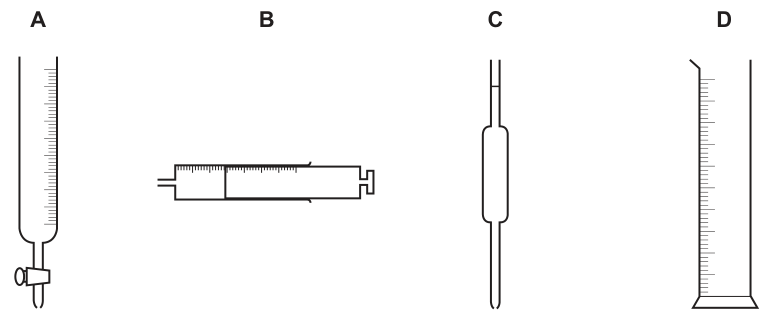
Answer
C
C
Walkthrough
The question asks which piece of apparatus is always filled to the same level. Let us examine each option:
- A is a burette. It has graduations along its tube and a tap at the bottom. It is used to deliver variable, measured volumes of liquid (for example, in a titration). The liquid level in the burette changes as it is used, so it is not filled to the same level every time.
- B is a gas syringe. It is used to measure the volume of a gas produced during a reaction. The volume of gas varies depending on the reaction, so it is not filled to a fixed level.
- C is a volumetric pipette. It has a single etched line (graduation mark) near the top and a bulb in the middle. It is designed to measure one specific, fixed volume of liquid (such as 25.0 cm³). To use it, the liquid must always be filled exactly to that single etched line. Therefore, it is always filled to the same level.
- D is a measuring cylinder. It has graduations along its vertical cylinder. It is used to measure variable volumes of liquid and is not filled to a fixed level.
Thus, the volumetric pipette (C) is the apparatus that is always filled to the same level.
Key Takeaways
- Volumetric pipettes have a single graduation mark and are used to measure a fixed, precise volume of liquid.
- Burettes and measuring cylinders have multiple graduations and are used to measure variable volumes.
- Gas syringes measure the volume of gas, which varies depending on the reaction.
Common Mistakes
- Confusing a volumetric pipette with an ordinary pipette or a measuring cylinder.
- Thinking a burette is filled to the same level; while it is refilled between titrations, the initial liquid level varies, and it is designed to deliver variable volumes.
Things to Be Careful About
- Read the diagrams carefully: a single line indicates a fixed volume (volumetric pipette), while multiple lines indicate variable volume (burette, measuring cylinder).
- Ensure you can visually distinguish the bulb and single mark of a volumetric pipette from the straight tube of a measuring cylinder or burette.
The chromatogram shown is produced using a spot of black ink placed at point X.
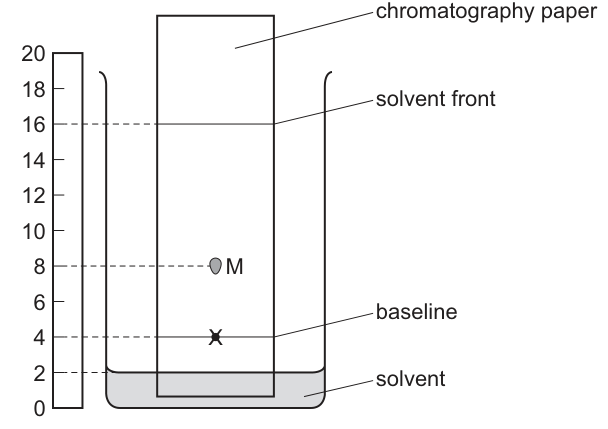
Spot M is produced by a blue dye in the ink.
What is the value of this blue dye?
Options
A 0.22
B 0.25
C 0.33
D 0.43
Working
Distance moved by solvent = 16 - 4 = 12
Distance moved by spot M = 8 - 4 = 4
Answer
C
C
Walkthrough
The value is calculated using the formula:
Distances must be measured from the baseline (the starting line where the spot was placed), not from the bottom of the paper or the solvent level.
From the chromatogram:
- Baseline is at 4.
- Spot M (the blue dye) is at 8.
- Solvent front is at 16.
Distance moved by the dye (spot M) = 8 - 4 = 4.
Distance moved by the solvent = 16 - 4 = 12.
This matches option C.
Key Takeaways
- The value is the ratio of the distance moved by a substance to the distance moved by the solvent front.
- All distances on a chromatogram must be measured from the baseline (origin), not from the solvent level or the bottom of the paper.
- values are unitless and always between 0 and 1.
Common Mistakes
- Measuring the distance moved by the solvent from the bottom of the paper (0) or the solvent level (2) instead of the baseline (4). For example, measuring from the solvent level gives a solvent distance of 14 and a dye distance of 6, leading to , which is distractor D.
- Forgetting to subtract the baseline reading from the spot and solvent front readings.
Things to Be Careful About
- Always read the position of the baseline, the spot, and the solvent front carefully from the scale provided.
- Ensure you subtract the baseline value from both the spot position and the solvent front position before dividing.
- values do not have units.
The table shows the results of a series of tests with two substances, X and Y.
| test | result with X | result with Y |
|---|---|---|
| dilute nitric acid added | no reaction | no reaction |
| then aqueous silver nitrate added | white precipitate | no precipitate |
| aqueous sodium hydroxide added | white precipitate, insoluble in excess | no precipitate |
| then aluminium foil added; warmed gently | no gas produced | ammonia produced |
| flame test | orange-red flame | yellow flame |
Which row shows the identities of the ions present in X and Y?
Options
| X | Y | |
|---|---|---|
| A | and | and |
| B | and | and |
| C | and | and |
| D | and | and |
Working
Analyze X:
- Flame test: orange-red flame → Ca²⁺
- With dilute nitric acid and aqueous silver nitrate: white precipitate → Cl⁻ (AgCl is white)
- With sodium hydroxide: white precipitate, insoluble in excess → consistent with Ca²⁺
- With aluminium foil: no gas produced → no nitrate present
So X contains Ca²⁺ and Cl⁻.
Analyze Y:
- Flame test: yellow flame → Na⁺
- With dilute nitric acid and aqueous silver nitrate: no precipitate → no halide ions
- With sodium hydroxide: no precipitate → no insoluble metal hydroxide
- With aluminium foil: ammonia produced → nitrate (NO₃⁻) present
So Y contains Na⁺ and NO₃⁻.
Answer
D
D
Walkthrough
This question tests your ability to identify ions using qualitative analysis tests.
Substance X:
- Flame test (orange-red flame): Calcium ions (Ca²⁺) produce a brick-red/orange-red flame. This immediately identifies the cation in X as calcium.
- Silver nitrate test (white precipitate): Adding dilute nitric acid followed by aqueous silver nitrate is the test for halide ions. A white precipitate indicates the presence of chloride ions (Cl⁻), forming silver chloride (AgCl).
- Sodium hydroxide test (white precipitate, insoluble in excess): Calcium hydroxide is sparingly soluble, so a white precipitate of Ca(OH)₂ forms. Unlike amphoteric hydroxides (like Al(OH)₃), it does not dissolve in excess NaOH.
- Aluminium foil test (no gas): This test is used to detect nitrate ions. Aluminium reduces nitrate to ammonia. No gas produced means no nitrate in X.
Substance Y:
- Flame test (yellow flame): Sodium ions (Na⁺) produce a persistent yellow flame.
- Silver nitrate test (no precipitate): No halide ions (Cl⁻, Br⁻, I⁻) are present.
- Sodium hydroxide test (no precipitate): No metal that forms an insoluble hydroxide is present (e.g., Ca²⁺, Mg²⁺, Al³⁺).
- Aluminium foil test (ammonia produced): This is the confirmatory test for nitrate ions (NO₃⁻). The aluminium reduces the nitrate to ammonia gas, which turns damp red litmus blue.
Matching to options:
- X = Ca²⁺ and Cl⁻ (eliminates A)
- Y = Na⁺ and NO₃⁻ (eliminates B and C)
Key Takeaways
- The flame test is used to identify metal cations based on characteristic flame colours (Ca²⁺ = orange-red, Na⁺ = yellow, Li⁺ = crimson).
- Silver nitrate solution is used to test for halide ions; the colour of the precipitate helps identify the halide (Cl⁻ = white, Br⁻ = cream, I⁻ = yellow).
- The aluminium foil test is specific for nitrate ions; ammonia gas is produced.
- Sodium hydroxide can be used to identify metal cations by the colour and solubility of the hydroxide precipitate formed.
Common Mistakes
- Confusing flame test colours: Mixing up calcium (orange-red) and sodium (yellow) is a common error.
- Forgetting the role of nitric acid: The nitric acid is added to remove interfering ions (like carbonates) and to provide acidic conditions for the silver nitrate test.
- Assuming X is a nitrate: The aluminium foil test is specifically for nitrate. If no ammonia is produced, nitrate is absent.
- Not eliminating options: This question can be solved by identifying just one ion from each substance and eliminating options.
Things to Be Careful About
- The white precipitate with silver nitrate could be AgCl, AgBr, or AgI. The colour is key: white = chloride, cream = bromide, yellow = iodide.
- The aluminium foil test must be done in the presence of alkali (NaOH) and heat to produce ammonia gas.
- When identifying ions, always check if the test results are consistent with the ion's known properties (e.g., calcium hydroxide is only slightly soluble, so it forms a precipitate).
Your score so far
Answer a question to start scoring
Your marks add up here as you work through the paper.