Chemistry 5070/41 — October/November 2022
Cambridge O-Level · Alternative to Practical · worked solutions for every part, with the mark scheme
Topics Experimental Contexts · Use of Techniques, Apparatus and Materials · Analysis, Conclusions and Evaluation · Qualitative Analysis · Observations and Measurements · Planning Experiments and Investigations
Two gases A and B have the properties shown.
| gas | density | solubility in water | appearance |
|---|---|---|---|
| A | less dense than air | insoluble | colourless |
| B | less dense than air | soluble | brown |
Some sets of apparatus, P, Q and R, used to collect gases are shown.
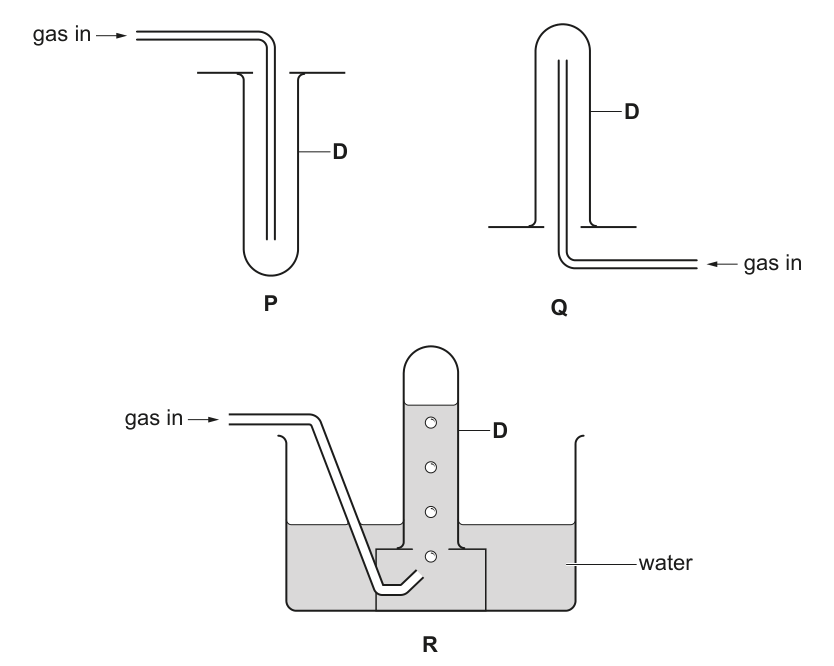
Name apparatus D.
______
Answer
boiling tube
boiling tube
Walkthrough
Apparatus D is the container collecting the gas. In the diagrams, it is a tube with a rounded bottom, open at one end. In 5070 practical work, this is typically a boiling tube or a gas jar. The mark scheme specifies 'boiling tube'.
Key Takeaways
Candidates must recognise standard laboratory apparatus used for gas collection.
Common Mistakes
Writing 'test tube' (acceptable in many mark schemes, but 'boiling tube' is preferred for this shape) or 'flask'.
Things to Be Careful About
Always use the exact name given in the mark scheme if possible. 'Boiling tube' is the expected answer here.
Q is used to collect gas B.
State why R is not used to collect gas B.
______
Answer
Gas B is soluble in water, so it would dissolve in the water in the trough instead of collecting in the tube.
Answer
soluble in water
Gas B is soluble in water.
Walkthrough
Apparatus R collects gas over water. This method can only be used for gases that are insoluble (or very slightly soluble) in water. The table states that gas B is 'soluble' in water. If gas B is bubbled through water, it will dissolve rather than displace the water and fill the tube D.
Key Takeaways
Gas collection over water is restricted to insoluble gases. Soluble gases will be lost to the water.
Common Mistakes
Saying 'it will react with water' when the table only says 'soluble'. Stick to the property given.
Things to Be Careful About
Ensure the reason directly references the property from the table ('soluble in water').
State why P is not used to collect gas B.
______
Answer
Gas B is less dense than air. Apparatus P uses downward delivery (tube upright), which is for gases denser than air. The less dense gas B would rise and escape from the top of the open tube D.
Answer
less dense than air
Gas B is less dense than air.
Walkthrough
Apparatus P shows downward delivery: the gas enters at the top and the tube D is upright. This method relies on the gas being denser than air so it sinks and fills the tube from the bottom up, pushing air out the top. The table states gas B is 'less dense than air'. If introduced into an upright tube, the lighter gas B would rise and escape through the open top, failing to collect.
Key Takeaways
Downward delivery (upright tube) is for gases denser than air. Upward delivery (inverted tube) is for gases less dense than air.
Common Mistakes
Saying 'it will mix with air' without referencing density. The key word is 'less dense'.
Things to Be Careful About
Match the property ('less dense than air') directly to the apparatus limitation (downward delivery requires denser gas).
State why R is more suitable than Q to collect gas A.
______
Answer
With apparatus Q (upward delivery into an open tube), there is no visible sign that the tube is full of gas. With apparatus R (collection over water), you can clearly see when the tube is full as gas bubbles out of the tube into the trough, or when the water is completely displaced.
Answer
(using Q) it would not be possible to tell when D was full
It is not possible to tell when D is full using Q.
Walkthrough
Gas A is colourless and insoluble. Both Q (upward delivery) and R (over water) can physically collect it. However, the question asks why R is more suitable. In apparatus Q, the gas is colourless and fills an open, upright (inverted) tube. There is no visual indicator to tell the candidate when the tube is completely full of gas and air has been displaced. In apparatus R, the water level in the tube drops visibly, and when the tube is full, gas bubbles out into the trough, giving a clear endpoint.
Key Takeaways
When collecting colourless gases, a method with a visible endpoint (like water displacement) is preferable to ensure the container is full.
Common Mistakes
Saying 'R is more accurate' or 'R is safer'. The specific advantage is the ability to see when the tube is full.
Things to Be Careful About
The mark scheme accepts ORA (otherwise worded to the same effect). Focus on the visibility of the endpoint.
The rest of this paper
6 more questions- Q2Experimental Contexts · Observations and Measurements · Qualitative Analysis · Use of Techniques, Apparatus and Materials8M
- Q3Use of Techniques, Apparatus and Materials · Qualitative Analysis · Experimental Contexts · Planning Experiments and Investigations · Analysis, Conclusions and Evaluation11M
- Q4Planning Experiments and Investigations · Experimental Contexts6M
- Q5Use of Techniques, Apparatus and Materials · Experimental Contexts · Observations and Measurements · Analysis, Conclusions and Evaluation16M
- Q6Qualitative Analysis9M
- Q7Use of Techniques, Apparatus and Materials · Experimental Contexts · Analysis, Conclusions and Evaluation6M