Chemistry 5070/42 — May/June 2021
Cambridge O-Level · Alternative to Practical · worked solutions for every part, with the mark scheme
Topics Use of Techniques, Apparatus and Materials · Experimental Contexts · Planning Experiments and Investigations · Analysis, Conclusions and Evaluation · Observations and Measurements · Qualitative Analysis
Hydrated magnesium sulfate has the formula .
When hydrated magnesium sulfate is heated, it loses the water of crystallisation to form anhydrous magnesium sulfate.
A student does an experiment to find the value of in .
The student:
1 records the mass of a crucible
2 adds hydrated magnesium sulfate to the crucible and records the mass again
3 heats the crucible strongly
4 allows the crucible and contents to cool and then records the mass again
5 repeats 3 and 4 until the same mass is recorded twice
6 uses the results to calculate the initial mass of and the final mass of .
Suggest why a crucible is used instead of a glass beaker.
______
Answer
Glass may break or melt when heated strongly, whereas a crucible (ceramic) withstands high temperatures. A crucible is also a better thermal conductor, allowing the solid to heat evenly and completely.
Glass may break or melt; crucible is a better thermal conductor.
Walkthrough
The experiment requires strong heating to drive off water of crystallisation. Glass beakers are not designed to withstand the high temperatures of a Bunsen burner flame directly and may crack or melt. A crucible is made of ceramic (e.g., porcelain) which has a high melting point and is chemically inert. Additionally, ceramic is a better thermal conductor than glass, ensuring the contents heat through efficiently.
Key Takeaways
Always select apparatus appropriate for the thermal conditions of the experiment. Crucibles are used for strong heating of solids.
Common Mistakes
- Saying "glass is too hot" (glass doesn't get too hot, it breaks). Must mention breaking or melting.
- Forgetting the ORA (Opposite Reason Answer): if you say glass breaks, you can also say crucible conducts heat better.
Things to Be Careful About
The question asks to suggest why a crucible is used instead of a glass beaker. Focus on the limitations of glass (breaking/melting) or the advantages of a crucible (thermal conductivity, heat resistance).
Suggest why 3 and 4 are repeated until the same mass is recorded twice.
______
Answer
The heating and cooling are repeated until a constant mass is recorded to ensure that all the water of crystallisation has been driven off. If the mass changes, it means more water is still leaving the solid; constant mass confirms the sample is fully anhydrous.
To ensure all water is driven off / sample is fully anhydrous.
Walkthrough
Heating hydrated salts drives off water. If heating is stopped too early, some water remains, making the final mass too high and the calculated water lost too low. By repeating the heating, cooling, and weighing process, the student checks if the mass is still decreasing. When two consecutive readings are the same (constant mass), no more water is being lost, meaning the dehydration is complete.
Key Takeaways
"Heating to constant mass" is a standard technique to ensure a reaction or physical change is complete.
Common Mistakes
- Saying "to make the experiment accurate" (too vague). Must specify what is being made accurate (complete removal of water).
- Saying "to get a better average" (this is for repeated readings of the same measurement, not for driving a reaction to completion).
Things to Be Careful About
The mark scheme accepts "to make sure ALL the water driven off" or "no water remains". Be specific about the water.
Several students do the same experiment with different initial masses of .
The results are shown in the table.
| initial mass of | 0.52 | 0.98 | 1.50 | 2.04 | 2.53 | 2.99 |
|---|---|---|---|---|---|---|
| final mass of | 0.25 | 0.48 | 0.83 | 1.00 | 1.23 | 1.46 |
| mass of lost / | 0.50 | 0.67 | 1.30 | 1.53 |
Complete the table.
Answer
| initial mass of / g | 0.52 | 0.98 | 1.50 | 2.04 | 2.53 | 2.99 |
|---|---|---|---|---|---|---|
| final mass of / g | 0.25 | 0.48 | 0.83 | 1.00 | 1.23 | 1.46 |
| mass of lost / g | 0.27 | 0.50 | 0.67 | 1.04 | 1.30 | 1.53 |
Working:
- For 0.52 g initial: g
- For 2.04 g initial: g
0.27 and 1.04
Walkthrough
The mass of water lost is the difference between the initial mass of the hydrated salt and the final mass of the anhydrous salt.
- Row 1, Column 1: g.
- Row 3, Column 4: g.
Key Takeaways
Mass lost = Initial mass - Final mass. Always check units and decimal places.
Common Mistakes
- Forgetting to copy the table headers correctly.
- Calculation errors in subtraction.
Things to Be Careful About
Ensure the values are placed in the correct empty cells in the table.
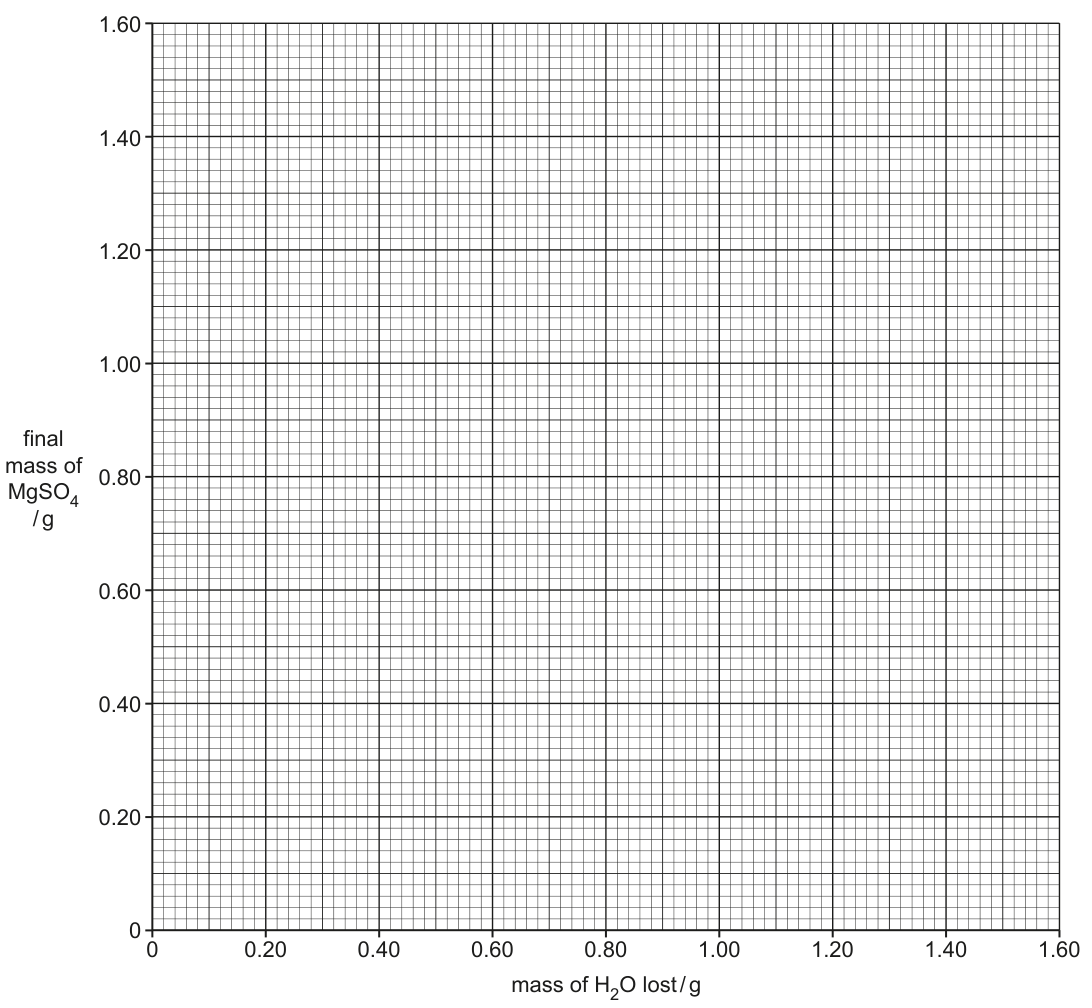
On the grid, plot the final mass of against the mass of lost.
Answer
Points to plot (x = mass of lost, y = final mass of ):
- (0.27, 0.25)
- (0.50, 0.48)
- (0.67, 0.83)
- (1.04, 1.00)
- (1.30, 1.23)
- (1.53, 1.46)
Graph with 6 points plotted at (0.27, 0.25), (0.50, 0.48), (0.67, 0.83), (1.04, 1.00), (1.30, 1.23), (1.53, 1.46).
Walkthrough
The question asks to plot "final mass of against the mass of lost". This means:
- x-axis (horizontal): mass of lost (independent variable, though here it's derived).
- y-axis (vertical): final mass of (dependent variable).
The grid provided has x-axis from 0 to 1.60 and y-axis from 0 to 1.60. Major markings are every 0.20. There are 10 small squares between 0.00 and 0.20, so each small square is 0.02.
Plotting the points:
- x=0.27 (1.5 small squares past 0.20), y=0.25 (1.25 small squares past 0.20).
- x=0.50 (on the line), y=0.48 (1 small square below 0.50).
- x=0.67 (3.5 small squares past 0.60), y=0.83 (1.5 small squares above 0.80).
- x=1.04 (2 small squares past 1.00), y=1.00 (on the line).
- x=1.30 (on the line), y=1.23 (1.5 small squares above 1.20).
- x=1.53 (1.5 small squares past 1.50), y=1.46 (3 small squares below 1.50).
Key Takeaways
Always check which variable goes on which axis. Plotting is a key skill in Paper 4.
Common Mistakes
- Swapping x and y axes.
- Misreading the grid scale (e.g., thinking each small square is 0.01 or 0.05).
Things to Be Careful About
Use crosses (x) or dots for points. The mark scheme shows crosses. Ensure points are within half a small square of the correct position.
Draw a circle around the anomalous result on your graph.
Answer
Circle the point at (0.67, 0.83). This point lies significantly above the line of best fit that would pass through the origin and the other points.
Circle the point (0.67, 0.83).
Walkthrough
Looking at the data, there is a roughly linear relationship. For every ~0.50 g of water lost, ~0.48-0.50 g of MgSO4 remains.
- Point 1: 0.27 -> 0.25 (ratio ~0.92)
- Point 2: 0.50 -> 0.48 (ratio ~0.96)
- Point 3: 0.67 -> 0.83 (ratio ~1.24) -> Anomaly
- Point 4: 1.04 -> 1.00 (ratio ~0.96)
- Point 5: 1.30 -> 1.23 (ratio ~0.95)
- Point 6: 1.53 -> 1.46 (ratio ~0.95)
The third point (0.67, 0.83) has a much higher mass of anhydrous salt than expected for the amount of water lost. It is the outlier.
Key Takeaways
An anomalous result is a data point that does not fit the general pattern or trend of the data.
Common Mistakes
- Circling a point that is just slightly off but part of the trend.
- Not circling clearly.
Things to Be Careful About
The circle must be around the specific data point (the cross), not just near it.
Suggest a reason for the anomalous result.
______
Answer
The sample was not heated strongly enough or for a long enough time, so not all the water of crystallisation was driven off. The final mass includes some remaining water, making the mass of MgSO4 appear too high and the mass of water lost too low.
Alternatively: The crucible was not cooled in a desiccator, so it absorbed moisture from the air during cooling.
Sample not heated to constant mass / still contains some water / not fully anhydrous.
Walkthrough
For the anomalous point (0.67, 0.83):
- Mass of water lost = 0.67 g (calculated from 1.50 - 0.83).
- Mass of final solid = 0.83 g.
- Expected final mass for 0.67 g water lost (based on other points, ratio ~0.95) would be around g.
- The actual final mass (0.83 g) is much higher than expected (0.64 g). This means the final solid is heavier than it should be. Since the only thing left after heating should be anhydrous MgSO4, the extra mass must be unevaporated water.
- Therefore, the heating was insufficient to remove all the water.
Another possible error: If the crucible was left in the open air to cool, anhydrous MgSO4 is hygroscopic and can reabsorb water from the atmosphere, increasing the final mass.
Key Takeaways
An anomalous result where the final mass is too high usually indicates incomplete reaction (not all water removed) or reabsorption of moisture.
Common Mistakes
- Saying "the balance was wrong" (too vague, needs a specific chemical/physical reason).
- Saying "too much water was lost" (this would make the final mass lower, not higher).
Things to Be Careful About
The reason must explain why the final mass of MgSO4 is too high (or water lost is too low). "Sample not heated to constant mass" is a key phrase.
Draw a straight line of best fit.
Answer
Draw a straight line of best fit that passes through the origin (0,0) and the five non-anomalous points: (0.27, 0.25), (0.50, 0.48), (1.04, 1.00), (1.30, 1.23), (1.53, 1.46). The line should not pass through the circled anomalous point (0.67, 0.83).
Straight line from origin through the 5 good points, excluding the circled point at (0.67, 0.83).
Walkthrough
A line of best fit should represent the trend of the data. Since the relationship is proportional (if 0 g water is lost, 0 g anhydrous salt is produced - well, actually if you start with 0 hydrated salt you get 0, so it passes through origin), the line should go through (0,0).
The line should pass as close as possible to the majority of the points (the 5 good ones), with roughly equal numbers of points above and below the line on either side of the anomaly. The anomalous point (0.67, 0.83) is ignored for the line.
Looking at the points: (0.27, 0.25), (0.50, 0.48), (1.04, 1.00), (1.30, 1.23), (1.53, 1.46). These are very close to a straight line (roughly). The line should go from (0,0) to roughly (1.53, 1.46).
Key Takeaways
- Line of best fit must be a straight line (for this data).
- Must pass through origin if the relationship is proportional (start with 0, get 0).
- Exclude anomalous points.
Common Mistakes
- Drawing a curve.
- Forcing the line through the anomalous point.
- Not starting the line at the origin (0,0).
Things to Be Careful About
Use a ruler. The line should be thin and clear.
In another experiment, the final mass of is .
Use your graph to determine the mass of lost.
______
Working
Find 1.20 on the y-axis (final mass of ). Draw a horizontal line to the line of best fit. Then draw a vertical line down to the x-axis (mass of lost).
Looking at the graph/line: At y=1.20, x is approximately 1.26.
Answer
1.26 g
1.26
Walkthrough
The question gives a new final mass of 1.20 g. We need to find the corresponding mass of water lost using the graph.
- Locate 1.20 on the vertical axis (y-axis).
- Move horizontally to the right until you hit the line of best fit.
- From that intersection, move vertically down to the horizontal axis (x-axis).
- Read the value. The line passes through (1.30, 1.23) and (1.04, 1.00). At y=1.20, x is slightly less than 1.30. 1.26 is a reasonable reading.
Note: Reading from a graph always has some uncertainty. The mark scheme accepts 1.26 (likely 1.24 - 1.28 range).
Key Takeaways
Reading values from a graph requires precision and using the line of best fit, not the raw data points (unless reading a specific point).
Common Mistakes
- Reading the wrong axis.
- Not using the line of best fit (reading off the anomalous point or a specific data point incorrectly).
Things to Be Careful About
The mark scheme gives 1.26. Ensure your reading is consistent with the line drawn.
Calculate the number of moles of water in your answer to (i).
[: H, 1; O, 16]
______
Working
Mass of water = 1.26 g (from part i).
of .
Answer
0.07 mol
0.07
Walkthrough
Use the formula: .
Mass of water = 1.26 g.
Relative molecular mass () of water () = .
Key Takeaways
Always calculate correctly. Water is 18, not 17 or 19.
Common Mistakes
- Using the wrong mass (e.g., using 1.20 g of MgSO4 instead of the water mass).
- Calculation error: . , so .
Things to Be Careful About
The mark scheme awards 1 mark for and 1 mark for the correct mole calculation (0.07). Show the working.
of contains of .
Calculate the value of in .
______
Working
Moles of = 0.01 mol (given).
Moles of = 0.07 mol (calculated in part ii).
The formula is . The ratio of moles of to moles of is .
So, .
Answer
7
7
Walkthrough
We have the moles of both components in the hydrated salt.
- Moles of anhydrous = 0.01 mol.
- Moles of water = 0.07 mol.
The chemical formula tells us that for every 1 mole of , there are moles of water.
Ratio = .
Therefore, . The formula is (magnesium sulfate heptahydrate, also known as Epsom salts).
Key Takeaways
To find the number of water molecules in a hydrate, calculate the mole ratio of water to the anhydrous salt.
Common Mistakes
- Inverting the ratio (calculating ).
- Forgetting that the ratio is , not .
Things to Be Careful About
The question asks for the value of , which is a whole number. 7 is a reasonable integer.
The rest of this paper
4 more questions- Q2Qualitative Analysis12M
- Q3Use of Techniques, Apparatus and Materials · Experimental Contexts10M
- Q4Use of Techniques, Apparatus and Materials · Experimental Contexts11M
- Q5Use of Techniques, Apparatus and Materials · Experimental Contexts · Planning Experiments and Investigations · Analysis, Conclusions and Evaluation15M