Chemistry 5070/41 — May/June 2021
Cambridge O-Level · Alternative to Practical · worked solutions for every part, with the mark scheme
Topics Experimental Contexts · Observations and Measurements · Use of Techniques, Apparatus and Materials · Analysis, Conclusions and Evaluation · Planning Experiments and Investigations · Qualitative Analysis
A student uses dilute sulfuric acid and copper(II) carbonate to make a pure dry sample of blue copper(II) sulfate crystals.
Dilute sulfuric acid is colourless.
Copper(II) carbonate is an insoluble green powder.
The equation for the reaction is shown.
The student:
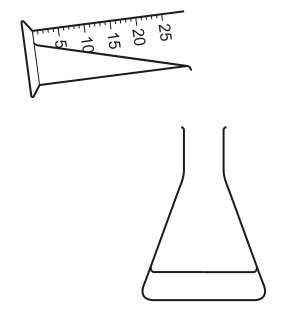
- uses one of the pieces of apparatus shown in the diagram to measure of dilute sulfuric acid
- pours the dilute sulfuric acid into the other piece of apparatus as shown in the diagram.
Name the apparatus the student uses to measure the acid.
______
Answer
Measuring cylinder
Measuring cylinder
Walkthrough
The diagram shows a graduated glass tube with markings from 5 to 25 being used to measure a volume of liquid. This is a measuring cylinder.
Key Takeaways
Measuring cylinders are used to measure volumes of liquids to an appropriate precision. They are not used for mixing or heating.
Common Mistakes
Do not call it a 'graduated cylinder' or 'burette'. The 5070 mark scheme expects 'measuring cylinder'.
Things to Be Careful About
Ensure the apparatus name matches exactly what is printed in the mark scheme.
Name the apparatus into which the student pours the acid.
______
Answer
Conical flask
Conical flask
Walkthrough
The diagram shows a flat-bottomed vessel with a narrow neck, used to receive the liquid. This is a conical flask (also known as an Erlenmeyer flask). It is the standard vessel for mixing reagents and heating solutions in salt preparation.
Key Takeaways
Conical flasks are used for mixing, heating, and titrations because their narrow neck reduces splashing and evaporation, and their flat base provides stability.
Common Mistakes
Do not call it a 'beaker'. The mark scheme accepts 'conical flask / Erlenmeyer flask', but 'conical flask' is preferred in 5070.
Things to Be Careful About
The mark scheme accepts 'conical flask / Erlenmeyer flask'. Use 'conical flask' as the primary answer.
The student adds solid copper(II) carbonate to the dilute sulfuric acid until the reaction is finished and the copper(II) carbonate is in excess.
Describe two observations which show that the reaction is finished and the copper(II) carbonate is in excess.
reaction is finished ______
copper(II) carbonate is in excess ______
Answer
reaction is finished: no more effervescence / fizzing / bubbles when solid is added
copper(II) carbonate is in excess: undissolved green solid remains
No more effervescence; undissolved green solid remains
Walkthrough
The reaction between a carbonate and an acid produces carbon dioxide gas, which is observed as effervescence (fizzing or bubbling). When the acid is completely used up, no more gas is produced, so effervescence stops. This indicates the reaction is finished. Because the student added copper(II) carbonate until it is in excess, there will be unreacted solid left over. Copper(II) carbonate is a green powder, so the excess solid will appear as an undissolved green solid.
Key Takeaways
In salt preparation using an insoluble carbonate and an acid, the end-point is indicated by the cessation of bubbling. Adding the solid in excess ensures all the acid is neutralised. The excess solid is then removed by filtration.
Common Mistakes
Do not say 'the solid dissolves' — the solid is in excess, so it does not all dissolve. Do not say 'the solution stops bubbling' without mentioning that no more bubbling occurs when solid is added. Do not confuse the colour of copper(II) carbonate (green) with copper(II) sulfate (blue).
Things to Be Careful About
The mark scheme awards one mark for 'no more effervescence / fizzing' and one mark for 'undissolved solid / green solid'. Both must be stated clearly for the two marks.
The student filters the reaction mixture through filter paper in a filter funnel.
Describe the appearance of the residue on the filter paper and the filtrate after filtration is complete.
appearance of the residue on the filter paper
______
appearance of the filtrate
______
Answer
appearance of the residue on the filter paper: green solid
appearance of the filtrate: blue solution
Green solid residue; blue filtrate
Walkthrough
Filtration separates the unreacted excess solid from the liquid solution. The residue on the filter paper is the unreacted copper(II) carbonate, which is a green powder. The filtrate is the aqueous copper(II) sulfate solution. Copper(II) ions in aqueous solution are characteristically blue, so the filtrate is a blue solution.
Key Takeaways
In salt preparation, the residue is the excess insoluble reactant, and the filtrate is the salt solution. Copper(II) compounds are typically green (as solids like carbonate and oxide) or blue (as aqueous solutions like sulfate).
Common Mistakes
Do not say the residue is 'colourless' or 'white'. Do not say the filtrate is 'green' — the green solid is filtered out, leaving only the blue copper(II) sulfate solution.
Things to Be Careful About
The mark scheme awards one mark for 'green solid' (residue) and one mark for 'blue solution' (filtrate). Both observations must be linked to the correct part of the mixture.
The rest of this paper
5 more questions- Q2Observations and Measurements · Experimental Contexts · Analysis, Conclusions and Evaluation · Planning Experiments and Investigations · Use of Techniques, Apparatus and Materials11M
- Q3Experimental Contexts · Qualitative Analysis11M
- Q4Planning Experiments and Investigations · Experimental Contexts9M
- Q5Experimental Contexts · Use of Techniques, Apparatus and Materials · Observations and Measurements · Analysis, Conclusions and Evaluation16M
- Q6Observations and Measurements · Analysis, Conclusions and Evaluation · Experimental Contexts7M