Chemistry 5070/11 — May/June 2021
Cambridge O-Level · Multiple Choice · answer key with instant marking and worked solutions
Topics Organic Chemistry · Experimental Techniques and Chemical Analysis · Chemical Reactions · Stoichiometry · Metals · Atoms, Elements and Compounds · +4 more
Tap an option under each question to check it — your score builds as you go.
A student has to measure of aqueous sodium bromide.
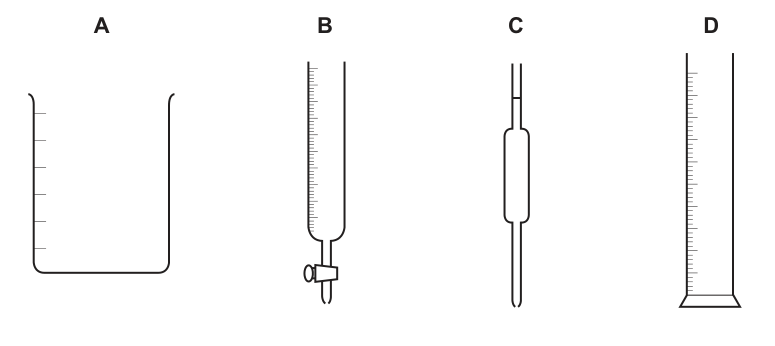
Which piece of apparatus should the student select?
Options
Working
The volume to be measured is , which requires an apparatus that can measure to precision (one decimal place).
- A (beaker): Only accurate to about . Not suitable for precise measurements.
- B (burette): Can measure variable volumes to or precision. Suitable for measuring .
- C (volumetric pipette): Measures only one fixed volume (e.g., or ). Cannot measure .
- D (measuring cylinder): Typically measures to or precision. Not precise enough for .
Answer
B
B
Walkthrough
The question asks for the correct apparatus to measure exactly of aqueous sodium bromide. The value has one decimal place, meaning the apparatus must be able to read to at least .
- Apparatus A (beaker): Beakers have graduation marks but are only used for rough estimates of volume, typically accurate to . They cannot measure accurately.
- Apparatus B (burette): A burette has graduations along its length and a tap at the bottom, allowing the user to deliver a variable volume of liquid very accurately, typically to or . This matches the required precision for .
- Apparatus C (volumetric pipette): This apparatus is designed to measure one specific, fixed volume (such as or ) very accurately. It cannot be used to measure a variable volume like .
- Apparatus D (measuring cylinder): While more accurate than a beaker, a standard measuring cylinder is usually only accurate to or . It would not allow the student to measure to the required precision.
Therefore, the burette (B) is the correct choice.
Key Takeaways
- Different apparatus have different levels of precision. Beakers are for rough measurements, measuring cylinders for moderate precision, and burettes or pipettes for high precision.
- Volumetric pipettes are for fixed volumes; burettes are for variable volumes measured to high precision.
- Always check the required decimal places in the volume to determine the necessary precision of the apparatus.
Common Mistakes
- Choosing a measuring cylinder (D) because it can measure , but forgetting that its precision is usually only to , not .
- Choosing a volumetric pipette (C) because it is precise, but forgetting that it only measures one fixed volume (e.g., ), not .
- Choosing a beaker (A) and ignoring the precision requirement of the measurement.
Things to Be Careful About
- Pay attention to the number of decimal places in the volume. requires an apparatus that reads to at least .
- Distinguish between measuring a fixed volume (volumetric pipette) and a variable volume (burette).
- Beakers and conical flasks are not considered measuring apparatus for accurate volumes in Cambridge O Level Chemistry.
The rest of this paper
39 more questions- Q2Experimental Techniques and Chemical Analysis1M
- Q3Experimental Techniques and Chemical Analysis1M
- Q4Experimental Techniques and Chemical Analysis1M
- Q5Experimental Techniques and Chemical Analysis1M
- Q6Atoms, Elements and Compounds1M
- Q7Atoms, Elements and Compounds1M
- Q8Atoms, Elements and Compounds1M
- Q9Stoichiometry1M
- Q10Stoichiometry1M
- Q11Stoichiometry1M
- Q12Stoichiometry1M
- Q13Electrochemistry1M
- Q14Electrochemistry1M
- Q15Electrochemistry1M
- Q16Electrochemistry · Chemical Reactions1M
- Q17Organic Chemistry · Chemistry of the Environment1M
- Q18Chemical Reactions1M
- Q19Chemical Reactions · Stoichiometry1M
- Q20Chemical Reactions1M
- Q21Chemical Reactions1M
- Q22Acids, Bases and Salts1M
- Q23Acids, Bases and Salts1M
- Q24Acids, Bases and Salts · Experimental Techniques and Chemical Analysis1M
- Q25Chemical Reactions1M
- Q26The Periodic Table1M
- Q27The Periodic Table · Atoms, Elements and Compounds1M
- Q28The Periodic Table1M
- Q29Metals1M
- Q30The Periodic Table · Metals1M
- Q31Metals1M
- Q32Metals1M
- Q33Metals1M
- Q34Chemistry of the Environment1M
- Q35Organic Chemistry1M
- Q36Organic Chemistry1M
- Q37Organic Chemistry1M
- Q38Organic Chemistry1M
- Q39Organic Chemistry1M
- Q40Organic Chemistry1M