Chemistry 5070/42 — October/November 2020
Cambridge O-Level · Alternative to Practical · worked solutions for every part, with the mark scheme
Topics Experimental Contexts · Analysis, Conclusions and Evaluation · Planning Experiments and Investigations · Use of Techniques, Apparatus and Materials · Observations and Measurements · Qualitative Analysis
A student investigates two different aqueous electrolytes using the apparatus shown.
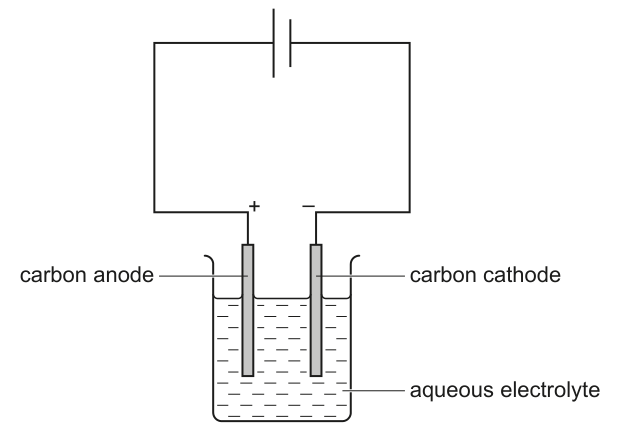
Complete the table.
| anode (+) | anode (+) | cathode (–) | cathode (–) | |
|---|---|---|---|---|
| aqueous electrolyte | name of product | observation | name of product | observation |
| dilute sulfuric acid | hydrogen | bubbles of colourless gas | ||
| aqueous copper(II) sulfate | bubbles of colourless gas |
Answer
| anode (+) | anode (+) | cathode (–) | cathode (–) | |
|---|---|---|---|---|
| aqueous electrolyte | name of product | observation | name of product | observation |
| dilute sulfuric acid | oxygen | bubbles of colourless gas | hydrogen | bubbles of colourless gas |
| aqueous copper(II) sulfate | oxygen | bubbles of colourless gas | copper | pink / brown / orange solid |
Table completed: oxygen and bubbles of colourless gas at the anode for both; copper and a pink/brown/orange solid at the cathode for copper(II) sulfate.
Walkthrough
For part (a), we are electrolyzing two aqueous solutions using inert carbon electrodes.
-
Dilute sulfuric acid: The ions present are H⁺, OH⁻, and SO₄²⁻. At the anode (+), OH⁻ is discharged in preference to SO₄²⁻ because sulfate ions are not discharged in dilute solutions. The OH⁻ ions lose electrons to form oxygen gas and water. Observation: bubbles of colourless gas. At the cathode (–), H⁺ ions are discharged to form hydrogen gas. Observation: bubbles of colourless gas.
-
Aqueous copper(II) sulfate: The ions present are Cu²⁺, H⁺, SO₄²⁻, and OH⁻. At the anode (+), OH⁻ is discharged to form oxygen gas. Observation: bubbles of colourless gas. At the cathode (–), Cu²⁺ ions are discharged in preference to H⁺ ions because copper is below hydrogen in the reactivity series. Cu²⁺ gains electrons to form solid copper metal. Observation: a pink, brown, or orange solid deposits on the cathode.
Key Takeaways
- In the electrolysis of dilute aqueous acids with inert electrodes, oxygen is produced at the anode and hydrogen at the cathode.
- In the electrolysis of aqueous solutions containing metals below hydrogen in the reactivity series (like copper), the metal is deposited at the cathode instead of hydrogen.
- The physical state of the metal deposit must be described correctly as a solid.
Common Mistakes
- Writing "hydrogen" or "sulphur" at the anode for dilute sulfuric acid. SO₄²⁻ is not discharged in dilute solutions; OH⁻ from water is discharged to form oxygen.
- Describing the copper deposit as a "solution" or "liquid" instead of a "solid". It is a solid metal depositing on the electrode.
- Confusing the observations at the anode and cathode.
Things to Be Careful About
- Ensure the table columns are matched correctly: anode (+) vs cathode (–).
- For the copper deposit, acceptable observations include "pink solid", "brown solid", "orange solid", or "pink / brown / orange solid". Do not just write "solid" without a colour description.
State the test and its observation to identify hydrogen gas.
test ______
observation ______
Answer
test: lighted splint (or burning splint)
observation: it pops (or squeaky pop)
Test: lighted splint; Observation: pops
Walkthrough
Hydrogen gas is identified using the standard "squeaky pop" test. A lighted (burning) splint is brought near the mouth of a test tube containing the gas. The hydrogen ignites and burns rapidly, producing a characteristic popping sound.
Key Takeaways
- The test for hydrogen gas is a lighted splint, not a glowing splint (which is for oxygen).
- The observation must include the word "pops" or "squeaky pop" to score the mark.
Common Mistakes
- Using a "glowing splint" instead of a "lighted splint". A glowing splint relights in oxygen but does not pop in hydrogen.
- Saying the gas "burns" without mentioning the "pop". The pop is the specific observation that confirms hydrogen.
Things to Be Careful About
- Ensure the test and observation are clearly separated. The test is the action (lighted splint), the observation is the result (pops).
The rest of this paper
5 more questions- Q2Experimental Contexts · Planning Experiments and Investigations · Analysis, Conclusions and Evaluation8M
- Q3Use of Techniques, Apparatus and Materials · Experimental Contexts · Observations and Measurements · Analysis, Conclusions and Evaluation15M
- Q4Experimental Contexts · Planning Experiments and Investigations4M
- Q5Qualitative Analysis11M
- Q6Analysis, Conclusions and Evaluation · Experimental Contexts · Use of Techniques, Apparatus and Materials · Observations and Measurements16M