Chemistry 5070/41 — October/November 2020
Cambridge O-Level · Alternative to Practical · worked solutions for every part, with the mark scheme
Topics Experimental Contexts · Analysis, Conclusions and Evaluation · Use of Techniques, Apparatus and Materials · Observations and Measurements · Planning Experiments and Investigations · Qualitative Analysis
A student wants to separate a mixture of dyes so that the dyes in the mixture can be identified.
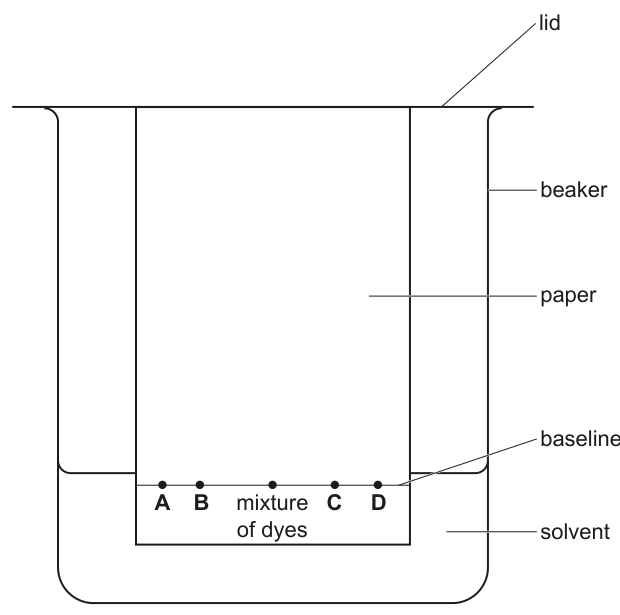
The apparatus the student uses is shown.
The student also tests dyes A, B, C and D.
Name the process the student uses to separate the mixture of dyes.
______
The apparatus shown in the diagram is set up incorrectly. Explain why.
______
The apparatus is then set up correctly.
The solvent travels up the paper.
The paper is removed and then dried.
The result is shown in the diagram.
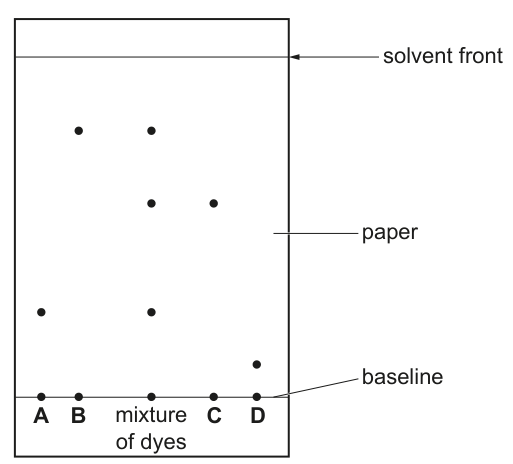
Which of the dyes A, B, C and D are present in the mixture of dyes?
______
The student identifies the dyes in the mixture of dyes using values.
Measure the distance between:
- the baseline and the solvent front = ______
- the baseline and the position of A = ______
Calculate the value of A.
value of A = ______
The rest of this paper
5 more questions- Q2Qualitative Analysis · Planning Experiments and Investigations · Experimental Contexts · Analysis, Conclusions and Evaluation8M
- Q3Use of Techniques, Apparatus and Materials · Experimental Contexts · Observations and Measurements · Analysis, Conclusions and Evaluation20M
- Q4Experimental Contexts · Planning Experiments and Investigations5M
- Q5Experimental Contexts · Analysis, Conclusions and Evaluation · Qualitative Analysis8M
- Q6Experimental Contexts · Observations and Measurements · Use of Techniques, Apparatus and Materials · Analysis, Conclusions and Evaluation · Planning Experiments and Investigations14M