Chemistry 5070/12 — October/November 2020
Cambridge O-Level · Multiple Choice · answer key with instant marking and worked solutions
Topics Organic Chemistry · Atoms, Elements and Compounds · Experimental Techniques and Chemical Analysis · Stoichiometry · Chemical Reactions · Metals · +5 more
Tap an option under each question to check it — your score builds as you go.
During a titration experiment, an acid is transferred into a burette.
The diagrams show part of the burette at the start of the titration and at the end-point.
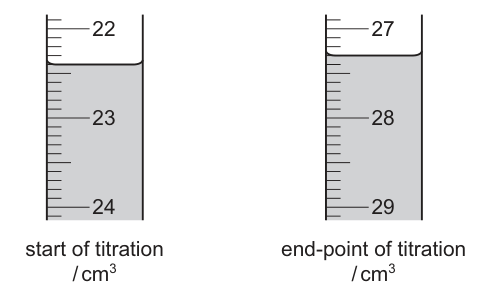
What is the volume of acid used during the titration?
Options
A
B
C
D
Working
The scale on a burette increases downwards. Readings are taken at the bottom of the meniscus.
Start reading =
End reading =
Answer
B
B
Walkthrough
In a titration, the volume of liquid delivered from the burette is found by subtracting the initial reading from the final reading. Burette scales are unique because the numbers increase downwards (0 at the top, higher numbers at the bottom). Readings must always be taken at the bottom of the liquid meniscus.
From the diagrams:
- The start of titration reading is .
- The end-point reading is .
Subtracting the start value from the end value:
This matches option B.
Key Takeaways
- Burette scales increase downwards, so the end reading is always larger than the start reading.
- Always read the volume at the bottom of the meniscus.
- Volume delivered = final reading - initial reading.
Common Mistakes
- Subtracting the start reading from the end reading in the wrong order (e.g., ).
- Reading the top of the meniscus instead of the bottom.
- Misreading the scale direction (thinking 22.7 is above 23 when it is below).
- Forgetting that the unit is and not .
Things to Be Careful About
- Burette readings are always to 1 decimal place (e.g., is acceptable but is standard for this level).
- Ensure the final answer is positive; if you get a negative number, you subtracted in the wrong order.
- The scale on a burette is inverted compared to a measuring cylinder.
The rest of this paper
39 more questions- Q2Chemical Reactions · Experimental Techniques and Chemical Analysis1M
- Q3Experimental Techniques and Chemical Analysis1M
- Q4Organic Chemistry1M
- Q5Experimental Techniques and Chemical Analysis1M
- Q6Experimental Techniques and Chemical Analysis1M
- Q7States of Matter1M
- Q8Atoms, Elements and Compounds1M
- Q9Atoms, Elements and Compounds1M
- Q10Atoms, Elements and Compounds1M
- Q11Atoms, Elements and Compounds1M
- Q12Atoms, Elements and Compounds1M
- Q13Stoichiometry1M
- Q14Stoichiometry1M
- Q15Stoichiometry1M
- Q16Stoichiometry1M
- Q17Stoichiometry1M
- Q18Electrochemistry1M
- Q19Electrochemistry1M
- Q20Chemical Energetics1M
- Q21Chemical Reactions1M
- Q22Chemical Reactions · Chemical Energetics1M
- Q23Acids, Bases and Salts1M
- Q24Acids, Bases and Salts · Metals1M
- Q25Chemical Reactions1M
- Q26Chemistry of the Environment · Acids, Bases and Salts1M
- Q27Atoms, Elements and Compounds1M
- Q28Atoms, Elements and Compounds1M
- Q29Metals1M
- Q30Metals1M
- Q31Metals1M
- Q32Chemistry of the Environment1M
- Q33Chemistry of the Environment1M
- Q34Organic Chemistry1M
- Q35Organic Chemistry1M
- Q36Organic Chemistry1M
- Q37Organic Chemistry1M
- Q38Organic Chemistry1M
- Q39Organic Chemistry · Chemistry of the Environment1M
- Q40Organic Chemistry1M