Chemistry 5070/42 — May/June 2020
Cambridge O-Level · Alternative to Practical · worked solutions for every part, with the mark scheme
Topics Experimental Contexts · Use of Techniques, Apparatus and Materials · Observations and Measurements · Planning Experiments and Investigations · Analysis, Conclusions and Evaluation · Qualitative Analysis
Iron tablets are used to treat iron deficiency in the body.
Iron tablets contain iron(II) ions, .
A student does a series of titrations with aqueous potassium manganate(VII), , to determine the percentage of iron in some iron tablets.
Diagrams of some of the apparatus the student uses are shown.
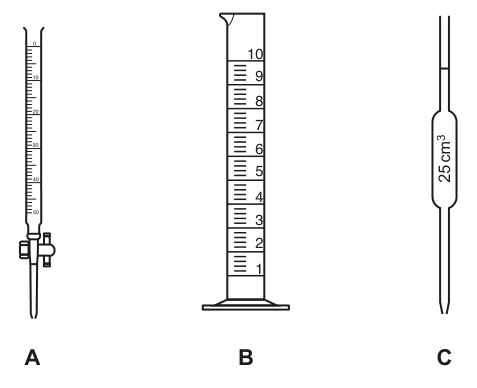
Name the three pieces of apparatus.
A ______
B ______
C ______
The student:
- records the total mass of five iron tablets
- crushes the tablets, dissolves them in distilled water and makes the solution up to
- uses apparatus C to transfer of the solution of ions into a conical flask
- uses apparatus B to add of dilute sulfuric acid to the conical flask
- fills apparatus A with
- titrates the solution of with the until the first permanent pink colour is seen in the conical flask
- repeats the titration three times.
The equation for the reaction is shown.
Suggest why dilute sulfuric acid is added to the conical flask.
______
Give the formula of the ion responsible for the pink colour seen at the end-point.
______
The diagrams show parts of apparatus A with the liquid levels at the beginning and the end of titration 3.
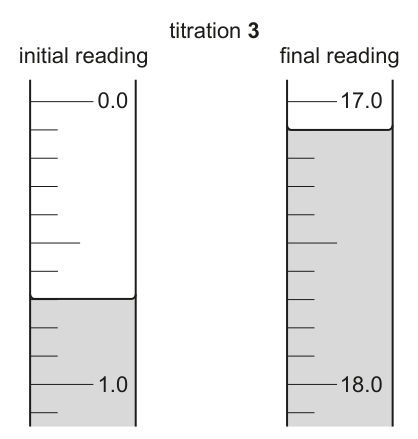
Record the values in the results table.
Complete the results table for each of titrations 1, 3 and 4.
| titration number | 1 | 2 | 3 | 4 |
|---|---|---|---|---|
| final reading / | 17.2 | 34.1 | 16.9 | |
| initial reading / | 0.0 | 17.2 | ||
| volume used / | 16.9 | 16.7 | ||
| best titration results (✓) |
Tick (✓) the best titration results in the table.
Use the ticked values to calculate the average volume of used.
average volume = ______
A second student does another series of titrations using the same method and .
This student obtains an average volume of .
The equation for the reaction is shown.
Calculate the number of moles of used by the second student.
______
Calculate the number of moles of ions present in the sample of solution.
______
Calculate the total mass of ions in the five tablets.
[: Fe, 56]
______
The total mass of the five tablets is .
Calculate the percentage, by mass, of iron in the tablets.
Give your answer to three significant figures.
______ %
The rest of this paper
4 more questions- Q2Qualitative Analysis10M
- Q3Experimental Contexts · Planning Experiments and Investigations8M
- Q4Experimental Contexts · Planning Experiments and Investigations · Observations and Measurements · Use of Techniques, Apparatus and Materials11M
- Q5Experimental Contexts · Planning Experiments and Investigations · Use of Techniques, Apparatus and Materials · Observations and Measurements · Analysis, Conclusions and Evaluation17M