Chemistry 5070/31 — May/June 2020
Cambridge O-Level · Practical Test · worked solutions for every part, with the mark scheme
Topics Observations and Measurements · Experimental Contexts · Analysis, Conclusions and Evaluation · Qualitative Analysis
Magnesium reacts with dilute hydrochloric acid to form magnesium chloride and hydrogen.
The equation for this reaction is shown.
You are going to investigate the effect of the concentration of hydrochloric acid on the rate of the reaction.
P is hydrochloric acid.
Q is magnesium ribbon.
Use the apparatus shown with the boiling tube in a rack and the measuring cylinder supported with a stand and clamp.
Fill the trough and measuring cylinder with water.
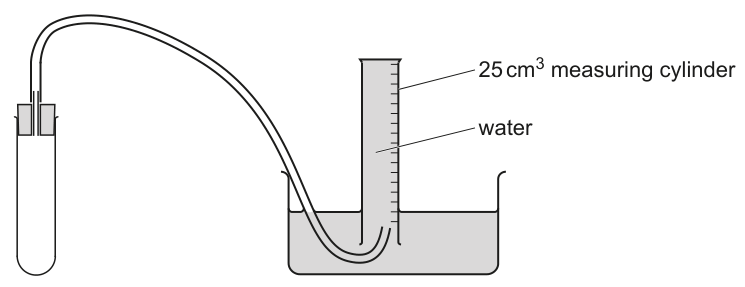
- Remove the bung from the boiling tube.
- Place one strip of Q into the boiling tube.
- In experiment 1 add of water and then of P to the boiling tube.
- Quickly insert the bung back into the boiling tube.
- Immediately start timing.
- Stop timing when of hydrogen has been collected. Record the time taken to the nearest second in the table.
- Repeat the experiment four more times using the volumes of P and water shown in the table.
| experiment | 1 | 2 | 3 | 4 | 5 |
|---|---|---|---|---|---|
| volume of water/ | 4.0 | 3.0 | 2.0 | 1.0 | 0.0 |
| volume of P/ | 6.0 | 7.0 | 8.0 | 9.0 | 10.0 |
| time to produce gas/ | |||||
| concentration of P in | 2.0 |
P is hydrochloric acid.
Calculate the concentration of hydrochloric acid in each experiment.
Write your answers in the table.
Use data from the table to plot a graph of the concentration of hydrochloric acid (-axis) against the time taken to collect of hydrogen (-axis).
Draw a curve of best fit.

Calculate the number of moles of hydrogen, , in of hydrogen at room temperature and pressure (r.t.p.).
[The volume of one mole of hydrogen is at r.t.p.]
number of moles of hydrogen = ______
Use your answer from (d) to calculate the number of moles of that react to form of at r.t.p.
number of moles of = ______
Use data from the table and your answer from (e) to calculate the mean rate of reaction, in , of P in experiment 5.
Give your answer to two significant figures.
mean rate of reaction in experiment 5 = ______
The rest of this paper
1 more questions- Q2Qualitative Analysis23M