Chemistry 5070/41 — October/November 2019
Cambridge O-Level · Alternative to Practical · worked solutions for every part, with the mark scheme
Topics Experimental Contexts · Analysis, Conclusions and Evaluation · Observations and Measurements · Qualitative Analysis · Use of Techniques, Apparatus and Materials · Planning Experiments and Investigations
A student electrolyses three solutions using the apparatus shown.
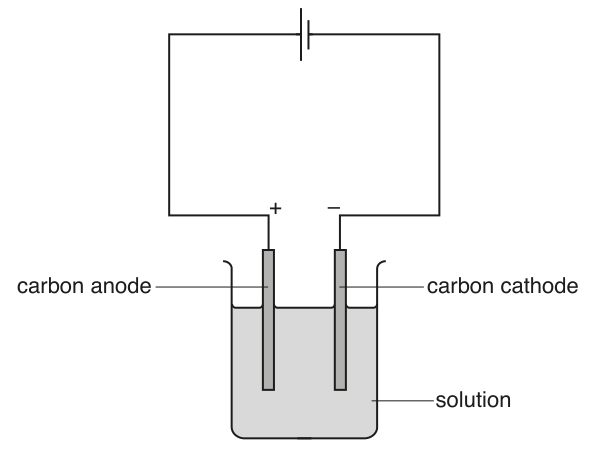
Complete the table.
| anode (+) | anode (+) | cathode (–) | cathode (–) | |
|---|---|---|---|---|
| solution | name of product | observation | name of product | observation |
| aqueous copper(II) sulfate | oxygen | bubbles of colourless gas | copper | |
| aqueous potassium iodide | brown liquid | |||
| dilute sulfuric acid | bubbles of colourless gas | bubbles of colourless gas |
Answer
| anode (+) | anode (+) | cathode (–) | cathode (–) | |
|---|---|---|---|---|
| solution | name of product | observation | name of product | observation |
| aqueous copper(II) sulfate | oxygen | bubbles of colourless gas | copper | pink / brown solid |
| aqueous potassium iodide | iodine | brown liquid | hydrogen | bubbles of colourless gas |
| dilute sulfuric acid | oxygen | bubbles of colourless gas | hydrogen | bubbles of colourless gas |
See completed table above.
Walkthrough
Electrolysis of aqueous solutions involves the discharge of ions from the solute and from water. At the cathode (negative electrode), positive ions or hydrogen ions from water are discharged. At the anode (positive electrode), negative ions or hydroxide ions from water are discharged.
- For aqueous copper(II) sulfate: Copper is below hydrogen in the reactivity series, so Cu²⁺ is discharged at the cathode to form a pink/brown solid. OH⁻ from water is discharged at the anode to form oxygen gas (bubbles of colourless gas).
- For aqueous potassium iodide: Potassium is above hydrogen, so H⁺ from water is discharged at the cathode to form hydrogen gas (bubbles of colourless gas). I⁻ ions are discharged at the anode to form iodine, which dissolves in water to give a brown liquid.
- For dilute sulfuric acid: H⁺ from the acid is discharged at the cathode to form hydrogen gas. OH⁻ from water is discharged at the anode to form oxygen gas. Both produce bubbles of colourless gas.
Key Takeaways
- In aqueous electrolysis, the reactivity series determines which metal ion is discharged at the cathode.
- Halide ions (like I⁻) are discharged at the anode in preference to OH⁻, forming the halogen.
- For dilute acids, OH⁻ from water is discharged at the anode to produce oxygen gas.
Common Mistakes
- Assuming potassium is discharged at the cathode in aqueous potassium iodide. Potassium is too reactive; hydrogen from water is discharged instead.
- Forgetting that iodine dissolves in aqueous solution to form a brown liquid, rather than just stating 'brown solid'.
- Writing 'water' as a product instead of the gas evolved (hydrogen or oxygen).
Things to Be Careful About
- Observations must be descriptive: 'pink / brown solid' for copper, 'bubbles of colourless gas' for hydrogen and oxygen.
- State symbols are not required in this table, but the physical state of the product (solid, gas, aqueous liquid) must be correctly observed.
Give a test and observation to identify oxygen gas.
test ______
observation ______
Answer
test: glowing splint
observation: relights
test: glowing splint; observation: relights
Walkthrough
Oxygen gas supports combustion. The standard test is to insert a glowing splint into a test tube of the gas. If the gas is oxygen, the splint will relight and burst into flames.
Key Takeaways
- The glowing splint test is the definitive test for oxygen gas.
- Do not confuse this with the 'pop' test for hydrogen (a lit splint).
Common Mistakes
- Saying 'a lit splint' instead of a 'glowing splint'. A lit splint will just continue to burn in oxygen; the relighting of a glowing splint is the specific test.
- Describing the observation as 'burns brightly' rather than 'relights'.
Things to Be Careful About
- Ensure the test and observation are matched correctly. The test is the action (inserting a glowing splint), and the observation is the result (it relights).
The rest of this paper
5 more questions- Q2Experimental Contexts · Use of Techniques, Apparatus and Materials · Planning Experiments and Investigations · Analysis, Conclusions and Evaluation10M
- Q3Experimental Contexts · Planning Experiments and Investigations · Observations and Measurements5M
- Q4Experimental Contexts · Qualitative Analysis · Observations and Measurements10M
- Q5Use of Techniques, Apparatus and Materials · Experimental Contexts · Observations and Measurements · Analysis, Conclusions and Evaluation14M
- Q6Experimental Contexts · Analysis, Conclusions and Evaluation13M