Chemistry 5070/32 — October/November 2019
Cambridge O-Level · Practical Test · worked solutions for every part, with the mark scheme
Topics Experimental Contexts · Observations and Measurements · Analysis, Conclusions and Evaluation · Use of Techniques, Apparatus and Materials · Qualitative Analysis
The reaction of sulfuric acid and sodium hydroxide is exothermic.
When dilute sulfuric acid is added to aqueous sodium hydroxide, the temperature of the mixture increases.
is sodium hydroxide solution.
is dilute sulfuric acid.
Experiment 1
- Pipette of into a plastic cup supported in a beaker. Measure the temperature of to the nearest and record the value in column E of the table.
- Put into a burette. Measure of from the burette into a measuring cylinder. To the in the measuring cylinder, add water until the total volume of liquid in the cylinder is .
- Pour this mixture into the plastic cup containing . Stir, using the thermometer, and measure the highest temperature reached. Record the value in column F of the table.
- Empty the plastic cup and rinse it with water.
Experiments 2–7
- Repeat Experiment 1 using the different volumes of and water given in columns C and D of the table. Refill the burette as necessary.
- Calculate the temperature rise for each of experiments 1–7 and record in column G of the table.
| A | B | C | D | E | F | G |
|---|---|---|---|---|---|---|
| experiment number | volume of / | volume of / | volume of water / | initial temperature of / | highest temperature of mixture / | temperature rise / |
| 1 | 25.0 | 5.0 | 20 | |||
| 2 | 25.0 | 10.0 | 15 | |||
| 3 | 25.0 | 12.0 | 13 | |||
| 4 | 25.0 | 16.0 | 9 | |||
| 5 | 25.0 | 18.0 | 7 | |||
| 6 | 25.0 | 20.0 | 5 | |||
| 7 | 25.0 | 25.0 | 0 |
Working
- Complete the table by recording all initial temperatures of (column E) and highest temperatures of the mixture (column F) to the nearest .
- For each experiment (1 to 7), calculate the temperature rise in column G:
- Ensure the trend shows an increase in temperature rise for increasing volumes of up to the neutralisation point, followed by a plateau or slight drop for subsequent experiments.
Answer
Complete table of temperature readings to the nearest with correctly calculated temperature rises.
Fully completed table with temperatures to nearest 0.5 °C and correct temperature rises
Walkthrough
In this practical investigation, the temperature changes for a neutralisation reaction between sodium hydroxide () and dilute sulfuric acid () are recorded across varying acid volumes while keeping the total added volume constant at .
- Data Collection: The initial temperature of alkali and the maximum temperature reached after adding the acid-water mixture must be recorded for all 7 experiments. All readings should be written to the nearest (e.g. , ).
- Calculating Temperature Rise: Column G is calculated as:
- Expected Trend: As the volume of increases, more moles of neutralisation reaction occur, producing more heat and resulting in a steeper temperature rise. Once all the has reacted (at equivalence), adding further acid produces no additional heat, so the temperature rise levels off.
Key Takeaways
- All thermometer readings must be recorded to a consistent precision of .
- Temperature rise is always final temperature minus initial temperature.
Common Mistakes
- Inconsistent precision (e.g. writing instead of ).
- Arithmetic errors when subtracting negative or fractional numbers.
Things to Be Careful About
- Ensure every cell in columns E, F, and G is filled.
- Verify that subtractions are checked carefully.
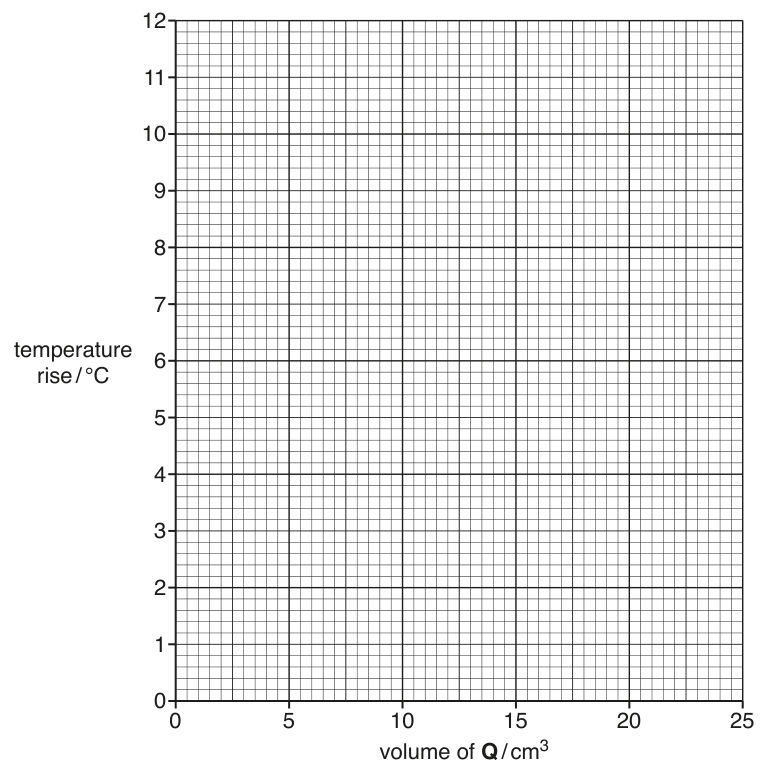
Plot a graph of temperature rise (column G) against volume of (column C) on the grid. Use these points to draw two intersecting straight lines.
Answer
- All 7 points plotted accurately within one small square on the grid (temperature rise on the -axis against volume of on the -axis).
- Two intersecting straight lines drawn using a ruler: one straight line through the rising section of points and a second straight line through the plateau/descending section.
Graph plotted with points within one small square and two intersecting straight lines of best fit
Walkthrough
- Plotting Points: Using the values from column G (temperature rise, vertical axis) and column C (volume of , horizontal axis), plot each of the 7 coordinates accurately within half a small square (or at least within 1 small square) using a small cross or encircled dot.
- Drawing Best-fit Lines:
- Draw a straight best-fit line through the points where temperature rise is increasing with volume of .
- Draw a second straight best-fit line through the points where the temperature rise levels off.
- Extend the two lines using a ruler so that they clearly intersect. The intersection point corresponds to the stoichiometric end-point (neutralisation point) of the reaction.
Key Takeaways
- Use a sharp pencil and ruler for drawing straight lines of best fit.
- The intersection of the two lines indicates the exact volume required for complete neutralisation in a thermometric titration.
Common Mistakes
- Drawing a single smooth curve instead of two straight intersecting lines.
- Joining points dot-to-dot rather than drawing best-fit straight lines.
Things to Be Careful About
- Check axis scales carefully so points are plotted at the exact grid lines.
From the graph, read the volume of where the two lines cross.
volume of = ______
Answer
Read the -axis value (volume of ) directly beneath the intersection point of the two straight lines on the graph (typically within the range , depending on experimental data).
Value read from graph intersection (e.g. 15.0 cm3)
Walkthrough
- Locate the point on the graph where the two straight lines cross.
- Trace vertically down from this intersection to the horizontal axis (-axis).
- Read and record the volume of to the nearest or half small square.
Key Takeaways
- The point of intersection represents the volume of acid that reacts completely with the fixed amount of alkali.
Common Mistakes
- Reading the highest plotted data point rather than the point where the two drawn lines cross.
- Misreading the scale divisions on the -axis.
Things to Be Careful About
- Ensure the reading reflects the graph drawn in part (b) and includes the correct unit ().
Your answer in (c) is the volume of that exactly neutralises of .
Calculate the concentration, in , of sulfuric acid in . Give your answer to 2 significant figures.
concentration of sulfuric acid in = ______
Working
- Calculate moles of in of ():
- Use the stoichiometric ratio from the balanced equation ():
- Calculate the concentration of in using the volume from (c), (in ):
(For example, if , to 2 s.f.)
Answer
15.625 / (volume of Q from (c)) rounded to 2 significant figures mol / dm3
Walkthrough
- Moles of :
Using the formula : - Mole Ratio:
From the balanced equation: react with . - Concentration of in :
- Rounding: The question specifies giving the final answer to 2 significant figures.
Key Takeaways
- Remember to apply the mole ratio between and .
- Convert volumes from to by dividing by .
- Adhere strictly to the required significant figures specified in the question.
Common Mistakes
- Forgetting the stoichiometric ratio (using ratio).
- Not rounding the final answer to 2 significant figures.
Things to Be Careful About
- Use error carried forward (ecf) from the volume read in part (c).
Explain why the reaction of the sulfuric acid and sodium hydroxide is carried out in a plastic cup.
______
Answer
To reduce heat loss (to the surroundings), as plastic is a poor conductor of heat / good insulator.
To reduce heat loss to the surroundings
Walkthrough
In calorimetry and thermometric titrations, the goal is to measure the total heat released by the reaction. A glass beaker conducts heat away rapidly to the surroundings, leading to lower recorded maximum temperatures. A plastic (polystyrene) cup is a good thermal insulator, which significantly reduces heat loss to the surroundings and ensures more accurate temperature measurements.
Key Takeaways
- Plastic cups act as thermal insulators to minimise heat transfer to the surroundings.
Common Mistakes
- Stating simply "because it does not react" without mentioning thermal insulation or heat loss.
Things to Be Careful About
- The key mark-scoring idea is "reduce heat loss".
Suggest two ways in which the accuracy of the temperature rises in the experiments can be improved.
- ______
- ______
Answer
Any two from:
- Use a lid on the plastic cup (to reduce heat loss).
- Use a more precise thermometer (e.g. reading to or with smaller subdivisions / a digital thermometer).
- Measure the volume of water using a burette / pipette (instead of a measuring cylinder).
- Check that the initial temperature of the acid-water mixture is the same as that of the alkali.
- Repeat the experiments and calculate an average.
Use a lid (to reduce heat loss) and use a more precise thermometer (e.g. reading to 0.1 °C)
Walkthrough
To improve the accuracy of temperature rise measurements in a thermometric experiment:
- Thermal Insulation: Adding a lid to the cup further minimises heat loss to the surroundings via convection and evaporation.
- Apparatus Precision: Using a thermometer with smaller scale divisions (e.g. reading to ) reduces reading uncertainty.
- Volumetric Precision: Measuring cylinders have greater measurement uncertainty than burettes or pipettes; using a burette for water delivers more accurate total reaction volumes.
- Temperature Consistency: Ensuring all starting solutions (, , and water) are at the same initial temperature eliminates errors caused by differing starting temperatures.
- Replication: Repeating each experiment identifies anomalous results and allows calculation of a mean.
Key Takeaways
- Improvements should target either reducing heat loss (e.g. lid) or reducing volumetric/temperature measurement uncertainty (e.g. more precise thermometer, burette for water).
Common Mistakes
- Suggesting vague improvements like "be more careful" or "use better equipment" without naming specific apparatus or changes.
Things to Be Careful About
- Make sure two distinctly different points are given.
The rest of this paper
1 more questions- Q2Qualitative Analysis · Experimental Contexts19M