Chemistry 5070/31 — October/November 2019
Cambridge O-Level · Practical Test · worked solutions for every part, with the mark scheme
Topics Experimental Contexts · Observations and Measurements · Analysis, Conclusions and Evaluation · Use of Techniques, Apparatus and Materials · Qualitative Analysis
The reaction between sulfuric acid and potassium hydroxide is exothermic.
When dilute sulfuric acid is added to aqueous potassium hydroxide, the temperature of the mixture increases.
is aqueous potassium hydroxide.
is sulfuric acid.
Experiment 1
- Pipette of into a plastic cup supported in a beaker. Measure the temperature of to the nearest and record the value in column E of the table.
- Put into a burette. Measure of from the burette into a measuring cylinder. To the in the measuring cylinder, add water until the total volume of liquid in the cylinder is .
- Pour this mixture into the plastic cup containing . Stir, using the thermometer, and measure the highest temperature reached. Record the value in column F of the table.
- Empty the plastic cup and rinse it with water.
Experiments 2–7
- Repeat Experiment 1 using the different volumes of and water given in columns C and D of the table. Refill the burette as necessary.
- Calculate the temperature rise for each of experiments 1–7 and record in column G of the table.
| A | B | C | D | E | F | G |
|---|---|---|---|---|---|---|
| experiment number | volume of / | volume of / | volume of water / | initial temperature of / | highest temperature of mixture / | temperature rise / |
| 1 | 25.0 | 5.0 | 20 | |||
| 2 | 25.0 | 10.0 | 15 | |||
| 3 | 25.0 | 12.0 | 13 | |||
| 4 | 25.0 | 16.0 | 9 | |||
| 5 | 25.0 | 18.0 | 7 | |||
| 6 | 25.0 | 20.0 | 5 | |||
| 7 | 25.0 | 25.0 | 0 |
Plot a graph of temperature rise (column G) against volume of (column C) on the grid. Use these points to draw two intersecting straight lines.
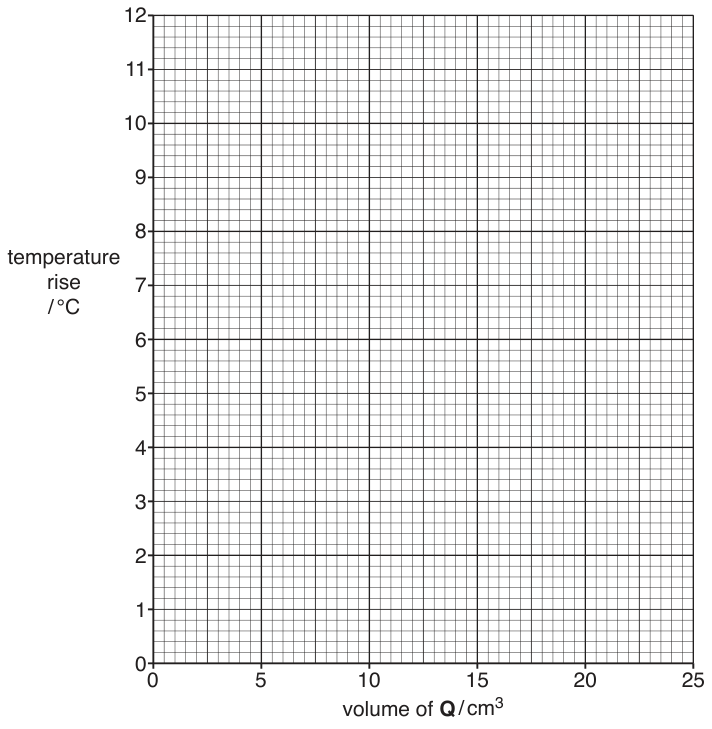
From the graph, read the volume of where the two lines cross.
volume of = ______
Your answer to (c) is the volume of that exactly neutralises of .
Calculate the concentration, in , of potassium hydroxide in . Give your answer to 2 significant figures.
concentration of potassium hydroxide in = ______
How has heat loss been reduced in the experiments?
______
Suggest two ways in which the accuracy of the temperature rises in the experiments can be improved.
- ______
- ______
The rest of this paper
1 more questions- Q2Observations and Measurements · Qualitative Analysis · Experimental Contexts · Analysis, Conclusions and Evaluation19M