Chemistry 5070/22 — October/November 2019
Cambridge O-Level · Theory · worked solutions for every part, with the mark scheme
Topics Stoichiometry · Acids, Bases and Salts · The Periodic Table · Experimental Techniques and Chemical Analysis · Metals · Organic Chemistry · +6 more
The diagram shows part of the Periodic Table.
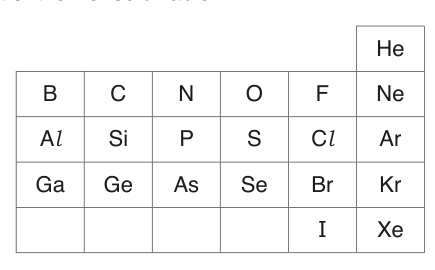
Answer the questions using only the elements shown in the diagram.
Each element may be used once, more than once or not at all.
Write the symbol for an element which:
forms a stable ion of type
______
Answer
O (or S or Se)
O
Walkthrough
Elements in Group VI (Group 16) of the Periodic Table have six electrons in their outer shell. To achieve a stable octet, they gain two electrons to form a stable ion with a 2- charge (X^{2-}). Looking at the provided diagram, the Group VI elements are oxygen (O), sulphur (S), and selenium (Se). Any of these symbols is a correct answer.
Key Takeaways
The group number in the Periodic Table determines the charge of the simple ion formed by non-metals. Group VI elements gain two electrons to form X^{2-} ions.
Common Mistakes
- Writing the name of the element (e.g., "oxygen") instead of the chemical symbol ("O"). The question explicitly asks for the symbol.
- Suggesting an element from Group V (forms 3-) or Group VII (forms 1-).
Things to Be Careful About
The question asks for "the symbol", not the name. Any of O, S, or Se is acceptable. Ensure the symbol is written correctly (capital first letter, lowercase second if applicable, though all three here are single letters).
is a light green gas at room temperature
______
Answer
Cl
Cl
Walkthrough
The halogens in Group VII have distinct physical properties at room temperature that change down the group. Fluorine (F) is a pale yellow gas, chlorine (Cl) is a light green gas, bromine (Br) is a reddish-brown liquid, and iodine (I) is a dark grey-black solid. From the elements shown in the diagram, chlorine (Cl) is the only light green gas.
Key Takeaways
The physical states and colours of the halogens change down the group: F (pale yellow gas), Cl (green gas), Br (red-brown liquid), I (grey-black solid). Melting and boiling points increase down the group.
Common Mistakes
- Confusing chlorine with fluorine (which is a pale yellow gas) or bromine (which is a reddish-brown liquid).
- Writing the name "chlorine" instead of the symbol "Cl".
Things to Be Careful About
The question asks for the symbol. Chlorine is a diatomic gas (Cl_2), but the question asks for the symbol of the element, which is Cl.
forms an ion which gives a yellow precipitate on addition of aqueous silver nitrate
______
Answer
I
I
Walkthrough
When aqueous silver nitrate (acidified with dilute nitric acid) is added to a solution containing halide ions, a precipitate of silver halide forms. The colour of the precipitate identifies the halide ion: chloride (Cl^-) gives a white precipitate, bromide (Br^-) gives a cream precipitate, and iodide (I^-) gives a yellow precipitate. The yellow precipitate is silver iodide (AgI). Therefore, the element that forms the iodide ion is iodine, symbol I.
Key Takeaways
The silver nitrate test distinguishes halide ions by the colour of the precipitate: Cl^- (white), Br^- (cream), I^- (yellow). The test must be carried out in the presence of dilute nitric acid to remove interfering ions like carbonate.
Common Mistakes
- Confusing the colours of the precipitates (e.g., thinking bromide gives a yellow precipitate).
- Writing the name "iodine" instead of the symbol "I".
- Forgetting that the test is for the ion, so the element must be one that forms that ion (iodine forms I^-).
Things to Be Careful About
The mark scheme accepts only the symbol "I". The precipitate is silver iodide, not silver chloride or silver bromide. Ensure the symbol is written with a capital I.
is used to make food containers
______
Answer
Al
Al
Walkthrough
Aluminium is widely used to make food containers, such as cans and foil, because it is lightweight (low density), does not react with food (it forms a tough, protective oxide layer on its surface), and is a good conductor of heat. From the elements shown in the diagram, aluminium is Al.
Key Takeaways
Aluminium's low density, resistance to corrosion (due to its protective oxide layer), and malleability make it ideal for food packaging, containers, and foil.
Common Mistakes
- Suggesting iron or copper for food containers (iron rusts and copper can react with acidic foods).
- Writing the name "aluminium" instead of the symbol "Al".
Things to Be Careful About
The question asks for the symbol. Must provide "Al" with the correct capitalisation (capital A, lowercase l).
is a diatomic gas which forms 78% of dry air.
______
Answer
N
N
Walkthrough
Clean, dry air is composed mainly of nitrogen (about 78%) and oxygen (about 21%), with small amounts of argon (about 0.9%) and carbon dioxide (about 0.04%). Nitrogen is a diatomic gas (N_2). From the elements shown in the diagram, nitrogen is N.
Key Takeaways
The composition of clean, dry air is approximately 78% nitrogen, 21% oxygen, and 1% other gases (mostly argon). Nitrogen is a diatomic, unreactive gas.
Common Mistakes
- Confusing nitrogen with oxygen (which is about 21% and supports combustion).
- Writing the name "nitrogen" instead of the symbol "N".
- Suggesting argon (which is monatomic, not diatomic, and makes up about 1% of air).
Things to Be Careful About
The question asks for the symbol and specifies "diatomic gas", which rules out argon (monatomic). Must provide "N" with a capital letter.
The rest of this paper
8 more questions- Q2Metals · Atoms, Elements and Compounds · Electrochemistry · The Periodic Table10M
- Q3Organic Chemistry · Chemistry of the Environment9M
- Q4Chemical Reactions · Stoichiometry · Experimental Techniques and Chemical Analysis · Acids, Bases and Salts13M
- Q5The Periodic Table · Stoichiometry · Acids, Bases and Salts · Metals8M
- Q6Organic Chemistry · States of Matter · Stoichiometry · Acids, Bases and Salts10M
- Q7Chemical Reactions · Chemical Energetics · Acids, Bases and Salts10M
- Q8Atoms, Elements and Compounds · Stoichiometry · Chemical Reactions10M
- Q9Organic Chemistry · Experimental Techniques and Chemical Analysis10M