Chemistry 5070/42 — May/June 2019
Cambridge O-Level · Alternative to Practical · worked solutions for every part, with the mark scheme
Topics Experimental Contexts · Qualitative Analysis · Use of Techniques, Apparatus and Materials · Observations and Measurements · Analysis, Conclusions and Evaluation · Planning Experiments and Investigations
Milk of Magnesia is a liquid medicine used to treat indigestion.
Milk of Magnesia contains magnesium hydroxide, .
A student does a series of titrations to determine the percentage by mass of magnesium hydroxide in Milk of Magnesia.
Diagrams of some of the apparatus used by the student are shown.
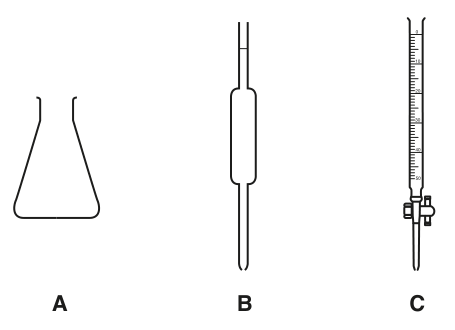
Name the three pieces of apparatus.
A ______
B ______
C ______
The student:
- puts of the Milk of Magnesia into apparatus A and adds some distilled water
- adds a few drops of a suitable indicator to the mixture in apparatus A
- fills apparatus C with hydrochloric acid
- titrates the contents of apparatus A with the hydrochloric acid until the indicator changes colour
- records the readings.
The student repeats the procedure three further times.
The diagrams show parts of apparatus C with the liquid levels at the beginning and the end of titration 3.
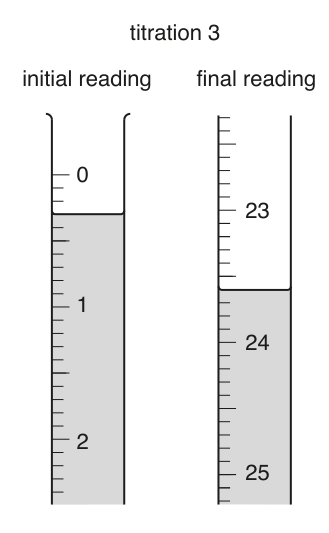
Record the values in the results table.
Complete the results table for each of titrations 1, 3 and 4.
| titration number | 1 | 2 | 3 | 4 |
|---|---|---|---|---|
| final reading / | 24.1 | 47.5 | 24.4 | |
| initial reading / | 0.0 | 23.7 | ||
| volume of hydrochloric acid used / | 23.8 | 23.6 | ||
| best titration results () |
Tick () the best titration results in the table.
Use these best titration results to calculate the average volume of hydrochloric acid used.
average volume = ______
Suggest why the volume of distilled water the student adds to apparatus A does not affect the results of the titrations.
______
A second student does another series of titrations using the same method. This student obtains an average volume of .
The equation for the reaction during the titration is shown.
Calculate the number of moles of hydrochloric acid used by this second student.
______ moles
Calculate the number of moles of magnesium hydroxide present in of the Milk of Magnesia.
______ moles
Calculate the mass of magnesium hydroxide in of the Milk of Magnesia.
[: ; ; ]
______
The density of the Milk of Magnesia is .
Calculate the mass of of the Milk of Magnesia.
______
Calculate the percentage by mass of magnesium hydroxide in the Milk of Magnesia.
______ %
The rest of this paper
5 more questions- Q2Experimental Contexts · Planning Experiments and Investigations6M
- Q3Experimental Contexts · Qualitative Analysis11M
- Q4Experimental Contexts · Observations and Measurements · Qualitative Analysis · Analysis, Conclusions and Evaluation14M
- Q5Experimental Contexts · Planning Experiments and Investigations · Use of Techniques, Apparatus and Materials9M
- Q6Qualitative Analysis · Experimental Contexts6M