Chemistry 5070/41 — May/June 2019
Cambridge O-Level · Alternative to Practical · worked solutions for every part, with the mark scheme
Topics Experimental Contexts · Analysis, Conclusions and Evaluation · Use of Techniques, Apparatus and Materials · Qualitative Analysis · Observations and Measurements · Planning Experiments and Investigations
Ammonium sulfate is a salt. It is used as a fertiliser.
A student prepares some ammonium sulfate crystals by neutralisation.
She uses dilute sulfuric acid and aqueous ammonia.
The diagrams show some of the apparatus the student can use.
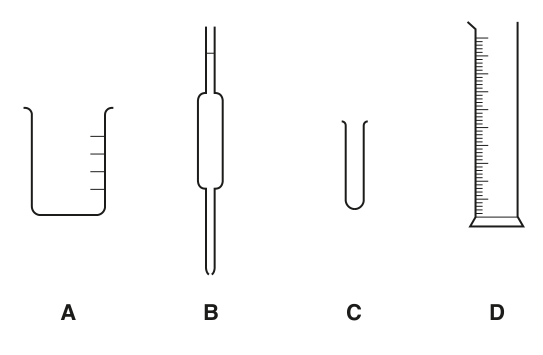
The student measures of aqueous ammonia into a conical flask.
Write the letter of the piece of apparatus she should use to measure the aqueous ammonia.
Name this piece of apparatus.
letter ______
name = ______
The student:
- adds a few drops of methyl orange indicator to the aqueous ammonia in the conical flask
- adds dilute sulfuric acid until the indicator changes colour
- records the volume of dilute sulfuric acid added.
She uses the apparatus shown in the diagram to add the sulfuric acid.
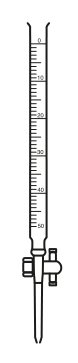
Name this piece of apparatus.
______
What is the colour of methyl orange indicator:
- in aqueous ammonia ______
- in dilute sulfuric acid? ______
At the end-point the student records that of sulfuric acid has neutralised of ammonia.
Plan an experiment to prepare a pure sample of ammonium sulfate crystals.
You should use:
- sulfuric acid
- ammonia
- the apparatus normally found in a chemistry laboratory.
Calcium hydroxide is used to neutralise soil acidity. It reacts with ammonium sulfate fertiliser in the soil.
The student investigates the reaction between these two compounds.
She uses the apparatus shown.
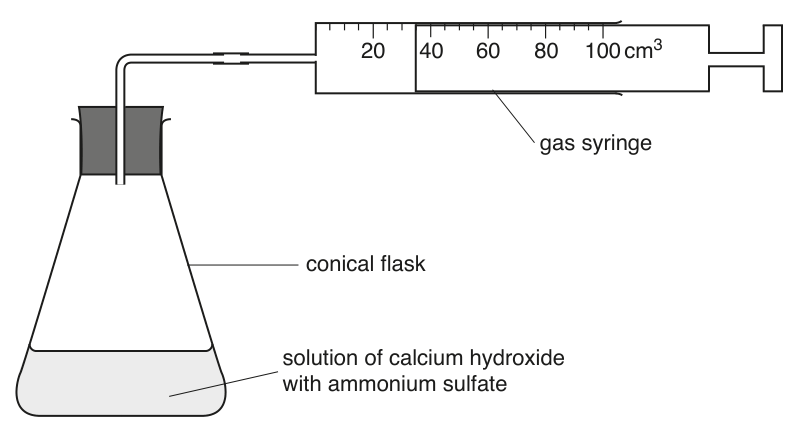
What volume of gas is in the gas syringe?
______
After the gas has been collected, a piece of damp blue litmus paper and a piece of damp red litmus paper are put in the gas.
What happens to the colour of:
- the damp blue litmus paper ______
- the damp red litmus paper? ______
The rest of this paper
5 more questions- Q2Analysis, Conclusions and Evaluation · Experimental Contexts11M
- Q3Analysis, Conclusions and Evaluation · Observations and Measurements · Experimental Contexts · Use of Techniques, Apparatus and Materials7M
- Q4Experimental Contexts · Qualitative Analysis5M
- Q5Experimental Contexts · Use of Techniques, Apparatus and Materials · Qualitative Analysis · Observations and Measurements · Analysis, Conclusions and Evaluation16M
- Q6Analysis, Conclusions and Evaluation · Experimental Contexts9M