Chemistry 5070/21 — October/November 2018
Cambridge O-Level · Theory · worked solutions for every part, with the mark scheme
Topics Stoichiometry · Chemical Reactions · Atoms, Elements and Compounds · The Periodic Table · Organic Chemistry · Metals · +6 more
The electronic configurations of five atoms are shown.
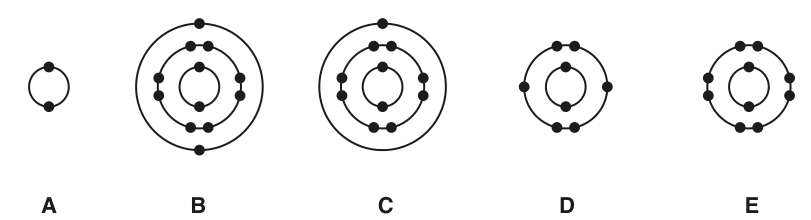
Which electronic configuration represents each of the following descriptions?
Each electronic configuration may be used once, more than once or not at all.
a sodium atom
______
Answer
B
B
Walkthrough
Sodium is a Group I element with atomic number 11. Its atom has 11 electrons distributed in shells as 2, 8, 1. Looking at the diagrams, B has three shells with 2, 8, and 1 electrons. Therefore, B represents a sodium atom.
Key Takeaways
The first shell holds a maximum of 2 electrons, the second holds 8, and the third holds 8 for the first 20 elements. Group I metals all have one electron in their outermost shell.
Common Mistakes
Confusing the total number of electrons with the number in the outer shell. Remember to read the configuration shell by shell from the inside out.
Things to Be Careful About
Ensure you count the electrons in each shell correctly from the diagram. Diagram B clearly shows 2, 8, 1.
an atom of a reactive non-metallic element
______
Answer
D
D
Walkthrough
Non-metallic elements typically have 4, 5, 6, or 7 electrons in their outer shell and tend to gain electrons to achieve a full outer shell. Diagram D has 2, 6 configuration (oxygen) and diagram E has 2, 7 configuration (fluorine). Both are reactive non-metals. The mark scheme accepts D. Oxygen (2, 6) is a reactive non-metal.
Key Takeaways
Metals have 1-3 outer electrons; non-metals have 4-7. Noble gases have a full outer shell (2 or 8).
Common Mistakes
Selecting a metal (B or C) or a noble gas (A) as a reactive non-metal. Remember that elements with full outer shells are unreactive.
Things to Be Careful About
The rubric states configurations may be used more than once. D is also the answer to part (v), which is perfectly valid.
an atom with a proton (atomic) number of 12
______
Answer
C
C
Walkthrough
For a neutral atom, the number of electrons equals the proton number (atomic number). We need an atom with proton number 12, so it must have 12 electrons. Adding the electrons in each diagram: A=2, B=11, C=12, D=8, E=9. Diagram C has 2, 8, 2 electrons, which totals 12. Therefore, C represents the atom with proton number 12 (magnesium).
Key Takeaways
In a neutral atom, number of electrons = proton number. Electron configurations are written shell by shell.
Common Mistakes
Forgetting that the atom is neutral and assuming ions. The question says 'an atom', so electrons = protons.
Things to Be Careful About
Count all electrons in the diagram carefully. 2 + 8 + 2 = 12.
an atom of a noble gas which is used to fill balloons
______
Answer
A
A
Walkthrough
Noble gases have full outer electron shells. Helium has a full first shell with 2 electrons. Diagram A shows one shell with 2 electrons, which is helium. Helium is a noble gas and is commonly used to fill balloons because it is less dense than air and unreactive.
Key Takeaways
Helium is the lightest noble gas and is used in balloons. It has a full outer shell of 2 electrons.
Common Mistakes
Choosing another noble gas configuration if one existed, or confusing helium with hydrogen (which also has 2 electrons but is not a noble gas and is not used in balloons for safety reasons).
Things to Be Careful About
Helium is the only noble gas with 2 electrons; all others have 8 in their outer shell.
an atom which forms a noble gas electronic configuration when it gains two electrons
______
Answer
D
D
Walkthrough
A noble gas electronic configuration has a full outer shell (8 electrons, or 2 for helium). If an atom gains two electrons to achieve this, it must originally have 8 - 2 = 6 electrons in its outer shell. Diagram D has the configuration 2, 6, meaning it has 6 outer electrons. Gaining 2 electrons gives 2, 8, which is the configuration of neon (a noble gas). Therefore, D is the correct answer.
Key Takeaways
Non-metals gain electrons to complete their outer shell. Group VI elements have 6 outer electrons and gain 2 to form 2- ions.
Common Mistakes
Thinking that gaining electrons means the atom already has 8 outer electrons. Remember, it gains electrons TO reach 8.
Things to Be Careful About
The question says 'gains two electrons', so the original outer shell must have 6 electrons.
Chlorine has two naturally occurring isotopes.
One isotope of chlorine is represented by the symbol shown.
Deduce the number of neutrons in one atom of this isotope of chlorine.
______
Working
Answer
20
20
Walkthrough
The isotope symbol is . The top number (37) is the mass number (protons + neutrons). The bottom number (17) is the proton number (atomic number). To find the number of neutrons, subtract the proton number from the mass number: 37 - 17 = 20.
Key Takeaways
Mass number = protons + neutrons. Proton number = number of protons. Neutrons = mass number - proton number.
Common Mistakes
Adding the numbers instead of subtracting, or confusing which number is the mass number and which is the proton number. The mass number is always on top.
Things to Be Careful About
Ensure the calculation is correct: 37 - 17 = 20. No units are required for a count of particles.
Chlorine has diatomic molecules.
What is the meaning of the term diatomic?
______
Answer
A molecule containing two atoms.
A molecule containing two atoms
Walkthrough
The term 'diatomic' means 'two atoms'. A diatomic molecule is a molecule that consists of exactly two atoms, which may be of the same element (like , , ) or different elements (like , ). In the context of chlorine, it forms molecules.
Key Takeaways
Diatomic means two atoms bonded together. Common diatomic elements are hydrogen, nitrogen, oxygen, fluorine, chlorine, bromine, and iodine (HOFBrINCl).
Common Mistakes
Saying 'two elements' instead of 'two atoms'. Diatomic refers to the number of atoms in the molecule, not the number of different elements.
Things to Be Careful About
Be precise with wording: 'molecule containing two atoms' is the standard accepted answer. 'Two atoms' alone is not sufficient as it does not specify they are bonded in a molecule.
The rest of this paper
8 more questions- Q2Chemical Reactions · Stoichiometry · Electrochemistry · Experimental Techniques and Chemical Analysis · Metals10M
- Q3Organic Chemistry · Chemical Reactions · Acids, Bases and Salts · Stoichiometry7M
- Q4Organic Chemistry · Stoichiometry11M
- Q5The Periodic Table · Atoms, Elements and Compounds · Stoichiometry · Acids, Bases and Salts · States of Matter · Chemical Reactions10M
- Q6States of Matter · The Periodic Table · Atoms, Elements and Compounds · Stoichiometry · Chemistry of the Environment10M
- Q7Chemical Reactions · Chemistry of the Environment · Organic Chemistry10M
- Q8Atoms, Elements and Compounds · The Periodic Table · Metals · Stoichiometry · Chemical Reactions10M
- Q9Chemical Reactions · Chemical Energetics · Stoichiometry10M