Chemistry 5070/41 — May/June 2018
Cambridge O-Level · Alternative to Practical · worked solutions for every part, with the mark scheme
Topics Experimental Contexts · Use of Techniques, Apparatus and Materials · Analysis, Conclusions and Evaluation · Planning Experiments and Investigations · Observations and Measurements · Qualitative Analysis
A student does a series of titrations to determine the percentage of ethanoic acid in a sample of vinegar.
Diagrams of some of the apparatus used by the student are shown.
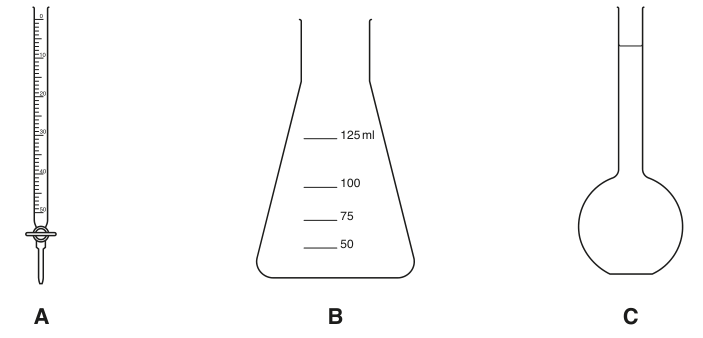
Name the three pieces of apparatus.
A = ______
B = ______
C = ______
Answer
A = burette
B = conical flask (or Erlenmeyer flask)
C = volumetric flask (or graduated flask)
A = burette, B = conical flask, C = volumetric flask
Walkthrough
The question asks to name three pieces of apparatus shown in Fig. 1.1, which are used in a titration.
- Apparatus A has a stopcock at the bottom and fine graduations along its length. This is a burette, used to deliver variable, measured volumes of a liquid (the titrant).
- Apparatus B is a flat-bottomed flask with a conical body and a narrow neck, marked with approximate volumes (50, 75, 100, 125 ml). This is a conical flask (also called an Erlenmeyer flask), used to hold the analyte and indicator during titration. The conical shape allows swirling without splashing.
- Apparatus C has a spherical body and a long, narrow neck with a single calibration mark. This is a volumetric flask (or graduated flask), used to prepare a solution of a precise, known volume (here, making up to 250 cm³).
Key Takeaways
Candidates must recognise standard apparatus used in quantitative analysis, particularly titrations. Knowing the specific names and purposes (burette for delivery, volumetric flask for precise volume preparation, conical flask for reaction vessel) is essential.
Common Mistakes
- Calling the volumetric flask a "flask" or "measuring flask" without the specific term "volumetric".
- Calling the conical flask a "beaker" or "Erlenmeyer flask" (though Erlenmeyer is accepted, "conical flask" is the standard O Level term).
- Confusing the burette with a pipette or measuring cylinder.
Things to Be Careful About
Use the exact terminology expected in the mark scheme: "burette", "conical flask" (or Erlenmeyer flask), "volumetric flask" (or graduated flask). State symbols are not required here as these are names of apparatus, not chemical substances.
The student measures of the vinegar into apparatus C and makes it up to with distilled water.
Apparatus A is filled with sodium hydroxide.
For each titration, of the diluted vinegar is transferred into apparatus B, using a measuring cylinder. A few drops of methyl orange indicator are added.
The diagram shows parts of apparatus A with the liquid levels at the beginning and end of titration 4.
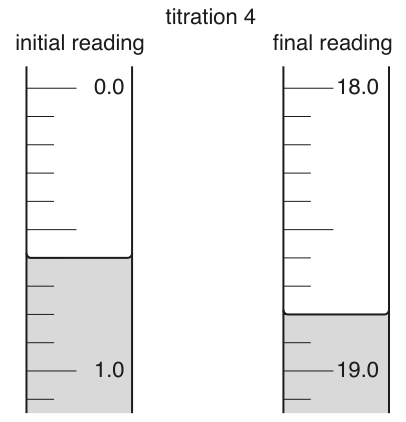
Record these values in the results table. Calculate and record the volume of sodium hydroxide used.
| titration number | 1 | 2 | 3 | 4 |
|---|---|---|---|---|
| final reading / | 19.0 | 36.4 | 19.1 | |
| initial reading / | 0.0 | 18.4 | 0.4 | |
| volume of sodium hydroxide used / | 18.0 | |||
| best titration results (✓) |
Answer
| titration number | 1 | 2 | 3 | 4 |
|---|---|---|---|---|
| final burette reading / cm³ | 19.0 | 36.4 | 19.1 | 18.8 |
| initial burette reading / cm³ | 0.0 | 18.4 | 0.4 | 0.6 |
| volume of 0.0250 mol / dm³ sodium hydroxide used / cm³ | 19.0 | 18.0 | 18.7 | 18.2 |
| best titration results (✓) | ✓ | ✓ |
From Fig. 1.2:
- Initial reading: The meniscus is at 0.6 cm³.
- Final reading: The meniscus is at 18.8 cm³.
- Volume used = 18.8 − 0.6 = 18.2 cm³.
Final reading = 18.8 cm³, Initial reading = 0.6 cm³, Volume used = 18.2 cm³
Walkthrough
The student must read the burette values for titration 4 from Fig. 1.2 and calculate the volume of sodium hydroxide used.
- Burette readings are always read to 1 decimal place (e.g., 0.6, 18.8). The meniscus is read at eye level from the bottom of the curve.
- Initial reading: The meniscus is between 0.0 and 1.0. There are 10 small divisions between 0.0 and 1.0, so each small division is 0.1 cm³. The meniscus is 6 small divisions below 0.0, so the reading is 0.6 cm³.
- Final reading: The meniscus is between 18.0 and 19.0. It is 8 small divisions below 18.0, so the reading is 18.8 cm³.
- Volume used (titre) = Final reading − Initial reading = 18.8 − 0.6 = 18.2 cm³.
Key Takeaways
Burette readings must be recorded to 1 decimal place. The volume of titrant used is always the final reading minus the initial reading. Always check the direction of the numbers on the burette (they increase downwards).
Common Mistakes
- Reading the burette to 2 decimal places (e.g., 0.60) — O Level burettes are read to 1 d.p.
- Subtracting in the wrong order (initial minus final), giving a negative volume.
- Misreading the meniscus level by ignoring the 0.1 cm³ graduations.
Things to Be Careful About
Ensure all readings in the table are to 1 decimal place, including 0.0. The volume used column must be calculated correctly for each row. Concordant results are those within 0.20 cm³ of each other.
Complete the results table by calculating the volume of sodium hydroxide used for each of titrations 1 and 3.
Answer
| titration number | 1 | 2 | 3 | 4 |
|---|---|---|---|---|
| final burette reading / cm³ | 19.0 | 36.4 | 19.1 | 18.8 |
| initial burette reading / cm³ | 0.0 | 18.4 | 0.4 | 0.6 |
| volume of 0.0250 mol / dm³ sodium hydroxide used / cm³ | 19.0 | 18.0 | 18.7 | 18.2 |
- Titration 1: 19.0 − 0.0 = 19.0 cm³
- Titration 3: 19.1 − 0.4 = 18.7 cm³
Titration 1 volume = 19.0 cm³, Titration 3 volume = 18.7 cm³
Walkthrough
The volumes for titrations 1 and 3 are calculated by subtracting the initial reading from the final reading.
- Titration 1: 19.0 − 0.0 = 19.0 cm³
- Titration 3: 19.1 − 0.4 = 18.7 cm³
These values are simply entered into the results table.
Key Takeaways
Calculating the titre is a straightforward subtraction. Ensure the units (cm³) are consistent and the arithmetic is correct.
Common Mistakes
- Arithmetic errors in subtraction (e.g., 19.1 − 0.4 = 18.3 instead of 18.7).
- Forgetting to include the unit in the final answer if required, though the table header provides the unit.
Things to Be Careful About
Keep the decimal places consistent. All burette readings and calculated volumes should be to 1 decimal place.
In the results table, tick (✓) the best titration results and use them to calculate the average titre.
average titre = ______
Answer
| titration number | 1 | 2 | 3 | 4 |
|---|---|---|---|---|
| final burette reading / cm³ | 19.0 | 36.4 | 19.1 | 18.8 |
| initial burette reading / cm³ | 0.0 | 18.4 | 0.4 | 0.6 |
| volume of 0.0250 mol / dm³ sodium hydroxide used / cm³ | 19.0 | 18.0 | 18.7 | 18.2 |
| best titration results (✓) | ✓ | ✓ |
Average titre = 18.1 cm³
Concordant results are those within 0.20 cm³ of each other. Titration 2 (18.0 cm³) and titration 4 (18.2 cm³) are concordant. Titration 1 (19.0 cm³) and titration 3 (18.7 cm³) are not concordant with these or each other, so they are discarded.
Average = (18.0 + 18.2) / 2 = 18.1 cm³.
18.1 cm³
Walkthrough
To find the average titre, the student must first identify the concordant results. Concordant results in a titration are volumes that are within 0.20 cm³ of each other.
- Titration 1: 19.0 cm³
- Titration 2: 18.0 cm³
- Titration 3: 18.7 cm³
- Titration 4: 18.2 cm³
Comparing the values:
- 18.0 and 18.2 are within 0.20 cm³ (difference = 0.2 cm³). These are concordant and should be ticked.
- 19.0 and 18.7 are not within 0.20 cm³ of the concordant pair, nor of each other (difference = 0.3 cm³). These are not concordant and are discarded.
The average titre is calculated from the concordant results:
Key Takeaways
Always tick concordant results (within 0.20 cm³) before calculating the average. Do not include anomalous results in the average calculation.
Common Mistakes
- Averaging all four results: (19.0 + 18.0 + 18.7 + 18.2) / 4 = 18.475 cm³. This is incorrect because anomalous results must be excluded.
- Selecting the wrong pair as concordant.
Things to Be Careful About
The mark scheme for part (c) uses an average titre of 18.4 cm³ for a second student. Do not confuse this with the average titre calculated in part (b)(iii) for the first student, which is 18.1 cm³. Use the correct value for each part.
Suggest an improvement that the student can make to the method to make the results more accurate. Explain your answer.
______
Answer
Improvement: Use a pipette (or burette) instead of a measuring cylinder to measure the 25 cm³ of diluted vinegar into the conical flask.
Explanation: A pipette has less uncertainty (or less apparatus error / is more accurate) than a measuring cylinder, so the volume measured is more precise.
(Alternatively: Repeat the titration to obtain more concordant results. Explanation: This helps to identify and exclude anomalous results, giving a more reliable average.)
Use a pipette instead of a measuring cylinder to measure the 25 cm3 of diluted vinegar; this reduces uncertainty/apparatus error in the volume measurement.
Walkthrough
The student used a measuring cylinder to transfer 25 cm³ of diluted vinegar into the conical flask. Measuring cylinders are not very accurate for measuring specific volumes (they have a large uncertainty, often ±0.5 cm³ or more).
Improvement: Use a pipette (e.g., a 25 cm³ volumetric pipette) to transfer the diluted vinegar.
Explanation: A pipette is designed to deliver a precise, fixed volume of liquid with much less uncertainty (or less apparatus error) than a measuring cylinder. This makes the volume of analyte more accurate, leading to more accurate final results.
Alternative improvement: Repeat the titration more times. Explanation: This provides more data points to identify anomalous results and calculate a more reliable average.
Key Takeaways
In quantitative analysis, the accuracy of the final result depends on the accuracy of all measurements. Volumetric pipettes are far more accurate than measuring cylinders for transferring fixed volumes.
Common Mistakes
- Suggesting "use a bigger measuring cylinder" — this does not necessarily improve accuracy.
- Saying "a pipette is more accurate" without explaining why it improves the result (i.e., less uncertainty/error in the volume measured).
- Suggesting "use a more accurate balance" — mass is not being measured here.
Things to Be Careful About
The explanation must link the improvement to a reduction in error or uncertainty. "Less uncertainty" or "less apparatus error" are acceptable phrases. Ensure the improvement is specific to the step mentioned (measuring 25 cm³ into the flask).
A second student does another series of titrations using the same solutions. This student obtains an average titre of .
The equation for the reaction that takes place during the titration is shown.
Calculate the number of moles of sodium hydroxide used.
______ moles
Working
The second student obtains an average titre of of sodium hydroxide.
Answer
0.00046 moles (or moles)
0.00046 moles
Walkthrough
Calculate the moles of sodium hydroxide used in the titration.
- Concentration of NaOH =
- Volume of NaOH used = (average titre given in the question)
- Convert volume to :
- Calculate moles:
Key Takeaways
Always convert volume from to before using the concentration formula . The molar gas volume at r.t.p. is , but here we are dealing with solutions, so use .
Common Mistakes
- Forgetting to divide the volume by 1000, calculating moles (wrong by a factor of 1000).
- Using the wrong average titre (e.g., 18.1 from part b(iii) instead of 18.4 given in part c).
Things to Be Careful About
The question states "This student obtains an average titre of ". Do not use the 18.1 cm³ calculated in part (b)(iii); that was for a different student/method. Use 18.4 cm³ for all calculations in part (c).
Calculate the number of moles of ethanoic acid present in the of diluted vinegar solution transferred into apparatus B for each titration.
______ moles
Answer
From the equation:
The mole ratio of ethanoic acid to sodium hydroxide is 1 : 1.
Therefore, moles of ethanoic acid = moles of sodium hydroxide = 0.00046 moles (or moles).
Answer
0.00046 moles
0.00046 moles
Walkthrough
The balanced chemical equation shows that 1 mole of ethanoic acid () reacts with 1 mole of sodium hydroxide ().
Since the ratio is 1:1, the number of moles of ethanoic acid that reacted is equal to the number of moles of sodium hydroxide used.
Moles of ethanoic acid = 0.00046 mol
Key Takeaways
Always use the mole ratio from the balanced equation to relate the moles of reactants. For a 1:1 ratio, the moles are equal.
Common Mistakes
- Using a 1:2 or 2:1 ratio incorrectly.
- Copying the answer from part (c)(i) without stating the reasoning (though for a fill-in-the-blank, just the number is needed).
Things to Be Careful About
The equation is already balanced and provided. Do not alter it. The ratio is clearly 1:1.
The diluted vinegar solution is made by making the original of vinegar up to with distilled water.
Calculate the number of moles of ethanoic acid in the original sample of vinegar.
______ moles
Working
The of diluted vinegar transferred into the flask contained 0.00046 moles of ethanoic acid (from part c(ii)).
The original of vinegar was diluted to in the volumetric flask.
The dilution factor is:
Therefore, the number of moles in the original sample is:
Answer
0.0046 moles (or moles)
0.0046 moles
Walkthrough
The titration was performed on a diluted sample of vinegar. We need to find the moles in the original sample.
- Dilution process: of vinegar was made up to with distilled water.
- Aliquot taken for titration: of this diluted solution was used.
- Scaling factor: The total diluted volume () is 10 times the volume used in the titration (). So, .
Moles of ethanoic acid in the original = Moles in × 10
Key Takeaways
When a solution is diluted and an aliquot is taken for titration, you must scale up the moles found in the aliquot to find the moles in the original sample. The scaling factor is .
Common Mistakes
- Forgetting to multiply by the dilution factor and leaving the answer as 0.00046 mol.
- Using the wrong dilution factor (e.g., , which is incorrect because the 25 cm³ aliquot already represents a fraction of the 250 cm³ total).
Things to Be Careful About
Ensure you are scaling up correctly. The 0.00046 mol is in the 25 cm³ aliquot. The 250 cm³ flask contains 10 times that amount. That total amount (0.0046 mol) came from the original 5.0 cm³ of vinegar.
Calculate the concentration, in , of ethanoic acid in the original sample of vinegar.
concentration = ______
Working
We need the concentration of ethanoic acid in the original sample of vinegar.
- Moles of ethanoic acid in the original sample = 0.0046 mol (from part c(iii))
- Volume of original sample =
Convert volume to :
Calculate concentration:
Answer
concentration = 0.92 (or )
0.92 mol / dm3
Walkthrough
Calculate the concentration of ethanoic acid in the original vinegar.
- Moles of ethanoic acid = 0.0046 mol (this is the amount in the original 5.0 cm³ sample)
- Volume of original sample = 5.0 cm³
Convert volume to :
Calculate concentration:
Key Takeaways
Concentration is always calculated using volume in . Remember to use the volume and moles from the original sample, not the diluted aliquot.
Common Mistakes
- Using the volume of the diluted solution (250 cm³ or 25 cm³) instead of the original volume (5.0 cm³).
- Forgetting to convert cm³ to dm³, calculating .
- Using the moles from the aliquot (0.00046) instead of the scaled-up moles (0.0046).
Things to Be Careful About
The question asks for the concentration in the original sample of vinegar. Ensure you are using the moles and volume that correspond to that original sample. Units must be .
The rest of this paper
5 more questions- Q2Qualitative Analysis · Experimental Contexts6M
- Q3Use of Techniques, Apparatus and Materials · Experimental Contexts · Analysis, Conclusions and Evaluation9M
- Q4Experimental Contexts · Planning Experiments and Investigations10M
- Q5Experimental Contexts · Use of Techniques, Apparatus and Materials · Analysis, Conclusions and Evaluation12M
- Q6Experimental Contexts · Planning Experiments and Investigations10M