Chemistry 5070/41 — October/November 2017
Cambridge O-Level · Alternative to Practical · worked solutions for every part, with the mark scheme
Topics Experimental Contexts · Use of Techniques, Apparatus and Materials · Analysis, Conclusions and Evaluation · Qualitative Analysis · Planning Experiments and Investigations · Observations and Measurements
The apparatus shown is used to electrolyse dilute hydrochloric acid.
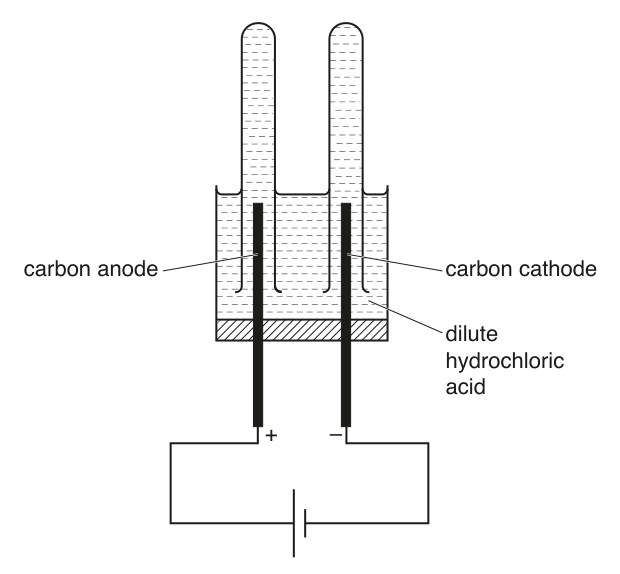
Name the gas given off at the carbon anode. Give a test and observation to identify this gas.
name of gas ______
test and observation ______
Answer
name of gas: chlorine
test and observation: damp blue litmus paper turns white (is bleached)
chlorine; damp blue litmus paper turns white (bleached)
Walkthrough
Dilute hydrochloric acid contains four ions: H⁺ and Cl⁻ from the acid, plus H⁺ and OH⁻ from water. At the anode (positive electrode), the negative ions Cl⁻ and OH⁻ are attracted. In dilute hydrochloric acid, the chloride ions are discharged in preference to hydroxide ions, producing chlorine gas:
Chlorine is a bleaching agent. The standard test is to hold damp blue litmus paper near the gas. The paper first turns red (because chlorine reacts with water to form acidic HCl and HClO), then the colour is bleached white. At O Level, the single observation "litmus paper bleached" or "turns white" is sufficient for the mark.
Key Takeaways
- In dilute HCl, Cl⁻ discharges at the anode to give chlorine gas.
- Chlorine is identified by its bleaching action on damp blue litmus paper.
- The litmus must be damp; dry litmus does not bleach.
Common Mistakes
- Writing "dry litmus" — dry litmus paper does not bleach. The water is needed for chlorine to form the bleaching agent HClO.
- Saying "litmus turns red" only — that is the test for an acid gas like HCl. The bleaching (turning white) is the distinctive test for chlorine.
- Naming the gas as "chloride" — the gas is chlorine, Cl₂. Chloride is the ion.
- Writing "burning splint pops" — that is the test for hydrogen, not chlorine.
Things to Be Careful About
- The mark scheme accepts "litmus paper bleached" or "turns white". Both are correct.
- Always say "damp" litmus paper, not just "litmus paper".
- Do not write state symbols for the gas test — this is a qualitative observation, not an equation.
Name the gas given off at the carbon cathode. Give a test and observation to identify this gas.
name of gas ______
test and observation ______
Answer
name of gas: hydrogen
test and observation: lighted splint (or burning splint) pops
hydrogen; lighted splint pops
Walkthrough
At the cathode (negative electrode), positive ions are attracted. Both H⁺ ions from the acid and from water reach the cathode. Hydrogen ions are discharged (reduced) to form hydrogen gas:
Hydrogen is identified by the "squeaky pop" test: a lighted splint or burning splint is brought to the mouth of the test tube collecting the gas. The hydrogen ignites with a characteristic pop.
Key Takeaways
- In the electrolysis of dilute acids, H⁺ is always discharged at the cathode to give hydrogen gas.
- Hydrogen is identified by a lighted splint producing a pop.
- This is a reliable test because hydrogen is the only common gas that gives a pop with a burning splint.
Common Mistakes
- Writing "glowing splint" — that is the test for oxygen. Hydrogen needs a burning/lighted splint.
- Saying "hydrogen burns" without mentioning the pop — the pop is the key observation.
- Writing "hydroxide ions are discharged at the cathode" — hydroxide ions go to the anode, not the cathode.
Things to Be Careful About
- Both "lighted splint" and "burning splint" are accepted by the mark scheme.
- The observation must include "pops" — not just "burns" or "ignites".
- Do not confuse the hydrogen test (burning splint pops) with the oxygen test (glowing splint relights). These are the two most commonly swapped tests at O Level.
The electrolyte, dilute hydrochloric acid, is replaced by another dilute acid. The gas given off at the carbon cathode is unchanged. At the carbon anode bubbles of another gas are seen.
Suggest the name of the replacement electrolyte.
______
Answer
dilute sulfuric acid
dilute sulfuric acid
Walkthrough
The question states two facts about the replacement electrolyte:
- The gas at the cathode is unchanged — still hydrogen. This means H⁺ ions are still being discharged, so the replacement must be an acid (providing H⁺).
- A different gas is produced at the anode. In dilute HCl, Cl⁻ was discharged to give chlorine. For a different gas to form, the acid must not contain chloride ions. Instead, the anion must be one that is not discharged in dilute solution, so OH⁻ from water is discharged instead, giving oxygen.
Dilute sulfuric acid, H₂SO₄(aq), fits perfectly. It provides H⁺ (so hydrogen still forms at the cathode) and SO₄²⁻ ions. Sulfate ions are not discharged in dilute solution — OH⁻ from water is discharged at the anode instead, producing oxygen gas.
Key Takeaways
- The cathode product tells you what cation is present: hydrogen means H⁺ is still there, so the electrolyte must be an acid.
- The anode product changes when the anion is not discharged. Sulfate, nitrate, and other oxyanions are not discharged in dilute solutions; OH⁻ from water is discharged instead, giving oxygen.
- The electrolyte must still be dilute — concentrated solutions can change which ions discharge.
Common Mistakes
- Suggesting dilute nitric acid — while technically it would work (NO₃⁻ is not discharged), sulfuric acid is the standard expected answer at O Level. Nitric acid is an oxidising acid and can complicate the chemistry.
- Forgetting "dilute" — concentrated sulfuric acid behaves very differently in electrolysis.
- Suggesting sodium chloride solution — this is not an acid, so the cathode product would still be hydrogen (from water), but the question says "another dilute acid".
- Suggesting dilute hydrofluoric acid — HF is a weak acid and not a standard 5070 answer.
Things to Be Careful About
- The mark scheme specifically accepts "dilute sulfuric acid". Include "dilute" — concentrated gives different results.
- Do not write the formula H₂SO₄ alone — the name "dilute sulfuric acid" is what is asked for.
- This is a reasoning question: the student must connect the observations to the composition of the electrolyte.
Name the gas given off at the carbon anode using the replacement electrolyte. Give a test and observation to identify this gas.
name ______
test ______
observation ______
Answer
name: oxygen
test: glowing splint
observation: relights / rekindles
oxygen; glowing splint relights
Walkthrough
With dilute sulfuric acid as the electrolyte, the ions present are H⁺, SO₄²⁻, and H⁺, OH⁻ from water. At the anode, SO₄²⁻ and OH⁻ are attracted. Sulfate ions are not discharged in dilute solution (they are too stable). Instead, hydroxide ions from water are discharged:
Oxygen gas is produced. The test for oxygen is to insert a glowing splint (a splint that has been lit and then blown out so it is just glowing) into the test tube. The oxygen supports combustion and the splint relights (rekindles).
Key Takeaways
- In the electrolysis of dilute acids with non-halide anions (sulfate, nitrate), oxygen is produced at the anode from discharge of OH⁻ ions.
- Oxygen is identified by a glowing splint relighting.
- This is the opposite test to hydrogen: burning splint pops for hydrogen, glowing splint relights for oxygen.
Common Mistakes
- Writing "burning splint" for the oxygen test — it must be a glowing splint. A burning splint will just burn more brightly, which is not the distinctive test.
- Saying "splint goes out" — that is the test for carbon dioxide.
- Naming the gas as "air" or "atmospheric gas" — must be specifically oxygen.
- Writing the half-equation wrong: forgetting the 4 electrons or the water molecules.
Things to Be Careful About
- Both "relights" and "rekindles" are accepted by the mark scheme.
- The test must be described as "glowing splint" — not "lighted splint" or "burning splint".
- This question tests whether the student can connect the change in electrolyte to a change in anode product, and then correctly identify and test the new gas.
The rest of this paper
5 more questions- Q2Experimental Contexts · Planning Experiments and Investigations4M
- Q3Use of Techniques, Apparatus and Materials · Analysis, Conclusions and Evaluation5M
- Q4Observations and Measurements · Analysis, Conclusions and Evaluation · Use of Techniques, Apparatus and Materials · Planning Experiments and Investigations · Experimental Contexts20M
- Q5Qualitative Analysis9M
- Q6Use of Techniques, Apparatus and Materials · Experimental Contexts · Observations and Measurements · Analysis, Conclusions and Evaluation15M