Chemistry 5070/42 — May/June 2017
Cambridge O-Level · Alternative to Practical · worked solutions for every part, with the mark scheme
Topics Use of Techniques, Apparatus and Materials · Analysis, Conclusions and Evaluation · Experimental Contexts · Qualitative Analysis · Observations and Measurements · Planning Experiments and Investigations
A student adds a known mass of magnesium ribbon to of dilute hydrochloric acid (an excess) in the apparatus shown. Hydrogen gas is evolved.
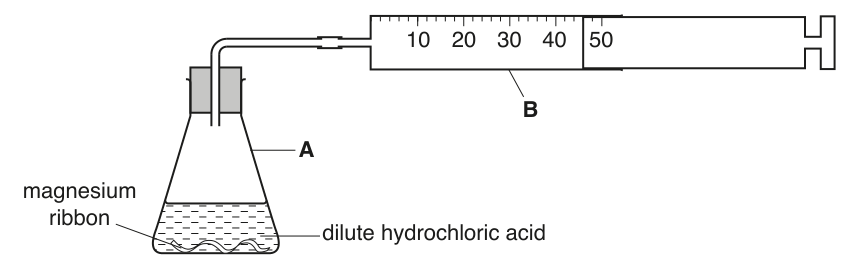
Give a test and observation to identify hydrogen gas.
______
Answer
Light a burning splint near the gas; the hydrogen pops.
Light a burning splint; the gas pops.
Walkthrough
Hydrogen is a flammable gas. The standard 5070 test is to bring a burning splint into contact with the gas. The hydrogen ignites rapidly in the presence of oxygen from the air, producing a small explosion that is heard as a 'pop'.
Key Takeaways
The 'pop test' is the definitive test for hydrogen gas at O Level. Always specify both the reagent (burning splint) and the observation (pops).
Common Mistakes
Saying the gas 'ignites' or 'burns with a blue flame' is not the standard test for hydrogen collected in a small volume; it must be the 'pop' with a burning splint. Saying 'lighted splint' without the observation 'pops' loses the mark.
Things to Be Careful About
The mark scheme requires both the action (burning splint) and the observation (pops). Writing only one may lose the mark.
Name apparatus A and B.
A ______
B ______
Answer
A: conical flask
B: gas syringe
A: conical flask, B: gas syringe
Walkthrough
Apparatus A is a flask with a flat bottom and conical sides, used as the reaction vessel. This is a conical flask. Apparatus B is a graduated tube with a movable piston used to collect and measure the volume of gas produced. This is a gas syringe.
Key Takeaways
Candidates must be able to name common apparatus used in gas collection experiments. A conical flask is preferred over a boiling tube here because it provides a wider base and more space to prevent splashing.
Common Mistakes
Calling A a 'beaker' or 'flask' (too vague). Calling B a 'syringe' (must specify gas syringe) or 'measuring cylinder'.
Things to Be Careful About
Use the exact names from the syllabus: 'conical flask' and 'gas syringe'.
What volume of hydrogen is collected in B?
______
Answer
46
46
Walkthrough
The gas syringe has major markings at 10, 20, 30, 40, and 50 cm³. Between 40 and 50, there are 5 small divisions, meaning each small division represents 2 cm³. The edge of the piston is at the third small division past 40, which is 40 + (3 × 2) = 46 cm³. Readings on a gas syringe are taken at the front edge of the piston (the side facing the reaction vessel).
Key Takeaways
When reading any scale, first determine the value of each small division. Always read from the correct edge of the meniscus or piston as specified by the apparatus convention.
Common Mistakes
Reading the back edge of the piston instead of the front. Miscounting the small divisions and assuming each is 1 cm³.
Things to Be Careful About
Ensure the unit is cm³ if asked, but here only the number is required in the blank. The mark scheme accepts 46.
A student is asked to produce a dry sample of hydrogen by passing it through a drying agent.
The direction of flow of the gas through the apparatus is shown by the arrows.
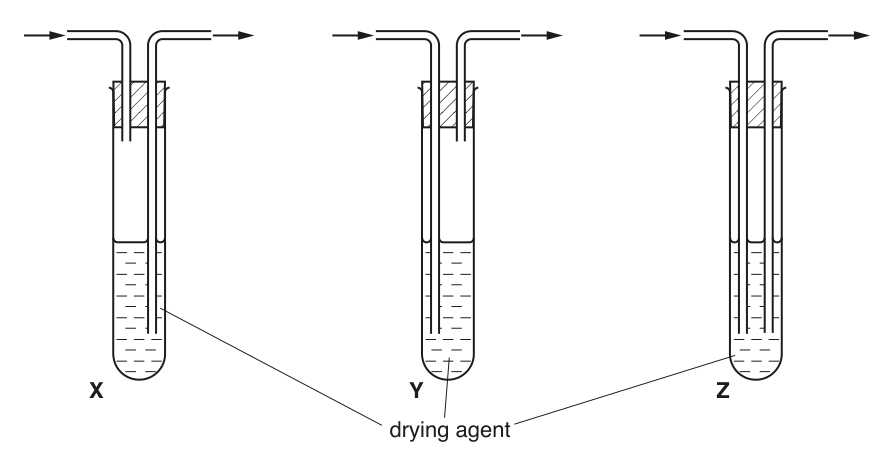
Which apparatus, X, Y, or Z, should be used?
______
Explain your answer.
______
Answer
Y
The gas must bubble through (into) the drying agent.
Y; the gas must bubble through the drying agent.
Walkthrough
To dry a gas using a liquid drying agent, the gas must come into direct contact with the liquid. This is achieved by forcing the gas to bubble through the liquid. Therefore, the inlet tube (where the gas enters) must dip below the liquid level, and the outlet tube (where the dry gas leaves) must be above the liquid level to prevent sucking liquid out. Apparatus Y has the inlet tube dipping into the liquid and the outlet tube above it, which is correct.
Key Takeaways
When using a liquid drying agent in a test tube or boiling tube, the gas must always bubble through the liquid. This is a 'gas washing' setup.
Common Mistakes
Choosing Z (both tubes in liquid) would force liquid out of the outlet tube. Choosing X (inlet above liquid) means the gas never touches the drying agent.
Things to Be Careful About
The explanation must state that the gas bubbles through or into the drying agent. Simply saying 'it dries the gas' is not enough; the mechanism (bubbling) is required for the mark.
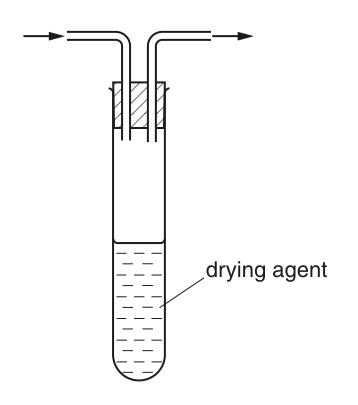
Explain why the student would not be able to produce a dry sample of the gas using the apparatus below.
______
Answer
The gas can enter the tube and leave it without passing through the drying agent.
The gas bypasses the drying agent without bubbling through it.
Walkthrough
In Fig 1.3, both the inlet and outlet tubes end above the level of the liquid drying agent. Gases follow the path of least resistance. Since there is an open path through the air space above the liquid from the inlet to the outlet, the gas will simply flow through this space and exit without ever coming into contact with the drying agent. Therefore, the gas remains wet.
Key Takeaways
If a drying tube or gas washing bottle is set up incorrectly so that the gas does not bubble through the liquid, the drying process will not occur.
Common Mistakes
Saying 'the drying agent is not reached' without explaining why (i.e., the gas takes the path above the liquid). Saying 'the gas will push the liquid out' is incorrect for this specific diagram where both tubes are above the liquid.
Things to Be Careful About
Focus on the path of the gas. The gas enters, finds an easy route above the liquid, and exits. It does not interact with the drying agent.
The rest of this paper
5 more questions- Q2Experimental Contexts · Use of Techniques, Apparatus and Materials5M
- Q3Experimental Contexts · Use of Techniques, Apparatus and Materials · Planning Experiments and Investigations · Analysis, Conclusions and Evaluation8M
- Q4Experimental Contexts · Analysis, Conclusions and Evaluation · Observations and Measurements · Use of Techniques, Apparatus and Materials17M
- Q5Qualitative Analysis11M
- Q6Analysis, Conclusions and Evaluation · Experimental Contexts · Planning Experiments and Investigations12M