Chemistry 5070/41 — May/June 2017
Cambridge O-Level · Alternative to Practical · worked solutions for every part, with the mark scheme
Topics Analysis, Conclusions and Evaluation · Experimental Contexts · Use of Techniques, Apparatus and Materials · Observations and Measurements · Qualitative Analysis · Planning Experiments and Investigations
A student does an experiment to convert magnesium into magnesium oxide, .
A sample of magnesium is heated strongly for several minutes using the apparatus shown.
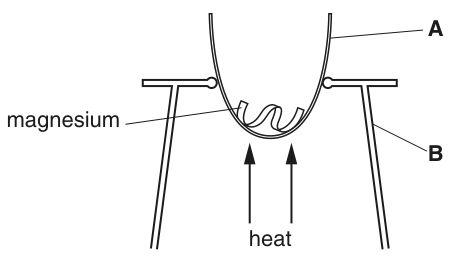
Name apparatus A and B.
A ______
B ______
Magnesium is converted into a white powder, . The expected mass of is .
The student found that of is produced in the experiment.
Suggest one reason why the mass of is lower than expected and suggest how the expected result may be achieved.
______
The student does a similar experiment using of zinc instead of of magnesium.
Explain why he is wrong to expect that the mass of zinc oxide will also be .
[: ; ]
______
Suggest a safety item that the student should use when doing this experiment.
______
The rest of this paper
5 more questions- Q2Planning Experiments and Investigations · Experimental Contexts5M
- Q3Use of Techniques, Apparatus and Materials · Experimental Contexts9M
- Q4Observations and Measurements · Experimental Contexts · Qualitative Analysis · Use of Techniques, Apparatus and Materials · Analysis, Conclusions and Evaluation17M
- Q5Analysis, Conclusions and Evaluation · Qualitative Analysis8M
- Q6Experimental Contexts · Observations and Measurements · Analysis, Conclusions and Evaluation14M