Chemistry 5070/12 — May/June 2017
Cambridge O-Level · Multiple Choice · answer key with instant marking and worked solutions
Topics Organic Chemistry · Atoms, Elements and Compounds · The Periodic Table · Acids, Bases and Salts · Stoichiometry · Chemical Reactions · +6 more
Tap an option under each question to check it — your score builds as you go.
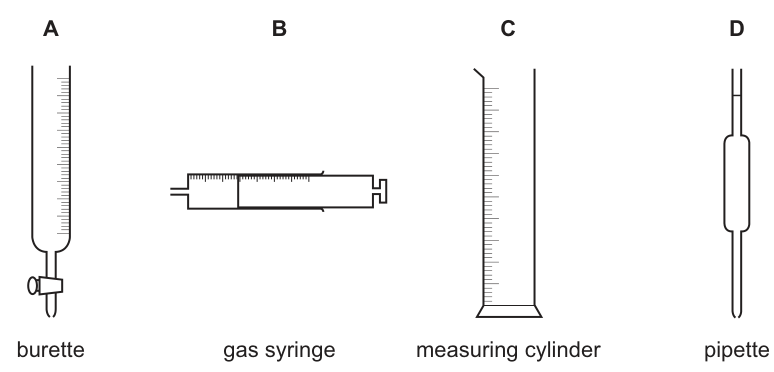
The diagram shows four pieces of apparatus that are used to measure the volume of a gas or liquid.
Which piece of apparatus should always be filled to the same level?
Options
Working
A burette, gas syringe, and measuring cylinder are all used to measure variable volumes of liquid or gas; their contents change during use. A volumetric pipette (D) is designed to deliver one specific fixed volume (for example, 25.0 cm³). It has a single calibration mark on its upper stem, so it must always be filled to that same level to measure the correct volume.
Answer
D
D
Walkthrough
The question asks which apparatus must always be filled to the same level. Let us look at each option:
- A (burette): A burette is used in titrations to deliver a variable volume of liquid. It has a tap at the bottom and markings along its length (usually 0.00 cm³ at the top to 50.00 cm³ at the bottom). Before use, it is filled to near the 0.00 mark, but the volume delivered is calculated from the difference between initial and final readings. It does not have a single fixed level it must be filled to for every use, though standard practice is to fill to 0.00.
- B (gas syringe): A gas syringe is used to collect and measure the volume of a gas produced in a reaction. As gas is produced, the plunger is pushed out, so the level of the plunger changes continuously.
- C (measuring cylinder): A measuring cylinder is used to measure a rough volume of liquid. You pour liquid into it until it reaches the desired mark. The level depends on how much liquid you want to measure, so it is not always filled to the same level.
- D (pipette): The diagram shows a volumetric (or graduated) pipette. It has a bulb in the middle and a single calibration mark on the narrow upper stem. It is designed to measure one specific, fixed volume of liquid (for example, 25.0 cm³). To use it correctly, you must fill it until the bottom of the meniscus sits exactly on that single mark. Therefore, it is always filled to the same level.
Key Takeaways
- Volumetric pipettes are used to measure a single, fixed volume precisely. They have one calibration mark and must always be filled to that mark.
- Burettes, measuring cylinders, and gas syringes are used to measure variable volumes; their contents change during use.
Common Mistakes
- Confusing a burette with a pipette. While a burette is typically filled to the 0.00 cm³ mark before a titration, its defining feature is that it measures a variable volume delivered (final reading minus initial reading). A volumetric pipette is defined by having only one mark that must be filled to.
- Mistaking the volumetric pipette (D) for a Pasteur pipette (dropper). A Pasteur pipette has no markings and is used to add drops of liquid. The apparatus shown has a bulb and a single mark, identifying it as a volumetric pipette.
Things to Be Careful About
- Ensure you can distinguish the shapes of the apparatus: a burette is long and thin with a tap; a measuring cylinder is wide with a spout; a gas syringe is horizontal with a plunger; a volumetric pipette has a bulb in the middle and a single mark on the upper stem.
- In titrations, a burette is filled to the 0.00 cm³ mark, but the question asks which apparatus should always be filled to the same level to measure its designated volume. A pipette's entire purpose is to deliver a fixed volume, requiring it to be filled to its single mark every time.
The rest of this paper
39 more questions- Q2Atoms, Elements and Compounds1M
- Q3Experimental Techniques and Chemical Analysis1M
- Q4Atoms, Elements and Compounds1M
- Q5Atoms, Elements and Compounds1M
- Q6Experimental Techniques and Chemical Analysis1M
- Q7Atoms, Elements and Compounds1M
- Q8Atoms, Elements and Compounds · The Periodic Table · Acids, Bases and Salts1M
- Q9Stoichiometry1M
- Q10Stoichiometry1M
- Q11Electrochemistry1M
- Q12Electrochemistry1M
- Q13Electrochemistry1M
- Q14Chemical Energetics1M
- Q15Chemical Energetics · States of Matter1M
- Q16Chemical Reactions · Stoichiometry1M
- Q17Chemical Reactions1M
- Q18Chemical Reactions1M
- Q19Organic Chemistry · Acids, Bases and Salts1M
- Q20Acids, Bases and Salts1M
- Q21Acids, Bases and Salts1M
- Q22The Periodic Table1M
- Q23The Periodic Table1M
- Q24Stoichiometry · The Periodic Table1M
- Q25The Periodic Table1M
- Q26Metals1M
- Q27Metals1M
- Q28Metals1M
- Q29Metals1M
- Q30Chemical Reactions1M
- Q31Acids, Bases and Salts1M
- Q32Chemistry of the Environment1M
- Q33Chemistry of the Environment1M
- Q34Stoichiometry1M
- Q35Chemical Reactions1M
- Q36Organic Chemistry1M
- Q37Organic Chemistry1M
- Q38Organic Chemistry1M
- Q39Organic Chemistry1M
- Q40Organic Chemistry1M