Chemistry 5070/21 — May/June 2016
Cambridge O-Level · Theory · worked solutions for every part, with the mark scheme
Topics Stoichiometry · Chemical Reactions · Organic Chemistry · Atoms, Elements and Compounds · Acids, Bases and Salts · Chemistry of the Environment · +5 more
Choose from the following polymers to answer the questions.
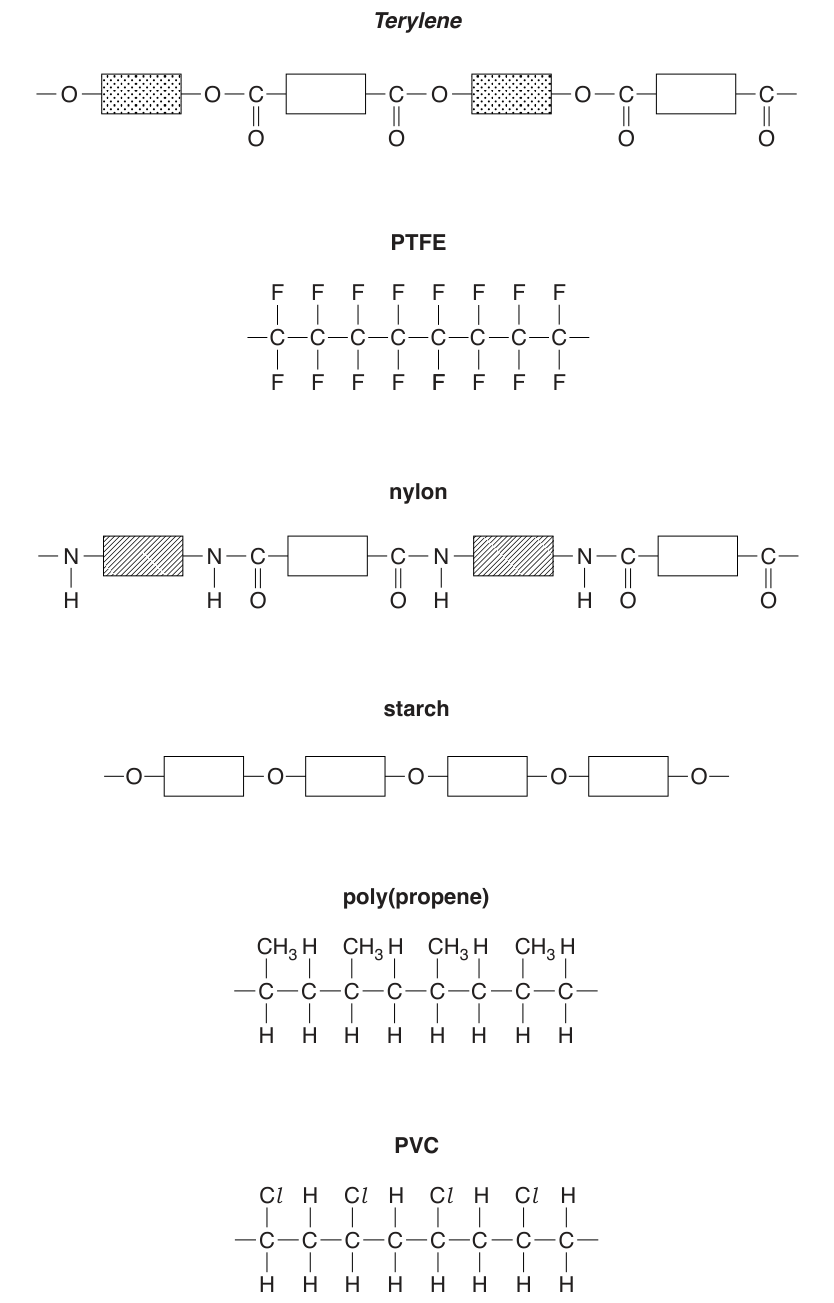
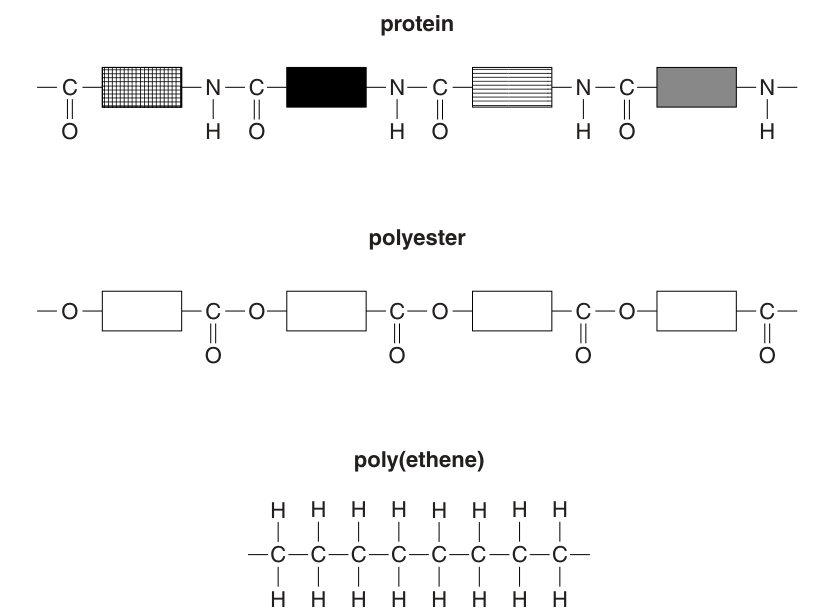
Each polymer can be used once, more than once or not at all.
Which is a polymer that
is made from propene,
______
Answer
poly(propene)
poly(propene)
Walkthrough
The question asks for the polymer made from propene. Propene is an alkene with the formula . When propene undergoes addition polymerisation, the double bond opens up to form a carbon chain with methyl groups () attached to alternating carbon atoms. Looking at Fig. 1.1, the structure labelled poly(propene) shows a carbon backbone with and groups attached, matching the monomer propene.
Key Takeaways
Addition polymers are formed from alkene monomers. The repeat unit of the polymer contains the same atoms as the monomer, just with the double bond changed to a single bond in the chain.
Common Mistakes
Confusing poly(propene) with poly(ethene). Poly(ethene) has only hydrogen atoms attached to the carbon backbone, whereas poly(propene) has methyl groups ().
Things to Be Careful About
Ensure you match the name of the polymer in the figure to the monomer name. Propene gives poly(propene), not poly(ethene) or PVC.
will form hydrogen chloride when combusted,
______
Answer
PVC
PVC
Walkthrough
Hydrogen chloride () contains hydrogen and chlorine. For a polymer to produce on combustion, it must contain chlorine atoms in its structure. Looking at the figures:
- PVC (poly(chloroethene)) in Fig. 1.1 has chlorine atoms () attached to the carbon backbone. Combustion of PVC releases gas.
- PTFE contains fluorine (), which would produce , not .
- The other polymers (Terylene, nylon, starch, poly(propene), protein, polyester, poly(ethene)) do not contain chlorine.
Key Takeaways
Polymers containing halogens can produce hydrogen halides when burned. PVC is poly(chloroethene) and contains chlorine.
Common Mistakes
Choosing PTFE because it is a halogen-containing polymer. PTFE contains fluorine, producing hydrogen fluoride (), not hydrogen chloride ().
Things to Be Careful About
Read the chemical symbols in the structures carefully. is chlorine, is fluorine.
can be hydrolysed to form amino acids,
______
Answer
protein
protein
Walkthrough
Amino acids are the monomers of proteins. Proteins are natural polyamides (polypeptides) linked by peptide bonds, which are amide linkages (). In Fig. 1.2, protein is shown as a chain with amide linkages connecting different blocks (representing amino acid residues). Hydrolysis of the amide bonds in proteins breaks them down into individual amino acids.
Note: Nylon is also a polyamide, but it is a synthetic polymer made from diamines and dicarboxylic acids, not amino acids. Therefore, protein is the correct answer for hydrolysis to amino acids.
Key Takeaways
Proteins are natural polyamides that hydrolyse to amino acids. The linkage is the amide (peptide) bond, .
Common Mistakes
Choosing nylon. While nylon has amide linkages, it does not hydrolyse to amino acids; it hydrolyses to diamines and dicarboxylic acids.
Things to Be Careful About
Distinguish between natural polyamides (proteins) and synthetic polyamides (nylon) based on the hydrolysis products.
can be hydrolysed to make simple sugars,
______
Answer
starch
starch
Walkthrough
Simple sugars (monosaccharides like glucose) are the monomers of polysaccharides. Starch, shown in Fig. 1.1, is a polysaccharide made of many glucose units linked together. Hydrolysis (breaking down with water) of starch breaks the bonds between the glucose units, producing simple sugars (glucose).
Key Takeaways
Starch is a natural polymer (polysaccharide) of glucose. Hydrolysis yields simple sugars.
Common Mistakes
Confusing starch with proteins or polyesters. Starch is the carbohydrate polymer.
Things to Be Careful About
The taxonomy classifies carbohydrates under a legacy topic, but starch hydrolysis is a standard concept. Ensure you recognise the structure of starch (repeating sugar units linked by oxygen atoms) in Fig. 1.1.
contains the same linkage as that present in a fat?
______
Answer
Terylene (or polyester)
Terylene/polyester
Walkthrough
Fats are esters formed from glycerol and fatty acids. They contain ester linkages ().
- In Fig. 1.1, Terylene is a polyester. Its structure shows alternating blocks linked by groups, which are ester linkages.
- In Fig. 1.2, polyester also shows the same ester linkage ().
Both Terylene and the generic polyester contain the ester linkage found in fats. The mark scheme accepts either.
Key Takeaways
Fats contain ester linkages. Polyesters (like Terylene) also contain ester linkages. This is the link between condensation polymerisation of dicarboxylic acids/diols and the chemistry of fats.
Common Mistakes
Choosing nylon or protein. These contain amide linkages (), not ester linkages.
Things to Be Careful About
The ester linkage is (or ). Ensure you can spot this in the displayed formulae. In Terylene, it is .
The rest of this paper
9 more questions- Q2Atoms, Elements and Compounds · Acids, Bases and Salts · Stoichiometry10M
- Q3Organic Chemistry · States of Matter7M
- Q4Chemical Reactions · Stoichiometry7M
- Q5Metals · Stoichiometry · Chemical Reactions · Atoms, Elements and Compounds8M
- Q6Chemistry of the Environment · Atoms, Elements and Compounds · Chemical Reactions · Stoichiometry8M
- Q7Acids, Bases and Salts · Experimental Techniques and Chemical Analysis · Stoichiometry · Electrochemistry10M
- Q8Organic Chemistry · Stoichiometry10M
- Q9Chemical Energetics · Stoichiometry · Chemical Reactions · Chemistry of the Environment · Organic Chemistry10M
- Q10Stoichiometry · Acids, Bases and Salts · Experimental Techniques and Chemical Analysis · Chemical Reactions10M