Chemistry 5070/42 — October/November 2015
Cambridge O-Level · Alternative to Practical · worked solutions for every part, with the mark scheme
Topics Experimental Contexts · Analysis, Conclusions and Evaluation · Qualitative Analysis · Use of Techniques, Apparatus and Materials · Observations and Measurements · Planning Experiments and Investigations
A student determines the mass of copper in mixture A which is composed of only copper and zinc.
Zinc reacts with dilute sulfuric acid. Copper does not.
Dilute sulfuric acid is mixed with A in the apparatus below. A gas is given off which is collected in B.
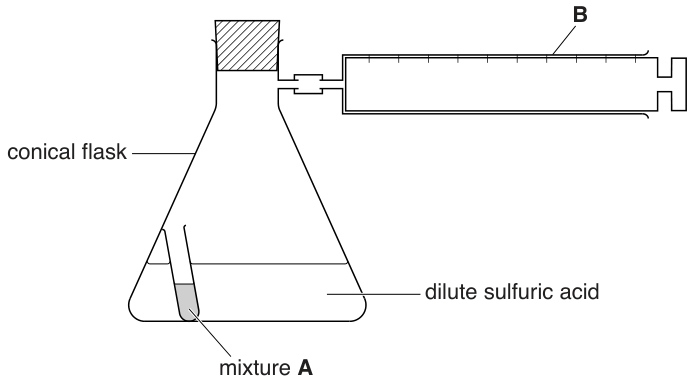
Name apparatus B.
______
Answer
Gas syringe
Gas syringe
Walkthrough
The diagram shows a horizontal tube with a plunger used to collect and measure the volume of gas produced. In a chemistry laboratory, this apparatus is a gas syringe.
Key Takeaways
Candidates must be able to recognise standard laboratory apparatus from diagrams, particularly those used for collecting and measuring gases.
Common Mistakes
Calling it a 'test tube', 'burette', or 'measuring cylinder'. A gas syringe has a distinctive plunger and barrel.
Things to Be Careful About
Ensure the answer matches the exact name accepted by the mark scheme: 'gas syringe'.
Name the gas collected in B. Give a test and observation to identify the gas.
name of gas ______
test and observation ______
Answer
name of gas: hydrogen
test and observation: lighted (burning) splint; gas burns with a 'pop' (or 'squeaky pop')
Hydrogen; burning splint pops
Walkthrough
Zinc is a metal above hydrogen in the reactivity series, so it reacts with dilute acids to produce hydrogen gas. Copper is below hydrogen and does not react. The standard test for hydrogen is to bring a lighted splint near the gas; hydrogen is flammable and burns rapidly with oxygen in the air, causing a characteristic 'pop'.
Key Takeaways
Metals above hydrogen in the reactivity series displace hydrogen from dilute acids. The test for hydrogen is a burning splint causing a pop.
Common Mistakes
Saying the gas 'explodes' (it just pops). Forgetting to specify that the splint must be lit/burning. Naming the gas as 'oxygen' or 'steam'.
Things to Be Careful About
The mark scheme requires both the test (burning splint) and the observation (pops). Writing only one will lose a mark.
Construct an equation for the reaction between zinc and dilute sulfuric acid.
______
Answer
Zn + H2SO4 → ZnSO4 + H2
Walkthrough
Zinc displaces hydrogen from dilute sulfuric acid. The reactants are solid zinc () and aqueous sulfuric acid (). The products are aqueous zinc sulfate () and hydrogen gas (). The equation is already balanced with a 1:1:1:1 ratio.
Key Takeaways
Metals react with dilute acids to form a salt and hydrogen gas. Zinc forms zinc sulfate with sulfuric acid.
Common Mistakes
Writing as or . Forgetting to write as a diatomic molecule. Not balancing the equation (though it is naturally balanced here).
Things to Be Careful About
State symbols are not strictly required by this mark scheme, but if included, they should be correct: .
When all the zinc has reacted, the volume of gas collected in B is when measured at room temperature and pressure.
[]
Calculate the number of moles of gas in .
______ moles
Working
Answer
0.004
0.004
Walkthrough
The molar volume of any gas at room temperature and pressure (r.t.p.) is given as . To find the number of moles, divide the measured volume by the molar volume: .
Key Takeaways
At r.t.p., 1 mole of any gas occupies (or ). Moles = Volume / Molar Volume.
Common Mistakes
Dividing 24000 by 96.0 instead of the other way around. Forgetting to convert to if using (i.e., using 24 instead of 24000).
Things to Be Careful About
Ensure the volume units match the molar volume units. Here, both are in , so no conversion is needed.
Using your answers to (b)(ii) and (c)(i) calculate the mass of zinc in A.
[]
______
Working
From the equation in (b)(ii), 1 mole of produces 1 mole of .
Moles of .
Answer
0.26
0.26
Walkthrough
The balanced equation shows a 1:1 molar ratio between zinc and hydrogen gas. Therefore, the moles of zinc that reacted equal the moles of hydrogen gas collected, which is . Using the relative atomic mass of zinc (), the mass is calculated as .
Key Takeaways
Use the mole ratio from the balanced equation to find the moles of the reactant, then use to find the mass.
Common Mistakes
Using the wrong mole ratio (e.g., assuming 1:2). Multiplying by the molar mass of the gas instead of zinc. Forgetting to multiply by .
Things to Be Careful About
The question asks for the mass of zinc, not the mass of the salt. Use the correct value given in the question (65).
The mass of mixture A is . Calculate the mass of copper in mixture A.
______
Working
Mixture A contains only copper and zinc.
Answer
0.94
0.94
Walkthrough
The mixture is composed solely of copper and zinc. Since we have calculated the mass of zinc () and know the total mass of the mixture (), the mass of copper is simply the difference: .
Key Takeaways
In a mixture of two substances where one reacts and the other does not, the mass of the unreacted substance can be found by subtracting the mass of the reacted substance from the total initial mass.
Common Mistakes
Adding the masses instead of subtracting. Using the wrong total mass value.
Things to Be Careful About
Ensure significant figures are consistent. , which is correct to 2 decimal places.
When the reaction has finished, the student separates the copper from the solution remaining in the conical flask by filtration, using a previously weighed filter paper. As soon as the filtration finishes the student weighs the filter paper containing the copper residue and finds that its mass is greater than he expected. Explain why.
______
Answer
The copper residue is wet (not dried) / still contains water or solution.
The copper is wet / not dried / contains solution.
Walkthrough
After filtration, the solid residue on the filter paper will be coated with the filtrate (the liquid that passed through). If the student weighs it immediately without drying it (e.g., in an oven or by leaving it to dry), the mass of the water or remaining solution will add to the mass of the copper, making it greater than expected.
Key Takeaways
Filtration separates an insoluble solid from a liquid. To obtain the dry mass of the solid, it must be dried after filtration. Weighing it wet will give an erroneously high mass.
Common Mistakes
Saying the filter paper absorbed water (it doesn't, it's already wet). Saying the copper reacted further (it doesn't react with the dilute acid or water).
Things to Be Careful About
The explanation must relate to the mass being greater than expected. Mentioning that the copper is 'wet', 'not dried', or 'has solution on it' are all acceptable answers. Simply saying 'it is wet' is sufficient.
The rest of this paper
9 more questions- Q2Use of Techniques, Apparatus and Materials · Experimental Contexts · Analysis, Conclusions and Evaluation · Qualitative Analysis9M
- Q3Analysis, Conclusions and Evaluation1M
- Q4Experimental Contexts · Analysis, Conclusions and Evaluation1M
- Q5Experimental Contexts1M
- Q6Qualitative Analysis · Experimental Contexts1M
- Q7Experimental Contexts · Use of Techniques, Apparatus and Materials · Observations and Measurements · Analysis, Conclusions and Evaluation14M
- Q8Qualitative Analysis9M
- Q9Experimental Contexts · Analysis, Conclusions and Evaluation10M
- Q10Experimental Contexts · Planning Experiments and Investigations6M