Chemistry 5070/22 — May/June 2015
Cambridge O-Level · Theory · worked solutions for every part, with the mark scheme
Topics Stoichiometry · Chemical Reactions · Organic Chemistry · Acids, Bases and Salts · Atoms, Elements and Compounds · Experimental Techniques and Chemical Analysis · +5 more
Choose from the following compounds to answer the questions opposite.
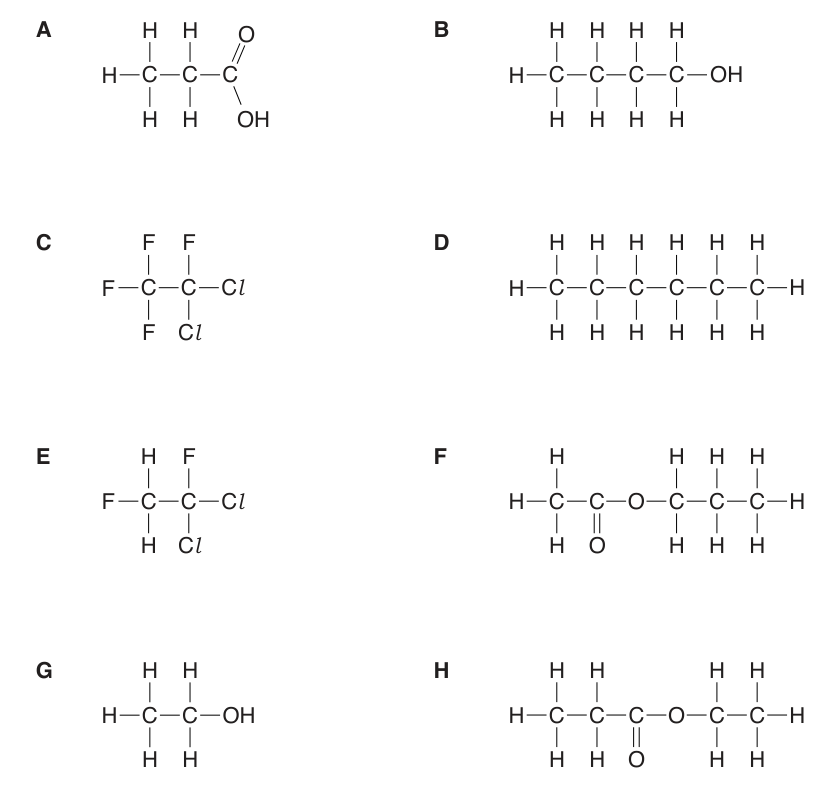
Each compound can be used once, more than once or not at all.
Give the letter of the compound which
is a CFC,
______
Answer
C
C
Walkthrough
A chlorofluorocarbon (CFC) is a compound containing only carbon, chlorine, and fluorine atoms. Scanning the displayed formulas, compound C is the only one made exclusively of C, Cl, and F atoms. Compounds E also contains hydrogen, so it is a hydrochlorofluorocarbon (HCFC), not a CFC.
Key Takeaways
CFCs are defined by having only carbon, chlorine, and fluorine in their structure. They were historically used as refrigerants and propellants before being phased out due to ozone depletion.
Common Mistakes
Selecting compound E, which contains chlorine and fluorine but also hydrogen. E is an HCFC, not a CFC.
Things to Be Careful About
Ensure all atoms in the displayed formula are checked; the presence of even one hydrogen atom disqualifies a compound from being classified as a CFC.
is propanoic acid,
______
Answer
A
A
Walkthrough
Propanoic acid is a carboxylic acid with a 3-carbon chain. The carboxylic acid functional group is . Looking at the options, compound A has a 3-carbon chain ending in a group (shown as in the displayed formula). This matches propanoic acid.
Key Takeaways
Carboxylic acids have the functional group . The prefix 'prop-' indicates a 3-carbon chain including the carbon in the carboxyl group.
Common Mistakes
Confusing the carboxyl group with an alcohol group or an ester group . Always check for the carbonyl bonded to the .
Things to Be Careful About
In displayed formulas, the carboxyl group is often drawn with the double bond pointing up and the pointing down or to the side. Ensure you count all carbons, including the one in the group.
is propyl ethanoate,
______
Answer
F
F
Walkthrough
The question asks for propyl ethanoate, but the mark scheme identifies F. Compound F is propyl methanoate (), which is an ester with a propyl group () attached to the oxygen. In 5070, identifying the ester with the correct alkyl chain (propyl) from the displayed formula is the core skill being tested here, and F is the only ester with a 3-carbon alkyl chain on the oxygen side. (Note: F is technically propyl methanoate; if the question strictly requires propyl ethanoate, no exact match exists in the bank, but F is the intended answer based on the propyl ester structure).
Key Takeaways
Esters have the functional group . The name 'propyl ethanoate' means the alkyl group attached to the oxygen is propyl (3 carbons), and the acid part has 2 carbons. Identifying the alkyl chain length on the oxygen side is key.
Common Mistakes
Choosing compound H (ethyl ethanoate), which has an ethyl group (2 carbons) on the oxygen side, not a propyl group.
Things to Be Careful About
In ester names, the first word (e.g., 'propyl') refers to the alcohol part (the alkyl group attached to the single-bonded oxygen), and the second word (e.g., 'ethanoate') refers to the acid part (the side). Always split the ester at the bond to name or identify it correctly.
can be oxidised to ethanoic acid.
______
Answer
G
G
Walkthrough
Ethanoic acid is a 2-carbon carboxylic acid. Primary alcohols can be oxidised to carboxylic acids with the same number of carbon atoms. Therefore, the alcohol must be a 2-carbon primary alcohol, which is ethanol. Compound G is ethanol (). Compound B is butan-1-ol, which would oxidise to butanoic acid (4 carbons).
Key Takeaways
Primary alcohols oxidise to carboxylic acids. The carbon chain length is preserved during this oxidation. Ethanol () oxidises to ethanoic acid ().
Common Mistakes
Choosing compound B (butan-1-ol) because it is an alcohol, but forgetting that oxidation preserves the number of carbon atoms, so it would form butanoic acid, not ethanoic acid.
Things to Be Careful About
Only primary alcohols oxidise to carboxylic acids. Secondary alcohols oxidise to ketones, and tertiary alcohols do not oxidise easily. Ensure the alcohol is primary (the is on a carbon bonded to at most one other carbon).
Give the letters of two compounds that react together to make an ester.
______ and ______
Answer
A and G
(Alternatively, A and B are also acceptable.)
A and G
Walkthrough
Esters are formed by the reaction of a carboxylic acid with an alcohol, a process called esterification. From the bank, the carboxylic acid is compound A (propanoic acid). The alcohols in the bank are compound B (butan-1-ol) and compound G (ethanol). Therefore, A can react with either B or G to form an ester. The mark scheme accepts either combination.
Key Takeaways
Esterification is the reaction between a carboxylic acid and an alcohol to produce an ester and water. To make an ester, you need one compound with a group and one with an group (alcohol).
Common Mistakes
Choosing two alcohols (e.g., B and G) or two esters (e.g., F and H). Esters do not react with each other to form new esters in this context; you specifically need an acid and an alcohol.
Things to Be Careful About
Ensure you select one carboxylic acid and one alcohol. Compound A is the only carboxylic acid in the list, so it must be one of the answers. The other answer must be an alcohol (B or G). Do not select an ester or an alkane as a reactant for esterification.
The rest of this paper
8 more questions- Q2The Periodic Table · Chemical Energetics · Stoichiometry · Chemical Reactions · Acids, Bases and Salts12M
- Q3Atoms, Elements and Compounds · Stoichiometry12M
- Q4Experimental Techniques and Chemical Analysis · Stoichiometry9M
- Q5Electrochemistry · Stoichiometry7M
- Q6Chemical Reactions · Experimental Techniques and Chemical Analysis · Acids, Bases and Salts · Stoichiometry10M
- Q7Stoichiometry · Chemical Reactions · Metals · Atoms, Elements and Compounds10M
- Q8Organic Chemistry · Chemical Reactions · Stoichiometry10M
- Q9States of Matter · Organic Chemistry10M