Chemistry 5070/22 — October/November 2014
Cambridge O-Level · Theory · worked solutions for every part, with the mark scheme
Topics Stoichiometry · Chemical Reactions · Acids, Bases and Salts · Atoms, Elements and Compounds · Metals · Experimental Techniques and Chemical Analysis · +6 more
The diagram shows part of the Periodic Table. Only some of the elements are shown.
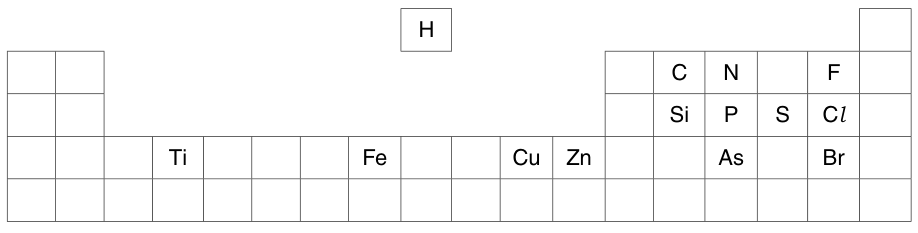
Answer each of the following questions using only those elements shown in the diagram.
Each element may be used once, more than once or not at all.
Give one element which
is a simple molecular solid at room temperature and pressure,
______
oxidises in the presence of water and air to form rust,
______
has an atom with three occupied electron shells, the outer of which has only 5 electrons,
______
has an oxide which is amphoteric,
______
has a chloride of type whose aqueous solution forms a reddish-brown precipitate on addition of aqueous ammonia,
______
is a colourless diatomic gas.
______
Arsenic reacts with oxygen to form arsenic(III) oxide, .
Construct the equation for this reaction.
______
Arsenic(III) oxide is slightly soluble in water. A weak acid, arsenous acid, , is formed.
Use kinetic particle theory to explain why a solution of arsenous acid reacts much more slowly with magnesium ribbon than a solution of hydrochloric acid.
The rest of this paper
8 more questions- Q2The Periodic Table · States of Matter · Stoichiometry · Chemical Energetics · Chemical Reactions · Metals12M
- Q3Experimental Techniques and Chemical Analysis · States of Matter · Atoms, Elements and Compounds · Stoichiometry9M
- Q4Acids, Bases and Salts · Experimental Techniques and Chemical Analysis · Stoichiometry · Chemistry of the Environment10M
- Q5Metals · Electrochemistry5M
- Q6Atoms, Elements and Compounds · Electrochemistry · Chemical Reactions · Stoichiometry10M
- Q7Organic Chemistry · Stoichiometry · Acids, Bases and Salts10M
- Q8Stoichiometry · Chemical Reactions · Acids, Bases and Salts10M
- Q9Chemical Reactions · Stoichiometry10M