Chemistry 5070/21 — October/November 2014
Cambridge O-Level · Theory · worked solutions for every part, with the mark scheme
Topics Stoichiometry · Atoms, Elements and Compounds · Chemistry of the Environment · Acids, Bases and Salts · Chemical Reactions · Experimental Techniques and Chemical Analysis · +5 more
The diagram shows part of the Periodic Table. Only some of the elements are shown.
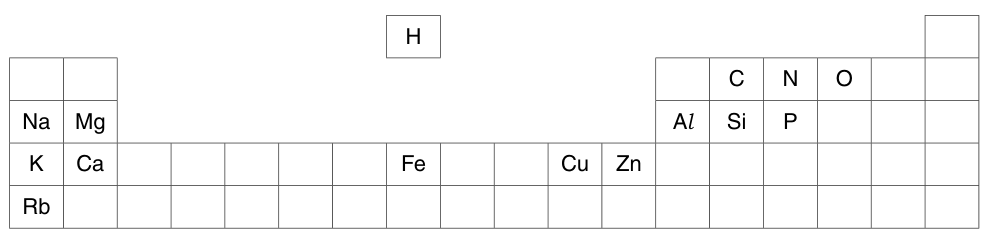
Answer each of the following questions using only those elements shown in the diagram.
Each element may be used once, more than once or not at all.
Give one element which
has a giant molecular structure,
______
combines with oxygen to form a gas which contributes to acid rain,
______
forms an ion of type which has only three completely filled shells of electrons,
______
has an atom with only seven protons in its nucleus,
______
has an atom with only six electrons,
______
has a chloride of type , whose aqueous solution forms a white precipitate on addition of sodium hydroxide.
______
Under reduced pressure, potassium reacts with oxygen to form potassium oxide, .
Construct the equation for this reaction.
______
Aluminium is higher than zinc in the reactivity series.
Explain why aluminium foil does not react with an aqueous solution of zinc ions.
______
The rest of this paper
8 more questions- Q2The Periodic Table · States of Matter · Stoichiometry · Chemistry of the Environment10M
- Q3Experimental Techniques and Chemical Analysis · Acids, Bases and Salts · Stoichiometry9M
- Q4Electrochemistry · Metals · Atoms, Elements and Compounds9M
- Q5Stoichiometry · Acids, Bases and Salts · Chemical Reactions8M
- Q6Atoms, Elements and Compounds · Organic Chemistry · Stoichiometry10M
- Q7Stoichiometry · Chemistry of the Environment · Atoms, Elements and Compounds10M
- Q8Stoichiometry · Chemical Reactions · Chemistry of the Environment10M
- Q9Acids, Bases and Salts · The Periodic Table · Chemical Reactions · Organic Chemistry · Atoms, Elements and Compounds10M