Chemistry 5070/41 — May/June 2014
Cambridge O-Level · Alternative to Practical · worked solutions for every part, with the mark scheme
Topics Experimental Contexts · Analysis, Conclusions and Evaluation · Qualitative Analysis · Observations and Measurements · Use of Techniques, Apparatus and Materials
A student determines the oxygen content of air using the apparatus shown.

Syringe A contains of air. The air is forced over heated copper into syringe B. The air is then forced back over the heated copper into syringe A.
The process is repeated several times until the volume of gas forced back into syringe A is constant. The apparatus is allowed to cool to room temperature.
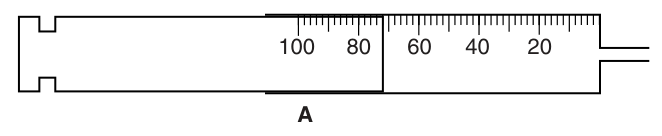
The diagram below shows the volume of gas in syringe A after the experiment is finished.
Copper reacts with oxygen in the air to produce copper(II) oxide.
Construct the equation for this reaction.
______
Answer
2Cu + O2 -> 2CuO
Walkthrough
Copper reacts with diatomic oxygen gas () to form copper(II) oxide ().
Balancing the atoms on both sides requires copper atoms reacting with oxygen molecule to produce formula units of copper(II) oxide:
Key Takeaways
- Copper(II) oxide has the formula because copper has a oxidation state and oxide has a charge ( and ).
- Oxygen in air exists as diatomic molecules, .
Common Mistakes
- Writing oxygen as atomic instead of .
- Writing incorrect formulae such as or .
Things to Be Careful About
- Ensure both the copper and oxygen atoms balance on both sides.
What colour is copper(II) oxide?
______
Answer
black
black
Walkthrough
Copper is a reddish-brown/pink metal. When it is heated in air, it oxidises to copper(II) oxide (), which is a black solid.
Key Takeaways
- is black.
- is red/brown, but copper(II) oxide formed in excess air is black.
Common Mistakes
- Confusing copper metal (pink/brown) or hydrated copper(II) salts (blue) with copper(II) oxide (black).
Things to Be Careful About
- Give a clear, unambiguous colour term: black.
What is the volume of gas remaining in syringe A?
______
Answer
72 cm3
Walkthrough
Looking at Fig. 1.2, the scale has major divisions every and subdivisions of (since there are 10 subdivisions between 60 and 80, each small division is ).
The edge of the plunger aligns exactly one small division to the left of 70, which is .
Key Takeaways
- Determine the value of each subdivision on a scale before reading the value.
- Read the position corresponding to the flat leading face of the plunger.
Common Mistakes
- Miscounting the subdivisions (e.g. assuming each mark represents instead of ).
Things to Be Careful About
- Ensure you read from the correct side of the scale (the gas volume is between 0 and the plunger face).
Name the major component of the gas remaining in syringe A.
______
Answer
nitrogen
nitrogen
Walkthrough
Clean, dry air is approximately nitrogen, oxygen, and argon/other gases. When oxygen is removed by reaction with copper, nitrogen remains as the unreactive major component (making up about four-fifths of the remaining gas).
Key Takeaways
- Nitrogen is the main component of air (approx. ) and is unreactive under these conditions.
Common Mistakes
- Naming noble gases or carbon dioxide, which are only present in trace amounts compared to nitrogen.
Things to Be Careful About
- The question asks to 'name' the gas, so write 'nitrogen' (or ).
Calculate the volume of oxygen that reacts with the copper.
______
Working
Answer
18 cm3
Walkthrough
The initial volume of air in syringe A was .
The volume of gas remaining after complete reaction was .
The decrease in volume corresponds to the volume of oxygen gas consumed by the copper:
Key Takeaways
- The contraction in air volume during this experiment equals the volume of oxygen that reacted.
Common Mistakes
- Using as the starting volume instead of reading the stem value ().
Things to Be Careful About
- Ensure error carried forward (ecf) is applied if an incorrect value was recorded in part (b)(i).
Using your answer to (b)(iii), calculate the number of moles of oxygen that react with the copper.
[One mole of a gas occupies at room temperature and pressure.]
______ moles
Working
Answer
0.00075 moles
Walkthrough
To find the number of moles of a gas from its volume at room temperature and pressure (r.t.p.):
Given that occupies :
(or ).
Key Takeaways
- Number of moles of gas at r.t.p. = or .
Common Mistakes
- Dividing by directly without converting the volume from to .
Things to Be Careful About
- Count the leading zeros carefully in decimal notation ().
Using your equation in (a)(i) and your answer to (b)(iv) calculate the mass of copper that reacts with the oxygen.
[: , 64]
______
Working
From the equation , the mole ratio is .
Answer
0.096 g
Walkthrough
- Use the stoichiometric ratio from the balanced equation :
reacts with .
- Calculate the mass of copper using :
Key Takeaways
- Always use the mole ratio from the balanced chemical equation before calculating reacting masses.
- (or ).
Common Mistakes
- Forgetting the molar ratio and assuming .
Things to Be Careful About
- Ensure correct relative atomic mass () is used for .
In another experiment of oxygen is required to react with all the copper.
Calculate the volume of air required to provide this volume of oxygen.
______
Working
From the experiment, of air contains of oxygen ( oxygen by volume):
Answer
300 cm3
Walkthrough
From parts (b)(i) and (b)(iii), of air provides of oxygen.
This means oxygen represents:
To find the volume of air needed to supply of oxygen:
Key Takeaways
- Air is approximately to oxygen by volume.
- Scaling the volume of oxygen back to the total volume of air requires dividing by the volume fraction of oxygen (or multiplying by the reciprocal ratio ).
Common Mistakes
- Multiplying by () instead of dividing by .
Things to Be Careful About
- The volume of air must be greater than the volume of oxygen required.
The rest of this paper
8 more questions- Q2Qualitative Analysis · Experimental Contexts · Use of Techniques, Apparatus and Materials12M
- Q3Analysis, Conclusions and Evaluation1M
- Q4Qualitative Analysis1M
- Q5Experimental Contexts1M
- Q6Analysis, Conclusions and Evaluation1M
- Q7Observations and Measurements · Experimental Contexts · Qualitative Analysis · Use of Techniques, Apparatus and Materials · Analysis, Conclusions and Evaluation16M
- Q8Qualitative Analysis8M
- Q9Experimental Contexts · Analysis, Conclusions and Evaluation12M