Chemistry 5070/41 — October/November 2013
Cambridge O-Level · Alternative to Practical · worked solutions for every part, with the mark scheme
Topics Experimental Contexts · Analysis, Conclusions and Evaluation · Qualitative Analysis · Observations and Measurements · Use of Techniques, Apparatus and Materials
A student adds a known mass of magnesium ribbon to of dilute hydrochloric acid (an excess) in the apparatus shown below. Hydrogen gas is evolved. The time taken to collect of gas at room temperature and pressure is measured.
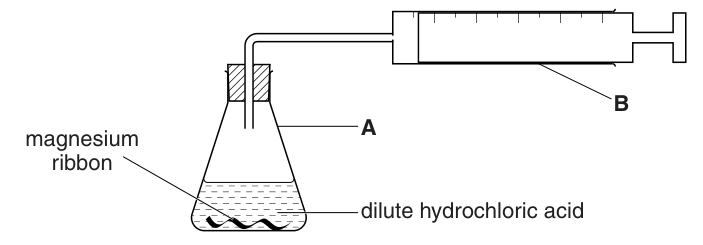
Name apparatus A.
______
Name apparatus B.
______
Calculate the number of moles of hydrogen in the of gas.
[ of any gas occupies at room temperature and pressure.]
______ moles
Use the equation below to deduce the mass of magnesium used in the experiment to produce of hydrogen at room temperature and pressure.
[: Mg, 24]
______
Give a test for hydrogen gas.
______
What is the effect on the time taken to collect the same volume of gas if,
large lumps of the same mass of magnesium are used instead of magnesium ribbon,
______
the reaction is carried out at a higher temperature?
______
The rest of this paper
9 more questions- Q2Experimental Contexts · Qualitative Analysis · Observations and Measurements16M
- Q3Analysis, Conclusions and Evaluation1M
- Q4Experimental Contexts · Analysis, Conclusions and Evaluation1M
- Q5Analysis, Conclusions and Evaluation1M
- Q6Experimental Contexts1M
- Q7Experimental Contexts1M
- Q8Experimental Contexts · Use of Techniques, Apparatus and Materials · Observations and Measurements · Analysis, Conclusions and Evaluation12M
- Q9Experimental Contexts · Qualitative Analysis10M
- Q10Experimental Contexts · Observations and Measurements · Analysis, Conclusions and Evaluation10M