Chemistry 5070/41 — May/June 2013
Cambridge O-Level · Alternative to Practical · worked solutions for every part, with the mark scheme
Topics Experimental Contexts · Analysis, Conclusions and Evaluation · Qualitative Analysis · Observations and Measurements · Use of Techniques, Apparatus and Materials
A student heats some sodium hydrogencarbonate in the apparatus shown below. The reaction produces carbon dioxide.
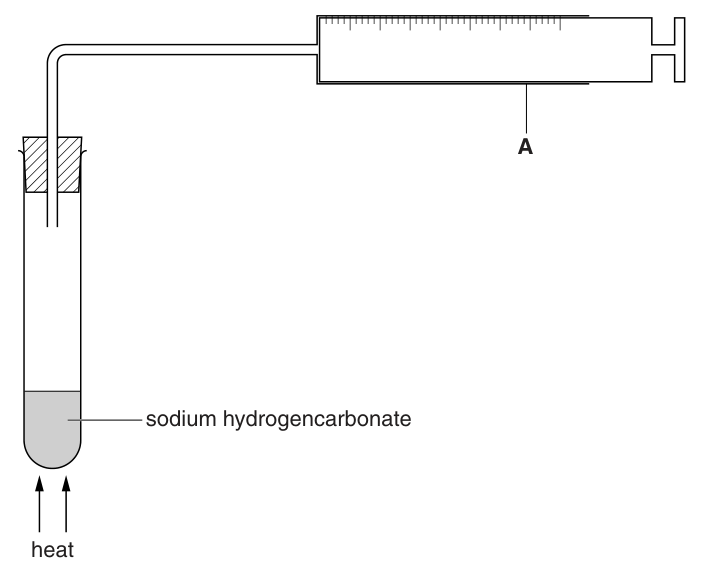
Name apparatus A.
______
Give a test for carbon dioxide.
______
The diagram below shows apparatus A at the completion of the reaction. The carbon dioxide collected is at room temperature and pressure.

What volume of carbon dioxide is collected?
______
Using your answer to (c), calculate the number of moles of carbon dioxide collected, measured at room temperature and pressure.
(One mole of a gas occupies at room temperature and pressure.)
______ moles
Using the equation for the reaction and your answer to (d) calculate the number of moles of sodium hydrogencarbonate used in the experiment.
______ moles
Calculate the relative formula mass of sodium hydrogencarbonate.
[: H, 1; C, 12; O, 16; Na, 23]
______
Using your answers to (e)(i) and (e)(ii) calculate the mass of sodium hydrogencarbonate used in the experiment.
______
The rest of this paper
9 more questions- Q2Qualitative Analysis9M
- Q3Experimental Contexts1M
- Q4Experimental Contexts1M
- Q5Experimental Contexts1M
- Q6Analysis, Conclusions and Evaluation1M
- Q7Analysis, Conclusions and Evaluation1M
- Q8Observations and Measurements · Experimental Contexts · Analysis, Conclusions and Evaluation · Qualitative Analysis17M
- Q9Experimental Contexts · Qualitative Analysis9M
- Q10Experimental Contexts · Observations and Measurements · Analysis, Conclusions and Evaluation13M