Chemistry 5070/41 — May/June 2012
Cambridge O-Level · Alternative to Practical · worked solutions for every part, with the mark scheme
Topics Experimental Contexts · Analysis, Conclusions and Evaluation · Observations and Measurements · Use of Techniques, Apparatus and Materials · Qualitative Analysis
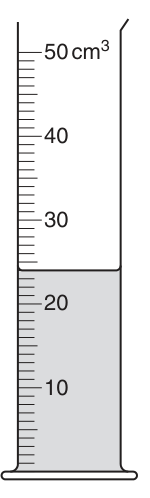
Name the apparatus shown in the diagram.
______
Answer
measuring cylinder
measuring cylinder
Walkthrough
The diagram shows a tall, narrow container with volume markings (graduations) along its side and a pouring spout at the top. This is the standard appearance of a measuring cylinder, which is used in the laboratory to measure the volume of liquids.
Key Takeaways
Candidates must be able to recognise common pieces of laboratory apparatus from line drawings and use the correct UK terminology (measuring cylinder, not graduated cylinder).
Common Mistakes
Calling it a 'graduated cylinder' (US term) or simply a 'cylinder'. The 5070 syllabus requires the term 'measuring cylinder'.
Things to Be Careful About
Ensure the spelling is correct: m-e-a-s-u-r-i-n-g c-y-l-i-n-d-e-r. State symbols are not required for apparatus names.
What is the volume of liquid in the apparatus?
______
Answer
24
24
Walkthrough
The major markings on the cylinder are at 10, 20, 30, 40, and 50 cm³. Between 20 and 30, there are 10 small intervals, meaning each small division represents 1 cm³. The liquid level (the bottom of the meniscus) is at the fourth mark above 20. Therefore, the volume is 20 + 4 = 24 cm³.
Key Takeaways
When reading a measuring cylinder, always determine the value of each small division first. Count up from the nearest major marking. Always read the volume at the bottom of the meniscus (the curved surface of the liquid) for accuracy.
Common Mistakes
Reading from the top of the meniscus instead of the bottom. Miscounting the number of small divisions between major markings. Forgetting that the unit is already given in the question line (cm³), so only the number is needed in the blank.
Things to Be Careful About
The question provides the unit after the blank, so the final answer is just the number '24'. Do not write '24 cm³' in the blank if the unit is already printed. Ensure the reading is taken at eye level with the bottom of the meniscus in a real practical setting.
The rest of this paper
11 more questions- Q2Observations and Measurements · Experimental Contexts · Analysis, Conclusions and Evaluation6M
- Q3Experimental Contexts · Observations and Measurements · Analysis, Conclusions and Evaluation6M
- Q4Experimental Contexts · Use of Techniques, Apparatus and Materials · Analysis, Conclusions and Evaluation · Observations and Measurements8M
- Q5Use of Techniques, Apparatus and Materials1M
- Q6Analysis, Conclusions and Evaluation1M
- Q7Experimental Contexts1M
- Q8Analysis, Conclusions and Evaluation1M
- Q9Experimental Contexts1M
- Q10Observations and Measurements · Analysis, Conclusions and Evaluation · Use of Techniques, Apparatus and Materials · Experimental Contexts15M
- Q11Qualitative Analysis · Experimental Contexts10M
- Q12Observations and Measurements · Experimental Contexts · Analysis, Conclusions and Evaluation8M