Chemistry 5070/42 — October/November 2011
Cambridge O-Level · Alternative to Practical · worked solutions for every part, with the mark scheme
Topics Experimental Contexts · Qualitative Analysis · Use of Techniques, Apparatus and Materials · Analysis, Conclusions and Evaluation · Observations and Measurements
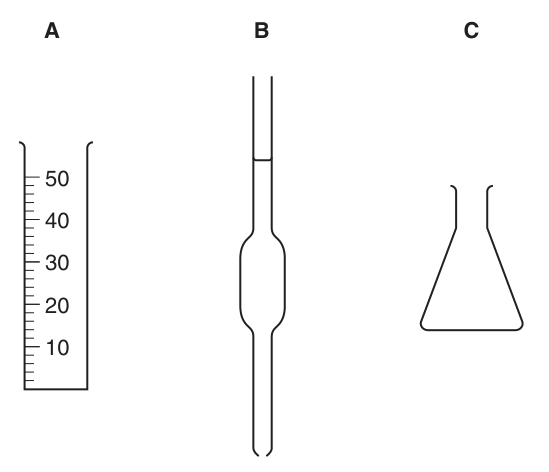
Which of the above apparatus A, B or C, is used for measuring out a fixed volume of liquid for a titration experiment?
______
Answer
B
B
Walkthrough
The question asks for apparatus used to measure a fixed volume of liquid in a titration. Apparatus A is a measuring cylinder, which is used for approximate volumes. Apparatus C is a conical flask, used to hold the reaction mixture, not to measure volume precisely. Apparatus B is a volumetric pipette, which is designed to deliver a specific, fixed volume of liquid accurately. Therefore, B is the correct choice.
Key Takeaways
Volumetric pipettes are used for measuring fixed, precise volumes of liquid in titrations. Measuring cylinders are for approximate volumes. Conical flasks are reaction vessels.
Common Mistakes
Choosing the measuring cylinder (A) because it has a scale. Choosing the conical flask (C) because it is used in titrations (but not for measuring the fixed volume of the titrant or analyte being transferred).
Things to Be Careful About
Ensure you distinguish between measuring a fixed volume (pipette or volumetric flask) and a variable or approximate volume (measuring cylinder). In titrations, the pipette measures the fixed volume of one reactant (often the analyte), while the burette measures the variable volume of the titrant.
Name this apparatus.
______
Answer
pipette
pipette
Walkthrough
Apparatus B has a bulb in the middle and a graduation mark on the upper stem. This is the characteristic shape of a volumetric pipette (often just called a pipette in O Level). It is used to measure a fixed volume.
Key Takeaways
A pipette (specifically a volumetric pipette) has a bulb and a single graduation mark, used for fixed volumes. A burette is long and has a tap and scale, used for variable volumes. A measuring cylinder is straight with a scale, used for approximate volumes.
Common Mistakes
Calling it a 'volumetric pipette' when 'pipette' is accepted (though volumetric is more precise, the mark scheme accepts 'pipette'). Calling it a 'burette' (burette has a tap at the bottom and a scale along the length).
Things to Be Careful About
The mark scheme accepts 'pipette'. 'Volumetric pipette' is also correct but longer. Do not confuse with a burette.
The rest of this paper
11 more questions- Q2Experimental Contexts · Qualitative Analysis8M
- Q3Experimental Contexts · Use of Techniques, Apparatus and Materials · Qualitative Analysis9M
- Q4Use of Techniques, Apparatus and Materials · Qualitative Analysis · Analysis, Conclusions and Evaluation · Experimental Contexts5M
- Q5Experimental Contexts1M
- Q6Qualitative Analysis1M
- Q7Analysis, Conclusions and Evaluation1M
- Q8Experimental Contexts1M
- Q9Experimental Contexts1M
- Q10Experimental Contexts · Use of Techniques, Apparatus and Materials · Observations and Measurements · Analysis, Conclusions and Evaluation10M
- Q11Qualitative Analysis · Experimental Contexts10M
- Q12Observations and Measurements · Experimental Contexts · Analysis, Conclusions and Evaluation11M