Chemistry 5070/12 — October/November 2011
Cambridge O-Level · Multiple Choice · answer key with instant marking and worked solutions
Topics Atoms, Elements and Compounds · Organic Chemistry · Experimental Techniques and Chemical Analysis · Metals · Chemistry of the Environment · The Periodic Table · +5 more
Tap an option under each question to check it — your score builds as you go.
Oxygen was prepared from hydrogen peroxide, with manganese(IV) oxide as catalyst. The oxygen was collected as shown in the diagram.
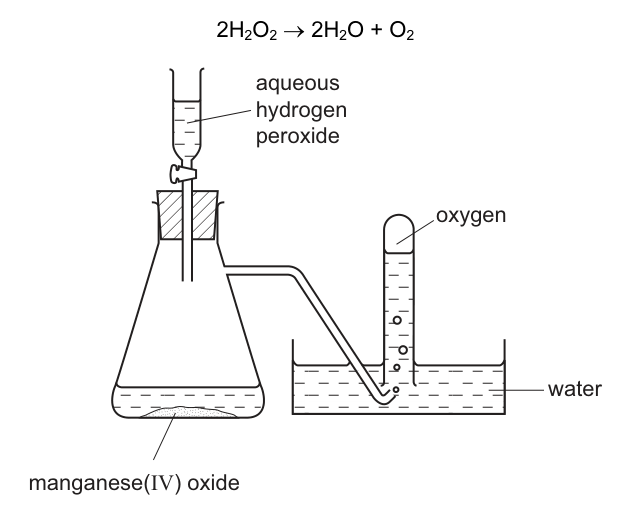
The first few tubes of gas were rejected because the gas was contaminated by
Options
A hydrogen.
B hydrogen peroxide.
C nitrogen.
D water vapour.
Working
The apparatus (conical flask and delivery tube) is initially filled with air. Air is a mixture of gases, primarily nitrogen (~78%) and oxygen (~21%). When the reaction begins, the oxygen produced first displaces this air into the collection tube. Therefore, the first few tubes of gas collected are contaminated with nitrogen from the air. Gas collected over water is always wet (contains water vapour), but this is not the reason for rejecting the first tubes specifically; the first tubes are rejected to ensure the collected gas is pure oxygen and not air. Hydrogen is not produced in this reaction. Hydrogen peroxide is a liquid reactant and does not vaporise to contaminate the gas.
Answer
C
C
Walkthrough
The question describes the preparation of oxygen from hydrogen peroxide using manganese(IV) oxide as a catalyst. The oxygen is collected by downward displacement of water (over water).
When any gas collection apparatus is set up, the flask, delivery tube, and the space above the water in the trough initially contain air. Air is a mixture of gases, and its most abundant component is nitrogen (approximately 78%), with oxygen making up about 21%.
As soon as the hydrogen peroxide is added and the reaction starts, the oxygen gas produced will expand and push out whatever gas is currently in the apparatus. The first gas to travel down the delivery tube and into the inverted test-tube is therefore the air that was originally in the flask and tube. This air is contaminated with a large amount of nitrogen.
To collect a pure sample of oxygen, the first few tubes (or the first few minutes of gas collection) are discarded. This ensures that the air (and thus the nitrogen) is completely expelled before the pure oxygen is collected.
Let's evaluate the other options:
- A (hydrogen): The reaction is . No hydrogen gas is produced.
- B (hydrogen peroxide): Hydrogen peroxide is an aqueous solution (a liquid). It does not vaporise under these conditions to contaminate the collected gas as a vapour in the same way air does.
- D (water vapour): Because the gas is collected over water, the collected oxygen will indeed be saturated with water vapour. However, this is true for all the gas collected, not just the first few tubes. The specific reason for rejecting the first tubes is to remove the air (nitrogen) from the apparatus.
Key Takeaways
- When collecting a gas over water, the initial gas displaced from the reaction vessel is air, not the product gas.
- Air is primarily composed of nitrogen (~78%).
- The first portion of gas collected must be discarded to ensure the final sample is pure and not contaminated with air.
Common Mistakes
- Choosing water vapour (D): Students often remember that gas collected over water is wet and choose water vapour. However, water vapour is present throughout the entire collection, so it is not the reason for rejecting only the first few tubes.
- Choosing hydrogen (A): Students may confuse this reaction with the reaction of a metal with an acid, which produces hydrogen gas. Here, only oxygen is produced.
Things to Be Careful About
- Read the question carefully: it asks why the first few tubes are rejected, not why the gas is generally impure. Gas collected over water is always wet, but that is an accepted characteristic of the method, not a reason to discard the initial fraction.
- Remember that the apparatus is not evacuated before the experiment; it is filled with ordinary laboratory air.
The rest of this paper
39 more questions- Q2Experimental Techniques and Chemical Analysis1M
- Q3Experimental Techniques and Chemical Analysis1M
- Q4Atoms, Elements and Compounds1M
- Q5Atoms, Elements and Compounds1M
- Q6The Periodic Table1M
- Q7Atoms, Elements and Compounds1M
- Q8Atoms, Elements and Compounds1M
- Q9Atoms, Elements and Compounds1M
- Q10Atoms, Elements and Compounds1M
- Q11Stoichiometry1M
- Q12Stoichiometry1M
- Q13Electrochemistry1M
- Q14Chemical Energetics · Chemistry of the Environment1M
- Q15Electrochemistry1M
- Q16Chemical Reactions1M
- Q17Acids, Bases and Salts1M
- Q18The Periodic Table1M
- Q19The Periodic Table1M
- Q20The Periodic Table1M
- Q21Experimental Techniques and Chemical Analysis1M
- Q22Chemical Reactions1M
- Q23Acids, Bases and Salts1M
- Q24Metals1M
- Q25Metals1M
- Q26Metals1M
- Q27Metals1M
- Q28Metals1M
- Q29Chemistry of the Environment1M
- Q30Atoms, Elements and Compounds1M
- Q31Experimental Techniques and Chemical Analysis1M
- Q32Chemistry of the Environment1M
- Q33Chemical Reactions1M
- Q34Organic Chemistry1M
- Q35Organic Chemistry1M
- Q36Stoichiometry1M
- Q37Organic Chemistry1M
- Q38Organic Chemistry1M
- Q39Organic Chemistry1M
- Q40Organic Chemistry1M