Chemistry 5070/42 — May/June 2011
Cambridge O-Level · Alternative to Practical · worked solutions for every part, with the mark scheme
Topics Experimental Contexts · Analysis, Conclusions and Evaluation · Observations and Measurements · Qualitative Analysis · Use of Techniques, Apparatus and Materials
A student adds hydrochloric acid to calcium carbonate to produce carbon dioxide.
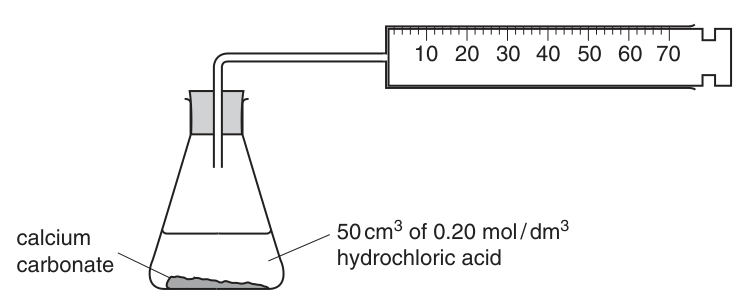
The diagram below shows the gas syringe containing the volume of carbon dioxide collected in one minute.

What volume of carbon dioxide is collected in one minute?
______
Will the volume collected during the second minute be less than, the same, or more than the volume collected during the first minute? Explain your answer.
______
The equation for the reaction is
of hydrochloric acid is added to an excess of calcium carbonate.
Calculate the number of moles in of hydrochloric acid.
______ moles
Calculate the relative formula mass of calcium carbonate.
[: C, 12; O, 16; Ca, 40.]
______
Using your answers to (c)(i) and (c)(ii) and the equation for the reaction, calculate the mass of calcium carbonate required to completely react with of hydrochloric acid.
______
Calculate the maximum volume of carbon dioxide that is produced when of of hydrochloric acid reacts completely with the excess calcium carbonate.
[1 mole of a gas occupies a volume of at room temperature and pressure.]
______
Suggest how the speed of this reaction can be increased by changing
the particle size of calcium carbonate,
______
the concentration of hydrochloric acid.
______
Suggest another way in which the student can increase the speed of the reaction.
______
The rest of this paper
9 more questions- Q2Experimental Contexts · Observations and Measurements · Analysis, Conclusions and Evaluation · Qualitative Analysis10M
- Q3Experimental Contexts1M
- Q4Analysis, Conclusions and Evaluation1M
- Q5Experimental Contexts1M
- Q6Experimental Contexts1M
- Q7Experimental Contexts1M
- Q8Experimental Contexts · Observations and Measurements · Analysis, Conclusions and Evaluation · Use of Techniques, Apparatus and Materials13M
- Q9Qualitative Analysis · Experimental Contexts10M
- Q10Experimental Contexts · Observations and Measurements · Analysis, Conclusions and Evaluation12M