Physics 5054/22 — October/November 2025
Cambridge O-Level · Theory · worked solutions for every part, with the mark scheme
Topics Forces · Kinematics · Energy, Work and Power · Mass, Weight and Density · Momentum · Thermal Properties of Matter · +9 more
A car travels along a straight horizontal road, initially at a constant speed. The speed–time graph in Fig. 1.1 shows the motion of the car from time .
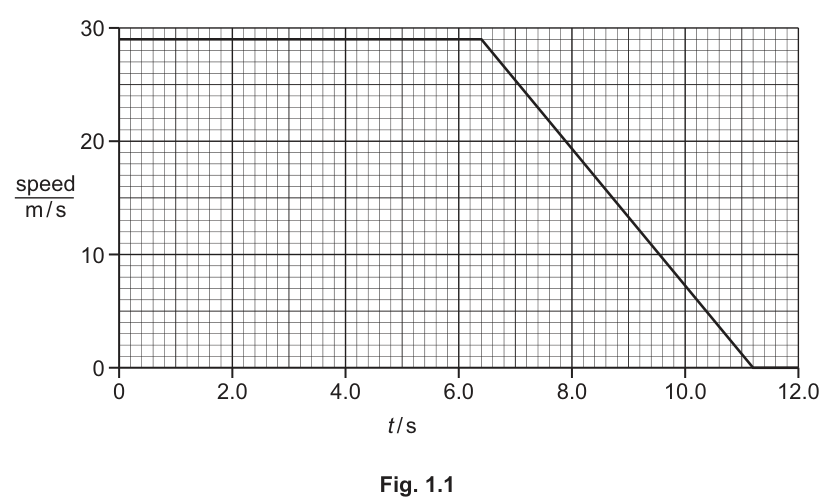
At time , the driver sees an obstruction in the road.
The driver applies the brakes a short time later, and the car begins to slow down.
Using Fig. 1.1, determine:
Answer
29
29 m/s
Walkthrough
The question asks for the speed of the car at time . Looking at the speed-time graph (Fig. 1.1), the vertical axis represents speed in m/s and the horizontal axis represents time in seconds. The graph begins with a flat horizontal line, indicating the car is travelling at a constant speed. Reading the value on the vertical axis where this line sits, we find it is just below the 30 m/s mark. Counting the grid lines (each representing 1 m/s), the line is at 29 m/s. Therefore, the speed at is 29 m/s.
Key Takeaways
Speed-time graphs plot speed on the vertical axis against time on the horizontal axis. A horizontal line indicates constant speed, and the value can be read directly from the y-axis.
Common Mistakes
- Reading the wrong axis (e.g., reading the time value instead of the speed value).
- Miscounting the grid lines; the major markings are every 10 units, but there are 10 small squares between them, meaning each small square represents 1 unit.
Things to Be Careful About
Always include the correct unit (m/s) when stating a speed read from a graph. Ensure you are reading from the correct axis (vertical for speed, horizontal for time).
the distance travelled by the car between the driver seeing the obstruction at and the car beginning to slow down
distance = ______
Working
The driver sees the obstruction at . The car begins to slow down when the graph starts to slope downwards, which is at .
During this interval, the car is travelling at a constant speed of .
Time interval:
Rounding to 2 significant figures (consistent with the data given):
Answer
20
20 m
Walkthrough
The question asks for the distance travelled between and the moment the car begins to slow down. From the graph, the car travels at a constant speed until , where the line starts to slope downwards. Thus, the braking begins at .
The time interval during which the car is moving at constant speed is:
During constant speed, distance is calculated using:
Substituting the values:
Given that the speed (29 m/s) and the time difference (0.7 s) have 2 and 1 significant figures respectively, the answer is appropriately rounded to 2 significant figures, giving 20 m.
Key Takeaways
The area under a speed-time graph represents distance. For a constant speed, this area is a rectangle, and the calculation simplifies to . Identifying the correct start and end times from the problem description and the graph is crucial.
Common Mistakes
- Using the wrong time interval (e.g., using 5.7 s instead of the difference ).
- Forgetting to convert or calculate the time difference correctly.
- Not rounding to the appropriate number of significant figures.
Things to Be Careful About
Always calculate the time interval () rather than just using the end time. Pay attention to significant figures; 20.3 m rounds to 20 m to 2 s.f.
Working
The total distance travelled is the area under the speed-time graph from to .
The shape under the graph is a trapezium, which can be split into a rectangle and a triangle, or calculated directly using the trapezium formula.
Method 1: Rectangle + Triangle
Area of rectangle (constant speed phase):
Area of triangle (braking phase):
Total distance:
Method 2: Trapezium formula
where , , and .
Rounding to 2 significant figures:
Answer
260
260 m
Walkthrough
The total distance travelled by the car is equal to the total area under the speed-time graph from to .
The graph consists of two sections:
- A rectangle from to at a constant speed of 29 m/s.
- A triangle from to where the speed decreases uniformly from 29 m/s to 0.
Calculating the area of the rectangle:
Calculating the area of the triangle:
Total distance = .
Alternatively, the entire shape is a trapezium with parallel sides and , and height :
Rounding to 2 significant figures (as the speed 29 m/s has 2 s.f.), the distance is 260 m.
Key Takeaways
The area under a speed-time graph always represents the distance travelled. For uniform acceleration (straight line slope), the area is a triangle; for constant speed, it is a rectangle. These can be combined or treated as a trapezium.
Common Mistakes
- Calculating the area of the triangle using the full time base (11.2 s) instead of the braking time (4.8 s).
- Forgetting to add the area of the constant speed section.
- Not rounding to the correct number of significant figures.
Things to Be Careful About
Ensure the base of the triangle is the difference in time (), not the absolute time value. Check significant figures at the end; 255.2 rounds to 260 to 2 s.f.
The speed of the car affects both the thinking distance and the braking distance.
State one factor that affects only the braking distance of the car.
Explain how a change in this factor increases the braking distance.
factor ______
explanation ______
Answer
factor: condition of the road (or: wear on tyres / mass of the car / condition of brakes)
explanation: a slippery or smooth road reduces the friction between the tyres and the road surface, which reduces the deceleration of the car and increases the time taken to stop, thereby increasing the braking distance.
Factor: condition of the road. Explanation: reduces friction, leading to reduced deceleration and a longer distance to stop.
Walkthrough
The question asks for a factor that affects only the braking distance, not the thinking distance. Thinking distance is affected by the driver's reaction time (e.g., alcohol, drugs, fatigue). Braking distance is affected by the vehicle and the road conditions.
Valid factors include:
- Mass of the car or load (heavier vehicle)
- Condition/wear of the tyres (worn tyres)
- State of the road (slippery, wet, icy, smooth)
- Condition of the brakes (worn brakes)
Let's choose road condition (e.g., a slippery or icy road).
Explanation chain:
- A slippery road reduces the friction between the tyres and the road surface.
- Reduced friction means the braking force is smaller.
- By Newton's second law (), a smaller resultant force leads to a reduced deceleration.
- With a smaller deceleration, it takes longer for the car to stop from the same initial speed, meaning the braking distance increases.
Key Takeaways
Stopping distance = thinking distance + braking distance. Thinking distance depends on the driver; braking distance depends on the vehicle and road. Factors affecting braking distance include mass, tyre condition, road surface, and brake condition. The explanation must link the factor to friction, then to deceleration, and finally to the increased distance.
Common Mistakes
- Suggesting a factor that affects thinking distance (e.g., driver fatigue, alcohol, speed).
- Stopping the explanation at "reduced friction" without explaining how that leads to a longer distance (i.e., failing to mention reduced deceleration or increased stopping time).
- Saying "less force" without specifying it is friction or braking force.
Things to Be Careful About
The question asks for a factor that affects only the braking distance. Speed affects both, so it is not a correct answer here. Ensure the explanation is a clear causal chain: factor effect on friction/force effect on deceleration effect on distance.
A spherical container is used to carry measuring instruments to the bottom of a lake.
Fig. 2.1 shows the container held at rest just below the water surface of a lake.
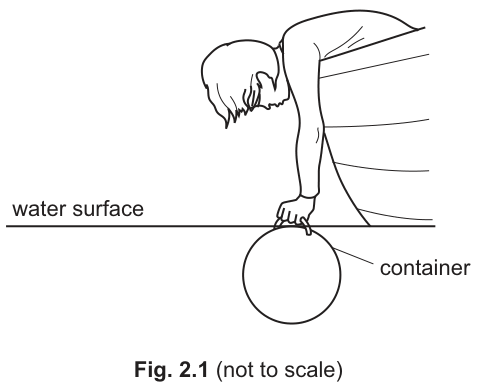
The container is released and falls through the water to the bottom of the lake.
The container reaches terminal velocity before it hits the bottom of the lake.
Explain, in terms of the forces on the container, the motion of the container through the water until it reaches terminal velocity.
Answer
Initially, the weight is greater than the drag, so there is a resultant force downwards and the container accelerates (speeds up). As the speed increases, the drag (or friction / viscous force) increases. This reduces the resultant force and so the acceleration decreases. When the drag equals the weight, the resultant force is zero, the acceleration is zero, and the container falls at a constant terminal velocity.
Container accelerates as weight > drag; drag increases with speed until it equals weight, resultant force is zero and terminal velocity is reached.
Walkthrough
To explain the motion until terminal velocity is reached, we must link the forces acting on the container to its acceleration using Newton's second law ().
Step 1: Initial motion. When the container is released, its speed is zero, so the upward drag force is zero. The only significant force is the downward weight. The resultant force is downwards, causing the container to accelerate and gain kinetic energy.
Step 2: Increasing drag. As the container speeds up, the water resistance (drag / viscous force) acting upwards increases. Because the weight remains constant, the resultant downward force () decreases.
Step 3: Terminal velocity. According to , a decreasing resultant force means the acceleration decreases. Eventually, the upward drag force grows large enough to exactly equal the downward weight. The forces balance, the resultant force becomes zero, and the acceleration drops to zero. The container then continues to fall at a constant maximum speed, known as terminal velocity.
Key Takeaways
- Terminal velocity is reached when the resistive force (drag) equals the driving force (weight).
- Acceleration is proportional to the resultant force; as drag increases, resultant force and acceleration decrease.
- At terminal velocity, the object moves at a constant speed with zero acceleration.
Common Mistakes
- Saying "forces become equal so it stops" — it does not stop; it continues at a constant speed.
- Using the word "gravity" instead of "weight" when referring to the downward force.
- Forgetting to mention that drag increases as speed increases.
Things to Be Careful About
- The question specifically asks to explain the motion in terms of the forces. Simply stating "it speeds up then goes at a constant speed" is not enough; you must link the speed changes to the resultant force and acceleration.
- Acceptable terms for the upward force include drag, friction, resistance, or viscous force.
The container falls through a vertical distance of before it hits the bottom of the lake.
The container and instruments have a total mass of .
Calculate the energy transferred from the gravitational potential energy store of the container.
energy transferred = ______
Working
Answer
2.3 x 10^4 J
Walkthrough
The energy transferred from the gravitational potential energy store is the loss in gravitational potential energy () as the container falls.
Step 1: Identify the equation. The change in gravitational potential energy is given by , where is the mass, is the gravitational field strength, and is the vertical distance fallen.
Step 2: Substitute the values. The mass , the vertical distance , and we use (or ).
Step 3: Round to an appropriate number of significant figures. The given values (74 and 32) have two significant figures, so we round the answer to two significant figures: .
Key Takeaways
- Gravitational potential energy depends on mass, gravitational field strength, and vertical height: .
- Always ensure mass is in kg and distance is in metres to get energy in joules.
- Round final answers to the same number of significant figures as the least precise given data.
Common Mistakes
- Using when the mark scheme expects (though would typically be accepted if is used consistently, the scheme explicitly shows ).
- Forgetting to convert units (e.g., using cm instead of m, or g instead of kg).
- Writing the answer as without rounding to 2 significant figures.
Things to Be Careful About
- The question asks for the energy transferred from the gravitational potential energy store, which is simply the loss in . No efficiency or other losses need to be considered for this specific calculation.
- Use standard form () for large numbers to clearly show significant figures.
Answer
Energy can neither be created nor destroyed. Energy can only be transferred from one energy store to another or from one object to another.
Energy can neither be created nor destroyed, and can be transferred from one store to another.
Walkthrough
This part tests the rote recall of the principle of conservation of energy. The principle has two key components that must both be stated to earn full marks:
- Energy cannot be created or destroyed.
- Energy can be transferred between stores or objects.
Key Takeaways
- The conservation of energy is a fundamental law of physics.
- In any closed system, the total energy remains constant; it only changes form or location.
Common Mistakes
- Saying "energy is used up" or "energy is lost" — energy is never lost, it is just transferred to less useful stores (like internal energy due to friction).
- Forgetting the second part of the principle (that energy can be transferred between stores). Just saying "energy is conserved" is not a complete statement of the principle.
Things to Be Careful About
- Use the exact wording expected: "neither created nor destroyed" and "transferred from one store to another". Avoid informal language like "energy doesn't disappear".
Work is done to transfer energy from the gravitational potential energy store as the container falls at terminal velocity.
Describe, in terms of the work done, how the energy is transferred from the gravitational potential energy store to one other energy store in the water.
Answer
The container does work against the friction (or drag / resistive force) of the water. This work transfers energy from the gravitational potential energy store to the internal energy store of the water.
Work is done against drag, transferring energy to the internal energy store of the water.
Walkthrough
The question asks how the energy is transferred in terms of the work done and to one other energy store in the water.
Step 1: Identify the mechanism of transfer. When a force acts over a distance, work is done. As the container falls at terminal velocity, it pushes through the water, doing work against the drag (friction / resistive force) exerted by the water.
Step 2: Identify the destination energy store. The work done against the resistive force causes the water to heat up slightly. In the 5054 energy stores model, this is described as transferring energy to the internal energy store of the water. (Avoid using the word 'heat' as an energy store; 'thermal energy' or 'internal energy' is the correct terminology for the store itself, though 'heat transfer' is acceptable for the process).
Step 3: Combine the statements. Energy is transferred from the gravitational potential energy store to the internal energy store of the water by doing work against the drag force.
Key Takeaways
- Work done against friction or drag results in an increase in the internal energy of the surrounding medium.
- Energy transfers can be described as 'doing work against a force'.
- The correct energy store for a heated substance is the 'internal energy store', not 'heat'.
Common Mistakes
- Saying the energy is transferred to the 'kinetic energy store' of the water — while the water molecules do move more, the correct 5054 terminology for the store that increases when something is heated is the 'internal energy store'.
- Using the word 'heat' as a noun for the energy store (e.g., 'transferred to the heat store'). 'Heat' is the process of energy transfer, not the store.
- Forgetting to mention 'work done' or 'doing work against drag', which the question specifically asks for.
Things to Be Careful About
- The question specifies 'in terms of the work done', so you must include the phrase 'work done against friction/drag'.
- Ensure you specify the energy store is in the water, not the container (though both heat up, the question asks about the water's store).
Fig. 3.1 shows a firefighter directing a jet of water at a wall.
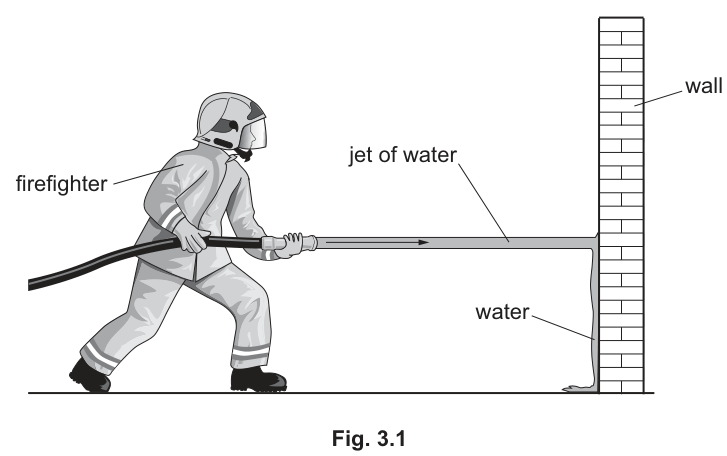
In , a volume of of water hits the wall horizontally, at a speed of .
The density of water is .
Calculate:
Working
Answer
7.5
7.5
Walkthrough
The question provides the volume of water and the density of water . To find the mass that hits the wall in 1.0 s, we use the density equation rearranged for mass: . Substituting the given values gives . The units are consistent (kg/m³ and m³), so no unit conversion is needed.
Key Takeaways
Mass, density, and volume are linked by . Always check that your units are compatible before multiplying.
Common Mistakes
Students sometimes invert the formula and divide density by volume, or forget to use the scientific notation correctly (e.g., calculating and missing the ).
Things to Be Careful About
Ensure the volume is in cubic metres () to match the density unit. Here, is already in the correct units, so directly.
Working
Answer
180
180
Walkthrough
Momentum is the product of mass and velocity . From part (a)(i), the mass of water hitting the wall in 1.0 s is . The speed of the water is given as . Substituting these into gives .
Key Takeaways
Momentum is a vector quantity defined as mass times velocity. The standard unit is .
Common Mistakes
Using a wrong mass value (e.g., from a different part of the question) or forgetting to multiply by the velocity. Also, forgetting to include the unit if the question asks for it, though here the unit is provided in the blank.
Things to Be Careful About
If part (a)(i) was answered incorrectly, you can still earn the mark here by using your incorrect mass value (error carried forward, ecf), as long as the method is correct.
The horizontal momentum of the water decreases to zero when the water hits the wall. None of the water bounces back from the wall.
Explain why the momentum calculated in (a)(ii) is equal in size to the horizontal force exerted on the water by the wall.
Answer
Force is defined as the rate of change of momentum: . The change in momentum of the water is and the time taken is . Therefore, the force is . Since the time is exactly , the numerical value of the force in newtons is equal in size to the change in momentum in .
Force equals the change in momentum divided by time; since the time is 1.0 s, the force is numerically equal to the change in momentum.
Walkthrough
Newton's second law can be stated as: the force acting on an object is equal to the rate of change of its momentum. Mathematically, . The water hits the wall with a momentum of and comes to rest, so the change in momentum is . This change happens over a time . Calculating the force gives . The question asks why the momentum value is equal in size to the force; the answer is that dividing by leaves the numerical value unchanged.
Key Takeaways
Force is the rate of change of momentum. When the time interval is , the force in newtons is numerically equal to the change in momentum.
Common Mistakes
Stating "force is momentum" without mentioning the time factor or rate of change. The mark scheme specifically looks for the relationship .
Things to Be Careful About
The question asks about the force on the water by the wall. The momentum calculated in (a)(ii) is the momentum of the water, which is fully lost (change is 180). The time given is exactly 1.0 s, which is the key to the numerical equality.
Explain, in terms of Newton's third law, why there is a horizontal force exerted on the wall by the water.
Answer
Newton's third law states that when object A exerts a force on object B, object B exerts an equal and opposite force on object A. The wall exerts a horizontal force on the water to stop it (from part b), so the water must exert an equal and opposite horizontal force on the wall.
By Newton's third law, the wall exerts a force on the water, so the water exerts an equal and opposite force on the wall.
Walkthrough
Newton's third law is about action-reaction force pairs. It states that forces always occur in equal and opposite pairs between two interacting objects. Here, the wall exerts a force on the water (which changes the water's momentum). Therefore, the water exerts a force of equal size and opposite direction on the wall. This is why the wall feels a push from the water jet.
Key Takeaways
Newton's third law pairs act on different objects. The force of A on B is equal and opposite to the force of B on A.
Common Mistakes
Saying "forces are equal and opposite" without specifying which force acts on which object. The mark scheme requires identifying that the wall exerts a force on the water, leading to the reaction force on the wall.
Things to Be Careful About
Ensure you name the two objects (wall and water) and the direction of the forces (equal and opposite). Do not say "the water pushes the wall because it has momentum"; the question specifically asks to explain in terms of Newton's third law.
The pump that forces the water to flow through the hose is adjusted, and the speed of the water leaving the hose doubles.
Explain why the force exerted by the water on the wall increases by a factor of 4.
Answer
If the speed of the water doubles, the volume of water hitting the wall in 1.0 s also doubles, so the mass hitting the wall in 1.0 s doubles. Since momentum , doubling both the mass and the velocity means the momentum hitting the wall in 1.0 s increases by a factor of . Because force is the rate of change of momentum over 1.0 s, the force also increases by a factor of 4.
Doubling the speed doubles the mass hitting the wall per second, and quadruples the momentum transferred per second, so the force increases by a factor of 4.
Walkthrough
The force is the rate of change of momentum: . For a 1.0 s interval, . If the speed doubles to , the volume of water flowing through the hose in 1.0 s also doubles (since flow rate = area velocity). This means the mass hitting the wall in 1.0 s also doubles to . The new momentum transferred in 1.0 s is . Since the time is still 1.0 s, the new force is 4 times the original force.
Key Takeaways
Flow rate is proportional to velocity. Doubling velocity doubles the mass flow rate. Momentum transfer rate depends on both mass flow rate and velocity, so it scales with the square of the velocity.
Common Mistakes
Only considering the effect of velocity on momentum () and forgetting that doubling the speed also doubles the amount of water (mass) hitting the wall in the same time. This leads to an incorrect factor of 2 instead of 4.
Things to Be Careful About
The question asks to explain why the force increases by a factor of 4. You must explicitly state that the mass hitting the wall in 1.0 s doubles, and then combine this with the doubling of velocity to get the factor of 4 for momentum (and thus force).
A large test-tube contains a thermometer and some solid wax at a temperature of .
At time , the test-tube is partially immersed in a beaker of boiling water and the temperature of the wax is recorded for the next .
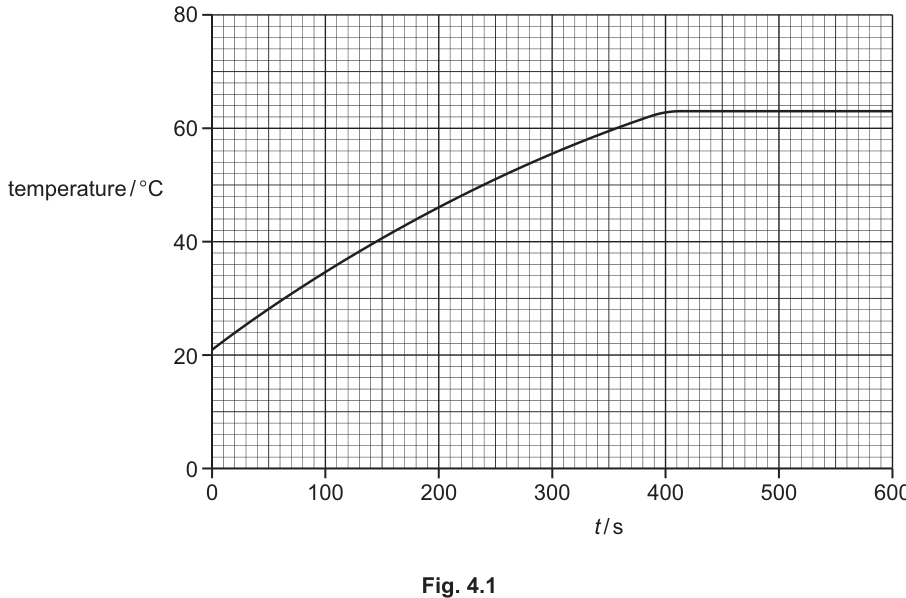
Fig. 4.1 shows the variation of the temperature of the wax with time .
Answer
The temperature remains constant at 63 °C (the line is horizontal), which indicates the wax is melting at this temperature.
The temperature remains constant at 63 °C (the line is horizontal).
Walkthrough
The question asks how the graph shows the melting temperature is 63 °C. On a heating curve, a substance's temperature rises as it absorbs thermal energy. When it reaches its melting point, the energy goes into breaking the bonds between particles rather than increasing their kinetic energy, so the temperature stays constant. On the graph, this is shown by a horizontal line (a plateau) at 63 °C. The gradient of the line becomes zero, meaning the rate of temperature change is zero.
Key Takeaways
During a phase change like melting, the temperature of a substance remains constant even though thermal energy is still being supplied. This appears as a horizontal line on a temperature-time graph.
Common Mistakes
Saying 'the temperature is 63 °C' without explaining that it is constant or that the line is horizontal. The mark scheme requires the observation of a constant temperature or zero gradient, not just stating the value.
Things to Be Careful About
Use precise language: 'temperature remains constant' or 'line is horizontal' rather than 'it stops heating'. The graph shows temperature vs. time, so focus on the gradient and the value of the temperature at the plateau.
As the temperature of the wax increases, the energy in the internal energy store increases.
The mass of the wax in the test-tube is and its temperature at time is . The specific heat capacity of wax is .
Using Fig. 4.1, determine the increase in the energy in the internal energy store of the wax between and . Show your working.
increase in energy in internal energy store = ______
Working
From Fig. 4.1, the temperature of the wax at is .
The increase in temperature is:
The increase in energy in the internal energy store is given by:
Substituting the values:
Rounding to 2 significant figures:
Answer
increase in energy in internal energy store = 2300
2300
Walkthrough
First, read the temperature of the wax at from the graph. The curve passes through at this time. The initial temperature at is . The temperature change is . Next, use the specific heat capacity formula . Substitute the mass , specific heat capacity , and . The calculation gives . Since the given values (, , ) have 2 significant figures, the final answer is rounded to .
Key Takeaways
The equation calculates the thermal energy transferred to change the temperature of a substance. Always ensure you read the temperature change from the graph correctly and match units (kg, C, J/(kg C)).
Common Mistakes
Reading the wrong temperature from the graph (e.g., reading 45 C instead of 48 C). Forgetting to calculate the temperature change and using the final temperature directly in the equation. Not rounding to the correct number of significant figures.
Things to Be Careful About
Ensure the mass is in kg (it is given as 0.040 kg, so no conversion is needed). The specific heat capacity is in J/(kg C), so temperature in C is correct. Do not use here; this is a thermal energy calculation, not a weight calculation.
Describe what happens to the motion of the molecules of the solid wax as the internal energy of the wax increases.
Answer
As the internal energy increases, the molecules gain kinetic energy. In the solid wax, this means the molecules vibrate more vigorously (or faster).
The molecules gain kinetic energy and vibrate more vigorously.
Walkthrough
Internal energy is the sum of the kinetic and potential energies of the particles in a substance. When the temperature of a solid increases, the thermal energy supplied increases the kinetic energy of the particles. In a solid, particles are held in fixed positions and can only vibrate. Therefore, an increase in kinetic energy means they vibrate more vigorously or faster. This is a direct consequence of the kinetic particle model.
Key Takeaways
Temperature is a measure of the average kinetic energy of the particles. For a solid, this kinetic energy manifests as vibration. Increasing internal energy without a phase change increases this vibrational motion.
Common Mistakes
Saying 'the molecules move faster' without specifying 'vibrate', which is more accurate for a solid. Saying 'they move around more' which implies they are becoming a liquid or gas. Confusing internal energy with temperature (they are related, but the question asks about the motion of the molecules).
Things to Be Careful About
Use the correct terminology: 'vibrate' for solids, 'move faster' for liquids and gases. The mark scheme accepts 'gain kinetic energy' and 'vibrate more vigorously' as separate marks.
When the wax reaches its melting temperature, energy continues to be transferred thermally to the wax.
Describe, in terms of the forces between particles, why energy is required to melt the wax.
Answer
Energy is required to do work against the attractive forces between the molecules. This separates the molecules and breaks the rigid solid structure, allowing them to move more freely as a liquid.
Energy is required to do work against the attractive forces between the molecules to separate them.
Walkthrough
During melting, the temperature remains constant, so the kinetic energy of the particles does not increase. The thermal energy supplied is instead used to increase the potential energy of the particles. This happens because work must be done against the attractive forces (bonds) holding the particles in their fixed positions in the solid lattice. Overcoming these forces separates the particles, changing the substance from a solid to a liquid. This energy is called latent heat of fusion.
Key Takeaways
Latent heat is the energy required to change the state of a substance without changing its temperature. This energy increases the potential energy store by doing work against intermolecular forces to separate the particles.
Common Mistakes
Saying 'energy is needed to heat the substance' (it's already at the melting point). Saying 'bonds are broken' without mentioning the forces between molecules. The mark scheme specifically asks for an explanation 'in terms of the forces between particles'.
Things to Be Careful About
Distinguish between kinetic energy (which relates to temperature) and potential energy (which relates to state and particle separation). During melting, potential energy increases while kinetic energy stays constant.
The microwave region is one region of the electromagnetic spectrum.
Fig. 5.1 represents the electromagnetic spectrum divided into the seven main regions.
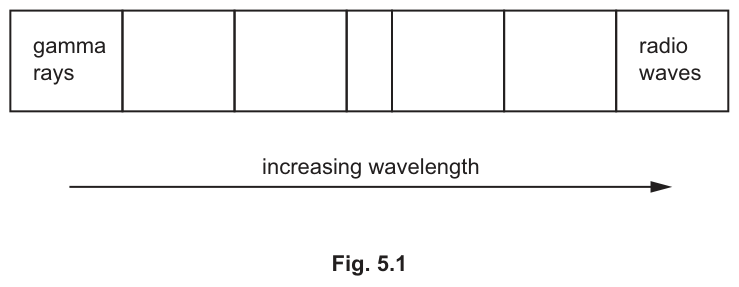
The regions are arranged from left to right in order of increasing wavelength.
On Fig. 5.1:
- indicate the microwave region by marking it with the letter M
- indicate the ultraviolet region by marking it with the letters UV.
Answer
UV in the 3rd box, M in the 6th box
Walkthrough
The electromagnetic spectrum is ordered by wavelength. From shortest wavelength (left) to longest wavelength (right), the seven main regions are: gamma rays, X-rays, ultraviolet (UV), visible light, infrared, microwaves, and radio waves.
Given that the leftmost box is gamma rays and the rightmost is radio waves, and the arrow indicates increasing wavelength from left to right:
- Box 1: gamma rays (given)
- Box 2: X-rays
- Box 3: ultraviolet (UV)
- Box 4: visible light
- Box 5: infrared
- Box 6: microwaves (M)
- Box 7: radio waves (given)
Mark the third box with 'UV' and the sixth box with 'M'.
Key Takeaways
- The electromagnetic spectrum has a fixed order based on wavelength or frequency.
- Short wavelength corresponds to high frequency and high energy (gamma rays).
- Long wavelength corresponds to low frequency and low energy (radio waves).
Common Mistakes
- Placing microwaves before infrared (microwaves have a longer wavelength than infrared).
- Forgetting that visible light is a distinct region between UV and infrared.
- Misreading the direction of the 'increasing wavelength' arrow.
Things to Be Careful About
- Always check the direction of the arrow. Here, wavelength increases from left to right, so frequency decreases from left to right.
- Ensure labels are placed clearly inside the correct boxes.
The frequency of the microwaves used by some satellite television systems is .
The speed of microwaves in a vacuum is .
Calculate the wavelength of these microwaves in a vacuum.
wavelength = ______
Working
The wave equation is:
Given:
- Speed of microwaves,
- Frequency,
Substitute the values:
Answer
wavelength = 0.025 m
0.025 m
Walkthrough
- Identify the given values: The speed of electromagnetic waves in a vacuum is . The frequency is given as .
- Convert units: The prefix 'G' (giga) means . So, . In standard scientific notation, this is . It is crucial to convert GHz to Hz before substituting into the equation.
- Select the equation: The wave equation links speed, frequency, and wavelength: . For electromagnetic waves in a vacuum, , so . Rearranging for wavelength gives .
- Substitute and calculate:
- Final answer: is equal to . Both forms are acceptable, but the question blank implies a decimal or standard form value with the unit 'm'.
Key Takeaways
- Always convert units to standard SI units (Hz for frequency, m/s for speed) before calculating.
- The wave equation applies to all waves, including electromagnetic waves where .
- .
Common Mistakes
- Forgetting to convert GHz to Hz (using 12 instead of ).
- Rearranging the equation incorrectly (e.g., ).
- Arithmetic errors with powers of ten.
Things to Be Careful About
- Pay close attention to metric prefixes (kilo, mega, giga, milli, micro, nano).
- Ensure the final answer includes the correct unit (meters).
Answer
- Microwaves are used to carry encoded data (or a microwave signal) from a transmitting station on Earth to a satellite in orbit.
- The satellite then transmits the microwave signal back down to a receiving dish (antenna) on Earth for television reception.
Microwaves transmit data from Earth to a satellite, which then transmits the signal to a receiving dish on Earth.
Walkthrough
Satellite television systems rely on microwaves because they can penetrate the Earth's atmosphere (including clouds) and travel long distances through space.
- Transmission to satellite: Information (television signals) is encoded onto a microwave carrier wave. This microwave signal is beamed upwards from a ground station on Earth to a communications satellite in orbit.
- Transmission to Earth: The satellite receives the signal, amplifies it, and transmits it back down to Earth. The signal is received by a satellite dish (antenna) at a subscriber's home, which decodes it into television pictures and sound.
Key Takeaways
- Microwaves are ideal for satellite communication because they have short wavelengths that allow them to travel in straight lines and penetrate the atmosphere.
- The process involves uplink (Earth to satellite) and downlink (satellite to Earth) microwave transmissions.
Common Mistakes
- Stating that microwaves are used to 'heat' the satellite (confusing satellite TV with microwave ovens).
- Forgetting to mention both the transmission to the satellite and the transmission from the satellite to Earth.
Things to Be Careful About
- Use precise terminology: 'encoded data', 'signal', 'transmit', 'satellite dish' or 'antenna'.
All microwave ovens have a switch that turns the oven off when the door is opened.
Suggest why it is important for a microwave oven to switch off when the door is opened.
Answer
- If the oven is not switched off when the door opens, microwaves could escape from the oven and spread out into the surrounding environment.
- Microwaves can be absorbed by living tissue (including people), causing heating, burns, or tissue damage.
To prevent microwaves from escaping and causing burns or tissue damage to people nearby.
Walkthrough
Microwave ovens work by emitting microwaves that are absorbed by water molecules in food, causing them to vibrate and generate heat. This same heating effect can occur in human tissue.
- Preventing leakage: The metal casing and the mesh in the door are designed to contain the microwaves inside the oven. If the door is opened and the magnetron (the device that generates the microwaves) continues to operate, microwaves could leak out into the kitchen.
- Health hazard: If a person is exposed to leaking microwaves, the radiation can penetrate their skin and be absorbed by their body's water content. This causes rapid heating of the tissue, which can lead to severe burns, blisters, and damage to internal tissues (especially eyes and testes, which have poor blood circulation to dissipate heat).
Therefore, the interlock switch is a critical safety feature that cuts power to the magnetron the moment the door latch is released.
Key Takeaways
- Electromagnetic radiation can be hazardous if not contained.
- Microwaves cause heating in matter, including biological tissue.
- Safety interlocks are essential in appliances that generate ionising or high-energy non-ionising radiation.
Common Mistakes
- Saying microwaves are 'radioactive' (they are not; they are non-ionising radiation).
- Stating that microwaves cause cancer (the primary immediate danger is thermal damage/burns, not cancer, at the power levels used in ovens).
- Simply saying 'it is dangerous' without explaining why (tissue heating/burns).
Things to Be Careful About
- Distinguish between the danger of microwaves (heating/burns) and the danger of ionising radiation like X-rays or gamma rays (cell damage/cancer).
An electric car is driven by a direct current (d.c.) motor that is powered by a direct current power supply.
Answer
Direct current flows in one direction only and does not reverse direction (or change polarity).
Direct current flows in one direction and does not reverse direction.
Walkthrough
The question asks for the difference between direct current (d.c.) and alternating current (a.c.). The defining characteristic of a d.c. supply is that the charge flows in one constant direction around the circuit. In contrast, an a.c. supply causes the charge to repeatedly reverse direction, meaning the current changes direction periodically.
Key Takeaways
- Direct current (d.c.) flows in one direction only.
- Alternating current (a.c.) repeatedly reverses direction.
Common Mistakes
- Saying that d.c. is 'constant' in magnitude (while a steady d.c. is constant, a pulsed d.c. is not; the defining feature is the direction, not the magnitude).
- Saying that a.c. is 'faster' or 'higher voltage' — these are not defining differences.
Things to Be Careful About
- The mark scheme specifically looks for the idea of 'one direction' or 'does not reverse direction'. Simply saying 'it is constant' is not enough and may not score.
Fig. 6.1 represents the motor circuit. Point P is a point in the circuit between the motor and the positive terminal of the power supply.
Point P is shown to the left of the motor in the circuit diagram.
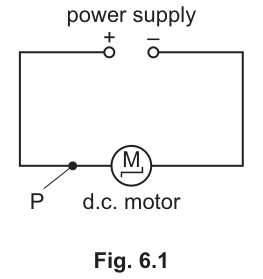
During a time of , the current in the circuit at point P is .
Working
Answer
charge = 4920 C (or C)
4920 C
Walkthrough
The question asks for the charge that flows through point P. We are given the current and the time . The relationship between charge, current, and time is . Substituting the values gives . This can also be written in standard form as .
Key Takeaways
- Current is the rate of flow of charge: , which rearranges to .
- Units: current in amperes (A), time in seconds (s), and charge in coulombs (C).
Common Mistakes
- Using the wrong formula, such as without rearranging.
- Arithmetic errors when multiplying 41 by 120.
Things to Be Careful About
- The mark scheme accepts or or 4920. Ensure you provide the unit 'C' as the blank asks for 'charge = _____ C', but writing the unit explicitly in your answer is good practice. Here the unit is already given in the blank, so just the number is needed, but stating it fully is clearer.
The current in the circuit is due to the flow of electrons. Each electron carries a charge of magnitude .
State the direction which the electrons move past point P and determine the number of electrons that pass point P in .
direction ______
number of electrons = ______
Answer
direction: towards the positive terminal (or away from the motor)
Working
Conventional current flows from the positive terminal to the negative terminal. Since electrons are negatively charged, they flow in the opposite direction to the conventional current. At point P (on the wire from the positive terminal to the motor), conventional current flows towards the motor, so electrons move towards the positive terminal (away from the motor).
Number of electrons in :
number of electrons =
direction: towards the positive terminal; number of electrons = 2.6 x 10^20
Walkthrough
First, determine the direction of electron flow. Conventional current is defined as the flow of positive charge, from the positive terminal of the supply to the negative terminal. In the circuit, point P is on the wire connecting the positive terminal to the motor, so conventional current flows from the positive terminal towards the motor (to the right in Fig. 6.1). Electrons are negatively charged, so they flow in the opposite direction to conventional current. Therefore, electrons move past point P towards the positive terminal (or away from the motor).
Second, calculate the number of electrons passing point P in . The current is , which means of charge flows past point P every second. Each electron carries a charge of . The number of electrons is the total charge divided by the charge per electron:
Rounding to 2 significant figures gives .
Key Takeaways
- Conventional current flows from positive to negative; electrons flow from negative to positive (opposite direction).
- The number of electrons can be found by dividing the total charge by the elementary charge .
Common Mistakes
- Stating that electrons flow in the same direction as the current.
- Using the total charge from part (b)(i) () and dividing by without dividing by the time (120 s) first, or forgetting to adjust for the 1.0 s time interval.
Things to Be Careful About
- The direction must be stated clearly: 'towards the positive terminal' or 'away from the motor'. Vague answers like 'left' may not score if not referenced to circuit components.
- Use 2 or 3 significant figures for the final number of electrons. is appropriate.
The power supply for the electric car is a number of batteries, each made from a large number of identical cells.
The e.m.f. (electromotive force) of each cell is .
Answer
Electromotive force (e.m.f.) is the electrical work done by a source in moving a unit of charge around a complete circuit.
Electromotive force is the work done by a source in moving a unit charge around a complete circuit.
Walkthrough
The question asks for the definition of electromotive force (e.m.f.). The mark scheme awards two marks for two distinct ideas: (1) the work done by the source in moving charge, and (2) that this is per unit charge. Combining these, e.m.f. is the work done by a source in moving a unit charge (1 coulomb) around a complete circuit.
Key Takeaways
- e.m.f. is a measure of the energy converted from non-electrical to electrical form per unit charge.
- It is defined for a complete circuit, not just across the terminals.
Common Mistakes
- Defining e.m.f. as 'voltage across the terminals' — this is the terminal potential difference, which is less than e.m.f. when current flows due to internal resistance.
- Saying 'work done per unit charge' without mentioning the source or the complete circuit.
- Using the word 'heat' or 'power' instead of 'work done'.
Things to Be Careful About
- Both 'work done by a source' and 'per unit charge' are required for full marks. 'Electrical work done' is also acceptable.
Each battery consists of 92 cells in series.
Calculate the e.m.f. of one battery.
e.m.f. = ______
Working
For cells connected in series, the total e.m.f. is the sum of the individual e.m.f.s.
Answer
e.m.f. = 340 V
340 V
Walkthrough
Each cell has an e.m.f. of . When cells are connected in series, their e.m.f.s add up. The battery consists of 92 cells in series, so the total e.m.f. of the battery is:
Rounding to 3 significant figures gives .
Key Takeaways
- Cells in series: total e.m.f. = sum of individual e.m.f.s ().
- Cells in parallel: total e.m.f. = e.m.f. of one cell.
Common Mistakes
- Dividing the e.m.f. by the number of cells instead of multiplying.
- Adding an incorrect unit or omitting the unit.
Things to Be Careful About
- The mark scheme accepts 340 V. is also correct but 340 V is the expected 3-significant-figure answer. Ensure you multiply, not divide.
The power supply is made by connecting 85 of these batteries in parallel.
State the e.m.f. of the power supply.
e.m.f. = ______
Answer
When batteries are connected in parallel, the total e.m.f. is the same as the e.m.f. of one battery.
e.m.f. = 340 V
340 V
Walkthrough
The power supply is made by connecting 85 of the batteries from part (c)(ii) in parallel. A fundamental rule of cells and batteries in parallel is that the total e.m.f. (or voltage) is the same as the e.m.f. of a single cell or battery. The parallel connection increases the available current capacity, but does not change the voltage.
Therefore, the e.m.f. of the power supply is the same as the e.m.f. of one battery, which is .
Key Takeaways
- Batteries in series: e.m.f. adds up.
- Batteries in parallel: e.m.f. is the same as one battery; current capacity increases.
Common Mistakes
- Multiplying the e.m.f. by the number of batteries (85) — this would be correct if they were in series, but they are in parallel.
- Dividing the e.m.f. by 85.
Things to Be Careful About
- Read the connection type carefully: 'in parallel' means the e.m.f. is unchanged. The answer is simply the value from part (c)(ii), which is 340 V.
An electric kettle has an outer casing made of metal. Fig. 7.1 shows the kettle.
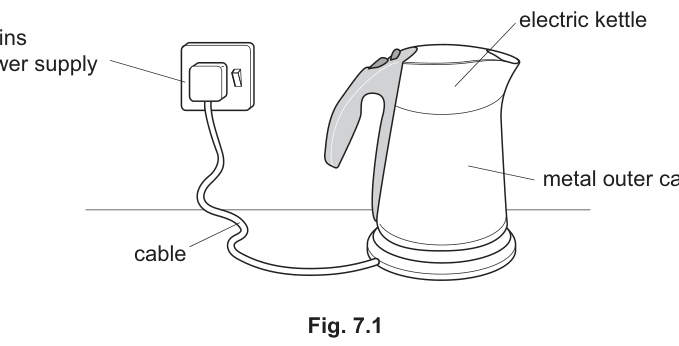
The heater in the electric kettle is connected to a mains power supply and has a power rating of .
The kettle is switched on.
Working
Answer
10 A
Walkthrough
To find the current passing through the heater, we use the relationship between electrical power , potential difference (voltage) , and current :
Rearranging for current gives:
Substitute the given values ( and ):
Key Takeaways
- Electrical power is the product of voltage and current: .
- Current is measured in amperes ().
Common Mistakes
- Inverting the division ().
- Multiplying voltage and power instead of dividing.
Things to Be Careful About
- Check that power is in watts () and voltage is in volts () before calculating.
The manufacturer of the kettle states that the cable for the kettle is safe for currents that are smaller than . The wiring in the mains power supply in the wall is safe for currents that are smaller than .
The fuses available for the kettle have the ratings shown.
State which of these fuses is the most appropriate. Explain why it is the most appropriate.
most appropriate fuse rating = ______
explanation ______
Answer
most appropriate fuse rating:
explanation: It is slightly larger than the normal operating current of so the fuse does not blow during normal use, but it is less than so it protects the cable from overheating.
13 A; slightly larger than the operating current so it does not blow during normal use, and smaller than 15 A to protect the cable
Walkthrough
A fuse must satisfy two conditions:
- Its current rating must be slightly higher than the device's normal working current (), so it will not melt (blow) when the appliance is operating normally.
- Its current rating must be lower than the maximum safe current of the cable () and wall wiring (), so that if a fault occurs, the fuse blows before the cable overheats and catches fire.
From the given list ():
- or lower would blow during normal operation.
- or higher would not protect the cable safely.
- Therefore, is the correct choice.
Key Takeaways
- A fuse rating must be just above the normal operating current of the appliance.
- The fuse prevents excessive currents that could cause wires to overheat and cause a fire.
Common Mistakes
- Choosing (which would blow as soon as the kettle is turned on due to normal operating current or surges).
- Choosing or higher, which does not provide adequate safety margin for the cable.
Things to Be Careful About
- Ensure both aspects of the explanation are mentioned: operating without blowing under normal current, and protecting the wiring/cable.
There are three wires in the cable that connects the kettle to the mains power supply:
- the earth wire
- the live (line) wire
- the neutral wire.
The wires are all correctly connected.
State the name of the wire that the fuse is connected into. Explain why the fuse is connected into this wire.
name of wire ______
explanation ______
Answer
name of wire: live (line) wire
explanation: If the fuse blows, it disconnects the appliance from the high-voltage supply, so no part of the kettle remains live.
live wire; disconnects the kettle from the high voltage so it is no longer live if the fuse blows
Walkthrough
- Name of wire: The fuse (and any switches) must always be placed in the live wire (also called the line wire).
- Explanation: The live wire is at high alternating potential ( relative to earth). When the fuse blows, placing it in the live wire breaks the circuit before the current reaches the appliance. This completely disconnects the kettle from the high-voltage mains, making it safe to touch. If the fuse were placed in the neutral wire, the fuse blowing would still break the circuit, but the appliance would remain at (live) and present an electric shock hazard.
Key Takeaways
- Fuses and switches are always connected in the live wire.
- This isolates the appliance from the high voltage when the circuit is broken.
Common Mistakes
- Stating the earth wire or neutral wire instead of the live wire.
- Giving a vague explanation like "to stop current" without mentioning that it disconnects the high voltage / stops the kettle remaining live.
Things to Be Careful About
- Both the wire name and the explanation are required for this 1-mark part.
The insulation on the live wire is damaged so that the wire is exposed.
Explain what happens when the exposed live wire touches the metal outer casing.
Answer
- A large current flows from the live wire through the metal outer casing to the earth wire (low-resistance path to earth).
- This large surge in current causes the fuse to melt (blow), cutting off the electricity supply.
A large current flows through the casing to earth, causing the fuse to blow and cut off the supply
Walkthrough
When an exposed live wire touches the metal casing of an appliance:
- The metal casing is connected to the earth wire, which provides a very low-resistance path to ground.
- A very large current flows from the live wire into the casing and down the earth wire.
- This excessive current exceeds the fuse's current rating, causing the thin wire inside the fuse to melt and break (blow).
- This immediately cuts off the power supply, preventing the casing from staying at a high voltage and protecting users from electric shocks.
Key Takeaways
- Metal-cased appliances must have an earth wire.
- Earthing combined with a fuse ensures that a fault causes a large current to earth, which blows the fuse and isolates the appliance.
Common Mistakes
- Mentioning only that the person gets a shock (the earth wire prevents this by blowing the fuse).
- Forgetting to mention that a large current flows or that the fuse blows.
Things to Be Careful About
- The question has 2 marks: one for the large current in the earth/live wire (or casing becoming live), and one for the fuse blowing/melting.
The kettle is switched on for a total time of during one year.
The cost of electricity is $0.32 per kilowatt-hour (kWh).
Calculate the cost of using the kettle during the year.
cost = $ ______
Working
Answer
$25.02
$25.02
Walkthrough
- Convert power from watts to kilowatts:
- Calculate energy consumed in kilowatt-hours ():
- Calculate total cost: Rounding to two decimal places (cents) gives $25.02.
Key Takeaways
- is the electrical energy used by a appliance operating for .
- .
- .
Common Mistakes
- Forgetting to convert power from to (dividing by 1000).
- Converting time into seconds instead of leaving it in hours when computing .
Things to Be Careful About
- Ensure money is written to 2 decimal places (e.g., $25.02).
The element lithium has several different isotopes.
State one way in which the compositions of the atoms of all lithium isotopes are the same.
Answer
They have the same number of protons (and therefore the same number of electrons in a neutral atom).
same number of protons
Walkthrough
Isotopes are atoms of the same element that have the same number of protons but a different number of neutrons. Since the number of protons defines the element, all lithium isotopes must have 3 protons. In a neutral atom, the number of electrons equals the number of protons, so they also have the same number of electrons. The question asks for one way they are the same, so stating either the proton number or the electron number is sufficient.
Key Takeaways
- Isotopes of an element share the same proton number (atomic number).
- Neutral isotopes also share the same electron number.
- The difference between isotopes lies only in their neutron number (and thus their nucleon/mass number).
Common Mistakes
- Saying they have the same "mass" or "weight" — isotopes have different masses.
- Saying they have the same number of neutrons — this is exactly what makes them different.
Things to Be Careful About
- The question asks for the composition of the atoms, not the nucleus. While the nucleus has the same protons, the electron cloud is also identical in a neutral atom. Stating "same number of protons" is the most direct and safest answer.
State one way in which the composition of a lithium atom of one isotope is different from the composition of a lithium atom of a different isotope.
Answer
They have a different number of neutrons (or a different total number of nucleons / mass number).
different number of neutrons
Walkthrough
By definition, isotopes of the same element have the same proton number but different nucleon numbers. Since nucleon number = protons + neutrons, and the proton number is constant, the difference must come from the neutron number. Therefore, one isotope has more (or fewer) neutrons than the other.
Key Takeaways
- Isotopes differ only in their number of neutrons.
- This leads to different nucleon (mass) numbers for different isotopes of the same element.
Common Mistakes
- Saying they have different numbers of protons — if the proton number changed, it would be a different element entirely.
- Saying they have different numbers of electrons — neutral atoms of different isotopes have the same number of electrons.
Things to Be Careful About
- Be precise with terminology: use "neutrons" or "nucleons", not just "mass" or "weight". The mark scheme accepts "number of neutrons" or "nucleons".
Fig. 8.1 is a diagram that represents a neutral atom of a radioactive isotope of lithium (Li).
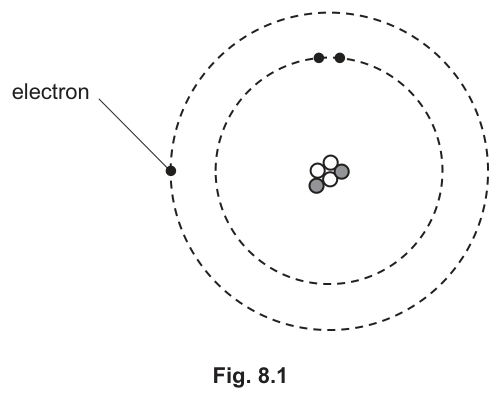
There are three electrons in orbit around the nucleus.
The nuclide symbols for isotopes of lithium are represented as where and are numbers.
Determine the values of and for the isotope represented by Fig. 8.1.
= ______
= ______
Working
From the diagram in Fig. 8.1, the nucleus contains 3 protons and 2 neutrons.
The proton number is the number of protons:
The nucleon number is the total number of protons and neutrons:
Answer
= 5
= 3
X = 5, Y = 3
Walkthrough
Nuclide notation is written as , where is the nucleon number (mass number) and is the proton number (atomic number).
- Proton number (): Count the number of protons in the nucleus. The diagram shows 3 shaded circles representing protons. Thus, . This also confirms the element is lithium, as lithium has atomic number 3.
- Nucleon number (): Count the total number of nucleons (protons + neutrons) in the nucleus. The diagram shows 3 protons and 2 neutrons (total 5 particles in the nucleus). Thus, .
Key Takeaways
- In nuclide notation , (top) is the nucleon number (protons + neutrons) and (bottom) is the proton number (protons only).
- The proton number defines the element; the nucleon number identifies the specific isotope.
Common Mistakes
- Swapping and : placing the proton number on top and the nucleon number on the bottom.
- Counting the electrons when calculating the nucleon number: electrons are not in the nucleus and do not contribute to the nucleon number.
Things to Be Careful About
- Always check which number is which in the notation: top is nucleon (mass) number, bottom is proton (atomic) number.
- Ensure the counts from the diagram match the symbol: 3 protons means , and total nucleus particles means .
An ion of this isotope of lithium has a single positive charge and is represented as ().
Describe how the diagram that represents this ion differs from Fig. 8.1.
Answer
The diagram for the ion would have only two small black dots (electrons) in the orbits/shells, instead of the three shown in Fig. 8.1. The nucleus remains unchanged.
one fewer electron (only two black dots in the shells)
Walkthrough
A neutral lithium atom has 3 protons and 3 electrons. A lithium ion with a single positive charge () has lost one electron, leaving it with 3 protons and 2 electrons.
When describing how the diagram differs:
- The nucleus (protons and neutrons) does not change during ionisation, so it remains exactly the same.
- The electron shells will show one fewer electron. Fig. 8.1 shows three small black dots on the shells; the ion's diagram should show only two small black dots.
Key Takeaways
- Ionisation involves the gain or loss of electrons only; the nucleus is unaffected.
- A positive ion (cation) has lost electrons; a negative ion (anion) has gained electrons.
- When asked to describe a diagrammatic change, specify what is added or removed from the relevant part of the diagram (here, an electron dot on the shell).
Common Mistakes
- Saying the nucleus loses a proton or neutron: this would change the element or isotope.
- Saying the atom has a different number of protons: the proton number defines the element and does not change in chemical ionisation.
Things to Be Careful About
- The question asks how the diagram differs, not just what the ion is. You must describe the visual change: "one fewer black dot" or "two dots instead of three".
Radioactive isotopes emit nuclear radiation which can affect living things.
Answer
Any one of:
- Causes cell death
- Causes mutations (in DNA)
- Causes cancer
- Causes radiation sickness (or hair loss)
- Causes cataracts
- Causes burns
- Ionises cells
causes cell death / mutations / cancer / radiation sickness
Walkthrough
Nuclear radiation is ionising, meaning it has enough energy to knock electrons out of atoms, creating ions. In living tissue, this can damage biological molecules like DNA, leading to various harmful effects.
Common damaging effects include:
- Cell death: Radiation can kill cells outright, which is why it is used in radiotherapy to kill cancer cells, but it can also damage healthy tissue.
- Mutations: Damage to DNA can cause mutations, which may lead to cancer or be passed on to offspring.
- Radiation sickness: High doses cause acute symptoms like nausea, hair loss, and fatigue.
- Cataracts and burns: Localised high doses can damage the eyes (cataracts) or skin (burns).
Key Takeaways
- Ionising radiation damages living tissue primarily by ionising atoms and breaking chemical bonds in molecules like DNA.
- Effects range from cellular damage (death, mutations) to systemic illness (radiation sickness, cancer).
Common Mistakes
- Saying "radiation heats the body" — while radiation can deposit energy, the primary biological damage is from ionisation, not thermal heating.
- Giving a vague answer like "it is bad" — a specific biological effect is required.
Things to Be Careful About
- The question asks for one damaging effect. Any single valid effect from the mark scheme list will score.
The emission of radioactive radiation from an unstable isotope is described as random and spontaneous.
State what is meant by 'random' and what is meant by 'spontaneous'.
random ______
spontaneous ______
Answer
random: The emission of radiation is unpredictable in time and direction; there is no fixed time interval between decays, and it follows no pattern.
spontaneous: The emission is not influenced by external factors (such as temperature, pressure, or chemical combination); it happens on its own without any trigger.
random: unpredictable in time/direction; spontaneous: not influenced by external factors
Walkthrough
Radioactive decay is a quantum mechanical process. Two key characteristics define it:
-
Random: You cannot predict when a specific nucleus will decay, nor in which direction the emitted radiation will travel. If you have a large sample, you can predict the overall decay rate (half-life), but for any individual nucleus, the decay is completely unpredictable. There is no pattern or fixed time interval between individual decay events.
-
Spontaneous: The decay happens on its own. It is not triggered or influenced by external conditions such as changes in temperature, pressure, magnetic fields, or the chemical environment (e.g., whether the atom is in a compound or pure element). An unstable nucleus will decay regardless of what is happening to it externally.
Key Takeaways
- Random refers to the unpredictability of when and where (direction) a decay event occurs for an individual nucleus.
- Spontaneous refers to the independence of the decay process from external physical or chemical conditions.
Common Mistakes
- For 'random': Saying "it happens at random times" without explaining that it is unpredictable or has no pattern.
- For 'spontaneous': Saying "it happens quickly" or "it happens by itself" without explicitly stating that external factors (temperature, pressure, etc.) do not influence it.
Things to Be Careful About
- Ensure both definitions are distinct. 'Random' is about unpredictability and lack of pattern; 'spontaneous' is about independence from external influences.
- Do not confuse 'spontaneous' with 'immediate' — some isotopes have half-lives of billions of years, but the decay of each individual nucleus is still spontaneous.
Fig. 9.1 shows how the Sun and the rest of the Solar System orbit around the centre of the Milky Way in a circular path.
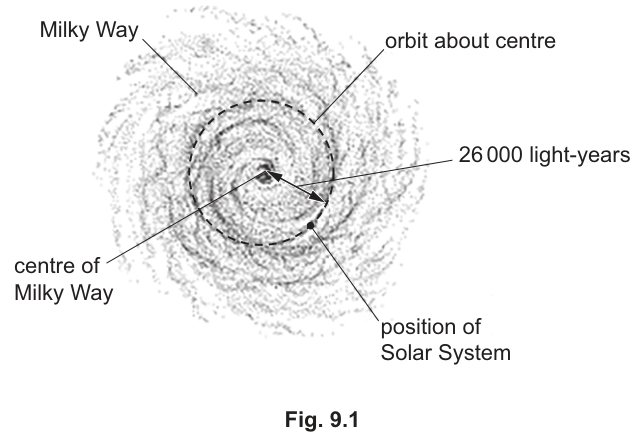
The Sun travels around the circular path at a speed .
The speed of light in a vacuum is .
The Sun is from the centre of the Milky Way.
Determine the distance from the Sun to the centre of the Milky Way in kilometres (km).
distance = ______
Working
Answer
2.5 x 10^17
Walkthrough
The question gives the speed of light as and the distance from the Sun to the centre of the Milky Way as light-years. A light-year is the distance light travels in one year, so the distance in kilometres is simply the speed of light multiplied by the number of years. Multiply by to get , which rounds to to two significant figures.
Key Takeaways
A light-year is a unit of distance, not time. To convert a distance given in light-years to kilometres, multiply the number of light-years by the speed of light in km/year.
Common Mistakes
- Forgetting to multiply and instead adding the values.
- Rounding too early or to the wrong number of significant figures. The mark scheme accepts .
Things to Be Careful About
Ensure you are multiplying the speed by the number of years, not dividing. Keep track of powers of ten carefully when multiplying by .
It takes the Sun to complete one orbit around the centre of the Milky Way.
Calculate the speed .
= ______
Working
Convert radius to metres:
Convert period to seconds:
Substitute into the equation:
Answer
2.1 x 10^5
Walkthrough
The Sun travels in a circular orbit. The speed is the circumference of the orbit divided by the orbital period . The circumference is . The radius must be in metres and the period in seconds to give the speed in m/s.
Radius . (Using the unrounded value gives , which is also accepted). Period . Convert years to seconds: . Calculate .
Key Takeaways
For circular motion, speed = distance / time. The distance for one complete orbit is the circumference . Always convert units to SI (metres and seconds) before calculating speed in m/s.
Common Mistakes
- Forgetting to convert the radius from km to m (dividing by 1000) or the period from years to seconds (multiplying by ).
- Using the wrong formula for circumference (e.g., instead of ).
- Rounding intermediate values too early, which can lead to ; both and are accepted depending on rounding.
Things to Be Careful About
Be careful with the powers of ten. . Make sure your calculator handles the large numbers correctly, or break the calculation into parts: calculate the numerator and the denominator separately before dividing.
Astronomical observations suggest that, at the centre of the Milky Way, there is a black hole.
Black holes are produced from red supergiants.
Near the end of its life, a massive star becomes a red supergiant.
Describe what happens inside the star as it becomes a red supergiant.
Answer
- Most of the hydrogen in the core has been converted to helium (or the star runs out of hydrogen fuel in the core).
- The core contracts and becomes hotter, while the outer layers expand outwards (pushed by increased radiation pressure from hydrogen fusion in a shell around the core).
Hydrogen in the core is converted to helium; the core contracts and becomes hotter while the outer layers expand.
Walkthrough
As a massive star exhausts the hydrogen fuel in its core, nuclear fusion of hydrogen stops there. The core, no longer supported by the outward radiation pressure from fusion, begins to contract under its own gravity. This contraction heats the core up. The increased temperature ignites hydrogen fusion in a shell surrounding the core. The increased radiation pressure from this shell fusion pushes the outer layers of the star outwards, causing the star to expand and cool on the surface, becoming a red supergiant.
Key Takeaways
The end of hydrogen fusion in the core triggers a chain of events: core contraction, core heating, shell hydrogen fusion, and expansion of the outer layers. These are the defining characteristics of a star evolving into a red supergiant.
Common Mistakes
- Saying the star 'runs out of all fuel' (it still has helium and heavier elements, just not hydrogen in the core).
- Saying the outer layers 'contract' instead of expand.
- Using the word 'heat' instead of 'thermal energy' or 'radiation pressure' when explaining why the star expands.
Things to Be Careful About
The question asks what happens 'inside the star'. Focus on the core and the shell around it, not just the surface. Two distinct points are needed for the two marks.
Answer
The red supergiant explodes violently in a supernova explosion. This explosion ejects the outer layers of the star into space, forming a nebula, and leaves behind a very dense, collapsed core that becomes a black hole.
The red supergiant explodes as a supernova, ejecting its outer layers and leaving behind a collapsed core that becomes a black hole.
Walkthrough
When the core of a red supergiant can no longer support itself against gravity (after fusing elements up to iron), it collapses rapidly. This collapse triggers a catastrophic explosion called a supernova. The outer layers of the star are blown out into space at high speed, creating an expanding nebula. The core, if it is massive enough (typically above about 3 solar masses), continues to collapse beyond the neutron star stage, forming a black hole from which not even light can escape.
Key Takeaways
A supernova is the explosive death of a massive star. It disperses heavy elements into space and can leave behind a neutron star or a black hole, depending on the mass of the remaining core.
Common Mistakes
- Saying the star 'collapses into a black hole' without mentioning the explosion (supernova). Both the explosion and the remnant are needed for the marks.
- Confusing a supernova with a planetary nebula (which is left behind by lower-mass stars like the Sun).
- Saying the black hole 'sucks in' the surrounding matter as part of its formation (the formation is due to gravitational collapse of the core).
Things to Be Careful About
The mark scheme specifically looks for the words 'explodes' or 'supernova' and the result 'black hole' or 'nebula'. Ensure you mention the explosion, not just the collapse.
Answer
The heaviest elements are produced during the supernova explosion, when lighter nuclei are forced together (fused) under the extreme temperature and pressure.
Lighter nuclei are fused together during a supernova explosion.
Walkthrough
While normal fusion in a star's core can produce elements up to iron, creating heavier elements requires even more energy. This energy is provided during the supernova explosion. The extreme temperatures and pressures force lighter nuclei to fuse together, a process called nucleosynthesis, producing the heaviest elements in the universe (like gold, uranium, etc.). These elements are then scattered into space by the explosion.
Key Takeaways
Supernovae are responsible for creating and dispersing the heaviest elements in the universe through rapid nuclear fusion.
Common Mistakes
- Saying heavy elements are produced in normal stellar fusion (they can only be produced up to iron in a stable star).
- Saying heavy elements are produced by 'breaking apart' nuclei (that is fission, not the process that creates heavy elements in supernovae).
Things to Be Careful About
Keep the answer simple: 'lighter nuclei fuse together' or 'nuclei are forced together' during the 'supernova explosion'.