Physics 5054/21 — October/November 2025
Cambridge O-Level · Theory · worked solutions for every part, with the mark scheme
Topics Energy, Work and Power · Mass, Weight and Density · Practical Electricity · Transfer of Thermal Energy · Thermal Properties of Matter · Kinetic Particle Model of Matter · +12 more
A car is at rest on a straight horizontal road.
At time , the car begins to accelerate.
Fig. 1.1 shows how the momentum of the car varies with time.
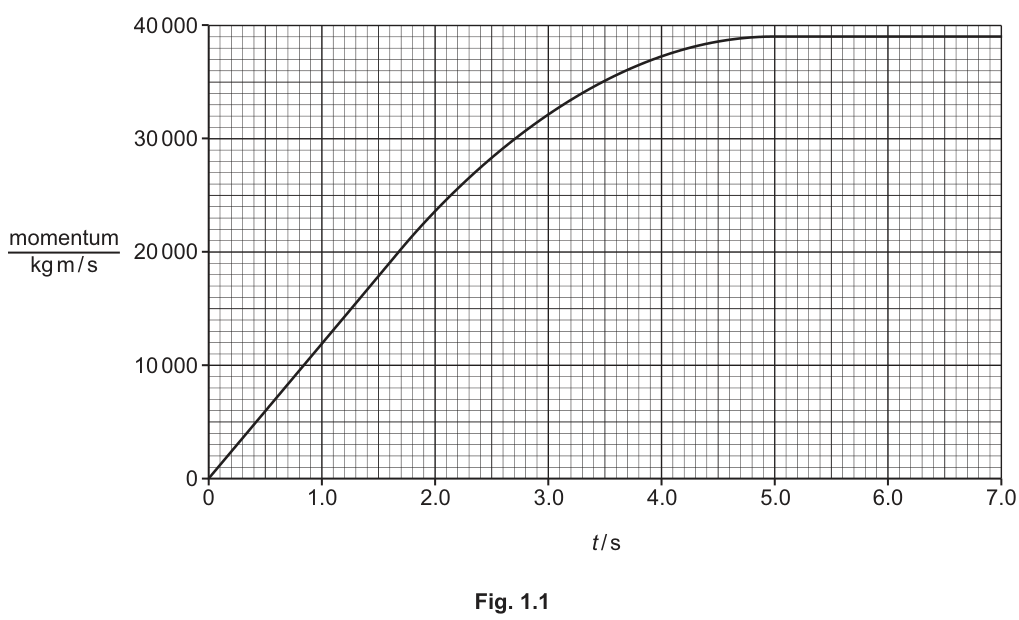
Use Fig. 1.1 to determine the resultant force acting on the car during the first of its motion.
resultant force = ______
Working
From Fig. 1.1, at , the momentum is . At , momentum is .
Change in momentum .
Time taken .
Resultant force .
Answer
12 000
12 000
Walkthrough
The question asks for the resultant force during the first . Newton's second law can be stated as force being the rate of change of momentum: .
- Read the momentum at from Fig. 1.1: it is .
- Read the momentum at from Fig. 1.1. The graph passes through at this time.
- Calculate the change in momentum: .
- Apply the formula with to find .
Key Takeaways
Force is not just ; it is equally valid to use . When momentum changes uniformly over time, the force is constant and equal to the gradient of the momentum-time graph.
Common Mistakes
- Reading the wrong value from the graph (e.g., reading the speed or acceleration instead of momentum).
- Forgetting to include the unit in the final answer, as the mark scheme explicitly requires it for the answer blank.
- Using an incorrect time interval or change in momentum.
Things to Be Careful About
- Ensure the time is read to the correct precision from the graph. The minor divisions are , so is exact.
- The momentum axis has major divisions of and minor divisions of . Reading at requires careful interpolation.
- Force is a vector, but here the direction is implied along the road; the magnitude is sufficient for the blank.
The car has mass .
Answer
Start with the definition of momentum: , so .
Substitute into the expression :
Since the kinetic energy is defined as , we have shown that:
Shown that p^2 / 2m = E_k
Walkthrough
The goal is to show that is equal to the kinetic energy .
- Recall the definition of momentum: . This allows us to write .
- Substitute into the given expression: .
- Simplify the fraction by cancelling one from the numerator and denominator: .
- Recognise that is the standard formula for kinetic energy, .
- Therefore, .
Key Takeaways
This derivation is a useful bridge between momentum and kinetic energy. It shows that for a given mass, kinetic energy is proportional to the square of the momentum.
Common Mistakes
- Attempting to start from and trying to force in, which can lead to algebraic errors.
- Failing to show the intermediate step , which is a required mark in the scheme.
- Not explicitly stating that is equal to .
Things to Be Careful About
- Ensure the algebraic cancellation of is clear: .
- The mark scheme awards marks for seeing and for recognising .
- Do not introduce or other unrelated formulas; stick to the definitions of and .
At , the kinetic energy of the car is .
Use Fig. 1.1 to determine the momentum of the car at , and use the equation in (b)(i) to determine the mass of the car.
Show your working.
= ______
= ______
Working
From Fig. 1.1, at , the momentum is constant at .
So, .
Given at this time.
Using the equation from (b)(i): .
Rearrange to solve for mass :
Substitute the values:
Rounding to 2 significant figures (consistent with the data): .
Answer
p = 39 000 kg m/s, m = 1400 kg
Walkthrough
- Read the momentum at from Fig. 1.1. The graph is horizontal at this point, indicating constant momentum. Reading the value from the y-axis, it is .
- We are given .
- Use the relationship derived in part (b)(i): .
- Rearrange the formula to make the subject: .
- Substitute the values: .
- Calculate the numerator: .
- Calculate the denominator: .
- Divide: .
- The mark scheme accepts (2 s.f.), which is appropriate given the precision of the graph reading and the given .
Key Takeaways
Graph reading must be combined with algebraic manipulation. When a value is read from a graph, it may not be exact, so the final answer should reflect the appropriate significant figures.
Common Mistakes
- Reading the wrong value from the graph (e.g., instead of ). The graph is slightly below , and is the accepted reading.
- Algebraic errors when rearranging to solve for . A common mistake is or .
- Calculation errors with large numbers; using scientific notation helps avoid mistakes.
- Forgetting to include units in the final answer.
Things to Be Careful About
- The graph reading at is . The mark scheme explicitly accepts . If a candidate reads , they will get an error carried forward (ecf) mark for the mass calculation, but the final mass must be consistent with their reading.
- Significant figures: has 2 s.f., so the mass should ideally be given to 2 s.f. ( or ).
In a factory, an electric motor is used to lift the boxes shown in Fig. 2.1.
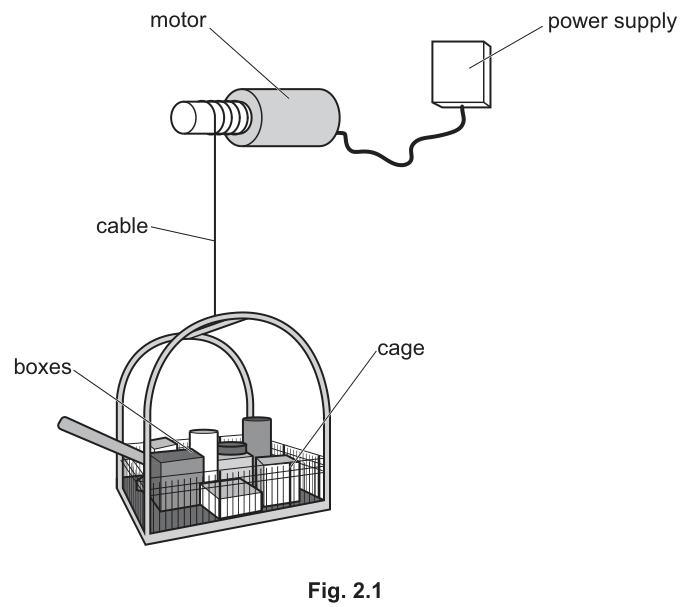
The boxes are placed in a cage and the motor winds a cable around a cylinder to lift the cage and boxes.
The total mass of the boxes is and they are lifted vertically through to a storage area.
Calculate:
Answer
weight = 360 N
360 N
Walkthrough
Weight is the force of gravity on an object, calculated by multiplying mass by gravitational field strength (). Using , the weight is . Rounding to two significant figures gives , which matches the mark scheme.
Key Takeaways
Weight is a force and must be calculated using . Always include the unit newtons (N).
Common Mistakes
Forgetting to multiply by and just writing the mass value. Using the wrong value for (e.g. not converting if given in different units, though here it is standard).
Things to Be Careful About
The mark scheme accepts , which is rounded to two significant figures. Ensure you use (or ) rather than , as would not match the expected for subsequent marks.
the useful work done in lifting the boxes to the storage area.
useful work done = ______
Working
Answer
useful work done = 4700 J
4700 J
Walkthrough
The useful work done in lifting the boxes is the work done against gravity. This is calculated by multiplying the upward force (the weight of the boxes, ) by the vertical distance moved (). , which rounds to to two significant figures.
Key Takeaways
Work done is force times distance in the direction of the force. For lifting, the force is the weight and the distance is the height.
Common Mistakes
Using the electrical energy from part (b) instead of the useful work done. Forgetting to multiply by the distance.
Things to Be Careful About
Use the rounded value of from part (a) if following the mark scheme's path, though using also rounds to . Always round the final answer to the appropriate number of significant figures (two here, based on the given data and ).
The e.m.f. of the power supply for the motor is . The current in the motor is .
It takes for the motor to lift the cage and boxes to the storage area.
Calculate:
Working
Answer
energy = J
1.4 x 10^4 J
Walkthrough
The total electrical energy transferred to the motor is given by the formula , where is the potential difference (e.m.f.), is the current, and is the time. Substituting the given values: . To two significant figures, this is .
Key Takeaways
Electrical energy can be calculated using . Always ensure time is in seconds.
Common Mistakes
Using and forgetting to multiply by time to get energy. Forgetting to convert minutes to seconds (not applicable here as time is already in seconds).
Things to Be Careful About
The mark scheme expects the answer in standard form to two significant figures: . Writing or may not be accepted if strict significant figure rules are applied, though is the safest format.
Working
Answer
efficiency = 33 %
33 %
Walkthrough
Efficiency is the ratio of useful energy output to total energy input, expressed as a percentage. The useful energy output is the work done lifting the boxes (), and the total energy input is the electrical energy transferred (). Dividing and multiplying by 100 gives , which rounds to .
Key Takeaways
Efficiency is always less than 100% in real processes. It is calculated as (useful output / total input) × 100.
Common Mistakes
Calculating efficiency as (total input / useful output), which gives a number greater than 1. Forgetting to multiply by 100 to get a percentage.
Things to Be Careful About
Use the unrounded values ( and ) for the calculation to avoid rounding errors, though using also gives approximately , which the mark scheme accepts as or .
Some of the energy transferred by the motor during the lifting process is not transferred usefully.
State two reasons why the efficiency of the lifting process is less than .
- ______
- ______
Answer
- Work done to lift the cage and cable (not just the boxes).
- Energy transferred thermally (heating) in the motor coils due to resistance.
(Alternatively: Work done overcoming friction in the motor and pulley, or air resistance on the cage.)
Work done lifting the cage/cable; thermal energy loss in motor coils
Walkthrough
In any real lifting system, not all the electrical energy is converted into useful gravitational potential energy for the boxes. Energy is dissipated in several ways:
- The motor must also lift the cage itself and the cable, which requires work but is not the 'useful' output defined in the question.
- The motor has electrical resistance in its coils, which causes some electrical energy to be transferred thermally (heating the motor).
- Friction in the moving parts of the motor and the cable winding mechanism converts some energy into thermal energy.
- Air resistance (drag) on the moving cage also dissipates energy.
Key Takeaways
Efficiency is less than 100% because energy is always dissipated to the surroundings as thermal energy or used to move non-useful parts of the system.
Common Mistakes
Saying 'energy is lost'. Energy is never lost; it is dissipated or transferred to the surroundings. Saying 'friction' without specifying what is overcome (e.g. 'work done overcoming friction').
Things to Be Careful About
The mark scheme specifically accepts 'work done / GPE to lift the cage / cable'. Simply saying 'lifting the cage' might be marked correct, but 'work done to lift the cage' is more precise. 'Heat in the motor' is acceptable, but 'thermal energy in motor coils' is better physics terminology.
Fig. 3.1 shows a small block of ice at and a plastic cup that contains of water.
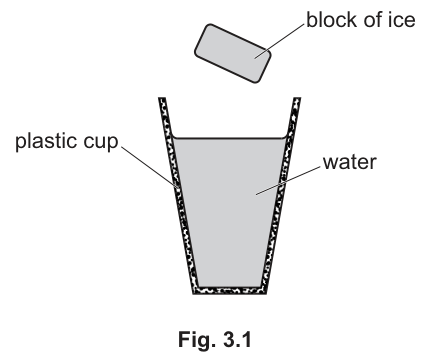
The initial temperature of the water in the cup is .
The block of ice is dropped into the water.
Describe, in terms of molecules, how energy is transferred by conduction from the water to the ice.
Answer
Water molecules collide with the molecules in the ice.
This causes the molecules in the ice to vibrate faster / with more energy, overcoming the forces of attraction (and breaking bonds) so they are knocked out of the solid lattice.
Water molecules collide with molecules in the ice, causing them to vibrate faster with more energy and overcome the forces of attraction.
Walkthrough
Conduction is the transfer of thermal energy through a material without any overall movement of the material itself. In this case, the warmer water molecules are moving more vigorously than the molecules in the colder ice. When they come into contact, the fast-moving water molecules collide with the slower molecules at the surface of the ice. These collisions transfer kinetic energy to the ice molecules, causing them to vibrate more vigorously. As the vibrations become large enough, the forces of attraction holding the ice molecules in their fixed lattice positions are overcome, and the molecules are knocked free (melting).
Key Takeaways
Thermal conduction at the molecular level is driven by collisions between particles. Higher temperature means greater average kinetic energy, so collisions transfer energy from the hotter region to the colder region until thermal equilibrium is reached.
Common Mistakes
- Saying "heat moves" instead of describing the mechanism (collisions and increased vibration).
- Saying "water molecules move into the ice" (conduction does not involve bulk movement of the particles themselves).
- Forgetting to mention that the forces of attraction / bonds in the solid are overcome.
Things to Be Careful About
The question specifically asks for the explanation "in terms of molecules". You must use particle language: collide, vibrate, kinetic energy, forces of attraction. Do not just say "energy transfers from water to ice" without explaining how.
All of the ice melts and, at equilibrium, the temperature of the water in the cup is .
The specific heat capacity of water is .
Calculate the energy transferred from the of water as it cools.
energy = ______
Working
The energy transferred as the water cools is given by the specific heat capacity equation:
where:
- (mass of water)
- (specific heat capacity of water)
- (temperature change)
Substitute the values:
Rounding to two significant figures (matching the mass given):
Answer
J
1.6 x 10^4 J
Walkthrough
The water cools from to , so the temperature change is . The mass of the water is and its specific heat capacity is . Using the equation , we multiply these three values together to find the total thermal energy lost by the water. . This is correctly expressed in standard form as to two significant figures.
Key Takeaways
The equation calculates the energy transferred when a substance changes temperature. Always ensure mass is in kg, temperature change is in (or K), and specific heat capacity is in .
Common Mistakes
- Using the wrong temperature change (e.g., using instead of the difference ).
- Forgetting to convert mass to kg (not an issue here as it is already in kg, but a common trap).
- Failing to express the final answer in standard form or with the correct number of significant figures.
Things to Be Careful About
The question asks for the energy transferred from the water, which is a positive quantity representing the magnitude of energy lost. The temperature change is always taken as the absolute difference when calculating energy transferred.
Describe how the molecular structure of water at differs from the molecular structure of ice at .
Answer
- Water molecules have no orderly arrangement (unlike the fixed, regular lattice in ice).
- Water molecules can move freely within the volume of the water / slide over each other.
Water molecules have no orderly arrangement and can move freely within the water's volume / slide over each other.
Walkthrough
In solid ice, water molecules are arranged in a fixed, regular, orderly lattice and can only vibrate about fixed positions. When ice melts into liquid water at , the molecules gain enough energy to overcome the forces of attraction holding them in the lattice. In the liquid state, the molecules are still close together but have no regular or orderly arrangement. They are free to move around and slide past one another within the volume of the liquid.
Key Takeaways
The transition from solid to liquid involves a change from an ordered, fixed arrangement to a disordered, mobile arrangement. The molecules remain close together in both states, but their freedom of movement increases.
Common Mistakes
- Saying molecules are "further apart" in liquid water (for water, liquid is actually slightly denser than ice, so molecules are closer together on average; even generally, saying they are further apart is not a primary defining feature of melting).
- Saying molecules "move faster" (this is about temperature/kinetic energy, not the structural difference between the phases at a given comparison).
- Confusing the structure of a liquid with that of a gas (molecules in a gas are far apart and move freely in all directions; liquid molecules are still close together).
Things to Be Careful About
The question asks for differences in molecular structure (arrangement and motion), not just temperature or energy. Focus on arrangement (orderly vs. random) and motion (vibrating in place vs. sliding/moving freely).
The plastic cup containing water at is left in a room where the room temperature is . The temperature of the water in the cup rises slowly to room temperature.
When the water at is left in a metal cup, the temperature of the water rises to room temperature more quickly.
State why the temperature of the water in the cup returns to room temperature more quickly when the cup is made from metal.
Answer
Metal is a good thermal conductor (or plastic is a bad thermal conductor / good insulator).
Metal is a good thermal conductor (or plastic is a bad thermal conductor).
Walkthrough
The room is at and the water is at , so thermal energy is transferred from the room to the water, warming it up. The rate of this transfer depends on the thermal conductivity of the cup's material. Metals are good thermal conductors because they have delocalised electrons that can rapidly transfer kinetic energy through the material. Plastic is a poor thermal conductor (a good thermal insulator) because it lacks these delocalised electrons. Therefore, a metal cup allows thermal energy to enter the water much faster than a plastic cup.
Key Takeaways
The rate of heat transfer by conduction through a material depends on its thermal conductivity. Metals are good conductors; non-metals like plastics and wood are poor conductors (insulators).
Common Mistakes
- Saying "metal conducts heat better" without linking it to the rate of temperature change.
- Saying "metal is colder" or "metal absorbs more heat" (the issue is the rate of transfer, not the total energy or the temperature of the cup itself).
- Using the word "heat" as a substance instead of "thermal energy" or describing the conduction mechanism.
Things to Be Careful About
The question asks to "State why". A single, clear statement about thermal conductivity or insulation is sufficient. Do not overcomplicate with convection or radiation unless specifically asked; the primary difference here is conduction through the cup walls.
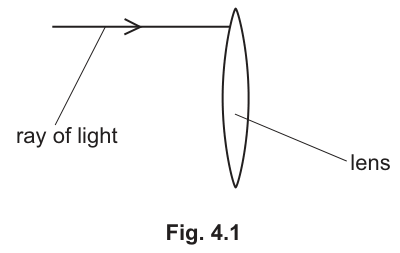
Fig. 4.1 shows a ray of light striking the left-hand surface of a thin glass converging lens.
Answer
- Light travels more slowly in glass than in air (or at a different speed).
- It enters an optically denser medium (or a medium with a different refractive index).
(Any two from the above. Accept: wavelength changes while frequency stays the same, or angle of incidence is greater than 0.)
Light travels more slowly in glass; it enters an optically denser medium.
Walkthrough
Refraction occurs when a wave crosses a boundary between two media with different optical densities. For light entering glass from air, two key things happen: the speed of light decreases because glass is optically denser than air, and the wavelength decreases while the frequency remains constant. Because the angle of incidence is not zero (the ray is not along the normal), this change in speed causes the ray to change direction. The mark scheme awards two marks for any two valid points from the list.
Key Takeaways
- Refraction is caused by a change in wave speed when crossing a boundary between media of different optical densities.
- Frequency remains constant across a boundary; speed and wavelength change together.
Common Mistakes
- Saying "light bends because it is heavier" or "gravity pulls it" — refraction is due to speed change, not mass or gravity.
- Saying "heat changes" — thermal effects are irrelevant here.
- Forgetting to mention the change in speed or density; just saying "it bends" is not enough for full marks.
Things to Be Careful About
- The mark scheme explicitly accepts "angle of incidence is greater than 0" as a reason. If the ray entered along the normal (angle of incidence = 0), it would not change direction even though it changes speed.
- Avoid vague terms like "different material"; use "optically denser" or "different refractive index".
Explain what is meant by:
Answer
The point where rays parallel to the principal axis meet (after refraction through the lens).
The point where rays parallel to the principal axis meet after refraction.
Walkthrough
For a thin converging lens, parallel rays of light (paraxial rays) that are parallel to the principal axis will be refracted by the lens and converge at a single point on the other side. This point is called the principal focus or focal point. The mark scheme requires the student to mention both "parallel rays" and "meet after refraction" to earn both marks.
Key Takeaways
- The principal focus is defined specifically for rays parallel to the principal axis.
- It is a real point for a converging lens where light actually meets.
Common Mistakes
- Saying "where all rays meet" — only parallel rays meet at the principal focus; rays from other points meet at other image points.
- Forgetting to say "after refraction" or "through the lens".
Things to Be Careful About
- Ensure the definition includes "parallel to the principal axis". Rays parallel to each other but not to the principal axis will meet at a point on the focal plane, not at the principal focus itself.
Answer
The distance between the principal focus (focal point) and the centre of the lens.
The distance between the principal focus and the centre of the lens.
Walkthrough
The focal length is a specific distance associated with the principal focus. It is measured from the optical centre (centre) of the thin lens to the principal focus. This is a standard definition.
Key Takeaways
- Focal length () is a distance, not a point.
- It is measured from the centre of the lens to the principal focus.
Common Mistakes
- Saying "distance from the focus to the object" — that is the object distance ().
- Saying "distance from the lens edge" — for a thin lens, we measure from the centre (optical centre).
Things to Be Careful About
- The unit of focal length is metres (m) or centimetres (cm), but the definition itself does not require units.
An object O of height is placed at a point to the left of the centre of the lens.
Fig. 4.2 is a full-scale diagram that shows the converging lens, its principal axis and its two principal focuses, and .
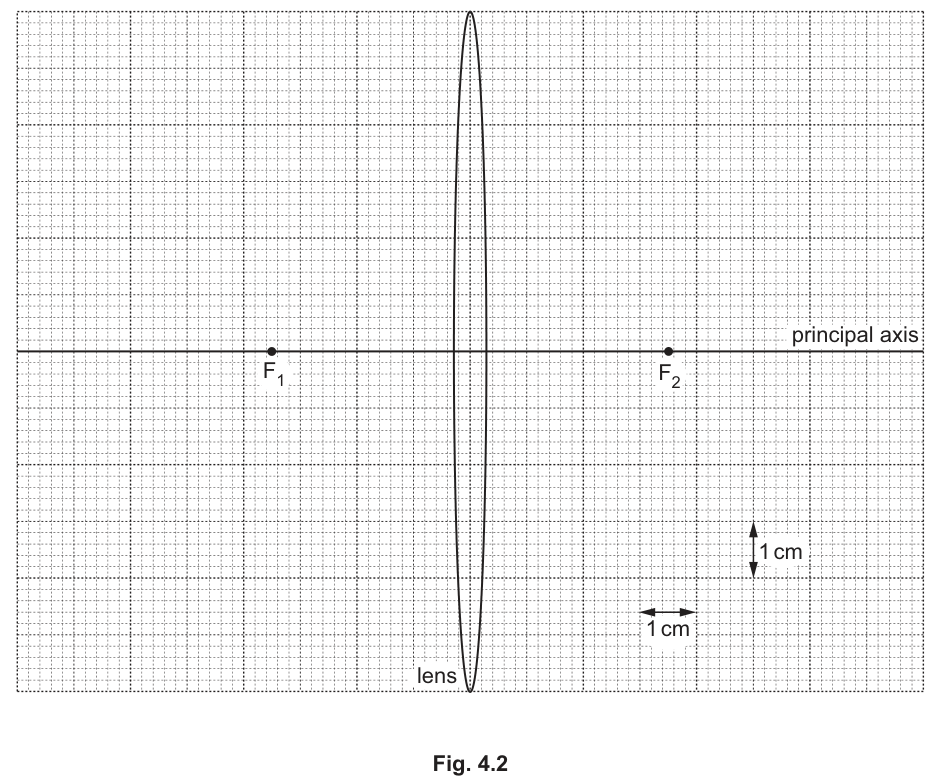
On Fig. 4.2, draw an arrow to represent the height and position of object O. The arrow should start on the principal axis.
Answer
Draw an upward-pointing arrow on the principal axis, 2.2 cm to the left of the centre of the lens, with a height of 1.8 cm.
Arrow 2.2 cm left of lens centre, height 1.8 cm.
Walkthrough
The question gives an object height of 1.8 cm and a position 2.2 cm to the left of the lens centre. Using the grid in Fig. 4.2, where each large square is 1 cm (as indicated by the scale markers), the student must count 2.2 cm to the left of the vertical lens line and draw an arrow 1.8 cm tall starting from the principal axis. The arrow should point upwards.
Key Takeaways
- Ray diagrams must be drawn to scale if a grid is provided.
- Object distance is measured from the centre of the lens.
Common Mistakes
- Placing the object at the wrong distance (e.g., measuring from the edge of the lens instead of the centre).
- Drawing the arrow downwards instead of upwards.
- Not starting the arrow on the principal axis.
Things to Be Careful About
- Read the scale carefully. The diagram shows 1 cm markers. 2.2 cm is 2 small squares and 1/5 of a small square if there are 5 subdivisions, or just estimate carefully. Ensure the height is exactly 1.8 cm.
On Fig. 4.2, draw two rays from the tip of the arrow drawn in (c)(i) to locate the position of the tip of the image I of object O.
Draw an arrow to represent the image I of the object O. Label the image I.
Answer
Three rays are drawn from the tip of object O:
- A ray parallel to the principal axis refracts through F₂.
- A ray through the centre of the lens continues straight.
- A ray directed towards F₁ refracts and emerges parallel to the principal axis.
The refracted rays on the right side of the lens are extended backwards (using dashed lines) to meet at a point on the left side. An upward-pointing arrow is drawn from the principal axis to this intersection point and labelled I.
See diagram. Virtual image I is upright, on the same side as the object, and further away.
Walkthrough
Since the object is placed inside the focal length (2.2 cm < focal length, which appears to be around 4-5 cm from the diagram), the image formed is virtual, upright, and magnified. To locate it:
- Ray 1: From the tip of O, draw a ray parallel to the principal axis to the lens. After refraction, it passes through F₂ on the right. Extend this refracted ray backwards (dashed line) to the left.
- Ray 2: From the tip of O, draw a ray straight through the optical centre of the lens. It continues in a straight line without deviation. Extend this backwards (dashed line) to the left.
- Ray 3: From the tip of O, draw a ray towards F₁ on the left. After refraction, it emerges parallel to the principal axis on the right. Extend this backwards (dashed line) to the left.
The three dashed lines will meet at a point on the left side, further away from the lens than the object. This is the tip of the virtual image I. Draw an arrow from the principal axis to this point and label it I.
Key Takeaways
- When the object is inside the focal point of a converging lens, the image is virtual and upright.
- Three standard rays are used to locate the image: parallel-to-axis, through-centre, and through-focus.
- Virtual images are located by extending refracted rays backwards with dashed lines.
Common Mistakes
- Drawing the refracted rays as solid lines continuing forward without extending them backwards.
- Forgetting to label the image I.
- Drawing the image arrow pointing downwards (inverted) — it must be upright.
- Not drawing the rays to scale; the intersection point must be accurate.
Things to Be Careful About
- Use a sharp pencil and ruler for accurate ray construction.
- Dashed lines must be used for the backward extensions; solid lines for actual light paths.
- The image will be larger than the object and on the same side as the object.
State whether the image I of the object O is a real or a virtual image, and explain your answer.
Answer
Virtual image. The light rays do not actually pass through the image position; they only appear to come from it (or: the object is placed within the focal length, or: the image is upright).
Virtual; the rays do not pass through the image (or object distance < focal length, or image is upright).
Walkthrough
A real image is formed when light rays actually converge at a point. A virtual image is formed when light rays diverge after passing through the lens, and they only appear to come from a point behind the lens (or on the same side as the object for a single lens). In this case, the refracted rays diverge, so we extend them backwards to find the image. Since the rays do not actually meet at the image location, it is a virtual image. Additionally, the image is upright and the object is inside the focal length, both of which are characteristics of a virtual image formed by a converging lens.
Key Takeaways
- Real images: rays actually meet, can be projected on a screen, usually inverted.
- Virtual images: rays only appear to meet (extended backwards), cannot be projected on a screen, usually upright.
- For a converging lens, a virtual image is formed when the object is inside the focal length.
Common Mistakes
- Saying "real" because the rays meet — they only meet if extended backwards with dashed lines.
- Giving no reason, or giving an incorrect reason like "it is on the same side as the object" without explaining why that makes it virtual.
Things to Be Careful About
- The mark scheme accepts multiple valid reasons: rays do not pass through the image, object distance < focal length, or image is upright. Any one of these paired with "virtual" scores the mark.
An iron beaker containing liquid X is placed on the bench in a laboratory.
Liquid X begins to evaporate slowly.
Answer
The fastest-moving particles have the highest kinetic energy and escape from the liquid. This removes energy from the liquid, so the average kinetic energy of the remaining particles decreases, causing the temperature to fall.
The fastest particles escape, taking kinetic energy with them. The average kinetic energy of the remaining particles decreases, lowering the temperature.
Walkthrough
Evaporation is a surface phenomenon where particles with enough kinetic energy to overcome intermolecular forces escape from the liquid into the air. Because the fastest (highest energy) particles leave, the average kinetic energy of the particles remaining in the liquid drops. Since temperature is a measure of average kinetic energy, the temperature of the liquid decreases. This is known as evaporative cooling.
Key Takeaways
- Evaporation preferentially removes high-energy particles from a liquid.
- Temperature is proportional to average kinetic energy; removing high-energy particles lowers the average.
Common Mistakes
- Saying 'heat escapes' instead of 'particles with high kinetic energy escape'.
- Saying 'temperature decreases because energy is lost' without linking it to average kinetic energy.
Things to Be Careful About
- The mark scheme specifically looks for 'fastest moving particles' or 'high kinetic energy' escaping, and 'average kinetic energy decreases'. Don't just say 'energy is removed' without the particle explanation.
The iron beaker containing liquid X is placed on an induction heater as shown in Fig. 5.1.
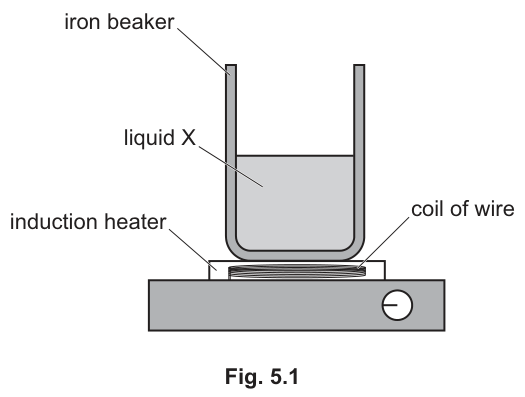
The induction heater contains a coil of wire in which there is a high-frequency alternating current (a.c.).
The alternating current in the coil generates a current in the base of the iron beaker by electromagnetic induction.
Explain how electromagnetic induction generates the current in the base of the iron beaker.
Answer
The alternating current in the coil produces a changing magnetic field. This changing magnetic field passes through the base of the iron beaker and induces an e.m.f. in it, which drives a current.
The a.c. in the coil produces a changing magnetic field, which induces an e.m.f. in the base of the beaker, causing a current to flow.
Walkthrough
An induction heater works by passing a high-frequency alternating current (a.c.) through a coil of wire. This a.c. produces a magnetic field that is constantly changing in magnitude and direction. When this changing magnetic field passes through the conductive iron base of the beaker, it induces an electromotive force (e.m.f.) in the base according to Faraday's law of electromagnetic induction. Because the iron base is a conductor, this induced e.m.f. drives a current (eddy currents) through it, which heats the base due to electrical resistance.
Key Takeaways
- A.c. in a coil produces a changing magnetic field.
- A changing magnetic field through a conductor induces an e.m.f.
- The induced e.m.f. drives a current in the conductor.
Common Mistakes
- Forgetting to mention that the magnetic field must be changing or alternating. A steady magnetic field does not induce an e.m.f.
- Saying 'induces a current' without first stating that an e.m.f. is induced. The e.m.f. is the cause, the current is the effect.
Things to Be Careful About
- The mark scheme awards marks for: (1) magnetic field of coil, (2) magnetic field is changing/alternating, (3) e.m.f. in container. Ensure all three are stated clearly in order.
The current in the base of the iron beaker causes the base to become hot. The temperature of the liquid at point P just above the base increases.
Fig. 5.2 shows the position of point P.
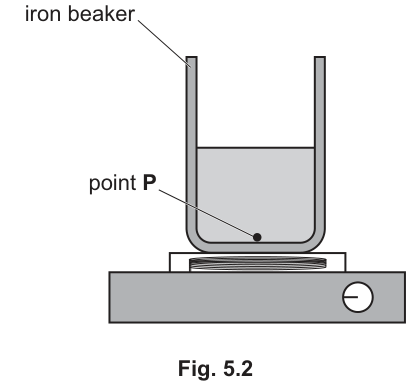
Explain, in terms of particles, why the density of liquid X decreases as its temperature increases.
Answer
As the temperature increases, the particles gain kinetic energy and move faster. They push each other further apart, which increases the volume of the liquid. Since the mass remains constant, the density decreases.
The particles move faster and push each other further apart, increasing the volume of the liquid. With constant mass, the density decreases.
Walkthrough
When the liquid at point P is heated, thermal energy is transferred to the particles, increasing their kinetic energy. As they move faster, they collide more forcefully and push each other further apart. This increased separation between particles means the overall volume of the liquid increases. Density is defined as mass divided by volume (). Since the mass of the liquid does not change but its volume increases, the density must decrease.
Key Takeaways
- Heating increases particle kinetic energy and speed.
- Faster particles push each other apart, increasing volume (thermal expansion).
- Constant mass with increased volume results in decreased density.
Common Mistakes
- Saying 'particles expand'. Particles themselves do not expand; the space between them increases.
- Forgetting to mention that mass is constant when explaining why density decreases.
Things to Be Careful About
- The question asks for an explanation 'in terms of particles'. You must mention particle speed/motion and the space between them. The mark scheme awards marks for: (1) speed of particles increases, (2) particles push each other apart, (3) volume of liquid increases.
The decrease in the density of the liquid at point P causes the transfer of thermal energy throughout liquid X.
Explain how this happens.
Answer
The less dense, heated liquid at point P rises. The denser, cooler liquid from above sinks to replace it, establishing a convection current that transfers thermal energy throughout the liquid.
The less dense heated liquid rises and the denser cooler liquid sinks, establishing a convection current that transfers thermal energy.
Walkthrough
Because the liquid at point P (near the hot base) has decreased in density, it becomes lighter than the cooler liquid above it. Buoyancy causes the less dense, heated liquid to rise towards the surface. As it rises, the cooler, denser liquid at the surface moves down to take its place. This continuous cycle of rising warm fluid and sinking cool fluid is called a convection current, and it is the primary mechanism for transferring thermal energy through liquids and gases.
Key Takeaways
- Convection occurs due to density differences in fluids.
- Less dense (heated) fluid rises; denser (cooler) fluid sinks.
- This creates a convection current that transfers thermal energy.
Common Mistakes
- Saying 'heat rises'. Heat does not rise; the less dense fluid rises, carrying thermal energy with it.
- Forgetting to mention that the cooler/denser liquid sinks to replace the rising liquid.
Things to Be Careful About
- The mark scheme awards marks for: (1) less dense/heated liquid rises, (2) denser/cooler liquid sinks or convection current established. Ensure both the rising and sinking aspects are covered.
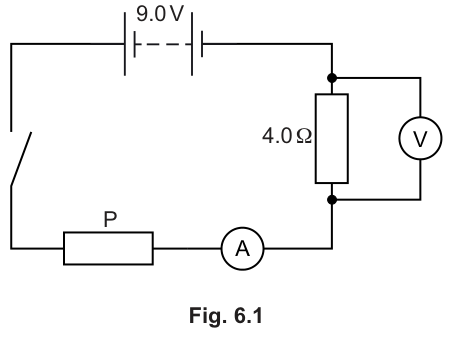
A circuit consists of a battery of e.m.f. , a switch, a resistor P, an ammeter, a resistor and a voltmeter.
Fig. 6.1 is the circuit diagram of the circuit.
Answer
potential difference across a component is directly proportional to the current in it (at constant temperature)
potential difference across a component is directly proportional to the current in it at constant temperature
Walkthrough
Ohm's law states that the potential difference (p.d.) across a conductor is directly proportional to the current flowing through it, provided that the temperature and other physical conditions remain constant. The mark scheme awards one mark for the proportionality statement and one mark for the constant temperature condition. Both must be stated to earn full marks.
Key Takeaways
- Ohm's law is for an ohmic conductor at constant temperature.
- Always include the "constant temperature" condition when stating Ohm's law, as resistance changes with temperature for many materials.
Common Mistakes
- Stating "voltage is proportional to current" without specifying "across a component" or "in a component".
- Forgetting the "at constant temperature" condition, which is a separate mark in the scheme.
- Saying "current is proportional to voltage" is acceptable, but the proportionality must be clear.
Things to Be Careful About
- The question asks to "State" Ohm's law, so no calculation is needed. Just write the two required statements clearly.
Resistor P is a cylinder of length , made from conducting modelling clay.
Fig. 6.2 shows resistor P.
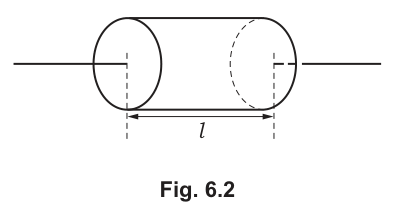
P has a resistance of .
The switch in the circuit in Fig. 6.1 is closed.
Calculate the reading on the ammeter.
ammeter reading = ______
Working
Answer
0.75 A
0.75 A
Walkthrough
The circuit consists of resistor P () and the resistor connected in series. The total resistance is the sum of the two: . Using Ohm's law (), the current flowing from the battery is . The ammeter reads this current.
Key Takeaways
- Resistors in series add together: .
- The current is the same everywhere in a series circuit and is given by .
Common Mistakes
- Forgetting to add the two resistances and using only or in the denominator.
- Using the wrong voltage value (e.g., using the p.d. across one resistor instead of the battery e.m.f.).
Things to Be Careful About
- Ensure units are consistent: resistance in and voltage in V gives current in A.
- The ammeter is in series, so it reads the total circuit current.
Calculate the power transferred electrically to resistor P.
power transferred = ______
Working
Answer
4.5 W
4.5 W
Walkthrough
The power transferred to resistor P can be calculated using . We already know the current . The p.d. across resistor P is . Multiplying these gives . Alternatively, .
Key Takeaways
- Power can be calculated as , , or .
- The voltage in must be the p.d. across the specific component (resistor P), not the total battery voltage.
Common Mistakes
- Using the battery voltage () instead of the p.d. across resistor P () in the formula.
- Forgetting to square the current if using .
Things to Be Careful About
- The question asks for power transferred to resistor P specifically, so use the values relevant to P.
Resistor P is removed from the circuit.
The conducting modelling clay from resistor P is reshaped to make a second cylindrical resistor that has the same volume as resistor P but has a length .
Fig. 6.3 shows the reshaped resistor.
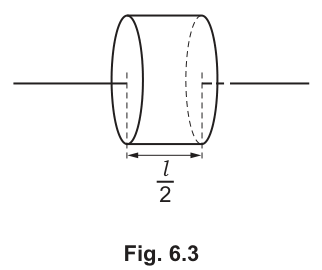
Calculate the resistance of the reshaped resistor.
resistance of reshaped resistor = ______
Working
Volume is constant, so if the length is halved (), the cross-sectional area must double.
Answer
2.0 Ω
2.0 Ω
Walkthrough
The resistance of a wire is given by , where is the resistivity, is the length, and is the cross-sectional area. The volume of the cylinder is . Since the volume is constant and the new length is , the new area must be to keep the same. Substituting these into the resistance formula: . Thus, .
Key Takeaways
- Resistance is directly proportional to length and inversely proportional to cross-sectional area.
- If volume is constant, halving the length doubles the area, reducing resistance by a factor of 4.
Common Mistakes
- Forgetting that area also changes when length changes for a constant volume.
- Assuming resistance is halved just because length is halved.
Things to Be Careful About
- The material is the same, so resistivity is unchanged. Only geometry changes.
The reshaped resistor is connected into the circuit instead of resistor P.
Calculate the new reading on the voltmeter. Show your working.
voltmeter reading = ______
Working
Answer
6.0 V
6.0 V
Walkthrough
The voltmeter is connected in parallel across the resistor (resistor Q). This is a potential divider circuit. The voltage across resistor Q is given by . Substituting the values: . Alternatively, find the new current: , then .
Key Takeaways
- A series circuit acts as a potential divider: the voltage across a resistor is proportional to its resistance.
- The potential divider formula is .
Common Mistakes
- Using the old resistance of resistor P () instead of the new resistance ().
- Calculating the voltage across resistor P instead of the voltmeter reading (which is across the resistor).
Things to Be Careful About
- The voltmeter is across the resistor, not resistor P. Read the diagram carefully.
An insulating rod is made of plastic and is initially uncharged. The rod is rubbed with a cloth and becomes negatively charged.
Answer
Electrons move from the cloth to the rod.
Electrons move from the cloth to the rod.
Walkthrough
When an insulating rod is rubbed with a cloth, friction causes electrons to be transferred between the two materials. Because the rod becomes negatively charged, it must have gained negatively charged particles. In solids, the particles that can move are electrons; protons are bound in the nucleus and cannot transfer. Therefore, electrons move from the cloth to the rod, leaving the cloth positively charged and the rod negatively charged.
Key Takeaways
Charging by friction always involves the transfer of electrons, never protons. A negatively charged object has an excess of electrons, while a positively charged object has a deficit.
Common Mistakes
Students often write 'charge moves' without specifying the particle, or say 'electrons move from the rod to the cloth' (the reverse direction). Protons are sometimes incorrectly stated to move.
Things to Be Careful About
The question asks for the explanation 'in terms of particles', so the word 'electrons' must be used. Saying 'negative charge moves' is not accepted on its own; the particle must be named.
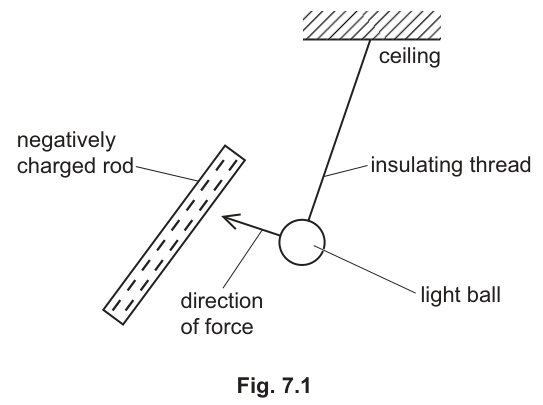
A light ball has a thin conducting surface. The ball is suspended from the ceiling by an insulating thread. The ball is not charged.
The negatively charged rod is brought close to the ball.
Fig. 7.1 shows that the ball experiences a force attracting it towards the negatively charged rod.
Explain, in terms of particles, how an electrical conductor differs from an electrical insulator.
Answer
In a conductor, electrons are free to move.
Electrons are free to move.
Walkthrough
The fundamental difference between a conductor and an insulator at the particle level is the mobility of the charge carriers. In conducting materials (like metals), the outer electrons of the atoms are not bound to any single atom and can move freely throughout the material. In insulators, all electrons are tightly bound to their atoms and cannot move from place to place.
Key Takeaways
Conductors have free electrons that can move; insulators do not. This mobility is what allows charge to redistribute in conductors.
Common Mistakes
Saying 'current can flow' or 'resistance is low' does not answer the question 'in terms of particles'. The answer must specifically mention free electrons.
Things to Be Careful About
The question specifically asks for the explanation 'in terms of particles', so mentioning free electrons is essential.
The conducting surface of the ball contains both negatively charged particles and positively charged particles.
Explain what happens to the negatively charged particles and to the positively charged particles as the rod is brought close to the ball.
Answer
Like charges repel, so the negative charges (electrons) in the ball are repelled by the negatively charged rod and move to the right-hand side of the ball. The positive charges (protons) cannot move, so the left-hand side of the ball is left with a net positive charge.
The negative charges (electrons) are repelled and move to the right side of the ball, while the positive charges (protons) cannot move, leaving the left side positively charged.
Walkthrough
The ball has a conducting surface, meaning it contains both positive charges (protons in the nuclei) and negative charges (free electrons). When the negatively charged rod is brought near the left side of the ball, the negative charges in the ball experience a repulsive force because like charges repel. Since the ball is a conductor, these free electrons move away from the rod to the right-hand side of the ball. The positive charges (protons) are bound in the atomic nuclei and cannot move. As the electrons leave the left side, that region is left with an excess of positive charge.
Key Takeaways
Electrostatic induction in a conductor causes a separation of charge: free electrons move away from a like external charge, leaving the near side oppositely charged.
Common Mistakes
Saying 'positive charges move to the left' is incorrect; protons do not move in solids. Saying 'the ball becomes positively charged' is incorrect; the ball as a whole remains neutral, the charge is just redistributed.
Things to Be Careful About
Be precise about which charges move and which do not. The question states the ball contains both, so you must address the behaviour of both. Mentioning 'like charges repel' provides the physical reason for the electron movement.
Answer
Unlike (opposite) charges attract. The positive charges on the left side of the ball are closer to the negatively charged rod than the negative charges on the right side. Therefore, the attractive force between the rod and the positive charges is stronger than the repulsive force between the rod and the negative charges, resulting in a net force towards the rod.
The positive charges are closer to the rod than the negative charges, so the attractive force is stronger than the repulsive force.
Walkthrough
After the charge separation in part (ii), the left side of the ball is positive and the right side is negative. The negatively charged rod attracts the positive charges and repels the negative charges. However, the positive charges are physically closer to the rod than the negative charges. The electrostatic force between two charges decreases with increasing distance. Because the distance to the positive charges is smaller, the attractive force is stronger than the repulsive force acting on the more distant negative charges. The resultant (net) force is therefore attractive, pulling the ball towards the rod.
Key Takeaways
Even a neutral object is attracted to a charged object due to electrostatic induction and the distance-dependence of the electrostatic force. The closer opposite charge always experiences a stronger force than the further like charge.
Common Mistakes
Saying 'the ball is neutral so it is attracted' is not a full explanation. Saying 'the rod pulls the positive charges' without mentioning the repulsion of the negative charges and the distance argument misses the mark. Simply stating 'unlike charges attract' is only one of the two required marks.
Things to Be Careful About
The question asks why the resultant force is towards the rod. You must mention both the attractive force on the closer positive charges and the repulsive force on the further negative charges, and explain why the attraction wins (distance).
The nuclide notation for the radioactive isotope radon-222 is .
An atom of radon-222 decays by the emission of an alpha particle (-particle).
Describe how the composition of an atom of radon-222 differs from that of an atom of radon-224.
Answer
- Radon-222 has two fewer neutrons than radon-224 (radon-222 has neutrons whereas radon-224 has neutrons).
- Both atoms have the same number of protons ( protons) and electrons ( electrons).
Radon-222 has two fewer neutrons than radon-224 (136 neutrons compared to 138 neutrons)
Walkthrough
Isotopes of an element share the same chemical identity because they have the same proton number (atomic number, ). Therefore, both radon-222 and radon-224 have protons and, as neutral atoms, electrons.
The nucleon number (mass number, ) represents the total number of protons and neutrons:
- For radon-222:
- For radon-224:
Thus, an atom of radon-222 has fewer neutrons (or nucleons) than an atom of radon-224.
Key Takeaways
- Isotopes have the same number of protons (and electrons) but different numbers of neutrons.
- Nucleon number .
Common Mistakes
- Stating that the number of protons differs (isotopes always have identical proton numbers).
- Merely stating that they have different masses without specifying that the difference lies in the number of neutrons.
Things to Be Careful About
- Ensure you specify which isotope has more or fewer neutrons (e.g. radon-222 has fewer neutrons than radon-224).
Radon-222 decays to an isotope of polonium (Po).
Complete the nuclide equation for the decay of radon-222.
Working
An alpha particle is a helium nucleus: .
Balancing nucleon numbers (top row):
Balancing proton numbers (bottom row):
Answer
Walkthrough
In nuclear equations, two conservation laws must be satisfied:
- Conservation of nucleon number (mass number): The sum of top numbers before the reaction must equal the sum of top numbers after the reaction.
- Conservation of proton number (atomic number/charge): The sum of bottom numbers before the reaction must equal the sum of bottom numbers after the reaction.
An alpha particle () consists of protons and neutrons, so its nuclide notation is (or ).
Applying conservation:
- Top row:
- Bottom row:
Hence, the resulting polonium nuclide is .
Key Takeaways
- Alpha emission reduces the nucleon number by and the proton number by .
- Always check that both the top and bottom rows balance independently.
Common Mistakes
- Confusing the notation of alpha particles with beta particles ().
- Adding instead of subtracting numbers on the product side.
Things to Be Careful About
- Ensure the numbers are written clearly as superscripts and subscripts in front of the respective chemical symbols.
Radon-222 is used in an alpha-particle scattering experiment.
Fig. 8.1 shows a beam of alpha particles from radon-222 hitting a very thin sheet of gold in a vacuum.
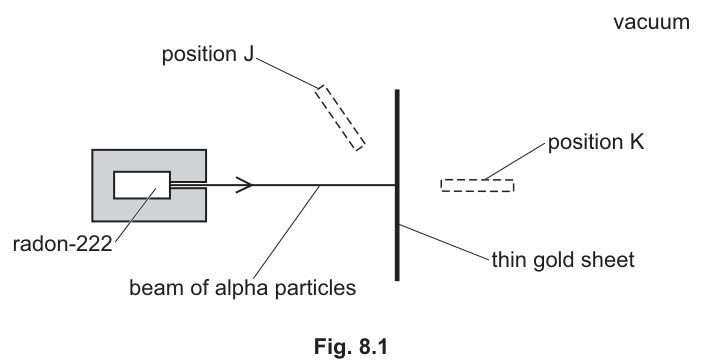
An alpha-particle detector is moved around in the vicinity of the gold sheet. Two positions of the detector, J and K, are shown.
Describe what is observed when the detector is at position J and when it is at position K.
position J ______
position K ______
Answer
- position J: A small count rate is detected (some -particles are deflected through large angles / backscattered).
- position K: A very large count rate is detected (most / nearly all -particles pass straight through undeflected).
position J: small count rate / some alpha particles deflected through large angles; position K: very high count rate / most alpha particles pass straight through
Walkthrough
In the Rutherford alpha-particle scattering experiment:
- Position K is directly in line behind the thin gold foil. The vast majority of alpha particles pass straight through the gold sheet without any deflection, resulting in a very high count rate at detector position K.
- Position J is at a large angle (backwards/side deflection). Only a very tiny fraction of alpha particles encounter a close electrostatic repulsion with a gold nucleus and are deflected through large angles (greater than ), so detector J registers a very low (but non-zero) count rate.
Key Takeaways
- Most alpha particles pass straight through with little or no deflection.
- A very small proportion are deflected through large angles.
Common Mistakes
- Stating that zero particles reach position J (it must be noted that some particles are detected, i.e. count rate is not zero).
- Confusing the count rates at J and K.
Things to Be Careful About
- Clearly distinguish between position J (large-angle deflection / side) and position K (straight through).
Answer
- Most of the atom is empty space (which allows most -particles to pass through undeflected).
- The atom has a very small, dense, positively charged nucleus where most of the mass and charge of the atom is concentrated (causing large deflections when positively charged -particles approach closely).
Most of the atom is empty space; the atom has a tiny, dense, positively charged nucleus containing most of its mass and charge
Walkthrough
The observations from the scattering experiment lead to fundamental conclusions about atomic structure:
- Most alpha particles pass straight through undeflected (Position K): This proves that the atom consists mostly of empty space.
- A small number of alpha particles are deflected through large angles (Position J): Since alpha particles are positively charged and relatively massive, large deflections can only be caused by a strong repulsive electrostatic force. This shows that the positive charge and most of the atom's mass are concentrated in a very small, dense central region called the nucleus.
Key Takeaways
- Straight-through transmission atom is mostly empty space.
- Large-angle deflection / backscattering mass and positive charge are concentrated in a tiny, dense nucleus.
Common Mistakes
- Claiming the nucleus contains electrons.
- Stating that the atom is completely solid or dense throughout (the plum pudding model).
Things to Be Careful About
- Awarding two distinct marks: one for the atom being mostly empty space, and one for the concentrated mass/charge (nucleus).
An object moves through space. It is a large distance from any other object.
There are no external forces acting on the object.
Describe two features of the motion of the object that are a consequence of Newton’s first law.
- ______
- ______
Answer
- The speed is constant.
- The motion is in a straight line.
Speed is constant and motion is in a straight line
Walkthrough
Newton's first law states that an object will continue in its state of rest or uniform motion in a straight line unless acted upon by a resultant external force. If there are no external forces (resultant force is zero), the object cannot accelerate. Acceleration involves a change in speed, a change in direction, or both. Therefore, with no resultant force, both speed and direction must remain constant.
Key Takeaways
Newton's first law implies constant velocity (constant speed in a straight line) when the resultant force is zero.
Common Mistakes
Saying 'no forces' instead of 'resultant force is zero'. Saying 'it moves at a constant speed' without mentioning the straight line, or vice versa. Both are needed for full marks.
Things to Be Careful About
The question asks for two features. Speed constant and straight line are the two. Velocity is constant, but the mark scheme splits it into speed and direction (straight line).
Planet X and Venus are two of the planets in the Solar System.
Fig. 9.1 shows the orbit of Venus and the orbit of planet X. Both orbits are approximately circular.
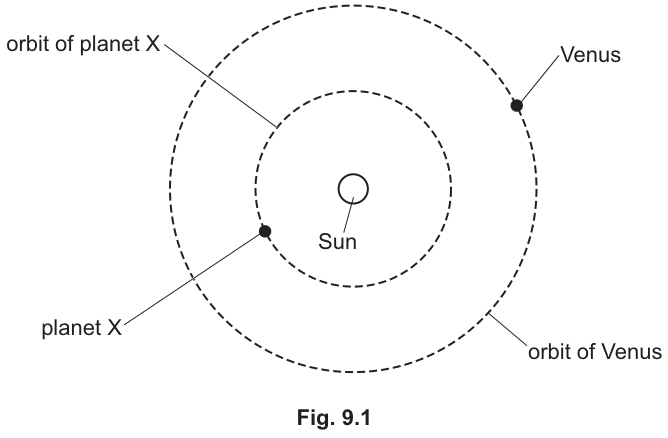
Venus experiences an external force as it orbits the Sun.
State why a force must act on Venus to keep it following an approximately circular orbit.
Answer
A force is needed to change the direction of the velocity (of Venus); otherwise it would move in a straight line.
To change the direction of the motion / velocity
Walkthrough
Velocity is a vector quantity, having both magnitude (speed) and direction. In a circular orbit, even if the speed is constant, the direction of motion is continuously changing. A change in velocity means there is an acceleration. According to Newton's first law, a resultant force is required to produce this acceleration. Thus, a force must act to continuously change the direction of Venus's motion, preventing it from moving off in a straight line tangent to the orbit.
Key Takeaways
Circular motion requires a force because the direction of velocity is constantly changing.
Common Mistakes
Saying 'to keep it moving' or 'to overcome inertia'. Inertia is not a force. The force is needed to change the direction, not to keep it moving.
Things to Be Careful About
Be precise: it's a change in direction of motion (or velocity), not necessarily speed.
State what causes this force, and state the direction of the force.
cause ______
direction ______
Answer
cause: gravitational field (of the Sun) / gravitational attraction / gravity
direction: towards the centre of the circle / towards the Sun / inward
Gravitational attraction of the Sun; towards the Sun
Walkthrough
The force that keeps planets in orbit is the gravitational attraction between the planet and the Sun. This is a gravitational field force exerted by the Sun. Because gravity is an attractive force, it pulls the planet towards the source of the field, which is the centre of the Sun (or the centre of the circular orbit).
Key Takeaways
Planetary orbits are maintained by the Sun's gravitational pull directed towards the Sun.
Common Mistakes
Saying 'gravity' without specifying it is the gravitational field of the Sun. Saying 'centrifugal force' (not a real force in this context). Giving the direction as 'outwards' or 'away from the Sun'.
Things to Be Careful About
The mark scheme awards marks for 'gravitational field', 'gravitational attraction', or 'gravity', provided it is specified as being of the Sun. The direction must be 'towards the centre' or 'towards the Sun'.
The average radius of the orbit of Venus is . It takes Venus to complete one orbit of the Sun.
Calculate the average orbital speed of Venus around the Sun.
speed = ______
Working
Rounding to 2 significant figures:
Answer
3.6 x 10^4
Walkthrough
The orbit is approximately circular, so the distance travelled in one complete orbit is the circumference of the circle, . The time taken is the orbital period, . Speed is distance divided by time. First, convert the time from hours to seconds: . Then calculate the circumference: . Finally, divide the distance by the time: . Rounding to 2 significant figures gives .
Key Takeaways
Orbital speed can be calculated using . Always ensure time is in standard SI units (seconds) before calculating.
Common Mistakes
Forgetting to convert hours to seconds. Using the diameter instead of the circumference. Rounding to too many or too few significant figures (the given radius has 2 s.f., so the answer should be 2 s.f.).
Things to Be Careful About
Ensure the calculator is in the correct mode for . Write the final answer in standard form as indicated by the mark scheme and the magnitude of the number.
Planet X is closer to the Sun than Venus.
State the name of planet X and state how its orbital speed around the Sun compares with the orbital speed of Venus.
name ______
speed ______
Answer
name: Mercury
speed: greater (than that of Venus)
Mercury; greater
Walkthrough
Looking at the Solar System, the planet closest to the Sun is Mercury. In the diagram, planet X is in the inner orbit, closer to the Sun than Venus. Therefore, planet X is Mercury. For planets orbiting the Sun, the closer a planet is to the Sun, the stronger the gravitational pull it experiences, and the faster it must travel to maintain a stable orbit. Thus, Mercury's orbital speed is greater than Venus's.
Key Takeaways
Planets closer to the Sun have smaller orbital radii and higher orbital speeds.
Common Mistakes
Naming the wrong planet (e.g., Mars or Earth). Stating that the speed is 'less' or 'the same' as Venus. Forgetting to specify 'greater than that of Venus' and just writing 'greater'.
Things to Be Careful About
Ensure you know the order of the planets: Mercury, Venus, Earth, Mars, Jupiter, Saturn, Uranus, Neptune. Planet X is the innermost orbit shown, which corresponds to Mercury.