Physics 5054/22 — October/November 2024
Cambridge O-Level · Theory · worked solutions for every part, with the mark scheme
Topics Energy, Work and Power · Forces · Pressure · Momentum · Mass, Weight and Density · Transfer of Thermal Energy · +10 more
A jet ski is a type of boat that carries one or two people and travels at high speed on water.
Fig. 1.1 shows a student riding on a jet ski.
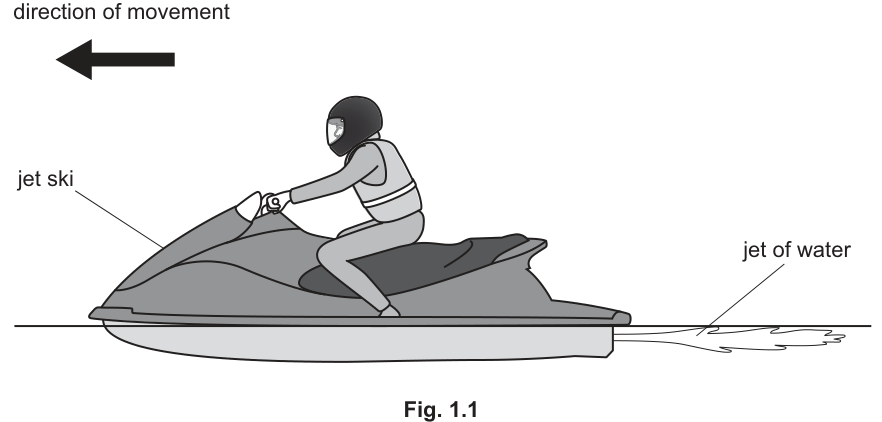
A high-speed jet of water is forced backwards out of the back of the jet ski by a pump inside the jet ski.
The pump increases the momentum of the water that is forced backwards out of the back of the jet ski.
Complete the word equation to show the relationship between the resultant force on an object and the change in momentum of the object.
Answer
increase in momentum / unit time
(or rate of increase in momentum)
increase in momentum / unit time
Walkthrough
The question asks for the word equation linking resultant force to momentum. Newton's second law can be stated as , which in words is 'resultant force equals the rate of change of momentum' or 'increase in momentum per unit time'.
Key Takeaways
Force is the rate of change of momentum. This is the more general form of Newton's second law, equivalent to when mass is constant.
Common Mistakes
Writing 'mass times acceleration' is not the word equation for momentum. The scheme specifically accepts 'increase in momentum / unit time' or 'rate of increase in momentum'.
Things to Be Careful About
Ensure the wording matches the mark scheme exactly. 'Change in momentum over time' is acceptable, but 'momentum divided by time' is not precise enough as it ignores the change in momentum.
In , the pump increases the backwards speed of of water by .
Calculate the backwards force exerted on the water.
force = ______
Working
Answer
2700
2700
Walkthrough
The pump increases the speed of of water by in . The change in momentum is . The force is the rate of change of momentum: . Alternatively, calculate the acceleration , then use .
Key Takeaways
Force can be calculated directly from the mass, change in velocity, and time using . This is equivalent to finding the acceleration first and then using .
Common Mistakes
Forgetting to divide by the time interval, or using the wrong mass (e.g., the mass of the jet ski instead of the water).
Things to Be Careful About
The question asks for the force on the water, so use the mass of the water (), not the total mass of the jet ski and student. The unit is newtons (N), which is already provided in the answer blank.
Using Newton's third law of motion, explain why there is a forwards force on the jet ski.
Answer
The pump (or jet ski) exerts a backwards force on the water.
By Newton's third law, the water exerts an equal and opposite (forwards) force on the pump (or jet ski).
The water exerts an equal and opposite force on the jet ski
Walkthrough
Newton's third law states that when two bodies interact, the forces they exert on each other are equal in magnitude and opposite in direction. The jet ski's pump pushes the water backwards (the action force). Therefore, the water pushes back on the pump/jet ski with an equal force in the opposite direction (the reaction force), which is forwards.
Key Takeaways
Newton's third law pairs always act on different objects. The action and reaction forces are equal in size and opposite in direction.
Common Mistakes
Saying 'the water pushes back' without specifying that the forces are equal and opposite. Stating that the forces act on the same object (e.g., 'the forces on the water cancel out') is incorrect; they act on different objects.
Things to Be Careful About
The mark scheme specifically looks for the word 'opposite' to describe the direction of the reaction force. 'Forwards' is also acceptable if 'opposite' is used, but 'opposite' is the key scientific term here.
The student has a mass of and the jet ski has a mass of .
Use your answer from (a)(ii) to determine the acceleration of the student and jet ski when no resistive forces are acting.
acceleration = ______
Working
Answer
7.7
7.7
Walkthrough
The forwards force on the jet ski is equal in magnitude to the backwards force on the water, so . The total mass being accelerated is the mass of the student plus the mass of the jet ski: . Using Newton's second law, , which rounds to .
Key Takeaways
When applying , the mass must be the total mass of the object or system being accelerated by the resultant force .
Common Mistakes
Using only the mass of the jet ski () or only the mass of the student () instead of the total combined mass. Forgetting to add the masses together.
Things to Be Careful About
The force calculated in (a)(ii) is the force on the water. By Newton's third law, the force on the jet ski is equal in magnitude (). Always use the total mass of the system when calculating acceleration.
The jet ski reaches a speed of .
Calculate the total kinetic energy of the student and jet ski at this speed.
kinetic energy = ______
Working
Answer
70000
70000
Walkthrough
The total kinetic energy of the student and jet ski is calculated using the formula . The total mass is and the speed is . Substituting these values gives .
Key Takeaways
Kinetic energy depends on both the mass and the square of the speed. Always use the total mass of the moving system.
Common Mistakes
Using only the mass of the jet ski or the student. Forgetting to square the velocity. Forgetting the factor in the formula.
Things to Be Careful About
Ensure the mass is in kilograms and the speed is in metres per second to get the energy in joules. The answer should be given to a sensible number of significant figures; or are both acceptable.
A glass beaker of mass is at rest on a horizontal surface.
The base of the beaker is a circle with a radius .
The beaker exerts a pressure on the horizontal surface.
Determine an expression for the pressure in terms of the gravitational field strength , and .
Working
Answer
mg / (πr^2)
Walkthrough
To find the pressure exerted by the beaker on the horizontal surface, we use the definition of solid pressure:
- Identify the downward force: The force pressing downwards on the surface is the weight of the beaker. Weight is calculated using the mass and the gravitational field strength :
- Identify the contact area: The base of the beaker is circular with a radius , so the contact area is given by the area formula for a circle:
- Combine the expressions: Substitute force and area into the pressure formula:
Key Takeaways
- Solid pressure is defined as force per unit area: .
- On a horizontal surface, the normal force exerted by a resting object is equal to its weight ().
- The contact area of a circular face is .
Common Mistakes
- Confusing diameter and radius, or writing (the circumference) instead of for the area.
- Using mass directly in place of force/weight instead of .
Things to Be Careful About
- Ensure the final expression is written strictly in terms of the given variables: , , and .
Fig. 2.1 shows the beaker being filled with a liquid from container X.
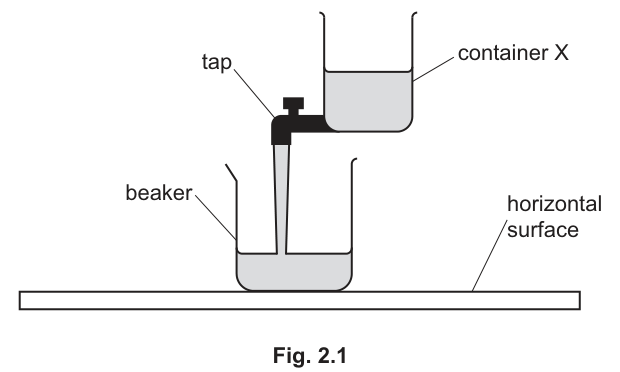
Initially, the beaker is empty.
At time , the tap is opened and liquid from container X flows slowly into the beaker at a constant rate.
At time , the liquid stops flowing into the beaker.
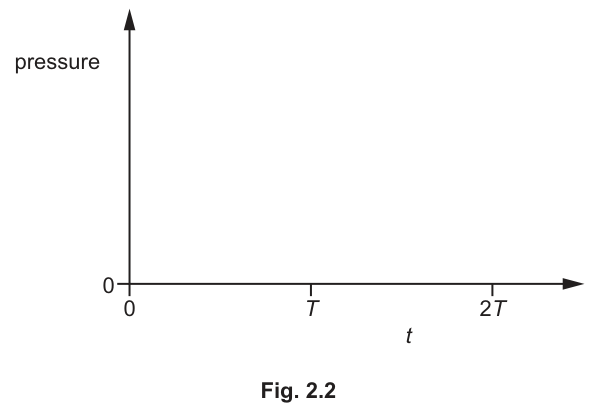
Sketch on Fig. 2.2 to show how the pressure exerted on the horizontal surface varies between and .
Answer
On Fig. 2.2, draw:
- A line starting at an intercept on the vertical axis greater than zero (at ).
- A straight line with a constant positive gradient from to .
- A horizontal straight line from to continuing from the value reached at .
Graph with non-zero y-intercept at t = 0, straight line with positive gradient from t = 0 to t = T, and horizontal line from t = T to t = 2T
Walkthrough
Let us break down how the pressure changes over the three key time intervals:
-
At time :
The beaker is empty, but it still has a mass . Therefore, the initial pressure is non-zero:The line must start at a positive value on the vertical 'pressure' axis, not at the origin .
-
Between and :
Liquid flows in at a constant rate (mass per unit time is constant). Since the contact area is constant, the total weight and therefore the pressure increase at a constant rate. A constant rate of increase produces a straight line with a positive gradient. -
Between and :
The tap is closed at , so no more liquid enters the beaker. The total mass remains constant, which means the total force and contact area remain unchanged. The pressure remains constant from to , represented by a horizontal straight line.
Key Takeaways
- When sketching graphs from physical descriptions, always consider the initial conditions (), the rate of change during dynamic processes, and the steady state when processes end.
- Constant rate of mass addition to a constant area results in a constant gradient (straight line).
Common Mistakes
- Starting the line from the origin , forgetting that the empty beaker itself has mass and exerts pressure.
- Drawing a curved line between and instead of a straight line, missing that the flow rate is constant.
- Allowing the line to drop back to zero after , confusing stopping the flow with emptying the beaker.
Things to Be Careful About
- The transition at should be clear: the straight rising line should meet the horizontal line precisely at , and the horizontal line must extend all the way to .
Fig. 3.1 shows a laboratory freezer.
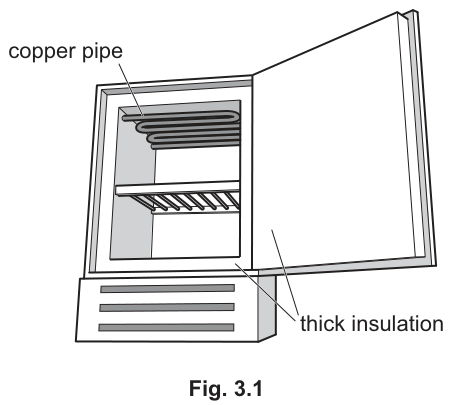
The door is closed and the freezer is switched on.
A cold liquid is pumped through the copper pipe at the top of the freezer.
The temperature of the air next to the copper pipe decreases quickly.
Answer
The air next to the cold copper pipe cools and its volume decreases, so its density increases. The cold, denser air sinks. This causes the warmer air at the bottom of the freezer to rise, setting up a convection current that circulates the air and cools the rest of the freezer.
The air next to the pipe cools and its density increases, so it sinks. Warmer air at the bottom rises, setting up a convection current.
Walkthrough
The question asks how the temperature of the rest of the air in the freezer decreases. This is a classic convection scenario in a gas.
- The cold copper pipe cools the air immediately next to it. As this air cools, its particles lose kinetic energy and move closer together, causing the air to contract and its density to increase.
- Because this cooled air is now denser than the surrounding air, it sinks towards the bottom of the freezer compartment.
- As the cold air sinks, it displaces the warmer, less dense air at the bottom, forcing it to rise. This rising warm air then comes into contact with the cold copper pipe, cools, and sinks. This continuous cycle is a convection current, which transfers thermal energy around the freezer and cools the rest of the air.
Key Takeaways
Convection is the transfer of thermal energy in fluids (liquids and gases) by the movement of the fluid itself. Warmer, less dense fluid rises while cooler, denser fluid sinks, creating a convection current.
Common Mistakes
- Saying 'cold air rises' or 'hot air sinks'. Cold air is denser and sinks; hot air is less dense and rises.
- Forgetting to link the density change to the temperature change. The scheme requires stating that the air contracts or its volume decreases, leading to an increase in density before it sinks.
Things to Be Careful About
Ensure you use the correct terminology: 'density increases', 'sinks', 'rises', and 'convection current'. Simply saying 'the air moves' is not enough; you must explain the mechanism of density-driven flow.
The thick insulation shown in Fig. 3.1 is made from a plastic material.
The plastic material in the insulation is a poor thermal conductor.
Describe how thermal energy is transferred through a plastic material.
Answer
In a solid like plastic, the particles are held in fixed positions and vibrate. When one part is heated, the particles vibrate more vigorously and collide with their neighbours. These collisions pass the vibrational kinetic energy (thermal energy) from particle to particle through the material.
Particles vibrate and collide with neighbouring particles, passing thermal energy through the material.
Walkthrough
The question asks how thermal energy is transferred through a solid plastic material. This is conduction.
- In a solid, particles are closely packed and held in fixed positions by strong forces. They cannot move freely, but they can vibrate about their fixed positions.
- When thermal energy is added to one end, the particles there gain kinetic energy and vibrate more vigorously.
- These vibrating particles collide with their neighbouring particles, passing on some of their vibrational energy. This process continues from particle to particle, transferring thermal energy through the material without any overall movement of the particles themselves.
Key Takeaways
Conduction in solids occurs through the vibration of particles and the collision of neighbouring particles. It does not involve the bulk movement of the material.
Common Mistakes
- Saying 'particles move through the material'. In conduction, particles only vibrate in place; they do not travel through the solid.
- Forgetting to mention collisions. The transfer of energy relies on particles bumping into each other.
Things to Be Careful About
Use precise language: 'vibrate', 'collide', 'neighbouring particles', and 'transfer thermal energy'. Avoid using the word 'heat' as a noun to describe the energy; use 'thermal energy' instead.
The plastic material also contains a large number of small air bubbles.
Explain how the air bubbles reduce the transfer of thermal energy through the insulation.
Answer
The small air bubbles trap the air, preventing it from moving freely and thus stopping convection currents from forming. Air is also a poor thermal conductor, so the trapped air reduces heat transfer by conduction through the insulation.
The air is trapped, preventing convection, and air is a poor conductor, reducing conduction.
Walkthrough
The question asks how air bubbles in the plastic insulation reduce thermal energy transfer. This involves both stopping convection and minimizing conduction.
- Trapping the air: The plastic matrix holds the air in small, isolated pockets or bubbles. This prevents the air from flowing freely.
- Preventing convection: Because the air is trapped and cannot circulate, convection currents cannot form. Convection is a major way heat is lost in unfrozen air spaces, so stopping it significantly reduces energy transfer.
- Poor conductivity: Air itself is a very poor thermal conductor (a good insulator) because its particles are far apart, making collisions infrequent. By trapping air in small bubbles, the insulation relies on this low conductivity to slow down heat transfer by conduction.
Key Takeaways
Trapped air is an excellent insulator because it stops convection (no bulk fluid movement) and minimizes conduction (air is a poor conductor). This principle is used in many insulating materials, such as fiberglass, foam, and double-glazed windows.
Common Mistakes
- Saying 'air is a good conductor'. Air is a poor conductor; gases are generally good insulators.
- Only mentioning one reason. The scheme awards marks for trapping air, preventing convection, AND air being a bad conductor. All three points are needed for full marks.
Things to Be Careful About
Ensure you clearly separate the two mechanisms: convection is stopped because the air is trapped and cannot move; conduction is reduced because air itself is a poor conductor. Do not just say 'it insulates better'; explain the physics.
Fig. 4.1 shows a large syringe that is sealed at the nozzle by wax. There is a piston inside the syringe.
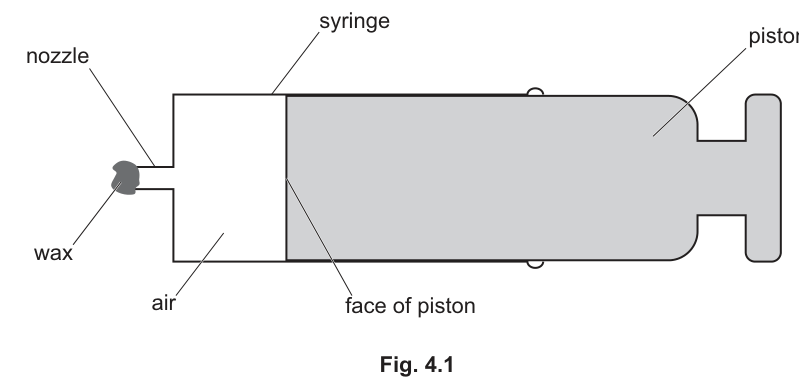
The pressure of the air inside the syringe is equal to atmospheric pressure, .
The volume of the air inside the syringe is .
The area of the end of the piston that is in contact with the air is .
The friction between the piston and the syringe is negligible.
Calculate the force on the piston due to the pressure of the air inside the syringe.
force = ______
Working
Answer
350
350 N
Walkthrough
Pressure is defined as force per unit area:
Rearranging this equation to solve for the force exerted by the enclosed air on the piston face gives:
Substitute the given values for internal air pressure () and cross-sectional area of the piston ():
Key Takeaways
- Force is calculated from pressure using .
- Always ensure is in pascals ( or ) and area is in square metres () so that the resulting force is directly in newtons ().
Common Mistakes
- Dividing pressure by area instead of multiplying ().
- Errors when multiplying powers of ten ().
Things to Be Careful About
- The unit is already printed on the answer line, so only the numerical value is needed in the blank.
The force on the piston in (a)(i) acts to the right.
Explain why the piston does not move to the right.
Answer
- There is an equal force acting to the left due to the atmospheric pressure of the air outside the syringe.
- The two opposing forces are balanced, so there is no resultant force on the piston.
An equal force acts to the left due to atmospheric pressure outside, so the forces balance and there is no resultant force
Walkthrough
For the piston to remain stationary, it must be in mechanical equilibrium according to Newton's first law:
- The air inside the syringe exerts a pressure of on the left face of the piston, pushing it to the right with a force of .
- The surrounding atmosphere outside the syringe also exerts atmospheric pressure () on the right side of the piston, producing an equal force of directed to the left.
- Since friction is negligible and these two opposing forces are equal in magnitude and opposite in direction, the resultant (net) force on the piston is zero (). Hence, the piston does not accelerate or move.
Key Takeaways
- An object remains at rest when the resultant force acting on it is zero.
- Atmospheric pressure acts on all exposed surfaces from the outside.
Common Mistakes
- Stating only that 'atmospheric pressure acts' without specifying that it creates a force to the left or that the forces balance.
- Attributing the lack of motion to friction, even though the question explicitly states that friction is negligible.
Things to Be Careful About
- Both marking points are required: (1) naming the opposing force/pressure from the outside atmosphere acting to the left, and (2) stating that the forces balance / there is no resultant force.
The piston is now pulled to the right by an additional force.
The temperature of the air in the syringe does not change.
Answer
- Gas pressure is caused by air particles colliding with the walls (or piston) of the syringe.
- As the volume increases, the particles become further apart (less densely packed).
- Therefore, the collisions of particles with the walls occur less frequently (fewer collisions per second).
Particles collide with the walls; with increased volume they are further apart, so collisions with the walls are less frequent
Walkthrough
To explain why gas pressure decreases at constant temperature using the kinetic particle model, address three key logical steps:
- Origin of pressure: Gas pressure is the force per unit area exerted by gas particles as they constantly collide with and rebound from the inner walls of the container and the piston face.
- Change in particle density: When the piston is pulled to the right, the volume containing the trapped air increases while the total number of particles remains constant. The particles therefore become more spread out (further apart / less densely packed).
- Effect on collision rate: Because the particles are more spread out and their average speed is unchanged (since temperature is constant), they take longer to travel between wall collisions. Thus, the frequency of collisions with the walls (number of impacts per unit area per second) decreases, resulting in a lower pressure.
Key Takeaways
- At constant temperature, the average kinetic energy and speed of the gas particles remain constant.
- Increasing the volume reduces particle density and therefore reduces the collision rate with the container walls.
Common Mistakes
- Saying that the particles move slower or have less kinetic energy (incorrect because temperature is constant).
- Stating only 'fewer collisions' without specifying collisions with the walls or collisions per unit time / frequency.
- Omitting the mention that particles are further apart / volume increases.
Things to Be Careful About
- Do not confuse collisions between particles with collisions between particles and the walls. It is the collisions with the walls/piston that generate gas pressure.
Calculate the pressure of the air inside the syringe when the volume of the air is .
pressure = ______
Working
Answer
8.0 x 10^4 Pa
Walkthrough
Because the temperature of the trapped air remains constant, Boyle's law applies:
Identify the initial and final conditions from the question:
- Initial pressure,
- Initial volume,
- Final volume,
- Final pressure,
Rearrange to make the subject:
Substitute the values:
(Alternatively written as or ).
Key Takeaways
- For a fixed mass of gas at constant temperature, pressure is inversely proportional to volume ().
- As volume increases, pressure decreases proportionately.
Common Mistakes
- Inverting the volumes, calculating , which would incorrectly give an increased pressure.
- Arithmetic mistakes when handling scientific notation and negative exponents.
Things to Be Careful About
- The unit is provided on the answer line.
- Ensure the answer is written to a sensible number of significant figures (2 s.f., matching the input data: or ).
Some glass lenses are converging lenses, and others are diverging lenses.
Answer
A biconcave or plano-concave lens shape, drawn thinner at the centre than at the edges.
Walkthrough
A diverging lens is defined by its shape: it is thinner at the middle than at the edges. Candidates can draw either a biconcave lens (curved inwards on both sides) or a plano-concave lens (flat on one side, curved inwards on the other). The key feature that earns the mark is the clear depiction of the central region being narrower than the outer edges.
Key Takeaways
Diverging lenses are thinner in the middle and cause parallel light rays to spread out (diverge). Converging lenses are the opposite: thicker in the middle and causing rays to come together.
Common Mistakes
Drawing a lens that is thicker in the middle (which is a converging lens) or drawing a rectangular block of glass with parallel sides. The mark scheme explicitly requires the lens to be 'thinner at the middle'.
Things to Be Careful About
The drawing does not need to be perfectly symmetrical, but the concave curvature must be obvious. A plano-concave lens is perfectly acceptable as long as the thinner-at-the-centre feature is clear.
Fig. 5.1 shows the cross-section of a converging lens, the principal axis and the two principal focuses (focal points) and on a full-scale grid.
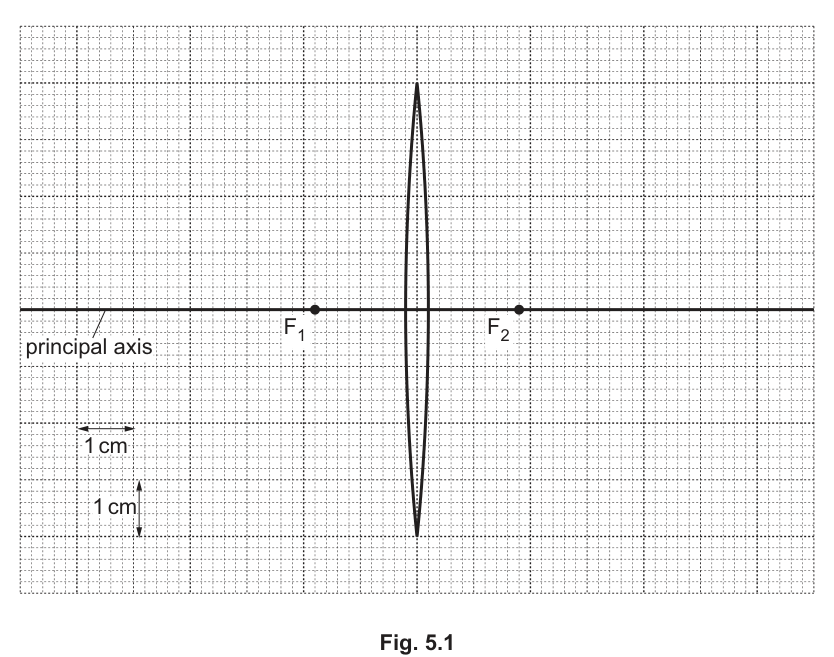
A student places an object of height at a distance of from the centre of the lens.
Answer
1.8
1.8
Walkthrough
The focal length is the distance from the optical centre of the lens to the principal focus (or ). The grid in Fig. 5.1 is full-scale with major squares of 1 cm by 1 cm. Counting the major squares from the centre of the lens to the dot labelled , we find it is 1.8 cm away. Thus, the focal length is 1.8 cm.
Key Takeaways
The focal length is a fundamental property of a lens, measured from the optical centre to the principal focus. On a full-scale grid, it can be read directly.
Common Mistakes
Reading the distance to the edge of the lens instead of the centre. Counting the minor grid squares instead of using the major 1 cm squares, leading to an incorrect power of ten.
Things to Be Careful About
Ensure the measurement is taken from the exact centre of the lens (the optical centre) to the centre of the dot representing the focus. The mark scheme accepts 1.8 cm.
On Fig. 5.1, draw a vertical arrow of height that is from the centre of the lens and label the arrow O. The arrow is the object.
Answer
A vertical arrow of height 2.1 cm, placed 3.0 cm to the left of the lens, pointing upwards from the principal axis, labelled O.
Walkthrough
The object is placed 3.0 cm from the centre of the lens. Since the focal length is 1.8 cm, 3.0 cm is between and on the left side. Measure 3.0 cm to the left of the lens along the principal axis. From that point, draw a vertical arrow upwards with a height of 2.1 cm (just over 2 major grid squares). Label the tip or the arrow 'O'.
Key Takeaways
In ray diagrams, the object is typically drawn as an upright arrow on the principal axis. Its height and distance from the lens are given in the question and must be plotted to scale.
Common Mistakes
Placing the object on the wrong side of the lens (it should be on the side opposite to where the image will form, usually the left). Drawing the arrow with the wrong height (e.g., 2 cm instead of 2.1 cm) or pointing it downwards.
Things to Be Careful About
The arrow must be vertical and perpendicular to the principal axis. The label 'O' should be clearly associated with the arrow.
On Fig. 5.1, draw two rays from the tip of the object arrow to find the tip of the image.
Draw another arrow to show the image.
Answer
Two rays drawn from the tip of O: one parallel to the axis refracting through F2, and one through the optical centre undeviated. They intersect to form an inverted real image.
Walkthrough
To find the image, draw at least two of the three principal rays from the tip of the object arrow O:
- Ray 1: Draw a line from the tip of O parallel to the principal axis until it hits the lens. After passing through the lens, draw this ray refracting so that it passes through the principal focus on the right side.
- Ray 2: Draw a line from the tip of O straight through the optical centre of the lens. This ray passes through without deviation.
- Ray 3 (optional): Draw a line from the tip of O through the principal focus on the left side until it hits the lens. After the lens, draw this ray emerging parallel to the principal axis.
The rays will converge and intersect at a point on the right side of the lens, above the principal axis. This intersection is the tip of the image. Draw a vertical arrow from this intersection point down to the principal axis to represent the image. The image is inverted (pointing downwards) and real.
Key Takeaways
Three principal rays can be used to locate an image formed by a converging lens. Any two of these are sufficient. The intersection of the refracted rays gives the position and size of the image.
Common Mistakes
Drawing the ray through as refracting towards instead of emerging parallel. Drawing the image on the same side as the object. Forgetting to draw the image arrow down to the principal axis, or drawing it upright instead of inverted.
Things to Be Careful About
Use a ruler for all straight lines. The rays must be drawn from the tip of the object arrow, not the base. The image arrow must be drawn from the intersection point down to the principal axis, and it must be inverted.
Using the image marked on Fig. 5.1 in (b)(iii), determine the linear magnification produced.
magnification = ______
Working
From the ray diagram, the image height is approximately .
(Alternatively, using the lens formula: . Magnification .)
Answer
1.5 (accept 1.2 to 1.8)
1.5
Walkthrough
Linear magnification is defined as the ratio of the image height to the object height: . From the ray diagram constructed in part (iii), measure the height of the image arrow. It should be approximately . Dividing this by the object height of gives . The mark scheme accepts a range from 1.2 to 1.8 to allow for graphical construction inaccuracies.
Key Takeaways
Linear magnification can be calculated from heights () or from distances (). For a real image formed by a converging lens, the magnification is positive when calculated as (using sign convention) or simply as the ratio of heights.
Common Mistakes
Using the wrong formula, such as . Reading the image height incorrectly from the grid (e.g., reading 3.0 cm instead of 3.15 cm). Forgetting that magnification is a ratio and has no units.
Things to Be Careful About
The mark scheme allows a range (1.2 to 1.8) because the answer depends on the accuracy of the hand-drawn ray diagram. If a candidate uses the lens formula with the given values (, ), they will get exactly 1.5, which is well within the accepted range.
Answer
The image is real because it is formed by the actual convergence (intersection) of light rays.
Real
Walkthrough
An image is real if it is formed by the actual convergence of light rays and can be projected onto a screen. In the ray diagram, the refracted rays physically intersect on the opposite side of the lens from the object. This intersection point is where the image is formed, making it a real image. Virtual images, by contrast, are formed by the apparent divergence of rays (they appear to come from a point behind the lens) and cannot be projected onto a screen.
Key Takeaways
Real images are formed by converging rays and are always inverted (for a single lens). Virtual images are formed by diverging rays (extended backwards) and are always upright.
Common Mistakes
Saying 'real because it is on the right side' without mentioning the convergence of rays. Saying 'virtual' because the object is inside the focal length (which is not the case here; ).
Things to Be Careful About
The explanation must link the classification ('real') to the physical reason ('formed by converging rays' or 'actual intersection of rays'). Simply stating 'real' may not earn the mark if an explanation is implicitly required by the word 'Explain'.
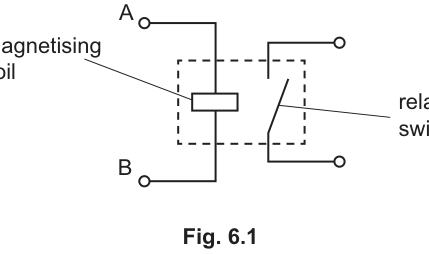
Fig. 6.1 shows the circuit symbol for a relay and two labelled terminals.
Answer
Current in the coil produces a magnetic field. The magnetic field attracts the iron relay switch, causing it to close.
Current in the coil produces a magnetic field, which attracts the iron relay switch and closes it.
Walkthrough
When a current flows from A to B through the magnetising coil, it produces a magnetic field around the coil. This is the principle of an electromagnet. The relay switch is made of iron (or another magnetic material) and is positioned within this magnetic field. The magnetic field magnetises the switch and attracts it towards the coil, overcoming any spring tension and closing the switch contacts. This completes the second circuit.
Key Takeaways
A current-carrying coil produces a magnetic field. An iron switch placed in this field will be attracted and move, which is the basis of how a relay operates to switch a separate circuit on or off.
Common Mistakes
Saying 'the current magnetises the switch' without mentioning the magnetic field produced by the coil. Saying 'the switch is pulled by the current' rather than 'attracted by the magnetic field'. Using the word 'gravity' or 'pull' without specifying the magnetic attraction.
Things to Be Careful About
Ensure both marks are covered: the production of the magnetic field by the coil, and the physical closing of the switch due to magnetic attraction. The switch must be identified as being made of a magnetic material like iron for the attraction to occur.
Fig. 6.2 shows two circuits linked by a relay. The heater transfers energy at a rate of when it is connected to a supply.
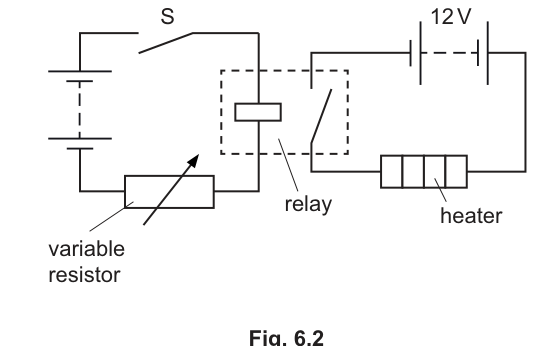
Switch S is closed. The variable resistor is adjusted so that its resistance increases from 0.
Fig. 6.3 shows how the power transferred in the heater varies as increases from 0. The graph shows a sharp decrease when the resistance reaches .
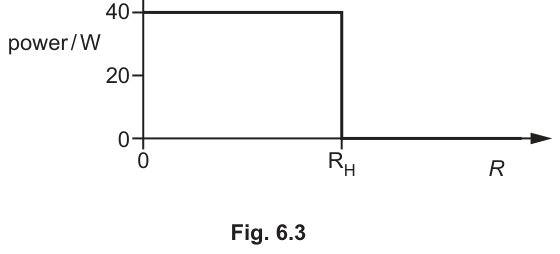
Explain the shape of the graph in Fig. 6.3.
Answer
Initially, the resistance is small, so the current in the relay coil is large. This produces a strong magnetic field that keeps the relay switch closed, so the heater remains connected to the 12 V supply and dissipates 40 W. As increases, the current in the relay coil decreases, so the magnetic field weakens. When , the magnetic field is no longer strong enough to hold the relay switch closed, so it opens and the heater is disconnected from the supply, causing the power to drop to 0 W.
Initially, the current in the relay coil is large enough to keep the switch closed and the heater at 40 W. As R increases, the current and magnetic field decrease until at R_H the switch opens and the heater is disconnected.
Walkthrough
The graph shows the power in the heater (right-hand circuit) as the variable resistance in the control circuit (left-hand circuit) increases. For , the power is constant at 40 W. This means the relay switch is closed and the heater is fully connected to the 12 V supply. Initially, is small (near 0), so the total resistance of the control circuit is small, meaning the current is large. A large current produces a strong magnetic field in the relay coil, which easily holds the switch closed.
As increases, the total resistance of the control circuit increases. By Ohm's law, the current in the relay coil decreases. A smaller current produces a weaker magnetic field. The magnetic field is still strong enough to hold the switch closed, so the heater power remains at 40 W.
At , the resistance is high enough that the current has fallen to a critical value. The magnetic field is no longer strong enough to hold the relay switch against its spring, so the switch opens. This breaks the load circuit, disconnecting the heater from the 12 V supply, and the power instantly drops to 0 W.
Key Takeaways
A relay uses a small current in a control circuit to switch a larger current in a load circuit. The strength of the electromagnet depends on the current, which is controlled by a variable resistor. If the current falls below a threshold, the magnetic force is insufficient to hold the switch closed.
Common Mistakes
Stating that the heater's power decreases gradually. The graph shows a sharp drop because the switch is either fully closed or fully open; it does not partially open.
Assuming the 12 V supply voltage changes. The supply voltage is constant; only the connection to it is broken.
Forgetting to mention that the current in the control circuit decreases as increases.
Things to Be Careful About
Clearly distinguish between the control circuit (left, with the variable resistor) and the load circuit (right, with the heater). The variable resistor only affects the current in the control circuit, not the voltage across the heater when it is connected.
The heater connected to the supply is switched on.
Calculate:
Working
Answer
4800
4800
Walkthrough
The heater operates at a constant power of . The time it is switched on is . Energy transferred is calculated using . First, convert the time into seconds because the watt is joules per second: . Then multiply: .
Key Takeaways
Power is the rate of energy transfer. To find total energy, multiply power by time, ensuring time is in seconds when power is in watts.
Common Mistakes
Forgetting to convert minutes to seconds, which would give an answer of 80 J instead of 4800 J.
Using the wrong formula, such as without calculating first, though that is also valid if done correctly.
Things to Be Careful About
Always check the units. The mark scheme explicitly expects the answer in joules, so time must be in seconds. Give the answer to 2 or 3 significant figures; 4800 is exact here.
Working
Answer
3.6
3.6
Walkthrough
The heater is connected to a 12 V supply and dissipates 40 W. To find the resistance, we can use the power equation to find the current, and then Ohm's law .
First, calculate the current: .
Next, calculate the resistance: .
Alternatively, you could use directly to find , but the mark scheme outlines the two-step method via current.
Key Takeaways
Power, voltage, and current are linked by . Resistance is linked to voltage and current by . These can be combined to find resistance directly from power and voltage using .
Common Mistakes
Rounding the intermediate current value too early (e.g., using gives , which might be accepted but carries a rounding error). It is best to keep the fraction in the calculator.
Using without first finding correctly.
Things to Be Careful About
The question asks for resistance in ohms (). Ensure the final answer has the correct unit if writing it out, though the blank provides the unit. Keep at least 3 significant figures for intermediate values to avoid rounding errors in the final answer.
The frequency of an alternating current mains electricity supply is . The maximum voltage of the supply is .
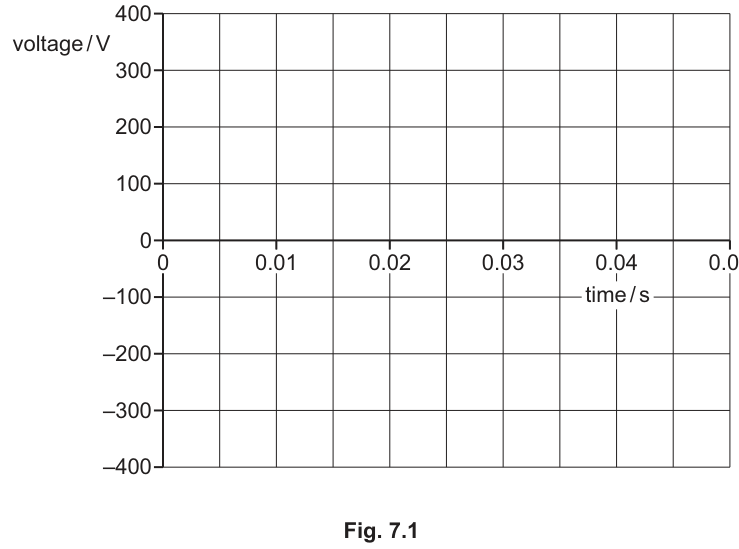
Using the axes in Fig. 7.1, sketch a graph to show how the voltage of the supply varies in a time of .
Answer
A sinusoidal curve oscillating between +300 V and -300 V. The period is s. In 0.05 s, there are 2.5 cycles.
Sinusoidal graph with amplitude 300 V and period 0.020 s (2.5 cycles in 0.05 s)
Walkthrough
The frequency of the a.c. supply is 50 Hz, which means there are 50 complete cycles every second. The period of one cycle is the reciprocal of the frequency: s. The maximum voltage (amplitude) is given as 300 V. We need to sketch the voltage variation over 0.05 s. Since each cycle takes 0.020 s, the total time of 0.05 s contains exactly cycles. The graph starts at 0 V at , rises to +300 V at s, crosses zero at s, falls to -300 V at s, and returns to zero at s to complete the first cycle. This pattern repeats for 2.5 cycles in total.
Key Takeaways
For an alternating current, the voltage-time graph is sinusoidal. The frequency determines the period (), and the maximum voltage is the amplitude. The number of cycles shown on a graph is the total time divided by the period.
Common Mistakes
- Drawing a graph that does not start at zero or is not sinusoidal.
- Using the wrong amplitude (e.g., using 400 V from the axis limits instead of the given 300 V).
- Miscalculating the number of cycles (e.g., drawing only 2 or 3 full cycles instead of 2.5).
Things to Be Careful About
- Ensure the amplitude is exactly 300 V on the vertical axis.
- Ensure the period is exactly 0.020 s (one cycle from 0 to 0.020, or 0.010 to 0.030).
- The graph must end at s, which is exactly at the peak of the third half-cycle (2.5 cycles).
Fig. 7.2 shows the mains power supply connected to the primary coil of a transformer. The primary coil consists of 750 turns.
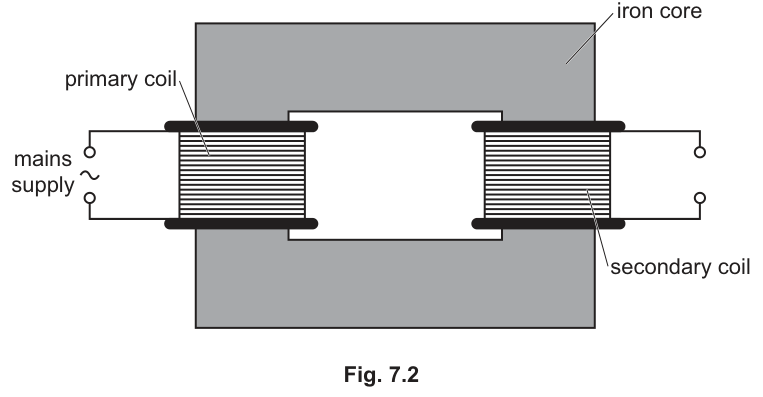
The core of the transformer is made from iron.
Explain why iron is a suitable material for the core of the transformer.
Answer
Iron is a temporary magnetic material (it can be easily magnetised and demagnetised as the current alternates).
Iron is a temporary magnetic material.
Walkthrough
A transformer requires a changing magnetic field in the core to induce a voltage in the secondary coil. Because the primary coil is connected to an a.c. supply, the current and therefore the magnetic field constantly change direction and magnitude. Iron is a soft magnetic material, meaning it is easily magnetised and demagnetised. This allows the magnetic flux in the core to follow the alternating current without retaining permanent magnetism, which is essential for the transformer to work.
Key Takeaways
Transformer cores must be made of a soft magnetic material (like iron) that can be easily magnetised and demagnetised to match the alternating current.
Common Mistakes
- Saying iron is a 'good conductor of electricity' (this is irrelevant and does not explain why it is used for the magnetic core).
- Saying 'iron is magnetic' without specifying that it is a temporary magnetic material.
Things to Be Careful About
- Use the exact phrase 'temporary magnetic material' or explain that it is easily magnetised and demagnetised. Just saying 'magnetic' is not sufficient.
Answer
- There is an alternating (changing) current in the primary coil.
- This produces an alternating (changing) magnetic field in the iron core.
- The changing magnetic field induces a voltage (e.m.f.) in the secondary coil.
Alternating current in the primary coil creates a changing magnetic field in the core, which induces a voltage in the secondary coil.
Walkthrough
Electromagnetic induction is the process of inducing a voltage across a conductor when it is exposed to a changing magnetic field. In a transformer:
- The a.c. mains supply causes an alternating current to flow through the primary coil.
- This alternating current produces a magnetic field that is constantly changing in magnitude and direction within the iron core.
- The secondary coil is wrapped around the same core, so it is exposed to this changing magnetic field. According to the principle of electromagnetic induction, a changing magnetic flux through a coil induces an e.m.f. (voltage) across it.
Key Takeaways
A transformer works on the principle of electromagnetic induction. An alternating current in the primary coil creates a changing magnetic field, which induces a voltage in the secondary coil.
Common Mistakes
- Stating that the magnetic field is 'constant' or 'static'. It must be changing or alternating.
- Saying 'current flows from the primary to the secondary coil'. The coils are electrically isolated; only the magnetic field links them.
- Forgetting to use the word 'induced' for the voltage in the secondary coil.
Things to Be Careful About
- Each of the three points (alternating current, changing magnetic field, induced voltage) is a separate mark. Ensure all three links in the causal chain are stated clearly.
There are 60 turns on the secondary coil.
Calculate the maximum value of the voltage across the secondary coil.
maximum voltage = ______
Working
Answer
maximum voltage = 24 V
24 V
Walkthrough
The transformer turns-ratio equation relates the voltages across the primary and secondary coils to the number of turns on each coil:
where is the secondary voltage, is the primary voltage, is the number of turns on the secondary coil, and is the number of turns on the primary coil. This equation applies to maximum (peak) voltages as well as r.m.s. voltages, as long as the units are consistent. We are given:
- V (maximum)
- turns
- turns
Rearranging for :
Key Takeaways
The transformer equation can be used with either maximum (peak) voltages or r.m.s. voltages. A step-down transformer has fewer turns on the secondary coil than on the primary coil, resulting in a lower output voltage.
Common Mistakes
- Inverting the turns ratio (e.g., calculating ).
- Using r.m.s. values when the question asks for maximum values, or vice versa (though here only maximum values are given, so no conversion is needed).
- Forgetting to include the unit 'V' in the final answer.
Things to Be Careful About
- Ensure the equation is rearranged correctly before substituting the values.
- The answer must be given with the correct unit (V).
The isotope thorium-230 () decays by alpha particle (-particle) emission.
Answer
2 neutrons and 2 protons and no other particles present.
2 neutrons and 2 protons and no other particles present
Walkthrough
An alpha particle (-particle) is emitted from an unstable nucleus during alpha decay. It is identical to a helium nucleus, meaning it is made up of 2 protons and 2 neutrons bound together. It contains no electrons or any other particles.
Key Takeaways
Alpha particles are helium nuclei consisting of exactly 2 protons and 2 neutrons. They have a nucleon number of 4 and a proton number of 2.
Common Mistakes
Writing 'helium atoms' instead of 'helium nuclei' or 'alpha particles'. An alpha particle has no electrons, so it is not a neutral atom. Writing '2 protons and 2 electrons' is incorrect; electrons are not present in the nucleus.
Things to Be Careful About
The mark scheme requires all three elements: 2 neutrons, 2 protons, and the absence of other particles (like electrons). Omitting 'no other particles' can cost a mark.
Answer
helium nucleus
helium nucleus
Walkthrough
Because an alpha particle contains 2 protons and 2 neutrons and no electrons, it is exactly the nucleus of a helium-4 atom. Therefore, the particle identical in composition to an alpha particle is a helium nucleus.
Key Takeaways
Alpha particles and helium nuclei are the same thing. Remember to specify 'nucleus' rather than 'atom' because there are no electrons.
Common Mistakes
Answering 'helium atom'. A helium atom has 2 electrons orbiting the nucleus; an alpha particle does not.
Things to Be Careful About
The word 'nucleus' is essential. 'Helium' on its own is not precise enough to score the mark.
The -particle decay of thorium-230 produces an isotope of radium.
Deduce:
the number of neutrons in a neutral atom of this isotope of radium
number of neutrons = ______
Working
Thorium-230 has nucleon number 230 and proton number 90.
Alpha decay emits a helium nucleus (), which has nucleon number 4 and proton number 2.
The radium isotope has nucleon number = .
The proton number = .
Number of neutrons = nucleon number proton number = .
Answer
138
138
Walkthrough
When thorium-230 () undergoes alpha decay, it emits an alpha particle (). The nucleon number (top number) decreases by 4, and the proton number (bottom number) decreases by 2. This gives a new isotope with nucleon number and proton number . The number of neutrons is found by subtracting the proton number from the nucleon number: .
Key Takeaways
In alpha decay, the parent nucleus loses 4 nucleons and 2 protons. The daughter nucleus always has a nucleon number 4 less and a proton number 2 less than the parent.
Common Mistakes
Forgetting to subtract the alpha particle's nucleon number from the total before calculating neutrons. Using the proton number of thorium (90) instead of radium (88) when calculating neutrons.
Things to Be Careful About
Ensure you are calculating the neutrons for the daughter nucleus (radium), not the parent (thorium). The question asks for the number of neutrons in the isotope of radium.
the number of electrons in a neutral atom of this isotope of radium.
number of electrons = ______
Answer
88
88
Walkthrough
The proton number of the radium isotope was found to be 88. In a neutral atom, the number of negatively charged electrons exactly balances the number of positively charged protons. Therefore, a neutral atom of this radium isotope has 88 electrons.
Key Takeaways
For any neutral atom, number of electrons = proton number (atomic number).
Common Mistakes
Assuming the number of electrons changes during radioactive decay. Only the nucleus changes; the electron cloud adjusts later if the atom becomes an ion, but the question specifies a 'neutral atom', so electrons = protons.
Things to Be Careful About
The question specifies 'neutral atom'. If it asked for the number of electrons immediately after decay (before any electron is captured or lost), it might be different, but 'neutral atom' always means electrons = protons.
The half-life of thorium-230 is .
A radioactive sample contains thorium-230 atoms.
Determine the time it takes for the number of thorium-230 atoms to decrease to .
time = ______
Working
Initial number of atoms =
Final number of atoms =
Find the ratio of initial to final atoms:
Since the number of atoms has decreased by a factor of 8, and , this means 3 half-lives have passed.
Time =
In standard form: years.
Answer
2.25 x 10^5
Walkthrough
First, determine how many times the original amount has been halved. Divide the initial number of atoms by the final number: . This means the sample has been reduced to of its original amount. Since , exactly 3 half-lives have elapsed. Multiply the number of half-lives by the duration of one half-life: years. This can be written as years.
Key Takeaways
A reduction by a factor of corresponds to half-lives. Always calculate the ratio of initial to final quantity to find .
Common Mistakes
Dividing the final number by the initial number () and getting confused about how many half-lives that represents. Forgetting to multiply by the half-life duration after finding the number of half-lives. Arithmetic errors with powers of 10.
Things to Be Careful About
The mark scheme accepts or . Ensure the unit 'years' is understood if not provided in the answer blank, though here the blank is followed by 'years'.
When it decays, thorium-230 also emits gamma radiation (-radiation).
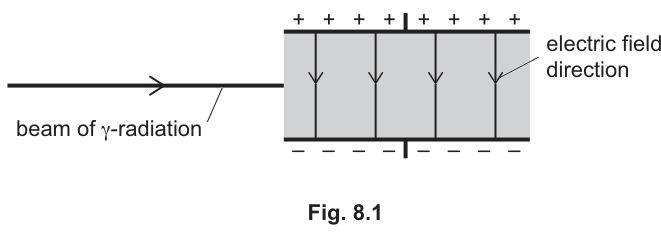
Fig. 8.1 shows a narrow beam of -radiation passing into an electric field.
Answer
A straight horizontal line continuing through the electric field without any deflection.
Straight horizontal line continuing through the electric field without deflection
Walkthrough
Gamma radiation (-radiation) is high-frequency electromagnetic radiation. It carries no electric charge. Electric fields only exert forces on charged particles (like alpha or beta particles). Since gamma rays are uncharged, they experience no force in the electric field and travel in a straight line, completely undeflected.
Key Takeaways
Gamma rays are uncharged and pass straight through electric and magnetic fields without being deflected. Alpha particles deflect towards the negative plate, and beta particles deflect towards the positive plate.
Common Mistakes
Drawing a slight curve for gamma radiation. Drawing deflection in the same direction as alpha or beta particles. Forgetting to extend the line through the entire region between the plates.
Things to Be Careful About
The line must be drawn straight through the field region. Any curvature, even slight, will not score the mark. The line should continue horizontally past the field region as well.
Fig. 8.2 shows the electric field replaced with a magnetic field that is directed into the page.
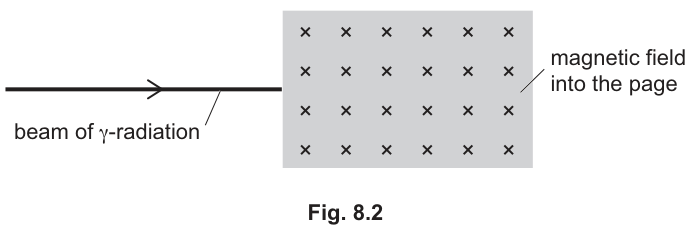
On Fig. 8.2, sketch the path of the -radiation in the magnetic field.
Answer
A straight horizontal line continuing through the magnetic field without any deflection.
Straight horizontal line continuing through the magnetic field without deflection
Walkthrough
Magnetic fields only exert forces on moving charged particles (and on magnetic materials). Since gamma radiation is uncharged electromagnetic radiation, it is completely unaffected by the magnetic field. It will travel in a straight line, passing through the field region without any deviation.
Key Takeaways
Neither electric nor magnetic fields can deflect gamma radiation because it has no charge. This is a key way to distinguish gamma rays from alpha and beta particles in experiments.
Common Mistakes
Drawing a curved path for gamma radiation. Applying Fleming's left-hand rule incorrectly to gamma radiation. Drawing deflection upwards or downwards.
Things to Be Careful About
Just like in the electric field, the path must be a perfectly straight horizontal line through the entire magnetic field region. The direction of the magnetic field (into the page) is irrelevant for gamma rays.
The Earth has a radius of and rotates on its axis once in every .
Fig. 9.1 shows that as the Earth rotates, objects on the surface of the Earth move in circular paths around the axis of rotation.
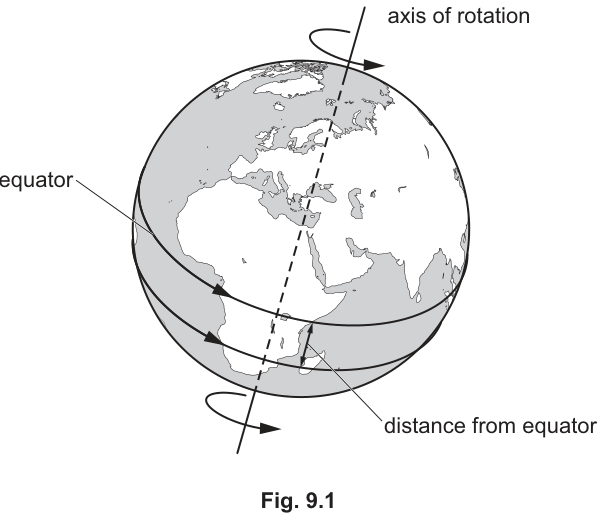
Calculate the speed of an object at the equator as it moves in a circular path around the axis of rotation.
speed = ______
Working
The object at the equator moves in a circular path with radius .
The distance travelled in one rotation is the circumference:
The time for one rotation is 24 hours. Convert this to seconds:
Speed is distance divided by time:
Rounding to 2 significant figures (as given for the radius):
Answer
470
470
Walkthrough
The question asks for the speed of an object at the equator. Speed is defined as distance divided by time (). The object moves in a circle around the Earth's axis. At the equator, the radius of this circular path is the radius of the Earth itself, .
First, calculate the distance travelled in one full rotation. This is the circumference of the circle at the equator:
Next, identify the time taken for one rotation. The problem states this is 24 hours. Since the required speed is in m/s, convert hours to seconds:
Finally, substitute these values into the speed equation:
The radius is given to 2 significant figures, so the answer should be rounded to 2 significant figures: .
Key Takeaways
- Speed in circular motion is the circumference divided by the period of rotation.
- Always ensure units are consistent; convert hours to seconds when the required unit is m/s.
- Respect significant figures in the final answer based on the data provided.
Common Mistakes
- Forgetting to calculate the circumference and using the diameter or radius as the distance.
- Forgetting to convert 24 hours into seconds (using 24 directly would give a wildly incorrect answer).
- Using without calculating first (though valid, is more direct for O Level).
Things to Be Careful About
- The mark scheme accepts 470 m/s (2 s.f.) or 465 m/s (3 s.f.). Since the input data () has 2 s.f., 470 is the strictly correct rounding.
- Do not include the unit in the final answer blank if the unit is already printed next to the blank line, but ensure it is clear in the working.
Explain why the speed around the axis of rotation of an object on the Earth decreases as the distance of the object from the equator increases.
Answer
As the distance from the equator increases, the radius of the circular path around the axis of rotation decreases. Therefore, the circumference of the path (the distance travelled in one rotation) decreases.
The time taken for one complete rotation (the rotation period) remains constant at 24 hours for all objects on Earth.
Since speed = distance / time, and the distance decreases while the time remains constant, the speed decreases.
The circumference of the path decreases while the rotation period remains constant.
Walkthrough
The question asks why speed decreases as an object moves away from the equator (towards the poles).
Recall the definition of speed for uniform circular motion: , where is the distance travelled in one cycle (circumference) and is the time for one cycle (period).
- Distance (): At the equator, the path is the largest circle (the equator itself). As you move north or south, the circular path around the axis gets smaller. At the poles, the path is a point (radius 0). So, the circumference of the path decreases as the distance from the equator increases.
- Time (): The Earth is a rigid body rotating on its axis. Every point on the Earth completes one full rotation in the same amount of time (24 hours). The period is constant.
Since , if decreases and is constant, then must decrease.
Key Takeaways
- All points on a rotating rigid body have the same angular speed and period.
- Linear speed depends on the radius of the circular path ().
Common Mistakes
- Saying "the radius of the Earth decreases" (the Earth's radius is constant; the radius of the path decreases).
- Forgetting to mention that the time period is constant; just saying the distance decreases is not enough for full marks.
Things to Be Careful About
- Use precise language: "circumference of the path" or "radius of the circular path", not just "distance".
- The mark scheme awards one mark for the decreasing path length and one mark for the constant time period.
The Earth moves around the Sun because a force acts on the Earth.
Answer
The force is provided by the gravitational attraction (or gravitational field) due to the Sun.
Gravitational attraction due to the Sun
Walkthrough
The Earth moves in a curved path (orbit) around the Sun. According to Newton's first law, an object will move in a straight line at constant speed unless acted upon by a resultant force. Since the Earth's direction is constantly changing, there must be a resultant force acting on it.
This force is directed towards the Sun and is the gravitational force of attraction between the Sun and the Earth. The Sun's gravity pulls the Earth, keeping it in orbit.
Key Takeaways
- Gravity is the force that keeps planets in orbit around the Sun and moons around planets.
- It is an attractive force acting at a distance.
Common Mistakes
- Saying "centrifugal force" (this is a fictitious force and not the provider of the orbital force in this context).
- Saying "gravity" without specifying it is due to the Sun (though often accepted, "gravitational attraction due to the Sun" is precise).
- Saying "solar wind" or "radiation pressure".
Things to Be Careful About
- The question asks to "State what provides this force". Two marks are allocated, likely for "gravitational attraction/field" and "due to Sun".
- Do not just write "gravity"; be specific about the source (the Sun).
The orbit of the Earth around the Sun is an ellipse.
Describe what happens to the magnitude of the force that acts on the Earth as it moves in this elliptical orbit.
Answer
The magnitude of the force varies (or increases and decreases / is not constant).
It decreases when the Earth moves away from the Sun and increases when the Earth moves towards the Sun.
The force varies; it decreases as distance increases and increases as distance decreases.
Walkthrough
The orbit is an ellipse, meaning the distance between the Earth and the Sun changes throughout the year.
Gravitational force depends on distance (though the inverse square law is A Level, the qualitative relationship is expected at O Level: force increases as distance decreases).
- When the Earth is moving away from the Sun (towards aphelion), the distance increases, so the gravitational force decreases.
- When the Earth is moving towards the Sun (towards perihelion), the distance decreases, so the gravitational force increases.
Therefore, the magnitude of the force is not constant; it fluctuates as the distance changes.
Key Takeaways
- In an elliptical orbit, the distance between the two bodies changes.
- Gravitational force is stronger at closer distances and weaker at larger distances.
Common Mistakes
- Saying the force is constant (this is only true for a circular orbit).
- Saying the force increases then decreases without explaining the link to distance.
Things to Be Careful About
- The mark scheme asks for a description of what happens to the magnitude. "Fluctuates" or "varies" is not enough on its own; you must explain how it varies with position (closer/farther).
Explain why the Earth travels the slowest when it is at its furthest distance from the Sun.
Answer
At the greatest distance from the Sun, the gravitational potential energy of the Earth is the greatest.
By the principle of conservation of energy (total energy is constant), the kinetic energy must be the smallest.
Since kinetic energy is given by , the smallest kinetic energy means the speed is the smallest (slowest).
Greatest potential energy means smallest kinetic energy, hence smallest speed.
Walkthrough
This question is about the conservation of energy in an elliptical orbit.
- Gravitational Potential Energy (GPE): As the Earth moves further away from the Sun, work is done against the gravitational pull. This increases the gravitational potential energy of the Earth-Sun system. At the furthest point (aphelion), the GPE is at its maximum.
- Conservation of Energy: Assuming no energy is lost to friction (space is a vacuum), the total mechanical energy (GPE + Kinetic Energy) remains constant.
- Kinetic Energy (): Since GPE is maximum at the furthest distance, must be minimum to keep the total constant.
- Speed: Kinetic energy is related to speed by . If is minimum and mass is constant, then speed must be minimum.
Therefore, the Earth travels slowest at its furthest distance from the Sun.
Key Takeaways
- Energy transforms between gravitational potential and kinetic in an orbit.
- High GPE (far away) corresponds to low (slow speed).
- Low GPE (close by) corresponds to high (fast speed).
Common Mistakes
- Saying "the force is weaker so it slows down" (this is a partial explanation but doesn't use energy stores, which the mark scheme specifically asks for: "gravitational potential energy... kinetic energy").
- Forgetting to link kinetic energy to speed.
Things to Be Careful About
- The mark scheme explicitly looks for the energy store argument: GPE greatest -> KE smallest -> speed smallest.
- Do not use calculus or advanced orbital mechanics; stick to the O Level energy stores model.